A Movie A Day #43: The Big Heist (2001, directed by Robert Markowitz)


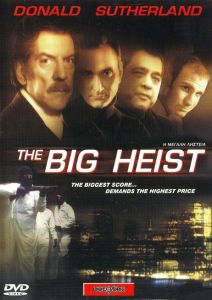
the_big_heist_2001In 1978, low-level mob associate Jimmy Burke (Donald Sutherland) is released after serving a six years in prison.  As soon as he arrives home, he discovers that his son, Frank (Jamie Harris), has failed to keep up with the family business and that the Burke Crew is close to becoming a joke.  Looking for a big score, Jimmy masterminds a robbery at John F. Kennedy International Airport.  The so-called Lufthansa Heist becomes the largest cash robbery committed on American soil at that time.  Growing paranoid, Burke decides it would be easier to just kill all the members of his crew than to give them their cut of the robbery.  What Burke doesn’t realize is that his closest associates are destined to be his downfall.  Tommy DeSimone (Rocco Sisto) has offended John Gotti (Steven Randazzo) while Henry Hill (Nick Sandow) has become hooked on drugs and is considering turning informant.

If all this sounds familiar, that’s because part of this story was already told in Goodfellas.  The Big Heist was made for TNT and, because it focuses exclusively on the robbery, it goes into far more detail than Martin Scorsese’s film.  For instance, the character of Frank Burke was entirely left out of Goodfellas and it’s interesting to see how much more negatively Henry Hill is portrayed in The Big Heist.  Since it’s told from the viewpoint of Jimmy Burke instead of Henry Hill, The Big Heist makes for an interesting companion piece to Goodfellas but, at the same time, it never escapes the shadow of the other film.  With both movies employing voice over narration and frequent freeze frames, it’s impossible to watch The Big Heist without comparing it to Goodfellas.  Since Goodfellas was made by Martin Scorsese and The Big Heist was made for TNT, the former comes out on top.

It’s also hard to watch Donald Sutherland as Jimmy Burke without comparing his performance to Robert De Niro’s Jimmy Conway.  Though he never reaches the heights of De Niro’s performance, Sutherland is convincing as a sociopathic criminal mastermind.  Less convincing are Rocco Sisto and Nick Sandow, who both struggle to make an impression in roles previously made famous by Joe Pesci and Ray Liotta.
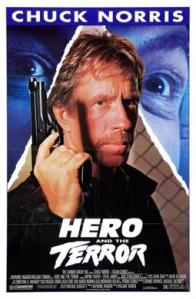
A Movie A Day #42: Hero and The Terror (1988, directed by Steve Tannen)


hero_and_the_terror_posterDanny O’Brien (Chuck Fucking Norris!) is a tough Los Angeles cop who has been nicknamed Hero.  Danny hates it when people call him “Hero.”  Maybe if Danny knew what people usually call cops, he would not complain so much about his nickname.  Three years ago, Danny captured Simon Moon (Jack O’Halloran), a neck-breaking serial killer nicknamed “The Terror.”  After he was captured, The Terror faked his own death and disappeared.  He ended up living in a deserted theater and not bothering anyone until the Mayor of Los Angeles (Ron O’Neal, Superfly himself!) decides to tear down his new home.  The Terror does not take kindly to urban renewal and goes on another killing spree.  Can Hero track down and beat the The Terror while also making it to the hospital in time to see his girlfriend give birth to their baby?
Not surprisingly, Hero and the Terror is one of the films that Chuck made for Cannon Films in the late 80s and, along with Chuck and Ron O’Neal, it features Cannon regulars Steve James and Billy Drago.  (Billy Drago actually plays a good guy, for a change.)  It’s obvious that Chuck was trying to broaden his horizons with Hero and the Terror: with the exception of the final confrontation between Hero and the Terror, there’s less kung fu action than in his previous films and a lot of the movie is dedicated to his relationship with his girlfriend and his struggle to handle her pregnancy.  That’s all good and well and the Chuck Norris of Hero and The Terror is a much better actor than the Chuck Norris who could barely deliver his lines in Breaker, Breaker but, ultimately, a Chuck Norris movie with more human interest and less roundhouse kicks just feels wrong.

(On Netflix, there’s a whole documentary about how Chuck Norris’s roundhouse kicks led to the collapse of Nicolae Ceaușescu’s communist dictatorship in Romania.  It’s called Chuck Norris vs. Communism.  Communism didn’t have a chance.  Hopefully, Chuck will never turn against capitalism because, if he does, it’ll probably lead to another stock market crash.)

I once read an interview with Gene Hackman, in which he was asked to name his least favorite of the movies that he had made.  Hackman selected March or Die.  “I can’t believe I was in something called March or Die,” Hackman said.  If he thought March or Die was a bad title, he should be happy that he didn’t end up in Hero and The Terror.  Give Chuck Norris credit.  Even if he’s not Gene Hackman and even if the movie does not really work, he is the only actor who could credibly star in something called Hero and the Terror.

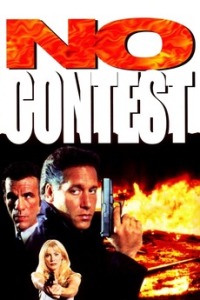
A Movie A Day #41: No Contest (1995, directed by Paul Lynch)


8348-no-contest-0-230-0-345-cropUnder the direction of their leaders, Oz (Andrew “Dice” Cay) and his second-in-command, Ice (Roddy Piper), a diverse group of terrorists have taken the Miss Galaxy contest hostage.  If they don’t receive a ransom of diamonds, they will kill the Miss Galaxy contestants, including the daughter of a powerful senator.  What the terrorists didn’t count on was that the show would be hosted by actress and kick boxer Sharon Bell (Shannon Tweed).  Now, it’s up to Sharon to sneak through a locked-down hotel, killing the terrorists one-by-one.  Her only help comes from a battle-scarred but supportive security officer (Robert Davi) locked outside of the hotel.
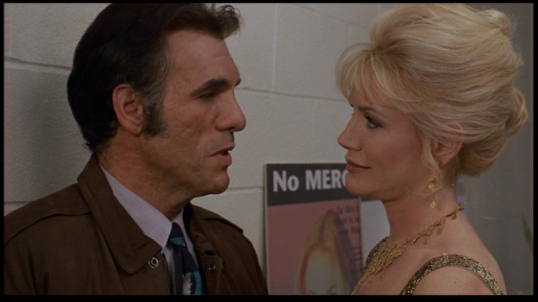
No Contest is so much of a rip-off of Die Hard that it almost qualifies as a remake.  (It is probably not a coincidence that Robert Davi appears in both movies.)  Despite being such a blatant rip-off, No Contest is redeemed by the combination of Andrew “Dice” Clay’s Broolyn-accented villainy and a surprisingly convincing performance from Shannon Tweed.  Toss in Roddy Piper and Robert Davi and the end result is one entertaining direct-to-video thriller.

Shannon Tweed’s best film?  No contest.  It’s No Contest.

vlcsnap-2011-08-02-15h19m14s75

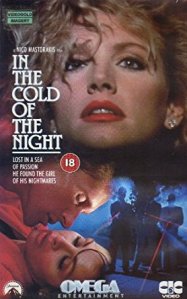
A Movie A Day #40: In the Cold of the Night (1990, directed by Nico Mastorakis)


51zd7jstaol-_sy445_Scott Bruin (Jeff Lester) is a high fashion photographer who is haunted by nightmares in which he strangles a naked woman in the swimming pool.  His nymphomaniac girlfriend, Lena (Shannon Tweed!), is surprisingly understanding when she wakes up to discover Scott strangling her but Scott is worried that he might be losing his mind.  His psychiatrist (David Soul) is not much help.  When Scott has a violent vision in the middle of photo shoot, he freaks out.  “Hey, are you on drugs?” one of the models asks.
Then Scott meets Kimberly (Adrienne Sachs) and she looks exactly like the woman from his dreams.  When she invites him to back to her house, the house looks exactly like the house from his nightmares.  Is Scott going crazy or is he seeing the future?  And how is Kimberly’s ex, a cold businessman named Ken Strom (Marc Singer), involved?

Does anyone remember this movie?  In the 90s, this used to be on HBO and Cinemax all of the time.  It’s a typical sex-fueled, nudity-filled direct-to-video thriller but Nico Mastorakis, a Greek director who has obviously learned a lot from Brian DePalma, gives the movie an enjoyably slick sheen.  Neither Jeff Lester nor Adrienne Sachs gives a good performance and the plot feels like it was made up on the spot but fans of Shannon Tweed in her Skinemax heyday might enjoy it.

In the Cold of the Night also features Tippi Hedren, playing Kimberly’s mother.  She only appears in one scene and freaks out when she sees some birds.  The scene ends with Adrienne Sachs looking directly at the camera and saying, “Mother simply hates birds!”

A Movie A Day #39: Prime Cut (1972, directed by Michael Ritchie)


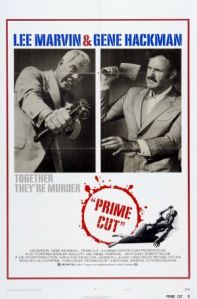
primecutNick Devlin (Lee Marvin) is a veteran enforcer for the Chicago mob.  His latest assignment has taken him out of the city and sent him to the farmlands of Kansas.  Nick is the third enforcer to be sent to Kansas, all to collect a $500,000 debt from a local crime boss named Mary Ann (Gene Hackman).  The first one ended up floating face down in the Missouri River.  The second was chopped up into sausages at the local slaughterhouse.  Nick might have better luck because he once had an affair with Mary Ann’s wife, Clarabelle (Angel Tompkins).
When Nick tracks down Mary Ann to demand the money, he discovers that Mary Ann and his brother Weenie (Gregory Walcott, best remembered for his starring role in Plan 9 From Outer Space) are running a white slavery ring.  Kidnapping girls from a nearby orphanage, Mary Ann and Weenie keep them naked and doped up in a barn.  One of the girls, Poppy (Sissy Spacek, in her film debut), looks up at Nick and says, “Help me.”  Nick takes Poppy with him, claiming that he’s holding her for collateral until he gets the money.

The main attraction here is to see two iconic tough guys — Lee Marvin and Gene Hackman — fighting over Sissy Spacek, who is only slightly less spacey here than in her breakthrough role in Badlands.  In Prime Cut, the ruthless Chicago mobster turns out to have more of a conscience than the rural good old boys who work for Mary Ann and Weenie.  Nothing sums up Prime Cut better than the scene where Lee Marvin, wearing a black suit, and Sissy Spacek are pursued through a wheat field by a thrasher that’s being driven by a roly-poly farmer wearing overalls.  Prime Cut is both an exciting crime film and a trenchant satire of both the American heartland and the type of gangster movies that made Lee Marvin famous.

A Movie A Day #38: Fighting Back (1982, directed by Lewis Teague)


fightingbackpost

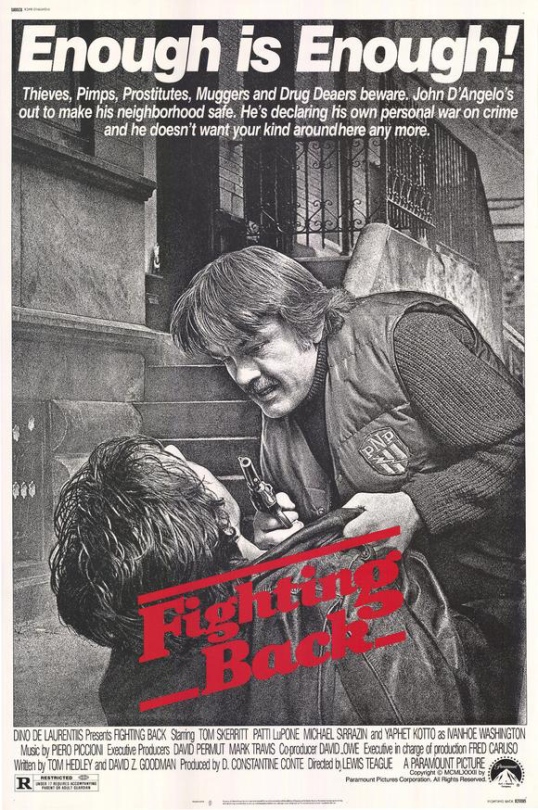
The time is 1982.  The place is Hell on Earth, also known as Philadelphia.  Crime is out of control and the police are powerless to stop it.  When deli owner John D’Angelo (Tom Skerritt) and his wife, Lisa (Patti LuPone), confront a pimp named Eldorado (Pete Richardson), he rams his car into the back of their car, causing the pregnant Lisa to lose her unborn child.  At almost the exact same time, John’s mother (Gina DeAngles) is mugged by two thugs who chop off her ring finger.

In the grand tradition of Charles Bronson, John decides to fight back.  But he doesn’t go it alone.  With his best friend, a police officer named Vince (Michael Sarrazin), John starts the People’s Neighborhood Patrol.  The PNP is going to clean up Philadelphia, one street at a time.  The media (represented by David Rasche) make John into a celebrity.  The black community (represented by Yaphet Kotto) suspect that John and the PNP are guilty of racial discrimination.  The Mafia wants to bring John over to their side.  John runs for city council but he still has time to drop a grenade in a pimp’s car.

Fighting Back was one of the many urban vigiliante films to come out after the success of Death Wish.  Fighting Back‘s producer, Dino De Laurentiis, also produced Death Wish but made the mistake of later selling the rights to Cannon.  Fighting Back was not the box office success that either Death Wish or its sequels were, even though Fighting Back is actually the better movie.  That’s because Fighting Back was directed by the underrated Lewis Teague.  Teague does a good job of making Philadelphia look like a war zone and the scenes of vigilante justice are enjoyable but, overall, Teague takes a far more ambiguous approach to vigilantism than Michael Winner did when he directed Death Wish.  As vile as Philadelphia criminals may be, John D’Angelo isn’t always that likable himself.  When Kotto accuses John and the all-white PNP of being racially prejudiced, Teague suggests that he has a point.  Tom Skerritt gives a good performance, playing John as a proud, blue collar guy who wants to do the right thing but gets seduced by his newfound celebrity.

Better acted than Death Wish and smarter than The Exterminator, Fighting Back is an underrated vigilante gem.

Fighting Back is also known as Philadelphia Security and Death Vengeance.

Fighting Back is also known as Philadelphia Security and Death Vengeance.

A Movie A Day #37: The Challenge (1970, directed by Alan Smithee)


A U.S. spy satellite has crashed onto an uninhabited island in the Pacific Ocean.  Both the United States and an unnamed communist country (described as being “a fifth-rate China,” but obviously meant as a stand-in for not only China but North Korea and North Vietnam as well) have both lay claim to the satellite.  To prevent a possible war, the two countries agree to a compromise.  One American and one communist will be dropped off on the island and will fight to the death.  The survivor gets the satellite.  The communists send the disciplined Yuro (Mako).  The American select Jacob Galley (Darren McGavin), a grizzled Vietnam veteran-turned-mercenary.  Jacob is armed with the latest advancements in weaponry, including a double-barreled sub-machine gun.  Yuro is armed mostly with his wits and an endless supply of booby traps.  Jacob and Yuro fight to a stand still, growing to respect each other even as each tries to kill the other.  However, both countries are willing to cheat to win the challenge.

Originally made for television, this is one of the many films to have been credited to Alan Smithee, the pseudonym that directors used to use whenever they felt that the finished film, usually because of studio interference, did not properly represent their vision.  According to the imdb, The Challenge was actually directed by veteran television directed George McGowan, whose other credits includes episodes of shows like Fantasy Island, Starsky and Hutch, and Charlie’s Angels.  I am surprised that McGowan chose to take his name off of The Challenge because, for a television movie, it’s not bad.  The Vietnam analogy is laid on a little thick but the action is exciting and both McGavin and Mako give excellent performances as the two very different combatants.

The Challenge can be viewed on YouTube.  Keep an eye out for a very young Sam Elliott, in the role of America’s insurance policy.

original_thechallenge5

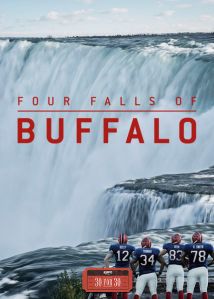
A Movie A Day #36: Four Falls of Buffalo (2015, directed by Ken Rodgers)


four-falls-of-buffalo-movie-posterIn America, they love winners and that’s especially true when it comes to the Super Bowl.  Every year, one team wins the Super Bowl and goes home to a parade and sometimes a riot.  Another teams loses the Super Bowl, often becomes a laughing-stock, and spends the next season searching for “redemption,” never mind that even the team that loses the Super Bowl still did something that 30 other NFL teams failed to do.
Just ask the Buffalo Bills.  In the early 1990s, the Bills accomplished something that no other football team had ever accomplished.  They went to four consecutive super bowls.  And yet, because they lost all four times, the 90s Bills are remembered for what they lost instead of what they accomplished.  If the Bills had won all four of those Super Bowls, they would be remembered as the greatest team of all time.  But because they lost, they are forever remembered as being  joke.

Four Falls of Buffalo is a documentary about those four Super Bowls, all told from the point of view of the players that lost and the city that loved them.  Four Falls of Buffalo is very much a fan’s film but it’s still interesting to watch.  Along with detailing what went wrong (and sometimes right) at all four of the Super Bowls that the Bills lost, it also features interviews with the Bills players.  Particularly notewothy is an interview with Scott Norwood, the kicker who missed a field goal that, had he made it, would have won Super Bowl XXV for the Bills.  Even though the city of Buffalo embraced him after the loss, it is obvious that missed kick still haunts him.

Watch Four Falls of Buffalo in honor of all the teams that made it to the Super Bowl but did not get that win.

A Movie A Day #35: This Was The XFL (2017, directed by Charlie Ebersol)


hhmRemember the XFL?

Though it may be regarded as a joke today, the XFL was a big deal for a few months in 2001.  The brainchild of the WWF’s Vince McMahon, the XFL was a football league that, like the USFL before it, would play during the NFL’s off-season.  McMahon promised that, if the NFL was now the “No Fun League,” the XFL would be the “Extra Fun League.”  McMahon’s longtime friend and the President of NBC sports, Dick Ebersol, purchased the rights to broadcast the XFL’s first two seasons.

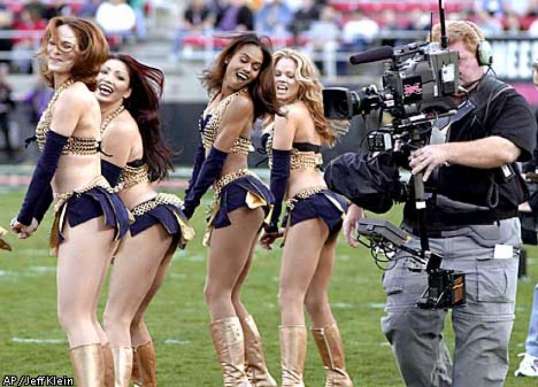
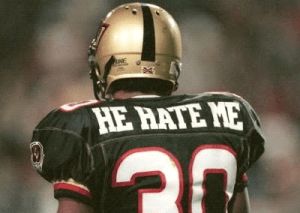
Ebersol and McMahon put together the XFL (8 teams and 2 divisions) in just a year’s time.  They recruited players who hadn’t been able to find a place in NFL.  Using many of the same techniques that he perfected in the world of professional wrestling, McMahon encouraged the players to be big personalities and allowed them to pick their own nicknames.  Rod Smart would briefly become a star as He Hate Me while another player requested to be known as Teabagger.  McMahon tweaked the rules, encouraging faster and more aggressive play.  Instead of a coin flip, each game would start with two opposing players scrambling for the ball.  The XFL was not only more violent than the NFL but it also had sexier cheerleaders.

xfl-cheers

In 2001, I was really excited for the XFL.  It was everything that an 18 year-old male football fan could hope for.  I was one of the 14 million people who watched the very first broadcast.  I watched half of the second broadcast and that was it.  I lost interest and I was not alone.  The XFL started with higher ratings than expected but the final games of that inaugural season set records for being the lowest-rated prime time sports telecasts in history.

What went wrong?  That’s what ESPN’s latest 30 for 30 documentary, This Was The XFL, explains.  Directed by Dick Ebersol’s son, Charlie, This Was The XFL features interviews with McMahon, the senior Ebersol, players like Rod Smart and Tommy Maddox, and sports journalists like Bob Costas.  The XFL’s rise and demise is presented as being a comedy of errors.  Already viewed with skepticism because of McMahon’s unsavory reputation, the XFL was doomed by a combination of terrible luck and bad gameplay that confirmed why many XFL players couldn’t find a place in the NFL.  During the first week, several players were injured during the opening scramble.  In the 2nd week, a power outage interrupted the broadcast of a game in Los Angeles.  With ratings in freefall, McMahon resorted to playing up the cheerleaders and sending Gov. Jesse “The Body” Ventura onto the field so that he could harass the coaches during the game.  Trying to do damage control, McMahon appeared on The Bob Costas Show and their hostile interview is one of the highlights of the documentary.  Even if the league ultimately failed, it is impossible not to admire McMahon’s determination to shake things up.

The XFL’s first season was also its last but, as This Was The XFL makes clear, its legacy is still evident today.  Miked-up players, the skycam, sideline interviews, all of these are the legacy of the XFL.  Even Jerry Jones, when interviewed, says that the XFL changed the way that NFL football is broadcast.

With this being Super Bowl weekend, take a moment to raise a toast to the memory of the XFL.

xfl

A Movie A Day #33: Two-Minute Warning (1976, directed by Larry Peerce)


mpw-8771

For the longest time, I thought that Two-Minute Warning was a movie about a gang of art thieves who attempt to pull off a heist by hiring a sniper to shoot at empty seats at the Super Bowl.  As planned by a master criminal known as The Professor (Rossano Brazzi), the sniper will cause a riot and the police will be too busy trying to restore order to notice the robbery being committed at an art gallery that happens to be right next to the stadium.

I believed that because that was the version of Two-Minute Warning that would sometimes show up on television.  Whenever I saw the movie, I always through it was a strange plan, one that had too many obvious flaws for any halfway competent criminal mastermind to ignore them.  What if the sniper was captured before he got a chance to start shooting?  What if a riot didn’t break out?  The sniper spent the movie aiming at empty seats but, considering how many people were in the stadium, it was likely that he would accidentally shoot someone.  Were the paintings really worth the risk of a murder charge?

Even stranger was that Two-Minute Warning was not only a heist film but it was also a 1970s disaster film.  Spread out throughout the stadium were familiar character actors like Jack Klugman, John Cassevetes, David Janssen, Martin Balsam, Gena Rowlands, Walter Pidgeon, and Beau Bridges.  It seemed strange that, once the shots were fired and Brazzi’s men broke into the gallery, all of those familiar faces vanished.  When it comes to disaster movies, it is an ironclad rule that at least one B-list celebrity has to die.  It seemed strange that Two-Minute Warning, with all those characters, would feature a sniper shooting at only empty seats.  For that matter, why would there be empty seats at the Super Bowl?

That wasn’t the strangest thing about Two-Minute Warning, though.  The strangest thing was that Charlton Heston was in the film, playing a police captain.  In most of his scenes, he had dark hair.  But, in the scenes in which he talked about the art gallery, Heston’s hair was suddenly light brown.

Recently, I watched Two-Minute Warning on DVD and I was shocked to discover that the movie on the DVD had very little in common with the movie that I had seen on TV.  For instance, the television version started with the crooks discussing their plan to rob the gallery.  The DVD version opened with the sniper shooting at a couple in the park.  In the DVD version, there was no art heist.   The sniper had no motive and no personality.  He was just a random nut who opened fire on the Super Bowl.  And,  in the DVD version, he did not shoot at empty seats.  Several of the characters who survived in the version that I saw on TV did not survive in the version that I saw on DVD.

What happened?

The theatrical version of Two-Minute Warning was exactly what I saw on the DVD.  A nameless sniper opens fire and kills several people at the Super Bowl.  In 1978, when NBC purchased the television broadcast rights for Two-Minute Warning, they worried that it was too violent and too disturbing.  There was concern that, if the film was broadcast as it originally was, people would actually think there was a risk of some nut with a gun opening fire at a crowded event.  (In 1978, that was apparently considered to be implausible.)  So, 40 minutes of new footage was shot.  Charlton Heston even returned to film three new scenes, which explains his changing hair color.  The new version of Two-Minute Warning not only gave the sniper a motive (albeit one that did not make much sense) but it also took out all of the violent death scenes.

Having seen both versions of Two-Minute Warning, neither one is very good, though the theatrical version is at least more suspenseful than the television version.  (It turns out that it was better to give the sniper no motive than to saddle him with a completely implausible one.)  But, even in the theatrical version, the potential victims are too one-dimensional to really care about.  Ultimately, the most interesting thing about Two-Minute Warning is that, at one time, an art heist was considered more plausible than a mass shooting.

tmw