A Movie A Day #154: The Day They Hanged Kid Curry (1971, directed by Barry Shear)


Welcome to the Old West.  Hannibal Heyes (Pete Duel) and Kid Curry (Ben Murphy) are two of the most wanted outlaws in the country, two cousins who may have robbed trains but who also never shot anyone.  After being promised a pardon if they can stay out of trouble for a year, Heyes and Curry have been living under the names Joshua Smith and Thaddeus Jones.

During a trip to San Francisco to visit his old friend, a con artist named Silky O’Sullivan (Walter Brennan), Heyes is told that Kid Curry is currently on trial in Colorado.  When Heyes goes to the trial, he discovers that the accused (Robert Morse) is an imposter and that the real Kid Curry is watching the trial from the back of the courtroom.  It turns out that the man of trial is just an attention seeker , someone who is so desperate for fame that he is willing to be hanged to get it.  At first, Curry thinks this is a great thing.  After the imposter hangs, everyone will believe that Curry is dead and they’ll stop searching for him.  Heyes, however, disagrees, especially after the imposter starts to implicated Heyes in crimes that he didn’t commit.

Obviously inspired by Butch Cassidy and the Sundance Kid, Alias Smith and Jones was one of the last of the classic TV westerns.  Though I originally assumed that it was the show’s pilot, The Day They Hanged Kid Curry was actually the first episode of the second season.  With commercials, it ran 90 minutes.  Because of its extended running time, The Day They Hanged Kid Curry was not included in Alias Smith and Jones‘s standard rerun package.  Instead, it was edited to remove the show’s usual opening credits and it was then sold as a motion picture, despite the fact that it is very obviously a television show.

As long as no one is expecting anything more than an extended television episode, The Day They Hanged Kid Curry is okay.  I have never been a big Alias Smith and Jones fan but this episode’s plotline, with Robert Morse confessing to crimes he didn’t commit just so he can have a taste of fame before he dies, feels prescient of today’s culture.  For classic western fans, the main reason to watch will be the chance to see a parade of familiar faces: Slim Pickens, Henry Jones, Paul Fix, and Vaughn Taylor all have roles.  Most important is familiar Western character actor and four-time Oscar winner, Walter Brennan, as Silky O’Sullivan.  This was one of Brennan’s final performance and the wily old veteran never loses his dignity, even when he’s pretending to be Kid Curry’s grandmother.

As for Alias Smith and Jones, it was a modest success until Pete Duel shot himself halfway through the second season.  Rather than retire the character of Hannibal Heyes, the show’s producers replaced Pete Duel with another actor, Roger Davis.  One day after Duel’s suicide, Davis being fitted for costumes.  This move was not popular with the show’s fanbase and Alias Smith and Jones was canceled a year later, though it lived on for years in reruns.

A Movie A Day #153: Blue Collar (1978, directed by Paul Schrader)


Three Detroit auto workers (played by Harvey Keitel, Yaphet Kotto, and Richard Pryor) are fed up.

It’s not just that management is constantly overworking them and trying to cheat them out of their money.  That’s what management does, after all.  What really upsets them is that their union is not doing anything to help.  While the head of the union is getting rich off of their dues and spending time at the White House, Keitel is struggling to pay for his daughter’s braces, Kotto is in debt to a loan shark, and Pryor is lying to the IRS about the number of children that he has.  (When a social worker shows up unexpectedly, Pryor’s wife recruits neighborhood children to pretend to be their’s.)  Kotto, Pryor, and Keitel plot to rob the union but instead, they just discover evidence of the union’s ties to the mob.  The union bosses will do anything to keep that information from being revealed, from trying to turn the friends against one another to committing murder.

Blue Collar was the directorial debut of screenwriter Paul Schrader.  Schrader has said that the three main cast members did not get along during the filming, with Richard Pryor apparently bringing a gun to the set and announcing that there was no way he was going to do more than three takes of any scene.  The tension between the lead actors is visible in the film, with all three of them giving edgy and angry performances.  That anger is appropriate because Blue Collar is one of the few films to try to honestly tackle what it’s like to be a member of the “working class” in America.  While management is presented as being a bunch of clowns, Blue Collar reserves its greatest fury for the corrupt union bosses who claim to represent the workers but who, instead, are just exploiting them.  The characters in Blue Collar are pissed off because they know that nobody’s got their back.  To both management and the union, the workers are worth less than the cars that they spend all day putting together and the money that can be subtracted from all their already meager pay checks.

Since it’s a Paul Schrader film from 1978, the action in Blue Collar does come to a halt, 40 minutes in, for a cocaine-fueled orgy that feels out of place.  While Keitel and especially Kotto give believable performances, Pryor sometimes seems to be struggling to keep up.  Still, flaws and all, Blue Collar has a raw and authentic feel to it, something that few other movies about the working class have been able to capture.  Perhaps because it never sentimentalizes its characters or their situation, Blue Collar was not a box office success but it has stood the test of time better than many of the other films that were released that same year.  Sadly overlooked, Blue Collar is a classic American movie.


A Movie A Day #152: Bad Company (1972, directed by Robert Benton)


Missouri during the Civil War.  All young men are being forcibly constricted into the Union army, leaving those who want to avoid service with only two options: they can either disguise themselves as a woman and hope that the soldiers are fooled or they can head out west.  Drew Dixon (Barry Brown) opts for the latter solution but his plans hit a snag when he’s robbed and pistol-whipped by Jake Rumsey (Jeff Bridges).  When Drew coincidentally meets Jake for a second time, he immediately attacks him.  Jake is so impressed that he insists that Drew join his gang of thieves.

Jake’s gang, which include two brothers (one of whom is played by John Savage) and a ten year-old boy, is hardly the wild bunch.  They spend most of their time robbing children and are, themselves, regularly robbed by other gangs, including the one run by Big Joe (David Huddleston).  Their attempt to rob a stagecoach goes hilariously wrong.  Less hilarious is what happens when they try to steal a pie from a window sill.

Bad Company was the directorial debut of Robert Benton and it has the same combination of comedy and fatalism that distinguished both his script for Bonnie and Clyde and several of the other revisionist westerns of the 1970s.  While the interplay between Drew and Jake may remind some of Butch Cassidy and the Sundance Kid, the film’s sudden bursts of violence feel like pure Peckinpah.  Fortunately, the combination of Robert Benton’s low-key direction and the excellent performances of Jeff Bridges and Barry Brown allows Bad Company to stand on its own.  Brown and Bridges make for an excellent team, with Bridges giving a charismatic, devil-may-care performance and the late Barry Brown holding his own as the more grounded Drew.  (Sadly, Brown, who appears to have had the talent to be a huge star, committed suicide six years after the release of Bad Company.)  This unjustly forgotten western is one of the best films of the 1970s.

A Movie A Day #151: Easy Money (1983, directed by James Signorelli)


Rodney Dangerfield.  He didn’t get no respect but he did smoke a lot of weed.
It’s true.  Rodney first lit up in 1942 when he was a 21 year-old struggling nightclub comic.  According to his widow, the moment meant so much to Rodney that, decades later, he could still remember the room number — 1411, at the Belvedere Hotel in New York City — where he and fellow comedians Bobby Byron and Joe E. Ross smoked that first joint.  That was back when Rodney was performing under the name Jack Roy.  (His was born Jacob Cohen.)  Rodney’s first comedy career went so badly that he quit and spent the next twenty-two years as an aluminum siding salesman until he found the courage to return to the stage.  However, whether he was selling or performing, Rodney never stopped smoking marijuana.  When he was working on his autobiography, he wanted to call it My Lifelong Romance With Marijuana.  His wife convinced him to go with a different title:  It’s Not Easy Bein’ Me: A Lifetime of No Respect but Plenty of Sex and Drugs.

There’s plenty of drugs in Easy Money, which is a problem for baby photographer Monty Capuletti (Rodney, of course).  Monty likes to gamble, drink, and smoke pot, much to the disapproval of his wealthy mother-in-law (Geraldine Fitzgerald).  When she dies, she stipulates in her will that if Monty goes for a year without indulging in any of his vices, he and his family will receive 10 million dollars.  Sounds easy, right?  The only problem is that Monty really likes to eat, drink, gamble, and get high.  His best friend (Joe Pesci) doesn’t think he can do it.  His mother-in-law’s former assistant, Quincy Barlow (Jeffrey Jones), is determined to catch Monty slipping back into his old ways so that he can inherit the money.  Monty’s determined, though, to win the money for his family, especially now that his daughter (Jennifer Jason Leigh) has married the bizarre Julio (Taylor Negron).

The episodic plot is really just an excuse for Rodney to be Rodney, spouting off one liners and making snobs like Quincy look foolish.  Rodney and Joe Pesci were a surprisingly effective comedy team.  The scene where they get stoned and try to drive home without damaging the huge wedding cake in the back of the van is a hundred times funnier than it has any right being.  Even though it is hard to imagine her being, in any way, related to Rodney Dangerfield, Jennifer Jason Leigh is always a welcome presence.  Like many comedies of that era, Easy Money is uneven, with as many jokes failing as succeeding but, for Rodney Dangerfield fans, it is a must see.

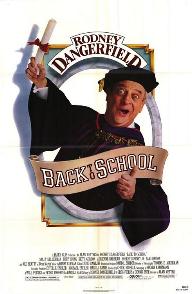
A Movie A Day #150: Back to School (1986, directed by Alan Metter)


Thornton Melon (Rodney Dangerfield) started with nothing but through a combination of hard work and chutzpah, he started a chain of “Tall and Fat” clothing stores and made a fortune.  Everyone has seen his commercials, the one where he asks his potential customers, “Do you look at the menu and say, ‘Okay?'”  He has a new trophy wife named Vanessa (Adrienne Barbeau) and a chauffeur named Lou (Burt Young).  Thornton never even graduated from high school but he gets respect.
However, his son, Jason (Keith Gordon), doesn’t get no respect.  No respect at all.  Jason is a student at a pricey university, where he is bullied by Chas Osborne (William Zabka) and can’t get a date to save his life.  Jason’s only friend is campus weirdo Derek Lutz (Robert Downey, Jr.).  When Thornton sees that his son isn’t having any fun, he decides to go back to school!

Back to School is a predictable but good-natured comedy.  It is like almost every other 80s college comedy except, this time, it’s a 65 year-old man throwing raging parties and making the frat boys look stupid instead of Robert Carradine or Curtis Armstrong.  On the stand-up stage, Dangerfield always played the (sometimes) lovable loser but in the movies, Dangerfield was always a winner.  In both Caddyshack and Back to School, Dangerfield played a self-made man who forced his way into high society and showed up all of the snobs.  While Back to School is no Caddyshack, it does feature Rodney at his best.

Rodney may be the funniest thing about Back to School but a close second is Sam Kinison, who owed much of his early success to Rodney Dangerfield’s support.  Kinison plays a history professor, who has some very strongly held views about the Vietnam War and who punctuates his points with a primal screen.

Also, keep an eye out Kurt Vonnegut, playing himself.  Rodney hires him to write a paper about Kurt Vonnegut for one of his classes.  The paper gets an F because Rodney’s literature professor (Sally Kellerman) can tell that not only did Rodney not write it but whoever did knows absolutely nothing about the work of Kurt Vonnegut.

So it goes.

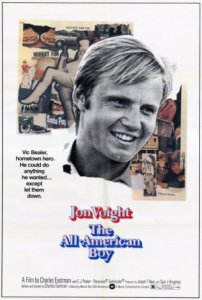
A Movie A Day #149: The All-American Boy (1973, directed by Charles Eastman)


Vic “The Bomber” Bealer is an amateur boxer who appears to be poised to escape from life in his dreary hometown.  He is such a good fighter that he is on the verge of making the U.S. Olympic Team and he is so good-looking that everyone, from his teenage girlfriend (Anne Archer) to his gay manager (Ned Glass) to a woman he meets at a gas station, automatically falls in love with him.  However, after his girlfriend tells him that she is pregnant, Vic abandons both her and boxing.  When she leaves town to have an abortion, Vic starts boxing again but then he learns that she may not have actually had an abortion and Vic leaves for Los Angeles, to see both her and his son.

Sadly, there is something about boxing that has always brought out the pretentious side of some filmmakers and that is the case with The All-American Boy.  This episodic film (which claims to portray “The Manly Art In Six Rounds”) tries to present Vic as being an anti-hero but mostly, he just seems to be vacant loser.  Vic sulks through the entire film, despite not really having much to sulk about.  When one of his conquests asks him what he is thinking, Vic replies, “I ain’t thinkin'” and the movie provides no reason to doubt him on this point.  I was not surprised to learn that The All-American Boy was filmed in 1969 and was deemed unreleasable until the combined success of Midnight Cowboy and Deliverance made Voight into a star.  On the plus side, when he made the film, Jon Voight looked like he could actually step inside the ring and throw a few punches.  On the negative side, the boxing scenes go heavy on the slow motion which, when overused, just looks stupid.  Raging Bull, this film is not.

When it comes to The All-American Boy, Duke has the right idea:

A Movie A Day #148: Badge 373 (1973, directed by Howard W. Koch)


In this cop film, Robert Duvall plays Eddie Ryan, a tough New York detective who gets suspended from the force when he is accused of tossing a Puerto Rican suspect off of a roof.  Eddie’s innocent but, because he spends all of his time talking about how much he hates Puerto Ricans and using Archie Bunker-style racial slurs, everyone assumes that he is guilty.  Eddie is suspended from the force but then his former partner is killed while investigating an operation to smuggle guns to, you guessed it, Puerto Rico.  Suspended or not, Eddie is going to track down the man who killed his partner.  If that puts everyone from his girlfriend, Maureen (Verna Bloom), to NYC pedestrians in danger, that’s just the way it has to be.
Robert Duvall as an action star?  Duvall was only 41 when he starred in Badge 373 but it is still strange to see America’s greatest character actor jumping out of windows and chasing suspects.  Badge 373 was one of the many cop films made in the wake of Dirty Harry and The French Connection and the film is actually credited as being “inspired by the exploits of Eddie Egan.”  Egan also served as the inspiration for Gene Hackman’s Popeye Doyle in The French Connection. Duvall is good in the role but he is almost a little too good.   Hackman played Doyle with a twinkle in his eye that suggested his casual racism was just a part of his streetwise persona.  Duvall is so grim and determined as Eddie Ryan that there is never any doubt that he hates everyone just as much as he says he does.

(Just as he did in The French Connection, the real-life Eddie Egan has a role in Badge 373.  He plays Eddie Ryan’s supervisor and best friend.)

Like most of the cop films that came out immediately after The French Connection, the highlight of Badge 373 is an extended chase scene.  In this one, Eddie escapes from the gun smugglers by hijacking a city bus.  The only problem is that Eddie isn’t sure how to drive a bus and Duvall acts the hell out of his struggle to figure out how to switch gears.  It’s worth the price of admission.

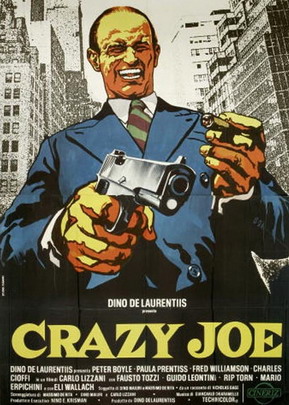
A Movie A Day #147: Crazy Joe (1974, directed by Carlo Lizzani)


Crazy Joe (Peter Boyle) is a gangster with a chip on his shoulder and a self-taught intellectual who can (misquote) Sartre and Camus with the best of them.  Sick of being taken for granted, Joe and his brother, Richie (Rip Torn), attempt to challenge the Mafia establishment.  The mob sets Joe up and gets him sent to prison.  While doing time, Joe befriends a Harlem gangster named Willy (Fred Williamson).  Refusing to associate with the other Italian prisoners, Joe allies himself with the black inmates and even helps to start a riot over the prison’s inhumane conditions.  When he is released, Joe hits the streets of New York with a vengeance, now backed up by Willy and his criminal organization.

Crazy Joe is based on the life of Joey Gallo, who was briefly a New York celebrity, hobnobbing with actors like Jerry Orbach and writers like Norman Mailer before he was gunned down at Umberto’s Clam Shop in Little Italy.  Though the names were changed to protect the guilty, Eli Wallach plays Vito Genovese, Charles Cioffi plays Joe Columbo, and Luther Adler is Joe Profaci.  Fred Williamson’s character is based on the infamous Nicky Barnes.

Crazy Joe is a good and violent mix of the gangster, prison, and blaxploitation genres.  Despite wearing an unfortunate toupee, Peter Boyle is great at putting the crazy in Crazy Joe and Fred Williamson ups the coolness factor of any movie he appears in.  Keep an eye out for Henry Winkler, giving a very un-Fonzie performance as Joe’s right-hand man.

A Movie A Day #146: The Dogs of War (1981, directed by John Irvin)


Jamie Shannon (Christopher Walken) is a professional mercenary who is hired, by a British businessman, to overthrow the government of Zangaro.  Though Zangaro is currently ruled by a ruthless dictator, Shannon’s employers want to replace him with someone even worse, all so they can get their hands on the country’s platinum mines.  After Shannon is captured and tortured by the government, he wants nothing else to do with Zangaro.  Instead, he wants to return to New York and propose to his ex-wife (JoBeth Williams).  But, when she turns down his proposal, Shannon and his mercenary army return to Zangaro.

Before winning an Oscar for The Deer Hunter and becoming one of our most popular character actors, Christopher Walken was a finalist for the role of Han Solo in Star Wars.  If not for George Lucas’s decision to hire Harrison Ford to read lines for the actors at the auditions, Christopher Walken’s career could have developed far differently.  The Dogs of War, which was Walken’s first big film after the high of The Deer Hunter and the low of Heaven’s Gate, features Walken playing a character who has much in common with George Lucas’s original conception of Han Solo, an amoral mercenary who will work for anyone who pays him.  Walken is almost too good as Jamie, playing the part as being so aloof and ruthless that it is sometimes hard to feel any sympathy for him at all.  If he had taken that approach to playing Han Solo, audiences would have really been shocked when Han returned to attack the Death Star.  They would probably be worried that he had returned because the Empire offered him a thousand credits to kill Luke.

The Dogs of War has an intriguing premise but it’s a very slow movie that gets caught up in all the minutia that goes into staging a coup.  It’s exciting when Walken and his mercenaries finally attack the dictator’s compound but it takes forever to get there.  The book, by Frederick Forsyth, is a well-written page turner but the film adaptation largely falls flat.

A Movie A Day #145: The Incredible Hulk: A Death In The Family (1977, directed by Alan J. Levi)


Following the events of The Incredible Hulk and with the world convinced that he is dead, Dr. David Banner (Bill Bixby) is hitchhiking his way across California, hoping to reach a hospital where research is being done on the effects of gamma radiation.  When he stops off in an orange grove, he spots a young, crippled woman named Julie (Laurie Prange).  When Julie faints, David carries her back to her mansion.  It turns out that, after the mysterious death of her father, Julie stands to inherit millions.  David suspects that her doctor (played by William Daniels) may be poisoning her and he gets a job working on the grounds of her mansion.  At first, David thinks that his biggest problem is going to be the head groundskeeper (Gerald McRaney), who is jealous of David’s relationship with Julie.  But, actually, it’s Julie’s stepmother (Dorothy Tristan) that David has to watch out for.  When David tries to protect Julie and a bitter hermit (John McLiam) from the stepmother’s evil plans, he soon finds himself being pursued through the swampland by both men with guns and tabloid journalist Jack McGee (Jack Colvin).  They are all making David Banner angry and they’re about to discover that they wouldn’t like David Banner when he’s angry.

This was the second pilot for The Incredible Hulk.  It aired a week after the first pilot and, like that one, it was also given a theatrical release in Europe.  While the first movie established David Banner’s backstory and explained why he transformed into the Hulk whenever he bumped his head on a door frame or twisted his ankle, A Death in The Family is more typical of the series that would follow.  Like every subsequent episode, A Death In The Family opens with David Banner finding an odd job and ended with him walking down the road with his thumb stuck out.  In between, Banner helps a special guest star.

Watching the second pilot, it’s easy to see why CBS took a chance on The Incredible Hulk even though, at the time, comic book adaptations were considered to be a risk.  Both Bill Bixby and Lou Ferrigno really throw themselves into playing Banner and his alter ego and the show takes the idea seriously.

There’s nothing special about the pilot’s story.  The stepmother and the doctor are obviously guilty from the start.  But the plot (and the 90 minute running time) does allow for four appearances by the Hulk.  David Banner even gets attacked by a grizzly bear, which brings the Hulk right out.  David Banner always had the worst luck with wild animals and barbed wire.  The Hulk, though, just throws the grizzly bear over into the next pond.  The bear is not harmed.  The Hulk may have been angry but he was never really dangerous.

Finally, for the record, Death In the Family featured the first of many aliases that David Banner would assume over the next four years.  This time, he’s David Benton.