Horror Film Review: Love At First Bite (dir by Stan Dargoti)


Disco Dracula!

In 1979’s Love At First Bite, George Hamilton plays Dracula, who goes from living in Transylvania to trying to make it in New York City.  Even when you’re the King of the Vampires, it turns out that New York can be a difficult place to live.  No one has much respect for the tanned man in the cape, even after he shows off his powers.  He falls in love with a model, Cindy Sondheim (Susan Saint James), but she doesn’t buy into the idea that he’s a vampire.  She’s a New Yorker and she’s in therapy.  Her therapist, Dr. Jeffrey Rosenberg (Richard Benjamin), is a direct descendant of Prof. Van Helsing and he does believes that “Vladimir” is a vampire but he can’t get anyone to believe him.  When he takes his concerns to the NYPD, Lt. Ferguson (Dick Shawn) dismisses him as being insane.  Which, to an extent, he is but only because no one will believe him….

Meanwhile, Dracula’s faithful servant, Renfield (Arte Johnson), starts every morning by leaning out of his apartment window and pretending to be a rooster.  It’s his signal to let Dracula know that it’s time to come home.  Dracula is so in love with Cindy that he sometimes forgets to keep track of time.  It’s a New York love story….

Love At First Sight is a comedy that essentially gets a lot of mileage out of a handful of jokes.  The main joke is the idea of George Hamilton, with his perpetual tan, playing Dracula and speaking with a Bela Lugosi-style accent.  Hamilton plays Dracula as being very confident and very smooth but also rather befuddled by 1979.  He’s a gentleman of the “old world” after all.  The other big joke is that Dracula is in New York, a city where no one is impressed by anything.  This is very much a “New Yorkers Will Be Rude To Anyone” movie, a genre that was very popular in the 70s.  Some films, like Taxi Driver, used the rudeness of New York as a metaphor for paranoia and detachment.  Love At First Bite uses it for laughs.

(For the record, my favorite “New Yorkers Will Be Rude To Anyone” movie is the original The Taking of Pelham One Two Three.  Also, the last time I briefly visited New York, everyone was very nice and polite to me.  Only once did someone yell, “Look out, lady!” and I’m still not really sure what I was supposed to be looking out for.)

There’s a lot to like about Love At First Sight.  Susan Saint James and George Hamilton don’t exactly have a ton of chemistry but Hamilton himself is fun to watch.  “Children of the night — shut up!” he yells at the wolves and it’s hard not to smile.  It’s just so goofy.  Hamilton and Arte Johnson are a good comedic team and, for that matter, so are Richard Benjamin and Dick Shawn.  It’s a film of set pieces.  Dracula and Renfield rob a blood bank.  Jeffrey confronts Dracula at dinner.  Dracula pops out of his coffin at a church.  Some of the set pieces work better than others and this is very much a film of its time but overall, it’s a genial and amusing send-up of the vampire genre.

And it features Dracula at a disco!  It’s a 70s movie and it stars George Hamilton so it’s not really surprising that the action moves to a disco.  Still, if you can’t appreciate the sight of a caped Dracula showing off his best moves, I don’t know what to tell you.

Love At First Sight is a reminder that not every Halloween movie has to be terrifying.  Some of them can just make you laugh.

Retro Television Review: Indict & Convict (dir by Boris Sagal)


Welcome to Retro Television Reviews, a feature where we review some of our favorite and least favorite shows of the past!  On Sundays, I will be reviewing the made-for-television movies that used to be a primetime mainstay.  Today’s film is 1974’s Indict & Convict!  It  can be viewed on YouTube.

There’s been a murder!

The wife of Assistant District Attorney Sam Belden (William Shatner) has been found, shot to death.  Making things especially awkward is that the body of her lover is found next to her.  Though Belden is the obvious suspect, he has an alibi for the time of the murders.  He claims that he was in Las Vegas, attending a convention.  Two gas station attendants remember seeing him filling up his car with gas at around the same time that his wife and her lover was being shot.

Attorney General Timothy Fitzgerald (Ed Flanders) is not so sure that Belden is innocent.  He instructs two of his top prosecutors to check out Belden’s story and to see if there’s enough evidence to not only indict but also to convict.  Bob Matthews (George Grizzard) is a veteran prosecutor and he’s the one who narrates the story for us.  Assisting him is Mike Belano, who is played by the always likable Reni Santoni.  Just three years before this movie aired, Santoni played Harry Callahan’s partner in Dirty Harry.  There was just something about Santoni’s friendly but determined demeanor that made him perfect the role of the supportive partner or assistant.

The film is very much a legal procedural, with the emphasis on not only the investigation but also on the strategies and the techniques that are used in the courtroom by Matthews and defense attorney DeWitt Foster (Eli Wallach).  In many ways, it feels like a forerunner to Law & Order.  Usually, I love court procedurals but Indict & Convict was a bit too slow and high-minded for its own good.  Maybe it’s because I’ve been spoiled by all of the legal shows that I’ve seen but I have to admit that I spent a good deal of Indict & Convict wanting the prosecutors to get on with it.  Flanders, Grizzard, Santoni, and Wallach were all ideally cast but the film itself sometimes got bogged down with all the debate about the best way to win a conviction.  It’s a shame because the story itself is an intriguing one and I actually enjoyed the movie’s use of spinning newspaper headlines to let us know what had happened in between scenes.  Also, as a classic film fan, I enjoyed seeing Myrna Loy as the judge.  She didn’t get to do much other than say, “Sustained” and “Overruled,” but still …. Myrna Loy!

Most people who watch this film will probably do so out of the hope of seeing some trademark Shatner overacting.  William Shatner doesn’t actually get to say much in this film.  He spends most of the running time sitting silently at the defense table.  Towards the end, he does finally get a chance to deliver a brief speech and it’s everything you could hope for.  Shatner takes dramatic pauses.  Shatner emphasizes random words.  Every line is delivered with the subtext of, “Pay attention, Emmy voters!”  Eventually, Shatner would learn the value of laughing at oneself but apparently, that lesson had not yet been learned when he did Indict & Convict.

October Hacks: Sweet Sixteen (dir by Jim Sotos)


1983’s Sweet Sixteen takes place in a small town in Texas.

Sherriff Dan Burke (Bo Hopkins) does his best to try to maintain the peace but it’s not always easy.  Not when a good majority of the town is prejudiced against the Native Americans living on a nearby reservation.  There’s a major archeological dig happening on the reservation, headed up by Dr. John Morgan (Patrick Macnee), but the town doesn’t care about any of the artifacts that Dr. Morgan and his team might discover.  They’re too busy harassing local activist Jason Longshadow (Don Shanks) for stepping into the wrong bar.

However, a distraction from all of the casual racism has arrived in the form of Dr. Morgan’s daughter, Melissa (Aleisa Shirley).  Soon, it seems like every teenage boy and young man in town is lusting after Melissa.  Melissa, for her part, is only fifteen years old and is struggling to deal with all of the attention.  Sometimes, she enjoys the attention.  Sometimes, she just wants to be left alone.  (Believe me, as someone who had adults hitting on her when she was 13, I could relate.)  Melissa’s birthday is coming up and her mother (Susan Strasberg) is planning on throwing a big party and inviting the whole town to come over and celebrate.  Sheriff Burke thinks it’s a great idea.  “This town could use something to celebrate.”

The only problem is that any boy who so much as looks at Melissa ends up getting brutally murdered.  When an old Native American man named Greyfeather (Henry Wilcoxin) is spotted near the scene of one of the crimes, the local redneck blame him for the murders and tragedy ensues.  Sheriff Burke has to find the real murderer and, whether he likes it or not, he’s going to get some help from his kids, Hank (Steve Antin) and Marci (Dana Kimmel).

Hank and Marci really are this film’s secret weapons.  In the past, I’ve been pretty critical of Dana Kimmel’s performance in Friday the 13th Part 3 and her insistence that her character be re-written to reflect her own religious beliefs and desire to be a good role model.  However, Kimmel is really likable (and perhaps more appropriately cast) as the fiercely intelligent but still relatively innocent Marci, who reads murder mysteries and is totally excited about the prospect of getting to solve a real murder.  Hank is perhaps a bit less enthusiastic about about crime-solving than Marci but he still helps out his sister because she’s his sister.  Awwwwww!

Sweet Sixteen is a bit of an untraditional slasher film, one that is as concerned with social issues as is it was stalking and slashing teenagers.  Perhaps that explains why it has a slightly better cast than the typical 80s slasher, with veteran actors like Patrick McNee, Susan Stasberg, and Bo Hopkins acting opposite equally capable but younger actors like Kimmel, Antin, and Aleisa Shirley.  It’s also a surprisingly likable slasher film, due to the Dana Kimmel and Steve Antin’s engaging lead performances.  Honestly, I think it’s kind of a shame that there weren’t a series of films featuring Marci and Hank solving crimes.  Dana Kimmel and Steve Antin make quite a team in this above average slasher.

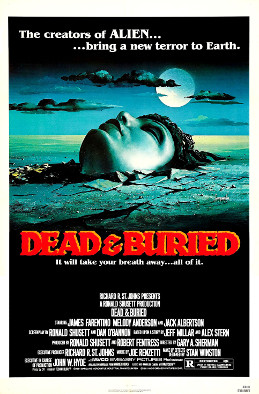
Horror Film Review: Dead & Buried (by Gary Sherman)


The 1981 horror film, Dead & Buried, takes place in the small town of Potters Bluff.  It seems like it should be a nice place to live.  The people are friendly.  The scenery is lovely.  The town is right on the coast of the ocean so the view is great.  It’s a bit of an artist’s colony, the type of place where you would expect to find Elizabeth Taylor painting the sunset while Richard Burton battles a hangover in the beach house.  It’s the type of small town that used to by very popular on television.  It’s just one Gilmore girl away from being an old CW show.

It’s such a nice town.  So, why are so many people dying?

That’s the mystery that Sheriff Dan Gillis (James Farentino) has to solve.  Actually, it’s one of the many mysteries that Dan has to solve.  There’s also the mystery of why his wife, Janet (Melody Anderson), has been acting so strangely.  And then there’s the mystery of what happened to the person who, one night, Dan ran into with his car.  The person ran away but he left behind his arm.  When Dan gets some skin from the arm analyzed, he’s told that the arm belongs to someone who has been dead for at least four months!

Who can explain all of this?  How about William G. Dobbs (Jack Albertson), the folksy coroner who seems to enjoy his work just a little bit too much.  In fact, Dr. Dobbs seems to be a bit more than just a tad eccentric.  One would necessarily expect a coroner to have a somewhat macabre view of life but Dr. Dobbs seems to take things to extreme.  Is it possible that Dr. Dobbs knows more than he’s letting on?

Dead & Buried has a reputation for being something of a sleeper, a deliberately-paced and often darky humorous horror film that had the misfortune to be released at a time when most horror audiences were more interested in watching a masked man with a machete kill half-naked teenagers.  Because the studio wasn’t sure how exactly to market Dead & Buried, it failed at the box office and it was only years later, after it was released on home video, that people watched the film and realized that it was actually pretty good.  And make no mistake about it, Dead & Buried is a fairly clever horror film, one that is full of effective moments and which does a good job of creating a creepy atmosphere.  If I’m not quite as enthused about this film as others, that’s because I do think that it’s occasionally a bit too slow and the film’s twist ending, while well-executed, didn’t particularly take me by surprise.  This is one of those films that you enjoy despite the fact that you can see the surprise conclusion coming from a mile away.

In the end, Dead & Buried fills like a particularly twisted, extra-long episode of one of those old horror anthology shows, like Night Gallery, Twilight Zone, or maybe even Ghost Story.  It’s a nicely done slice of small town horror, featuring a study lead performance from James Farentino and an enjoyably weird one from Jack Albertson.  Though the film is not heavy on gore, Stan Winston’s special effects are appropriate macabre.  Even if it’s not quite up there with Gary Sherman’s other films (like Vice Squad and Death Line, to name two), Dead & Buried is an entertainingly eccentric offering for Halloween.

Cleaning Out the DVR #16: Keep Calm and Watch Movies!


gary loggins's avatarcracked rear viewer

All last week, I was laid up with sciatic nerve pain, which begins in the back and shoots down my left leg. Anyone who has suffered from this knows how  excruciating it can be! Thanks to inversion therapy, where I hang upside down three times a day on a table like one of Bela Lugosi’s pets in THE DEVIL BAT , I’m feeling much better, though not yet 100%.

Fortunately, I had a ton of movies to watch. My DVR was getting pretty full anyway, so I figured since I could barely move, I’d try to make a dent in the plethora of films I’ve recorded.., going all the way back to last April! However, since I decided to go back to work today, I realize I won’t have time to give them all the full review treatment… and so it’s time for the first Cleaning Out the DVR post…

View original post 1,081 more words

A Movie A Day #335: Ruby and Oswald (1978, directed by Mel Stuart)


The year is 1963.  The month is November.  The city is Dallas.  The President of the United States, John F. Kennedy, is coming to visit and two very different men have very different reactions.  An eccentric and lonely strip club owner, Jack Ruby (Michael Lerner), worries about an anti-Kennedy ad that has just appeared in the Dallas Morning News.  Another loner, a strange man named Lee Harvey Oswald (Frederic Forrest), is busy making plans of his own.  When Kennedy is assassinated, history brings Ruby and Oswald together in a way that a shattered nation will never forget.

This is a curious one.  It was made for television and, according to Wikipedia, its original running time was 180 minutes.  The version that I saw, on VHS, was barely 90 minutes long so obviously, the version I saw was heavily edited.  (In the 70s, it was common for made-for-TV movies to be reedited for both syndication and overseas theatrical release.)  Maybe that explains why Ruby and Oswald felt do disjointed.  In the version I saw, most of the emphasis was put on Jack Ruby running around Dallas and getting on people’s nerves.  Very little time was devoted to Oswald and the film was almost entirely stolen by Lerner. Michael Lerner is a familiar character actor.  You may not know his name but you will definitely recognize his face.  Lerner was convincing and sometimes even sympathetic as the weaselly Ruby.  Ruby and Oswald supported the Warren Commission’s findings, that Oswald killed Kennedy and Ruby shot Oswald out of a sense of loyalty to Jackie Kennedy.  Michael Lerner’s performance was so good that he almost made that theory plausible.

One final note, for fans of WKRP in Cincinnati: Gordon Jump and Richard Sanders, best known as Arthur Carlson and Les Nessman, were both in Ruby and Oswald, though they did not share any scenes together.

A Movie A Day #33: Two-Minute Warning (1976, directed by Larry Peerce)


mpw-8771

For the longest time, I thought that Two-Minute Warning was a movie about a gang of art thieves who attempt to pull off a heist by hiring a sniper to shoot at empty seats at the Super Bowl.  As planned by a master criminal known as The Professor (Rossano Brazzi), the sniper will cause a riot and the police will be too busy trying to restore order to notice the robbery being committed at an art gallery that happens to be right next to the stadium.

I believed that because that was the version of Two-Minute Warning that would sometimes show up on television.  Whenever I saw the movie, I always through it was a strange plan, one that had too many obvious flaws for any halfway competent criminal mastermind to ignore them.  What if the sniper was captured before he got a chance to start shooting?  What if a riot didn’t break out?  The sniper spent the movie aiming at empty seats but, considering how many people were in the stadium, it was likely that he would accidentally shoot someone.  Were the paintings really worth the risk of a murder charge?

Even stranger was that Two-Minute Warning was not only a heist film but it was also a 1970s disaster film.  Spread out throughout the stadium were familiar character actors like Jack Klugman, John Cassevetes, David Janssen, Martin Balsam, Gena Rowlands, Walter Pidgeon, and Beau Bridges.  It seemed strange that, once the shots were fired and Brazzi’s men broke into the gallery, all of those familiar faces vanished.  When it comes to disaster movies, it is an ironclad rule that at least one B-list celebrity has to die.  It seemed strange that Two-Minute Warning, with all those characters, would feature a sniper shooting at only empty seats.  For that matter, why would there be empty seats at the Super Bowl?

That wasn’t the strangest thing about Two-Minute Warning, though.  The strangest thing was that Charlton Heston was in the film, playing a police captain.  In most of his scenes, he had dark hair.  But, in the scenes in which he talked about the art gallery, Heston’s hair was suddenly light brown.

Recently, I watched Two-Minute Warning on DVD and I was shocked to discover that the movie on the DVD had very little in common with the movie that I had seen on TV.  For instance, the television version started with the crooks discussing their plan to rob the gallery.  The DVD version opened with the sniper shooting at a couple in the park.  In the DVD version, there was no art heist.   The sniper had no motive and no personality.  He was just a random nut who opened fire on the Super Bowl.  And,  in the DVD version, he did not shoot at empty seats.  Several of the characters who survived in the version that I saw on TV did not survive in the version that I saw on DVD.

What happened?

The theatrical version of Two-Minute Warning was exactly what I saw on the DVD.  A nameless sniper opens fire and kills several people at the Super Bowl.  In 1978, when NBC purchased the television broadcast rights for Two-Minute Warning, they worried that it was too violent and too disturbing.  There was concern that, if the film was broadcast as it originally was, people would actually think there was a risk of some nut with a gun opening fire at a crowded event.  (In 1978, that was apparently considered to be implausible.)  So, 40 minutes of new footage was shot.  Charlton Heston even returned to film three new scenes, which explains his changing hair color.  The new version of Two-Minute Warning not only gave the sniper a motive (albeit one that did not make much sense) but it also took out all of the violent death scenes.

Having seen both versions of Two-Minute Warning, neither one is very good, though the theatrical version is at least more suspenseful than the television version.  (It turns out that it was better to give the sniper no motive than to saddle him with a completely implausible one.)  But, even in the theatrical version, the potential victims are too one-dimensional to really care about.  Ultimately, the most interesting thing about Two-Minute Warning is that, at one time, an art heist was considered more plausible than a mass shooting.

tmw

Cleaning Out The DVR Yet Again #38: The Baby (dir by Ted Post)


(Lisa recently discovered that she only has about 8 hours of space left on her DVR!  It turns out that she’s been recording movies from July and she just hasn’t gotten around to watching and reviewing them yet.  So, once again, Lisa is cleaning out her DVR!  She is going to try to watch and review 52 movies by the end of Thursday, December 8th!  Will she make it?  Keep checking the site to find out!)

poster_of_the_movie_the_baby

On October 30th, I recorded The Baby off of TCM.

First released back in 1973, The Baby is a seriously strange little movie.  It’s about a 21 year-old man named Baby (played by David Manzy).  Why is he called Baby?  Because he lives in a crib.  And he wears a diaper that occasionally needs changing.  And he sounds exactly like a baby.  (Whenever he opens his mouth, the sound of an actual baby is dubbed in.)  When he’s alone with his babysitter, he eagerly sucks on her breast, half-nursing and half-perving.

Baby is the only son of Mrs. Wadsworth (Ruth Roman, giving a chillingly evil performance).  Mrs. Wadsworth was abandoned by her husband shortly after Baby was born and the film implies that she’s taken a lot of her hatred towards her ex out on her son.  Despite not liking her son, Mrs. Wadsworth is determined to hold onto him.  She gets a weekly welfare check from the state.  The money is supposed to be used to take care of Baby but Mrs. Wadsworth uses it to take care of herself and her two daughters.

Who are her daughters?  Alba Wadsworth (Suzanne Zenor) is an implied nymphomaniac who has a way with a cattle prod.   Germaine Wadsworth (Marianna Hill) is an actress and model who, it’s suggested, has incestuous designs on her brother.

That’s right — they’re a messed up family!  However, they do throw great parties, the type that are full of all the typical characters who you would expect to appear in a low-budget film from 1973.  Hippies, hipsters, aspiring disco dancers, they all show up.  Michael Pataki shows up as well!  You my not know the name but if you’re a fan of 70s exploitation films like me, you’ll immediately recognize Michael Pataki.

In order to continue receiving money from the government, the Wadsworths have to impress their case worker.  They’ve moved through several social workers and, for the most part, they’ve survived by being so strange that no one wants to spend too much time dealing with them.  However, their case has just been assigned to Ann Gentry (Anjanette Comer) and she actually takes an interest in Baby and his life with the Wasdworths.

Ann says that she thinks Baby could benefit from going to a special school.  The Wadsworths suggest that she mind her own business.  Ann, however, has no intention of doing that.  Ann refuses the give up on giving Baby a chance at a better life.

Sounds heart-warming, right?

Well, no.

At first, Ann seems like just another concerned do-gooder.  But, at the film progresses, we start to suspect that Ann might have some secrets of her own.  We’re told that she lost her husband in a car accident but the details are left intentionally vague.  What we do know is that Ann lives in a huge house with her mother-in-law (Beatrice Manley Blau) and we find ourselves wondering why, if her husband is gone, are the two of them still living together.

We also fin ourselves wondering: Does Ann have Baby’s best interests in mind?  For that matter, does anyone?

Being a 70s movie, it all ends with a violent home invasion that’s followed by a surprise twist.  The twist caught me totally off-guard and forced me to reconsider everything that I had previously seen.  It was shocking, it was borderline offensive, it was just a little bit ludicrous, and it was rather brilliant in its odd way.

The same can be said for The Baby as a whole.  This is one weird movie and you’ll never see another like it.  For that reason alone, The Baby is worth seeing at least once.

Horror Film Review: Zoltan, Hound of Dracula (dir by Albert Band)


Were you aware that Dracula owned a dog?  And that dog was a vampire?  And that dog’s name was Zoltan?

It’s true!  Or, at least, it’s true according to a low-budget 1977 film called Zoltan, the Hound of Dracula.

Zoltan opens with a bunch of Russians unearthing an underground tomb that, we’re told, once housed Dracula.  Inside the tomb, they find two coffins.  One contains a man with a stake in his chest.  The other contains the body of a dog that has a stake in its chest.  Foolishly, the Russians remove the stakes and bring back to life both Zoltan and Veidt Smit (played by a very creepy-looking actor named Reggie Nalder, who also played the vampire in the made-for-tv adaptation of Stephen King’s Salem’s Lot).  Veidt is a former servant of Dracula who can walk around in the daylight.  As for Zoltan — well, he’s Dracula’s dog.  His eyes glow.  He has gigantic fangs.  He’s a vampire dog!

It turns out that, in order to survive, Veidt and Zoltan have to find the last human descendant of Dracula and turn him into a vampire.  So, Veidt and Zoltan had to Los Angeles and start to stalk family man Michael Drake (Michael Pataki).  Drake (and yes, his last name was shortened from Dracula) has little knowledge of his heritage.  Oddly enough, we’re told repeatedly that he’s the last member of the Dracula bloodline but he has two kids so it seems like they would actually be the last descendants of Dracula and…

Oh, who cares!?  Why are we worrying about logic when it comes to reviewing a film called Zoltan, the Hound of Dracula?

Michael and his family leave Los Angeles so that they can spend the weekend at a campground and, needless to say, they are followed by Zoltan and Veidt.  Soon, Zoltan is turning every other dog in California into a vampire and chasing Michael and his family.

Fortunately, a vampire hunter (played by Jose Ferrer) shows up and offers to help Michael survive.  But will his help be enough?

Okay, so Zoltan, the Hound of Dracula is technically a pretty bad film.  The budget is very low.  Director Albert Band doesn’t really bother much with things like subtext or suspense.  With the exception of the genuinely intimidating Reggie Nadler, the actors pretty much just go through the motions.  But, with all that in mind — how can you not love a film called Zoltan, the Hound of Dracula?  It’s fun because the film is just so ludicrous.  Criticizing a film like this for being bad ultimately feels like being way too much of a scold.

Add to that, there’s a vampire puppy!  And yes, he is just adorable!

I have to say that I am very disappointed that Zoltan did not make an appearance in last year’s Dracula Untold.  Hopefully, any future Dracula movies will make room for Zoltan. He may have been a vampire but seriously, Zoltan was a good dog!


http://www.youtube.com/watch?v=Hebcn3hD50M

Embracing the Melodrama Part II #78: American Anthem (dir by Albert Magnoli)


American_anthem_poster

“He’s thrown a tripus!  Steve Tevere has thrown a tripus!  The most outstanding dismount tonight, or any night!” 

— Really Excited Announcer In American Anthem (1986)

Way back in March, I dvr’d a movie called American Anthem off of Encore.  I did this for two reasons.  First off, the film was described as having something to do with gymnastics and that’s always been my favorite part of the Summer Olympics.  Secondly, any film from the 1980s that has the word “American” in the title is sure to be fun or, at the very least, achingly sincere.

When I finally got around to watching American Anthem, I wasn’t expecting much.  The film turned out to be largely what I expected it would be: the story of gymnasts hoping to qualify for the Olympics and find some personal redemption along the way.  All of the stock characters were present.  We had Steve Tevere (Mitch Gaylord), the brooding rebel who had to decide between pursuing his Olympic dreams or working in a garage for the rest of his life.  We had Steve’s girlfriend, Julie (Janet Jones), who had to learn to be humble before she could be great.  We had Kirk (Stacy Maloney), Steve’s best friend and fellow gymnast.  We had kinda bitchy Becky Cameron (Maria Anz), who was Julie’s friend and rival.  And then there was Arthur (Andrew White), Julie’s crippled, musician cousin.  And let’s not forget Tracy Prescott (Jenny Ester), the 12 year-old gymnast with the impressive afro.  And, of course, there was Coach Sarnoff (Michael Pataki) who was tough, compassionate, and Russian.  The majority of the cast was made up of real-life gymnasts and, with the exception of the genuinely charismatic Stacy Maloney, they all gave performances that suggested that they should stick with gymnastics.

And yet, despite all of that, I absolutely loved American Anthem.  Now, don’t get me wrong.  For the most part, I loved it for all the wrong reasons.  My love for the film is not the type of love that would lead to me being quoted on the back of a Blu-ray case.  American Anthem is a thoroughly bad film but it’s also compulsively watchable.  From the minute that I started watching it, I became obsessed with American Anthem‘s bizarre ineptness.  Since that first night in March, I’ve rewatched American Anthem a few dozen times.  I’ve lost track of how many times that I have grimaced at the cutesy music that Sarnoff tried to force Julie to use for her floor routine.  I can imitate Becky’s squeal of pain when she’s tries to compete with an injured knee.  Whenever Julie and the girls start to chant, “Kirk!  Kirk!  Kirk!,” I chant with them.  And don’t even get me started on how much I love hearing, “He’s thrown a tripus!”

American Anthem is pure style.  This is one of the few films that I’ve seen that has absolutely no subtext.  There is literally nothing going on beneath the surface.  It’s almost as if somebody dared director Albert Magnoli to make a film that was just one big montage.  This is one of those films where the camera is always moving, the colors are always bright, and the soundtrack is always soaring.  Hardly anyone in the film can actually act but oh my God, everyone looks so good (in a 1986 sort of way, of course).

The other “great” thing about American Anthem is that there’s not a single cliché that the film doesn’t include and, as a result, you really don’t have to pay that much attention to the film to understand what’s going on.  To its credit, this film doesn’t even pretend to be anything other than a collection of clichés.  It’s almost as if the characters themselves realize that they are in a film and understand that they have no choice but to conform to what the audience has been conditioned to expect.

(Hmmm…I guess American Anthem does have a subtext.  And kind of a disturbing one at that!)

For instance, within minutes of meeting and despite having no chemistry, Steve and Julie are in love.  Why?  Because the only reason that they are in the film is to fall in love.  It has to be done.

Steve fights with his father (John Aprea) and we’re never quite sure why, beyond the fact that all brooding rebels fight with their fathers.  When his father shows up to watch his son compete, the triumphant music soars and it no longer matters that he’s been portrayed as being an abusive rageaholic up until that moment.

All of the characters tell us that Coach Sarnoff is the best, despite the fact that we don’t actually see any evidence of that fact.  But Sarnoff has to be the best because nobody ever makes a movie about athletes training under a merely adequate coach.

When Becky suddenly shows up at the final competition with a bandaged knee, it doesn’t matter that we don’t actually see her get injured beforehand or, for that matter, hear anything about it.  All that matters is that, in films like this, someone has to compete with an injury.  Becky is simply playing her part.

American Anthem.  It’s not a particularly good film but it sure is watchable.  And, as I’ve come to realize while writing this review, it’s a bit of an existential nightmare as well!

I don’t think I’m ever going to erase it from my DVR.

americananthem01