Brad’s thoughts on KILL BILL: THE WHOLE BLOODY AFFAIR!


Anything new from Quentin Tarantino is a big deal at my house. When you consider that it’s been over six years since the auteur released his most recent film, ONCE UPON A TIME IN HOLLYWOOD (2019), I was understandably excited when I saw that the full “extended cut” version of the KILL BILL films, dubbed “The Whole Bloody Affair” was being released to theaters. Then, after seeing the trailer, I became really curious about the new scenes that were added, as well as the different presentations of the previous material. When I originally watched the separate volumes at the movie theater in 2003 and 2004, I enjoyed the first movie slightly more than the second based on the fact that it had more action. Now, I wanted to see how the two volumes flowed as one single film. My wife was working this weekend, so I had some time on my hands and decided to spend about four hours of that time watching KILL BILL: THE WHOLE BLOODY AFFAIR.

First, a quick summary of the film… on the eve of her wedding, a pregnant bride-to-be (Uma Thurman) and her entire wedding party is gunned down by the Deadly Viper Assassination Squad, commanded by her former lover, Bill (David Carradine). Somehow surviving the rehearsal massacre, the Bride, who was once a member of the same assassination squad, sets her sights for revenge on each of the members, beginning with O’Ren Ishii (Lucy Liu), and then moving on to Vernita Green (Vivica A. Fox), Budd (Michael Madsen), Elle Driver (Daryl Hannah), and finally Bill himself. It’s a simple premise, but Tarantino uses that premise as a springboard to share his love of kung fu movies, samurai cinema, spaghetti westerns and grind house fare and create something truly special. I loved the KILL BILL films when they were originally released, and the four hours seemed to go by very quickly today as I had a blast watching this definitive version with a relatively full theater of fans.

After watching KILL BILL: THE WHOLE BLOODY AFFAIR, my first thought is that it wouldn’t be that different if the theater just showed Volume One, had a 15-minute intermission, and then showed Volume Two. This isn’t putting down the new version in any way, but there are not a large number of changes that enhance the overall quality of the film itself, and screening the original volumes back-to-back would provide the context for the “big picture” of the story that was lacking when the movies were released in the separate years of 2003 and 2004. With that said, watching the film in this new version was a lot of fun for me, and it should become the norm moving forward as it is truly Tarantino’s vision. It does flow better, mainly by eliminating the unnecessary, late cliffhanger reveal of the daughter in Volume One, as well as the Bride’s “direct to the camera” update at the beginning of Volume Two.

For those who want to go see this new version, I did want to point out the significant differences I noticed while viewing KILL BILL: THE WHOLE BLOODY AFFAIR. The first sequence where I noticed obvious additions to the film occurred in the anime sequence that introduces the background of O’Ren Ishii. This extended version adds additional footage of the Yakuza assassin Pretty Riki to the sequence, and once O’Ren is a slightly older schoolgirl, we get to see her execute a plan of vengeance against him. I would guess somewhere between five and ten minutes of action was added to the sequence. I enjoyed it in Volume One, and I also enjoyed the extended anime sequence in this new version. Does the sequence really add to the overall quality of the film, though? Even though I enjoyed the new material and am glad it was added, I would say no. The next significant difference I noticed with this version concerns the addition of color to the fight sequence between the Bride and the crazy 88’s in the House of Blue Leaves, as compared to the sequence in Volume One that was shown largely in black and white. As a person who doesn’t enjoy a lot of gore in my movies, it never bothered me that the scene switched from color to black and white once the limbs and heads started getting lopped off. With that said, it was kind of fun watching all those limbs hacked off in glorious color this time around. Finally, there is a post-credits animated sequence called “The Lost Chapter: Yuki’s Revenge” where Gogo Yubari’s twin sister tries to get revenge on the Bride. It lasts about ten minutes or so, but honestly, it didn’t add much to the overall experience for me, and I doubt I’ll ever watch it again. As a completist though, I am glad that I stuck around and watched it. These are the only big changes I noticed while watching THE WHOLE BLOODY AFFAIR. I’m sure there had to be some more changes, but I don’t think they were significant. 

I did want to share some final thoughts I had while watching KILL BILL: THE WHOLE BLOODY AFFAIR this afternoon. I noticed on the opening title card that the movie is dedicated to the great Japanese director Kinji Fukasaku, and you can definitely see his influence all over this film. It also affected me more watching Michael Madsen’s excellent performance as Bill’s brother Budd. Tarantino just knows how to get the best out of Madsen, and considering that he passed away a few months ago, I just really appreciated his work while watching the film. I also enjoyed the multiple shoutouts to my movie hero Charles Bronson in the film. First, there’s a MR. MAJESTYK poster hanging on the wall in Budd’s trailer that is featured often throughout the various shenanigans and fights that take place in the trailer. Second, Charles Bronson passed away in 2003, the year that Volume One of KILL BILL was released. In the final credits of the film, Bronson receives an RIP credit. I’ve always loved the fact that Tarantino loves Charles Bronson, and that’s on full display in KILL BILL: THE WHOLE BLOODY AFFAIR. I would have given anything if Bronson had been in better health as Tarantino was coming into his own as a filmmaker. I have no doubt that he would have been offered a chance to appear in one of the director’s films.

At the end of the day, I had a great time watching KILL BILL: THE WHOLE BLOODY AFFAIR. The four hours flew by, and I truly appreciated seeing Tarantino’s full vision realized on screen. While I do think this should be the definitive version moving forward, I loved the KILL BILL films before today. THE WHOLE BLOODY AFFAIR improves the overall flow of the film and adds some fun new stuff, but my love for the film didn’t really change that much today… it just runs a tad bit deeper.

#MondayMuggers present BLOOD FATHER (2016), starring Mel Gibson!


Every Monday night at 9:00 Central Time, my wife Sierra and I host a “Live Movie Tweet” event on X using the hashtag #MondayMuggers. We rotate movie picks each week, and our tastes are quite different. Tonight, Monday March 10th, we’re watching BLOOD FATHER starring Mel Gibson, Erin Moriarty, Diego Luna, Michael Parks, William H. Macy, and Miguel Sandoval.

BLOOD FATHER is the story of an ex-con (Mel Gibson) who reunites with his estranged 17-year old daughter (Erin Moriarty) to protect her from drug dealers hell bent on killing her.

I remember being very excited about BLOOD FATHER when it was released back in 2016. I’ve always been a big fan of Mel Gibson’s work, and this movie looked like it would be right down my alley. I was visiting the Tampa area on a business trip and decided to take in the film at a theater in Pinellas Park during some downtime. I remember enjoying the film very much and thinking Gibson was especially badass in the title role. I’m looking forward to watching it again with the #MondayMuggers crew.

Here are a few interesting tidbits about BLOOD FATHER:

  1. Raoul Max Trujillo plays a badass Sicario trying to kill Mel Gibson and his on-screen daughter in this film. 10 years earlier he had played the chief warrior in APOCALYPTO (2006), which was directed by Gibson.
  2. The movie Lydia (Erin Moriarty) is watching in the theater is the remake of ASSAULT ON PRECINCT 13 (2005). Jean-François Richet directed that film and BLOOD FATHER.
  3. In 2008, Sylvester Stallone was planning to direct and star in an adaptation of Peter Craig’s novel “Blood Father.” Stallone and Mel Gibson would work together in 2014 on THE EXPENDABLES 3. 
  4. Director Jean-Francois Richet’s most recent film is PLANE (2023), starring Gerard Butler. It’s a damn good action film as well. 
  5. BLOOD FATHER was written by Peter Craig. His other credits include THE TOWN (2010), THE HUNGER GAMES: MOCKINGJAY 1 & 2 (2014-2015), THE BATMAN (2022) and TOP GUN: MAVERICK (2022). 

So, join us tonight for #MondayMuggers and watch BLOOD FATHER! It’s on Amazon Prime. 

DEATH WISH V: THE FACE OF DEATH – The end.


Picture it…it’s 1992 or 1993 and I’m back at my local Hastings Entertainment superstore browsing through an entertainment magazine. Surprisingly, I came across a bit of entertainment news that a 71 year old Charles Bronson had accepted an offer of $5 million to reprise his Paul Kersey character for a fifth time. I couldn’t help but wonder what possible direction that they could take the series that would be interesting. I didn’t see anything else about the movie for the next year or so, and then it showed up some time in 1994 available for rent at that same Hastings Entertainment superstore. As far as I know, it never played in theaters in Arkansas, although it did play in some theaters in other parts of the country prior to going to home video. I immediately rented the film, somewhat apprehensive of what it would be….

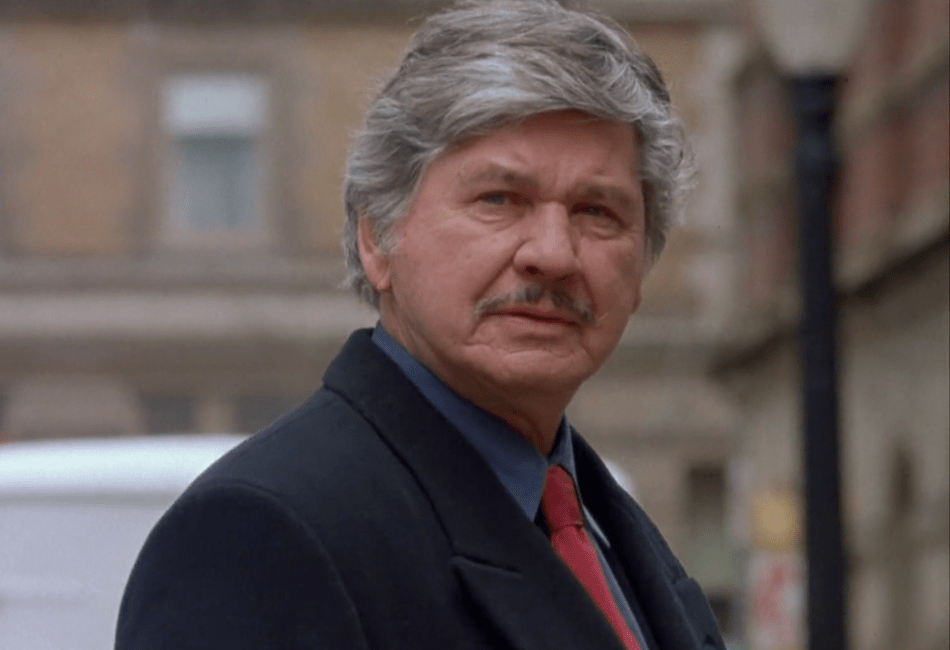
DEATH WISH V: THE FACE OF DEATH, begins with Paul Kersey (Charles Bronson) back in New York. We first see him, looking quite dapper I might add, walking down the street in the garment district. He’s on his way to see his latest girlfriend, fashion designer Olivia Regent (Lesley Anne-Down), whose fashion show is currently underway. You immediately feel sorry for Ms. Regent as you know her prospects for survival are somewhere between slim and none since Kersey’s her man. It doesn’t help matters when her ex-husband, awkwardly impotent mobster Tommy O’Shea (Michael Parks) shows up and starts physically abusing her and her employees. You see, O’Shea is trying to force his ex-wife to use her fashion business to help him launder money from his various criminal activities. Kersey tries to convince Olivia to go to District Attorney Brian Hoyle (Saul Rubinek) to try to put O’Shea away. Unfortunately, there’s corruption in the D.A.’s office in the form of Hector Vasquez (Miguel Sandoval), who passes the information back to O’Shea. From this point forward, Ms. Regent’s life is in serious jeopardy and we all know Kersey’s record of keeping his women alive isn’t that great. I won’t give the details away, but let’s just say that events conspire so that the cursed Kersey will have to resume his old vigilante ways in pursuit of a justice that can never be provided to him by the law.  

I remember vividly my first ever viewing of DEATH WISH V back in 1994. I put the videotape in the VCR and watched several previews that looked crappy and didn’t give me a lot of hope for the movie. And then it started, and I have to admit I enjoyed it from the very beginning to the end. I guess my expectations were so low that it was a major relief when I realized that it was a reasonably well-made, audience satisfaction movie designed for people like me who simply enjoy seeing Bronson acting as an instrument of justice. I thought Bronson looked good for an action star over 70 years old. I really liked the movie’s sense of humor. Michael Parks overacted to the point of parody as O’Shea, and the character of Freddie Flakes (Robert Joy) was especially fun as a hitman with major dandruff problems. And there was something about Charles Bronson that was different in comparison to some of the earlier entries. Then I realized what it was, Bronson was having fun. He took out the bad guys with things like poisoned cannolis and exploding soccer balls, all with a twinkle in his eyes. In the 70’s, Bronson made several movies where his characters had that twinkle. It was nice to see it back. Bad things happened of course, but director Allan A. Goldstein kept a tone of black comedy that suited the movie and its aging star well. 

Even in 1994, watching DEATH WISH V felt like the end, not just of the DEATH WISH series, but of Bronson’s time as a movie star. As his biggest fan, that made me kind of sad. He would only make 3 more TV movies after this, those being the FAMILY OF COPS TV movies. And while there are some who don’t like DEATH WISH V and seem to go out of their way to put it down, I’m exactly the opposite. To me, DEATH WISH V: THE FACE OF DEATH is a gift to Charles Bronson fans and an enjoyable end to his signature series!

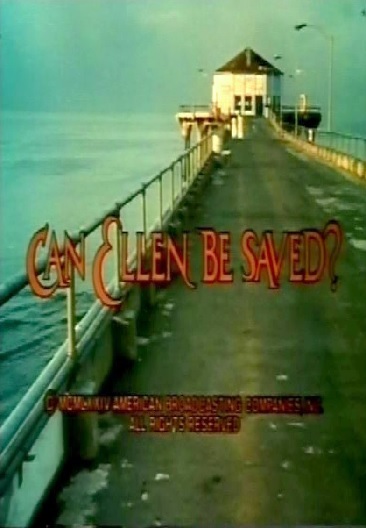
Retro Television Reviews: Can Ellen Be Saved (dir by Harvey Hart)


Welcome to Retro Television Reviews, a feature where we review some of our favorite and least favorite shows of the past!  On Sundays, I will be reviewing the made-for-television movies that used to be a primetime mainstay.  Today’s film is 1974’s Can Ellen Be Saved!  It  can be viewed on YouTube!

Ellen Lindsey (Katharine Cannon) is an intelligent but depressed teenager who feels that she just doesn’t belong anywhere in the world.  She’s not interested in the money and class-obsessed lifestyle of her parents, Arnold (Leslie Nielsen, back in his serious actor days) and Bea (Louise Fletcher).  At the same time, she’s also not interested in the silly lives of her friends, who spend all of their time chasing boys and talking about celebrities.  Ellen is looking for something deeper and she thinks that she may have found it when she attends a religious retreat led by a charismatic man named Joseph (Michaele Parks).

Everyone at the retreat is very friendly and very dedicated and very concerned with finding more to life than just surface pleasures.  They spend hours listening to sermons.  They spend even longer singing hymns.  The leaders of the retreat emphasize that anyone can leave whenever they want but, if they do, they’ll still be making the biggest mistake of their life.  Ellen is happy because she’s finally found a group of friends who seem to feel the same way that she does about society and materialism.  Joseph is happy because he’s brainwashed another member of his cult who he can now send out to panhandle for him and the compound.

Arnold and Bea are not happy when Ellen runs away to join Joseph’s commune.  When Arnold visits the commune, he discovers a secretive world where outsiders are not welcome.  He also discover that Ellen no longer seems to be capable of thinking for herself.  With the police unwilling to help, Arnold and Bea turn to an enigmatic deprogrammer named James Hallbeck (John Saxon).  Hallbeck specializes in grabbing kids that have joined cults and bringing them back to their parents.  Of course, it’s hard not to notice that neither Joseph nor Arnold seems to be giving much thought to what Ellen actually wants from her life.

Can Ellen Be Saved? is a well-made TV movie that has a lot in common with later films like Split Image and Ticket To Heaven.  As in both those movies, the first half of the film details how cults initially brainwash their members while the second half deals with the sometimes harsh process of reversing that brainwashing.  And, just as in those two later films, Can Ellen Be Saved? features parents who mistakenly assume that their child can be returned to them exactly as she was before.  Though all three of the films feature cults that are definitely sinister, they also feature main characters who were lost before they joined the cult and all three of them end on an ambiguous note, leaving us to wonder if the characters have regained their free will or if they’ve just traded one brainwashing for another.

Along with being a well-written and well-acted film, Can Ellen Be Saved features one of those once-in-a-lifetime casts.  Popping up in small roles are familiar faces like William Katt, Rutanya Alda, and Kathleen Quinlan.  Michael Parks and John Saxon are both convincing as two morally ambiguous characters whose own motives are left enigmatic.  Katherine Cannon is sympathetic as Ellen, whose need to be a part of something leaves her vulnerable to manipulation.  Finally, it must be said that Leslie Nielsen — despite his reputation for having been a dull dramatic actor — is actually very effective as Ellen’s confused but well-meaning father.  Usually, when I watch Neilsen in a dramatic film, I find myself expecting him to wink at the camera or deliver a silly line in a deliberately flat and unemotional tone.  But, in this film, I actually forgot I was watching Leslie Nielsen.  Instead, he just become a suburban dad, trying to understand why his daughter was so dissatisfied with the life that he had worked so hard to give her.

I wasn’t expecting much from Can Ellen Be Saved? but it turned out to be surprisingly effective.

Retro Television Reviews: Fantasy Island 2.22 “The Comic/The Golden Hour”


Welcome to Retro Television Reviews, a feature where we review some of our favorite and least favorite shows of the past!  On Tuesdays, I will be reviewing the original Fantasy Island, which ran on ABC from 1977 to 1986.  The entire show is currently streaming on Tubi!

This week, Fantasy Island brings us a mix of crime and comedy!

Episode 2.22 “The Comic/The Golden Hour”

(Dir by Earl Bellamy, originally aired May 5th, 1979)

Since this series began, I’ve been wondering what the legal status of Fantasy Island is.  Is it a territory of the United States?  Is it a part of the British Commonwealth?  Is it an independent nation?  Finally, in this episode, the question is answered.  Fantasy Island is an independent nation, though one that appears to be closely aligned to the United States.  And Mr. Roarke is the sole legal authority.  In short, Mr. Roarke is a bit of a dictator and the Island’s laws are pretty much determined by his whims.

This becomes apparent when a plane is forced to make an emergency landing on the island.  The plane is carrying a prisoner named Mike Banning (Michael Parks) to the United States.  When Federal Marshall Victor Grennan (Morgan Woodward) announces that there is no way he’s going to let Mike out of his handcuffs, Mr. Roarke announces that he’s in charge of the Island and, on the Island, no one is handcuffed.  Reluctantly, Grennan sets Mike free.

It also turns out that Mr. Roarke had a specific reason for wanting Mike on the island.  While in prison, he developed a pen pal relationship with a woman named Sandy Larson (Toni Tennille).  Mike’s letters provided a lot of comfort to Sandy after an auto accident left her in a wheelchair.  In fact, Sandy is in love with Mike and she’s on the Island!  Roarke arranges for Mike and Sandy to finally meet face-to-face.  Unfortunately, Sandy is self-conscious about her wheelchair and Mike feels like he’s a loser with no future.  Mike even tries to escape at one point, running through the jungle until he’s eventually captured by the Marshal.  Still, despite all of that, Mike and Sandy realize that they really do love each other.  Mike is willing to finish out his three years in prison if it means that Sandy will be waiting for him on the outside.  Fortunately, a bit Deus ex Machina comes into play as evidence is miraculously found that proves that Mike wrongfully convicted.  Yay!

While all of that’s going on, joke writer Jerry Burton (Fred Grandy) fantasizes about quitting his job working for comedic legend Danny Baker (Jack Carter) and instead pursuing a stand-up career of his own.  Mr. Roarke arranges for Jerry to perform at a bar on the northside of the Island.  Roarke explains that the bar is popular with the workers at the local pineapple plantation.  (See?  We’re learning even more about the Island!)  However, when the bar is shut down due to a brawl, Jerry instead finds himself performing at the big Fantasy Island talent show.  In fact, he’ll even be substituting for Danny, who was scheduled to host but has been held up on another part of the Island.

At first, Jerry bombs.  He has no confidence.  But then Danny joins him on stage and they bring down the house.  Jerry and Danny arrived on the Island as employee and employer but now, they’re leaving a comedy team.  Yay!  Plus. Jerry reconnects with his old high school girlfriend (Pat Klous).  Yay again!

The comedy stuff was fun, largely because Fred Grandy was as likable and goofy here as he was as Gopher on the The Love Boat.  However, what really made this episode memorable was the method intensity that Michael Parks brought to the role of Mike Banning.  While all the other guest stars goof around and enjoy the scenery, Parks plays his role with a seething rage.  It’s unexpected but it works.

All in all, this was a good episode.  The combination of Fred Grandy and Michael Parks turned out to be just what Fantasy Island needed.

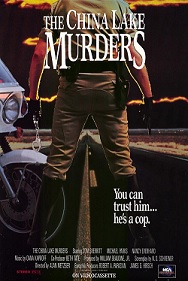
The China Lake Murders (1990, directed by Alan Metzger)


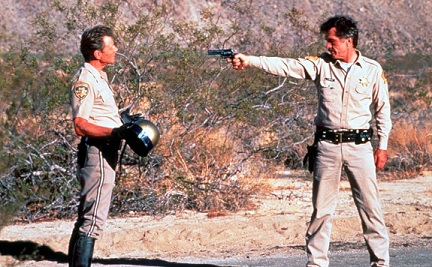
Officer Donnelly (Michael Parks) of the Arizona Highway Patrol has snapped.  One day, he doesn’t show up for roll call and instead drives out to the desert.  Sometimes, he pulls people over and tells them that they’ve violated a traffic law.  Sometimes, he stops to help a stranded motorist.  Every encounter ends with Donnelly killing someone.  When Donnelly reaches the town of China Lake, he flirts with a waitress (Lauren Tewes) and befriends Sheriff Sam Brodie (Tom Skerritt).  Brodie is investigating the mystery of why so many people are turning up dead in the desert and he slowly comes to realize that his new friend is the one responsible.

The China Lake Murders was produced by the USA Network and it used to air regularly throughout the 90s.  For a while, it held the record for the highest rated basic cable film.  One reason why so many people would watch it whenever it aired was because the movie started out with a warning that it contained strong violence and some sexual content.  That warning was all that it took to convince most people to watch the movie.  While the sexual content is tame (we see someone’s bare back at one point), the violence is indeed strong. 

So is the performance of Michael Parks, who plays Donnelly as the ultimate nightmare cop.  In many ways, Donnelly epitomizes everything that people hate about the police.  He’s a bully who hides behind his uniform and his badge.  The movie never explains why Donnelly suddenly snapped but watching him, it’s easy to guess that he’s always been a sadist.  He channeled his cruelty into law enforcement and now that he’s crossed the line and is killing random people, he still believes that his uniform will protect him.  Tom Skerritt, on the other hand, is the epitome of what most people would hope a cop would be, fair-minded and more concerned with helping the community than controlling it.

The China Lake Murders is a little slow.  Since it’s revealed early on that Parks is the killer, there’s not much suspense during the middle section of the film.  Things pick up, though, when Skerritt and Parks finally go after each other.  The two veteran actors bring a lot of gravitas to their roles and their final confrontation does not disappoint.

Quick Review – Grindhouse (dir. by Robert Rodriguez & Quentin Tarantino)


The following was posted on 4/6/2007 from my LiveJournal on Grindhouse (which is celebrating it’s 15th Anniversary). I’ll admit I respect Death Proof a bit more now than I did back then:

Gotta write fast. Have to jump into shower and head for work.

I got into the movie theatre at about 8pm, and spent the hour talking with a pair of film students from the School of Visual Arts. At 9 (an hour before the movie), the rest of the sold out crowd appeared. I was officially 3rd in line. Sweet. 🙂 I didn’t my preferred seat (the single one on the right reserved for patrons coming in with someone in a wheelchair), but did get a seat in the empty row (meaning I could stretch my legs, even better).

The short of it: Grindhouse is paying one low price for 2 bad movies, on purpose. You get 3 great built in trailers, and two mini movies. Between the two mini movies, I loved “Planet Terror” (the Rodriguez one) more than “Death Proof” (The Tarantino film), simply because Death Proof had too much of Tarantino’s conversational style that all of his films have. It’s like you’re listening to a conversation that absolutely doesn’t tie itself to any of the storyline’s major points. It’s just “cool” stuff, but I literally almost fell asleep until Kurt Russell showed up on screen. I think that if one knows to expect this from Tarantino, it comes across better. It’s like watching both Kill Bill volumes back to back. The first one’s cool and action packed, and the second one has some action (the chase scene alone in Death Proof had me wondering how they did that), but is so slow before getting there, you want to sigh.

Being a Charmed Fan, it was great to see Rose McGowan again, and there were so many cameos to laugh at. Fergie has a cameo, and Michael Biehn’s (“Hicks” from Aliens, Navy Seals) even in this. Where did they dig up these guys?

Grindhouse is easily a party film. I’d go see it again in the theatre, but I don’t see myself getting the DVD. It takes you back about a good 30 years, and does that really well. There are missing reels, serious jump cuts in the film and the sound sometimes cuts out. 🙂 In that sense, it’s really beautiful. The audience laughed and applauded, though there were some that at the end were like “Man, that sucked.” In the 60’s and 70’s, Grindhouse movies were pretty bad. I guess it’s like watching one of those old Hammer films, mixed in with a cheap horror flick. You have to walk into this movie not expecting “The Departed” for it to work. Just have fun with what you’re seeing and remember, this is what your parents sometimes saw in the movies (it should be noted that my parents went to something of a Grindhouse once – the movie they went to see was Night of the Living Dead. The other movie that was in the show was John Carpenter’s “Halloween”, which freaked my Dad out).

The music in particular is really great. Robert Rodriguez, Chingon, and a few friends come up with a sound for Planet Terror that’s in essence a John Carpenter like sound. If you have access to the Itunes Music Store, give it a listen (I bought it). Plus, if you’re a fan of some of the older movies out there, you’ll find references to some of Carpenter’s films in there (for example, one of the songs from “Escape from New York” is actually used in the film). The same occurs with the soundtrack from “Creepshow” – The story with the drowned couple. There are also tons of older Tarantino/Rodriguez references in there. One fellow actually yelled out a line, word for word, from what was on screen. It took me a second to realize the line came from “From Dusk Till Dawn”. Sweet.

The in betwen trailers are absolutely fantastic. If I were to get the DVD, it would probably be for this reason alone. You can tell that Rob Zombie, Edgar Wright (Shaun of the Dead) and Eli Roth (Hostel) really had fun with their pieces.

So, Grindhouse is worth seeing in theatre at least once with a bunch of friends, but know what you’re walking into. The movie can get gross at times and no young kid should even be brought near to this (we got carded to actually get into the theatre, and a Weinstein Rep. was on hand after the film to let us take surveys). Also before the movies, one of the teaser trailers is for Rob Zombie’s “Halloween”. I haven’t been so excited for a horror film like this since Zack Snyder’s version of “Dawn of the Dead”. This looks really good, and I’m wondering what Michael Myers is going to look like when someone like Tyler Mane (Sabretooth from the first X-Men movie) is playing him. That’s going to be creepy.

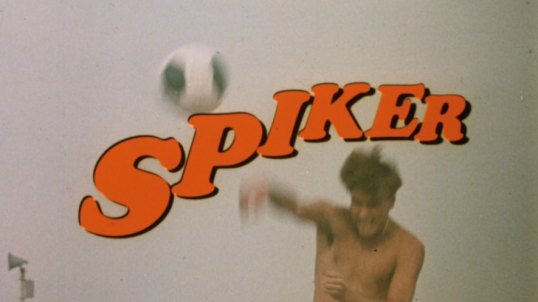
Guilty Pleasure No. 46: Spiker (dir by Roger Tilton)


The 1985 film, Spiker, is an attempt to make an exciting movie out of the one of the most boring sports in the world, men’s volleyball.  Not only does the film attempt to make volleyball look exciting but it attempts to do it on absolutely no budget.  Anyone who doesn’t appreciate the combination of guts and foolishness necessary to even attempt this is not a real film fan.

Spiker follows a group of college volleyball players as they train to qualify for the Olympics.  Or, at least, that’s what I think is supposed to be going on.  The plot is really difficult to follow, not because it’s complex but just because it’s volleyball and who cares?  We learn that the coach of the team (played by Michael Parks) is a tough taskmaster.  We learn that one of the players needs to get his act together and be more mature.  We learn that another member of the team has a wife who is jealous of all of his volleyball groupies.  Eventually, the team competes in Japan and Poland.  In Japan, the teammate who needs to get his act together gets drunk and wanders around with two prostitutes.  Poland, meanwhile, is represented by a high school gym and four women doing the polka.  One Polish woman asks a member of the team to smuggle out some letters.  Which he does.  Yay.  Exciting.

As I said, there’s a lot of volleyball in Spiker but you’re never really sure if the American team is winning or not.  Unless it’s being played on a beach and everyone’s wearing a skimpy bathing suit, volleyball is a thoroughly uncinematic sport.  I mean, what do you think of when you think about volleyball in the movies?  You think about Carrie White not hitting the ball and then burning down the school.  What you don’t wonder is, “I wonder who was winning when Carrie missed that hit?”

What makes Spiker a pleasure is it’s determination.  The film is truly convinced that it can somehow make volleyball exciting and you have to admire it for being so sure of itself.  It’s kind of like those people who spend night after night in Marfa, waiting for the UFOs to arrive.  They may be crazy but you can’t help but admire their dedication, even while you’re laughing at some of the absolutely atrocious dialogue.

The other thing that makes Spiker a guilty pleasure is the extremely intense and almost unhinged performance of Michael Parks at the volleyball coach.  Parks plays the coach as being tough-as-nails and always in a bad mood.  The film’s best scene features him throwing volleyball after volleyball at a player who has displeased him.  Parks does so with a look of grim determination on his face, the sign of a dedicated method actor giving it his best even in a B-movie that he probably agreed to do because he needed to pay the rent.  What makes Parks’s performance so memorable is that he never really seems angry.  Instead, he just seems to be perpetually annoyed and that makes him all the scarier.  Anger, after all, passes.  Annoyance is forever.

Spiker is a bad film but it’s endlessly watchable precisely because it so misjudged.  You can’t help but find both it and Michael Parks’s performance to be oddly fascinating.

Previous Guilty Pleasures

  1. Half-Baked
  2. Save The Last Dance
  3. Every Rose Has Its Thorns
  4. The Jeremy Kyle Show
  5. Invasion USA
  6. The Golden Child
  7. Final Destination 2
  8. Paparazzi
  9. The Principal
  10. The Substitute
  11. Terror In The Family
  12. Pandorum
  13. Lambada
  14. Fear
  15. Cocktail
  16. Keep Off The Grass
  17. Girls, Girls, Girls
  18. Class
  19. Tart
  20. King Kong vs. Godzilla
  21. Hawk the Slayer
  22. Battle Beyond the Stars
  23. Meridian
  24. Walk of Shame
  25. From Justin To Kelly
  26. Project Greenlight
  27. Sex Decoy: Love Stings
  28. Swimfan
  29. On the Line
  30. Wolfen
  31. Hail Caesar!
  32. It’s So Cold In The D
  33. In the Mix
  34. Healed By Grace
  35. Valley of the Dolls
  36. The Legend of Billie Jean
  37. Death Wish
  38. Shipping Wars
  39. Ghost Whisperer
  40. Parking Wars
  41. The Dead Are After Me
  42. Harper’s Island
  43. The Resurrection of Gavin Stone
  44. Paranormal State
  45. Utopia
  46. Bar Rescue
  47. The Powers of Matthew Star

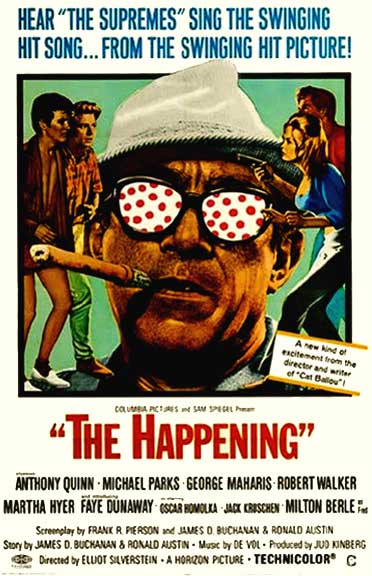
An Offer You Can Refuse #5: The Happening (dir by Elliot Silverstein)


https://www.youtube.com/watch?v=lAupa3dICGs

The 1967 film, The Happening, opens with two “young” people — Sureshot (Michael Parks) and Sandy (Faye Dunaway) — waking up on a Florida beach.  The previous night, they attended a party so wild that the beach is full of passed out people, one of whom apparently fell asleep while standing on his head.  (It’s a happening!)  From the dialogue, we discover that, despite their impeccably clean-cut appearances, both Sureshot and Sandy are meant to be hippies.

After trying to remember whether or not they “made love” the previous night (wow, how edgy!), Sandy and Sureshot attempt to find their way off of the beach.  As they walk along, they’re joined by two other partygoers.  Taurus is played by George Maharis, who was 38 when this film was shot and looked about ten years older.  Taurus is a tough guy who carries a gun and dreams of being a revolutionary and who says stuff like, “Bam!  Et cetera!”  Herbie is eccentric, thin, and neurotic and, presumably because Roddy McDowall wanted too much money, he’s played by Robert Walker, Jr.

Anyway, the four of them end up stealing a boat and talking about how life is a drag, man.  Eventually, they end up breaking into a mansion and threatening the owner and his wife.  Since this movie was made before the Manson murders, this is all played for laughs.  The owner of the mansion is Roc Delmonico (Anthony Quinn).  Roc used to be a gangster but now he’s a legitimate businessman.  The “hippies” decide to kidnap Roc because they assume they’ll be able to get a lot of money for him.

The only problem is that no one is willing to pay the ransom!

Not Roc’s wife (Martha Hyer)!

Not Roc’s best friend (Milton Berle), who happens to be sleeping with Roc’s wife!

Not Roc’s former mob boss (Oscar Homolka)!

Roc gets so angry when he find out that no one wants to pay that he decides to take control of the kidnapping,  He announces that he knows secrets about everyone who refused to pay any money for him and unless they do pay the ransom, he’s going to reveal them.  We’ve gone from kidnapping to blackmail.

Along the way, Roc bonds with his kidnappers.  He teaches them how to commit crimes and they teach him how to be anti-establishment or something.  Actually, I’m not sure what they were supposed to have taught him.  The Happening is a comedy that I guess was trying to say something about the divide between the young and the middle-aged but it doesn’t really have much of a message beyond that the middle-aged could stand to laugh a little more and that the young are just silly and kind of useless.  Of course, the whole young/old divide would probably work better if all of the young hippies weren’t played by actors who were all either in their 30 or close enough to 30 to make their dorm room angst seem a bit silly.

It’s an odd film.  The tone is all over the place and everyone seems to be acting in a different movie.  Anthony Quinn actually gives a pretty good dramatic performance but his good performance only serves to highlight how miscast almost everyone else in the film is.  Michael Parks comes across like he would rather be beating up hippies than hanging out with them while Faye Dunaway seems to be bored with the entire film.  George Maharis, meanwhile, goes overboard on the Brando impersonation while Robert Walker, Jr. seems like he just needs someone to tell him to calm down.

But even beyond the weird mix of acting style, the film’s message is a mess.  On the one hand, the “hippies” are presented as being right about the establishment being full of hypocritical phonies.  On the other hand, the establishment is proven to be correct about the “hippies” being a bunch of easily distracted idiots.  This is one of those films that wants to have it both ways, kind of like an old episode of Saved By The Bell where Mr. Belding learns to loosen up while Zack learns to respect authority.  This is an offer that you can refuse.

And that’s what’s happening!

Previous Offers You Can’t (or Can) Refuse:

  1. The Public Enemy
  2. Scarface
  3. The Purple Gang
  4. The Gang That Could’t Shoot Straight

Cinemax Friday: Stranger By Night (1994, directed by Gregory Brown a.k.a. Gregory Hippolyte a.k.a. Gregory Dark)


Detective Bobby Corcoran (Steven Bauer!) is a cop with an anger problem.  Whenever he and his parter, Troy Rooney (William Katt!!), catch a criminal, Bobby just loses control.  Since, for some reason, they seem to catch a lot of criminals on rooftops, this often leads to Bobby threatening to throw someone over the edge.  Even when his boss, Detective Larson (Michael Parks!!!) tells Bobby to stop trying to kill all of the suspects, Bobby still struggles to control his rage.  He’s seeing a Dr. Anne Richmond (Jennifer Rubin!!!!), a psychiatrist, about his anger issues but since their sessions usually get interrupted by bouts of soft-core, saxophone-scored sex, it is debatable how much time they actually spend digging into the roots of Bobby’s problems.

Bobby also suffers from frequent blackouts.  While he’s unconscious, he’s haunted by black-and-white memories of his abusive father (J.J. Johnston) beating up his mother.  When he wakes up, he’s often in a different room from where he blacked out.  Anne says that Bobby must be sleep-walking.  Bobby says that he’s not sleep walking because he’s stubborn and doesn’t feel safe letting anyone into his mind.  Lately, whenever Bobby passes out, a prostitute ends up dead.  An unknown killer is stalking them and chopping off their ears.  Bobby, with his anger issues and his dislike of prostitutes, is an obvious suspect.  Is Bobby the killer or is he being framed?

Stranger By Night‘s credited director is Gregory Brown, who is better known as Gregory Dark.  Dark is one of the best-known of the directors who specialized in erotic thrillers in the 90s.  Dark was responsible for some of the classics of the genre but, unfortunately, Stranger By Night is not one of his better efforts.  The action frequently drags and, with the exception of Bobby’s black-and-white flashbacks, Stranger By Night has none of Dark’s usual visual style.  The film looks and feels flat and the plot is never feels as involving as it should.  The discovery of the killer’s identity inspires not shock but an indifferent shrug.

On the positive side, it’s got a cast of skilled genre vets and all of them do what they can to elevate the material.  William Katt is jittery and frequently funny while Jennifer Rubin, who deserved to have a much bigger career, is as sultry as ever.  (Rubin brought both intelligence and sex appeal to almost every role that she played and it made her one of the best genre actresses around.)  Steven Bauer, another actor who probably deserves a bigger career than he’s had, does a good job in the lead role.  Bobby isn’t always a likable character and Bauer doesn’t try to make him one.  On the other hand, it’s frustrating that Michael Parks does not get to do much, other than frown.  There’s nothing more frustrating than watching a film that doesn’t take full advantage of the casting of Michael Parks.

Stranger By Night does seem to have a serious subtext.  It tries to deal seriously with how Bobby’s abusive childhood has scarred him and there’s a lengthy scene where Bobby finally talks to his aged father.  The scene is played straight and it’s not the sort of thing that you’d normally expect to see in a direct-to-video erotic thriller.  (It’s a good example of what set Gregory Dark apart from some of the other directors churning out these type of films in the 90s.)  For the most part, though, Stranger By Night is a forgettable trip to the world of late night Cinemax.