Film Review: No Highway In The Sky (dir by Henry Koster)


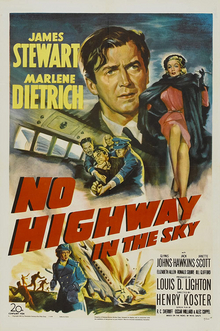
In 1951’s No Highway In The Sky, James Stewart stars as Dr. Theodore Honey.

In many ways, Theodore Honey is similar to the other roles that Stewart played after he returned from serving in World War II.  Dr. Honey is intelligent, plain-spoken, and good-hearted.  He’s eccentric and he sometimes has a difficult time relating to other people.  He’s also deeply troubled.  Dr. Honey is an engineer, one who specializes in determining how many hours an airplane can fly before it starts to fall apart.  Dr. Honey is in England, working for an airline and testing his hypothesis that their newest model’s tail will fall off after the plane accumulates a specific number of hours.  As is usually the case with these things, Dr. Honey’s employers are skeptical about his claims.  There’s a lot of money to be made in air travel and the last thing they need is some eccentric American scaring everyone.

When Honey sets out to investigate a recent crash site, he finds himself on the same type of airplane that he’s been testing.  After the plane takes off, Dr. Honey talks to the pilots and discovers, to his horror, that the plane is closing in on the time limit.  While flight attendant Marjorie Corder (Glynis Johns) tries to keep him calm, Dr. Honey explains his theory to a film star named Monica Teasdale (Marlene Dietrich), who just happens to be a passenger on the flight.  Both Marjorie and Monica find themselves falling in love with Dr. Honey and who can blame them?  He may be an eccentric and it may be hard to follow what he’s talking about but he’s still Jimmy Stewart!

I’ve often thought that Stewart was “Jimmy” before World War II but he was definitely James afterwards.  Stewart, unlike a lot of Hollywood stars who enlisted and were then used solely for PR purposes, actually flew several combat missions and saw firsthand the devastation of the war.  He returned to America deeply disturbed by what he had seen and there’s a definite sense of melancholy to be found in all of Stewart’s post-war performances.  That’s certainly the case here.  Dr. Honey is a widower, his wife having been killed by a rocket attack during the war.  He’s raising his 12 year-old daughter on his own and he deals with his sadness by throwing himself into his work.  He’s someone who has seen and experienced great tragedy firsthand and it’s left him more than a little obsessed. There’s a very authentic sadness at the heart of Stewart’s performance and it elevates this film, making what could have been a by-the-book corporate thriller into a character study of a man standing at the dawning of a new age, the post-war era of commercial air travel, and saying, “Well, hold on one minute.”

Unfortunately, Honey’s obsessive nature makes it easy for some to dismiss him.  When Dr. Honey purposefully sabotages the plane to keep it from flying again, he finds himself forced to defend his actions.  Can he prove that his theory is true?  And who will he end up falling in love with?  You can probably guess the answers but it doesn’t matter if the latter half of the film is a bit predictable.  James Stewart’s performance carries the film and keeps you watching.
The Unnominated #15: Touch of Evil (dir by Orson Welles)


Though the Academy of Motion Picture Arts and Sciences claim that the Oscars honor the best of the year, we all know that there are always worthy films and performances that end up getting overlooked.  Sometimes, it’s because the competition too fierce.  Sometimes, it’s because the film itself was too controversial.  Often, it’s just a case of a film’s quality not being fully recognized until years after its initial released.  This series of reviews takes a look at the films and performances that should have been nominated but were, for whatever reason, overlooked.  These are the Unnominated.

I come here to defend Charlton Heston.

1994’s Ed Wood is a great film that has one unfortunate line.  Towards the end of the film, director Ed Wood (Johnny Depp) meets his hero, Orson Welles (Vincent D’Onoforio), in a bar.  They talk about the difficulties of directing a film.  Wood talks about the trouble that he’s having with Plan 9 From Outer Space.  Welles says that he can understand what Wood is going through because the studio is forcing him to cast Charlton Heston as a Mexican in his next movie.

And look, I get it.  It is true that Charlton Heston does play a Mexican prosecutor named Mike Vargas in Welles’s 1958 film, Touch of Evil.  And it is true that Heston is not the most convincing Mexican to ever appear in a film.  And I understand that there are people who enjoy taking cheap shots at Charlton Heston because he did have a tendency to come across as being a bit full of himself and he was a conservative in a industry dominated by Leftists. There are people who actually think Michael Moore doesn’t come across like a self-righteous prick when he confronts Heaton in Bowling for Columbine.  I get the joke.

But it’s not true and it’s not fair.  When Touch of Evil was first put into production by Universal, Welles was not hired to direct.  He was hired to play Hank Quinlan, the formerly honest cop with a habit of planting evidence on those who he believed to be guilty.  When Charlton Heston was offered the role of Vargas, he asked who had been hired to direct.  When he was told that a director hadn’t been selected, Heston was the one who suggested Welles be given the job.  When, as often happened with Welles’s film, the studio decided to take the film out of Welles’s hands, Heston argued for Welles’s vision while Welles was off trying to set up his long-dreamed of film of Don Quixote.  Say what you will about Charlton Heston’s career, he fought for Orson Welles, just as he later fought for Sam Peckinpah during the making of Major Dundee.  Heston may not have agreed with either Welles or Peckinpah politically but he fought for them when few people were willing to do so.

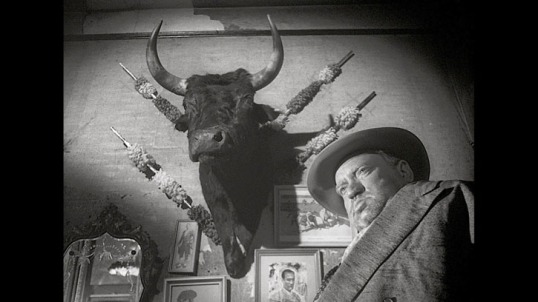
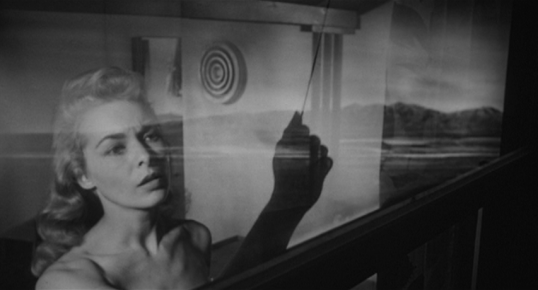
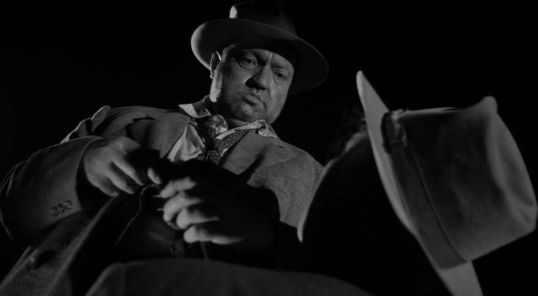
That Touch of Evil is a brilliant film is pretty much entirely due to Welles’s directorial vision.  The story is pure pulp.  While investigating the murder of an American businessman in Mexico, Vargas comes to believe that Quinlan is attempting to frame a young Mexican for the crime.  While Vargas watches Quinlan, his wife Susie (Janet Leigh) is menaced by the crime lord Joe Grandi (Akim Tamiroff), who has his own issues with both Vargas and Quinlan.  The plot may be the stuff of a B-programmer but, as directed by Welles, Touch of Evil plays out like a surreal nightmare, a journey into the heart of darkness that is full of eccentric characters, shadowy images, memorably askew camera angles, and lively dialogue.  Welles and cinematographer Russell Metty create a world that feels alien despite being familiar.  Just as he did with Gregg Toland in Citizen Kane, Welles shapes a film that shows us what’s happening in the shadows that most people try to ignore.

There’s really not a boring character to be found in Touch of Evil and the cast is full of old colleagues and friends of Welles.  Marlene Dietrich shows up as Quinlan’s former lover.  Mercedes McCambridge plays a leather-clad gang leader.  Dennis Weaver is the creepy owner of a remote motel.  (Two years before Psycho, Touch of Evil featured Janet Leigh being menaced in a motel.  Mort Mills, who played Psycho’s frightening highway patrolman, plays a member of law enforcement here as well.)  Zsa Zsa Gabor shows up for a few brief seconds and it makes a strange sort of sense.  Why shouldn’t she be here?  Everyone else is.  Joseph Cotten plays a coroner.  Ray Collins plays a local official.   In the film’s skewered world, Charlton Heston as Mike Vargas works.  His upright performance grounds this film and keeps it from getting buried in its own idiosyncrasies.   Big personalites are everywhere and yet the film is stolen by Joseph Calleia, playing Quinlan’s quiet but observant partner.  Calleia’s performance is the heart of the film.

Touch of Evil was not nominated for a single Oscar and that’s not surprising.  It’s not really the type of film that was noticed by the Academy in the 50s.  It was too pulpy and surreal and, with its story of a crooked cop framing someone who might very well be guilty anyway, it was probably too subversive for the Academy of the 1950s.  It would take a while for Touch of Evil to be recognized for being the noir masterpiece that it is.  In a perfect world, Welles would have been nominated for directing and for his larger-than-life performance as Quinlan.  Joseph Calleia would have been nominated for Supporting Actor and perhaps both Janet Leigh and Marlene Dietrtich would have been mentioned for Supporting Actress.  That didn’t happen but it would have been nice if it had.

Previous entries in The Unnominated:

  1. Auto Focus 
  2. Star 80
  3. Monty Python and The Holy Grail
  4. Johnny Got His Gun
  5. Saint Jack
  6. Office Space
  7. Play Misty For Me
  8. The Long Riders
  9. Mean Streets
  10. The Long Goodbye
  11. The General
  12. Tombstone
  13. Heat
  14. Kansas City Bomber

10 Oscar Snubs From The 1930s


Ah, the 1930s. America was mired in the Great Depression. FDR was plotting to pack the courts.  The American public, sick of playing by the rules and getting little in return, began to admire gangsters and outlaws.  The horror genre became the new way to vent about societal insecurity. In Europe, leaders were trying to ignore what was happening in Italy, Spain, and Germany. As for the Academy, it was still growing and developing and finding itself. With people flocking to the movies and the promise of an escape from reality, the Academy Awards went from being an afterthought to a major cultural event.

And, of course, the snubs continued.

1930 — 1931: Crime Doesn’t Pay For Little Caesar and The Public Enemy 

When people think about the 1930s, gangsters are probably one of the first things that come to mind.  In the 30s, audiences flocked to movies about tough and streetwise criminals who did what they had to do in order to survive during the Depression.  Unfortunately, the Academy was not always as quick to embrace the gangster genre.  Though The Public Enemy did pick up a nomination for its screenplay, both it and Little Caesar were largely ignored by the Academy.  Not only did the films fail to score nominations for Best Picture but neither James Cagney nor Edward G. Robinson would be nominated for bringing their title characters to life.  It’s a crime, I tells ya.

1930 — 1931: Bela Lugosi Is Not Nominated For Best Actor For Dracula

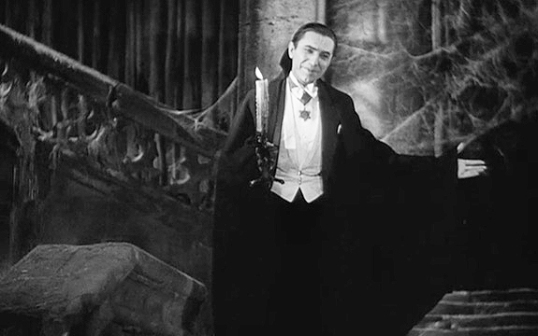
Admittedly, the 1931 version of Dracula is a bit of a creaky affair, one that feels quite stagey to modern audiences.  But Bela Lugosi’s performance in the title role holds up well, despite the number of times that it has been parodied.  Unfortunately, from the start, the Academy was hesitant about honoring the horror genre.

Frankenstein (1931, dir by James Whale)

1931 — 1932: Boris Karloff Is Not Nominated For Best Actor For Frankenstein

Again, the Academy snubbed an iconic horror star.  Not only was Boris Karloff not nominated for Frankenstein but the film itself was not nominated for Best Picture, despite being infinitely better than at least one of the 8 films that were nominated.  (That film, by the way, was Bad Girl.  When is the last time that anyone watched that one?)  In fairness to the Academy, they did honor one horror film at that year’s awards.  Fredric March won Best Actor for Dr. Jekyll and Mr. Hyde.  Of course, he also tied with Wallace Beery, who was nominated for The Champ.  Obviously, the Academy still had to work out its feelings towards the horror genre, a process that continues to this very day.

1932 — 1933: King Kong Is Not Nominated For Best Picture

Oh, poor King Kong.  Film audiences loved him but the Academy totally ignored both him and his film.  Unfortunately, back in 1933, the Academy had yet to introduce a category for special effects.

1932 — 1933: Duck Soup Is Ignored By The Academy

King Kong was not the only worthy film to be ignored at the 1932-1933 Oscars.  The Marx Brothers’s greatest film also went unnominated.

1934: The Scarlet Empress Is Not Nominated For Best Picture

Josef von Sternberg’s surreal historical epic was totally ignored by the Academy.  Not only did it miss out on being nominated for Best Picture but the sterling work of Marlene Dietrich and Sam Jaffe was ignored as well.  How was the opulent set design ignored?  How did it not even pick up a nomination for costume design?  My guess is that Paramount chose to promote Cleopatra at expense of The Scarlet Empress.  Either the way, the Best Picture Oscar was won by one of my favorite films, It Happened One Night.

1935: Fred Astaire and Ginger Rogers Are Not Nominated For Top Hat

Top Hat scored a best picture nomination but the film’s two stars went unnominated.

1936: My Man Godfrey Is Nominated For Everything But Best Picture

My Man Godfrey, a classic screwball comedy, was nominated for Best Actor, Best Actress, Best Supporting Actor, Best Supporting Actress, Best Director, and Best Screenplay but somehow, it was not nominated for Best Picture.  It’s a shame because My Man Godfrey, along being a very funny movie, is also a film that epitomizes an era.  Certainly, it’s far more entertaining today than the film that won Best Picture that year, The Great Ziegfeld.  (Interestingly enough, William Powell played the title role in both Godfrey and Ziegfeld.)

1937: Humphrey Bogart Is Not Nominated For Best Supporting Actor in Dead End

Dead End featured one of Bogart’s best gangster roles.  As a gangster who returns to his old neighborhood and is rejected by his own mother, Bogart was both menacing and, at times, sympathetic.  Like Cagney and Robinson, Bogart definitely deserved a nomination for his portrayal of what it was like to live a life of crime.  Unfortunately, Bogart was an actor who was taken for granted for much of his career.  It wasn’t until he played Rick Blaine in Casablanca that the Academy would finally nominate him.

The Adventures of Robin Hood (1938, dir by Michael Curtiz)

1938: Errol Flynn Is Not Nominated For Best Actor In The Adventures of Robin Hood

This is truly one of the more shocking snubs in Academy history.  Errol Flynn’s performance as Robin Hood pretty much set the standard for every actor who followed him.  Russell Crowe is undoubtedly a better actor than Flynn was but Crowe’s dour interpretation of Robin could in no way compete with the joie de vivre that Flynn brought to the role.

Agree?  Disagree?  Do you have an Oscar snub that you think is even worse than the 10 listed here?  Let us know in the comments!

Up next: 1940s, in which Hollywood joins the war effort and the snubs continue!

Dead End (1937, dir by William Wyler)

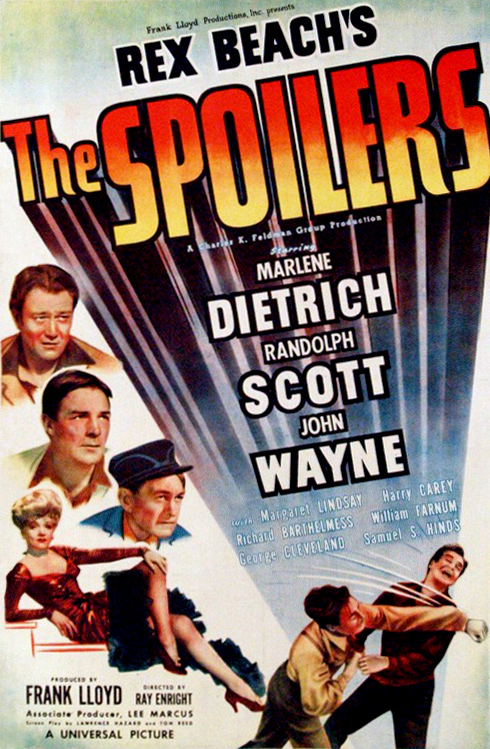
Yukon Gold: THE SPOILERS (Universal 1942)


gary loggins's avatarcracked rear viewer

What’s this?? A “Northern” Western set in 1900 Alaska Gold Rush territory starring my two favorite cowboys, John Wayne and Randolph Scott ? With the ever-enticing Marlene Dietrich thrown in as a sexy saloon owner? Count me in! THE SPOILERS is a big, brawling, boisterous film loaded with romance, action, and, most importantly,  a sense of humor. It’s the kind of Hollywood entertainment epic that, as they say, “just don’t make ’em like that anymore”. I’ve never been quite sure who “they” are, but in regards to THE SPOILERS, they’re right – and more’s the pity!

Rex Beach’s popular 1906 novel had been filmed three times before (1914, 1923, 1930), and would be one more time after (in 1955), but with The Duke, Rugged Randy, and La Dietrich on board, this has got to be the best of the bunch. Even though audiences were more than familiar with the story…

View original post 697 more words

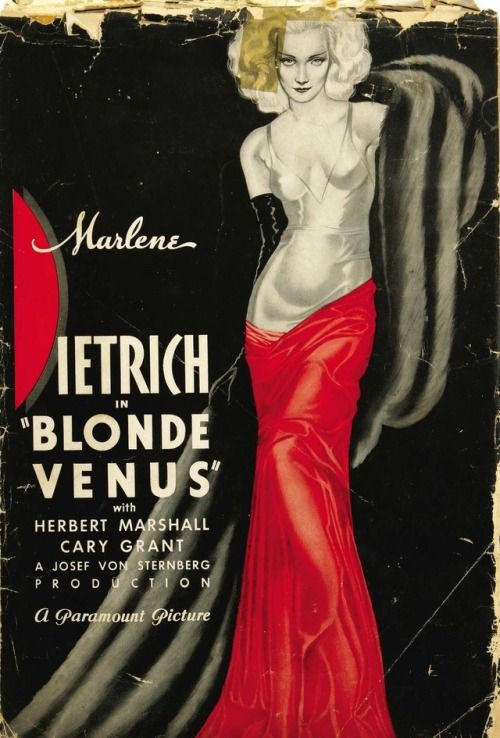
Pre Code Confidential #23: Marlene Dietrich in BLONDE VENUS (Paramount 1932)


gary loggins's avatarcracked rear viewer

Director Josef von Sternberg and his marvelous muse Marlene Dietrich  teamed for their fifth film together with BLONDE VENUS, a deliciously decadent soap opera that’s a whole lot of fun for Pre-Code lovers. Sternberg indulges his Marlene fetish by exploring both sides of her personality, as both Madonna and whore, and Dietrich plays it to the hilt in a film that no censor would dare let pass just a scant two years later.

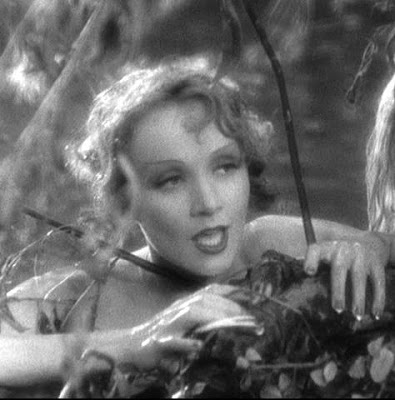
How’s this for an opening: a group of schoolboys hiking through the Black Forest stumble upon a bevy of naked stage chanteuses taking a swim! The girls scream and try to hide, and beautiful Helen (Marlene) tries to shoo them away. Ned Faraday refuses until Helen agrees to meet him later. Flash forward to a scene of Helen and Ned now married with a young son named Johnny. Ned, a chemist by trade, has been poisoned by…

View original post 693 more words

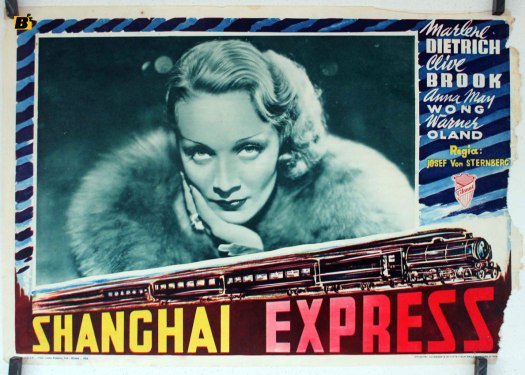
Pre Code Confidential #19: Marlene Dietrich in SHANGHAI EXPRESS (Paramount 1932)


gary loggins's avatarcracked rear viewer

Marlene Dietrich is TCM’S Star of the Month for May, and “Shanghai Express” airs tonight at 12:00 midnight EST. 

A train ride from Peking to Shanghai is fraught with danger and romance in Josef von Sternberg’s SHANGHAI EXPRESS, a whirlwind of a movie starring that Teutonic whirlwind herself, Marlene Dietrich. This was the fourth of their seven collaborations together, and their biggest hit, nominated for three Oscars and winning for Lee Garmes’s striking black and white cinematography.

The Director and his Muse

Dietrich became a huge sensation as the sultry seductress Lola Lola in Sternberg’s 1930 German film THE BLUE ANGEL, and the pair headed to America to work for Paramount. Marlene became the autocratic director’s muse, as he molded her screen image into a glamorous object of lust and desire. Sternberg’s Expressionistic painting of light and shadows, aided by Dietrich’s innate sexuality, turned the former chorus girl and cabaret…

View original post 551 more words

Lisa Reviews An Oscar Nominee: Shanghai Express (dir by Josef von Sternberg)


(With the Oscars scheduled to be awarded on March 4th, I have decided to review at least one Oscar-nominated film a day.  These films could be nominees or they could be winners.  They could be from this year’s Oscars or they could be a previous year’s nominee!  We’ll see how things play out.  Today, I take a look at the 1932 best picture nominee, Shanghai Express!)

Welcome to China, circa 1931.  The country is beautiful, mysterious, and dangerous.  Civil War has broken out and living in China means being caught between two equally brutal forces, the government and the Communists.  Captain Doc Harvey (Clive Brook) is scheduled to ride the so-called Shangai Express, the train that will take him from Beiping to Shanghai.  The Governor-General is ill and Doc Harvey is the only man in China who operate on him.

For Doc, it’s a matter of duty.  However, soon after boarding, he discovers that he is traveling with the infamous Shanghai Lily (Marlene Dietrich).  Though Doc has never heard of her, everyone assures him that Shanghai Lily is one of the greatest courtesans in China.   When Doc does finally meet her, he’s shocked to discover that Shanghai Lily is his former lover, Magdalen.  Did his decision to break up with her lead to Magdalen becoming a courtesan?

“It took more than one man to change my name to Shanghai Lily,” she replies.

However, Doc and Lily aren’t the only two people with their own personal drama taking place on the train.  The train is full of passengers, all of whom have their secrets.  Some of the secrets are minor.  One woman spends most of the trip trying to keep anyone from discovering that she’s smuggled her dog onto the train.  Other secrets are major.  It is suspected that one of the passengers might be working for the rebels.  And then there’s people like Sam Salt (Eugene Pallette), who is addicted to gambling and Eric (Gustav von Syffertitz), the opium dealer.  Looking over it all is a Christian missionary (Lawrence Grant) who considers both Lily and her companion, Hui Fey (Anna May Wong), to be fallen women.

It’s not an easy journey, no matter how nice and romantic the train may be.  If the express isn’t being stopped by government soldiers, it’s being hijacked by a warlord who not only wants to stop Doc from performing the operation but who also wants to take Lily back to his palace…

Shanghai Express is pre-code drama at its best.  Director Josef von Sternberg delivers an ornate mix of opulence and melodrama, never shying away from the story’s more flamboyant possibilities.  Marlene Dietrich, appearing in her fourth film for von Sternberg, gives a strong and unapologetic performance as Shanghai Lily.  Just as Lily never apologizes for who she is, the film both refuses to judge her and condemns anyone who would try.  The film’s sympathy is purely with Dietrich and Wong as they do what they must to survive in a world dominated by men who are either judgmental, brutish, or weak.  (Within just a few years, the Hays Code would make it impossible for a film like Shanghai Express to be made by an American studio.)  With one very important exception, the entire cast is strong, with Warner Oland and Eugene Pallette especially turning in strong support.  The only exception is Clive Brook, who comes across as being a bit too dull to have ever won the the heart of Shanghai Lily.

Shanghai Express is not the best von Sternberg/Dietrich collaboration.  That would be the brilliantly insane Scarlet Empress.  However, it’s still a wonderfully entertaining melodrama.  It was nominated for best picture but lost to another entertaining melodrama, Grand Hotel.

http://www.youtube.com/watch?v=F3Qljls-FkI

Cleaning Out The DVR #5: Around The World In 80 Days (dir by Michael Anderson)


Last night, as a part of my effort to clean out my DVR by watching and reviewing 38 movies in 10 days, I watched the 1956 Best Picture winner, Around The World In 80 Days.

Based on a novel by Jules Verne, Around The World In 80 Days announces, from the start, that it’s going to be a spectacle.  Before it even begins telling its story, it gives us a lengthy prologue in which Edward R. Murrow discusses the importance of the movies and Jules Verne.  He also shows and narrates footage from Georges Méliès’s A Trip To The Moon.  Seen today, the most interesting thing about the prologue (outside of A Trip To The Moon) is the fact that Edward R. Murrow comes across as being such a pompous windbag.  Take that, Goodnight and Good Luck.

Once we finally get done with Murrow assuring us that we’re about to see something incredibly important, we get down to the actual film.  In 1872, an English gentleman named Phileas Fogg (played by David Niven) goes to London’s Reform Club and announces that he can circumnavigate the globe in 80 days.  Four other members of the club bet him 20,000 pounds that he cannot.  Fogg takes them up on their wager and soon, he and his valet, Passepartout (Cantinflas) are racing across the world.

Around The World in 80 Days is basically a travelogue, following Fogg and Passepartout as they stop in various countries and have various Technicolor adventures.  If you’re looking for a serious examination of different cultures, this is not the film to watch.  Despite the pompousness of Murrow’s introduction, this is a pure adventure film and not meant to be taken as much more than pure entertainment.  When Fogg and Passepartout land in Spain, it means flamenco dancing and bullfighting.  When they travel to the U.S., it means cowboys and Indians.  When they stop off in India, it means that they have to rescue Princess Aouda (Shirley MacClaine!!!) from being sacrificed.  Aouda ends up joining them for the rest of their journey.

Also following them is Insepctor Fix (Robert Newton), who is convinced that Fogg is a bank robber.  Fix follows them across the world, just waiting for his chance to arrest Fogg and disrupt his race across the globe.

But it’s not just Inspector Fix who is on the look out for the world travelers.  Around The World In 80 Days is full of cameos, with every valet, sailor, policeman, and innocent bystander played by a celebrity.  (If the movie were made today, Kim Kardashian and Chelsea Handler would show up at the bullfight.)  I watch a lot of old movies so I recognized some of the star cameos.  For instance, it was impossible not to notice Marlene Dietrich hanging out in the old west saloon, Frank Sinatra playing piano or Peter Lorre wandering around the cruise ship.  But I have to admit that I missed quite a few of the cameos, much as how a viewer 60 years in the future probably wouldn’t recognize Kim K or Chelsea Handler in our hypothetical 2016 remake.  However, I could tell whenever someone famous showed up on screen because the camera would often linger on them and the celeb would often look straight at the audience with a “It’s me!” look on their face.

Around The World in 80 Days is usually dismissed as one of the lesser best picture winners and it’s true that it is an extremely long movie, one which doesn’t necessarily add up to much beyond David Niven, Cantinflas, and the celeb cameos.  But, while it may not be Oscar worthy, it is a likable movie.  David Niven is always fun to watch and he and Cantinflas have a nice rapport.  Shirley MacClaine is not exactly believable as an Indian princess but it’s still interesting to see her when she was young and just starting her film career.

Add to that, Around The World In 80 Days features Jose Greco in this scene:

Around The World In 80 Days may not rank with the greatest films ever made but it’s still an entertaining artifact of its time.  Whenever you sit through one of today’s multi-billion dollar cinematic spectacles, remember that you’re watching one of the descendants of Around The World In 80 Days.

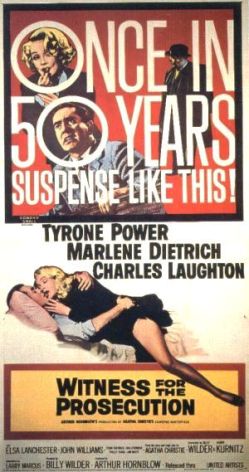
Lisa Watches an Oscar Nominee: Witness for the Prosecution (dir by Billy Wilder)


Movie_poster_for_-Witness_for_the_Prosecution-

Earlier today, I DVRed the 1957 best picture nominee, Witness for the Prosecution, off of TCM.  I watched the film as soon as I finished dinner and, having now seen Witness for the Prosecution, I am prepared to give you my professional and erudite review.

Okay, are you ready for it?  Here we go:

🙂 Oh my God, I freaking love this movie!!!!!!!!! 🙂

Witness for the Prosecution is many things.  It’s a courtroom drama.  It’s a domestic comedy.  It’s a twisty murder mystery.  It’s a showcase for three great performers.  It’s crowd pleaser that will make you think and, even if it does involve people killing each other, it will probably make you smile as well.  Don’t let that 1957 date fool you.  Witness For the Prosecution is a lot of fun.

Leonard Vole (Tyrone Power) is a somewhat sleazy man who has two claims to fame.  One is that he claims to be responsible for inventing the egg beater.  The other is that he’s been accused of murdering Mrs. French (Norma Varden), a wealthy widow who had recently named Leonard as the beneficiary of her will.  Everyone assumes that Leonard must have been having an affair with Mrs. French but Leonard claims that he’s innocent.

Suspecting that he is soon going to be arrested, Leonard hires Sir Wilfred Robarts (Charles Laughton) to serve as his attorney.  Though Sir Wilfred is recovering from a heart attack and has been ordered to not take on any more stressful criminal cases, he agrees to defend Leonard.  He proceeds to do just that, under the watchful eye of his nurse, the protective Mrs. Plimsoll (Elsa Lanchester).

(The testy relationship between Sir Wilfred and Mrs. Plimsoll provides the film with its comedic relief.  Laughton and Lanchester were married in real life and, watching the film, you can tell that they had a lot of fun acting opposite each other.)

Sir Wilfred is convinced that he can win acquittal for Leonard, especially since Leonard’s German wife, Christine (Marlene Dietrich), is willing to provide an alibi for him.  (In one of the film’s best moments, Sir Wilfred talks about how distraught Christine will be to discover that Leonard has been arrested just to then have the very calm and self-possessed Christine step into the room.)  However, to everyone’s shock, Christine is called as a witness for the prosecution.  She testifies that Leonard confessed the murder to her and that she only provided an alibi out of fear and love.

Things aren’t looking good for Leonard but then, a mysterious woman with a cockney accent contacts Sir Wilfred and reveals that Christine may have had reasons of her own for not giving Leonard an alibi…

Witness For The Prosecution ends with a voice over that says, “The management of this theater suggests that for the greater entertainment of your friends who have not yet seen the picture, you will not divulge, to anyone, the secret of the ending of Witness for the Prosecution.”  And I have to say that, when I heard that, it just made me love the film even more.  I had enjoyed the film so much and had so much fun following all the twists and the turns of the mystery that I found myself nodding in agreement.

“Sure, 58 year-old voice over,” I said, “I will not divulge the secret ending of Witness For The Prosecution.”

And I’m not going to!  Though, to be honest, you’ll probably guess the secret before it’s revealed.  It’s a plot twist that has been imitated by so many other courtroom dramas that it’s probably not as much of a mind-blower today as it may have been back in 1957.

But no matter!  Witness For The Prosecution is still a lot of fun.  Even if you figure out the mystery early, you can still watch the film and enjoy Laughton’s wonderfully theatrical performance.

Witness for the Prosecution was nominated for best picture and, interestingly enough, another theatrical courtroom drama — 12 Angry Men — was also nominated that year.  It’s interesting to compare the low-key drama of 12 Angry Men to the cheerful flamboyance of Witness For The Prosecution.  They are both great films about the law but each is told from a very different perspective.

Of course, in the end, both of these great films ended up losing to The Bridge On The River Kwai.

Film Review: Judgment At Nuremberg (dir by Stanley Kramer)


I previously posted a review of the 1967 best picture nominee Guess Who’s Coming To Dinner that was somewhat critical of Stanley Kramer as a filmmaker.  In retrospect, I feel like I may have been a bit too dismissive of Stanley Kramer.  When one looks over the list of every film that has ever been nominated for best picture, one comes across the name Stanley Kramer (as a producer, a director, or both) far too many times to just blindly dismiss him for the sin of being old-fashioned.  While Kramer made his share of well-intentioned misfires like Guess Who’s Coming To Dinner, he was also responsible for some films that remain important and watchable today.  Judgment at Nuremberg is one of those films.

Judgment at Nuremberg opens in 1947, with one car being driven through the ruins of Nuremberg, Germany.  Inside the car is Dan Haywood (Spencer Tracy), a judge from Maine who has been appointed chief of a military tribunal that will be passing judgment on four German judges who are accused of crimes against humanity for their legal rulings during the Nazi regime.  As Haywood quickly learns,  many people don’t feel that the Nazi judges should be held as accountable for their actions as men like Hitler, Goebbles, and Goering should have been.  It’s up to Haywood to determine whether the accused were simply doing their job or if they had a responsibility to defy the laws that they had sworn to uphold.

Judgment at Nuremberg almost feels like two films.  The first film is a courtroom drama, where the Nazi judges (the main one of which is played by Burt Lancaster) are prosecuted by the fiery Col. Tad Lawson (Richard Widmark) and defended by the idealistic Hans Rolfe (Maximilian Schell).  While Lawson approaches the case and regards the defendants with righteous anger, Rolfe takes a more cerebral approach to defending the undefensible.  Rolfe argues that the judges were following the laws of Germany and that if the tribunal finds them guilty than it will be finding the entire nation of Germany guilty.  (In a rather clever twist, director Kramer and screenwriter Abby Mann initially make the German defense attorney a far more likable character than the American prosecutor.)  During the trial, we also hear heart-wrenching testimony from two people (played by Montgomery Clift and Judy Garland) who were victimized by the Nazi regime and the judges who gave legal legitimacy to the regime’s crimes.

The second film deals with Haywood adjusting to working in Germany and trying to understand how the Nazis could have come to power in the first place.   Haywood asks several Germans to tell him about life under the Nazis and every time, he is met with bland excuses.  (“We were not political,” he is told more than once.)  The film’s strongest scenes are the ones where Haywood simply walks alone through the ruins of Nuremberg.  Spencer Tracy was a uniquely American actor and, much as he did in Guess Who’s Coming To Dinner, Tracy here stood in for every American who was struggling to make sense of a changing world.

In his book Pictures At A Revolution, Mark Harris correctly points out that Stanley Kramer started out as a producer and, even after he started directing, he still approached filmmaking like a producer.  While that approach led to many uninspiring films, it was also the right approach for Judgment at Nuremberg.  Perhaps realizing that Judgment at Nuremberg was a long and talky movie about a disturbing subject manner, Kramer made the very producer-like decision to fill Judgment at Nuremberg with recognizable faces.  While this approach has proven disastrous for many films, it works quite well in Judgment at Nuremberg.

This is one of the most perfectly cast films of all time, with all of the actors bringing both their characters and the issues that they’re confronting to vivid life.  As the main defendant, Burt Lancaster brings a combination of intelligence and self-loathing to his role, playing him in such a way to reveal that even he can’t believe the evil he upheld as a judge.  Meanwhile, Spencer Tracy is perfectly cast as a world-weary man who is simply trying to figure out what justice means in the post-war world.  Maximilian Schell plays his role with so much passion that it’s impossible not to listen to him even when you despise the argument he’s making.  Marlene Dietrich has an extended cameo where she plays the widow of Nazi general who befriends Judge Haywood but still refuses to admit that she knew anything about what Adolf Hitler was doing.  Even William Shatner shows up, playing a small role as Haywood’s chief military aide and yes, he does deliver his lines in that Shatner way of his.

First released in 1962, Judgment at Nuremberg won Oscars for Best Actor (Maximilian Schell) and Best Adapted Screenplay (Abby Mann) and was nominated for 9 more: Best Picture, Best Director, Best Actor (Spencer Tracy), Best Supporting Actor (Montgomery Clift), Best Supporting Actress (Judy Garland), Best Black-and-White Art Direction, Best Black-and-White Cinematography, Best Black-and-White Costume Design, and Best Film Editing. While it’s hard to argue with the victory of West Side Story in that year’s Oscar race, Judgment at Nuremberg remains a watchable and thought-provoking film.