Guilty Pleasure No. 79: Kate’s Secret (dir by Arthur Allan Seidelman)


In this 1986 melodrama, Kate (Meredith Baxter) has a secret.  She may look like healthy and young and blonde.  She may have a beautiful house and a handsome husband (Ben Masters).  She and her fitness instructor best friend (Shari Belafonte) may spend their time making fun of how fat everyone else.  But deep down, Kate is convinced that she’s overweight.  She gets on the scale and that declaration of 120 pounds feels like a slap in the face.

How does Kate lose weight?  She exercises frequently.  And she spends a lot of time staring at herself in the mirror, as if trying to mentally burn away the pounds.  Mostly, though, Kate just binges on food whenever she gets stressed and then she throws up.  Kate has a lot of reasons to be stressed and they are almost entirely due to her mother (Georgann Johnson), who rarely has a nice word to say to Kate and who constantly tells Kate that she’s going to lose her husband to his assistant (Leslie Bevis).

(Who does everyone always assume that assistants are going to be homewreckers?)

Now, to be clear, eating disorders are a serious thing.  I know more than a few people who have had eating disorders.  During my first semester of college, I got very used to the sound of the girl in the room next to mine throwing up every morning.  There’s nothing funny about the idea of someone having an eating disorder.  However, there is something funny about an overwritten movie about an eating disorder that features Meredith Baxter literally attacking a chocolate cake then blaming the mess in the kitchen on the dogs.  This is one of those well-intentioned programs that takes a real problem and then goes so overboard in portraying it that it’s more likely to make you snicker than feel horrified.  You might not feel good about laughing but the crazed look in Meredith Baxter’s cake-filled eyes will make it difficult not to.  Hence, the term guilty pleasure.

As always happens in these type of movies, Kate ends up in a treatment center where a doctor (Edward Asner) tries to reach her and the other patients are all either extremely nice or extremely rude.  Kate’s roommate (Tracy Nelson) is a model with anorexia.  Another patient (Mindy Seeger) harps on Kate’s “perfect life.”  Meanwhile, poor Deyna (Mackenzie Phillips) freaks out when someone moves the garbage can.  It’s all very well-meaning but also very over-written and overacted to the point that, once again, it’s more likely to illicit a guilty laugh than anything else.

In the end, Kate realizes that it’s all her mother’s fault.  That was kind of obvious from the first time her mother told Kate that her husband was obviously planning on leaving her.  “I’m getting better,” Kate says as the credits roll.  Yay, Kate!

Previous Guilty Pleasures

  1. Half-Baked
  2. Save The Last Dance
  3. Every Rose Has Its Thorns
  4. The Jeremy Kyle Show
  5. Invasion USA
  6. The Golden Child
  7. Final Destination 2
  8. Paparazzi
  9. The Principal
  10. The Substitute
  11. Terror In The Family
  12. Pandorum
  13. Lambada
  14. Fear
  15. Cocktail
  16. Keep Off The Grass
  17. Girls, Girls, Girls
  18. Class
  19. Tart
  20. King Kong vs. Godzilla
  21. Hawk the Slayer
  22. Battle Beyond the Stars
  23. Meridian
  24. Walk of Shame
  25. From Justin To Kelly
  26. Project Greenlight
  27. Sex Decoy: Love Stings
  28. Swimfan
  29. On the Line
  30. Wolfen
  31. Hail Caesar!
  32. It’s So Cold In The D
  33. In the Mix
  34. Healed By Grace
  35. Valley of the Dolls
  36. The Legend of Billie Jean
  37. Death Wish
  38. Shipping Wars
  39. Ghost Whisperer
  40. Parking Wars
  41. The Dead Are After Me
  42. Harper’s Island
  43. The Resurrection of Gavin Stone
  44. Paranormal State
  45. Utopia
  46. Bar Rescue
  47. The Powers of Matthew Star
  48. Spiker
  49. Heavenly Bodies
  50. Maid in Manhattan
  51. Rage and Honor
  52. Saved By The Bell 3. 21 “No Hope With Dope”
  53. Happy Gilmore
  54. Solarbabies
  55. The Dawn of Correction
  56. Once You Understand
  57. The Voyeurs 
  58. Robot Jox
  59. Teen Wolf
  60. The Running Man
  61. Double Dragon
  62. Backtrack
  63. Julie and Jack
  64. Karate Warrior
  65. Invaders From Mars
  66. Cloverfield
  67. Aerobicide 
  68. Blood Harvest
  69. Shocking Dark
  70. Face The Truth
  71. Submerged
  72. The Canyons
  73. Days of Thunder
  74. Van Helsing
  75. The Night Comes for Us
  76. Code of Silence
  77. Captain Ron
  78. Armageddon

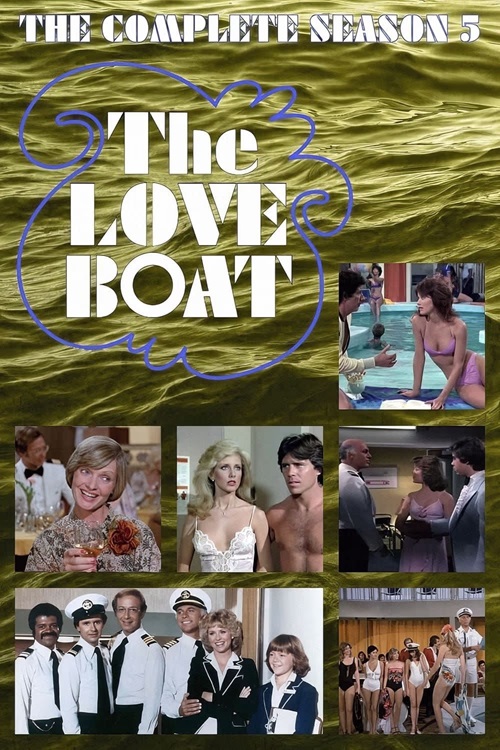
Retro Television Review: The Love Boat 5.15 “I Don’t Play Anymore/Gopher’s Roommate/Crazy For You”


Welcome to Retro Television Reviews, a feature where we review some of our favorite and least favorite shows of the past!  On Wednesdays, I will be reviewing the original Love Boat, which aired on ABC from 1977 to 1986!  The series can be streamed on Paramount Plus!

This week, Gopher thinks that he recognizes a passenger!

Episode 5.15 “I Don’t Play Anymore/Gopher’s Roommate/Crazy For You”

(Dir by Bob Sweeney, originally aired on January 23rd, 1982)

When Rachel (Mackenzie Phillips) boards the ship, Gopher is sure that they’ve met before.  Rachel tells Gopher that he must be mistaken and, in fact, she goes out of her way to avoid him.  Since no one on this ship has ever stopped to consider that getting the cruise line sued would be bad for their career, Gopher continues to follow Rachel around.  Rachel finally tells Gopher the truth.

She does know him.

In fact, they were once quite close.

In college, Rachel was Gopher’s roommate and she played for the football team.  However, after graduating college, she had gender-affirmation surgery and now, she goes by the name of Rachel.  Gopher is stunned and I know what you’re probably thinking.  You’re probably looking at the 1982 air date and assuming that the whole storyline becomes consumed with gay panic as Gopher grapples with having been attracted to his former roommate.  (Doc also hits on her but then again, Doc hits on anyone.)  Well, believe it or not, The Love Boat handles this storyline with a surprising amount of sensitivity.  Yes, Gopher is stunned at first.  But he soon comes to respect and support Rachel’s decision, even if he doesn’t fully understand it.  Physically, the rather slight Mackenzie Phillips is not particularly believable as a former football player but still, both she and Fred Grandy gave good performance in the story.  This week was a case of The Love Boat really taking me by surprise.

Meanwhile, psychiatrist Lisa Lessing (Joanna Cassidy) boards the boat to observe David Jackson (Dick Shawn), an exec who is asking for worker’s compensation because he claims to be mentally ill.  Lisa (hey!) is on board to check on David’s sanity.  Lisa comes to believe that David is not faking but — surprise! — David actually is faking and now he feels bad because he and Lisa have fallen in love.  Lisa decides to pretend to be crazy too.  Uhmmm, okay.

Pianist Paul Krakauer (James MacArthur) has retired from playing because of the crippling arthritis in his hands.  When he meets Irene (Donna Pescow), a maid on the ship, he falls in love and decides to give one last performance so that he can make a quick $25,000 and give it to Irene so she can get an operation to fix her ankle.  Turns out that Doc has some ‘medicine” that allows Paul to play the piano but it takes several hours to take it effect so Paul misses a date that he previously set up with Irene.  Irene is ready to dump David until she finds out why he stood her up.

So, this episode had one surprisingly sensitive and two kind of bland storylines.  (The pianist storyline was ultimately saved by Donna Pescow’s performance as Irene.)  And I’ve got a massive headache and a cold.  Bleh.  That said, this was actually an above-average cruise, featuring some good performances on the part of the passengers and the cruise.  This week’s trip on The Love Boat was worth it.

Retro Television Reviews: The Love Boat 2.5 “Julie’s Aunt/Where Is It Written?/The Big Deal”


Welcome to Retro Television Reviews, a feature where we review some of our favorite and least favorite shows of the past!  On Wednesdays, I will be reviewing the original Love Boat, which aired on ABC from 1977 to 1986!  The series can be streamed on Paramount Plus!

Things get a bit icky this week.  Ugh!

Episode 2.5 “Julie’s Aunt/Where Is It Written?/The Big Deal”

(Dir by Allen Baron, originally aired on October 14th, 1978)

How icky can one cruise get?

Well, consider this.  On this week’s episode of The Love Boat, Captain Stubing’s uncle (Red Buttons) is a passenger on the boat.  Uncle Cyrus decides that he likes Julie.  How does he express how much he likes Julie?  He invites her to his cabin and then lunges at her and starts kissing her.  Julie runs out of the cabin and Uncle Cyrus chases her through the corridors of the boat.  Once Julie does get away from him, she tells Doc and Gopher about what happened.  Doc and Gopher both think that it’s funny.

(Uhmm, guys, this isn’t some old guy with a crush.  This is someone who invited the cruise director to his cabin …. AND ATTACKED HER!)

Everyone agrees that Julie should just try to avoid Cyrus and that she should not tell the Captain about what happened.  Unfortunately, because Uncle Cyrus told the Captain about how much he enjoys Julie’s company, Stubing insists that Julie spend as much time as possible with Uncle Cyrus.  Every time that Julie goes down to his cabin, Cyrus grabs her and starts kissing her.  Scene after scene, Julie has to push Cyrus off of her so that she can escape, screaming, into the hallway.

Finally, realizing that she can’t go on like this, Julie realizes that she has to do something, even if both Doc Bricker and Gopher refuse to take the situation seriously.  Out of the three choice below, which do you think she goes with?

  1. Call the police
  2. Tell Captain Stubing and demand that he call the police
  3. Have Gopher dress up like a woman and pretend to be a member of the police

If you picked number three, you could have been a writer for The Love Boat!

Ugh!  I hated everything about this storyline!

I wasn’t a fan of the other two storylines as well.  The first featured Hope Lange as Sandra Newberry, the wife of publisher Alfred Newberry (Gene Barry).  She is upset to discover that Alfred has invited a Norman Maileresque writer named Mark Littlejohn (Richard Mulligan) to accompany them on the cruise.  Alfred wants Mark to hurry up and finish the final chapter of his autobiography.  Make wants to steal Sandra away.  In the end, Alfred and Mark get into a fight.  They’re too clumsy to actually hit each other but they do manage to knock out Captain Stubing.  Again, you would think that this would be the sort of thing that would eventually involve the police but instead Stubing just accepts a payment that will come from the royalties of Mark’s book.  Whatever.  Go deal with your uncle, Captain.

Finally, Martin Scott (Allen Ludden) is a businessman who is selling his business to Brad Collins (Sam Groom).  Martin’s daughter, Allison (Mackenzie Phillips), feels like she has to date Brad even though she’s actually in love with a musician named Jim Warren (Erik Estrada).  It was hard not to feel that, intentionally or not, Martin was basically pimping out his daughter.  Again, it was just icky.

This was not a fun cruise.  Hopefully, next week will be better.

Lisa Cleans Out Her DVR: Girl On The Edge (dir by Jay Silverman)


(I’m currently in the process of cleaning out my DVR!  It’s going to take me forever because I have like absolutely no self-control and I’ve got over 150 things to watch!  For instance, I recorded Girl On The Edge off of Showtime on February 19th!)

Hannah Green (Taylor Spreitler) is a 15 year-old dancer and is even more troubled than the typical teenage girl.  She is struggling to deal with her parent’s divorce.  Her father, Hank (Gil Bellows), has remarried and, though loving, he doesn’t know how to talk to his daughter.  After the manipulative Tommy (Shane Graham) rapes her at a party and pictures of her are posted online, Hannah stops dancing and descends into depression, self-harm, drugs, and alcohol.  With no idea what to do, her father and stepmother stage an intervention and send Taylor to a “healing center,” a ranch in the wilderness where Hannah and other troubled girls attend therapy sessions, take care of horses, and hopefully, begin the process of recovery.

Girl on the Edge actually feels like two movies that, when smashed together, make for something of an awkward fit.  The better of the two movies deals with Hannah and how her stay at the ranch affects her.  At first, Hannah is resistant to the discipline.  She resents being told what to do and, most heart-breakingly, even risks getting expelled from the program so that she can attempt to contact the boy who raped her.  (“Kill yourself slut,” he writes back.)  Taylor Spreitler gives such a good performance as Hannah that, at times, it was difficult for me to watch.  When I was sixteen, I was rebellious and angry.  I knew Hannah’s pain and, even more importantly, I also knew her anger.  Spreitler’s performance is matched by Peter Coyote, playing the tough-minded founder of the ranch, and the late Elizabeth Pena, who played Hannah’s therapist.

But then there was the second film, which was basically Hank sitting around and feeling guilty.  And don’t get me wrong.  Gil Bellows gives a good performance as Hank.  There are a lot of scenes where Hank is silent and lost in thought but, just through his posture and the sadness in his eyes, Bellows shows us exactly what’s going on inside of Hank’s mind.  Hank ends up confronting Tommy at the ice cream parlor where he works.  He also ends up confronting Travis Lee (Rex Lee), the sleazy head of the company that created the app that Tommy used to stalk Hannah online.  Rex Lee, who is probably best known for playing Jeremy Piven’s assistant on Entourage, gives an over-the-top and rather cartoonishly evil performance.  It feels thoroughly out-of-place, especially when compared to the more naturalistic performances of … well, of everyone else in the cast.

Even if I’m not a huge fan of rehabilitation centers, I am a huge fan of movies about out-of-control teenagers so I enjoyed that aspect of Girl on the Edge.  I think, ultimately, the main reason why this film works is because it’s a very sincere movie.  Cynicism is not to be found in this film’s DNA.  You can tell that the filmmakers really believed in the movie’s message.  Everyone’s heart was in the right place and that goes a long way towards helping the film get over a few rough patches.  Girl on the Edge has its flaws.  Some of the dialogue is a bit too on the nose.  Occasionally, you do wish that it had been directed with a slightly more subtle touch.  But, ultimately, this is one of those movies that is so well-intentioned that it feels a bit petty to get too snarky.

Sometimes, you just have to be willing to appreciate a little sincerity.

Back to School #13: American Graffiti (dir by George Lucas)


Well, this is certainly intimidating.  I know I’ve said this many time before but it deserves to be repeated: it’s often a hundred times more difficult to review a great film than it is to review a merely mediocre one.  When a film fails, it’s usually easy to say why.  The acting was bad.  The directing was uninspired.  The plot didn’t make any sense.  Or maybe the film has been so overpraised that you, as a reviewer, are almost obligated to be tougher on it than you would be with any other film.  However, it’s never as easy to put into words just what exactlyit is that makes a movie great.

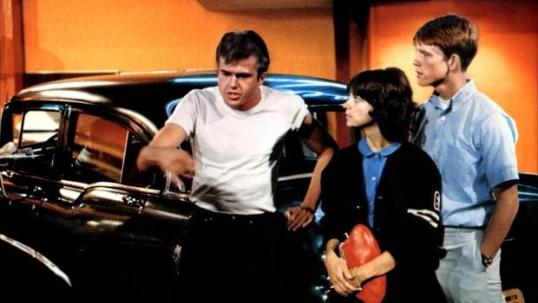
Take the 1973 Best Picture nominee American Graffiti for instance.  I could tell you that this is a very well-acted film and that it features an ensemble of very likable performers, many of whom subsequently went on to become stars and celebrated character actors.  Then again, you can say the same thing about countless other films.

american-graffiti-1973-03-g

I could say that director George Lucas does such a good job putting this film together that it’s hard to believe that he’s the same man who would later be responsible for all three of the Star Wars prequels.  Then again, I could also say the same thing about how odd it is that the same man who directed the entertaining Final Destination 5 was also responsible for the far less enthralling Into The Storm.

i007737

I could tell you that the film serves as a valuable time capsule in that not only does it feature a loving recreation of small town America in the early 60s but that it’s also a chance to see what Richard Dreyfuss, Ron Howard, and Charles Martin Smith all looked like when they still had hair.  But then again, I also praised The Young Graduates for being a time capsule as well.

MelsGraffiti

Let’s face it — it’s difficult to define the intangible qualities that make a film great.  Often times, it’s a case of simply knowing it when you see it.  I’ve seen American Graffiti a few times.  The last time I saw it was at a special Sunday showing at the Alamo Drafthouse.  And, on that early Sunday afternoon, the theater was packed with people who had paid for the chance to see the 40 year-old film on the big screen.  I’m 28 years old and it’s significant that, while the majority of the audience was older than me, there were quite a few people who were younger.  American Graffiti is one of those films that obviously spoke to audiences when it was first released and continues to speak to audiences today.

As I mentioned in my review of Rebel Without A Cause, films about teens tend to age quickly and, often times, one generation’s masterpiece will turn out to be a later generation’s joke.  When a film like Rebel or American Graffiti survives the test of time, it’s because the film has managed to capture a universal truth about what it means to be young and to have your entire life ahead of you.

American Graffiti takes place over the course of one long night in Modesto, California in 1962.  The film follows several different characters, the majority of whom have just graduated from high school.  What these characters all have in common is that one phase of their life has ended and a new one is about to begin.  Over the course of that one night, all of them are forced to say goodbye to their past identities and, in some instances, are forced to face their future.

Curt and the Pharoahs

For instance, there’s Curt (an amazingly young Richard Dreyfuss), a neurotic intellectual who spends the night trying to decide whether or not he actually wants to leave for college in the morning.  Complicating Curt’s decision is a mysterious blonde who mouths “I love you” at him before driving away.  While searching for her, Curt finds himself unwillingly recruited into the Pharoahs, a somewhat ludicrous small town gang that’s led by Joe (played, in hilariously clueless fashion, by Bo Hopkins.)  Curt, incidentally, is my favorite character in the film.  He’s just adorable, which admittedly is not a reaction that one often has to Richard Dreyfuss.

(Curt is also featured in one of my favorite scenes, in which he smokes a cigarette with a lecherous teacher named Mr. Wolf.)

Cindy Williams, Ron Howard, and Charles Martin Smith

Curt’s sister (Cindy Williams) is dating Steve Bolander (Ron Howard).  Steve is the former class president and, unlike Curt, he’s very excited about leaving home.  Ron Howard gives such a likable performance that it actually takes a few viewing to realize just how big of a jerk Steve really is.

Terry and Debbie


And then there Terry (Charles Martin Smith) who wears big glasses and has bad skin.  Terry gets to spend the night driving around in Steve’s car and manages to pick up a girl named Debbie (Candy Clark).  For Terry, this is his night to actually be somebody and what makes it all the more poignant is just how obvious it is that Terry will probably never get another chance.  Though he may not realize it, those of us watching understand that this is literally going to the be the best night of Terry’s life.

(Incidentally, much like Ron Howard, Charles Martin Smith would go on to become a film director and gave the world the amazingly sweet Dolphin Tale.)

John Milner

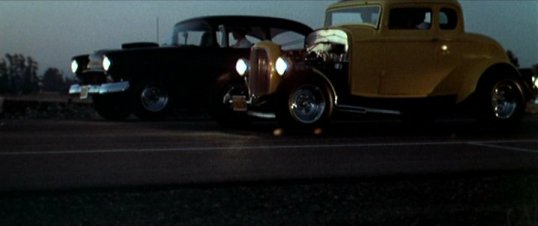
And finally, there’s John Milner (Paul Le Mat).  John is a little older than the other main characters.  He spends most of his time in his car, driving around and getting challenged to race.  He’s the epitome of late 50s/early 60s cool, with an attitude and a look that he obviously borrowed from James Dean and Marlon Brando.  Over the course of the night, he is forced to deal with a bratty 13 year-old stowaway (MacKenzie Phillips) and a mysterious challenger named Bob Falfa (played by a youngish Harrison Ford, who wears a cowboy hat and speaks with a country twang).

Harrison Ford in American Graffiti

The film follows these characters through the night and then, at the end of it, we get the famous epilogue where we discover that all of the male characters have pretty much ended up exactly how we thought they would.  In some cases, that’s a good thing.  And in other cases, it’s not.  It’s a good ending that’s kept from being great by the fact that none of the film’s female characters rate so much as even a mention.

So, what else can be said about American Graffiti?

It’s a great film.

Isn’t that enough?

American Graffiti

Embracing the Melodrama #27: Go Ask Alice (dir by John Korty)


Go Ask Alice

Earlier today, I took a look at The People Next Doora film about a family torn apart by the discovery that their teenage daughter is taking drugs.  For all of that film’s melodrama and over-the-top moments, it still worked.  It may have felt like it was taking place on a plane of heightened reality but it still felt real nonetheless.  Among the many films in the drugs-in-the-suburbs genre, that general feeling of reality made The People Next Door unique.  Far more typical of the genre is the 1973 made-for-TV movie, Go Ask Alice.

Go Ask Alice is based on a YA book that’s been in print for 43 years now.  (I can still remember spending an afternoon reading it in a Barnes and Noble when I was 14 years old.)  The book claims to be the diary of a  teenage girl who ended up getting addicted to drugs and sex.  She runs away from home for a bit and, even when she does manage to stop using drugs, her friends still insist on secretly slipping her acid.  She goes crazy and ends up spending some time in a mental asylum.  Eventually, she’s released and moves to a new town with her family.  She ends the diary saying that she’s looking forward to the future and then, in the afterward, we’re told that she died three weeks later of an overdose and this diary has been published so that we can all learn from her story.

Now, oddly enough, when Go Ask Alice was originally published, it was apparently sold as being an authentic diary of an anonymous teenage girl who had been a patient of the book’s “editor”, Dr. Beatrice Sparks.  However, if you actually read the book, it’s pretty obvious that, while Dr. Sparks may have indeed used some of her patients’ real-life experiences, Go Ask Alice is in no way authentic.  Instead, it’s a classic example of the type of cautionary tale in which a character makes one mistake (in this case, the girl drinks a soda that’s been spiked with LSD) and, immediately afterwards, everything bad thing that possibly could happen does happen.  The purpose of the book is to shock and titillate, to make us wonder how this girl can go from being the sweet optimist who bought a diary because she feels that she finally has something to say to being so jaded that she casually says stuff like, “Another day, another blowjob.”  And, of course, the answer is that she didn’t because the whole thing is totally made up.

But that still didn’t stop anyone from making a movie out of the book and informing us, at the start of the movie, that the story we are about to watch is true and only the names and certain details have been changed to protect everyone’s privacy.  Our diarist (who is now definitely named Alice) is played by a young actress named Jamie Smith-Jackson, who is sympathetic and pretty.  Alice’s mother (Ruth Roman) is too repressed and uptight to provide any guidance to her rapidly maturing daughter.  Meanwhile, Alice’s father is played by William Shatner, so we know he’s not going to be able to do any good either.

Much as in the original book, Alice goes to one party, drinks on LSD-spiked soda, and her life is never the same.  Soon, she’s spending all of her time doing drugs and, as she informs us, having a “monthly pregnancy scare.”  She’s no longer hanging out with her smart, nerdy friends.  Instead, she spends all of her time with a bunch of petty criminals who recruit Alice to help deliver drugs to the students at the junior high.  (“I push at the elementary school!” one junior high kid snarls).  Eventually, Alice runs away from home and lives on the streets.  Fortunately, she runs into a liberal Catholic priest (played by Andy Griffith and yes, you read that right) and starts trying to get her life straight…

Go Ask Alice is no The People Next Door but it’s no Reefer Madness either.  What it gets wrong about teenage drug use, it gets right about just how confusing and alienating it can be to be 15 years old.  At the same time, I’d be lying if I said that this film did not have some camp appeal.  How can it not when it features not only Andy Griffith talking tough but also William Shatner with a bushy mustache?

And guess what?

You can watch it below!