Late Night Retro Television Review: Highway to Heaven 4.13 “A Mother’s Love”


Welcome to Late Night Retro Television Reviews, a feature where we review some of our favorite and least favorite shows of the past!  On Thursdays, I will be reviewing Highway to Heaven, which aired on NBC from 1984 to 1989.  The entire show is currently streaming on Tubi and several other services!

This week, Mark is abandoned in the park.

Episode 4.13 “A Mother’s Love”

(Dir by Michael Landon, originally aired on January 6th, 1988)

It’s time for Jonathan and Mark to start a new assignment!  This week, Jonathan gets to be a teacher (again!) and Mark gets to be …. homeless.

Seriously, Mark is dropped off in the park and told to live there.  Eventually, Jonathan shows up and gives Mark a tent and some cooking supplies.  That was nice of him but still, you have to wonder why Mark always seems to get assignments that are designed to aggravate him.  “Thanks for giving up your independence to work with my angel,” the show’s version of God seems to be saying, “Now, here …. go live in the park.”

Also living in the park are four brothers whose mother has recently died.  They’re living in a van and are trying to not get sent to foster care.  Fortunately, there’s a teacher at Jonathan’s new school who regrets that she never had a family.  Guess who is going to end up adopting four kids!

This was pretty much the epitome of Highway to Heaven, sweet-natured, sentimental, shamelessly manipulative, and so earnest that it worked even when it shouldn’t have.  That said, I hope Jonathan will put a good word in for Mark.  The guy deserves at least one easy week!

The Unnominated: The Long Riders (Dir by Walter Hill)


Though the Academy of Motion Picture Arts and Sciences claim that the Oscars honor the best of the year, we all know that there are always worthy films and performances that end up getting overlooked.  Sometimes, it’s because the competition too fierce.  Sometimes, it’s because the film itself was too controversial.  Often, it’s just a case of a film’s quality not being fully recognized until years after its initial released.  This series of reviews takes a look at the films and performances that should have been nominated but were, for whatever reason, overlooked.  These are the Unnominated.

First released in 1980, The Long Riders is one of the many films to tell the story of the James/Younger Gang.

A group of former Confederate guerillas who became some of the most notorious bank robbers to roam post-Civil War America and who were based in Missouri, the brothers who made up the James/Younger Gang were hunted by the Pinkertons and beloved by the citizens who viewed them as being 19th Century Robin Hoods.  Following a disastrous attempt to rob a bank in Northfield, Minnesota, the Younger brothers were captured by the government while Jesse and Frank James made it back to Missouri.  Jesse was shot in the back by Bob Ford while Frank subsequently surrendered to authorities and made a good living on the lecture circuit.

The Long Riders tells the story of the gang, from their first encounter with the heavy-handed Pinkertons to the Northfield raid to Frank’s eventual surrender.  Director Walter Hill both celebrates the legend of the James/Younger Gang while also emphasizing that all the members of the gang were also individual humans who had their strengths and their flaws.  Hill emphasizes the idea of the gang being a group of post-war rebels, still fighting a war against a government that is more interested in protecting banks than looking after people.  The Long Riders deconstructs the legend while also celebrating it.

The main thing that sets The Long Riders apart from other films about the James/Younger Gang is the fact that the brothers are played by actual brothers.  David, Keith, and Robert Carradine plays the Youngers.  Randy Quaid plays Clell Miller while Dennis Quaid assumes the role of the cowardly Ed Miller.  Nicholas and Christopher Guest make a memorably creepy impression as Charley and Bob Ford.  And finally, Jesse and Frank James are played by James and Stacy Keach.  (The Keaches also worked on the film’s script).  And while Stacy is definitely the more charismatic of the Keach brothers, the film makes good use of James’s rather stoic screen presence.  While the rest of the gang enjoys the outlaw life, James Keach’s Jesse is rigid, serious, and ultimately too stubborn and obsessive for his own good.

Now, the casting might sound like a gimmick but it works wonderfully.  When Clell chooses the gang over Ed, it carries an emotional weight because we’re watching real brothers reject each other.  The comradery between the Carradines carries over to the comradery between the Youngers and it also informs their occasional rivalry with the better known James brothers.  While it is Stacy Keach and David Carradine who ultimately dominate the film, every brother in the cast makes a strong impression.  Also giving a memorable performance is Pamela Reed as a defiantly independent Belle Starr, who loves David Carradine’s Cole Younger but marries Sam Starr (James Remar).  The knife fight between Carradine and Remar is one of the film’s highlights, as is the violent and disastrous attempt to rob the bank in Northfield.

The Long Riders is an exciting and ultimately poignant western but sadly, it received not a single Oscar nomination, not even for the stunning cinematography or Ry Cooder’s elegiac score.  Fortunately, just like the legend of the James/Younger Gang, The Long Riders lives on.

Previous entries in The Unnominated:

  1. Auto Focus 
  2. Star 80
  3. Monty Python and The Holy Grail
  4. Johnny Got His Gun
  5. Saint Jack
  6. Office Space
  7. Play Misty For Me

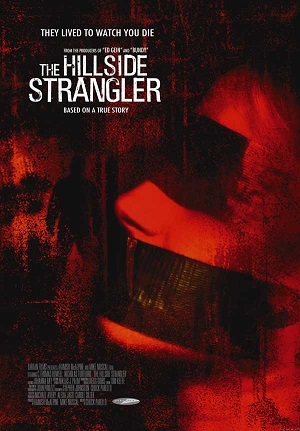
October True Crime: The Hillside Strangler (dir by Chuck Parello)


2004’s The Hillside Strangler opens with a woman stepping into a dressing room with several tops.  She removes all of the tags.  Then she puts all of them on and finally covers them with the sweater that she was wearing when she first stepped into the dressing room.

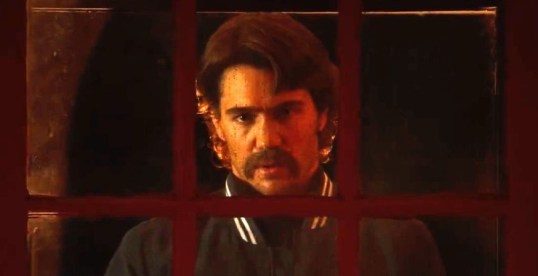
What she doesn’t realize is that she’s being watched by a security guard named Kenneth Bianchi (played by C. Thomas Howell, with a thin mustache).  Bianchi isn’t the type of security guard who relies on cameras.  Instead, he sneaks around in the store’s heating ducts and stares down into the dressing room.  Bianchi manages to get out of the duct quickly enough to stop the woman as she walks out of the store.  He takes her back to his office and orders her to remove each layer of stolen clothing while he watches.

Agck!  Seriously, as a former teen shoplifter, this scene totally freaked me out.  Beyond the creepiness of seeing Bianchi in the air ducts, this scene also captures the authoritarian mindset.  As soon as we see Bianchi, we know that his job is about more than just a paycheck to him.  His job is about wielding power and giving orders.  Wearing his uniform, Bianchi feels that he’s untouchable.

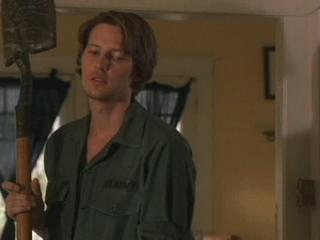
Bianchi dreams of being a real cop but the Rochester Police Department rejects his application to join because his test scores were too low.  Sick of having to listen to him whine, Bianchi’s mother sends him to Los Angeles so that he can stay with his cousin, Angelo Buono (Nicholas Turturro).  Maybe Angelo can knock some sense into him.  Maybe Angelo can teach him about being a man.

Instead, Angelo soon gets as tried of Bianchi as everyone else.  Still, he is impressed when Bianchi orders a fake diploma from Colombia University and sets up a practice as a sex therapist.  When Angelo attempts to set himself up as a pimp, he makes Bianchi is partner.  When Angelo and Bianchi fail at being pimps, they start picking up women and strangling them.  Angelo and Bianchi start out by stalking sex workers but soon, they’re using a fake LAPD badge to prey on anyone that catches their interest.

Based on the true crimes of Angelo Buono and Kenneth Bianchi, The Hillside Strangler is a grim and frequently trashy film, a portrait of two misogynists who can only feel confident when they’re hurting others.  Bianchi is the type who wears a t-shirt that reads, “Official Local Sex Instructor.”  Buono has a doormat that reads, “Italian Stallion” and a sign on his wall that announces, “Candy is Dandy But Sex Won’t Rot Their Teeth.”  Turturro and Howell give two disturbing performances as two losers who feed on each other’s sadism and anger.  Bianchi is desperate for Bouno’s approval.  Buono finds Bianchi to be annoying but he still enjoys being the younger man’s idol.  Would Bianchi and Buono have committed their crimes if they had never met?  The film leaves you wondering.  As a viewing experience, it’s effective and disturbing.

In real life, Angelo Buono died in prison in 2002.  Kenneth Bianchi continues to serve his life sentence.

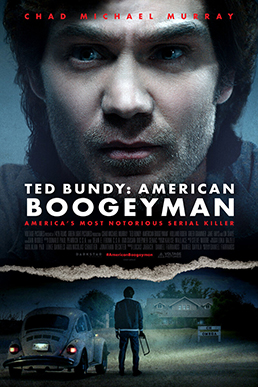
The TSL’s Horror Grindhouse: Ted Bundy: American Boogeyman (dir by Daniel Farrands)


The 2021 film, Ted Bundy: American Boogeyman, is yet another film about the life and crimes of America’s first celebrity serial killer, Ted Bundy.

In this particular film, Bundy is played as being a handsome nonentity by Chad Michael Murray.  The film follows Bundy as he moves from Seattle to Utah to Colorado and eventually to Florida, leaving a path of death in his wake.  Investigating his crimes are Seattle Detective Kathleen McChesney (Holland Roden) and FBI profiler Robert Ressler (Jake Hays).  McChesney not only has to track down Bundy but she also has to deal with her sexist police chief and his idiot son, both of whom think that Bundy’s victims are to blame.

Ted Bundy: American Boogeyman is the latest true crime horror film to be directed by Daniel Farrands.  The frustrating thing about Farrands is that, if you can overlook the subject matter of his recent films, he’s actually a talented horror director who knows how to create suspense and who can be counted on to come up with at least one effective jump scare in all of his films.  That said, he keeps making films that are almost impossible to defend because they exploit real-life tragedy.  Farrands’s best film, The Haunting of Sharon Tate, worked because of Hilary Duff’s committed performance in the title role and the fact that the film itself was fully on Tate’s side.  However, Farrands’s The Murder of Nicole Brown Simpson was a tacky piece of exploitation that, despite Farrands’s strong visuals, appeared to have little compassion for the woman whose murder served as the film’s inspiration.

Ted Bundy: American Boogeyman is neither as effective as The Haunting of Sharon Tate nor as bad as The Murder of Nicole Brown Simpson.  For the most part, the film plays loose with the facts of the case.  At one point, McChesney even shows up at one of Bundy’s crime scenes and takes a shot at him as he flees.  (Tarantino also played around with history in Once Upon A Time In Hollywood but, by allowing Brad Pitt and Leonardo DiCaprio to kill the members of the Mason family, he also allowed their victims to live.  Ted Bundy: American Boogeyman, on the other hand, is willing to change history to allow McChesney to arrive at the crime scene but it’s not willing to change history to allow any of Bundy’s victims to survive.  It’s hard not to feel that the film would have benefitted from following Tarantino’s approach and allowing Bundy’s victims to beat him to death.)  There are a few odd scenes in which Bundy is showing fondling several mannequins.  The scenes appear to pay homage to William Lustig’s Maniac but again, it doesn’t seem to be based on anything the actual Bundy did.  The film hints at the intriguing idea of Ted Bundy being America’s first celebrity serial killer but it doesn’t really follow up on it.  The whole thing feels rushed and rather icky.  It certainly doesn’t add any insight into Bundy or killers in general.

That said, our longtime readers know that I hate to end on a totally negative note so I will say that the film uses its low budget to its advantage.  The sparse sets and the small cast give the film something of a surreal feel, with Bundy as an evil specter who randomly shows up to haunt the dreams of a nation.  Lin Shaye and Diane Franklin appear in small roles.  Franklin plays a distraught mom who asks McChesney to kill Bundy rather than arrest him.  Shaye plays Bundy’s overprotective mother and gives a nicely creepy performance.  As I said earlier, it’s not so much that the film is badly made as the subject matter is so icky and the script is so bereft of any new insight that most viewers will wonder why the film needed to be made at all.

Horror Film Review: The Grudge (dir by Nicolas Pesce)


Eh, who cares?

Released way back in January (and, in fact, I think it may have been the first horror movie released in 2020), The Grudge is the latest film to tell the story of a house where ghosts compel inhabitant after inhabitant to kill themselves and their families.  Look, we all know how it works.  We’ve all seen Ju-on.  We all know that it begins with someone dying while extremely angry or extremely sad and then a curse being passed on from person to person.  The original Japanese films are frightening while the American versions tend to get bogged down in all of the usual horror clichés.  We all know how these things work.

Anyway, this version of The Grudge takes place, for the most part, at 44 Reyburn Drive, where a number of people die over the course of the film.  The Grudge is told in a nonlinear fashion, so we hope back and forth in time.  We meet a lot of different people and sit through a lot of different stories but none of them are particularly interesting.  Two real estate agents discover that their unborn child is going to have a rare genetic disorder.  An elderly couple prepare for an assisted suicide.  A nurse is haunted by the things that she saw while she was working in Japan.  A detective obsesses on all of the murders.  In the present day, another detective (Andrea Riseborough) tries to figure out why so many murders are connected to the house.  It’s difficult to really get caught up in her investigation because we already know the answer.

It’s all pretty dull.  Maybe if I had never seen any of the other Grudge films, I would have found this movie more interesting but The Grudge doesn’t really bring anything new to the table.  All it really does is remind you of how formulaic the American version of franchise has always been.  Of course, everyone’s going to die and, of course, there’s going to be a shock ending.  (Interestingly enough, the international version has a different ending.)  It’s all rather boring and it’s hard not to get annoyed that the film assembled a truly amazing cast and then basically didn’t anything with them.  Consider some of the people in this film: Andrea Riseborough, Demian Bichir, John Cho, Betty Gilpin, Lin Shaye, Jacki Weaver, William Sadler, Frankie Faison.  Wasting a cast with that much talent really does amount to cinematic malpractice.  It seems like it should be an impossible mistake to make but The Grudge somehow manages to do it.

The film’s nonlinear format doesn’t add much to the story.  I mean, you know everyone’s going to die eventually so having the story told in random chunks and pieces doesn’t really add any sort of suspense.  One could argue that the film does deserve some credit for being as dark as it is.  I mean, it does kill the type of sympathetic characters who, normally, would survive other horror films.  But, even with that in mind, it’s all just kind of boring.  I don’t hold a grudge against anyone for trying to reboot the franchise but this film just doesn’t bring anything new to the table.


Mardi Gras Film Review: Gothic Harvest (dir by Ashley Hamilton)


Are you currently heading to New Orleans for Mardi Gras?  Or are you already in New Orleans, getting drunk and dreaming about how many beads you’ll end up with by the end of Tuesday night?  If that’s the case, have fun but be careful.  New Orleans is a town that’s full of ghosts and voodoo.

At least, that’s what the movies would have you believe.  Whenever you see a horror film that’s set in New Orleans, you know that voodoo is going to somehow play into it.  The other thing that you can usually count on is that there will be at least one scene set during Mardi Gras.  Really, that’s not surprising.  Mardi Gras in New Orleans is not only a great party but it’s also uniquely cinematic in a way that Mardi Gras in Dallas never is.

(Yes, we celebrate Mardi Gras in Dallas.  It’s nothing to get too excited about.)

The 2018 film, Gothic Harvest, is all about Mardi Gras and voodoo.  When four college students head down to New Orleans for the party of the year, they have no idea that they’re about to get sucked into a centuries old curse.  When Hope (Abbie Gayle) meets the handsome and enigmatic Gar (Ashley Hamilton, who also directed the film), she goes off with him without bothering to tell her friends where she’s going.  That turns out to be a mistake because it turns out that Gar is a member of a cursed family.  The family is immortal but that immortality comes with a price.  Every year, they have to find and sacrifice a young woman in order to stay alive.  It’s all because the family, centuries ago, ran afoul the queen of New Orleans voodoo, Marie Laveau (Janee Michelle).

Hope’s friends are concerned about her disappearance but they can’t get anyone to help them out.  After all, it’s Mardi Gras and the entire city is full of people who are probably going to wake up in a strange bed with a hangover on Wednesday morning.  However, Hope’s friends do eventually run into an undercover cop named Detective Hollis (Bill Moseley).  Hollis has an impressive beard and brags about how his favorite band is Pantera.  He seems to be a bit strange but he agrees to help the girls look for Hope.


Hope, meanwhile, has now met the cursed and immortal Boudine family and, not surprisingly, they’re an interesting group of characters.  What distinguished them from other cursed immortals is that they all seem to be hate being stuck with each other but they hate the idea of dying even more.  So, they keep doing what they have to do even though it makes them all miserable.  The family matriarch is Griselda (Lin Shayne) while her daughter, Amelia (Sofia Mattson), is a self-styled dominatrix.  And then there’s Dolly (Ciara Rizzo), who is obsessed with dolls.

Gothic Harvest is a bit of a strange viewing experience.  This was Ashley Hamilton’s directorial debut and the film itself can be confusing upon first viewing.  The timeline jumps back and forth, from the past to the present, and it can often be hard to keep track of just who is doing what or why.  It’s hard not to feel that the film might have worked better if it had dropped the modern storyline and instead just concentrated on telling the story of how the family came to be cursed.  That said, Gothic Harvest does occasionally achieve a dream-like intensity and Hamilton makes good use of New Orleans’s spooky atmosphere.  This is a flawed film that doesn’t really work but I would still be interested in seeing what Hamilton directs next.

The cast is a bit of a mixed bag.  Hope and her friends are not particularly memorable but Bill Moseley and Lin Shaye are both ideally cast.  Moseley, in particular, appears to be having fun and there’s a great scene where he sits in a truck and recites some of the worst pick-up lines ever.  Finally, Janee Michelle goes totally over the top as Marie Laveau but that’s exactly the right approach to take to the character.  The Queen of New Orleans Voodoo isn’t going to be a quiet or a reserved character.

For those of you celebrating, have fun but use your common sense.  If someone says that he needs to sacrifice you so that his family can continue to live forever, don’t go off with him regardless of how many beads he offers.


Goin’ South (1978, directed by Jack Nicholson)


Jack Nicholson was not an overnight success.

Nicholson was 17 years old when he first came to Hollywood in 1954.  Looking to become an actor, Nicholson toiled as an office worker at the MGM cartoon studio, took acting classes, and went to auditions.  It would be four years before he even landed his first role, the lead in the Roger Corman-produced The Cry Baby Killer.  When that film failed to become a hit, Nicholson spent the next ten years doing minor roles and occasionally starring in a B-picture.  He auditioned for some big parts, like Benjamin Braddock in The Graduate, Buck Barrow in Bonnie and Clyde, and Guy Woodhouse in Rosemary’s Baby, but his big break continued to allude him.  By 1969, Nicholson was so disillusioned with acting that he was planning to instead pursue a career as a director.  However, before Nicholson officially retired from the acting game, he received a call from the set of Easy Rider.  Depending on who you ask, Rip Torn, who had previously been cast in the role of alcoholic George Hanson, had either quit or been fired.  Bruce Dern, the first choice to replace Torn, was busy filming They Shoot Horses, Don’t They?  Nicholson agreed to step into the role and the rest is history.

Easy Rider may have made Jack Nicholson one of the world’s biggest film stars but he never lost his ambition to direct.  In 1971, he made his directorial debut with Drive, He Said, a film about campus unrest.  At the time, the film flopped at both the box office and with critics and quickly sunk into obscurity.  (It has subsequently been rediscovered and, in some cases, positively reevaluated.)  After the failure of Drive, He Said, it would be another seven years before Nicholson again got a chance to direct.

Nicholson’s second film as a director, Goin’ South, is a comedic western.  Nicholson plays Henry Lloyd Moon, an unsuccessful outlaw who used to ride with Quantrill’s Raiders.  When Moon is captured in Longhorn, Texas, he is sentenced to be hanged.  Fortunately, for Moon, Longhorn has a special ordinance.  Any man condemned for any crime other than murder can be saved from the gallows if a local woman agrees to marry him and take responsibility for his good behavior.  As a result of this ordinance, Longhorn is populated almost exclusively by single women and reformed outlaws.

While standing on the gallows, the cocky Moon is stunned to discover that none of the women want to marry him.  Finally, an old woman emerges from the crowd and announces that she’ll become Moon’s wife.  When Moon hops off the gallows and thanks her, the woman drops dead.  Fortunately, another, younger woman, Julia Tate (Mary Steenburgen, making her film debut), steps forward.

Once they’re married, the lecherous Moon discovers that Julia is a virgin and that the only reason she married him was so she could force him to work in the secret gold mine that’s hidden underneath her property.  The railroad will soon be taking over the land and Julia wants to get all of the gold before she leaves town for Philadelphia.  Though Julia, at first, wants nothing to do with Moon, he eventually wears her down through sheer persistence and the two fall in love.

Complicating matters is Deputy Towfield (Christopher Lloyd), who is upset because he feels that Julia was meant to be his wife.  Also, the members of Moon’s former gang (including Danny DeVito and Veronica Cartwright) show up at Julia’s house and discover the truth about the mine.

Goin’ South gets off to a good start.  The scene on the gallows, where Moon waits for someone to marry him and save his life, is genuinely funny and Nicholson and Steenburgen have a playful chemistry for the first hour of the movie.  Nicholson leers even more than usual in this film but the script is written so that the joke is always on Moon.  Much of the film’s humor comes from Moon always overestimating both his charm and his cleverness.  However, once Moon and Julia finally consummate their marriage, the movie loses whatever narrative momentum it may have had and gets bogged down with the subplots about Towfield and Moon’s gang.  There are funny moments throughout but the story gets away from Nicholson and the film is reduced to a series of set pieces, none of which build up to much.

Not surprisingly, Nicholson gets good performances from his cast, which is largely made up by the members of his 1970s entourage.  Along with Danny DeVito and Christopher Lloyd, longtime Nicholson associates like Tracey Walter, Ed Begley Jr., Richard Bradford, Jeff Morris, and Luana Anders all appear in small roles.  John Belushi plays the tiny role of Deputy Hector.  (Goin’ South was actually the first film in which Belushi was cast, though production didn’t actually begin until after Belushi had finished working on National Lampoon’s Animal House.)  Unfortunately, despite all of the good performances, the script doesn’t do much to develop any of the characters.  Belushi especially feels underused.  (Because Belushi had moved on to Animal House by the time the film went into post-production, Nicholson ended up dubbing several of Belushi’s lines himself.)

Drive, He Said was largely considered to have failed at the box office because Nicholson remained behind the camera so he took the opposite approach with Goin’ South.  Nicholson is in nearly every scene and he gives one of his broadest performances.  It works for the first half of the film, when Moon is constantly trying to get laid and failing every time.  But, during the second half of the movie, Nicholson’s failure to reign in his performance works to the film’s detriment.  When the movie needs Nicholson to be romantic, he’s still behaving like a horny cartoon. Whenever he looks at Mary Steenburgen, it seems as if his eyes should be popping out of his head, Tex Avery-style.  He’s an entertaining cartoon, but a cartoon nonetheless.  As a result, Goin’ South is often funny but it still feels very inconsequential.

Like Drive, He Said, Goin’ South was both a critical and a box office flop and it temporarily turned Nicholson off of directing.  It would be another 12 years before he would once again step behind the camera.  In 1990, Nicholson directed The Two Jakes, the sequel to one of his best films, Chinatown That would be Nicholson’s last film as a director.  Nicholson acted for another 20 years, following the release of The Two Jakes.  To date, he made his final screen appearance in 2010, with a supporting role in James L. Brooks’s How Do You Know.  Nicholson has disputed claims that he’s officially retired, saying that he’s instead just being more selective about his roles.  Even though it’s been ten years since we last saw him on screen, Jack Nicholson remains an American icon and a living legend.

Horror Movie Review: A Nightmare On Elm Street (dir by Wes Craven)


Damn, this is a scary movie.

That may seem like an obvious point to make when talking about the original A Nightmare On Elm Street but it’s still one that needs to be made.  I always seem to forget just how scary the original is.  I mean, there’s been so many sequels.  And there was that kind of silly movie where Freddy Krueger fought Jason Vooerhees.  And then there was the fairly forgettable reboot.  Freddy Krueger is something of a cultural icon.  Even people who have never watched any of the movies knows who Freddy Krueger is.  Freddy has become so well-known for his quips and his puns and his bad jokes that it’s easy to forget that the reason he put razors on his gloves was so he could kill children.

Despite the fact that Jackie Earle Haley took over the role in the reboot, Freddy Krueger will always be associated with the actor who first played him, Robert Englund.  What’s interesting is that, whenever you watch or read an interview with Englund, he comes across as being literally the nicest guy in the world.  (His autobiography is one of the most cheerful Hollywood memoirs that I’ve ever read.)  Before he was cast as Freddy, Englund was a fairly busy character actor.  It’s always a little odd when he pops up in some old movie on TCM because, inevitably, he’s always seems to be playing a nice and often kinda shy guy.  Supposedly, when Englund auditioned for the role of Freddy, he darkened his lower eyelids with cigarette ash and he purposefully said very little while meeting with director Wes Craven.  Craven, who based Freddy Krueger on a childhood bully, was impressed enough to cast this very likable actor as one of the most evil killers in the history of horror cinema.

And make no mistake about it.  In the first film, Freddy Krueger is terrifying.  He’s not the joker that he would become in later installments of the franchise. When he does laugh, it’s because he’s taunting his latest victim.  This Freddy isn’t quite as quick-witted as the Freddy who showed up in Dream Warriors and other films.  This Freddy keeps things simple, popping up in your nightmares, chasing you, and, once he catches you, killing you.  It’s not just his glove and his burned faced that makes Freddy terrifying in this film.  It’s how determined and relentless he is.  He’s not going to stop until he catches you and, seeing as how he’s already dead, there’s really not much you can do to slow him down.  Englund plays Freddy as being the ultimate bully.  The only joy he gets is from tormenting the rest of us.  It’s a testament to the strength of Englund’s performance that memories of Freddy dominate our thoughts when it comes to A Nightmare of Elm Street, despite the fact that Freddy is only onscreen for seven minutes.

It’s an effective film, not just because of the nightmare scenes but also because of the scenes that take place in the waking world.  The majority of the film follows Nancy (Heather Langenkamp), Glen (Johnny Depp), Tina (Amanda Wyss), and Rod (Jsu Garcia, who is credited as Nick Corri in this film) as they try not to die.  And let’s be honest.  None of these characters are particularly deep.  Rod’s the bad boy.  Tina’s the rebellious Catholic.  Glen’s the nice guy.  Nancy’s the good girl.  They’re archetypes that should be familiar to anyone who has ever seen a slasher film.  And yet, you really do care about them, especially Nancy and Glen.  (Admittedly, everyone that I’ve ever talked to about this film seems to care about Rod the least.)  Langenkamp, Depp, and Wyss all give such likable performances that you really do find yourself worrying about what will happen to them when and if they fall asleep.

I rewatched A Nightmare on Elm Street last night and I was shocked to discover that, even though I knew what was coming, the movie still scared me.  The sight of Freddy straining against the wall over Nancy’s head was still unbelievably creepy.  The gory scene where Freddy attacks Tina still frightened me, as did the famous geyser of blood scene.  Even the much-parodied scene where Freddy’s glove rises up between Nancy’s legs while she sleeps in the bathtub still made me shudder.

It’s easy to take for granted just how good and scary the original Nightmare on Elm Street actually is.  For horror fans, it’s a film that deserves to be watched this October season.  Just don’t fall asleep afterwards.

Film Review: Insidious: The Last Key (dir by Adam Robitel)


Traditionally, good films are not released in January.

With most filmgoers more interested in catching up with the probable Oscar nominees and no one wanting to spend too much money after Christmas, January has become the month when the studios release all of the low-budget films that they’re hoping they can make a few bucks off before everyone forgets about them.  January is the month that sees sequels to the franchises that have a small but loyal fan base.  Just as last January saw the release of a new Underworld and a new Resident Evil, this January sees the release of Insidious: The Last Key.

Though it would subsequently be overshadowed by The Conjuring and its sequel, the Insidious franchise got off to a good start with the first film in the series.  Released in 2010, the first Insidious was a genuinely scary movie, one that can still give your nightmares if you watch it on a stormy night.  There are so many moments from that film that have stuck with me: the dancing ghost, the red demon suddenly appearing over Patrick Wilson’s shoulder, and the franchise’s first trip to the Further.  Of course, the thing that really elevated Insidious was the performance of Lin Shaye, in the role of demonologist Elise Rainier.  Lin Shaye played Elise with a combination of eccentricity and quiet authority and, from the minute she first showed up, you wanted to know more about Elise’s paranormal career.  Elise was the most popular character in the movie, which made it unfortunate that she was dead by the end of it.

Despite Elise’s death, she’s continued to be at the center of the Insidious franchise.  The first sequel dealt with her death by having her appear as a spirit, leading the hero through the Further.  The third film in the franchise was actually a prequel, dealing with one of Elise’s earlier investigations and showing how she first met her two comedy relief assistants, Tucker (Angus Sampson) and Specs (Leigh Whannell).  The Last Key is another prequel, revealing the details of Elise’s childhood and following her all the way through 2010.  The Last Key ends with a call back to the first Insidious movie, suggesting that the franchise has now come full circle.

The Last Key is another haunted house movie.  This time, the house in question is the one where Elise and her brother (played, as an adult, by Bruce Davison) grew up with their horribly abusive (and possibly demon-possessed) father.  In 2010, the house has been purchased by Ted (Kirk Acevedo).  No sooner has Ted bought the place then it becomes obvious that it’s haunted.  However, Ted can’t just abandon the place because he’s sunk all of his money into this house, which he was hoping to be able to then sell to someone else.  Apparently, you can’t get much money for a haunted house.

(Well, whatever.  I’d pay good money to buy a haunted house and then I would open it to the paying public every October.  I would make a fortune, assuming everyone didn’t get killed.)

Anyway, it all pretty much leads to everything you would expect to happen in an Insidious movie.  Doors open and close.  Malevolent beings appear in the shadows.  Everyone goes to the Further.  Lin Shaye gives another entertaining and fully committed performance, obviously enjoying the chance to be the star of the film.  Nothing about the film is particularly surprising but that doesn’t mean that it isn’t often effective.  Watching this film is a lot like listening to a skilled storyteller tell the story about the girl, her boyfriend, and the escaped mental patient who has a hook for a hand.  You know exactly what’s going to happen.  You know that it none of it really happened.  You know the story is borderline ludicrous.  But you still find yourself jumping at every unexpected sound.  You still find yourself staring into the shadows, wondering if you really saw something moving or if it was just your imagination.

Needless to say, The Last Key is never as effective or as scary as the first Insidious or either of The Conjuring films.  There were a few moments — mostly dealing with Elise’s childhood — where The Last Key showed the potential to be something a little deeper than what I was expecting but those moments were rarely followed up on.  In the end The Last Key is a rather modest and workmanlike horror film, the type that makes you jump while you’re watching it but which you will also probably end up forgetting about a day or two after seeing it. However, for a January horror film, it’s good enough.

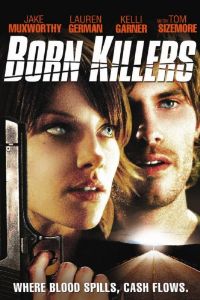
Insomnia File #9: Born Killers (dir by Morgan J. Freeman)


What’s an Insomnia File? You know how some times you just can’t get any sleep and, at about three in the morning, you’ll find yourself watching whatever you can find on cable? This feature is all about those insomnia-inspired discoveries!

Born Killers 2

If you were suffering insomnia at around 2:30 this morning, you could have turned over to ActionMax and watched the 2005 film Born Killers.

Now, probably the first thing that you noticed about this film is that the director is named Morgan J. Freeman.  That J is there for a reason.  In no way is Morgan J. Freeman the director related to Morgan Freeman the actor.  Instead, Morgan J. Freeman is a director who has done a few indie films and who will probably never live down the fact that he directed American Psycho II: All-American Girl.  According to the imdb, Freeman is also an executive producer on Teen Mom.

In other words, Morgan J. Freeman has been involved with a lot of crap.

However, Born Killers is actually a fairly good film.  It’s certainly far better than anything you would expect to see from the director of American Psycho II.

Born Killers tells the story of two brothers, John (Jake Muxworthy) and Michael (Gabriel Mann).  John and Michael are both killers.  They call other human beings “piggy banks” and they spend all of their time murdering innocent people and then robbing them.  For the wild and unpredictable Michael, it’s fun.  For the coolly calculating John, it’s strictly business.  They’re both sociopaths but, as quickly becomes apparent, Michael is the only one who is having any fun.

Through flashbacks, we discover that Michael and John never really had a chance to be anything other than what they eventually became.  From an early age, their father (Tom Sizemore, who is absolutely chilling) taught them how to kill and steal.  After their father’s violent death, John and Michael go on their own killing spree.

And everything seems to be going well for them, until John ends up shooting Michael.  Why did John kill him?  Even though John is narrating the story, he doesn’t seem to be sure.  He admits that his memory may be fooling him.  He thinks that it might have something to do with a woman named Archer (Kelli Garner), who the brothers reluctantly murdered.

With his brother now dead, John tracks down his half-sister, Gertle (Lauren German).  John hasn’t seen Gertle in years and, when he first approaches her, he pretends to be a Mormon missionary.  Gertle responds by leading him into her house and, after they have sex, she tells him that she knows that he is her half-brother.

Though John was originally planning on murdering her, he instead finds himself falling in love with her and even feeling that maybe his love for her would redeem him for all of his past crimes.  When she tries to warn him that she has issues of her own, John replies that he knows they are meant to be together.  He begs her to take a chance on him.

But Gertle, as you’ve probably guessed, has secrets of her own…

At first, I wasn’t expecting much from Born Killers.  And, for the first 30 minutes or so, it plays out like your typical serial killer road film.  I kept watching because of the performances but I didn’t think much of the story.  However, as soon as John tracks down his sister, the entire movie changes direction and it actually starts to catch you off guard.  Suddenly, you’re no longer sure just what exactly is going to happen or how it’s going to end.  During the final half of the film, Lauren German and Jake Muxworthy give such good and compelling performances that you forget about the shaky first half.  Even if the film’s ending is a little bit too twisted for its own good, it’s still an interesting journey.

All in all, Born Killers is not at all bad for a low-budget serial killer film airing on Cinemax at two in the morning!

born killers

Previous Insomnia Files:

  1. Story of Mankind
  2. Stag
  3. Love Is A Gun
  4. Nina Takes A Lover
  5. Black Ice
  6. Frogs For Snakes
  7. Fair Game
  8. From The Hip