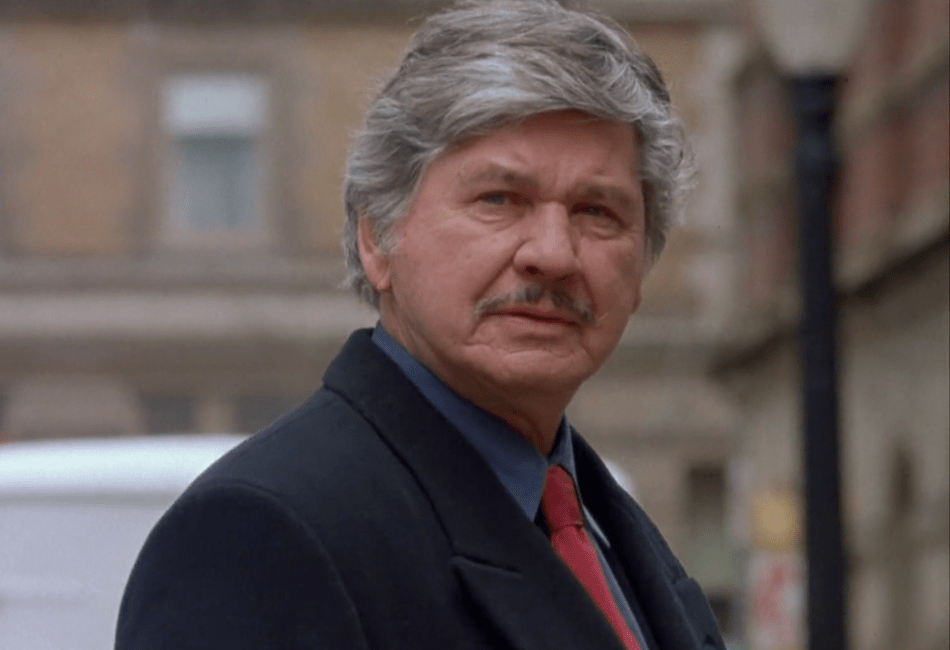
Brad reviews FAMILY OF COPS (1995), starring Charles Bronson!


Legendary actor Charles Bronson ended his five-decade career by starring in a series of made-for-TV movies, FAMILY OF COPS (1995), BREACH OF FAITH: A FAMILY OF COPS II (1997), and FAMILY OF COPS III: UNDER SUSPICION (1999). I was in my mid-twenties as this series played out, and I enjoyed each of the installments. Today, I’m going to take a look at the first in the series.

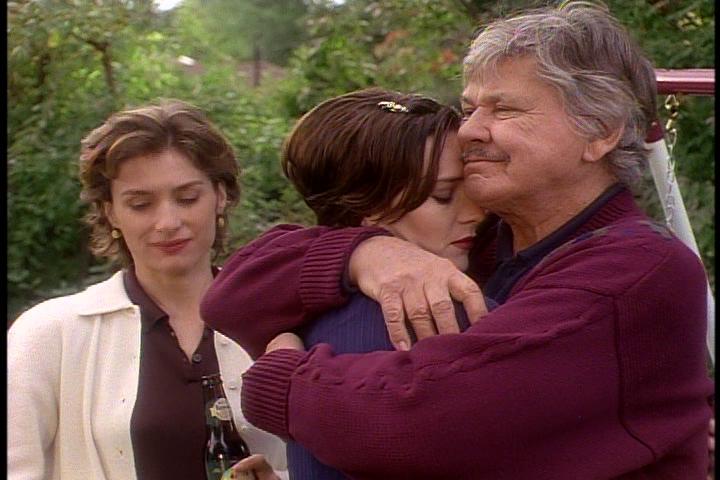
In FAMILY OF COPS, Charles Bronson stars as Police Inspector Paul Fein. Paul, a widower as we enter this story, leads a family who is heavily involved in law enforcement in Milwaukee, Wisconsin. His oldest son Ben (Daniel Baldwin) is a detective on the force. Ben is a family man in a loving marriage with several wild kids. Paul’s younger son Eddie (Sebastian Spence) is a patrol cop. Eddie’s single, has a beautiful girlfriend, and seems to be a nice guy with a well-adjusted life. Paul’s oldest daughter Kate (Barbara Williams) is a local public defender. She seems to be dedicated to her work, not leaving much time for a social life. And then there’s Paul’s youngest daughter Jackie (Angela Featherstone), who has moved out to California and refers to herself as “the family curse.” This story opens with Jackie reluctantly coming back to Milwaukee to attend her dad’s birthday party. All Paul wants for his birthday is for his family to be together. We soon learn that neither Ben or Kate care much for Jackie and her irresponsible life choices. As a matter of fact, the reason she ran off to California in the first place was to get out from under her family’s disapproval. It’s not long after she gets back that the family wishes she would have stayed away. Sneaking out of her sister’s house late at night to drink and party, she meets the prominent local businessman Adam Novacek (Simon MacCorkindale), eventually going to his home and engaging in sexual intercourse. Sadly, the next morning she wakes up to Novacek’s recently deceased corpse, and she’s arrested as the prime suspect in his murder. Convinced of her innocence, Paul, Ben, and Eddie set about trying to clear her name and find the real murderer. Besides Jackie, other suspects begin to emerge, including Novacek’s current wife Anna (Lesley-Anne Down), his former wife Laura (Kate Trotter), who’s now confined to a looney bin, and a local gangster named Frank Rampola (John Vernon), who has a vendetta against Paul for recently busting his grandson. How far will Paul Fein go to protect his family in his search for a killer?!!

FAMILY OF COPS is a perfect example of what I would refer to as entertainment for the “older person crowd,” and I don’t mean this as a put-down in any way as I enjoyed the movie. I just mean that it fits a type of entertainment that was popular in the 80’s and 90’s. These types of shows would depend greatly on the charisma or reputation of a veteran actor or actress, would contain simple production values, and would usually follow formulaic plots. Examples of the types of shows I’m referring to include MURDER, SHE WROTE with Angela Lansbury, MATLOCK with Andy Griffith, DIAGNOSIS MURDER with Dick Van Dyke, and WALKER: TEXAS RANGER with Chuck Norris. A combination of my dad, mom and grandma loved all of these shows. I’m a big fan of MATLOCK myself. In this case, FAMILY OF COPS leans heavily on Charles Bronson’s five decades as a tough guy icon to anchor a somewhat formulaic crime film and family melodrama. The role of Paul Fein fits a 73-year-old Bronson like a glove. He’s still in good physical shape, and the movie gives him a couple of opportunities to punch the shit out of some much younger thugs and henchmen. That was fun for me.

The supporting cast of the film is solid. Daniel Baldwin and Angela Featherstone make the biggest impact. Baldwin is good as the oldest son, a hothead, tough guy on the job who is constantly being humbled at home. Featherstone has the most beautiful eyes, and her rebellious character seems to have a good heart, but she just can’t seem to keep herself out of trouble. Paul Fein’s love for his troubled daughter Jackie is a sweet part of the story and provides something that most of us can relate to. She told me that she “loved Charles,” and I think you can see that in their scenes together. Sebastian Spence and Barbara Williams don’t have a lot to do in this first installment, but their characters will get their own moments to shine in the sequels. I also enjoy seeing John Vernon and Lesley Anne-Down show up in the movie as various persons of interest throughout the story. Bronson and Lesley Anne-Down had recently worked together in DEATH WISH V: THE FACE OF DEATH (1994) and were reportedly good friends in real life. Ted Kotcheff directed FAMILY OF COPS, which I find kind of disappointing. The same guy who directed movies like NORTH DALLAS FORTY (1979) and FIRST BLOOD (1982) didn’t bring anything special to the table in this film. I know it’s a modestly budgeted made-for-TV movie, but the best that can be said for the direction is that it’s workmanlike, and you would never suspect that the director had once helmed the original Rambo movie.

Ultimately, I enjoy FAMILY OF COPS because it stars Charles Bronson. Even as an older man, Bronson still dominates a scene, and the ratings success of the movie proved that Bronson still had an audience who wanted to see him on screen. And even though the story isn’t very unique and the central mystery isn’t very exciting, just the fact that Bronson is leading a solid story that includes action, crime, mystery and family melodrama will always provide some moments of joy for his fans like me. This is far from Bronson’s best work, but the old workhorse still knows how to entertain!
The TSL Grindhouse: Nomads (dir by John McTiernan)


1986’s Nomads opens with anthropologist Jean-Charles Pommier being rushed into an emergency room, badly beaten and struggling for his life.  Despite the best efforts of Dr. Eileen Flax (Lesley-Anne Down), Pommier dies in the ER.  Flax is shocked by Pommier’s death and, naturally, she’s upset that she couldn’t save him.  But, at the same time, people die in hospitals.  It happens to the best of doctors.

Except soon, Flax is seeing flashes of the events that led to Pommier’s death.  Pommier has somehow entered her mind and soon, she’s reliving his investigation into the origins of a group of destructive, urban nomads that Pommier witnessed causing havoc throughout Los Angeles.  Pommier often felt like he was the only person who was capable of seeing the nomads and he grew to be tortured by his fear that they were specifically stalking him.  We soon learn that there was reason for that….

Now, based on his name, you’re probably assuming that Pommier is meant to be French.  And he is!  He’s from France, though he considers himself to be a citizen of the world.  He’s traveled everywhere, taking pictures of different cultural rituals across the globe.  However, in Nomads, the very French Jean-Charles Pommier is played by Pierce Brosnan.  Pierce Brosnan is, needless to say, not French.  He’s Irish, even though a lot of people seem to be shocked when they first learn that.  Brosnan normally speaks with an accent that could best be described as a mix of posh London and mid-Atlantic American.  Everything about him screams the UK.  In short, Pierce Brosnan is one of the least convincing French people ever seen on film and he delivers his lines in an accent that sounds like every accent other than the French accent.  Watching this film, I found myself thinking about the Monty Python skit where Terry Jones and Carol Cleveland starred in a French movie.  (“I see you have a cabbage.”  “Oui.”)  Brosnan is not a bad actor and it’s entertaining to watch him overact in Nomads.  But there’s nothing French about him and every time that someone referred to him as being French, it totally took me out of the movie.

Which is a shame because Nomads may be narratively incoherent but it’s got some memorably surreal visuals and it does a good job of generating a properly ominous atmosphere.  Director John McTiernan (who later went on to do Predator, Die Hard, and The Hunt For Red October) makes smart use of slow motion and a handheld camera to keep the audience off-balance.  At its best, Nomads achieves a dream-like intensity that makes up for the fact that the story doesn’t make the least bit of sense.  The nomads themselves are a memorable and creepy.  While Adam Ant plays their leader (and the scene where he smiles as Brosnan attempts to throw him off a building is truly disturbing), the most frightening of the nomads is Mary Woronov as Dancing Mary.  Seriously, after I watched this film, I checked all the locks in the house.  No urban nomads were going to interrupt me in my sleep!

My suggestion to everyone is to do a Nomads/Nomadland double feature.  You’ll never get in another van.

The Films of 2024: Reagan (dir by Sean McNamara)


In Reagan, Dennis Quaid stars at the 40th President of the United States.

Framed as a story being told by a former KGB agent (Jon Voight) who is attempting to make a younger politician understand why Russia lost the Cold War, Reagan starts with Reagan’s childhood, includes his time as an actor and as the anti-communist head of the SAG, and then gets into his political career.  Along the way, several familiar faces pop up.  Robert Davi plays a thuggish Russian leader.  Mena Suvari plays Reagan’s first wife while Penelope Ann Miller plays his second.  Xander Berekely plays George Schultz (who was just previously played by Sam Waterston in The Dropout miniseries.)  C. Thomas Howell, Kevin Dillon, Dan Lauria, and Lesley-Anne Down all have small but important roles.  And the usual suspects when it comes to conservative filmmaking — Nick Searcy, Kevin Sorbo, and Pat Boone — are there to compliment Voight and Davi.  I was a little surprised to see that Dean Cain was not present.

As usually happens to films that feature sympathetic Republicans, Reagan was slammed by critic but better-appreciated by the audience for which the film was made.  I wasn’t particularly surprised.  Movie critics tend to be liberal and Reagan is very much not that.  For a professional film critic, a film like Reagan must be met with snark and derision because otherwise, one would risk cancellation.  Don’t get me wrong.  I’m not saying that there aren’t things to criticize about Reagan the film.  I’m just saying that one should always keep in mind that critics have their own individual biases.  One reason why the Rotten Tomatoes score is such an unfortunate development is because it ignores the fact that most films have things that work and things that don’t work and that quality is often in the eye of the beholder.  Instead, it just tells us that a film is either a 90% or a 10%.

As for Reagan, it’s definitely a bit on the heavy-handed side but, then again, I think the same can be said for just about every political film that’s come out over the last few decades.  For those who claim Reagan is somehow more heavy-handed than most, I invite them to sit through Rob Reiner’s LBJ.  Indeed, the only director who has really shown a willingness to admit that a President can be both good and bad was Oliver Stone and when was the last time anyone watched NixonReagan is at its weakness when it tries to recreate Reagan’s time as an actor.  Dennis Quaid gives a good and charming performance throughout the film but he’s also 70 years old and, in the scenes where he plays the youngish Ronald Reagan, all of the soft-lighting and Vaseline on the lens ends up making him look like a wax figure.  Once Reagan gets older, Quaid is allowed to act his age and both he and the film become much more convincing.  I enjoyed the film once Reagan became President, though you should understand that I have biases of my own.  I’m a fan of low taxes and individual freedom, which is why I’m also not a fan of communism or, for that matter, any extreme ideology that attempts to tell people how to live or think.  “Tear down this wall!” Regan says while standing in front of the Berlin Wall and it’s a rousing moment, both in reality and on film.

In the end, Reagan is a film that will be best appreciated by people who already like Ronald Reagan.  Yes, the film is heavy-handed and the framing device is a bit awkward.  But Dennis Quaid’s heartfelt (and, towards the end, heartbreaking) performance carries the film.  The film is not at all subtle but you know what?  I’ve seen a countless number of mediocre films that have portrayed Reagan negatively, often with as little nuance and just as heavy-handed an approach as Reagan uses in its positive portrayal of the man.  I sat through The Butler, for God’s sake.  There’s nothing wrong with having a film that looks at the man from the other side.  Those who like Ronald Reagan will feel vindicated.  Those who don’t will say, “What was up with that Pat Boone scene?”

DEATH WISH V: THE FACE OF DEATH – The end.


Picture it…it’s 1992 or 1993 and I’m back at my local Hastings Entertainment superstore browsing through an entertainment magazine. Surprisingly, I came across a bit of entertainment news that a 71 year old Charles Bronson had accepted an offer of $5 million to reprise his Paul Kersey character for a fifth time. I couldn’t help but wonder what possible direction that they could take the series that would be interesting. I didn’t see anything else about the movie for the next year or so, and then it showed up some time in 1994 available for rent at that same Hastings Entertainment superstore. As far as I know, it never played in theaters in Arkansas, although it did play in some theaters in other parts of the country prior to going to home video. I immediately rented the film, somewhat apprehensive of what it would be….

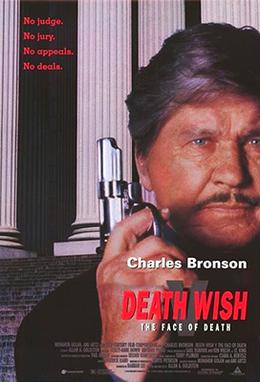
DEATH WISH V: THE FACE OF DEATH, begins with Paul Kersey (Charles Bronson) back in New York. We first see him, looking quite dapper I might add, walking down the street in the garment district. He’s on his way to see his latest girlfriend, fashion designer Olivia Regent (Lesley Anne-Down), whose fashion show is currently underway. You immediately feel sorry for Ms. Regent as you know her prospects for survival are somewhere between slim and none since Kersey’s her man. It doesn’t help matters when her ex-husband, awkwardly impotent mobster Tommy O’Shea (Michael Parks) shows up and starts physically abusing her and her employees. You see, O’Shea is trying to force his ex-wife to use her fashion business to help him launder money from his various criminal activities. Kersey tries to convince Olivia to go to District Attorney Brian Hoyle (Saul Rubinek) to try to put O’Shea away. Unfortunately, there’s corruption in the D.A.’s office in the form of Hector Vasquez (Miguel Sandoval), who passes the information back to O’Shea. From this point forward, Ms. Regent’s life is in serious jeopardy and we all know Kersey’s record of keeping his women alive isn’t that great. I won’t give the details away, but let’s just say that events conspire so that the cursed Kersey will have to resume his old vigilante ways in pursuit of a justice that can never be provided to him by the law.  

I remember vividly my first ever viewing of DEATH WISH V back in 1994. I put the videotape in the VCR and watched several previews that looked crappy and didn’t give me a lot of hope for the movie. And then it started, and I have to admit I enjoyed it from the very beginning to the end. I guess my expectations were so low that it was a major relief when I realized that it was a reasonably well-made, audience satisfaction movie designed for people like me who simply enjoy seeing Bronson acting as an instrument of justice. I thought Bronson looked good for an action star over 70 years old. I really liked the movie’s sense of humor. Michael Parks overacted to the point of parody as O’Shea, and the character of Freddie Flakes (Robert Joy) was especially fun as a hitman with major dandruff problems. And there was something about Charles Bronson that was different in comparison to some of the earlier entries. Then I realized what it was, Bronson was having fun. He took out the bad guys with things like poisoned cannolis and exploding soccer balls, all with a twinkle in his eyes. In the 70’s, Bronson made several movies where his characters had that twinkle. It was nice to see it back. Bad things happened of course, but director Allan A. Goldstein kept a tone of black comedy that suited the movie and its aging star well. 

Even in 1994, watching DEATH WISH V felt like the end, not just of the DEATH WISH series, but of Bronson’s time as a movie star. As his biggest fan, that made me kind of sad. He would only make 3 more TV movies after this, those being the FAMILY OF COPS TV movies. And while there are some who don’t like DEATH WISH V and seem to go out of their way to put it down, I’m exactly the opposite. To me, DEATH WISH V: THE FACE OF DEATH is a gift to Charles Bronson fans and an enjoyable end to his signature series!

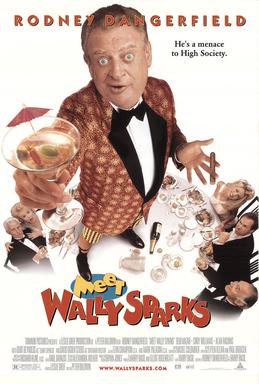
Meet Wally Sparks (1997, directed by Peter Baldwin)


Wally Sparks (Rodney Dangerfield) is a talk show host with a program that is so raunchy that even Jerry Springer says, “At least this isn’t The Wally Sparks Show!”

Despite being a huge hit amongst teens and college students, the show is on the verge of being canceled by the head of the network, Mr. Spencer (Burt Reynolds, wearing a fearsome toupee).  He is tired of Wally’s antics and he tells Wally and his producer, Sandy Gallo (Debi Mazar), that they have a week to make the show respectable.

Wally doesn’t know what to do.  Wally Sparks act respectable?  Wally’s a guy who don’t get no respect, no respect at all.  Then Sandy finds a letter inviting Wally to attend a party at the home of Georgia Governor Floyd Patterson (David Ogden Stiers), a noted critic of the show.  Hoping to get the interview that will save the show, Wally and Sandy head down south.

At the party, Wally acts like Wally and scandalizes all of the politicians and socialites.  He also shares a bottle of whiskey with a horse and then rides the horse through the mansion.  The party is a disaster but, after Wally claims that he can’t walk because of a spinal injury he suffered when he fell off the horse, the Governor allows him to recuperate in the mansion.  Wally causes more chaos while also teaching the Governor’s wife (Cindy Williams) how to play strip poker and eventually exposing a scheme to blackmail the Governor into building  a Confederate-themed amusement park.

Rodney Dangerfield playing a talk show host sounds like a great idea and there are a lot of talented people to be found in Meet Wally Sparks.  Debi Mazar is an actress who should have appeared in a lot more movies and she and Rodney Dangerfield make a good team.  The movie actually gets off to a funny start, with a montage of actual talk show hosts talking about how much they hate Wally Sparks and his show.  Gilbert Gottfried has a cameo as a manic guest and Wally repeats some of Rodney Dangerfield’s classic jokes.

Unfortunately, the movie starts to fall apart as soon as Burt Reynolds threatens to cancel the show for being too lowbrow.  No network executive has ever threatened to cancel a show that’s bringing in the ratings, regardless of how lowbrow it might be.  Things get even worse after Wally goes to Atlanta and ends up staying there.  The movie tries to recreate the Snobs vs. the Slobs dynamic of previous Dangerfield films but the Governor comes across as being such a decent man that there’s no joy to be found in watching his life get turned upside down.  The movie has a surprisingly large number of subplots, including one about Wally’s son (Michael Weatherly) falling for the Governor’s daughter (Lisa Thornhill), but most of them go nowhere and just distract from the man who should have been the film’s main attraction, Rodney Dangerfield.  By the end of the movie, even the usually irrepressible Dangerfield seems to have been neutered.

Rodney Dangerfield was a national treasure but Meet Wally Sparks was not the best showcase for his persona or his style of humor.  Fortunately, Caddyshack and Back To The School are available to watch anytime that we need a good laugh and we want to show Rodney Dangerfield a little respect.

Retro Television Review: 1775 1.1 “The Pilot”


Welcome to Retro Television Reviews, a feature where we review some of our favorite and least favorite shows of the past!  On Thursdays, I will be reviewing 1775, which aired on CBS in 1992.  The entire show is currently streaming on YouTube!

This week, we take a trip into the past.  Welcome to 1775!

Episode 1.1 “Pilot”

(Dir by David Trainer, originally aired on September 5th, 1992)

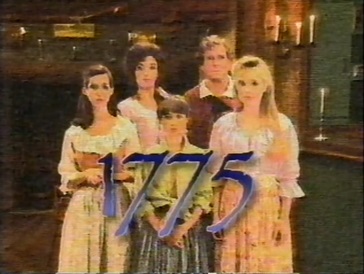
The year is 1775 and the streets of Philadelphia are awash in rumors of war and revolution.  While some prepare for war and others continue to declare their loyalty to the British Empire, Jeremy (Ryan O’Neal) and Annabelle Proctor (Lesley-Anne Down) just try to run their inn and find suitable husbands for their three daughters.  The youngest daughter (Danielle Harris, of Halloween fame) wants a horse because all of her friends have a horse.  She also wants to run off with a patriot and is offended when the pro-British Governor Massengill (Jeffrey Tambor) stops by the inn.

The Proctors know that one way to marry off their daughters would be to have them attend a fancy ball.  Unfortunately, that would require paying money that they don’t have.  Jeremy may have to ask his smug brother-in-law for cash.  His brother-in-law’s name?  George Washington.  Who plays George Washington?  Somewhat inevitably, Adam West.

Now, I know Adam West playing a smug and superficial George Washington might sound like a lot of fun but West only shows up for one scene and it’s a short one at that.  And he really doesn’t get any fun lines or really any opportunity to do any of his trademark Westing.  It’s a bit of a wasted opportunity.

Actually, the entire show feels like a wasted opportunity.  Reportedly, 1775 was an attempt to do a Blackadder for America but the pilot lacks all of Blackadder’s lacerating wit.  Instead of poking fun at American history and traditions in the way that Blackadder did to the Brits, 1775 is just a typically lame family sitcom that happens to take place in 1775.  The youngest daughter wants a horse …. BECAUSE IT’S 1775!  If it was the modern era, she would want a car.  That’s the entire joke.

As for the show’s cast, Lesley-Anne Down delivers a few snarky put-downs with elan but Ryan O’Neal appears to be lost in the main role.  Have you seen that famous clip of Ryan O’Neal saying, “Oh man, oh God,” over and over again?  Well, that’s the level of his performance here.  O’Neal sleepwalks through the show, delivering his lines in the weary voice of someone who needs the paycheck but otherwise could hardly care less.  When he gets exasperated with his daughters, he sounds numbly homicidal.  It’s not a pleasant performance and it features none of the fierce intelligence that Rowan Atkinson brought to countless incarnations of Edmund Blackadder.

Not surprisingly, only one episode of the show aired before it was canceled.  The series didn’t even reach the start of the Second Continental Congress but that’s okay.  We all know how that went.

Forever Young: Ingrid Pitt in COUNTESS DRACULA (20th Century Fox/Hammer 1971)


gary loggins's avatarcracked rear viewer

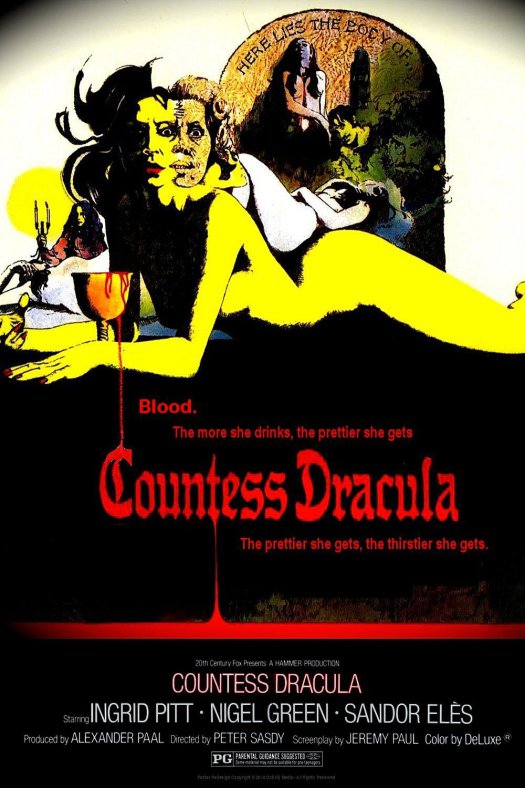
Iconic Ingrid Pitt became a horror fan favorite for her vampire roles in the early 1970’s.  The Polish-born actress, who survived the horrors of a Nazi concentration camp as a child during WWII, played bloodsucking lesbian Carmilla in Hammer’s THE VAMPIRE LOVERS, based on the classic story by J. Sheridan LeFanu, and was a participant in the Amicus anthology THE HOUSE THAT DRIPPED BLOOD opposite Jon Pertwee in that film’s best segment. Finally, Ingrid sunk her teeth into the title role of COUNTESS DRACULA, a juicy part where she’s not really a vampire, but a noblewoman who gets off on bathing in blood, loosely based on the real life events of Hungarian Countess Elizabeth Bathory.

Portrait of the real Elizabeth Bathory

Bathory (1560-1614) was the most infamous female serial killer in history, officially found guilty of 80 murders, yet a diary allegedly found puts the count as high as 650!…

View original post 383 more words

Embracing The Melodrama Part III #6: The Betsy (dir by Daniel Petrie)


“Wheeeeeeee!”

— Loren Hardeman Sr. (Sir Laurence Olivier) in The Betsy (1978)

Here’s a little thought experiment:

Imagine if The Godfather had starred Laurence Olivier and Tommy Lee Jones.

That may sound strange but it actually could have happened.  When Francis Ford Coppola first started his search for the perfect actor to play Don Vito Corleone, he announced that he could only imagine two actors pulling off the role.  One was Marlon Brando and the other was Laurence Olivier.

As for Tommy Lee Jones, he was among the many actors who auditioned for the role of Michael Corleone.  At the time, Jones was 26 years old and had only recently made his film debut in Love Story.  As odd as it may be to imagine the quintessentially Texan Tommy Lee Jones in the role, Coppola always said that he was looking for a brooder as Michael and that’s definitely a good description of Jones.

Of course, as we all know, neither Olivier nor Jones were ever cast in The Godfather.  Marlon Brando played Don Vito and Al Pacino was cast as Michael.  However, a few years later, Olivier and Jones would co-star in another family saga that combined history, organized crime, and melodrama.  That film was 1978’s The Betsy and, interestingly enough, it even co-starred an actor who actually did appear in The Godfather, Robert Duvall.

Of course, now would probably be a good time to point out that The Godfather is perhaps the greatest American film of all time.  And The Betsy … well, The Betsy most definitely is not.

The film’s German poster even gives off a Godfather vibe

Based on a novel by Harold Robbins, The Betsy exposes the secrets of Detroit.  Decades ago, Loren Hardeman founded Hardeman Motors and started to build his considerable fortune.  Sure, Loren had to break a few rules.  He cut corners.  He acted unethically.  He had an affair with his daughter-in-law and then drove his gay son to suicide.  Loren never said that he was perfect.  Now in his 80s, Loren has a vision of the future and that vision is a new car.  This car will be called the Betsy (named after his great-granddaughter) and it will be the most fuel-efficient car ever made.

Since the film appropriates the flashback structure used in The Godfather Part II, we get to see Loren Hardeman as both an elderly man and a middle-aged titan of industry.  Elderly Loren is played by Laurence Olivier.  Elderly Loren spends most of the film in a wheelchair and he speaks with a bizarre accent, one that I think was meant to be Southern despite the fact that the film takes place in Michigan.  Elderly Loren gets really excited about building his new car and, at one point, shouts out “Wheeeeeee!”

Middle-aged Loren is played by … Laurence Olivier!  That’s right.  Olivier, who was 71 years old at the time, also plays Loren as a younger man.  This means that Olivier wears a hairpiece and so much makeup that he looks a bit like a wax figure come to life.  Strangely, Middle-aged Loren doesn’t have a strange accent and never says “wheeeee.”

To build his car, Loren recruits race car driver Angelo Perino (Tommy Lee Jones).  Angelo’s father was an old friend of Loren’s.  When Angelo agrees, he discovers that the Hardeman family is full of drama and secrets.  Not only is great-granddaughter Betsy (Kathleen Beller) in love with him but so is Lady Bobby Ayers (Lesley-Anne Down), who is the mistress of Loren’s grandson, Loren the 3rd (Robert Duvall).

Because he blames his grandfather for the death of his father, Loren the 3rd has no intention of building Loren the 1st’s car.  Loren the 3rd wants to continue to make cars that pollute the environment.  “Over my dead boy!” Loren the 1st replies.  “As you wish, grandfather,” Loren the 3rd replies with a smile.

But we’re not done yet!  I haven’t even talked about the Mafia and the union organizers and the automotive journalist who ends up getting murdered.  From the minute the movie starts, it’s nonstop drama.  That said, most of the drama is so overdone that it’s actually more humorous than anything else.  As soon as Laurence Olivier shouts out, “Wheeeee!,” The Betsy falls into the trap of self-parody and it never quite escapes.  There’s a lot going on in the movie and one could imagine a more imaginative director turning the trashy script into a critique of capitalism and technology.  However, Daniel Petrie directs in a style that basically seems to be saying, “Let’s just get this over with.”

The cast is full of interesting people, all of whom are let down by a superficial script.  Nothing brings out the eccentricity in talented performers quicker than a line of shallow dialogue.  Jane Alexander, who plays Duvall’s wife, delivers all of her lines in an arch, upper class accent.  Edward Herrmann, playing a lawyer, smirks every time the camera is pointed at him.  Katharine Ross, as Olivier’s mistress and Duvall’s mother, stares at Olivier like she’s trying to make his head explode.  Tommy Lee Jones is even more laconic than usual while Duvall always seems to be struggling not to start laughing.

And then there’s Olivier.  For better or worse, Olivier is the most entertaining thing about The Betsy.  He doesn’t give a good performance but he does give a memorably weird one.  Everything, from the incomprehensible accent to a few scenes where he literally seems to bounce up and down, suggests a great actor who is desperately trying to bring a spark of life to an otherwise doomed project.  It’s a performance so strange that it simply has to be seen to be believed.

Tomorrow, we take a look at another melodrama featuring Robert Duvall, True Confessions!


Bronson One Last Time: Death Wish V: The Face of Death (1994, directed by Allen Goldstein)


To quote Geoffrey Chaucer, “All good things must come to an end.”

Death Wish V: The Face of Death marked the end of the original Death Wish franchise, concluding the violent saga of Paul Kersey 20 years after it began.  It probably should have ended sooner.

After the box office failure of Death Wish IV and the subsequent bankruptcy of Cannon Films, future plans for the Death Wish franchise were put on hold.  After the collapse of Cannon, Menahem Golan started a new production company, 21st Century Film Corporation.  In 1993, needing a hit and seeing that the previous Death Wish films were still popular on video, Golan announced that Paul Kersey would finally return in Death Wish V: The Face of Death.  Charles Bronson also returned, though he was now 72 years old and in poor health.  Death Wish V would also mark the end of Bronson’s feature film career.  He would make appearances in a few television movies before subsequently retiring from acting.

Death Wish V finds Paul in the witness protection program.  His latest girlfriend, Olivia (Lesley-Anne Down), just happens to be the ex-wife of a psychotic mobster named Tommy O’Shea (Michael Parks).  Throughout the entire franchise, the Death Wish films argued that crime is so out of control that no one was safe and that Paul had no choice but to pick up a gun and shoot muggers.  But, judging from Death Wish V, Paul just seems to have incredibly bad luck.  What are the odds that a mild-mannered architect would lose his wife, his maid, his daughter, his best friend from the war, his next two girlfriends, and then end up dating the ex-wife of New York City’s craziest gangster?

The district attorney’s office wants Olivia to testify against her ex-husband so Tommy gets his henchman, the dandruff-prone Freddie Flakes (Robert Joy), to kill her.  Looks like it’s time for New York’s favorite vigilante to launch a one-man war against the Mafia!

The only problem is that New York’s favorite vigilante is too old to chase people down dark alleys and shoot them.  He has to get creative, which means using everything from poisoned cannoli to a vat of acid to take out his targets.  One gangster is killed by an exploding soccer ball!

With both Bronson and Lesley-Anne Down giving an indifferent performances, it is up to the supporting cast to keep the movie interesting.  Appearing here after his bravura turn as Jean Renault in Twin Peaks but before Robert Rodriguez and Quentin Tarantino introduced him to a whole new generation of filmgoers, Michael Parks is flamboyantly evil as Tommy O’Shea and injects the movie with what little life that it has.  Speaking of Twin Peaks alumni, Kenneth Welsh (who played Windom Earle in the last few episodes of season 2) plays this installment’s understanding police detective.  Saul Rubinek plays the district attorney who is willing to look the other way when it comes to killing gangsters.

Dull and cheap-looking, Death Wish V was a box office bomb and it brought the original franchise to a definite end.  Will the Eli Roth/Bruce Willis reboot of Death Wish also lead to a reboot of the franchise?  Time will tell!

A Mardi Gras Film Review: Mardi Gras For The Devil (dir by David A. Prior)


A maniac is holding New Orleans hostage!  He’s committed a series of savage, Satanically-influenced homicides and the police cannot seem to even slow him down!  The entire city is terrified!

Well, actually … New Orleans doesn’t seem to be scared at all.  In fact, no one in this movie seems to be all that disturbed by all of the brutal murders that are happening around them.  Some people would probably say that’s because this film takes place during Mardi Gras and everyone’s too drunk to notice.  Why worry about being murdered when all you have to do to get a bunch of cheap beads is flash a boob?  Add to that, this is New Orleans.  New Orleans is a very forgiving city.

Anyway, regardless of whether people care or not, there’s a Satanic murderer prowling through the city.  Who is the killer?  Could he possibly be that guy who always dresses in black, who has a perfectly trimmed beard, and who is always throwing back his head and laughing before doing something evil?  The guy’s name is Bishop and he’s played by everyone’s favorite Canadian character actor, Michael Ironside.  As far as Michael Ironside villains are concerned, Bishop is pretty frightening though he’s nowhere near as a frightening as Darryl Revok.  I mean, he does a lot of evil stuff but he doesn’t actually make anyone’s head explode.

Detective Mike Turner (Robert Davi) is obsessed with stopping Bishop.  Unfortunately, Detective Turner doesn’t appear to be very good at his job.  I mean, everyone he knows he keeps getting seriously injured.  His first partner dies.  His second partner gets run over by a bus.  His ex-wife (Lesley-Anne Down) ends up trapped in a pool.  His girlfriend (Lydie Denier) ends up getting tied up in a barn while a time bomb ticks down across from her.  Fortunately, a few of these people do manage to survive.  Turner may not be a very good cop but, fortunately, Bishop isn’t that good of a serial killer.

It soon becomes apparent that Bishop has a motive for all of his murders, one that goes beyond the usual serial killer weirdness.  It turns out that Bishop’s murders are actually sacrifices and he has given his soul to Satan.  Giving your soul to the devil apparently gives you the power to do whatever the script needs you to do at any particular moment in the movie.  Fortunately, it also leaves you with a weakness that can be exploited whenever the movie decides to come to an end.

Am I saying that Mardi Gras For the Devil makes no sense?  I most definitely am!  However, that’s actually the film’s charm.  The film was made with so little concern for continuity and narrative logic that it plays out like a fever dream.  The cast is surprisingly good for a film like this, which means that everyone delivers the strangest of lines with the utmost sincerity.  Michael Ironside plays his role without a hint of subtlety, which is exactly the type of bad guy that a film like this requires.  Meanwhile, Robert Davi brings a weary cynicism to his role.  You can just hear him thinking, “Satanic serial killers?  I’m too old for this shit.”  Combine that with a fiery ending that doesn’t even try to make sense and you have a movie that, perhaps through no intention of the film’s director, manages to create and sustain a very surreal atmosphere.  The film may not be any good but it’s hard to look away from.

Though the film takes place at Mardi Gras and was released, in some countries, as both Mardi Gras For The Devil and Mardi Gras Nightmare, it actually has very little do with Mardi Gras.  The opening scenes were shot during a Mardi Gras parade but that’s about it.  The film was also released under the title Night Trap, which is a woefully generic title.  You can find the movie on YouTube.