Cleaning Out The DVR Yet Again #16: Zoolander 2 (dir by Ben Stiller)


(Lisa recently discovered that she only has about 8 hours of space left on her DVR!  It turns out that she’s been recording movies from July and she just hasn’t gotten around to watching and reviewing them yet.  So, once again, Lisa is cleaning out her DVR!  She is going to try to watch and review 52 movies by Wednesday, November 30th!  Will she make it?  Keep checking the site to find out!)

zoolander_2_poster

On October 14th, I recorded Zoolander 2 off of Epix.

A sequel to the 2001 cult hit, Zoolander 2 came out earlier this year and got absolutely terrible reviews and quickly vanished from theaters.  Watching the film last night, I could understand why it got such terrible reviews.  Zoolander 2 is not only a terrible movie but it’s also a rather bland one.  Somehow, the blandness is even more offensive than the badness.

Zoolander 2 opens with Justin Bieber getting assassinated and Derek Zoolander (Ben Stiller) being forced to come out of retirement and discover why pop stars are being targeted.  And, of course, Zoolander can’t do it without the help of Hansel (Owen Wilson)!  Penelope Cruz is in the film as well, playing  Zoolander’s handler and essentially being wasted in a role that could have been played by anyone.

Oh!  And Will Ferrell returns as well.  Ferrell gives a performance that essentially shouts out to the world, “Fuck you, I’m Will Ferrell and no one is going to tell Will Ferrell to tone his shit down!”

Actually, I think everyone in the world is in Zoolander 2.  This is one of those films that is full of cameos from people who probably thought a silly comedy would be good for their image.  For instance, there’s a huge number of journalists who show up playing themselves.  Matt Lauer shows up and I get the feeling that we’re supposed to be happy about that.  There was a reason why people cheered when the sharks ate him in Sharknado 3.

You know who else shows up as himself?  Billy Zane!  And Billy Zane has exactly the right type of attitude for a film like this.  He shows up and he mocks the whole enterprise by giving the Billy Zaniest performance of Billy Zane’s career.  For that matter, Kiefer Sutherland also shows up as himself.  I’m not really sure what Kiefer was doing in the film but he makes sure to deliver all of his lines in that sexy growl of his.  Kiefer knows what we want to hear.

You may notice that I’m not talking about the plot of Zoolander 2.  That’s largely because I couldn’t follow the plot.  This is an incredibly complicated film but it’s not complicated in a funny way.  Instead, it’s complicated in a way that suggests that the film was made up on the spot.  It’s as if the cast said, “We’re all funny!  Just turn on the camera and we’ll make it work!”

The problem with Zoolander 2 is obvious.  The first film pretty much exhausted the comic possibilities of making a spy film about shallow and stupid models.  Don’t get me wrong — the first film did a good job but it’s not like it left any material untapped.  But I would ask you to indulge me as I imagine an alternate reality.

Consider this: Terrence Malick was reportedly a huge fun of Zoolander.

Let’s take just a minute to imagine a world in which Ben Stiller asked Terrence Malick to write and direct Zoolander 2.  And let’s say, just for the sake of argument, that Malick agreed!

Just think about it — 4 hours of Zoolander and Hansel staring up at the sky and thinking about nature.  “What is this thing that causes the heart of man to beat?” Zoolander asks.  “Are we nature or has nature become us?” Hansel replies.

That would have been a fun film!

Back to School Part II #21: Brotherhood of Justice (dir by Charles Braverman)


Brotherhood_of_Justice_FilmPoster

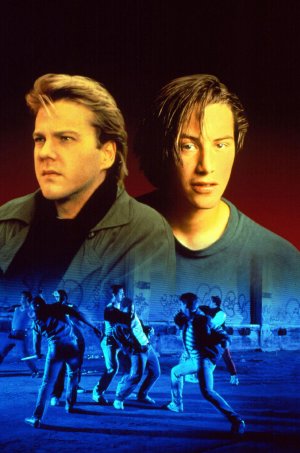
For my next back to school review, I want to take a look at one of the best films that you’ve probably never heard of, the 1986 made-for-TV film Brotherhood Justice!

Brotherhood of Justice takes place at a California high school.  It’s a school that is pretty much ruled by the football team and the divide between the children of the upper and the working class is often violently apparent.  After several acts of violence, drug dealing, and vandalism, the school’s principal (Joe Spano) is left with a choice.  He can either hire full-time security guards and turn his school into an armed camp or he can meet with the most popular seniors and ask them to do their part to maintain order at the school.

He goes with the latter option.

At first, quarterback Derek (Keanu Reeves) is excited about doing his part to make the school a better place.  He and his friends quickly form the Brotherhood of Justice and make out a list of trouble makers.  At first, Derek and his friends are just roughing up drug dealers and demanding that all students show some school pride.  (In order to maintain their anonymity, they all wear masks to hide their faces.  However, no effort is made to disguise anyone’s voice, which means that this film takes place in a world where no one can recognize the voice of Keanu Reeves.)  However, things quickly escalate.  One member of the Brotherhood — Les (Billy Zane) — is especially enthusiastic and he has a thing for knives.

Meanwhile, Derek is having issues with his girlfriend, Christie (Lori Loughlin).  Christie, who is apparently incapable of recognizing her boyfriend’s voice whenever he’s wearing a mask, thinks that the Brotherhood is idiotic.  Christie also has a new job as a waitress and one of her co-workers is Victor (Kiefer Sutherland).  Victor obviously likes Christie and he also bravely stands up to the Brotherhood when they try to harass a student who is named Pasty.  (I kid you not.)

When Derek grows disillusioned with the Brotherhood, they decide that the situation with Christie must be distracting him.  So, they decide to blow up Victor’s car…

It’s all in the name of justice!

Obviously, one of the best things about Brotherhood of Justice is that it’s a chance to see Neo and Jack Bauer compete over Aunt Becky while Cal Hockley plays with a switch blade in the background.  (Oddly enough, Derek’s younger brother is played by Danny Nucci, who later appeared with Zane in Titanic.)  But there’s more to Brotherhood of Justice than just the curiosity value of the cast.

That plot hole about the voices aside, Brotherhood of Justice is actually a really good movie and one that everyone should watch.  If anything, it’s even more relevant today than it probably was when it was originally made.  It’s easy to be dismissive of the self-righteous and judgmental Brotherhood but actually, how different are they from the outrage brigade who show up everyday on twitter?  When the Brotherhood demands that everyone follow the rules and love their school, how different are they from those assholes who, today, claim that anyone who disagrees with the president or questions the moral authority of the government is somehow guilty of treason?  If the Brotherhood existed today, they would be cyberbullying and doxxing anyone who they felt had failed to say or think the right thing.

Let’s face it — we currently live in a fascist culture.  In its own modest but important way, Brotherhood of Justice is one of those films that can tell us why.

And you can watch it below!

http://www.youtube.com/watch?v=0L1x2XI1t-I


Embracing the Melodrama Part II #104: Phone Booth (dir by Joel Schumacher)


Phone_Booth_movie (1)

First released in 2003, Phone Booth is a good film.

Now, I know that you’re probably thinking, “Okay, that’s good, Lisa.  There were a lot of good films released in 2003.  I can’t think of any off the top of my head but let me go look on Wikipedia and I’m sure I can come back with a few dozen good films and…”

Well, before you go over to Wikipedia and do a search on 2003 in film (and I even included a direct link to make it easy for you because I like to be helpful), allow me to point something else out about Phone Booth.

Phone Booth is not only a good film but it’s a good film that was directed by Joel Schumacher!

That’s right!  There are several online film critics who will tell you that Joel Schumacher is one of the worst directors of all time and, to be honest, there’s actually a pretty good argument that can be made in support of that.  However, Schumacher did direct both The Lost Boys and Phone Booth.  So, he’s directed at least two good films and that’s two more than Uwe Boll.

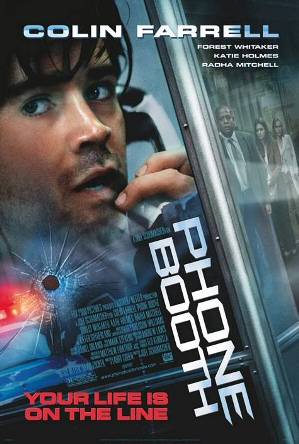
In Phone Booth, Colin Farrell plays Stu, a slick publicist who has both a wife named Kelly (Radha Mitchell) and a girlfriend named Pam (Katie Holmes).  When Stu steps into the last remaining phone booth in New York City in order to call his girlfriend, he’s shocked when a pizza deliveryman shows up and attempts to give him a pizza.  No sooner has he gotten rid of the pizzaman (and, seriously, who turns down free pizza?), the phone rings.  Stu answers and is told by an unseen sniper (voice by Kiefer Sutherland) that, if he leaves the phone booth, he will be shot.  The sniper goes on to order Stu to tell the truth to both Kelly and Pam or to risk being shot as a consequence.

While all of this is going on, a group of prostitutes demand that Stu get out of the booth and let them use the phone.  When Stu refuses, their pimp approaches the booth and is promptly gunned down by the sniper.  Soon, under the assumption that Stu has a weapon, the police — led by Forest Whitaker — have surrounded the booth and are demanding that Stu step out.  The sniper, however, reminds Stu that he’ll be shot if he leaves the booth.

As a crowd of onlookers (including Pam and Kelly), police, and reporters surround the booth, Stu finds himself literally with no escape…

Telling the story in real time and keeping the film largely focused on Stu’s increasing desperation, Schumacher actually does a pretty good job with Phone Booth.  Colin Farrell gives a great performance, making Stu into a character who you like despite yourself.  While Kiefer Sutherland never appears onscreen, his sexy growl of a voice works wonders and he even manages to sell the point where his character starts to maniacally laugh.  Reportedly, screenwriter Larry Cohen came up with the idea for Phone Booth way back in the 1960s.  It took nearly 40 years for the film to be made but Schumacher, Farrell, and Sutherland made it more than worth the wait.

Embracing the Melodrama Part II #82: Promised Land (dir by Michael Hoffman)


Promised_land_poster_(1987)When I made out my schedule of reviews for Embracing the Melodrama, I did not realize that I was setting myself up for a mini-marathon of Kiefer Sutherland movies but somehow, that’s exactly what happened!  No sooner had I watched and jotted down my impressions of Bright Lights, Big City and 1969, then I started watching a 1988 film called Promised Land (which should not be confused with the recent Matt Damon/Jon Krasinski fracking film).

And guess who stars in this particular film?

That’s right — Kiefer Sutherland!

Now, if Bright Lights, Big City featured Kiefer as a sociopath and 1969 featured Kiefer as a blonde-haired golden boy, Promised Land features Kiefer as a prototypical outsider.

Promised Land opens at a high school basketball game.  Hancock (Jason Gedrick) is the handsome and popular jock who is a star on the court and who is dating a cheerleader named Mary (Tracy Pollan).  Danny (Kiefer Sutherland) is the nerdy kid who gets good grades and who is nicknamed Senator because he wants to enter politics.  He has an obvious crush on Mary but also appears to have one on Hancock as well.  As Hancock runs up and down the court, nobody cheers louder than Danny.  Meanwhile, Hancock barely knows who Danny is.

Three years later and things have changed.  Hancock, having gone to college on an athletic scholarship just to drop out and return home, is now a vaguely fascistic police officer.  Mary has remained in college.  When she returns home for Christmas break, Hancock tries to rekindle their relationship but Mary has moved on.

Meanwhile, Danny has dropped out of school as well.  After spending a few years drifting around, he meets the lively, vivacious, and totally insane Bev (Meg Ryan).  He and Bev get married in Las Vegas and decide to head back to Danny’s hometown for Christmas…

Drama, violence, and tragedy follow!

But you already guessed that, didn’t you?  That’s one of the problems with Promised Land.  From the minute that Bev says that she wants to meet Danny’s family, you can tell exactly how this story is going to end.  And while a predictable plot can sometimes be redeemed by memorable performances, that’s not the case with Promised Land.  Kiefer Sutherland and Meg Ryan both give good and dangerous performances but Jason Gedrick and Tracy Pollan make for a boring couple.

(Interestingly enough, Tracy Pollan was also in Bright Lights, Big City.)

Promised Land does have some historical significance, in that it was the first film to ever be partially funded by the Sundance Institute.  Robert Redford is listed as an executive producer.  But, historical significance aside, there’s really not much about Promised Land to really recommend going to the effort to try to track it down.  It’s not so much bad as just very forgettable.

Embracing the Melodrama Part II #81: 1969 (dir by Ernest Thompson)


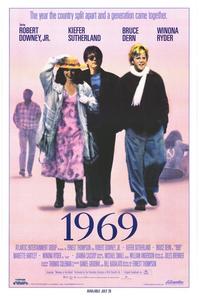
NineteensixtyninefilmIn 1988, the same year that he was forcing Michael J. Fox to snort cocaine in Bright Lights, Big City, Kiefer Sutherland played a far different role in the film 1969.

As you might guess from the film’s title, 1969 takes place in 1969.  Scott (Kiefer Sutherland) and Ralph (Robert Downey, Jr.) have just graduated from high school and are facing a future that involves either going to college or going to Vietnam.  Scott’s older brother, Alden (Christopher Wynne), has already enlisted in the army and has made their father, Cliff (Bruce Dern), proud in a way that Scott knows he will never be able to match.

So, Scott and Ralph make plans to go to college together and basically stay there until the war ends.  But, needless to say, things don’t work out as perfectly as Scott assumed that they would.  Scott and Ralph spend the summer on a road trip, during which time they meet the usual collection of hippies and fascists who always populate films like this.  They also discover that they have less in common than they thought.  Scott is an idealist who is convinced that he can change the world.  Ralph is far more fatalistic, a cynic who hides his pain behind a constant stream of sarcasm.

When Ralph is kicked out of school (and loses his draft deferment as a result), Alden is killed in Vietnam and Scott sees his father in a potentially compromising position with Ralph’s mother (Joanne Cassidy) (on the night of the moon landing no less!), the disillusioned Scott feels that he has to take action.  With the help of Ralph and Ralph’s sister, Beth (Winona Ryder), Scott breaks into the local draft office and tries to destroy all the records.

Now, if you guessed that the police arrive and that Scott and Beth eventually find themselves in a van, driving for the Canadian border, then you’ve probably seen countless other films that were set in the same year as 1969

1969 is a rather predictable film but, at the same time, it’s likable in much the same way that a rerun of Everybody Loves Raymond is likable.  It’s not something you really need to watch but, if you do watch it, you won’t necessarily be filled with regret.  I imagine that one reason why 1969 tends to show up on networks like Antenna and This TV so much is precisely because it is such a thoroughly inoffensive little movie.

The film also features some above average performances.  It’s not surprising that Robert Downey, Jr. and Winona Ryder both give good performances because, to a large extent, their characters mirror their own public personas.  But, considering that he’s best known for playing Jack Bauer in 24, it’s still somewhat surprising to see a much younger Kiefer Sutherland playing such an essentially gentle character and being totally convincing in the role.  (He already had that sexy growl of a voice, however.)  And finally, the film’s best performance comes from Bruce Dern.  Eternally befuddled and confused by the changes around him, Cliff is ultimately the film’s most sympathetic character, even if he wasn’t originally meant to be.

And needless to say, considering that the film is called 1969, it’s got a great soundtrack!

http://www.youtube.com/watch?v=XiNuAFoK-sQ


Embracing the Melodrama Part II #80: Bright Lights, Big City (dir by James Bridges)


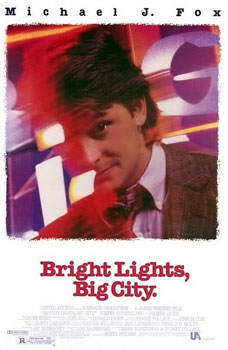
Bright_Lights_Big_CityThe 1988 film Bright Lights, Big City is one of the many films from the late 80s in which Kiefer Sutherland plays a demonic character.  In this case, his character is so demonic that his name is — seriously, check this shit out — Tad Allagash.  Nobody named Tad Allagash has ever been a good guy!

Tad is the best friend of Jamie Conway (Michael J. Fox), an aspiring writer who has moved to New York City from some middle-America farm state and who now has a job as a fact checker at the New Yorker.  Jamie is still struggling to deal with both the death of his mother (played in flashbacks by Dianne Wiest) and the collapse of his marriage to Amanda (Phoebe Cates).  Tad helps out his depressed little friend by taking him out to the clubs and supplying him with so much cocaine that Jamie literally spends the entire film on the verge of having a geyser of blood shoot out from his powder-coated nostrils.

And the thing is, Tad knows that he’s not a good influence on Jamie’s life but he doesn’t care.  Whenever Jamie starts to get a little bit too wrapped up in his self-pity, Tad is there to make a tasteless joke.  Whenever Jamie tries to argue that he and Amanda aren’t really broken up, Tad is there to remind him that Amanda wants nothing to do with him.  Whenever Jamie starts to think that doing all of this cocaine is potentially ruining his life, Tad is there to cheerfully cut another line.  Tad makes no apologies for being Tad Allagash.  He’s too busy having a good time and it’s obvious that Sutherland’s having an even better time playing Tad.  As a result, Tad Allagash becomes the perfect antihero, the bad guy that you like despite yourself.

Unfortunately, Bright Lights, Big City isn’t about Tad Allagash.  You’re happy whenever Kiefer shows up but he doesn’t show up enough to actually save the film.  No, Bright Lights, Big City is the story of Jamie Conway and that’s why the film is a bit of a pain to sit through.  Despite having a great Irish name, Jamie Conway is one of the whiniest characters that I have ever seen in a film.  From the minute he first appears on screen and starts complaining about the failure of his marriage, you want someone to just tell him to shut up.  When he tells an alcoholic editor (Jason Robards) that his latest short story was autobiographical, you nod and think, “So, that’s why it hasn’t been published.”

Of course, since Jamie is the main character, everyone in the film feels sorry for him but he really is just insufferable.  There’s a lengthy scene where Jamie delivers a drunken monologue to a sympathetic coworker, Megan (played by Swoosie Kurtz).  And while Jamie goes on and on about how he first met Amanda and how their marriage fell apart (and how it was all her fault), poor Megan has to sit there and try to look sympathetic.  Personally, I would have kicked Jamie out of my apartment after the first minute of that whiny diatribe.  Megan has the patience of a saint.

There is some curiosity value to watching Michael J. Fox snort cocaine.  (I wonder if contemporary audiences shouted, “McFly!” as they watched Fox sniffing up the devil’s dandruff.)  But otherwise, Bright Lights, Big City is a relic of 80s cinema that can be safely forgotten.

Two Late Reviews: The Legend of Hercules (dir by Renny Harlin) and Pompeii (dir by Paul W.S. Anderson)


As I mentioned in a previous review, I’ve only got a few months left before I’m going to have to make out my list of the 16 worst and the 26 best films of 2014.  With that in mind, I really need to get caught up on reviewing some of the films that might appear on those two lists.  For the most part, I try to review every single movie that I see but, occasionally, a movie or two will slip through the cracks.  And now, with Oscar season approaching but not quite arrived, seems like as good as time as any as to try to get caught up by reviewing two films that came out earlier this year: Renny Harlin’s The Legend of Hercules and Paul W. S. Anderson’s Pompeii.

Hercules_(2014_film)_poster

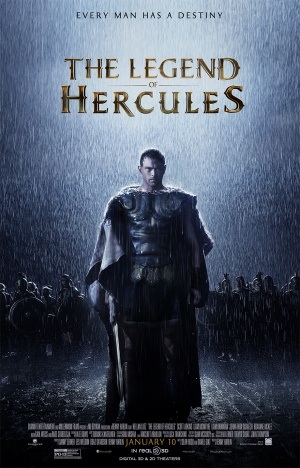
The Legend of Hercules is a film that I first saw with my BFF Evelyn way back in January.  And while I meant to review it after I first saw it, I simply never got around to actually doing so.  Some of that is because, when Kellan Lutz first showed up on screen, Evelyn said, “Nice tits,” and I ended up laughing so hard that I nearly fell out of my seat.  This led to Evelyn spending the entire film trying to make me laugh again and, in between all of the whispering and the giggling, we undoubtedly missed out on a lot of the film.

However, I recently rewatched The Legend of Hercules on Cinemax and I was quickly reminded about the other reason that I hadn’t gotten around to reviewing it.  There’s really just not that much to say about The Legend of Hercules.  It’s just not a very good film but yet it’s not bad in a fun way either.  It’s just boring.  As played by Kellan Lutz, Hercules wanders through the ancient world and he does all the stuff that you would expect Hercules to do.  Actually, he does all the stuff that you would expect any character in a rip-off of 300 to do.  The film could have just as easily been called The Legend of Eammon, an Irishman in Greece.  

In fact, I’d really like to see a movie called The Legend of Eammon, an Irishman in Greece.  Get on it, someone.

According to Wikipedia, The Legend of Hercules had a budget of 70 million dollars, which makes it a bit odd that the film itself just looks cheap and generic.  At one point, Hercules fights a lion and the CGI is so bad that, for a few minutes, the movie looks like one of those senior projects that students occasionally upload to YouTube.  (I was half-expecting to see a comment apologizing for the “crappy special effects” flash across the screen.)  During the film’s many fight scenes, director Renny Harlin does that thing where every punch is shown in slow motion.  It gets annoying after the hundredth time.

A few words about Kellan Lutz.  I happen to like Kellan Lutz.  I think he’s been likable in other roles.  But, in The Legend of Hercules, he really did spend the entire movie looking like he was wishing that he could be anywhere else.  But can you blame him?

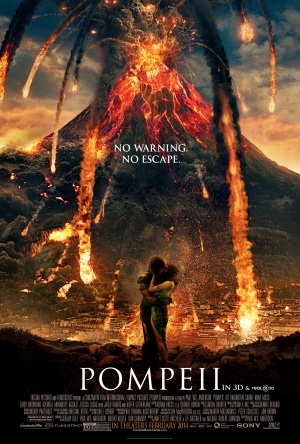
Pompeii-posterFor a far more enjoyable trip into the past, allow me to recommend a film that came out a few months after The Legend of Hercules, Pompeii. 

Now, before I review Pompeii, I should admit that, as you all know, I am a history nerd and, as you all might not know, I’ve always been fascinated by the Roman Empire.  The summer after I graduated high school, I took a trip to Italy and I actually walked through the streets of Pompeii.  My two main memories of Pompeii: while we were touring an ancient brothel, an Australian man lay down on one of the slabs.  My other memory is that it was a very windy day and I was wearing a skirt so I can legitimately say that not only have I visited Pompeii but I’ve flashed Pompeii as well.

Anyway, Pompeii the Movie tells the story of the final days of Pompeii the City.  A Celtic slave and gladiator named Milo (Kit Harrington) is sent to Pompeii where he, in quick order, meets and romances the noble Cassia (Emily Browning), establishes a friendly rivalry with fellow gladiator Atticus (the always intimidating Adewale Akinnuoye-Agbaje), spots the evil Roman General (Kiefer Sutherland) who killed Milo’s mother, and then eventually has to run for his life as a cloud of ash and a river of lava crashes down on Pompeii.

Pompeii is a lot of fun.  Harrington and Browning have a lot of chemistry, all of the actors are obviously having a good time with their melodramatic dialogue, and Kiefer Sutherland was born to play an evil Roman.  As opposed to the Legend of Hercules, Pompeii looks good and the eruption of Mt. Vesuvius is genuinely impressive.  Perhaps best of all, the film actually allows things to play out to their natural and logical conclusion.  For once, history is not changed just to force a happy ending on the viewers and Pompeii is all the better for it!

So, in conclusion: forget about The Legend of Hercules and give Pompeii a chance.  Actually, you’ve probably already forgotten about The Legend of Hercules so just try not to suddenly remember it.  But seriously, Pompeii is better than you might think.

A Quickie With Lisa Marie: Melancholia (dir. by Lars Von Trier)


Let us take a moment to consider the career of film director Lars Von Trier.  Is Von Trier a visionary?  Is he a genius?  Is he an artist who forces us to look at the world in a different way?  Is he one of the major voices working in the world of cinema today?  Or is he just full of crap?  This is the debate that always seems to come up whenever one talks about Lars Von Trier and a pretty good case can be made that the man is both a genius and an idiot, an artist and a charlatan.  How, we ask ourselves, do we reconcile the fact that this man who has directed so many memorable films is also the same man who goes to Cannes and hints that he might be sympathetic to Hitler.  As a result, Von Trier’s films seem to act as both aesthetic statements and as evidence in the never-ending trial to determine whether or not Lars Von Trier is worth all the trouble.  Melancholia — which is currently both playing at theaters and available OnDemand — is the latest exhibit in a long trial.

Melancholia is both the story of the relationship of two sisters (played by Charlotte Gainsbourg and Kirsten Dunst, who deservedly won best actress at Cannes for her performance here) and the story of what happens when a new planet called Melancholia appears in the sky and then promptly starts to move closer to the Earth.

The film is divided into two parts.  The first part takes place over the course of one long night.  Justine (Dunst) and her new husband Michael (Alexander Skarsgard who looks so amazing in a tux) attend a wedding reception at a mansion owned by Justine sister Clare (Gainsbourg) and Clare’s well-meaning but condescending husband John (Kiefer Sutherland).  While Justine and Michael, at first, appear to be the perfect couple, it slowly becomes apparent that the truth is far more complex.  The first part of the film takes its time establishing the characters and how they relate to each other but it never drags, largely because of the chemistry between Dunst and Skarsgard but also because Von Trier proves himself to be far more subtle director here than he’s usually given credit for being.  The first half of the film is full of details — some small and some not — that make us believe that these very familiar actors actually are the characters that they are portraying.  While Von Trier never explicitly show us what’s at the heart of Skarsgard and Dunst’s trouble relationship, he includes enough details that we, as the viewer, can figure it out.  Under Von Trier’s skilled direction, even such little things as Dunst’s constant struggle to keep her dress up take on an added and poignant significance.

In the second half of the film, a depressed Dunst is now living in the mansion with Gainsbourgh and Sutherland.  Despite the fact that Dunst is nearly catatonic, Sutherland has little sympathy for her and makes no secret of the fact that he’s not happy to have her living in his home.  However, things change rather quickly once it is learned that the new planet Melancholia is on a collision course with Earth.  While Sutherland insists that the two planets will not actually collide and Gainsbourgh panics, Dunst starts to find herself oddly rejuvenated by the prospect that the world might end…

If you were dismissive of Von Trier before this movie came out, I doubt watching Melancholia will change your mind.  In many ways, this film epitomizes everything that people tend to hate about his movies.  However, I loved Melancholia.  Visually, it’s beautiful and the film student in me loved the film simply for the many homages to Last Year at Marienbad.  Von Trier gets excellent performance from the entire cast but really, this is Kristen Dunst’s film and she proves that she’s capable of a lot more than just being a Manic Pixie Dream Girl.  Speaking of someone who has battled depression all of her life, I have to say that Dunst gets it right, capturing not only the pain of permanent sadness but also the odd moments of clarity that seem to come with it.  Finally, this is a unique film and it’s unique because Von Trier is a director that’s not afraid to be an egocentric asshole when it comes to telling the story that he wants to tell. 

I could spend hours debating what exactly Melancholia means and I’d probably change my mind several times during the conversation.  However, one thing is for sure: Melancholia is one of the best of films of 2011.