Shattered Politics: The Front Runner (dir by Jason Reitman)


Based (loosely, I assume) on a true story, 2018’s The Front Runner tells the story of a politician named Gary Hart (played by Hugh Jackman).

The year is 1987 and former U.S. Sen. Gary Hart is preparing to announce that he will be seeking the Democratic nomination for the Presidency of the greatest nation of all time, the United States!  (YAY!)  Hart is widely seen as the front runner, for both the nomination and the general election.  He’s got the youth vote sewn up.  He’s energetic.  He’s supposed to be intelligent.  We are told that he is handsome and charismatic.  (I say “told” because, in this film, they seem to be informed attributes as Hugh Jackman is given a truly terrible haircut and his performance here is a bit on the dull side.)  Hart announced his candidacy while standing in the Rocky Mountains.  His wife (Vera Farmiga) is behind him, even if she chooses not to join him on the campaign trail.  His campaign manager (J.K. Simmons) is welcoming new and idealistic volunteers to the campaign headquarters and encouraging them to remember that all of the difficulties of the campaign will be worth it after Gary Hart is elected president.  As for the press, they’re investigating long-standing rumors that Hart is a womanizer.  “Follow me around, you’ll get bored,” Hart says.  So, two reporters from the Miami Herald (Bill Burr and Steve Zissis) do just that they catch a young woman named Donna Rice (Sara Paxton) apparently staying over at Gary Hart’s Florida townhouse.

“It’s nobody’s business!” Hart snaps, when asked about his private life and it’s obvious that the film expects us to take Hart’s side.  The problem, as Hart’s campaign manager points out, is that a lot of people are volunteering for Hart’s campaign and have sacrificed a lot to help him out and now, if Hart doesn’t figure out some way to deal with the story, it looks like it was all for nothing.  Even if Hart didn’t cheat with Rice, he still showed remarkably poor judgment in spending time alone with her in Florida while his wife was back in Colorado.  The film argues that the press went overboard pursuing the story and perhaps they did.  The press tends to do that and really, no politician has any excuse not to realize that.  But, even if we accept the argument that the press acted unethically, that doesn’t exactly exonerate Gary Hart, though this film certainly seems to think that it does.  To a certain extent, this film reminded me a bit of James Vanderbilt’s Truth, in which it was assumed we would be so outraged that Cate Blanchett’s Mary Mapes was fired for producing a story about George W. Bush’s time in the National Guard that we would overlook that Mapes and CBS news tried to build a major story around a bunch of obviously forged documents.

(Of course, if Hart had been running today, I doubt the scandal would have ended his campaign.  If anything, Donald Trump’s personal scandals seemed to play to his advantage when he ran in 2016 and 2024.  To a find a 21st Century equivalent to Hart’s scandal, you’d probably have to go all the way back to John Edwards in 2008.  Of course, Edwards was cheating on his wife while she was dying of breast cancer, which makes Edwards a special type of sleaze.)

As for the film itself, director Jason Reitman tries to take a Altmanesque approach, full of overlapping dialogue and deceptively casual camera moments.  There are a few moments when Reitman’s approach work.  The start of the film, in which the camera glided over hundreds of journalists reporting from outside the 1984 Democratic Convention, was so well-handled that I briefly had hope for the rest of the film.  Reitman gets good performances from dependable veterans like J.K. Simmons and Alfred Molina.  But, at the heart of the film, there’s a massive blank as Hugh Jackman gives an oddly listless performance as Hart.  The film expects us to take it for granted that Gary Hart would have been a good President but there’s nothing about Jackman’s performance to back that up.  It’s odd because, typically, Hugh Jackman is one of the most charismatic actors around.  But, as Gary Hart, he comes across as being petulant and a bit whiny.

It’s an interesting story but ultimately, The Front Runner doesn’t do it justice.


May Positivity: Grace Unplugged (dir by Brad J. Silverman)


The 2013 film, Grace Unplugged, is about Grace Trey (AJ Michalka) and her father, Johnny Trey (James Denton).  Back in the 80s, Johnny was a rock star who had one hit song and then basically wasted away with his career with drugs and alcohol.  Eventually, he got clean and turned his back on rock stardom.  Instead, he started writing and performing faith-based music.  Like her father, Grace is musically talented but, at the age of 18, she is chafing at the idea of living under his strict rules.  Though she plays in his band, she resents the fact that he won’t left her play the songs the way that she wants to.

One day, Johnny is visited by his former manager, Mossy Mostin (Kevin Pollack).  (Never trust anyone named Mossy.)  Mossy explains that, because it was performed by the winner of an Australian singing competition, Johnny’s one hit is suddenly popular again.  Mossy wants Johnny to start recording again.  “None of the religious stuff, obviously,” Mossy says.  Johnny turns Mossy down but Grace, looking for an escape, records her own version of her father’s song and sends it to Mossy.

After she ditches youth group so that she can go to a movie and subsequently gets yelled at about it by her father, Grace decides to leave home and go to Mossy.  Mossy offers to manage Grace.  He also tells Grace that he will be totally taking over her image.  Soon, Grace finds herself in a phony relationship with a vapid television star (Zane Holtz) and she’s told that she has to be willing to sex up her image if she’s going to be a star.  Johnny continually asks her to come back home.  Mossy continually pressures her to stop thinking and just listen to her management.

On the positive side, Grace Unplugged avoids the many of the cliches that one might normally expect to come along with a film like this.  Grace, for instance, doesn’t get hooked on pills or any other drugs.  At worse, she has too much to drink one night and then wakes up with a bad hangover.  Grace may often feel confused about what she wants to do with her career and she doesn’t appreciate her father’s strict ways but she never becomes self-destructive or strung out or any of the other things that usually happen in movies like this.  As well, Mossy is portrayed as being a bit insensitive but he’s not some sort of a mustache-twirling villain.  In fact, the film is smart enough to understand that Grace does have a point about her father.  Johnny is too over-protective and over-controlling, especially when it comes to her music.  He fears that she’ll make the same mistakes that he did but the viewers never have any doubt that she’s not going to.  Grace is often naïve and unsure of what she should do but she’s never portrayed as being weak and I appreciated that.

That said, the film ends on a bit of a heavy-handed note as it reveals itself to be yet another adaptation of the parable of the Prodigal Son.  The film’s script conspires to only leave Grace with two options, which is either abandon her family or abandon stardom.  In the end, the film’s conclusion feels just a little bit too simplistic.

3000 Miles to Graceland (2001, directed by Demian Lichtenstein)


Five thieves show up in Vegas to rob a casino.  The casino is also hosting an Elvis convention so the criminals all dress up like Elvis before trying to pull off their heist.  Since one of the criminals is played by Kurt Russell and Russell famously played Elvis in a made-for-TV movie, it’s a meta joke.  The worst of the criminals is played by Kevin Costner because, in 2001, Costner’s career was dead in the water and he was trying to reinvent himself as some sort of badass character actor.

As a result of a shootout and series of personal betrayals, Russell and Costner are the only two thieves who survive the heist.  Kurt Russell ends up taking all of the money for himself and running off with single mother Courteney Cox.  (Yes, Cox’s then-husband, David Arquette, does have a small role in the movie.)  Costner pursues them, killing anyone who he comes in contact with until it all leads to one final shoot out.

3000 Miles to Graceland is a stupid, stupid movie that was made at the time when every director was still trying to remake Reservoir Dogs and The Usual Suspects.  If you need any proof of how bad this movie is, just consider that it is one of the few Kurt Russell films to never develop a cult following.  There are people who would jump into the mouth of a volcano if Kurt Russell told them to and even they won’t watch 3000 Miles to Graceland.  Even the worst 90s crime films have at least a few people willing to defend them but 3000 Miles to Graceland has been abandoned on the ash heap of crime film history.  Despite having a once-in-a-lifetime supporting cast — Christian Slater, Bookeem Woodbine, Kevin Pollack, Jon Lovitz, Howie Long, Ice-T, and even Paul Anka — 3000 Miles to Graceland has never even received a direct-to-video sequel.

Why is 3000 Miles to Graceland so forgettable?  The heist storyline has been done to death and this film doesn’t bring anything new to the genre.  The only new wrinkle that 3000 Miles to Graceland brings to its familiar story is that the thieves are all dressed like Elvis and that gets old pretty quick.  The other problem is that Kevin Costner is miscast as the psycho villain.  Michael Madsen could have handled the role.  So could Tom Sizemore or Woody Harrelson or just about other actor out there.  But Kevin Costner, who first found fame as a sort of modern-day Gary Cooper, never seems comfortable playing a cold-hearted sociopath.  He makes up for this discomfort by trying too hard.  Comparing his performance here to his more nuanced turn as another criminal in A Perfect World shows just how miscast he was in 3000 Miles To Graceland.

Fortunately, better things were ahead for almost everyone involved in this movie.  Kevin Costner has recently returned to playing the type of roles that made him a star to begin with and Kurt Russell has become an American idol.  Fortunately, 3000 Miles to Graceland is remembered, if at all, as just an unfortunate detour in their otherwise distinguished careers.

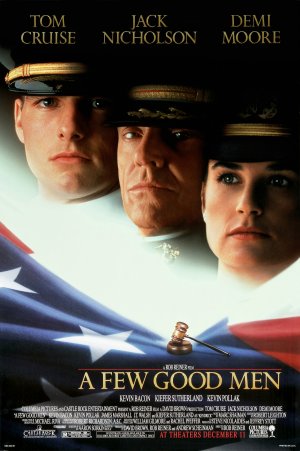
Lisa Watches An Oscar Nominee: A Few Good Men (dir by Rob Reiner)


A_Few_Good_Men_poster

So, late Saturday night, I turned over to TCM’s 31 Days Of Oscar and I was watching the 1992 best picture nominee, A Few Good Men, and I noticed that not only was there only one woman in the entire film but she was also portrayed as being humorless and overwhelmed.  While all of the male characters were allowed to speak in quippy one liners and all had at least one memorable personality trait, Lt. Commander Joanne Galloway (Demi Moore) didn’t get to do much beyond frown and struggle to keep up.

“Hmmmm…” I wondered, “why is it that the only woman in the film is portrayed as basically being a humorless scold?”  Then I remembered that A Few Good Men was written by Aaron Sorkin and it all made sense.  As I’ve discussed on this site before, Aaron Sorkin has no idea how to write woman and that’s certainly evident in A Few Good Men.  Joanne (who goes by the masculine Jo) is the one character who doesn’t get to say anything funny or wise.  Instead, she mostly serves to repeat platitudes and to be ridiculed (both subtly and not-so subtly) by her male colleagues.  You can tell that Sorkin was so busy patting himself on the back for making Jo into a professional that he never actually got around to actually giving her any personality.  As a result, there’s really not much for her to do, other than occasionally scowling and giving Tom Cruise a “that’s not funny” look.

(“C’mon,” Tom says at one point, “that one was pretty good.”  You tell her, Aaron Tom.)

A Few Good Men, of course, is the film where Tom Cruise yells, “I want the truth!” and then Jack Nicholson yells back, “You can’t handle the truth!”  At that point in the film, I was totally on Nicholson’s side and I was kinda hoping that the scene would conclude with Cruise staring down at the floor, struggling to find the perfect come back.  However, this is an Aaron Sorkin script which means that the big bad military guy is never going to have a legitimate point and that the film’s hero is always going to have the perfect comeback.  Fortunately, the scene took place in a courtroom so there was a wise judge present and he was able to let us know that, even if he seemed to be making the better point, Nicholson was still in the wrong.

As for the rest of the film, it’s a courtroom drama.  At Guantanamo Bay, a marine (Michael DeLorenzo) has died as the result of a hazing.  Two other marines (Wolfgang Bodison and James Marshall) have been accused of the murder.  Daniel Kafee (Tom Cruise), Joanne Galloyway (Demi Moore), and Sam Weinberg (Kevin Pollack) have been assigned to defend them.  Jack Ross (Kevin Bacon) is prosecuting them.  Kafee thinks that the hazing was ordered by Col. Nathan Jessup (Jack Nicholson) and Lt. Kendrick (Kiefer Sutherland).

We know that Kendrick’s a bad guy because he speaks in a Southern accent and is religious, which is pretty much the mark of the devil in an Aaron Sorkin script.  We know that Jessup is evil because he’s played by Jack Nicholson.  For that matter, we also know that Kafee is cocky, arrogant, and has father issues.  Why?  Because he’s played by Tom Cruise, of course.  And, while we’re at it, we know that Sam is going to be full of common sense wisdom because he’s played by Kevin Pollack…

What I’m saying here is that there’s absolutely nothing surprising about A Few Good Men.  It may pretend to be about big issues of national security but, ultimately, it’s a very slick and somewhat hollow Hollywood production.  This, after all, is a Rob Reiner film and that, above all else, means that it’s going to be a very conventional and very calculated crowd pleaser.

Which isn’t to say that A Few Good Men wasn’t enjoyable.  I love courtroom dramas and, with the exception of Demi Moore, all of the actors do a good job.  (And, in Demi’s defense, it’s not as if she had much to work with.  It’s not her fault that Sorkin hates women.)  A Few Good Men is entertaining without being particularly memorable.

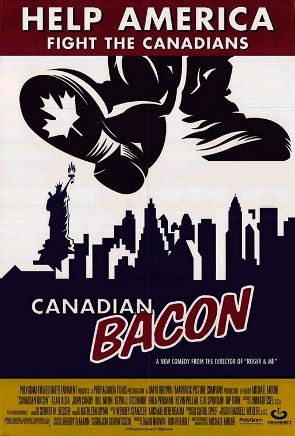
Shattered Politics #57: Canadian Bacon (dir by Michael Moore)


Canadian_Bacon_(movie_poster)

I have mixed feelings about the 1995 films Canadian Bacon.

On the one hand, Canadian Bacon is the only non-documentary to have been directed by Michael Moore.  And I’m just going to admit right now that I don’t care much for Michael Moore.  I think he’s fake.  I think he’s the epitome of the type of limousine liberal who exclusively preaches to the converted and who, when all is said and done, does more harm to his causes than good.  Just because he doesn’t shave, dresses like a slob, and apparently has never been to a gym, that doesn’t change the fact that he’s worth $50 million dollars.  Just because he may claim to be for the workers, that doesn’t keep him from notoriously overworking and underpaying his own employees.  Just because he may make films critical of capitalism, that certainly hasn’t stopped him from investing millions in the very same companies that he claims to oppose. And, quite frankly, it’s hard for me to take seriously a man who rails against income inequality when that man happens to own 9 mansions, none of which are exactly housing the homeless right now.

On the other hand, I love Canada!  Canada has produced some of my favorite actors.  It’s the country that created Degrassi.  It’s the home of Lindsay Dianne and the Becoming A Bolder Being blog!  Seriously, how can you not love Canada?

In fact, if a war ever broke out between American and Canada, I’m not sure who I’d support.  Then again, hopefully Texas will have seceded from the U.S.A. before that happens.  I’m keeping fingers crossed about that.  Hopefully, once we have seceded, our first action will be to declare war on Vermont.  (Not the rest of America, though.  Just Vermont.)

The plot of Canadian Bacon is that the President of the United States (Alan Alda) is suffering from low approval ratings so he decides that America needs to find a new country to be enemies with.  Mind you, the President doesn’t necessarily want to go to war.  Instead, he just wants to have an enemy that he can always be on the verge of going to war with.  After a riot breaks out at a hockey game, the President’s advisors realize that Canada would be the perfect enemy!

(And, while this is played for laughs, there actually is a historical precedent here.  The War of 1812 was basically a result of America’s desire to conquer Canada.)

Anyway, American airwaves are soon full of anti-Canada propaganda and, since Michael Moore thinks everyone in America is an idiot except for him, gun-toting rednecks are soon preparing to do whatever it takes to defend America.  A patriotic sheriff named Boomer (John Candy) decides to invade Canada on his own.  Needless to say, things get even more complicated from there and soon a crazy weapons manufacturer (G.D. Spradlin) is plotting to launch a missile attack on Russia and … oh, who cares?

When Canadian Bacon tries to satirize politics and blind patriotism, it falls flat.  Michael Moore has somehow earned a reputation for being a satirist but, if you actually look at his work, it quickly becomes apparent that he really doesn’t have much of a sense of humor.  The humor in his documentaries is pretty much based on Moore saying, “Look how stupid everyone is except for me!”  Since the people who watch Michael Moore documentaries are usually people who already agree with Michael Moore, they naturally find that to be hilarious because they already think anyone who disagrees with them is a joke.  However, that doesn’t mean that Moore himself is a comic genius.  He’s just a guy telling a joke to an audience that already knows the punchline.

Canadian Bacon is long on righteous indignation but it’s short on anything that would make you want to spend 90 minutes listening to the same point being made over and over again.  Moore did make one good decision, in that he selected Rip Torn to play a crazed general.  Rip Torn can deliver militaristic insults with the best of them.

The few times that Canadian Bacon actually works is when it gently (as opposed to indignantly) satirizes Canada’s reputation for being the most polite (and most hockey-obsessed) place on Earth.  Dan Aykroyd has a great cameo as a Canadian police officer who pulls over Boomer’s truck and politely reprimands him for not including French translations for all of the anti-Canadian graffiti on the side of the vehicle.

Canadian Bacon could have used more scenes like that.

http://www.youtube.com/watch?v=l5l0PD80u9k

Love you, Canada!

http://www.youtube.com/watch?v=8IyxGO4v0yA

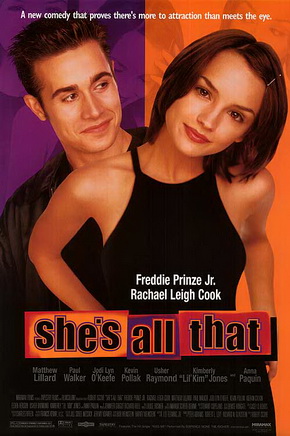
Back to School #58: She’s All That (dir by Robert Iscove)


Shes_All_That

She’s All That, a 1999 high school-set adaptation of My Fair Lady, has a lot to answer for.

When I, as an impressionable 13 year-old first saw this film, I left the theater believing that high school would be full of random, fully choreographed dance-offs.  That, after all, is what happened towards the end of She’s All That.  After watching as handsome jock Zack (Freddie Prinze, Jr.) spent almost the entire movie changing Laney (Rachael Leigh Cook) from an artist into a Prom Queen, the great prom dance-off made for the perfect climax.

I mean, just check it out:

Imagine how disappointed I was, once I finally did reach high school, to discover that it was actually nothing like She’s All That.  There were no big dance numbers for no particular reason.  I went to five different proms and none of them were ever as much fun as the prom at the end of She’s All That.

So thank you, She’s All That, for getting my hopes up.

As for the rest of the film, it’s a guilty pleasure in much the same way as Never Been Kissed.  I was recently doing some research over at the imdb and I was surprised to discover just how many films Freddie Prinze,Jr. made between 1999 and 2002.  For the most part, they’ve all got rather generic names.  What’s funny is that I probably saw most of them because, back then, I would get excited over almost any PG-rated movie that featured a cute guy and had a hint of romance about it.  But, with the exception of She’s All That, I can’t really remember a single one of them.  But you know what?  Freddie Prinze, Jr. may not be a great actor and his films may have basically all been the same but he had a certain something that, when you were 13 or 14, made him the perfect crush.  There was a hot blandness to Freddie Prinze, Jr. that prevented him from being compelling but did make him the perfect star for a film like She’s All That.

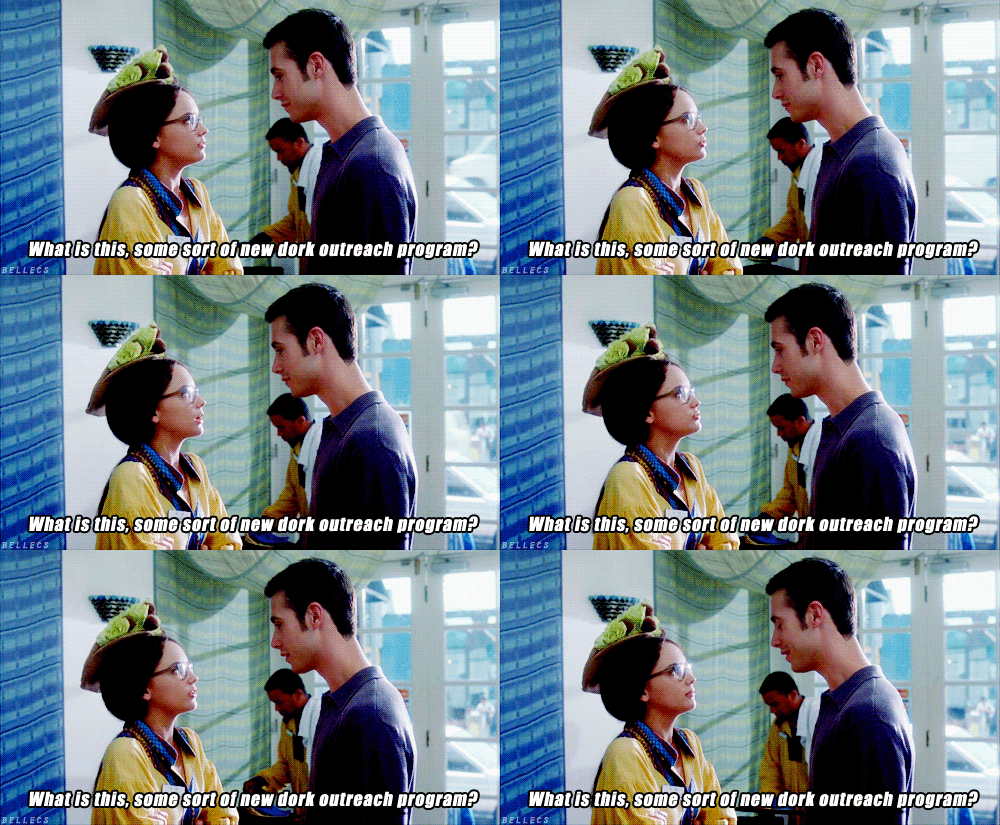
Along with featuring that prom dance-off and being the epitome of a Fredde Prinze, Jr. movie, She’s All That is also remembered for featuring Rachael Leigh Cook as one of the most unlikely ugly ducklings in the history of the movies.  Rachael plays Laney and the entire film’s starting off point is that Zack has made a bet with Dean (Paul Walker, as handsome here as he was in Varsity Blues) that he can turn Laney into a prom queen.  However, it should be a pretty easy bet to win because all Laney has to do is let her hair down, start wearing makeup, and stop wearing her glasses.

Myself, I’m severely myopic.  Usually, I wear contact lenses but occasionally, I may be running late or may not feel like putting my contacts in or maybe I just want to try a different look.  So, occasionally, I’ll wear my glasses and I have to say that, other than a few guys who always make “hot librarian” jokes, everyone pretty much treats me the same regardless of whether I’m wearing my glasses or not.  I do have to admit though that, when I take off my glasses and dramatically let my hair down, I always say that I’m having a She’s All That moment.

Anyway, She’s All That is okay.  I like it but I don’t love it and, to be honest, the film’s main appeal is a nostalgic one.  Freddie Prinze, Jr. and Paul Walker both look good, Rachael Leigh Cook and Jodi Lynn O’Keefe will keep the boys happy, and Matthew Lillard has a few good scenes where he plays an obnoxious reality tv celeb.

And there’s always that dance number!

shes-all-that-dork-outreach-program-rachael-leigh-cook-freddie-prinze-jr