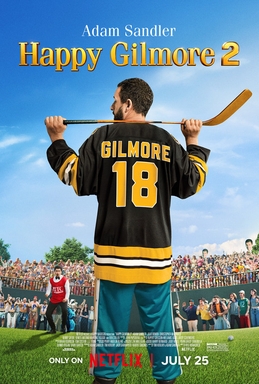
The Films of 2025: Happy Gilmore 2 (dir by Kyle Newacheck)


I love 1996’s Happy Gilmore and, over the past few months, I have very much been looking forward to the release of the long-delayed sequel, Happy Gilmore 2.  Still, I was a bit concerned when I opened the film on Netflix and discovered that the sequel had a nearly two-hour running time.  (The original clocked in at an efficient and fast-paced 90 minutes.)  Comedy is all about timing and, in general, shorter is funnier.  I know that Judd Apatow and Adam McKay might disagree with me on that but let’s be honest.  For all of the acclaim that it was met with, when was the last time you actually felt any desire to rewatch The King of Staten Island?  For that matter, if you have to pick between Anchorman or Anchorman 2, which are you going to pick?  The 90 minute original or the sequel that takes more than two hours to tell essentially the same story?

Having now watched the film, I can say that Happy Gilmore 2 does run a bit too long.  There are a few sequences that could have been trimmed without hurting the film.  I can also say that I thoroughly enjoyed the film.  I laughed more often than not.  It’s a funny film but it’s also a surprisingly touching one.

Taking place 29 years after the first film, Happy Gilmore 2 features an older and slightly more mature Happy.  It also features an older and slightly more mature Adam Sandler and, to its credit, the film acknowledges that.  It doesn’t try to convince us that Sandler and Gilmore are still the young hell-raisers that they once were.  (Happy’s Happy Place has changed considerably.)  I’ve often written that there are two Adam Sandlers.  There’s the youngish Sandler who made silly and often stupid films where he basically just hung out with his friends and didn’t seem to put much effort into anything.  That’s the Sandler who has won multiple Razzie awards.  And then there’s the older and wiser Adam Sandler, the sad-eyed character actor who gives sensitive performances as world-weary characters.  This is the Adam Sandler who seems to be overdue for an Oscar nomination.  If an alien came to Earth and only watched Adam Sandler’s serious films, they would probably think he was one our most-honored actors.  While Happy Gilmore 2 is definitely a comedy, it still features quite a bit more of the serious Sandler than I was expecting.

At the start of the movie, Happy is not in a happy place.  His grandmother has passed away.  His wife, Virginia, was killed by an errant tee shot.  He has four rambunctious sons and a daughter, Vienna (played by Sunny Sandler, who was so good in You Are So Not Invited To My Bat Mitzvah).  After Virginia’s death, Happy gave up golf.  He lost his money.  He lost his grandmother’s house.  Now, he’s working in a grocery store and he’s an almost forgotten figure.  He’s also an alcoholic, keeping bottles of liquor hidden around the house.  (A tiny liquor bottle is hidden in the cuckoo clock.)  And while this film is certainly not Uncut Gems or even The Meyerowitz Stories, Sandler still does a good job of capturing the reality of Happy’s depression.  There’s a true sense of melancholy running through the film’s first hour, as Happy returns to golf to try to make enough money to pay for Vienna to attend a prestigious dance academy.  The second hour, in which Happy leads a team of pro golfers against a team of “extreme” athletes is far more goofier but Happy’s love for his family is a theme that runs through the entire film.

Aging is the other theme that runs through the film.   Forced to play with three younger players (including Eric Andre and Margaret Qualley) at a local golf course, the rusty Happy grimaces when he hears one of them say, “Is he trying to do the Happy Gilmore swing?”  When Happy rejoins the PGA, he discovers that all of the younger players now hit the ball as hard as he used to.  An obnoxious tech bro (Benny Safdie) wants to start a new, extreme golf league, one that will “continue the revolution” that Happy started.  Happy finds himself defending traditional golf and it’s an acknowledgement that both Gilmore and Adam Sandler have grown up and have come to appreciate that not everything needs to change.  Sometimes, you just want to play a nice round of golf on a pretty course without having to deal with the sensory overload of the 2020s.

It’s a funny movie.  Even when he’s playing it straight, Sandler still knows how to deliver a funny line.  Ben Stiller returns as Hal L., who is now an addiction recovery specialist.  (His techniques include ordering people to wash his car.)  Christopher McDonald also returns as Shooter McGavin, having escaped from a mental asylum and now fighting, alongside Happy, to save the game that they both love.  As someone who always felt that Shooter kind of had every right to be upset during the first film, I was happy to see him get a bit of redemption.  Several professional golfers appear as themselves.  A running joke about Scottie Scheffler getting arrested and then forcing all of his cellmates to watch golf made me laugh a lot more than I was expecting it too.

The sequel is full of shout-outs to the first film.  A fight in a cemetery reveals that everyone who died during and after the first film just happens to have a gravestone and it was actually kind of a nice tribute.  (Even the “Get Me Out Of Here” Lady gets a headstone.)  It’s a sequel that truly appreciates and values the legacy and the fans of the first film.  It’s also a sequel that seems to truly love the game of golf, which is not necessarily something that could be said about the first film.

Happy Gilmore 2 is a worthy sequel, even if it is a bit long.  It made me laugh but, at the same time, it was hard not to be touched by the obvious love that Happy had for his family and that they had for him.  (It didn’t hurt that Happy’s daughter was played by Sandler’s daughter.)  In the first film, Happy played golf for his grandmother.  In the second film, he returns to the game for his daughter.  It’s all about family, as Adam Sandler’s unexpectedly heartfelt performance makes clear.
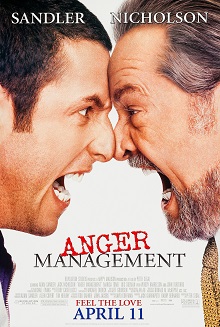
Anger Management (2003, directed by Peter Segal)


Dave (Adam Sandler), a timid man who has never gotten over being humiliated when he was a teenager, is sentenced to anger management after a slight argument on a plane is blown out of proportion by a taser-wielding shy marshal.  His therapist is Dr. Buddy Rydell (Jack Nicholson), whose techniques only seem to exacerbate Dave’s growing anger.  Among Dr. Rydell’s methods are giving Dave an unstable “anger buddy” named Chuck (John Turturro), ordering Dave to get revenge on the guy (John C. Reilly) who humiliated on his as a teenager, and also encouraging Dave to cheat on his girlfriend Linda (Maria Tomei) with a woman (Heather Graham) that they meet at bar.  Dave goes from timid to angry, Dr. Rydell starts dating Linda, and the whole thing is wrapped up with a totally implausible ending.

The idea of the star of Chinatown and Five Easy Pieces co-starring in an Adam Sandler comedy sounds like it should be exhibit #1 when it comes to talking about the decline of American cinema but I’ve always liked Anger Management.  Casting Jack Nicholson as the seemingly insane Dr. Rydell was an inspired choice and Nicholson gives a real performance in the film as opposed to just coasting on his already-established persona.  Anger Management came out a year after Adam Sandler’s first dramatic film, Punch-Drunk Love, and, even though Anger Management is a raunchy comedy from the start to finish, Sandler’s performance actually finds the reality in Dave’s situation.  Sandler plays Dave as being someone who is sincerely trying his best to get through his court-mandated anger management without losing control.  Nicholson and Sandler make for a surprisingly good team.

Of course, it’s an Adam Sandler comedy so it’s not for everyone.  The humor is often crude and the film’s final twist is so ridiculous that it can actually leave you feeling like you might need anger management.  But Anger Management does show how Jack Nicholson improves anything that he’s involved with and it also shows that Adam Sandler can act when he feels like it.  Anger Management also gave us the meme of Jack Nicholson nodding his approval, meaning the film and the performance will live forever.

Late Night Retro Television Review: Monsters 3.7 “Small Blessing”


Welcome to Late Night Retro Television Reviews, a feature where we review some of our favorite and least favorite shows of the past! On Wednesdays, I will be reviewing Monsters, which aired in syndication from 1988 to 1991. The entire series is streaming on YouTube.

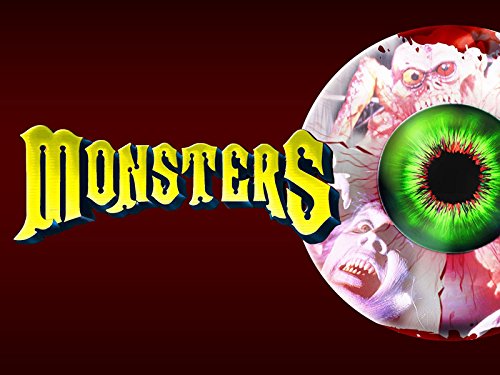
This week, comedians Julie Brown, Kevin Nealon, and David Spade deal with a baby who was born with a lot of very sharp teeth.  Is it a demon or is it just a little blessing?  Let’s find out.

Episode 3.7 “Small Blessing”

(Dir by Roger Nygard, originally aired on November 11th, 1990)

Julie Brown plays the mother of a three-month old baby and, like a lot of new mothers, she is exhausted.  The baby is constantly doing things like crying, crawling out of its crib, and walking on the ceiling.  The baby was also born with over 30 razor sharp teeth and it likes to eat meat.  (I’m going to assume Julie bottle-feeds.)  Julie’s husband (Kevin Nealon) insists that there is nothing wrong with their baby and he gets angry at his wife for constantly being exhausted.  Julie doesn’t know how much longer she can stand being around her carnivorous baby.  When a serial killer (David Spade) shows up at the house, the baby proves its worth.  Julie’s husband comes home to find her holding the baby and talking about how much she loves him.  Awwwww!

This episode was goofy but enjoyable.  It started out as a story about the exhaustion that every mother has felt and then it becomes a comedy in which Julie Brown is the only person who seems to notice that there is anything strange about her baby.  While her husband makes excuses for all of the baby’s odd behavior, Julie knows that it’s not normal for a baby to devour raw meat, climb on a ceiling, and bust its way out of its crib.  But then David Spade shows up with a big knife and the baby proves itself.  Go, Baby!

The main problem is that the baby looked really bad.  It wasn’t a real baby, of course.  It was obviously a puppet and, when I say obviously, I mean it was so clearly a fake baby that it actually worked against the show’s effectiveness.  There was a lot of good things about this episode, including the performances of Julie Brown, Kevin Nealon, and David Spade.  But that fake baby was just too fake to be as effective as it could have been.

Still, this episode proves that even mutant babies deserve love.


Playing Catch-Up: Popstar: Never Stop Never Stopping (dir by Akiva Schaffer and Jorma Taccone)


Have you heard of Conner4Real?

If you haven’t, you’re probably just old or else you don’t keep up with what’s happening in the world of popular music.  His real name is Conner Friel and he used to be a member of the Style Boyz.  Of course, the Style Boyz eventually broke up.  Kid Brain became a farmer.  Kid Contact became a DJ.  And Kid Conner — well, he became Conner4Real and he became a bigger star as a solo artist than he ever was as a Style Boy.  His debut album, Thriller, Also, broke records.

But the follow-up, Connquest … well, Connquest wasn’t quite as acclaimed.  In fact, it was hated by just about everyone.  This is despite featuring classic songs like:

Finest Girl (Bin Laden Song)

Mona Lisa

and Equal Rights (featuring P!nk).

Fortunately, when Conner4Real was facing his greatest existential crisis, a film crew was present to record his struggle.  For those of us who were fascinated by the career of Conner4Real, Popstar: Never Stop Never Stopping is a chance to see how Conner dealt with everything from his terminally ill pet turtle to the elaborate marriage proposal ceremony that led to Seal being attacked by wild wolves.  We would have gotten to see Conner and his manager defeat a swarm of mutant bees but, unfortunately, that happened right after the only time that Conner’s manager asked the film crew to stop filming.

Oh well, these things happen.

So, as you should have guessed from all that, Popstar is not a serious film.  It’s a mockumentary, with the emphasis on mock.  It was also one of the funniest films of 2016, a spot-on parody of the silliness and pretensions of fame.  Conner is a combination of Justin Bieber and Macklemore at their shallowest, a well-meaning but thoroughly empty-headed singer.  In fact, if Conner was played by anyone other than Andy Samberg, he would be so annoying that the film would run the risk of being unwatchable.

But fortunately, Conner is played by Andy Samberg.  It’s hard to think of anyone who plays dumb with quite the same panache as Andy Samberg does.  There are plenty of lines in Popstar that shouldn’t work but they do, specifically because they’re being delivered by Samberg.  He brings just the right amount of sweetly sincere stupidity to the role.  Almost despite yourself, you find yourself hoping that things will work out for Conner and the other Style Boyz.  Conner may not deserve to be as big a star as he is but it was obviously going to happen to some idiot so why not a sincere one?

Samberg is not the only funny person in Popstar.  The movie is full of funny people, from Sarah Silverman to Bill Hader to the always underrated Tim Meadows.  It’s also full of celebrity cameos and I have to admit that I usually tend to cringe when I see too many people playing themselves.  But in Popstar, it works.  One need only rewatch something like Zoolander 2 to see how well Popstar pulls off its celebrity cameos.

Sadly, as funny as Popstar was, it was also one of the biggest bombs of 2016.  (The trailer, it must be said, did not do the film justice.)  However, I expect that it will soon develop a strong cult following.  In a few years, we’ll get a sequel.  It probably won’t be as as good.

Oh well.  These things happen.

Guilty Pleasure No. 24: Walk of Shame (dir by Steven Brill)


I was recently looking over what some of my fellow movie bloggers consider to be the worst films of 2014 and imagine my surprise when I saw that almost all of them had found room to list a little comedy called Walk of Shame.

Now, don’t get me wrong.  I’m not going to argue that Walk of Shame was a great movie or anything like that.  Essentially, it was a dumb comedy that was full of plot holes.  For the most part, it was a film that was specifically designed to appeal to neurotic white people from the suburbs.  Then again, I am a neurotic white girl from the suburbs so maybe that’s why, despite all of the critical disdain and moralistic posturing that was directed towards Walk of Shame, I actually liked it.

In Walk of Shame, Elizabeth Banks plays Meghan, a local TV new correspondent who is being considered for a job with the national network.  However, soon after being informed of this, Meghan returns to her apartment and discovers that her boyfriend has left her.  Then she gets a call informing her that the network is leaning towards another candidate.  Depressed, Meghan puts on a skin-tight yellow dress, goes out to a club with her best friend (Gillian Jacobs), ends up drinking way too much (much like me, Meghan doesn’t have much of a tolerance when it comes to alcohol), and finally ends up meeting an aspiring writer named Gordon (Jason Marsden) and going back to his apartment with him.

The scenes where Meghan and Gordon drunkenly fool around before eventually having sex are actually surprisingly fun. Marsden and Banks have a really playful chemistry throughout this entire film.  You like both of their characters and it’s fun to see them together.  In fact, Jason Marsden, who I had previously assumed was a bad actor on the basis of his work in The Butler and Straw Dogs, gives a truly charming performance in his film, turning Gordon into both the ideal one night stand and the ideal boyfriend.

The next morning, Meghan gets a call informing her that the network has decided against the other candidate and they want to interview her for the job.  She’s told that she only has a few hours to get down to the station.  After sneaking out of Gordon’s apartment, Meghan discovers that not only has her car been towed but her purse and all of her money was also in the backseat.  (Not to mention the fact that she left her phone back in Gordon’s apartment…)  So now, still wearing that yellow dress, Meghan has to try to make her way across Los Angeles, get back her car, and get to her interview in time.

And, of course, this means that Meghan has to deal with drug dealers, simple-minded policemen, and snooty bus drivers.  Admittedly, there’s not a single problem that Meghan couldn’t have solved through the use of common sense but sometimes you have to be willing to cut a film a little slack.

Walk of Shame has a lot of flaws but I still enjoyed it, mostly because I’ve been there.  I may not have been there to the extreme that Meghan finds herself being there but I’ve still been there.  Elizabeth Banks is one of my favorite actresses and her chemistry with Jason Marsden generates enough good will to help the film get over a few rough patches.

And, for that reason, Walk of Shame is my favorite guilty pleasure of 2014.

Previous Guilty Pleasures

  1. Half-Baked
  2. Save The Last Dance
  3. Every Rose Has Its Thorns
  4. The Jeremy Kyle Show
  5. Invasion USA
  6. The Golden Child
  7. Final Destination 2
  8. Paparazzi
  9. The Principal
  10. The Substitute
  11. Terror In The Family
  12. Pandorum
  13. Lambada
  14. Fear
  15. Cocktail
  16. Keep Off The Grass
  17. Girls, Girls, Girls
  18. Class
  19. Tart
  20. King Kong vs. Godzilla
  21. Hawk the Slayer
  22. Battle Beyond the Stars
  23. Meridian