In this 1994 made-in-Canada movie, Anthony Denison plays John Gotti. We watch as he goes from being a street boss to Paul Castellano to assassinating Castellano so that he can take over the Gambino crime family. Gotti thinks that he’s the king of New York and he’s convinced that no one will ever bring him down. U.S. Attorney Diana Giacalone (Lorraine Bracco) is determined to prove him wrong. She becomes the first of many prosecutors to try to get Gotti and Gotti reacts by having his attorney launch a series of outrageously misogynistic attacks against her. Gotti doesn’t just want to defeat Diana. He also wants to humiliate her. Diane may have the evidence but Gotti’s got the money. Who will get Gotti?
Now, I guess I could argue here that the horror aspect of this film comes from the crimes that Gotti commits. And it is true that we see Gotti kill a number of people. He’s a sadistic killer, the type who will shoot someone twenty more times than he needs to. As the last of the truly flamboyant gangsters, Gotti would go on to become something of a pop cultural institution. But one should not overlook the fact that, for all of his charisma and bravado, John Gotti was not a nice guy. Of course, I should also point out that none of that charisma is really present in Anthony Denison’s performance as Gotti. As played by Denison, John Gotti — the so-called Teflon Don whose greatest strength was his shamelessness — comes across as being a little boring.
Actually, the scariest thing about this film is Lorraine Bracco’s performance as Diana Giacalone. Bracco does a lot of yelling as Giacalone. Sometimes, it’s understandable. Giacalone is portrayed as being someone who grew up on the same tough streets as Gotti and who resents people like Gotti and the Mafia giving a bad name to Italians in general. The problem is that Bracco yells her lines even when there’s no reason to be yelling. At one point, she discovers that someone screwed up her lunch order and she screams about it as if the world is ending. Visiting her mother (Ellen Burstyn) for the holidays, Giacalone yells at her family. When the verdict comes in, Giacalone yells some more. The yelling is pretty much nonstop and, as a result, one starts to feel that the other U.S. attorneys might have a point when they say that Giacalone is a loose cannon. The film tries to present her as being a strong, no-bullshit woman who is going up against an army of misogynists but there’s more to being strong than just yelling. It would be such a big deal if the film had given her a personality beyond yelling but it doesn’t. I blame the script more than I blame Lorraine Bracco, who can be a very good actress when cast in the right role.
GettingGotti pretty much hits every Mafia cliche. Whenever anyone drives around the old neighborhood, Italian string music plays. There’s a moment where Giacalone yells that her goal is to make sure that people understand that the Mafia isn’t “Al Pacino looking soulful” in The Godfather. I had to wonder if Giacalone had ever actually watched The Godfather. Seriously, an Italian attacking The Godfather? Who does she think she is, Joe Columbo?
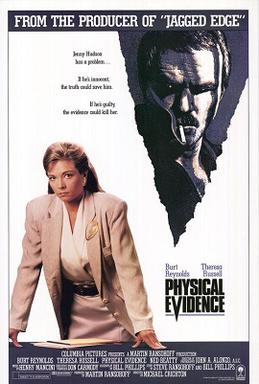
Ex-cop Joe Paris (Burt Reynolds) is arrested for the murder of a small-time criminal. Joe swears that he’s being framed but his public defender, Jenny Hudson (Theresa Russell), isn’t sure that she believes him. While Jenny’s boyfriend (Ted McGinley) makes a fortune trading stocks and Joe’s former mistress (Kay Lenz) tries to keep her mobster boyfriend from finding out about the affair, Jenny tries to outsmart prosecutor James Nicks (Ned Beatty) and Joe tries to find the real killer.
Tubi sent me to this film after I finished up RawJustice. When I saw that it was a Burt Reynolds films, I figured that I would take a chance with it but this one turned out to be one of Burt’s lesser films. Joe Paris feels like he might be distantly related to the cop that Burt played in Sharky’s Machine but PhysicalEvidence doesn’t have any of that movie’s style or grit. Burt doesn’t come across like he wants to be in the movie and he and a very miscast Theresa Russell have next to zero chemistry onscreen. This was Michael Crichton’s last film as a director and he directs in a stolid, made-for-television manner.
Supposedly, this was originally meant to be a sequel to the thriller JaggedEdge, with Glenn Close and Robert Loggia reprising their roles from the earlier film. When that fell through, the movie was refurbished into PhysicalEvidence, with Theresa Russell and Burt Reynolds replacing Close and Loggia. I think the film would have worked with Close and Loggia because, based on JaggedEdge, they were believable as people who had a close relationship and would do anything to help each other. Burt Reynolds and Theresa Russell come across like they can’t even stand to be in the same room together. Better get a new lawyer, Burt! This one seems like she might be planning on framing you herself.
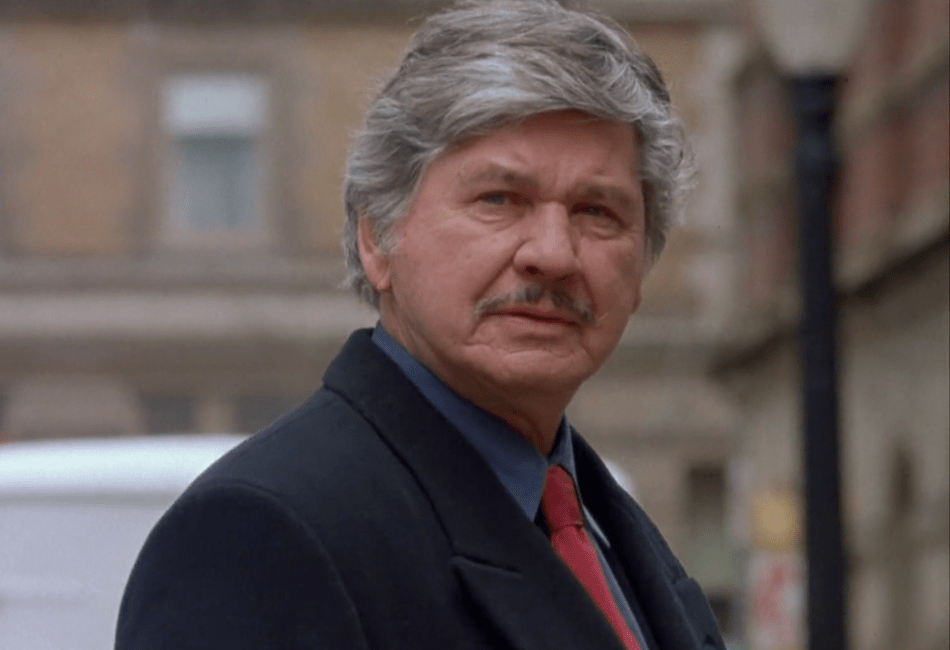
Picture it…it’s 1992 or 1993 and I’m back at my local Hastings Entertainment superstore browsing through an entertainment magazine. Surprisingly, I came across a bit of entertainment news that a 71 year old Charles Bronson had accepted an offer of $5 million to reprise his Paul Kersey character for a fifth time. I couldn’t help but wonder what possible direction that they could take the series that would be interesting. I didn’t see anything else about the movie for the next year or so, and then it showed up some time in 1994 available for rent at that same Hastings Entertainment superstore. As far as I know, it never played in theaters in Arkansas, although it did play in some theaters in other parts of the country prior to going to home video. I immediately rented the film, somewhat apprehensive of what it would be….
DEATH WISH V: THE FACE OF DEATH, begins with Paul Kersey (Charles Bronson) back in New York. We first see him, looking quite dapper I might add, walking down the street in the garment district. He’s on his way to see his latest girlfriend, fashion designer Olivia Regent (Lesley Anne-Down), whose fashion show is currently underway. You immediately feel sorry for Ms. Regent as you know her prospects for survival are somewhere between slim and none since Kersey’s her man. It doesn’t help matters when her ex-husband, awkwardly impotent mobster Tommy O’Shea (Michael Parks) shows up and starts physically abusing her and her employees. You see, O’Shea is trying to force his ex-wife to use her fashion business to help him launder money from his various criminal activities. Kersey tries to convince Olivia to go to District Attorney Brian Hoyle (Saul Rubinek) to try to put O’Shea away. Unfortunately, there’s corruption in the D.A.’s office in the form of Hector Vasquez (Miguel Sandoval), who passes the information back to O’Shea. From this point forward, Ms. Regent’s life is in serious jeopardy and we all know Kersey’s record of keeping his women alive isn’t that great. I won’t give the details away, but let’s just say that events conspire so that the cursed Kersey will have to resume his old vigilante ways in pursuit of a justice that can never be provided to him by the law.
I remember vividly my first ever viewing of DEATH WISH V back in 1994. I put the videotape in the VCR and watched several previews that looked crappy and didn’t give me a lot of hope for the movie. And then it started, and I have to admit I enjoyed it from the very beginning to the end. I guess my expectations were so low that it was a major relief when I realized that it was a reasonably well-made, audience satisfaction movie designed for people like me who simply enjoy seeing Bronson acting as an instrument of justice. I thought Bronson looked good for an action star over 70 years old. I really liked the movie’s sense of humor. Michael Parks overacted to the point of parody as O’Shea, and the character of Freddie Flakes (Robert Joy) was especially fun as a hitman with major dandruff problems. And there was something about Charles Bronson that was different in comparison to some of the earlier entries. Then I realized what it was, Bronson was having fun. He took out the bad guys with things like poisoned cannolis and exploding soccer balls, all with a twinkle in his eyes. In the 70’s, Bronson made several movies where his characters had that twinkle. It was nice to see it back. Bad things happened of course, but director Allan A. Goldstein kept a tone of black comedy that suited the movie and its aging star well.
Even in 1994, watching DEATH WISH V felt like the end, not just of the DEATH WISH series, but of Bronson’s time as a movie star. As his biggest fan, that made me kind of sad. He would only make 3 more TV movies after this, those being the FAMILY OF COPS TV movies. And while there are some who don’t like DEATH WISH V and seem to go out of their way to put it down, I’m exactly the opposite. To me, DEATH WISH V: THE FACE OF DEATH is a gift to Charles Bronson fans and an enjoyable end to his signature series!
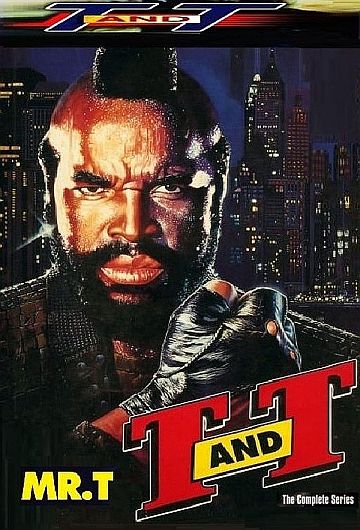
Welcome to Retro Television Reviews, a new feature where we review some of our favorite and least favorite shows of the past! On Fridays, I will be reviewing T. and T., a Canadian show which ran in syndication from 1987 to 1990. The show can be found on Tubi!
This week, season 2 begins with a supesized episode.
Episodes 2.1 through 2.4 “Straight Line”
(Dir by George Mihalka, originally aired on October 24, 1988)
Straight Line, the second season premiere of T & T, is one story that is told over the course of four, 30-minute episodes. According to both Wikipedia and the IMDb, all four of those episodes aired on October 24th, 1988. To me, that would seem to suggest that Straight Line originally aired as a made-for-TV movie and that it was later split up into four episodes for syndication. It’s something that happens with a lot of shows, especially when it comes to season premieres. Straight Line was also apparently released, direct to video, as a stand-alone film in 1990 and you have to wonder how many people ended up renting it without realizing that they were spending their money on a super-sized episode of T & T.
The second season begins with some changes to the opening credits. Most of the supporting cast — including Decker, Aunt Martha, Sophie, and Detective Jones — no longer appear in the opening credits. (Decker and Aunt Martha do appear in the episodes but both David Nerman and Jackie Richardson are credited as being “guest stars.”) Instead, it appears that there are now only three regular members of the cast — Mr. T, Alex Amini, and Sean Roberge as a new character named Joe Casper. (Roberge previously appeared during the first season, playing a character named Fabian.)
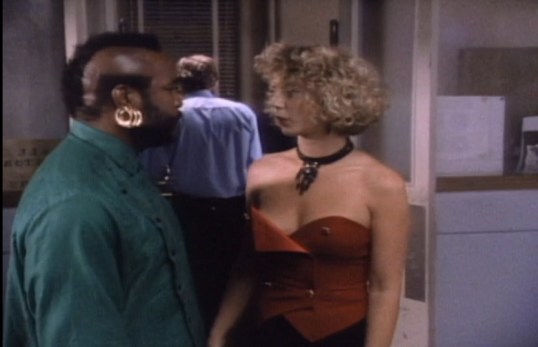
Joe Casper is a teenager who is in a bit of trouble. He’s gotten involved with a neighborhood gang known as The Future and when the Future disrupts a campaign event for a reverend who is seeking to become Toronto’s first black mayor, it leads to a bomb going off and killing Joe’s mother. Distraught by what’s happened, Joe attempts to jump off a bridge but T.S. Turner (who was at the rally) approaches Joe and says, “Take it easy, little brother,” and that’s all Joe needs to hear to turn himself into the police. Joe is going to need a good lawyer so T.S. calls Amy, who rushes over the police station and….
OH MY GOD, WHAT IS AMY WEARING!?
Amy explains that she was at a banquet when T.S. called but still, I would probably put on a coat or something before heading over to Toronto’s dirtiest police station.
Anyway, Amy is able to keep Joe out of jail. Joe is sent to a juvenile rehabilitation center that is run by Dr. Hammel (Kenneth Welsh). Dr. Hammel is an ally of the preacher who is running for mayor and everyone thinks that Dr. Hammel is a good and devoted social activist. Of course, the audience automatically knows that Dr. Hammel is the bad guy because he’s played by Kenneth Welsh, who I imagine is best-known in America for playing the totally evil Windom Earle in Twin Peaks.
T.S. investigates The Future and discovers that there started out as a neighborhood watch before being transformed into a bunch of Neo-Nazis. He also discovers that Dr. Hammel is the one who is behind the organization. T.S. and Amy have to expose Hammel and they better hurry because the preacher running for mayor has been assassinated and Hammel has just announced that he’s running for mayor of Toronto!
This all may sound pretty exciting but the second season premiere is actually a bit dull. The main problem is that, as opposed to the first season, T.S. doesn’t get to do much in the episode. He’s rather subdued and there’s none of the quirkiness that made the character so memorable during the first season. He doesn’t talk about his love for cookies. He hardly calls anyone, other than Joe, “brother.” There’s not even a scene of him hitting a punching bag. It’s disappointing! As well, he and Amy were separated for the majority of the show, which kind of goes against the whole idea of them being T and T. Instead, the majority of the episode was devoted to introducing Joe. The episode ended with Joe, tears streaming down his face, walking away with T.S. and apparently renouncing his former affiliation with The Future. Since Joe is in the opening credits now, I assume he’s going to become T.S.’s ward for at least the next few episodes.
Hopefully, the next episode will features T.S. acting more like T.S. Otherwise, this is going to be a long season.
Sitting off the coast of Delaware, Plum Island seems like the perfect place to live. The people are friendly. The town is small and quaint but definitely inviting. There are plenty of horses, for those who like to ride. The island’s one mailman is a welcome sight, dropping off mail everyday and giving everyone a friendly wave.
The only problem with Plum Island is that, as pretty as it may be, it is also the home to two feuding Irish families. Patrick O’Flynn (Kenneth Welsh) and Seamus Muldoon (Richard Fitzpatrick) have been enemies for as long as anyone can remember. Their feud has gone on for so long that its doubtful anyone even know what started it all. The two families have an uneasy peace up until the breakout of the zombie apocalypse. The O’Flynns want to kill every zombie that shows up on the island. The Muldoons, on the other hand, want to keep the zombies as pets and workers until a cure for their condition can be found. Eventually, Patrick O’Flynn turns out to be so reckless in his mission to destroy the undead that he’s exiled from the island. Even his own daughter, Janet (Kathleen Munroe), supports sending Patrick off to the mainland.
However, no sooner has Patrick been exiled then he hooks up with a bunch of AWOL National Guardsmen, who are weary of spending the rest of their days chasing the undead. Patrick leads them back to Plum Island, hoping to use them to destroy the the Muldoons forever.
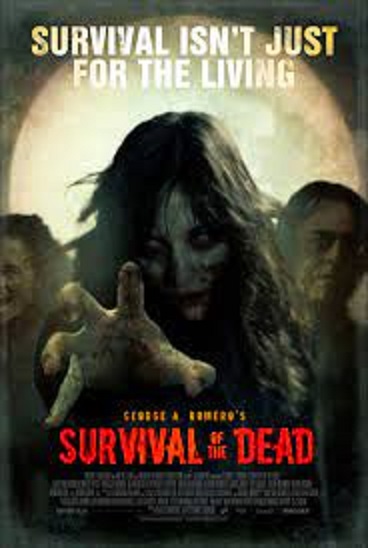
Released in 2010, Survival of the Dead is both the final entry in George Romero’s Dead films (which started way back in 1968 with the classic Night of the Living Dead) and it was also Romero’s last completed film as a director. (Romero died in 2017, while in pre-production on a film called Road of the Dead.) Unfortunately, Survival of the Dead was not warmly greeted by critics or audiences, many of whom felt that Romero was simply rehashing concepts that he had already fully explored in the previous Dead films.
To a certain extent, those critics have a point. There are a lot of flaws with Romero’s final film, from the obviously low budget to the inconsistent performances. (Welsh, Fitzpatrick, and Munroe are all well-cast and give good performances but the National Guardsmen are all forgettable at best.) At the same time, there’s enough weird moments in Survival of the Dead to make it watchable. Plum Island is a memorably surreal location. The undead of Plum Island continue to exhibit the same behavior in death that they did in life. The mailman still tries to deliver mail. Another zombie continues to ride her horse across the island. It’s only when they sense the living amongst them that they turn deadly. As with all of Romero’s Dead films, the living dead may be dangerous and relentless but the truly scary characters in the film are the living humans who, even in the middle of the end of the world, cannot set aside their differences long enough to work together. The film’s final shot, which suggests that it takes more than death to end a blood feud, is so striking that it makes up for a lot of the weaker moments that came before it.
In the end, the most interesting thing about Survival of the Dead is that it’s more of a western than a traditional horror movie, featuring two warring families fighting on horseback and battling to control the land. Romero often said that he felt trapped by his reputation as a horror filmmaker and that he was actually interested in all genres of film. With Survival of the Dead, Romero finally got to make a Western. The end result is uneven but still has enough interesting moments to make it worth watching.
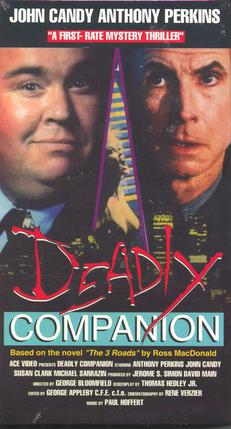
Deadly Companion starts with John Candy sitting in a mental institution and snorting cocaine while happily talking to his roommate, Michael Taylor (Michael Sarrazin). Michael has been in the institution ever since the night that he walked in on his estranged wife being murdered. Because of the shock, he can’t remember anything that he saw that night. When his girlfriend Paula (Susan Clark) comes to pick Michael up, Michael leaves the institution determined to get to the truth about his wife’s murder. Once Michael leaves, John Candy disappears from the movie.
Michael suspects that his wife was killed by her lover, Lawrence Miles (Anthony Perkins) but there is more to that night than Michael is remembering. Deadly Companion is a typical low-budget shot-in-Toronto thriller from the early 80s, with familiar Canadian character actors like Michael Ironside, Al Waxman, Kenneth Welsh, and Maury Chaykin all playing small roles. Michael Sarrazin is a dull lead but Anthony Perkins gets to do what he did best at the end of his career and plays a thoroughly sarcastic bastard who gets the only good lines in the film.
What’s interesting about Deadly Companion isn’t the predictable plot and it’s certainly not Michael Sarrazin. Instead, what’s strange is that several cast members of SCTV show up in tiny supporting roles, though none of them get as much of a chance to make as big an impression as John Candy. Deadly Companion is a serious thriller that just happens to feature Candy, Joe Flaherty, Eugene Levy, Catherine O’Hara, and Dave Thomas. It’s strange to see Michael Sarrazin trying to figure out who killed his wife while Eugene Levy loiters in the background. It leaves you waiting for a punchline that never comes.
The SCTV people are in the film because it was directed by George Bloomfield, who also directed several episodes of SCTV. Since this film was made before SCTV really broke into the American marketplace, it was probably assumed that no one outside of Canada would ever find the presence of John Candy in a dramatic murder mystery distracting. Of course, when Deadly Companion was later released on VHS in the late 80s, Candy and the SCTV crew were all given top billing.
To quote Geoffrey Chaucer, “All good things must come to an end.”
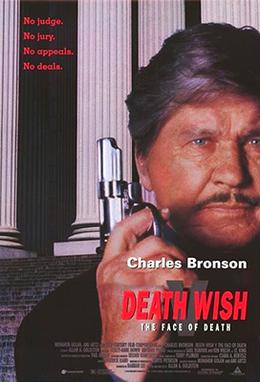
Death Wish V: The Face of Death marked the end of the original Death Wish franchise, concluding the violent saga of Paul Kersey 20 years after it began. It probably should have ended sooner.
After the box office failure of Death Wish IV and the subsequent bankruptcy of Cannon Films, future plans for the Death Wish franchise were put on hold. After the collapse of Cannon, Menahem Golan started a new production company, 21st Century Film Corporation. In 1993, needing a hit and seeing that the previous Death Wish films were still popular on video, Golan announced that Paul Kersey would finally return in Death Wish V: The Face of Death. Charles Bronson also returned, though he was now 72 years old and in poor health. Death Wish V would also mark the end of Bronson’s feature film career. He would make appearances in a few television movies before subsequently retiring from acting.
Death Wish V finds Paul in the witness protection program. His latest girlfriend, Olivia (Lesley-Anne Down), just happens to be the ex-wife of a psychotic mobster named Tommy O’Shea (Michael Parks). Throughout the entire franchise, the Death Wish films argued that crime is so out of control that no one was safe and that Paul had no choice but to pick up a gun and shoot muggers. But, judging from Death Wish V, Paul just seems to have incredibly bad luck. What are the odds that a mild-mannered architect would lose his wife, his maid, his daughter, his best friend from the war, his next two girlfriends, and then end up dating the ex-wife of New York City’s craziest gangster?
The district attorney’s office wants Olivia to testify against her ex-husband so Tommy gets his henchman, the dandruff-prone Freddie Flakes (Robert Joy), to kill her. Looks like it’s time for New York’s favorite vigilante to launch a one-man war against the Mafia!
The only problem is that New York’s favorite vigilante is too old to chase people down dark alleys and shoot them. He has to get creative, which means using everything from poisoned cannoli to a vat of acid to take out his targets. One gangster is killed by an exploding soccer ball!
With both Bronson and Lesley-Anne Down giving an indifferent performances, it is up to the supporting cast to keep the movie interesting. Appearing here after his bravura turn as Jean Renault in Twin Peaks but before Robert Rodriguez and Quentin Tarantino introduced him to a whole new generation of filmgoers, Michael Parks is flamboyantly evil as Tommy O’Shea and injects the movie with what little life that it has. Speaking of Twin Peaks alumni, Kenneth Welsh (who played Windom Earle in the last few episodes of season 2) plays this installment’s understanding police detective. Saul Rubinek plays the district attorney who is willing to look the other way when it comes to killing gangsters.
Dull and cheap-looking, Death Wish V was a box office bomb and it brought the original franchise to a definite end. Will the Eli Roth/Bruce Willis reboot of Death Wish also lead to a reboot of the franchise? Time will tell!
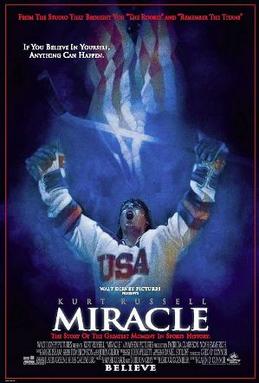
Like all good people, I’m currently obsessed with the Winter Olympics. Earlier this week I asked a couple of friends if they could recommend some good Winter Olympics movies. A lot of movies were suggested but, without fail, everyone thought I should see Miracle. (A lot of people also suggested Cool Runnings, which I’ll be watching next week.) Having watched Miracle earlier today, I can see why everyone recommended it.
The year is 1980 and two hockey teams are about to face off at the Winter Olympics in upstate New York. (The location, to be exact, is Lake Placid. Fortunately, the giant alligators are nowhere to be seen.)
On one side you have the Russian team (or the Soviets as they were known back then). They are widely considered to be one of the greatest hockey teams in history. They are big, fierce, and determined. Coming from a system that has declared individuality to be a crime against the state, the Soviet team plays like a machine. The Soviets have won the gold in the last four Olympics. As one American coach puts it, their greatest strength is that every other hockey team in the world is terrified of them.
On the other side, you have the American team. However, this isn’t the type of American dream team that one would expect to see today. In 1980, professional athletes were not allowed to compete on the U.S. Olympic team. Instead, the 1980 hockey team is made up of amateurs and college players. Unlike the Soviet teams, the American don’t have a government that grooms and supports them. Instead, win or lose, they have to do it on their own.
Of course, it’s not just two hockey teams that are about to face off. It’s also two super powers and two very different ways of life. In 1980, the U.S. and the Soviet Union were the two most powerful rivals in the world. The Soviets were trapped in an endless and unpopular war in Afghanistan. Meanwhile, in the U.S., the economy was shaky, American citizens were being held hostage in Iran, and an ineffective President gave long-winded speeches about how unhappy everyone in the country appeared to be. Both countries needed a victory but only one could win.
And it would take a miracle for that winning team to be American…
I don’t think it requires a spoiler alert to tell you that’s exactly what happens. I mean, after all, I’m reviewing a film called Miracle! On top of that, it’s based on true events. The U.S. hockey team — made up of college students and led by Coach Herb Brooks (played, in one of his best performance, by Kurt Russell) — not only managed to defeat the highly favored Soviet team but they went on to win the gold medal.
Even if you didn’t know that the Americans beat the Russians, you would never have any doubt about how Miracle is going to end. Miracle is a film that utilizes almost every sports film cliché but it manages to do so with such sincerity and such style that you don’t mind the fact that the movie doesn’t exactly take you by surprise. Is there any actor who is as good at project sincerity and human decency as Kurt Russell? Whenever he says that he’s going to make his team into champions, you believe him. When he says that he’s being hard on them because he wants them to be the best, you never doubt him or his techniques. When he says that he’s proud of his team and his country, it brings tears to your eyes. If there’s ever a movie that deserves a chant of “USA! USA! USA!,” it’s Miracle.
— Dale Cooper (Kyle MacLachlan) in Twin Peaks 2.22 “Beyond Life and Death”
“The Log Lady stole my truck!”
— Pete Martell (Jack Nance), same episode
“Some of your friends are here.”
— The Man From Another Place (Michael Anderson), same episode
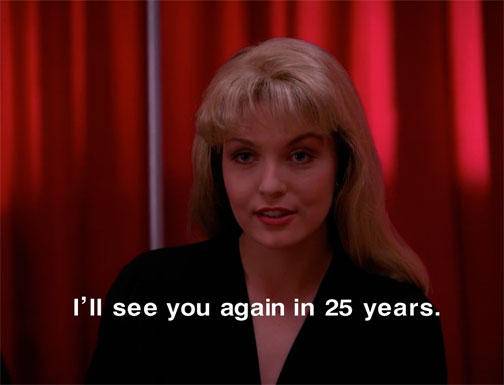
“I’ll see you again in 25 years.”
— Laura Palmer (Sheryl Lee), same episode
Here we are.
Starting exactly one month ago, we started our Twin Peaks recaps. I handled some, Leonard handled some, and Jeff handled some. Gary added a post on David Lynch’s first three short films. Val shared music videos that were either inspired by Lynch or directed by Lynch himself. Jeff devoted his Movie a Day posts to reviewing films that all had a Twin Peaks connection. As Leonard put it on twitter, projects are fun and I know we certainly had a lot of fun putting all of this together.
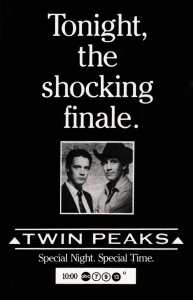
But, all good things must come to an end and, at least until the third season premieres on Showtime later this month, we have reached the end of Twin Peaks. Episode 30 brought the story to a temporary end. (The movie, Twin Peaks: Fire Walk With Me, was a prequel about the last days of Laura Palmer. It’s a haunting film and one that we’ll look at tomorrow but, at the same time, it doesn’t offer up any answers to any of the questions that the finale left hanging.)
A little history: Twin Peaks was a huge success during its first season but, during the second season, ratings plunged. According to the book, Reflections: An Oral History of Twin Peaks by Brad Dukes, neither David Lynch nor Mark Frost were as involved during the second season as they had been during the first. As compared to the genuinely unsettling first season, the second season struggled to find its voice. Was it a mystery? Was it a broad comedy? Was it a show about the paranormal or was it a soap opera? It was all of that and, for many people, that was too much. Today, of course, audiences are used to quirkiness. They’re used to shows that straddle several different genres. It’s no longer a revolutionary idea to be openly meta.
But in 1991, Twin Peaks was the show that ABC both didn’t know what to do with and, by the end, didn’t really want. It was regularly moved around the schedule and, often, weeks would pass without a new episode. Consider this: nearly two months passed between the airing of The Path to the Black Lodge and the final two episodes of the show. (Miss Twin Peaksand Beyond Life and Death were both aired on June 10th, 1991.)
For the final episode, David Lynch returned to direct and, though hardly anyone saw it when it originally aired, it’s an episode that left such an impression that — 25 years later — Showtime agree to bring the series back. The third season of Twin Peaks will premiere later this month but until then, let’s go ahead and recap Beyond Life and Death.
One last time, we open with Angelo Badalamenti’s beautiful theme music and those haunting shots of Twin Peaks.
We start at the sheriff’s station, with Lucy (Kimmy Robertson) and Andy (Harry Goaz) having a moment. Lucy talks about how scared she was when the lights went out and then says she found herself wondering what would happen if they were stuck in an elevator in the hospital and she went into labor. Andy replies that, if that happened, he would deliver the baby “in front of God and everyone.” Awwwww!
In Harry’s office, Cooper (Kyle MacLachlan) and Hawk (Michael Horse) stare at the cave drawing while Harry (Michael Ontkean) says that he has deputies in three counties looking for Windom Earle. Windom appears to have vanished. Cooper replies that the only hope they have of finding Windom and Annie is in the map.
“Fire walk with me,” Cooper says, softly, “Fire walk with me.”
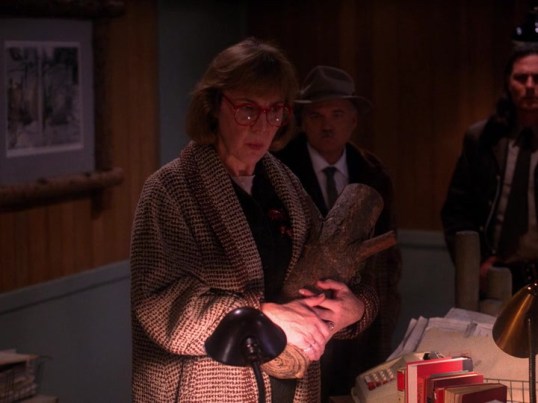
Pete (Jack Nance) steps into the office and announces that the Log Lady stole his truck. I love the way that Jack Nance delivers the line, “The Log Lady stole my truck!” (Sadly, Nance was murdered just a few years after the end of Twin Peaks.) Pete says that, when last seen, the Log Lady was driving into Ghostwood Forest.
“Pete,” Cooper announces, “the Log Lady did not steal your truck. The Log Lady will be here in one minute.”
“12 rainbow trouts in the bed,” Pete says.
This triggers Harry’s memory. He announces that there is a circle of 12 sycamores in Ghostwood Forest. It’s called Glastonbury Grove. Hawk says that Glastonbury Grove is where he found the pages from Laura’s diary. Cooper suddenly says, “That’s the legendary burial place of King Arthur! Glastonbury!”
“King Arthur is buried in England,” Pete says, dismissively, “Last I heard anyway.”
Right on time, The Log Lady (Catherine E. Coulson) shows up at the office.
“Where’s my truck?” Pete demands.
“Pete, Windom Earle stole your truck,” Cooper says.
Pete looks very confused. Jack Nance really acted the Hell out of this scene. (Interestingly enough, Catherine Coulson was, in real life, Nance’s ex-wife.)
The Log Lady ignores Pete. She has a jar of oil that she hands to Cooper. The Log Lady says that her husband claimed that the oil was the opening to a gateway. Everyone agrees that it smells like scorched engine oil. Cooper has Hawk bring in Ronette Pulaski (Phoebe Augustine), who says that she smelled the oil the night that she was attacked and Laura Palmer was killed.
Out in the woods, a pickup truck comes to a stop in front of Glastonbury Grove. Inside the truck, Windom Earle (Kenneth Welsh) forces Annie (Heather Graham) to look at the 12 rainbow trout in back. Annie tells Windom that, if he’s going to kill her, to go ahead and get it over with. Windom says that there is plenty of time for that but, right now, he is enjoying the fear that he is feeling.
(After being portrayed in far too cartoonish a manner over the past few episodes, Windom is finally menacing again. For that matter, this is the first — and, as fate would have it, the only — episode where Heather Graham seems to be truly committed to her role as Annie. This episode directly challenges anyone who thinks that David Lynch is merely a visual artist who can’t direct actors.)
As Annie recites Psalm 141, Windom drags her through the woods. Windom shoves her into the the middle of the grove.
“I tell you, they have not died,” Windom recites, “Their hands clasp, yours and mine.”
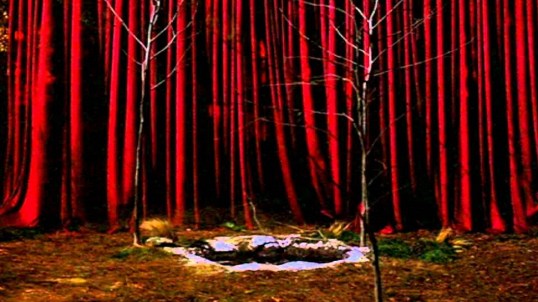
Suddenly, in the middle of the woods, the red curtains appears. Windom leads the now zombified Annie through them.
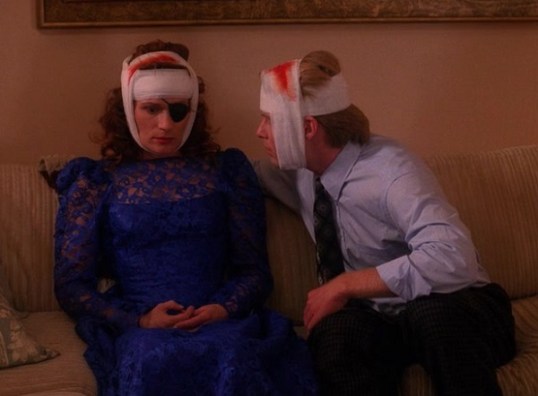
At the Hurley House, Doc Hayward (Warren Frost) is looking over the heavily bandaged Mike (Gary Hershberger) and Nadine (Wendy Robie). Meanwhile, Ed (Everett McGill) is cheerfully talking to Norma (Peggy Lipton) by the fire place. (I like the fact that, with everything that’s going on, Ed and Norma are just happy to be together.) Just as Ed and Norma start to dance, Nadine suddenly gets her memory back and starts to shout about silent drape runners. Nadine demands that Ed make everyone go away.
At the Hayward house, Eileen (Mary Jo Deschanel) sits in her wheelchair and stares at Ben Horne (Richard Beymer). Donna (Lara Flynn Boyle) comes walking down the stairs, carrying a suitcase. Eileen begs Donna not to leave but Donna starts screaming about not knowing who her parents are. Ben steps forward and apologizes. He says he only wanted to do good. He wanted to be good. He says that it felt good to finally tell the truth.
Doc Hayward arrives home and is not happy to see Ben. Ben is begging for forgiveness when, suddenly, his own wife (Jan D’Arcy) comes walking through the front door. She demands to know what Ben is trying to do to their family.
Donna looks at Doc Hayward and starts to chant, “You’re my Daddy! You’re my Daddy!” Eileen looks away, which is a polite way of saying, “No, Ben’s your Daddy and you’ve got a half-sister that everyone likes more than you.”
Ben tries to apologize again and, after 29 episodes of never losing his temper, Doc Hayward finally snaps and punches Ben. Ben falls back and hits the back of his head on the fireplace! Oh my God! Is Ben dead!? Is Doc Hayward now evil!?
(I know the answer but I’m not going to tell you until the end of this review.)
At the Martell House, Andrew (Dan O’Herlihy) is all excited because he’s figured out that the key is the key to a safety deposit box. He steals the key from the pie plate and replaces it with a duplicate. However, Pete steps into the room just in time to see Andrew doing it.
In the woods, Cooper and Harry come across the abandoned truck. They walk into the forest but Cooper suddenly announces that he must go alone. Cooper takes Harry’s flashlight and walks through the forest. Eventually, he hears the hooting of an owl and comes across Glastonbury Grove. Cooper steps into the circle and the red curtains appear. As Harry watches from a distance, Cooper steps though the curtains.
(Though it may just be coincidence, the red curtains always make me think about the opening of Dario Argento’s Deep Red.)
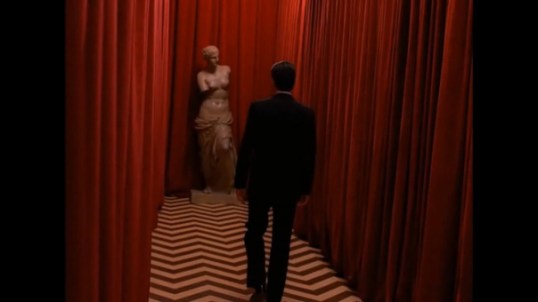
Cooper finds himself in the red curtained hallways. He walks until he reaches the room from his dreams. As the lights stobe, the Man From Another Place (Michael Anderson) dances while a lounge singer (Jimmy Scott) sings about Sycamore Trees. The Man From Another Place eventually hopes into a velvet chair. It’s deeply unsettling to watch because we know that, behind one of those curtains, BOB is lurking.
In the forest, Andy finds Harry. They sit outside of Glastonbury Grove and wait for Cooper to return.
Morning comes. We get a few final shots of the countryside around Twin Peaks. The mountains. The bridge where, 29 episodes ago, Ronette Pulaski was discovered battered and nearly catatonic. The forest. The countryside was beautiful when we first saw it but, after spending 31 hours in the world of Twin Peaks, it is now impossible to look at that wilderness without wondering what secrets are being concealed beneath the tranquil surface.
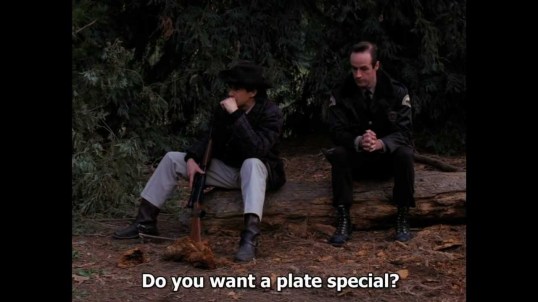
Harry and Andy are still sitting outside of Glastonbury and there is something truly touching about the sight of these two friends loyally waiting for their third friend to return. Andy volunteers to go to diner to get them breakfast. Harry says, “Yes.” Andy lists off all of the usual Twin Peaks food. Coffee. Pancakes. Desert. “Yeah,” Harry replies. When Andy finally asks if Harry wants pie, Harry falls silent. How can anyone eat pie with Cooper missing?
Meanwhile, at the bank — OH MY GOD! YOU MEAN WE’RE NOT GOING TO THE BLACK LODGE TO FIND OUT WHAT’S GOING ON WITH COOPER YET!? — an old lady sleeps at the new accounts desk. (It’s a very Lynchian image, to be honest.)
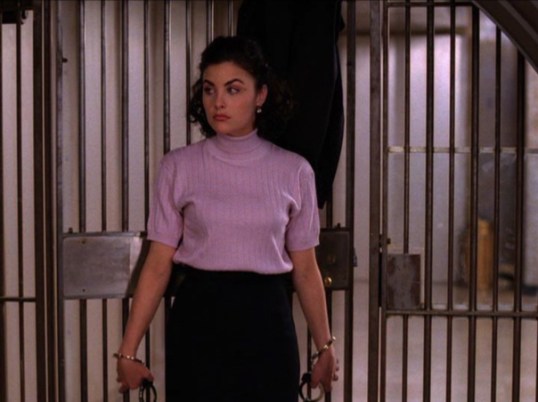
Audrey Horne (Sherilyn Fenn) comes in and says hello the elderly bank president, Mr. Mibbler (Ed Wright). Mibbler is really happy to see Audrey, even after she explains that she is going to be chaining herself to the vault as a part of her environmental protest. For whatever reason, almost all of David Lynch’s film features at least one elderly character who moves slowly and is utterly clueless about the world around them. Mr. Mibbler is certainly a part of that tradition.
(Speaking for myself, I like the way that the scene in the bank is shot and acted but it still frustrates me that, during the 2nd season, Twin Peaks could never quite figure out what to do with Audrey. When Kyle MacLachlan vetoed any romance between Cooper and Audrey, it pretty much destroyed Audrey’s storyline. To make us believe that Cooper and Audrey could actually fall in love with other people, the writers kept Cooper and Audrey from interacting and, as a result, it often seemed that Audrey was trapped in another, rather less interesting show. While Cooper investigated the Black Lodge and Windom Earle, Audrey was stuck playing Civil War with her father and improbably falling in love with John Justice Wheeler. Even in the finale, Audrey mostly serves as a distraction from the show’s main storyline. The character deserved better.)
Andrew and Pete show up at the bank. Mibbler is shocked to see that Andrew is still alive but Andrew is more concerned with opening up that deposit box. It takes Mibbler a while to find the box but when he does, he promptly opens it. What’s inside the box? Well, there’s a note from Thomas that read, “Finally got you, Andrew. Love, Thomas.” And there’s a bomb, which promptly explodes.
Oh my God, is Audrey dead!? Well, the episode never reveals who died or survived in the bank. However, having looked through the recently published The Secret History of Twin Peaks, I know the answer and I will reveal it at the end of this review.
At the Double R, Major Briggs (Don S. Davis) and Betty (Charlotte Stewart) are sharing a booth and, as opposed to the way they were portrayed all through the first season, they appear to be very much (and very playfully) in love.
At the counter, Bobby (Dana Ashbrook) watches his parents making out and then turns to Shelly (Madchen Amick.) He asks her to marry him. Shelly mentions that she’s still married to Leo and then she and Bobby start going, “Arf! Arf! Arf!,” which is a strangely cheerful callback to the way that Bobby and Mike taunted James Hurley at the end of the pilot. Bobby says that Leo is up in the woods, having the time of his life. A jump cut quickly reminds us that Leo is actually up in the woods trying to keep a bunch of tarantulas from falling down on his head.
Suddenly, Dr. Jacoby (Russ Tamblyn) and Sarah Palmer (Grace Zabriskie) step into the diner. They walk right over to Maj. Briggs. Dr. Jacoby says that Sarah has a message for him, one that she felt was very important. Speaking in the distorted voice of Windom Earle, Sarah says, “I am in the Black Lodge with Dale Cooper. I’m waiting for you.”
And here is where the finale basically goes insane. Seen today, the final 20 minutes of this episode remain genuinely unsettling and often rather frightening. I can only imagine how audiences reacted in 1991. I did a little research (which is a fancy way of saying that I looked on Wikipedia) and, believe it or not, the top-rated television show in 1991 was 60 Minutes. Needless to say, the finale of Twin Peaks was about as far from 60 Minutes as you could get.
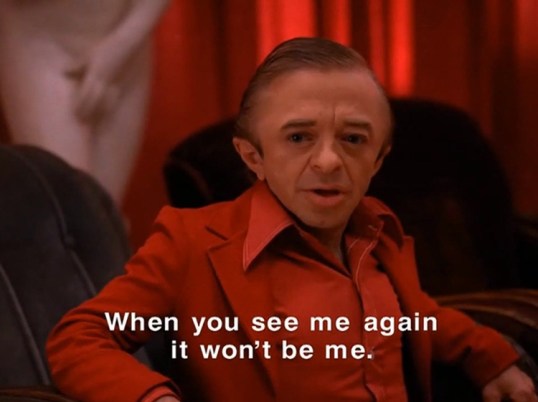
In the Black Lodge, Cooper still sits in the room with red curtains. The Man From Another Place tells him, “When you see me again, it won’t be me.” The Man From Another Place explains that the room with red curtain is a waiting room. (Purgatory, perhaps?)
“Some of your friends are here,” The Man From Another Place continues.
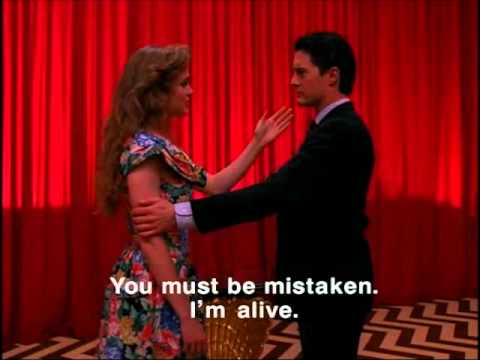
Laura Palmer (Sheryl Lee), dressed in black, walks in and sits down beside The Man From Another Place. “Hello Agent Cooper,” she says, speaking backwards. “I’ll see you again in 25 years. Meanwhile.” Laura vanishes.
(The 25 years explains why, way back in the third episode, Cooper appeared to be a much older man in his dream. It’s also interesting to note that, later this month, the 3rd season of Twin Peaks will air roughly 25 years after the 2nd season ended.)
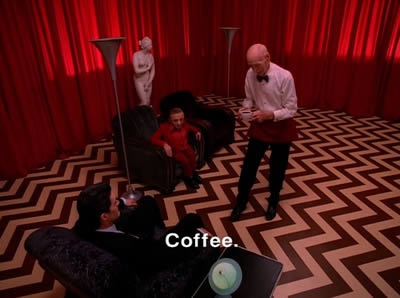
Suddenly, the room service waiter (Hank Worden) appears with a cup of coffee. “Hallelujah,” he says. “Hallelujah,” the Man from Another Place agrees.
The waiter places on a table next to Cooper. Suddenly, the waiter is gone and the Giant (Carel Struycken) stands in his place. The Giant sits down next to The Man From Another Place.
“One and the same,” he says.
(Even though I know what’s going to happen, watching this scene still makes me nervous. The Giant, the Waiter, and The Man From Another Place are the only friends that Cooper has in the Black Lodge. Once the Giant leaves, who will be the next to come out?)
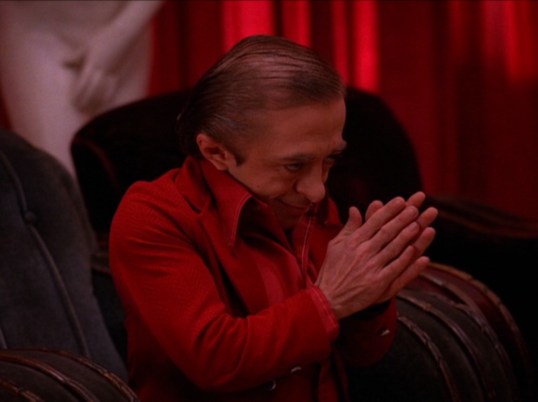
The Giant vanishes. The Man From Another Place rubs his hands together and gets a sinister little smile on his face. As he has done so many times since the series began, Cooper attempts to drink his coffee but discovers that it is now frozen solid. Suddenly, it’s not frozen and it pours out of the cup. Then, just as suddenly, it’s thick and only slowly dribbles out when Cooper tips the cup.
“Wow, BOB, wow,” the Man From Another Place says. He looks directly at the camera and says, his voice now much more rougher, “Fire walk with me.”
It’s an incredibly unsettling moment in an already unsettling episode. By this point, we all know what “Fire walk with me” means.
There’s an explosion. A woman (Laura or Annie?) screams. The lights start to strobe. Cooper walks out of the room and finds himself, once again, in the hallway. Having heard the scream and knowing what BOB did to Ronette, Laura, Maddy, and countless others, it is a coincidence that the only decoration in the hallway is a reproduction of the Venus de Milo, a beautiful woman who does not have the arms necessary to protect herself? As well, it is surely not a coincidence that the Black Lodge could just as easily pass for an “exclusive” section of One-Eyed Jack’s.
Cooper steps through another set of curtains and finds himself in a second room, one that looks just like the first room except that it’s deserted.
Cooper returns to the first room where The Man From Another Place snaps, “Wrong way!”
Cooper goes back to the second room. At first, it appears to be deserted but suddenly The Man From Another Place appears, laughing maniacally. “Another friend!” he says and suddenly, Maddy Ferguson (Sheryl Lee), dressed in black much like Laura, steps into the room. “Watch out for my cousin,” she says and then vanishes.
Cooper returns to the first room, which is now deserted.
Suddenly, the Man From Another Place appears beside him.
“Doppleganger,” the Man says.
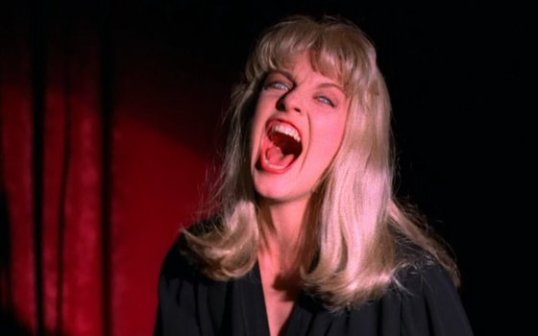
Laura, her eyes white, suddenly stands in front of Cooper. “Meanwhile,” she says.
Suddenly, Laura screams and the lights start to strobe again. Still screaming, Laura charges at Cooper. Cooper runs from the room and suddenly, finds himself in the Black Lodge’s foyer. He realizes that, like all of Windom Earle’s victims, he has been stabbed in the stomach. Cooper staggers back into the hallway and, following a trail of bloody footprints, he returns to the second room.
In the room, he sees himself lying on the floor next to Caroline Earle (Brenda E. Mathers). Like Cooper, Caroline has been stabbed. Suddenly, Caroline sits up and … IT’S ANNIE! Cooper calls out her name but suddenly, the bodies disappear and the strobe lights start again.
Calling Annie’s name, Cooper returns to the first room. Annie is waiting for him. “Dale,” she says, “I saw the face of the man who killed me. It was my husband.”
“Annie,” Dale says.
“Who is Annie?”
Suddenly, Annie is a white-eyed Caroline and then she transforms into the still shrieking Laura. Laura turns into Windom Earle. As Cooper and Windom stare at each other, Annie materializes and then vanishes again. Windom says that he will set Annie free but only if Cooper gives up his soul.
“I will,” Cooper says and, for the first time, Cooper’s voice is now as distorted as all the other inhabitants of the Black Lodge.
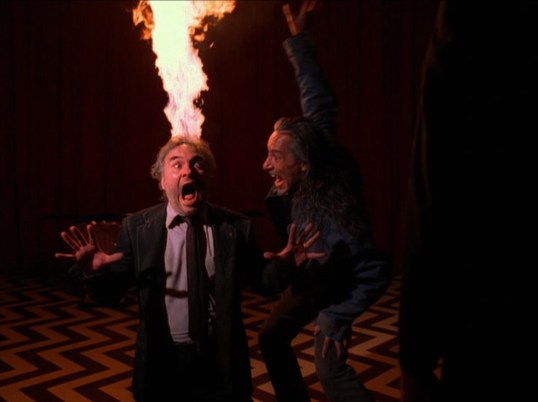
Windom stabs Cooper in the stomach and suddenly, there’s another explosion. The strobe lights start again and Windom is screaming for help. Cooper, no longer wounded, sees that BOB (Frank Silva) has grabbed Windom. Windom screams and BOB snaps, “BE QUIET!”
(As scary as BOB is, it’s undeniably satisfying to see Windom Earle finally not in control.)
BOB tells Cooper to go. Windom, BOB explains, is wrong. “He can’t ask for your soul. I will take his!”
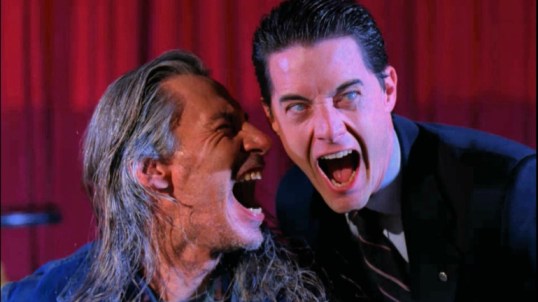
Windom screams as BOB literally rips his soul out of his head. Finally, Windom falls silent. As BOB continues to laugh, Cooper runs from the room. Suddenly, someone else comes running through the room and — OH NO! IT’S A DOPPELGANGER COOPER AND WOW, IS HE ACTING WEIRD!
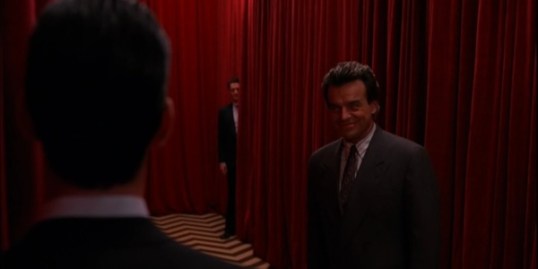
Cooper walks through the hallway when suddenly, Leland Palmer (Ray Wise) steps out from behind a curtain. His hair is brown again but his eyes are now white. Leland smiles and says, “I did not kill anybody.”
Doppelganger Cooper appears and chases after the real Cooper. They run through the Black Lodge until Doppelganger Cooper manages to grab the real Cooper.
BOB appears and stares straight at the camera. AGCK!
Suddenly, at Glastonbury Grove, the curtains appear. Night has fallen again but Harry is still loyally sitting in the forest, waiting for Cooper’s return. When he sees the curtains, Harry runs into the circle of trees and finds the bodies of both Cooper and Annie.
Cut to the Great Northern. Cooper wakes up in bed, with Doc Hayward and Harry sitting beside him. Speaking in an oddly mechanical tone of voice, Cooper first says that he wasn’t sleeping and then asks, “How’s Annie?” Harry says that Annie is at the hospital and she’ll be okay.
“I need to brush my teeth,” Cooper says.
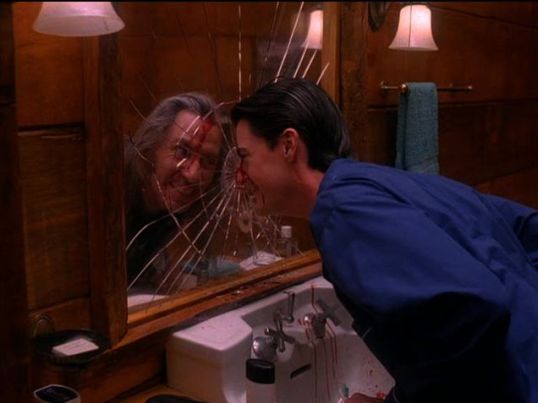
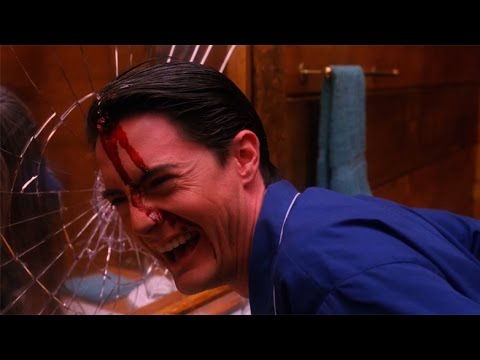
In the bathroom, Cooper squeezes an entire tube of toothpaste into the sink. He then rams his head into the mirror and, as the reflection of BOB stares back at him, he starts to laugh. “How’s Annie?” he mocking repeats. “How’s Annie?”
AGCK!
And, with that deeply unsettling turn of events, Twin Peaks came to a temporary end. This brilliantly directed episode ended with three cliffhangers. What happened to Ben? Who died at the bank? What happened to Dale Cooper?
I promised you answers to some of those question so, according to The Secret History of Twin Peaks, here they are:
Ben survived his injury.
At the bank, the bomb killed Mr. Dibbler, Andrew, and Pete. (Perhaps not coincidentally, both Dan O’Herlihy and Jack Nance died long before Showtime announced that it was reviving the show.) Audrey survived, largely because Pete shielded her with his body. Shaken by the violent death of both her brother and her husband, Catherine returned to Ben everything that he had signed over to her. Catherine became a recluse.
As for what happened to Dale — well, that’s question that we will hopefully get an answer to when Twin Peaks returns to Showtime on May 21st!
Well, that concludes our Twin Peaks recaps! Thank you everyone for reading and thank you, Jeff and Leonard, for going on this adventure with me!
Now, how about we all get some coffee and slice of cherry pie?
Here we go, with the second to last episode of the season.
“Miss Twin Peaks” starts with Leo (Eric Da Re), chained up as punishment for attacking Windom Earle (Kenneth Welsh – The Day After Tomorrow). While chained, he unlocks the chains for Major Briggs (Don Davis), and sets him free.
“Save Shelly.” he whispers, as Major Briggs rises to his feet and wanders off. Some time later, Windom Earle returns, asking how Briggs escaped. He would normally use the taser user he has on Leo, but has come up with a better idea – a better game – one that involves a bag of something he shakes with a sinister smile. A bag, worse than electricity? Doesn’t seem so bad, so far.
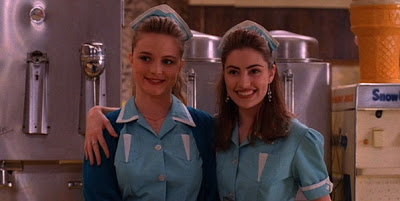
We cut to the Double R Cafe, where Norma presents some pies to Annie (Heather Graham – Horns, The Hangover) and Shelly (Madchen Amick) for the Miss Twin Peaks event. She tells them that she expects to see them in the Winner’s Circle. The pagent would be good for the town, to heal over the loss of Laura Palmer (Sheryl Lee). When asked if the town will honor her on the 20th Anniversary of her Miss Twin Peaks win, Norma laughs it off as bribery, as she’s a judge this year.
At the Great Northern, a barefoot Audrey Horne (Sherilyn Fenn) is sitting by the fire and dressed in red, a very subtle suggestion to her being a new woman. Ben (Richard Beymer) steps into the room with a series of books in each hand. He tells her they are the collected religious works of the world – The Bible, The Koran, The Talmud, The Tao-Te-Ching, among others. He carries these in the hopes that he’ll find the good within himself on reading them, but in explaining this to Audrey, she appears distracted. He notes this to be because of Jack (Billy Zane), who’s flown off to Brazil. She still misses him fondly, and fears she’ll never see him again. Ben promises her she will, but Audrey waves it off.
Changing the subject, Audrey informs her father that there’s a connection between the bank and the Packards, which Ben will look into. Ben asks Audrey if she’s considered joining the Miss Twin Peaks Pageant. Although Audrey scoffs at the idea, Ben explains that they could use the Pageant to voice the town’s concerns over preserving the wildlife and the Horne family plans. She reluctantly agrees to do so.
Meanwhile, Andy (Harry Goaz) is in the precinct, staring at the drawing recreation from the Owl Cave. Agent Dale Cooper (Kyle MacLachlan) explains to Truman (Michael Ontkean) that on the night of Josie’s (Joan Chen – Demolition Man) death, he saw BOB (Frank Silva) appear. He theorizes that perhaps Josie’s fear is what attracted BOB, and ultimately caused her death. Listening in via the hidden mic in the room, Windom Earle now has what he needs. If he can reach the Black Lodge and BOB, his vengeance against Dale Cooper will be complete. He celebrates this briefly, and we can see that the bag he had is now empty. As he approaches Leo, he bids him farewell, telling him he liked him, but that he has to pay for letting Briggs free.
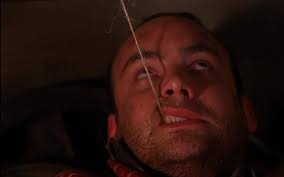
We follow a line of string that appears to be tied to Leo’s teeth, going up and over him and leading to a box full of tarantulas! Nope! Nope, a million times, Nope. I would have rather Windom Earle just set the cabin on fire and leave Leo inside. Poor Leo. Yeah, he was a douche, but even he didn’t deserve all that, whatever his fate becomes.
A dance rehearsal for the Pageant. Donna and Shelly can’t help but laugh at all of the awkward positions that Tim Pinkle (David L. Lander) has the girls doing, while Nadine (Wendy Robie) and Lucy Moran (Kimmy Robertson) are upset at it all. Tim has a tiny loss of composure when questioned about his methods. Lana (Robyn Lively) appears to be really into it, however, probably under the impression she’s already won. She also happens to be the only dancer in heels, for some reason.
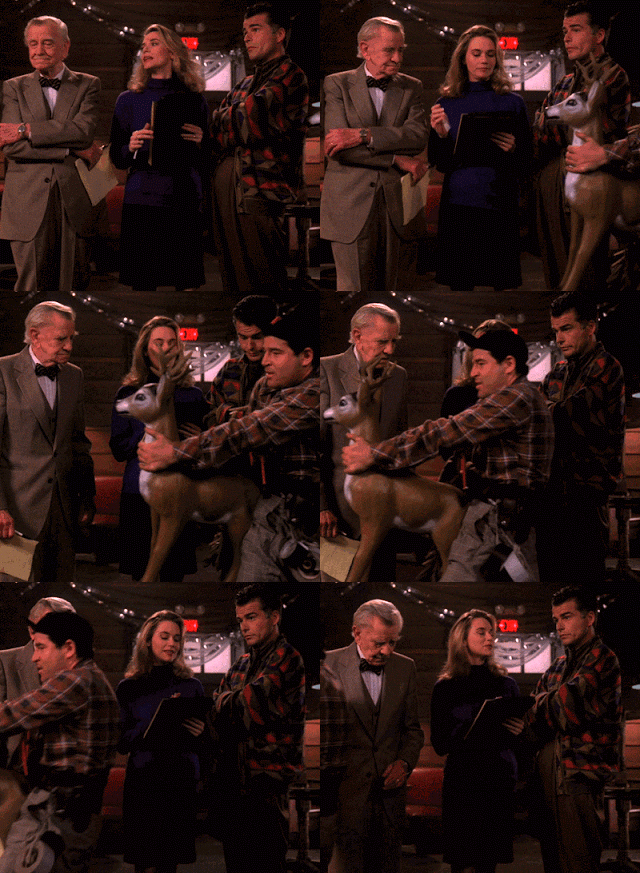
The judges – Norma, Mayor Dwayne Milford (John Boylan), and Dick Tremayne (Ian Buchanan) are looking on. Norma has to step away to handle some business, which leaves just the right opening for Lana to step in and improve her chances on becoming Miss Twin Peaks She mentions there’s something she’s looking for in the storage room, and asks Dick for some help. He joins her in the storage room with a flashlight. Lana’s communication style is through touch (because let’s face it, it’s easier to convince someone of something if there’s the slightest physical contact involved), and through this, she finds what she’s looking for. She doesn’t even need the flashlight to do so.
In Cooper’s room, Cooper records a message to Diane explaining that they’re working hard on the cave etching, and that Windom Earle is looking for the same source that they are. Should it fall into his hands, the ramifications could be disastrous. On a side note, Cooper praises Annie, who he’s very much warming up to.
Annie appears at Cooper’s door. He lets her in and she states she needs help with the Public Speaking part of the contest. Cooper explains that the Ghostwood Development could cause some problems for the town and the wildlife. In the midst of their conversation, Cooper makes a move.
“I don’t want to talk about trees anymore.” He simply says before kissing her. She leads him to his bed and they have a passionate moment together. I hope he remembered to pause his tape to Diane.
We’re watching a home movie, of Nadine and how she tackled Mike Nelson (Gary Hershberger) in wrestling class and fell in love. She and Nadine are in a room with Dr. Jacoby (Russ Tamblyn), Ed (Everett McGill) and Norma. Ed reveals to Nadine that he’s going to get married to Norma. Nadine’s stare is intense, but she smiles through it, holding on to Mike’s hand a little too tightly.
“Really?! Well that’s wonderful Eddie, ‘cause me and Mike are getting married, too!”, she says. You can hear the bones in Mike’s hand crack, and he wails in pain.
Major Briggs stumbles through the forest, finally making it to a road. He arrives just in time for Hawk (Michael Horse) to almost hit him with his Patrol Truck. Hawk gets out and puts Briggs into the truck.
The next scene has Briggs shivering and drinking water. It’s almost the same kind of shiver that Pete had. Cooper inspects Briggs and notes that he’s been shot full of Haloperidol, the same drug that the One Armed Man used to keep MIKE at bay. They try to find out where Windom Earle took Briggs, but they can’t get much from him. Andy comes back into the room, checking on the pictograph. Cooper says that if they aren’t at the right place at the right time, they might be able to find their way into the Black Lodge.
Catherine Martell (Piper Laurie), Pete (Jack Nance), and Andrew (Dan O’Herlihy) are trying to open the little box that was inside of the original black box given to Catherine. After a bit of frustration, Andrew throws the tiny metal box to the ground and shoots it with his revolver. This breaks the mini box open and reveals a key. Catherine puts the key inside a glass cake container, in full sight so that no one will steal it.
Donna comes downstairs in the Hayward house, dressed for the Pageant. She confronts her parents, demanding to know what the deal is between her mom (Mary Jo Deschanel) and Ben Horne. The parents won’t tell her, so she decides to get her answers from Ben.
Back at the precinct, Cooper realizes that one element was misread. He’s able to deduce that the map refers to Jupiter and Saturn coming into conjunction. They also learn that entering the portal requires Fear and/or Love (“Fear and Love open the doors.”, Briggs mumbles). If Windom Earle takes the Queen – in this case, Miss Twin Peaks – to the doorway, he should be able to get it to open. At least, that’s what I made of it. As they discuss this, Andy has a relegation, but is unable to share it, as Andy knocks over the bonsai plant. The plant breaks, and reveals Windom Earle’s bug. Now aware that he’s been listening in the whole time, Cooper, Truman and Andy head over to Miss Twin Peaks Pageant.
Here we are at the Miss Twin Peaks Pageant. The ladies of Twin Peaks are having an opening dance number. The show is underway, and there are a number of things occurring. Bobby Briggs (Dana Ashbrook) notices the Log Lady (Catherine E. Coulson) sitting by the bar, but then also notices her standing about 30 feet near him, by the restroom. When Bobby approaches the log lady by the door, we find it’s actually Window Earle, who bonks him on the head with his log, knocking him out.
Meanwhile, Lucy is dancing on stage. For someone due to have a baby in less than a year, she handles herself well on stage. Cooper and Truman arrive, and Truman notes that they have deputies surrounding the place. After her number is Lana’s, which is a bellydance that entrances the audience and the male judges. Lana’s gaze is focused primarily on Dick and Dwayne as she dances. Andy arrives on the scene, looking for Cooper to tell him what he was unable to say before.
Audrey gives a short speech on fighting for the environment, before leaving and seeing her dad before heading back out. Backstage, Donna confronts Ben, and asks him for the truth. We all learn that she is in fact Ben Horne’s daughter and Audrey’s half-sister. She runs off in tears before any major explanation can be given.
Annie gives a moving speech, one that catches Dick’s attention. Audrey also has a great speech. Lucy meets with Dick and Andy backstage to inform them that Andy will be the father of her child. Andy is surprised, and Dick is elated. Andy promises to be a great father, but he has to locate Cooper, and he leaves her standing there. It’s a humorous moment in the mix of everything.
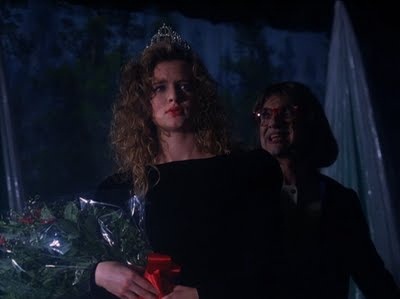
The announcement is underway. The winner and the new Miss Twin Peaks is…..Annie Blackburn!! There’s applause from the crowd as Annie accepts her award. Lana peeks out from behind the crowd to stare at Dwayne as if to say “What happened?”.Dwayne turns to Dick and asks him about the vote. Dick replies that Annie’s speech won him over.
The lights suddenly go out, and then flicker like a strobe. Very similar to Brian DePalma’s Carrie, we have pandemonium as everyone tries to evacuate. Nadine, standing under a ladder, is hit on the head with a sand bag, knocking her unconscious. Cooper catches sight of Windom Earle, but in trying to reach him, Earle sets of a flashbang that disorients Cooper. This gives Earle enough time to capture Annie with some chloroform and get out of the building. When Cooper comes to his senses, he tells Truman, who starts to get a perimeter setup. It’s here that Andy is finally able to reach Cooper and tell him what he found.
The puzzle they’ve been studying isn’t a puzzle at all, but a map!
So now, we come to the Season Finale (and ultimately the Series Finale) of Twin Peaks, which Lisa will close out tomorrow. Can Cooper save Annie? Can he catch Windom Earle? Is Nadine okay? What about Lucy and Andy? What about that blooming key? Will Donna confront all of her parents? Will Leo manage to escape the box of tarantulas? Hopefully, all of these will be answered.
This is my final piece on Twin Peaks. I hope that you’ve enjoyed reading about this show as we have writing about it. A lot of work went into this from different sides. This has been an awesome project to be a part of, and I’d like to give a quick thanks to both Lisa and Jeff for having me on board.

 Deadly Companion starts with John Candy sitting in a mental institution and snorting cocaine while happily talking to his roommate, Michael Taylor (Michael Sarrazin). Michael has been in the institution ever since the night that he walked in on his estranged wife being murdered. Because of the shock, he can’t remember anything that he saw that night. When his girlfriend Paula (Susan Clark) comes to pick Michael up, Michael leaves the institution determined to get to the truth about his wife’s murder. Once Michael leaves, John Candy disappears from the movie.
 To quote Geoffrey Chaucer, “All good things must come to an end.”




 Through the Shattered Lens