For today’s horror on the lens, we have a 1974 made-for-TV movie about what happens when a family comes down from the mountains and discovers that everyone’s disappeared.
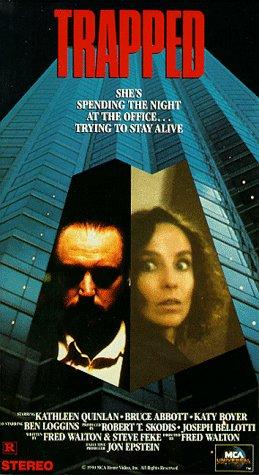
A man (Ben Loggins) leaves his home one day, thinks about how his life has recently gone wrong, and then goes to an unfinished office building where he kills not only the people who he considers responsible but also anyone else who gets in his way. Trapped in the building with him and trying to survive through the night until the doors automatically unlock in the morning are the building’s manager, Mary Ann Marshall (Kathleen Quinlan), and a corporate spy who is only willing to say that May Ann should call him John Doe (Bruce Abbott).
Trapped was produced for and originally aired on the USA network and it went on to become a USA mainstay for most of the 90s. It’s a surprisingly violent and gory for a made-for-TV film from 1989 and the nearly-empty office building is an appropriately creepy setting. Director Fred Walton does a good job of creating and maintaining a sense of suspense and he’s helped by three excellent lead performances from Kathleen Quinlan, Bruce Abbott, and especially Ben Loggins. Loggins is credited as simply being “The Killer” and the film keeps his motives murky. If you pay attention, you can discover what has driven him over the edge but the film is smart enough to concentrate on the cat-and-mouse game that he plays with Quinlan and Abbott. One thing that sets Trapped‘s Killer apart from other psycho move stalkers is that Trapped‘s Killer is ambidextrous, carrying a dagger in one hand and a baseball bat in the other, making him even more intimidating than the typical movie psycho. Kathleen Quinlan, an underrated actress who is probably best-known for playing Tom Hanks’s wife in Apollo 13, is also a feisty and likable heroine.
Don’t let its origin as a made-for-TV film scare you off. Trapped is a good and suspenseful thriller.
Steve Anders (Peter Graves) and his teenage children, David (George O’Hanlon, Jr.) and Deborah (Kathleen Quinlan), are exploring a cave in the mountains of California when they experience a sudden earthquake. After managing to escape from the cave and meeting a man who tells them about how there was a bright flash of light in the sky before the earthquake, the three of them come down from the mountain and discover that there does not appear to be anyone around. Instead, where people once stood, there are now only piles of clothes and white dust. Where have all the people gone?
As the Anders try to make their way back home to Malibu, they discover that the entire world has changed. Towns are completely deserted and once friendly animals are now viscous and hostile. While Steve tries to keep his children from giving up hope, he also tries to find the answer to the question, where have all the people gone?
This film, which is only a little over an hour long, was made for NBC. Though the film’s short running time can sometimes make it feel rushed, Where Have All The People Gone? is still a effectively creepy movie from made-for-television specialist John Llewellyn Moxey. Though it’s always difficult to accept an actor like Peter Graves as being anyone other than Peter Graves, he actually did a pretty good job playing the confused father and there are some good scenes where both of his children deal with thing in their own way. (David refuses to get emotional. Deborah does the opposite. Only Steve understands the importance of mixing emotion with reason.) When they do finally find another survivor, she’s played by Verna Bloom and the scene where they come across her sitting in her car, apparently catatonic, is really well-handled.
Though the film does eventually explain where all the people have gone, it still has an unsatisfying, open-ended ending. It wouldn’t surprise me if this film was meant to be pilot for a potential televisions series because it ends with the promise of future adventures. A weekly tv series would have allowed the Anders family to find more survivors and more angry animals but instead, the story ends with everyone still unsure as to what type of world they’re about to inherit.
If you’re one of those who is stuck inside right now, Were Have All The People Gone? is reasonably diverting and is available on YouTube and Prime.
She’s only a few weeks old and her life is already all drama all the time!
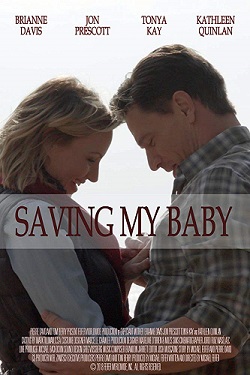
First off, Lilly was born slightly premature, shortly after her mother, Sarah (Brianne Davis), was involved in a serious and suspicious auto accident. Then, while her mother is still in a coma, her father, Travis (Jon Prescott), decides to take Lilly and run off to Palm Springs with her. Accompanying Travis is his overprotective mother, Virginia (Kathleen Quinlan) and Jessica (Tonya Kay), who just happens to be the friend who introduced Sarah to Travis in the first place. Speaking of just being friends, that’s what Travis swears that he and Jessica are but we all know that’s not the case. We know this because this is a Lifetime film and it’s rare that anyone’s ever just a friend in the world of Lifetime. Of course, Sarah’s parents and her sister object to Travis taking the baby to Palm Springs but what can they do? He’s the father.
Of course, eventually, Sarah wakes up and she’s like, “Where’s my baby?” When she hears that Lilly has been taken to Palm Springs, she quickly calls up Travis and demands to know what’s going on. Travis assures Sarah that his mother is looking after Lilly and promises that they’ll return the following morning. Sarah then hears Jessica talking in the background.
“IS JESSICA THERE!?” Sarah asks.
Travis, not surprisingly, doesn’t have a quick answer for that.
As should already be obvious, there was a lot more to Sarah and Travis’s whirlwind romance than just love. Unlike the attempted murder, the baby was never a part of the plan. However, now that Lilly’s been born, Travis definitely wants to keep her. Jessica, meanwhile, is concerned about how much Sarah and her family are willing to pay for the return of Baby Lilly….
Kidnapped children are pretty much a staple plot point when it comes to Lifetime movies. That really shouldn’t be surprising. The most effective Lifetime films are the ones that deal, however melodramatically, with real-life fears and what could be more scary than the thought of losing your baby? Whereas other mothers in Lifetime kidnapping films at least get to spend some time with their child before the abduction happens, Sarah wakes up to discover that her baby has been taken to another city. When she desperately asks her sister for information of how the baby looked before she was taken away, it’s a moment of intense emotional honesty.
Saving My Baby is a bit unique among Lifetime kidnapping films in that it actually spend more time with the kidnappers than with the family of the kidnapped. Don’t get me wrong. Sarah is a sympathetic character and Brianne Davis does a good job playing her but the film is far more interested in Jessica, Travis, and Virginia. As played by Jon Pescott, Travis spend most of his screentime wearing the haunted expression of someone who knows that he’s made the biggest mistake of his life. Not only does he have his wife angry at him but his mother won’t stop telling him that he’s a terrible father and his girlfriend keeps demanding that he get rid of both his mother and his daughter. Kathleen Quinlan does a great jon, keeping you guessing about Virginia. You’re never quite sure how much she knows about what Travis and Jessica are planning. However, the film is totally stolen by Tonya Kay, who is like a force of destructive nature in the role of Jessica. Jessica may be evil but you can’t help but sympathize with her frustration at times. I mean, everyone around her is just so incompetent!
Saving My Baby is an entertaining Lifetime kidnapping film. Wisely, the film eventually moves the action to Las Vegas, which is the perfect location for the movie’s melodrama. For the film’s finale, Saving My Baby makes good use of the Nevada desert, with the desolation perfectly capturing the feeling of hopelessness that Sarah’s been feeling ever since the disappearance of her daughter. It all leads to gunfire and tears and hopefully, a lesson learned about letting your no-good son-in-law take your granddaughter to Palm Springs. We can only hope.
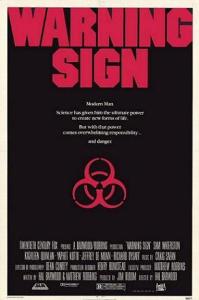
There is a laboratory in the middle of the desert. While everyone thinks that the lab is developing pesticides, it is actually a secret government facility where the scientists have developed a chemical that will turn anyone exposed to it into a homicidal maniac. While the scientists are celebrating the success of their project, Dr. Tom Schmidt (G.W. Bailey — yes, Captain Harris from the Police Academy movies) steps on a vial and releases the chemical. The lab locks down and the army (led by Yaphet Kotto) arrives. The government wants to let the scientists kill each other off but a pregnant security guard (Kathleen Quinlan) is also trapped in the lab and her husband, the county sheriff (Sam Waterston), is determined to get her out.
Warning Sign was blandly directed by Hal Barwood, a longtime associate of both George Lucas and Steven Spielberg. (Barwood wrote the script for Spielberg’s The Sugarland Express and designed the title sequence for Lucas’s THX 1138.) Barwood tried to take a very Spielbergian approach to Warning Sign, a mistake because successfully imitating Spielberg is easier said than done. Replace the shark with germs and the ocean with a lab on lock down and Warning Sign is like Jaws, without any of the suspense or humor. Sam Waterston’s germaphobic sheriff feels like a knock off of Roy Scheider’s aquaphobic police chief while Jeffrey DeMunn, as an alcoholic scientist, stands in for both Richard Dreyfuss and Robert Shaw. With the violence and the gore kept to a minimum, this is one of the most tasteful zombie films ever made. Just compare it to George Romero’s The Crazies (or even the remake) to see how needlessly safe Warning Sign is.
Event Horizon, a sci-fi/horror hybrid from 1997, is one of those films that starts out with a series of title cards:
“2015 First permanent colony established on moon.”
Wait … 2015? How did I miss that?
” 2032 Commercial mining begins on Mars.”
Yay! Only 16 more years to wait until we’re finally on Mars!
“2040 Deep space research vessel ‘Event Horizon’ launched to explore boundaries of Solar System. She disappears without trace beyond the eighth planet, Neptune. It is the worst space disaster on record.”
Wow, that sucks. But things happen…
“2047 Now…”
Alright, let’s get this story going!
Seven years after it disappeared, the Event Horizon suddenly sends out a distress signal. It turns out that it didn’t blow up like everyone assumed. Instead, it’s still out in space. The surly crew of the Lewis & Clark is called off of leave and sent on a rescue mission. (And when I say surly, I do mean sur-ly! Seriously, nobody on the Lewis & Clark is in a good mood … ever!) Accompanying the crew is Dr. Weir (Sam Neill), the scientist who designed the Event Horizon. Captain Miller (Laurence Fishburne) may not be happy about having Dr. Weir on his ship but, then again, Captain Miller always seems to be annoyed about something.
The Event Horizon appears to be deserted. The walls are covered with blood. The captain — at least it appears to be the captain — has been crucified and left on display. Dr. Weir explains that the Event Horizon was designed to create an artificial black hole and it’s possible that the ship went into another dimension and that it may have brought something back with it. Other crew members speculate that the Event Horizon may have accidentally been transported to Hell. Either way, it’s not a good thing but, after the Lewis & Clark suffers some damage, the crew find themselves stranded on the Event Horizon.
Soon, the crew members are having hallucinations. The ship’s doctor (Kathleen Quinlan) sees her son running through the ship. Captain Miller sees the burning corpse of a friend that he had to abandon during a previous mission. Another crewman appears to be possessed and attempts to commit suicide by opening up the airlock. Dr. Weir has visions of his dead wife. Things get darker and darker. People die. Eyes are ripped out of sockets. A video of the original crew is found and it’s like something out of a painting by Hieronymus Bosch. Miller wants to blow up the Event Horizon. Dr. Weir replies, “We are home!”
Agck!
Seriously, Event Horizon is a curious film. I’ve seen it a few times and I have to admit that it’s never quite as good as I remembered. If you want to get really technical about it, Event Horizon is a poorly paced film that is overly derivative of the Alien franchise and it features perhaps the worst performance of Laurence Fishburne’s career.
(Yes, even worse than his performance in Contagion…)
But, at the same time, even if I’m always somewhat disappointed with the film, Event Horizon is also a movie that stays with you. Whatever flaws the film may have, it is genuinely scary and disturbing. Director Paul W.S. Anderson does a good job of turning that spaceship into the ultimate floating haunted house and, even more importantly, he keeps you off-balance. This is one of the few horror films where literally anyone can die, regardless of whether they’re top-billed or have an Oscar nomination to their name. Whatever the evil is that has possessed the Event Horizon, it is ruthlessly and sadistically efficient.
Plus, there’s that video. If you’ve seen the movie, you know what I’m talking about. Anderson has complained that the studio made him cut a lot of footage out of the video but what remains is disturbing enough. Seriously, you’ll never want to hear another Latin phrase after watching Event Horizon.
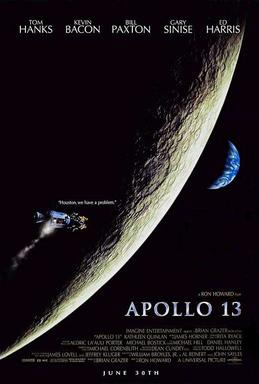
I just finished watching the TCM premiere of the 1995 Best Picture nominee, Apollo 13. Of course, it wasn’t the first time I had seen it. Apollo 13 is one of those films that always seems to be playing somewhere and why not? It’s a good movie, telling a story that is all the more remarkable and inspiring for being true. In 1970, the Apollo 13 flight to the moon was interrupted by a sudden explosion, stranding three astronauts in space. Fighting a desperate battle against, NASA had to figure out how to bring them home. Apollo 13 tells the story of that accident and that rescue.
There’s a scene that happens about halfway through Apollo 13. The heavily damaged Apollo 13 spacecraft is orbiting the moon. Originally the plan was for Apollo 13 to land on the moon but, following that explosion on the craft, those plans have been cancelled. Inside the spacecraft, three astronauts can only stare down at the lunar surface below them.
As Commander Jim Lovell stares out the craft’s window, we suddenly see him fantasizing about what it would be like if the explosion hadn’t happened and if he actually could fulfill his dream of walking on the moon. We watch as Lovell (and, while we know the character is Jim Lovell, we are also very much aware that he’s being played by beloved cinematic icon Tom Hanks) leaves his foot print on the lunar surface. Lovell opens up his visor and, for a few seconds, stands there and takes in the with the vastness of space before him and making the scene all the more poignant is knowing that Tom Hanks, before he became an award-winning actor, wanted to be a astronaut just like Jim Lovell. Then, suddenly, we snap back to the film’s reality. Back inside the spacecraft, Lovell takes one final look at the moon and accepts that he will never get to walk upon its surface. “I’d like to go home,” he announces.
It’s a totally earnest and unabashedly sentimental moment, one that epitomizes the film as a whole. There is not a hint of cynicism to be found in Apollo 13. Instead, it’s a big, old-fashioned epic, a story about a crisis and how a bunch of determined, no-nonsense professionals came together to save the day. “Houston,” Lovell famously says at one point, “we have a problem.” It’s a celebrated line but Apollo 13 is less about the problem and more about celebrating the men who, through their own ingenuity, solved that problem.
That Apollo 13 is a crowd-pleaser should come as no surprise. It was directed by Ron Howard and I don’t know that Howard has ever directed a film that wasn’t designed to make audiences break into applause during the end credits. When Howard fails, the results can be maudlin and heavy-handed. But when he succeeds, as he does with Apollo 13, he proves that there’s nothing wrong with old-fashioned, inspirational entertainment.
Of course, since Apollo 13 is a Ron Howard film, that means that Clint Howard gets a small role. In Apollo 13, Clint shows up as a bespectacled flight engineer. When astronaut Jack Swiggert (Kevin Bacon) mentions having forgotten to pay his taxes before going into space, Clint says, “He shouldn’t joke about that, they’ll get him.” It’s a great line and Clint does a great job delivering it.
Apollo 13 is usually thought of as being a Tom Hanks film but actually, it’s an ensemble piece. Every role, from the smallest to the biggest, is perfectly cast. Not surprisingly, Bacon, Bill Paxton, Gary Sinise, Kathleen Quinlan, and Ed Harris all turn in excellent performances. But, even beyond the marquee names, Apollo 13 is full of memorable performances. Watching it tonight, I especially noticed an actor named Loren Dean, who played a NASA engineer named John Aaron. Dean didn’t get many lines but he was totally believable in his role. You looked at him and you thought, “If I’m ever trapped in space, this is the guy who I want working to bring me home.”
Apollo 13 was nominated for best picture but it lost to Mel Gibson’s film Braveheart. Personally, out of the nominees, I probably would have picked Sense and Sensibility but Apollo 13 more than deserved the nomination.
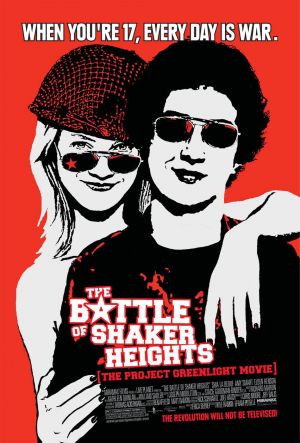
“When you’re 17, every day is war.” — Tagline of The Battle of Shaker Heights (2003)
Anyone here remember Project Greenlight? It’s a show that used to be on HBO and Bravo, in which Matt Damon and Ben Affleck would arrange for a director and screenwriter to get a chance to make their low budget feature film debuts. The catch, of course, is that a camera crew would then follow the director as he (and all of the Greenlight “winners” were male) struggled to get the film made. Mistakes would be made. Money would be wasted. Producer Chris Moore would randomly show up on set and start yelling. In short, it was typical reality show drama with the catch being that the film itself would then be released in a theater or two.
Well, after being consigned to footnote status for the past nine years. Project Greenlight is coming back for a fourth season and a lot of people are pretty excited about it. And why not? I own the first two seasons of Project Greenlight on DVD and I’ve watched the third season on YouTube. It’s a lot of fun, mostly because all of the directors, with the exception of season 3 winner John Gulager, turned out to be so incredibly inept. (Gulager is one of the few Project Greenlight success stories — not only did his movie, Feast, come across as being made by a professional but he’s actually had a career post-Greenlight.) It all makes for good televised drama.
However, it doesn’t necessarily make for a good movie.
Case in point: 2003’s The Battle of Shaker Heights.
The Battle of Shaker Heights is about a creepy 17 year-old named Kelly (played by the reliably creepy Shia LaBeouf). His mother (Kathleen Quinlan) is an artist. His father (William Sadler) is a former drug addict who, despite having been clean for 6 years, still has to deal with his son’s constant resentment. Kelly is a high school outcast who spends all of his spare time thinking and talking about war. Every weekend, he takes part in war reenactments. At night, he works in a 24-hour grocery store where he doesn’t realize that he’s the object of Sarah’s (Shiri Appleby) affection.
(Why Sarah has so much affection for Kelly is a good question. Maybe it’s the scene where he throws cans of cat food at her…)
At a reenactment of the Battle of the Bulge, Kelly meets and befriends Bart (Elden Hansen), which leads to him meeting Bart’s older sister, Tabby (Amy Smart). Tabby is an artist, because the film isn’t imaginative enough to make her anything else. (We’re also told that she’s a talented artist and it’s a good thing that we’re told this because otherwise, we might notice that her paintings are the type of uninspired stuff that you can buy at any county art fair.) Kelly decides that he’s in love with Tabby but — uh oh! — Tabby’s getting married. Naturally, she’s marrying a guy named Minor (Anson Mount). Imagine how the film would have been different if his name had been Major.
As a film, the Battle of Shaker Heights is a bit of a mess. It never establishes a consistent tone, the dialogue and the direction are all way too heavy-handed and on the nose, and Shia LaBeouf … well, he remains Shia LaBeouf. In some ways, Shia is actually pretty well cast in this film. He’s an off-putting actor playing an off-putting characters but the end of result is an off-putting film.
Of course, if you’ve seen the second season of Project Greenlight, then you know that The Battle of Shaker Heights had an incredibly troubled production. Neither one of the film’s two directors were particularly comfortable with dealing with the more low-key human aspects of the story. Screenwriter Erica Beeney was not happy with who was selected to direct her script and basically spent the entire production whining about it to anyone who would listen. (Sorry, Erica — your script was one of the film’s biggest problems. When you actually give a character a name like Minor Webber, it means you’re not trying hard enough.) Finally, Miramax took the completed film away from the directors and re-edited it, removing all of the dramatic scenes and basically leaving a 79-minute comedic cartoon.
So, in the end, Battle of Shaker Heights is not a very good film. But season two of Project Greenlight is a lot of fun!
Well, this is certainly intimidating. I know I’ve said this many time before but it deserves to be repeated: it’s often a hundred times more difficult to review a great film than it is to review a merely mediocre one. When a film fails, it’s usually easy to say why. The acting was bad. The directing was uninspired. The plot didn’t make any sense. Or maybe the film has been so overpraised that you, as a reviewer, are almost obligated to be tougher on it than you would be with any other film. However, it’s never as easy to put into words just what exactlyit is that makes a movie great.
Take the 1973 Best Picture nominee American Graffiti for instance. I could tell you that this is a very well-acted film and that it features an ensemble of very likable performers, many of whom subsequently went on to become stars and celebrated character actors. Then again, you can say the same thing about countless other films.
I could say that director George Lucas does such a good job putting this film together that it’s hard to believe that he’s the same man who would later be responsible for all three of the Star Wars prequels. Then again, I could also say the same thing about how odd it is that the same man who directed the entertaining Final Destination 5was also responsible for the far less enthralling Into The Storm.
I could tell you that the film serves as a valuable time capsule in that not only does it feature a loving recreation of small town America in the early 60s but that it’s also a chance to see what Richard Dreyfuss, Ron Howard, and Charles Martin Smith all looked like when they still had hair. But then again, I also praised The Young Graduates for being a time capsule as well.
Let’s face it — it’s difficult to define the intangible qualities that make a film great. Often times, it’s a case of simply knowing it when you see it. I’ve seen American Graffiti a few times. The last time I saw it was at a special Sunday showing at the Alamo Drafthouse. And, on that early Sunday afternoon, the theater was packed with people who had paid for the chance to see the 40 year-old film on the big screen. I’m 28 years old and it’s significant that, while the majority of the audience was older than me, there were quite a few people who were younger. American Graffiti is one of those films that obviously spoke to audiences when it was first released and continues to speak to audiences today.
As I mentioned in my review of Rebel Without A Cause, films about teens tend to age quickly and, often times, one generation’s masterpiece will turn out to be a later generation’s joke. When a film like Rebel or American Graffiti survives the test of time, it’s because the film has managed to capture a universal truth about what it means to be young and to have your entire life ahead of you.
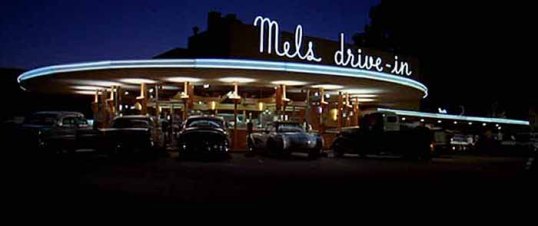
American Graffiti takes place over the course of one long night in Modesto, California in 1962. The film follows several different characters, the majority of whom have just graduated from high school. What these characters all have in common is that one phase of their life has ended and a new one is about to begin. Over the course of that one night, all of them are forced to say goodbye to their past identities and, in some instances, are forced to face their future.
For instance, there’s Curt (an amazingly young Richard Dreyfuss), a neurotic intellectual who spends the night trying to decide whether or not he actually wants to leave for college in the morning. Complicating Curt’s decision is a mysterious blonde who mouths “I love you” at him before driving away. While searching for her, Curt finds himself unwillingly recruited into the Pharoahs, a somewhat ludicrous small town gang that’s led by Joe (played, in hilariously clueless fashion, by Bo Hopkins.) Curt, incidentally, is my favorite character in the film. He’s just adorable, which admittedly is not a reaction that one often has to Richard Dreyfuss.
(Curt is also featured in one of my favorite scenes, in which he smokes a cigarette with a lecherous teacher named Mr. Wolf.)
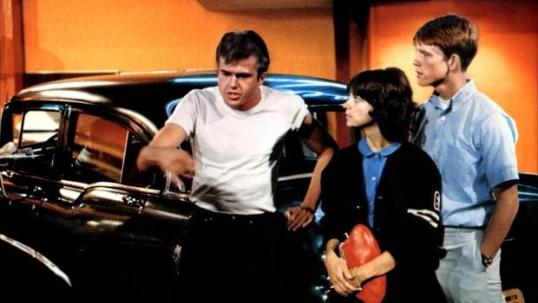
Curt’s sister (Cindy Williams) is dating Steve Bolander (Ron Howard). Steve is the former class president and, unlike Curt, he’s very excited about leaving home. Ron Howard gives such a likable performance that it actually takes a few viewing to realize just how big of a jerk Steve really is.
And then there Terry (Charles Martin Smith) who wears big glasses and has bad skin. Terry gets to spend the night driving around in Steve’s car and manages to pick up a girl named Debbie (Candy Clark). For Terry, this is his night to actually be somebody and what makes it all the more poignant is just how obvious it is that Terry will probably never get another chance. Though he may not realize it, those of us watching understand that this is literally going to the be the best night of Terry’s life.
(Incidentally, much like Ron Howard, Charles Martin Smith would go on to become a film director and gave the world the amazingly sweet Dolphin Tale.)
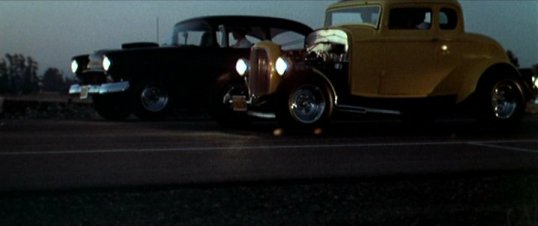
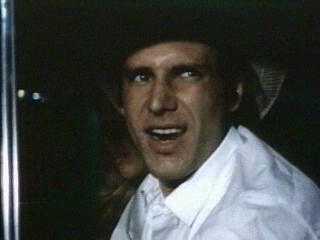
And finally, there’s John Milner (Paul Le Mat). John is a little older than the other main characters. He spends most of his time in his car, driving around and getting challenged to race. He’s the epitome of late 50s/early 60s cool, with an attitude and a look that he obviously borrowed from James Dean and Marlon Brando. Over the course of the night, he is forced to deal with a bratty 13 year-old stowaway (MacKenzie Phillips) and a mysterious challenger named Bob Falfa (played by a youngish Harrison Ford, who wears a cowboy hat and speaks with a country twang).
The film follows these characters through the night and then, at the end of it, we get the famous epilogue where we discover that all of the male characters have pretty much ended up exactly how we thought they would. In some cases, that’s a good thing. And in other cases, it’s not. It’s a good ending that’s kept from being great by the fact that none of the film’s female characters rate so much as even a mention.
So, what else can be said about American Graffiti?
Many people have issues about remakes and reboots. They see it as unnecessary and a proof that the film industry has run out of ideas. I can’t say that either points have no validity to them, but I disagree with both.While all genres of film have had it’s share of remakes and reboots its the horror section of the film aisle which has seen the most. This shouldn’t come as a shock since horror has always been ripe for remakes. The stories in horror films have always been quite simple and producers take advantage of this by remaking them for a new generation. Take the simple set-up, change the time and setting with a new cast of cheap, unknown actors and you got yourself a horror flick which should make back its budget and make its filmmakers a profit.
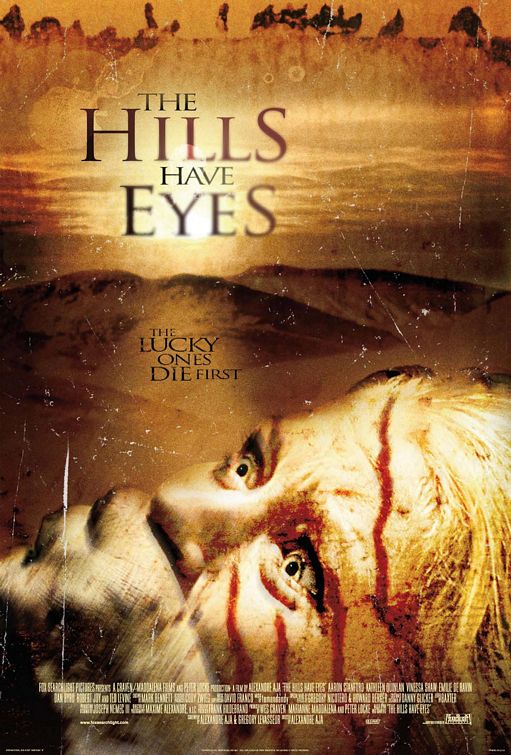
While most horror remakes usually range from average to truly dreadful there comes a time when one comes out of the horror remake heap to actually show promise and quality not seen in its remake brethren. One such film is in the Alexandre Aja directed and Wes Craven produced The Hills Have Eyes. Aja’s The Hills Have Eyes is the rare horror remake in that its more than a match to Wes Craven’s original and, at times, surpasses it.
Alexandre Aja first burst onto the horror-cinema scene with his ambitious and grisly homage to grindhouse horror: Haute Tension. Haute Tension was one nasty piece of horror filmmaking which brought to mind 70’s and early 80’s horror exploitation and grindhouse mentality. Aja’s directorial debut was a no-hold-s-barred punch and kick to the stomach that was overtly violent and sublimely painful for the audience to watch. Aja was soon tapped by Wes Craven to lead the remake project of his own The Hills Have Eyes and to Aja’s growing reputation as a rising star of horror, he grew as a filmmaker and more than earned this reputation.
Aja’s The Hills Have Eyes follows pretty much the very same story and characters as the original. This remake has abit more of a political sense to its storytelling in that it doesn’t just pit the basic premise of civilized humans versus the primal inbred, mutant hill dweller, but also the different demographics of red state versus blue state. This theme was hammered through to the audience through the subsurface conflict between Big Bob Carter’s (well-played by industry veteran Ted Levine) red state gung-ho ex-detective and his son-in-law Doug’s (X2‘s Aaron Stafford) pacifist mentality. I think this new wrinkle in the original’s sparse and tight story was unnecessary and unsubtly done. I really didn’t want to know what political leanings and motivations the Carter family members followed. What I did care about was how they would react to the outside forces that was soon to menace and attack them.
The first half of the film was very deliberate in its set-up as it slowly built up the tension and dread as the Carter family’s journey through a supposedly short-cut through the desert put them closer and closer to the dangerous people who dwelt amongst the hills bordering the desert road. Once the family becomes stranded in the middle of nowhere the fun begins for horror-aficionados. For those who have seen the original this remake doesn’t deviate from the main story. The hill people who, up until now have only been glimpsed through quick shadowy movements across the screen, were the true cause of the family’s predicament attack in a brutal and grisly fashion. None of the Carter family members were spared from this attack. From Big Bob Carter, his wife Ethel, their three children, son-in-law and young granddaughter they all suffer in one form or another. The night attack on the camper is the main highlight of the film and shows that Aja hasn’t lost his touch for creating a horror setpiece that doesn’t hold back. From the brutal rape of the Carter’s youngest daughter Brenda to the sudden deaths of several Carter family members. This sequence was both fast-paced and chaotic in nature. It also helped push the definition of what constitute a very hard R-rating. Just like Zombie’s The Devil’s Rejects and Roth’s Hostel, The Hills Have Eyes pushed the limits and boundaries of what the MPAA has allowed so far in terms of on-screen violence when it was first released in 2006. I’m very surprised that some of the violence and deaths in this film made the final cut. This film definitely brings back the 70’s style horror.
The cast for this remake was one high point that the original didn’t have. Where Craven had a very inexperienced cast for the original film. Aja had the luxury of a bigger budget to hire a more competent and able group of actors. A cast that was led by Ted Levine who shined in his role as the patriarch of the civilized Carters. Kathleen Quinlan as the mother of the bunch soldiers on even though its almost predestined in films such as this that she would be one of the doomed. The two daughters as played by Vinessa Shaw and Lost’s Emilie De Ravin were quite good in roles that involved some very graphic rape sequences. Much kudos must go to De Ravin for having to perform through her scene during the trailer-camper attack. But the two actors who excelled in the film has to be pacifist turned avenging angel Doug as played by Aaron Stafford. We see in his character Doug the lengths a civilized human being would go through to survive and protect those he cares for. Even if this means resorting to becoming more brutal and primal than the inbred, mutant hill dwellers. It’s in Doug’s character where the basic premise of the clash of the modern with the primitive comes close to matching the same theme in the original. To a smaller degree this was also echoed in the Carter’s teenage son Bobby. Dan Byrd of Entourage plays Bobby Carter and its in him we see the level-headedness of the family. Despite all the horror and carnage he has seen the hill dwellers have inflicted on his family, Bobby remains somewhat calm and even-keeled to protect what is left of his family. The only drawback as to the cast itself was that the opposing family seemed to have been shortchanged. In the original we actually got to understand some of the motivations that drove the hill dwellers to prey on unsuspecting travelers through their area. In this remake the hill dwellers seem more like superhuman monsters and boogeymen. It didn’t bother me as much, but then it also lessened the impact of the story’s basic premise of civilization versus primitives.
Lastly, the look of the film helps add to the grindhouse nature of Aja’s remake. The film has an oversaturated look and feel that took advantage of the desert location and the high-sun overhead. This oversaturation of the film’s look also lends some credence to its grindhouse sensibilities. It looked, felt and acted like something made during the late 70’s and early 80’s. For most fans of horror it would really come down to the special-effects used to show the death and violence’s impact on the audience. Once again, Greg Nicotero and his crew at KNB EFX house show that they’re the premiere effects house. The make-up used to show the mutant effects on the survivors of the original inhabitants of the hills was excellently done. The same goes for the gags used to show the many brutal and messy deaths of both families.
There’s no denying that The Hills Have Eyes was all about pain when boiled down to its most basic denominator. This film is all about pushing the boundaries and piling on violence upon violence. The Hills Have Eyes is not a film that tells us violence solves nothing. Here it does solve the problem for the Carter clan and is also the only avenue of survival of the remaining Carters. The same goes for the nuclear survivors and their offspring who stayed in the irradiated zones that was their home. This film is all about survival and the levels and heights individuals would take to achieve it.
The Hills Have Eyes might not be the original second helping some have expected from Aja after his brilliant, if somewhat flawed first major film with Haute Tension, but it does show his growth as a filmmaker and his clean grasp of what makes horror cinema truly terrifying and uncomfortable. Two ingredients that makes for making a genre exploitation fare into something of a classic. I’m sure that outside of the horror-aficionado circles this film will either be met with indifference or disgust, but for those who revel in this type of filmmaking then it’s a glorious continuation of the grindhouse horror revival that began with Aja’s own Haute Tension, continued by Zombie’s The Devil’s Rejects, Roth’s Hostel and continues to live each and every year with the many direct-to-video releases of cheap, but very good horror films. It truly is a great time to be a fan of horror and Aja’s The Hills Have Eyes more than holds its own against Craven’s original.


 The world might end, again.




 Through the Shattered Lens