The Best Of Times (1986, directed by Roger Spottiswoode)


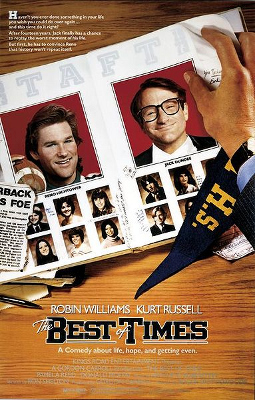
For years, banker Jack Dundee (Robin Williams) had been haunted by a pass that he dropped in high school.  The pass was perfectly thrown by quarterback Reno Hightower (Kurt Russell) but Jack couldn’t bring it in and, as a result, Taft High lost to its rival, Bakersfield.  Adding to Jack’s humiliation is that he now works for The Colonel (Donald Moffat), a confirmed Bakersfield fan who also happens to be Jack’s father-in-law.  When Jack visits a “massage therapist” (Margaret Whitton) and tells her about his problems, she suggests that he needs to replay the game.  Getting everyone interested in replaying the game is not easy.  No one wants to be humiliated a second time and Reno, who now fixes vans for a living, fears the he’s lost his edge.  Jack dresses up in the Bakersfield mascot’s uniform and vandalizes the town.  Finally, everyone is ready for the game.  Now, it’s a matter of town pride.

The Best of Times is a likable comedy about getting older and wishing you could have just one more chance to be young again and to have your entire future ahead of you.  Jack is haunted by that one dropped pass, feeling that it has cast a cloud over his entire life.  Reno is still a town hero but he’s struggling financially and in debt to Jack’s bank.  Replaying the game isn’t going to fix their lives but it is going to give them one last chance to relive their former glory and maybe an opportunity to learn that, even if they are getting older, they’re still living in the best of times.  The world that these two men live in is skillfully drawn and believable, with character actors like Moffat, M. Emmet Walsh, R.G. Armstrong, and Dub Taylor adding to the local color.  Jack and Reno’s wives are played by Holly Palance and Pamela Reed and they are also strong and well-developed characters.  Finally, Robin Williams and Kurt Russell are a strong comedic team.  Russell is perfectly cast as the aging jock and Williams gives one of his more restrained performances as Jack, allowing us to see the sadness behind Jack’s smile.

The stakes aren’t particularly high in The Best Of Times.  It’s just a football game between some middle-aged men looking to regain their youth.  But the story sticks with you.

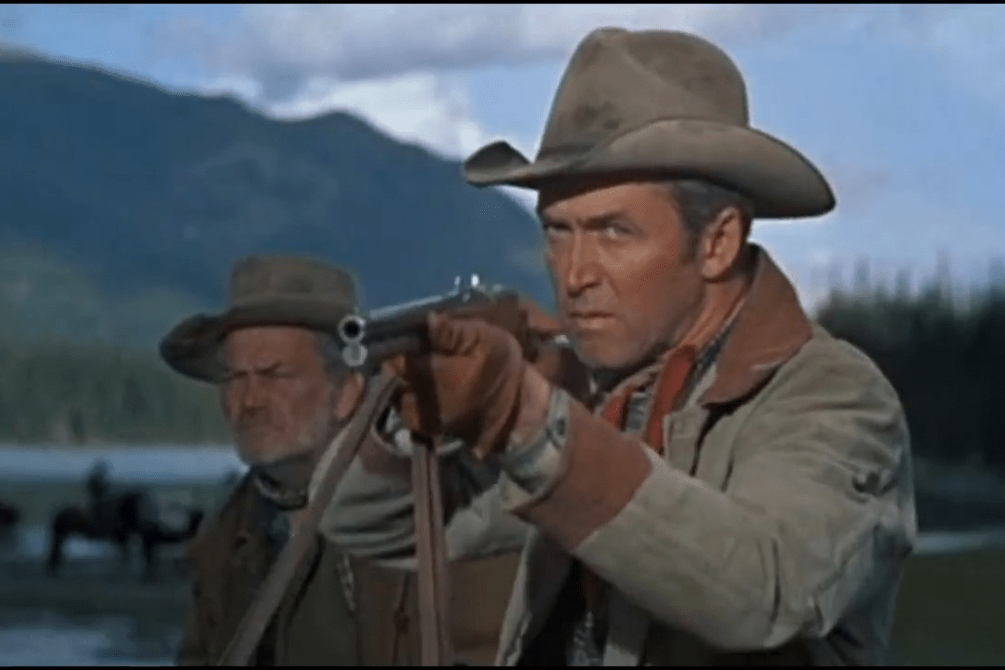
THE FAR COUNTRY (1954) – James Stewart and Walter Brennan head North to make their fortune!


James Stewart is one of the great movie stars of all-time. His work with Frank Capra (MR. SMITH GOES TO WASHINGTON, IT’S A WONDERFUL LIFE) and Alfred Hitchcock (REAR WINDOW, VERTIGO) is legendary. In my household, Stewart’s work with director Anthony Mann is celebrated just as much as those other classics. Mann and Stewart made five classic westerns, beginning with WINCHESTER ‘73 in 1950 and ending in 1955 with THE MAN FROM LARAMIE. I own them all on DVD and watch them quite often. It’s very cold in Arkansas today, so I decided to write about the Yukon-set THE FAR COUNTRY, from 1954. 

Jeff Webster (James Stewart) and his crusty ol’ coot of a partner Ben Tatem (Walter Brennan) head North towards Dawson City, in the Yukon Territory, with a herd of cattle. The two men encounter a variety of problems along the way, with the biggest being the corrupt Judge Gannon (John McIntire) of Skagway, Alaska. When Jeff finds himself in front of the judge for killing two cowhands who tried to steal his herd, Gannon acquits him on the charges but decides to keep his herd as payment for the court fees. With their cattle taken away from them, Jeff and Ben sign up to help business lady Ronda Castle (Ruth Roman) take supplies to Dawson City, where she plans to set up shop. After their first day on the trip, Jeff and Ben double back to Skagway and re-take their herd and take off towards Dawson as fast as they can go, with Gannon and his men in hot pursuit. They’re able to make it into Canada, so Gannon and his goons turn back, determined to hang the men if they ever come back through Skagway.

So Jeff and Ben make it to Dawson City with their cattle where they sell them off for $2 per pound to Ronda. Suddenly flush with cash, the two partners buy a gold claim and proceed to find some nice golden nuggets! When they head back into town, they find that Judge Gannon has now come to Dawson City and is in partnership with Ronda. Of course, that bastard immediately starts cheating the miners out of their claims, this time with gunman Madden (Robert J. Wilke) by his side, enforcing his corrupt actions with lead. Jeff and Ben decide they’re going to sneak out of town with their loot, but Gannon finds out about it and sends his men to stop them. Ben is killed in the process and Jeff is seriously injured. Jeff has tried his best up to this point to not get involved with the mess in Dawson City, but with his best friend now dead, he decides it’s time for Judge Gannon and his thugs to be stopped. 

James Stewart is just so good as Jeff Webster. The best thing about his work with Mann is how each of the movies would give him a meaty role that capitalized on his basic decency, while simultaneously making him a more complex, layered man, miles away from the likes of Mr. Smith or George Bailey. In THE FAR COUNTRY, he’s as tough as nails, but he really doesn’t want to get involved with the people around him. It takes the death of his best friend for him to finally commit to helping them stand up against the bad guys. Stewart’s work here, and in the other Mann westerns, ranks with his very best. 

The remainder of the cast is uniformly excellent. Three time Oscar winner Walter Brennan is always a welcome presence in a movie I’m watching. While he’d pretty much settled into the “old coot” role that would come to personify the later part of his career, his character is a valuable conscience for Stewart a couple of times in the story. I thought that John McIntire and Ruth Roman really stood out in their respective roles as the corrupt Judge Gannon and the stubbornly, independent businesswoman Ronda Castle. Both give excellent performances. The cast is rounded out with a who’s who of character actors like Jay C. Flippen, Harry Morgan, Robert J. Wilke, Royal Dano, and Jack Elam. It’s always nice seeing these familiar faces pop up in these old westerns.

I love it when movies are filmed on location in beautiful places. THE FAR COUNTRY was filmed at the Jasper National Park in Alberta, Canada, which added another interesting element to the film. The final thing I want to say about the film is that the screenplay for THE FAR COUNTRY was written by Borden Chase, who had penned RED RIVER a few years earlier. Not only would Chase write this movie, he would also write the screenplays for WINCHESTER ‘73 and BEND OF THE RIVER, both westerns that paired Anthony Mann and Jimmy Stewart. Chase was an excellent writer of western material, and his strong work in this group of films is crucial to their enduring success. 

Overall, I confidently recommend THE FAR COUNTRY to any person who enjoys westerns or Jimmy Stewart. I might rank THE NAKED SPUR and THE MAN FROM LARAMIE slightly above this one in the Mann / Stewart westerns, but the truth is that you can’t go wrong with any of them. 

I’m sharing the trailer for THE FAR COUNTRY below:

Horror on TV: Kolchak: The Night Stalker 1.19 “The Youth Killer” (dir by Don McDougall)


Tonight on Kolchak….

There’s a new dating service in Chicago!  It’s only for the hot, single, and young!  So, why are some of the members turning up dead and suddenly old?  Could it be that the owner of the dating service has a less-than-ethical way of remaining young!?

Carl Kolchak is going to find out!

This episode aired on March 14th, 1975.  It’s not one of the better episodes but, as always, Darren McGavin is a lot of fun in the role of Kolchak.

Enjoy!

A Movie A Day #244: Death of a Gunfighter (1969, directed by Allen Smithee)


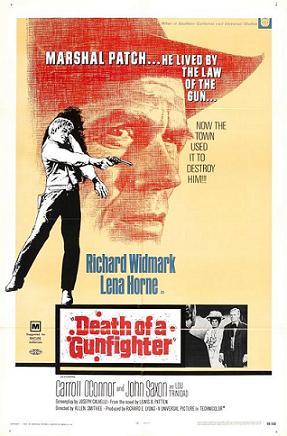
At the turn of the 20th century, the mayor and the business community of Cottonwood Springs, Texas are determined to bring their small town into the modern era.  The Mayor (Larry Gates) has even purchased one of those newfangled automobiles that have been taking the country by storm.  However, the marshal of Cottonwood Spings, Frank Patch (Richard Widmark), is considered to be an embarrassing relic of the past.  Patch has served as marshal for 20 years but now, his old west style of justice is seen as being detrimental to the town’s development.  When Patch shoots a drunk in self-defense, the town leaders use it as an excuse to demand Patch’s resignation.  When Patch refuses to quit and points out that he knows all of the secrets of what everyone did before they became respectable, the business community responds by bringing in their own gunfighters to kill the old marshal.

Death of a Gunfighter is historically significant because it was the very first film to ever be credited to Allen Smithee.  The movie was actually started by TV director Robert Totten and, after Widmark demanded that Totten be fired, completed by the legendary Don Siegel.  Since Totten worked for 25 days on the film while Siegel was only on set for 9, Siegel refused to take credit for the film.  When Widmark protested against Totten receiving credit, the Director’s Guild of America compromised by allowing the film to be credited to the fictitious Allen Smithee.

In the years after the release of Death of a Gunfighter, the Allen (or, more often, Alan) Smithee name would be used for films on which the director felt that he had not been allowed to exercise creative control over the final product.  The Smithee credit became associated with bad films like The O.J. Simpson Story and Let’s Get Harry which makes it ironic that Death of a Gunfighter is not bad at all.  It’s an elegiac and intelligent film about the death of the old west and the coming of the modern era.  It also features not only one of Richard Widmark’s best performances but an interracial love story between the marshal and a brothel madame played by Lena Horne.  The supporting cast is full of familiar western actors, with Royal Dano, Harry Carey, Jr., Larry Gates, Dub Taylor, and Kent Smith all making an impression.  Even the great John Saxon has a small role.  Though it may be best known for its “director,” Death of a Gunfighter is a film that will be enjoyed by any good western fan.