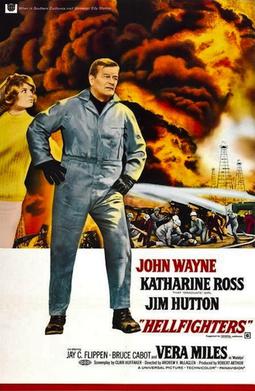
Chance Buckman (John Wayne) is the best there is when it comes to fighting oil fires. Along with Greg Parker (Jim Hutton), Joe Horn (Bruce Cabot), and George Harris (Edward Faulkner), Chance travels the world and puts out fires that the regular authorities can’t handle. Chance loves his job but he also loves his ex-wife, Madelyn (Vera Miles). When Madelyn indicates that she wants to remarry Chance but only if he pursues a less dangerous line of work, Chance retires from firefighting and becomes an oil executive. He leaves his firefighting company to his new son-in-law, Greg. When Greg and Chance’s daughter (Katharine Ross) head down to Venezuela to battle a fire and find themselves not only having to deal with the flames but also with a band of revolutionaries, Chance is the only one who can help them.
When I was growing up, Hellfighters was one of those movies that seemed to turn up on the local stations a lot. The commercials always emphasized the idea of John Wayne almost single-handedly fighting fires and made it seem as if the entire movie was just the Duke staring into the flames with that, “Don’t even try it, you SOB” look on his face. As a result, the sight of John Wayne surrounded by a wall of fire is one of the defining images of my childhood, even though I didn’t actually watch all the way through until recently. When I did watch it, I discovered that Hellfighters was actually a domestic drama, with an aging Wayne passing the torch to youngster Jim Hutton but then taking it back.
The fire scenes are the best part of Hellfighters and I wish there had been more of them. The movie gets bogged down with all of Chance’s family dramas but it comes alive again as soon as John Wayne and his crew are in the middle of a raging inferno, putting their lives at risk to try to tame the fire. Wayne was always at his best when he was playing strong, no-nonsense men who were the best at what they did. Hellfighters is slow in spots but the fire scenes hold up well. There’s no one I’d rather follow into an inferno than Chance Buckman.
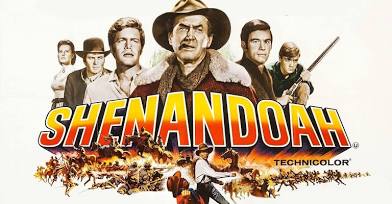
Jimmy Stewart plays Charlie Anderson, the patriarch of a large farming family in Virginia during the time of the Civil War. His family doesn’t own slaves, so he doesn’t figure it’s any of their business what all the fighting is about. He wants to keep working the land in hopes that the war will pass them by. Besides, he has six sons, a daughter, and a daughter in law that he wants to keep safe. He’s trying to keep the family together on his own as his beloved Martha had passed away sixteen years earlier giving birth to their youngest son, who we only know as Boy (Phillip Alford). Aside from the war that’s going on all around them, things seem pretty good for the Anderson’s. They all sit down for a big delicious meal every night. They attend Church every Sunday where they’re usually late and given the side-eye by Pastor Bjoerling (Denver Pyle). One of the sons, James Anderson (Patrick Wayne) and his wife Ann (Katharine Ross), have a precious newborn baby to take care of. The beautiful daughter Jennie (Rosemary Forsyth) is being courted by, and eventually marries, a lovestruck confederate officer named Sam (Doug McClure). Unfortunately the war won’t just go away, and when Boy is taken prisoner by Union soldiers, Charlie can’t stand idly by any longer. They head out to find him and bring him home.
In the guise of an entertaining semi-western, SHENANDOAH does a great job of illustrating how futile and randomly tragic war can be. The movie starts out lighthearted and fun as the family goes about its normal life, with Jimmy Stewart’s Charlie Anderson giving his homespun advice and rolling his cigars. This is a self-sufficient family that loves, respects and enjoys each other even if they don’t agree on everything. But the war keeps inching its way into their lives. First in the form of small group of confederate soldiers who come by to get some water and try to convince the boys to join up. None of the boys will join up, but they do help bury the soldiers when they’re ambushed and killed just down the road. Next a group of men come to the ranch to try to confiscate their horses for the Union army. Of course, Charlie Anderson isn’t going to let that happen and this turns into the type of brawl that seems to come right out of John Wayne western comedy like MCLINTOCK. Everybody joins in with the participants punching and being punched repeatedly, while Boy keeps getting knocked into the horse trough. This shouldn’t be a surprise because Director Andrew V. McLaglen directed MCLINTOCK and many other John Wayne films. Finally, Boy is taken prisoner because he is wearing a confederate cap that he found floating down the steam while he was out fishing one day. Once Charlie and most of his family head out to search for Boy, the movie begins a turn into tragedy. I won’t give the specifics away, but some members of the family will die, and not a single one of their deaths will be based on the actual fighting of a war. Rather, their deaths will be based on the chaos and depravity that surrounds the war. It’s tough to see, especially when they were all so happy just a little bit earlier. For me, the movie’s changes in tone make the tragedy more powerful and really drive home its message about the futility of war. But the Anderson family, like the United States of America after the Civil War, is made up of tough, resilient folks, and the movie ends on a hopeful note that definitely brought some extra moisture to my eyes.
Jimmy Stewart commands the screen in SHENANDOAH. You simply can’t take your eyes off of him, and his performance alone would make the movie worth watching. But with its powerful message, excellent cast, and solid direction, the movie is much more than just Stewart’s strong performance. I highly recommend it.
After watching 1967’s The Graduate, I defy anyone to listen to Simon and Garfunkel sing about the darkness without immediately picturing a young-looking Dustin Hoffman (he was 30 when the film was made but he was playing 22) standing on a moving airport walkway with a blank expression on his face.
If you don’t picture that, maybe you’ll picture Dustin Hoffman floating in a pool, wearing dark glasses and barely listening to his parents asking him about graduate school.
Or maybe you’ll remember him driving his car across the Golden Gate bridge. Or perhaps sitting at the bottom of his pool with a scuba mask on. Or maybe you’ll see him awkwardly standing at the desk in the lobby of a fancy hotel, trying to work up the courage to get a room. Or maybe you’ll just see him and Katharine Ross sitting at the back of that bus with a “what do we do now?” expression on their faces.
(Supposedly, that expression was not planned and was just a result of the shot running longer than expected.)
Ah, The Graduate. Based on a novel by Charles Webb, Buck Henry’s script remains one of the quotable in history. “Mrs. Robinson, you’re tying to seduce me …. aren’t you?” “Plastics.” “Elaine!” Myself, I have an odd feeling of affection for the line “Shall I get the cops? I’ll get the cops.” Perhaps that’s because the line is delivered by a young and uncredited Richard Dreyfuss, appearing in his second film and adding to the film’s general atmosphere of alienation.
Alienation is the main theme of The Graduate. As played by Hoffman, Benjamin Braddock feels alienated from everything. He was a track star. He was a top student in high school and college. Now, he’s just a college graduate with no idea what he wants to do with the rest of his life. One can argue, of course, that Braddock brings a lot of his alienation on himself. He can be a bit judgmental, even though he’s the one who is having an adulterous affair with Mrs. Robinson (Anne Bancroft) while also falling for Mrs. Robinson’s daughter, Elaine (Katharine Ross). His parents (William Daniels and Elizabeth Wilson) can be overbearing but it’s possible they have a point. Is he planning on spending the rest of his life floating in their swimming pool? Benjamin says that he just needs time to finally relax. After being pushed and pushed to be the best, he just wants time to do what he wants to do before his life becomes about plastics. When I first saw this movie, I was totally on Benjamin’s side. Now, as I’ve gotten older, I’ve started to understand where his parents were coming from. Still, it’s hard not to feel that Benjamin deserves at least a little bit of time to enjoy himself. That’s what Mr. Robinson (Murray Hamilton) thinks, at least initially.
Mrs. Robinson is the most interesting character in the film, a force of chaos who lives to disrupt the staid world around her. She’s bored with her marriage and her conventional but empty lifestyle so she has an affair with Benjamin. Later, she grows bored with Benjamin and his desire to “just talk” for once and she moves on from him. Benjamin and Elaine are both likable and you find yourself wishing the best for them but Mrs. Robinson is the character who you really remember. Mrs. Robinson grew up without losing her sense of rebellion. One doubts that Benjamin and Elaine are going to do the same.
A portrait of American suburbia and 60s alienation, The Graduate would prove to be one of the most influential social satires ever made. A box office hit, it was nominated for seven Academy Awards. It was nominated for Best Picture, Best Director (Mike Nichols), Best Actor (Dustin Hoffman), Best Actress (Anne Bancroft), Best Supporting Actress (Katharine Ross), Best Adapted Screenplay (Buck Henry and Calder Willingham), and Best Cinematography (Robert Surtees). The Simon and Garfunkel songs that set the film’s mood were, for the most part, not eligible. (Only Mrs. Robinson was written specifically for the film.) I would argue that the film deserved to be nominated for its editing as well. In the end, the film only won one Oscar, for Mike Nichols. But, regardless of what awards it won or lost, The Graduate‘s legacy lives on.
Malibu, CA will not be reviewed tonight so that we might bring you this special presentation….
My retro television reviews will return next week but, for now, why not enjoy something even better than me discussing my hatred of Malibu, CA? 1982’s Wait Until Dark is a videotaped record of a stage production of Frederick Knott’s classic play about a blind woman who is menaced by three criminals. (I assume it was filmed for PBS. According to Lettrboxd, this aired on television on June 20th, 1982.) This play was famously adapted into an Audrey Hepburn film in 1967. The production below gives us a chance to see how the suspense plays out in a theatrical setting. The cast, including Katharine Ross and Stacy Keach, is excellent!
In 1939, an ocean liner named the MS St. Louis set sail from Hamburg. Along with the crew, the ship carried 937 passengers, all of whom were Jewish and leaving Germany to escape Nazi persecution. The ship was meant to go to Havana, where the passengers had been told that they would be given asylum. Many were hoping to reunite with family members who had already taken the voyage.
What neither the passengers nor Captain Gustav Schroeder knew was that the entire voyage was merely a propaganda operation. No sooner had the St. Louis left Hamburg than German agents and Nazi sympathizers started to rile up anti-Semitic feelings in Cuba. The plan was to prevent the passengers from disembarking in Cuba and to force the St. Louis to then return to Germany. The Nazis would be able to claim that they had given the Jews a chance to leave but that the rest of the world would not take them in. Not only would the Jews be cast as pariahs but the Germans would be able to use the world’s actions as a way to defend their own crimes.
Captain Schroeder, however, refused to play along. After he was refused permission to dock in Cuba, he then attempted to take the ship to both America and Canada. When both of those countries refused to allow him to dock, Schroeder turned the St. Louis toward England, where he planned to stage a shipwreck so that the passengers could be rescued at sea. Before that happened, Belgium, France, the Netherlands, and the United Kingdom jointly announced that they would accept the refugees.
Tragically, just a few days after the passengers disembarked, World War II officially began and Belgium, France, and the Netherlands all fell to the Nazi war machine. It is estimated that, of the 937 passengers on the St. Louis, more than 600 of them subsequently died in the Nazi concentration camps.
The journey of the St. Louis was recreated in the 1976 film, Voyage of the Damned, with Max von Sydow as Captain Schroeder and a collection of familiar faces playing not only the ship’s passengers and crew but also the men and women in Cuba who all played a role in the fate of the ship. In fact, one could argue that there’s a few too many familiar faces in Voyage of the Damned. One cannot fault the performances of Max von Sydow, Malcolm McDowell, and Helmut Griem as members of the crew. And, amongst the passengers, Lee Grant, Jonathan Pryce, Paul Koslo, Sam Wanamaker, and Julie Harris all make a good impression. Even the glamorous Faye Dunaway doesn’t seem to be too out-of-place on the ship. But then, in Havana, actors like Orson Welles and James Mason are awkwardly cast as Cubans and the fact that they are very obviously not Cuban serves to take the viewer out of the story. It reminds the viewer that, as heart-breaking as the story of the St. Louis may be, they’re still just watching a movie.
That said, Voyage of the Damned still tells an important true story, one that deserves to be better-known. In its best moments, the film captures the helplessness of having nowhere to go. With Cuba corrupt and the rest of the world more interested in maintaining the illusion of peace than seriously confronting what was happening in Germany, the Jewish passengers of the St. Louis truly find themselves as a people without a home. They also discover that they cannot depend on leaders the other nations of the world to defend them.
Defending the passengers falls to a few people who are willing to defy the leaders of their own country. At the start of the film, Nazi Intelligence Chief Wilhelm Canaris (Denholm Elliott) explains that Captain Schroeder was selected specifically because he wasn’t a member of the Nazi Party and could not be accused of having ulterior motives for ultimately returning the passengers to Germany. Canaris and his fellow Nazis assume that anti-Semitism is so natural that even a non-Nazi will not care what happens to the Jewish passengers. Instead, Schroeder and his crew take it upon themselves to save the lives of the passengers. It is not Franklin Roosevelt who tries to save the passengers of St. Louis. Instead, it’s just a handful of people who, despite unrelenting pressure to do otherwise, step up to do the right thing. Max von Sydow, who was so often cast in villainous roles, gives a strong performance as the captain who is willing to sacrifice his ship to save his passengers.
Flaws and all, Voyage of the Damned is a powerful film about a moment in history that must never be forgotten.
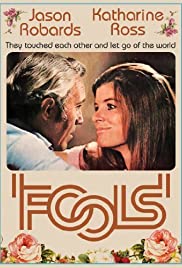
In this self-conciously hip and with-it portrait of life in San Francisco at the tail end of the hippie era, Jason Robards plays Matthew South, a veteran B-movie actor who is fed up with everyday life and who is prone to long monologues about how the machines are taking over. (Just imagine how Matthew would feel about the world today.) When Matthew gets into an argument with two people in a park, Anais Appleton (Katharine Ross) comes to his rescue and soon, they’re in the middle of a falling in love montage. Actually, there are several falling in love montages and they’re almost all scored by Kenny Rogers and the First Edition. It’s easy listening with a hippie tinge.
Fools follows Matthew and Anais as they wander around San Francisco and have several strange encounters, none of which make much sense. For instance, there’s a scene where two FBI agents suddenly burst into the room and then admit that they’re at the wrong address. Why is that scene there? What does it mean? Later, Matthew and Anais go to a dentist and they listen to a patient try to seduce her psychiatrist (who is played by Mako). Why is that scene there? What does any of it mean? Everywhere that Matthew and Anais go, they see evidence that society is dumb and that the answer to all life’s problems is a love song from Kenny Rogers. Matthew never stops talking and Anais never stops looking pretty (she’s Katharine Ross after all) but neither ever becomes a strong enough character to ground Fools in any sort of reality. It’s a movie that preaches nonconformity while so closely imitating A Thousand Clowns and Petulia that the entire thing feels like plagiarism.
Anais has a husband, an emotionally distant lawyer named David (Scott Hylands). David isn’t prepared to let Anais leave him, no matter how tired she is of their marriage. He hires a detective to follow Anais around. It all leads to an act of violence that doesn’t fit the mood of anything that’s happened before. Cue another falling love montage before the end credits role.
Fools is one of those films that probably would never have been made without the success of Easy Rider. Everyone wanted a piece of the counterculture in 1970 and Fools tries so hard that it’s painful to watch. Of course, neither Matthew nor Anais are really hippies. They do eventually come across some hippies playacting in the street. One of them is played by future David Lynch mainstay Jack Nance so that’s pretty cool. Otherwise, Fools deserves to stay in 1970.
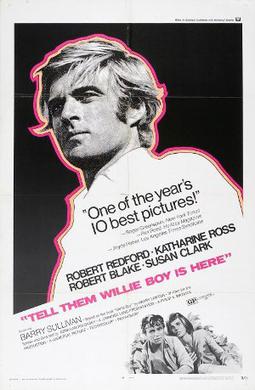
In 1908, a Paiute Indian named Willie (Robert Blake) has fallen in love with a white woman named Lola (Katharine Ross). After Lola’s father discovers Willie and Lola together, Willie shoots him. Willie claims that the shooting was in self-defense while the white citizens of California insist that it was cold-blooded murder, motivated by a tribal custom that would allow Willie to claim Lola as his wife upon the death of her father. Willie and Lola go on the run, trying to escape through the Morongo Valley.
Because President Taft is scheduled to make a trip to the area, the locals are eager for Willie Boy to either be captured or killed. Several posses form, all intent on tracking Willie down. A humane deputy sheriff named Cooper (Robert Redford) reluctantly leads the search for Willie. Cooper’s occasional lover is a school teacher named Elizabeth (Susan Clark) who insists that Cooper rescue Lola from Willie. The only problem is that Lola doesn’t want to be rescued and Willie would rather die than surrender to the white men.
Tell Them Willie Boy Is Here is one of those revisionist westerns that were all the rage in the late 60s and the early 70s. (The same year that he led a posse in Tell Them Willie Boy Is Here, Robert Redford also tried to outrun a posse in Butch Cassidy and the Sundance Kid.) Willie Boy gets off to a good start, showing how Willie has to spend almost every hour of the day dealing with prejudice and racism. The film does a good job of showing that even “liberal” whites, like Elizabeth, are capable of being prejudiced. There are hints that Cooper and Willie share a mutual respect and both Blake and Redford do a good job portraying the weary respect that the lawman and the outlaw have for each other.
Things start to fall apart when Willie shoots Lola’s father. The scene is shot so confusingly that it’s hard to know what exactly happened and it feels like a cop out. Rather than definitely saying whether Willie had no choice but to shoot Lola’s father or that Willie intentionally committed murder, the scene tries to have it both ways and it doesn’t work. Once the chase begins, the movie is equally split between Cooper and the posse and Willie and Lola and the end result is that the two main characters end up getting short changed.
Tell Them Willie Boy Is Here was directed by Abraham Polonsky, a screenwriter who was blacklisted during the McCarthy era. While this is definitely a film made from a left-wing perspective, its actual message still feels muddled. Willie is the driving force behind the plot but the film seems to be more interested in the less intriguing Cooper. The film ends on a note of ambiguity, which perhaps felt daring in 1969 but today, just feels like another cop out. Despite a great performance from Blake and a better-than-usual one from Redford, Tell Them Willie Boy Is Here is an unfortunate misfire.
— Loren Hardeman Sr. (Sir Laurence Olivier) in The Betsy (1978)
Here’s a little thought experiment:
Imagine if The Godfather had starred Laurence Olivier and Tommy Lee Jones.
That may sound strange but it actually could have happened. When Francis Ford Coppola first started his search for the perfect actor to play Don Vito Corleone, he announced that he could only imagine two actors pulling off the role. One was Marlon Brando and the other was Laurence Olivier.
As for Tommy Lee Jones, he was among the many actors who auditioned for the role of Michael Corleone. At the time, Jones was 26 years old and had only recently made his film debut in Love Story. As odd as it may be to imagine the quintessentially Texan Tommy Lee Jones in the role, Coppola always said that he was looking for a brooder as Michael and that’s definitely a good description of Jones.
Of course, as we all know, neither Olivier nor Jones were ever cast in The Godfather. Marlon Brando played Don Vito and Al Pacino was cast as Michael. However, a few years later, Olivier and Jones would co-star in another family saga that combined history, organized crime, and melodrama. That film was 1978’s The Betsy and, interestingly enough, it even co-starred an actor who actually did appear in The Godfather, Robert Duvall.
Of course, now would probably be a good time to point out that The Godfather is perhaps the greatest American film of all time. And The Betsy … well, The Betsy most definitely is not.
The film’s German poster even gives off a Godfather vibe
Based on a novel by Harold Robbins, The Betsy exposes the secrets of Detroit. Decades ago, Loren Hardeman founded Hardeman Motors and started to build his considerable fortune. Sure, Loren had to break a few rules. He cut corners. He acted unethically. He had an affair with his daughter-in-law and then drove his gay son to suicide. Loren never said that he was perfect. Now in his 80s, Loren has a vision of the future and that vision is a new car. This car will be called the Betsy (named after his great-granddaughter) and it will be the most fuel-efficient car ever made.
Since the film appropriates the flashback structure used in The Godfather Part II, we get to see Loren Hardeman as both an elderly man and a middle-aged titan of industry. Elderly Loren is played by Laurence Olivier. Elderly Loren spends most of the film in a wheelchair and he speaks with a bizarre accent, one that I think was meant to be Southern despite the fact that the film takes place in Michigan. Elderly Loren gets really excited about building his new car and, at one point, shouts out “Wheeeeeee!”
Middle-aged Loren is played by … Laurence Olivier! That’s right. Olivier, who was 71 years old at the time, also plays Loren as a younger man. This means that Olivier wears a hairpiece and so much makeup that he looks a bit like a wax figure come to life. Strangely, Middle-aged Loren doesn’t have a strange accent and never says “wheeeee.”
To build his car, Loren recruits race car driver Angelo Perino (Tommy Lee Jones). Angelo’s father was an old friend of Loren’s. When Angelo agrees, he discovers that the Hardeman family is full of drama and secrets. Not only is great-granddaughter Betsy (Kathleen Beller) in love with him but so is Lady Bobby Ayers (Lesley-Anne Down), who is the mistress of Loren’s grandson, Loren the 3rd (Robert Duvall).
Because he blames his grandfather for the death of his father, Loren the 3rd has no intention of building Loren the 1st’s car. Loren the 3rd wants to continue to make cars that pollute the environment. “Over my dead boy!” Loren the 1st replies. “As you wish, grandfather,” Loren the 3rd replies with a smile.
But we’re not done yet! I haven’t even talked about the Mafia and the union organizers and the automotive journalist who ends up getting murdered. From the minute the movie starts, it’s nonstop drama. That said, most of the drama is so overdone that it’s actually more humorous than anything else. As soon as Laurence Olivier shouts out, “Wheeeee!,” The Betsy falls into the trap of self-parody and it never quite escapes. There’s a lot going on in the movie and one could imagine a more imaginative director turning the trashy script into a critique of capitalism and technology. However, Daniel Petrie directs in a style that basically seems to be saying, “Let’s just get this over with.”
The cast is full of interesting people, all of whom are let down by a superficial script. Nothing brings out the eccentricity in talented performers quicker than a line of shallow dialogue. Jane Alexander, who plays Duvall’s wife, delivers all of her lines in an arch, upper class accent. Edward Herrmann, playing a lawyer, smirks every time the camera is pointed at him. Katharine Ross, as Olivier’s mistress and Duvall’s mother, stares at Olivier like she’s trying to make his head explode. Tommy Lee Jones is even more laconic than usual while Duvall always seems to be struggling not to start laughing.
And then there’s Olivier. For better or worse, Olivier is the most entertaining thing about The Betsy. He doesn’t give a good performance but he does give a memorably weird one. Everything, from the incomprehensible accent to a few scenes where he literally seems to bounce up and down, suggests a great actor who is desperately trying to bring a spark of life to an otherwise doomed project. It’s a performance so strange that it simply has to be seen to be believed.
Tomorrow, we take a look at another melodrama featuring Robert Duvall, True Confessions!
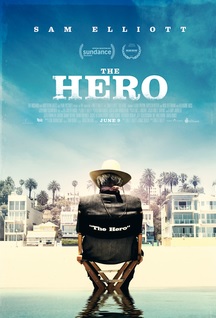
It’s too bad that The Hero didn’t get that much attention when it originally released because, towards the end of the film, Sam Elliott has a scene that features some of the best cinematic acting that I’ve ever seen.
I’m not going to spoil the scene, because I think you should experience it for yourself. I’ll just say that it’s a scene that will take you totally by surprise and force you to reconsider everything that you had previously assumed about both the film and the lead character. I’m not ashamed to say that the scene brought tears to my mismatched eyes. When you hear Elliott say, “I’ve wasted your time,” it will bring tears to your eyes too.
And that’s all I’m going to say about that scene.
As for the rest of the film, it’s a character study of an actor. Sam Elliott plays Lee Hayden, who we’re told was one of the top actors in the world in the 70s. He specialized in westerns, films and TV shows in which he always played the hero. Of course, that was a while ago. Lee is 70 years old now and both westerns and heroes are out of date. At this point, Lee’s only steady work comes from doing the voice over for a series of steak commercials. He spends most of his time smoking weed with his best friend, Jeremy (Nick Offerman).
It’s not a bad life though Lee certainly has his regrets. For instance, he hasn’t always been the best father. His daughter (Krysten Ritter) doesn’t seem to want much to do with him. He misses acting. As is made clear in the film’s opening scene, doing 6 different takes for a commercial voice over isn’t exactly the most challenging or rewarding way for a former star to spend his semi-retirement. But he has his one friend and he has marijuana and what else does he need?
But then one day, Lee is told that he might have cancer. He might be dying. Lee starts to think about his life and his legacy. He tries to reconnect with his daughter. He accepts a lifetime achievement award from the Western Hall of Fame and, just when you think both the film and Lee are about to get snarky, they surprise you by treating the award and Lee’s aging fans with a poignant respect. Lee also pursues a relationship with a much younger stand-up comedienne (Laura Prepon) and while I did arch an eyebrow at the huge age difference between them, the film itself actually addresses the issue in an unexpected way.
It’s not the most tightly constructed film. Darren Aronofsky’s The Wrestler was an obvious influence but The Hero never quite matches that film’s fatalistic glory. But no matter! The Hero is mostly about celebrating Sam Elliott, an underrated actor who shows that, much like Lee, he’s capable of much more than most viewers assume. Elliott gives a poignant, wonderfully human performance as a flawed man who still deserves to be known as The Hero.
This made-for-TV sequel to Butch Cassidy and the Sundance Kid opens several years after the death of Butch and Sundance in Bolivia. Etta Pace (Katharine Ross, reprising her role from the original film) is now a wanted woman. Hiding out in Arizona, she does her best to keep a low profile. But when Pinkerton detective Charlie Siringo (Steve Forrest) comes to town and one of Etta’s friends (Michael Constantine) is arrested, Etta knows that she’s going to need help to survive. Crossing the border into Mexico, she teams up with revolutionary Pancho Vila (Hector Elizondo). In return for helping him get his hands on a shipment of guns, Vila agrees to protect Etta.
Wanted: The Sundance Woman was ABC’s second pilot for a possible television series about Etta Pace’s adventures at the turn of the century. The first pilot starred Elizabeth Montgomery as Etta and directly dealt with Etta’s attempts to come to terms with the death of Butch and Sundance. While Katharine Ross returned to the role for the second pilot, Wanted: The Sundance Woman does not actually have much of a connection to Butch Cassidy and The Sundance Kid. Katharine Ross could have just as easily been playing Etta Smith as Etta Pace.
Wanted: The Sundance Woman is held back by its origins as a TV movie and a rather silly romance between Etta and Pancho Vila. Hector Elizondo is hardly convincing as a fiery revolutionary and Steve Forrest is reliably dull as Siringo. It is not really surprising that this pilot didn’t lead to a weekly series. On the positive side, the film does feature an exciting train robbery and Katharine Ross is just as good in this sequel as she was in the original. Even though she was talented, beautiful, and had important roles in two of the most successful films of the 60s (The Graduate and Butch Cassidy and the Sundance Kid), Hollywood never seemed to know what do with Katharine Ross. While she did have a starring role in The Stepford Wives, Katharine Ross spent most of the 70s appearing in stuff like The Swarm, They Only Kill Their Masters, and The Betsy. It’s unfortunate that Hollywood apparently did not want Katharine Ross as much Pancho Vila wanted the Sundance Woman.