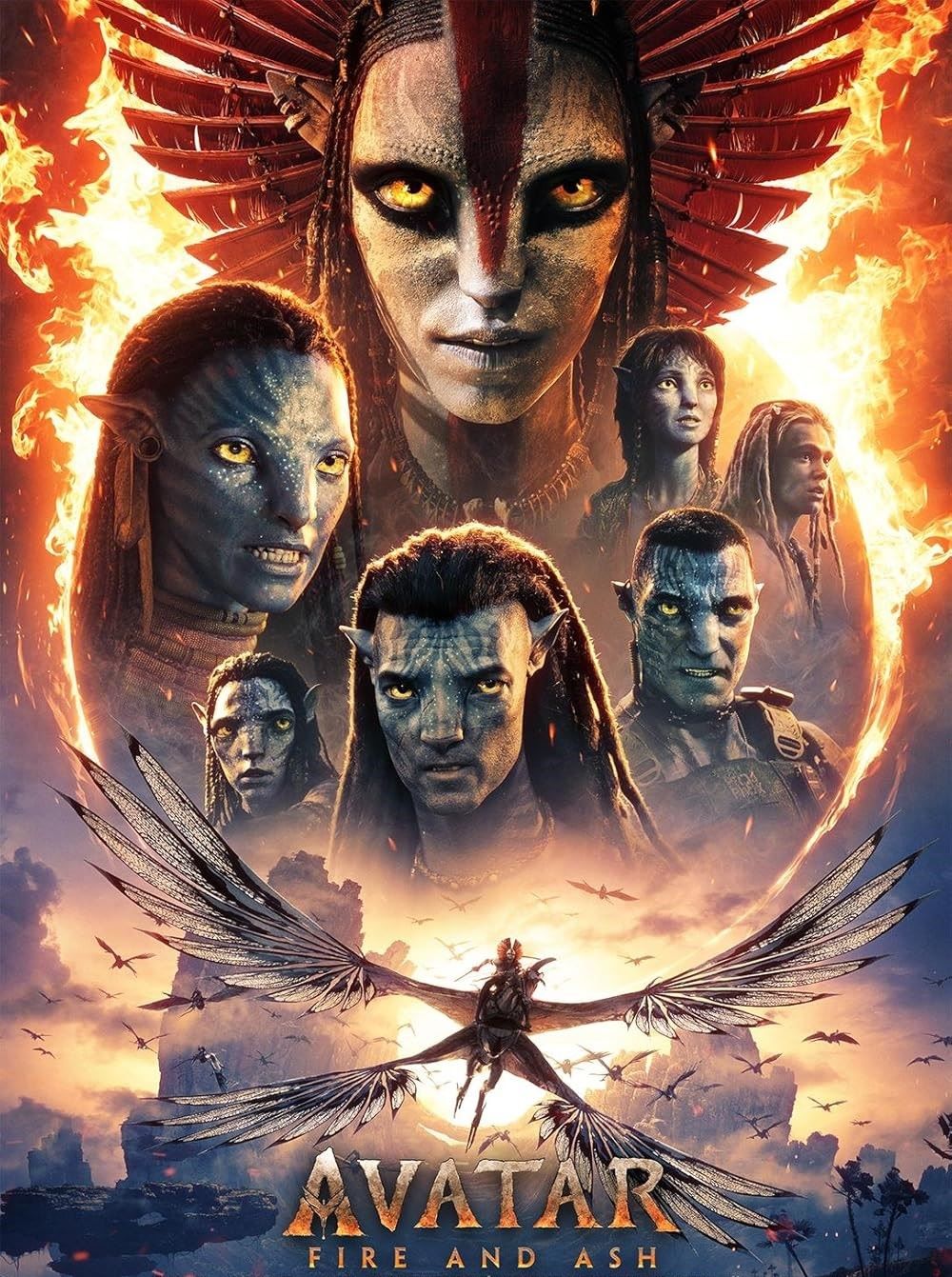
Avatar: Fire and Ash Review (dir. by James Cameron)


 “The fire came from the mountain… Eywa did not come. So I went to the fire, and I learned its way” – Varang

Avatar: Fire and Ash plays like a massive, molten crescendo for Cameron’s Pandora saga—visually overwhelming, emotionally heavier than the last two entries, but also very familiar in ways that will either feel comfortingly mythic or a little déjà vu, depending on your tolerance for repetition. The ash-choked skies, lava rivers, and volcanic Na’vi clans are often more compelling than some of the story beats, and the final stretch delivers the kind of operatic, war-movie scale that makes the three-plus-hour runtime go down easier than it should, even though the film clearly didn’t need to run this long.

This time around, the series leaves behind the cool blues and oceanic calm of the previous chapter for a harsher, volcanic corner of Pandora that feels like a nature documentary shot in a furnace. Jagged black rock, roiling lava, and smoke-stained skies dominate the frame, with creatures and plant life that look as if they evolved to survive heat and ash rather than coral reefs and open water, giving the movie an immediately distinct visual identity even when the story rhythms feel familiar.

At the center of this environment are the Ash People, or Mangkwan clan, a Na’vi group shaped by relentless scarcity and violence. They ride creatures adapted to fire and ash instead of waves, cover themselves in soot-black markings, and fight using a deliberate blend of traditional Na’vi weaponry and repurposed human tech, putting them ideologically at odds not just with the human invaders, but with other Na’vi clans who still cling to older, more spiritual ways of living with Eywa.

The story picks up with Jake and Neytiri’s family still reeling from Neteyam’s death, and the film leans hard into unresolved grief as its emotional baseline. Jake doubles down on his protector persona, treating every decision as a matter of survival, while Neytiri’s pain expresses itself as barely controlled rage, and that emotional weather trickles down to their children, who are increasingly frustrated at being treated like liabilities. The problem is that a lot of this family dysfunction was already unpacked in the second film, so instead of evolving those arcs, the script often feels like it is rehashing earlier conflicts.

The dynamic between Jake and Lo’ak is the clearest example of this repetition. Jake’s exasperation with Lo’ak’s impulsive, run-toward-the-bullets mentality resurfaces again and again, echoing arguments audiences have already seen: the father insisting his son isn’t ready, the son bristling at never being trusted. These moments still have emotional sting, but they circle the same drain so often that entire conversations could have been trimmed or removed without sacrificing character depth, and tightening that thread alone would have shaved a noticeable chunk off the runtime.

Where the film becomes more thematically interesting is in how it reframes Pandora’s conflict. Instead of a simple “Na’vi versus humans” setup, it pits the more traditional Na’vi clans—those still committed to a symbiotic relationship with Eywa—against the Ash People, whose warlike nature and embrace of human weaponry make them ideological outliers. That split plays as a pointed echo of historical events in the Americas, where European colonial powers armed and favored specific Indigenous nations to fight their neighbors, turning native communities into proxies in conflicts that ultimately benefitted outsiders more than the people doing the actual bleeding.

The analogy becomes sharper in how human forces hang back and quietly exploit these new divisions. By giving the Ash People access to superior firepower and nudging them toward confrontation, the outsiders effectively inflame existing grievances and reshape local power dynamics, much like colonial regimes once did by supplying guns and promises to one group while framing another as the enemy. The result is a Pandora that feels more fractured and politically complex, where internal Na’vi conflict is as dangerous as external invasion.

Varang, the leader of the Ash People, is one of the film’s strongest assets. She’s portrayed as a true believer who has taken real suffering and twisted it into a doctrine of purifying destruction, convinced that burning the world is the only way to save it. The character blends zealotry and charisma in a way that makes her both frightening and compelling, and she wields faith, desire, and fear as weapons with unnerving ease, giving the movie a volatile energy whenever she’s on-screen.

Her alliance with Quaritch pushes the story into darker, more uncomfortable territory. What begins as a pragmatic arrangement—a trade of firepower and influence for help tracking Jake—evolves into a twisted, intimate partnership that underlines just how far both are willing to go to achieve their goals. Their connection is meant to feel toxic and predatory, and it succeeds on that front, though some viewers may find the intensity of those scenes off-putting compared with the relatively straightforward romance and family dynamics of earlier entries.

On a craft level, the film is almost absurdly polished. Even if it no longer feels like a quantum leap in visual effects, the execution is meticulous: volcanic vistas glow with molten light, ash storms swirl with tactile grit, and the interplay of fire, smoke, and bioluminescence gives many shots a painterly quality. The action sequences rely on clear geography and patient staging, so even when the screen is full of creatures, machines, and chaos, it remains surprisingly easy to track who is where and what’s at stake.

The final act is where the movie unleashes everything it has: parallel battles on land, in the air, and over volatile seas, stitched together into a long, escalating crescendo. Familiar James Cameron signatures return—heroic last-second saves, nature itself intervening, climaxes that mirror earlier films—but the pacing of these sequences is handled with enough control that they rarely collapse into pure noise. Still, you can’t help but feel that with a leaner, more disciplined buildup, that climax would have hit even harder.

Structurally, the story leans heavily on patterns that loyal viewers will recognize. There is yet another relocation to a new culture, another period of uneasy assimilation, another slow slide into open warfare, and another sacrificial, emotionally charged finale. Whether that comes across as mythic repetition or simple recycling depends on how patient you are with Cameron’s tendency to “rhyme” his narratives rather than reinvent them.

Most of the main character arcs feel like refinements rather than reinventions. Jake remains the guilt-ridden warrior father terrified of losing his children; Lo’ak edges closer to full-on protagonist status as the reckless but big-hearted son; Kiri’s mystical bond with Eywa deepens while remaining intentionally enigmatic; and Quaritch once again fills the role of relentless, personal antagonist. With the same father–son friction repeatedly dragged back into the spotlight, the emotional landscape can feel stuck in place, and a stricter editorial hand might have refocused attention on the fresher elements—like Varang and the Ash People’s worldview.

Tonally, the film pushes into darker territory while still staying within a mainstream rating. The battles feel more brutal, with a greater emphasis on the physical cost of arrows, explosions, and close-quarters fighting, and there’s a persistent sense that no one is truly safe. That harshness extends to the emotional side as well, as the Sully family finds itself cornered into choices where every option exacts a price, reinforcing the idea that survival in this version of Pandora demands constant compromise.

Thematically, Avatar: Fire and Ash weaves together ideas about faith, extremism, and the way trauma can be weaponized. The Ash People act as a distorted mirror of earlier Na’vi cultures: a society that has taken genuine pain and turned it into an excuse for cruelty, abandoning balance in favor of cleansing violence. Layered on top of that is the divide-and-rule dynamic, where more technologically advanced outsiders stoke internal conflicts for their own advantage, mirroring how colonial powers in the Americas encouraged Indigenous groups to fight one another while expanding their control and extracting resources.

Despite all the digital wizardry, the performances still manage to cut through. Jake and Neytiri’s scenes carry the weight of years of loss and sacrifice, and there’s a believable exhaustion in the way they argue and compromise. The younger characters, especially Lo’ak and Kiri, feel more rooted and central than they did before, which helps sell the gradual shift toward a new generation, even if the script keeps dragging them back through conflicts that feel like reruns instead of genuine evolution.

At the same time, the movie sometimes undercuts its best character work in its rush to reach the next big set piece. Quieter moments that might have deepened side characters or given the Ash People’s beliefs more nuance are often compressed or sidelined, while scenes rehashing Jake and Lo’ak’s issues are allowed to run long. If the film had trusted audiences to remember the family dysfunction carried over from the second installment and cut down on repeated arguments, those smaller, richer beats could have had more space—and the whole piece would likely feel tighter and more focused.

For viewers already invested in Pandora, Avatar: Fire and Ash is clearly built for the biggest screen available: the volcanic vistas, layered sound design, and carefully staged action set pieces are all engineered to overwhelm in the best way. It delivers a darker chapter without abandoning the earnest, sometimes corny sincerity that has always defined this series, and as a conclusion to this phase of the story, it feels emotionally full even as it insists on revisiting familiar territory and stretching its narrative longer than necessary.

For more casual viewers or anyone who found the earlier films predictable, this is unlikely to be the conversion point. The structure is recognizable, the dialogue is often workmanlike rather than sharp, and the movie leans so hard into repeating certain family conflicts that it can feel like the story is padding itself instead of evolving. But if you can live with those flaws—the repetition, the length, the occasional heavy hand—the combination of technical craftsmanship, volcanic imagery, heavy emotional stakes, and that quietly pointed commentary on colonial-era divide-and-rule tactics makes Avatar: Fire and Ash a fiery, flawed, but undeniably impressive ride.

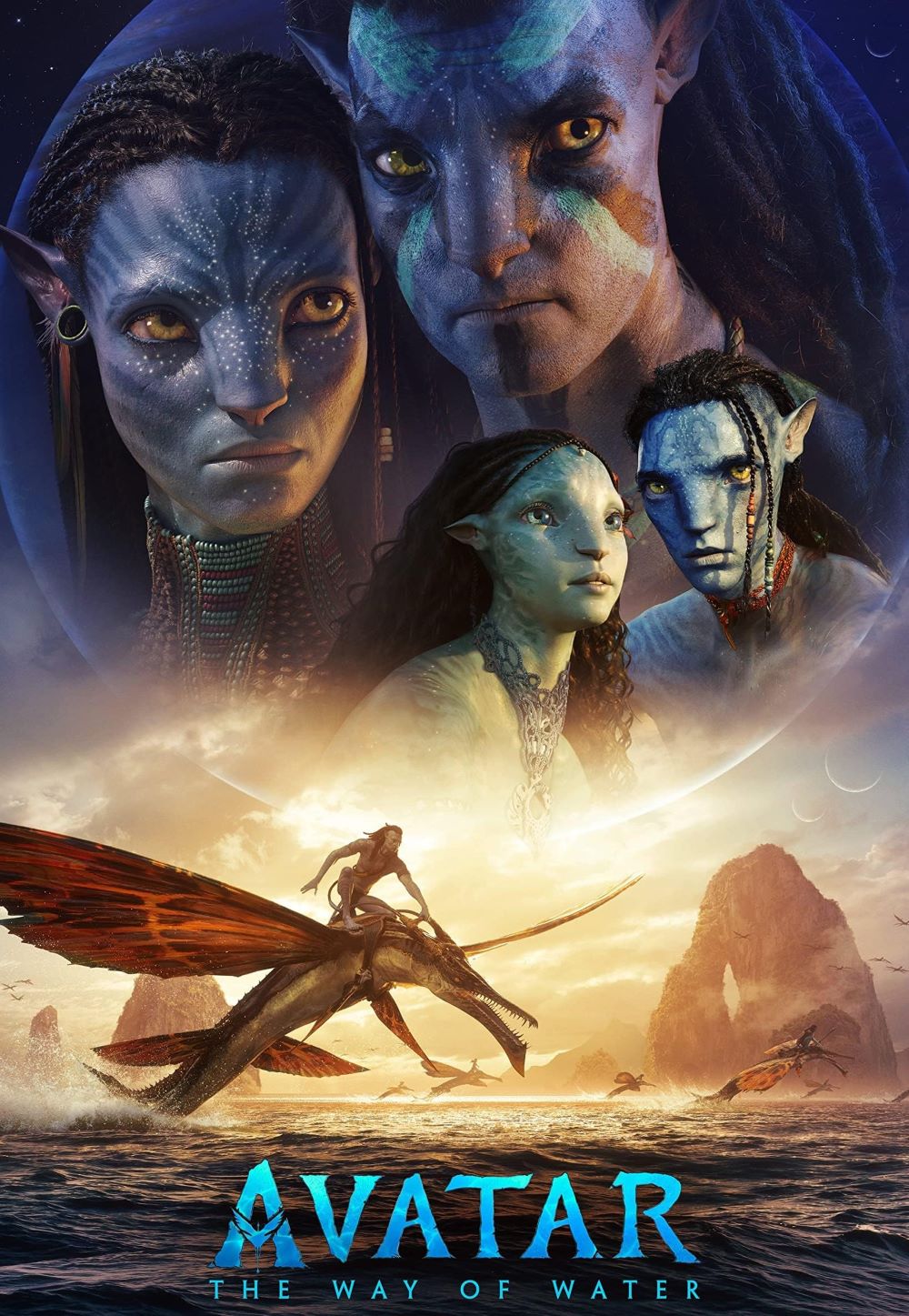
Avatar: The Way of Water Review


“I see now. I can’t save my family by running. This is our home. This is our fortress. This is where we make our stand.” — Jake Sully

Avatar: The Way of Water delivers jaw-dropping visuals and a sincere dive into family struggles, but it drags under its three-hour weight with repetitive plotting and uneven character depth that keeps it from breaking truly new ground.

James Cameron returns to Pandora over a decade after the original Avatar, catching up with Jake Sully and Neytiri as they’ve built a sprawling family amid fragile peace—only for human colonizers, the so-called Sky People, to crash back with upgraded tech, ruthless determination, and a deeply personal grudge led by a vengeful Colonel Quaritch reborn in Na’vi avatar form. This forces the Sullys into a desperate flight to the Metkayina, a reef-dwelling Na’vi clan whose ocean-adapted physiology and customs—broader tails for swimming, gill-like breathing aids, a deep spiritual bond with marine life—present a whole new cultural and environmental challenge, transforming the story from the first film’s jungle rebellion into a watery survival tale laced with themes of displacement and adaptation.​

What truly sets the film apart, even if the story treads familiar “pursued heroes vs. imperial baddies” territory without bold twists, is how it masterfully expands the Avatar universe’s worldbuilding, turning Pandora from a singular bioluminescent jungle into a teeming planet with diverse ecosystems and cultures. The Metkayina villages perch on floating lattices of woven kelp and coral, lit by phosphorescent anemones pulsing like underwater stars, while daily life revolves around symbiotic ties with ilu (skittish six-finned mounts) and skimwings (leathery ocean skimmers); nomadic Tulkun society—intelligent, philosophical whale-like beings communicating via sonic songs—clings to a strict non-violence “tulkun way” brutally shattered by human whalers.

These layers emerge organically through the Sullys’ awkward integration, like mastering fluid sign language or breath-holds for deep dives, and the spectacle dazzles relentlessly, powered by advancements in hyperrealistic CG that continue to erode the uncanny valley effect on characters—Na’vi faces now convey micro-expressions of pain, joy, and exhaustion with lifelike subtlety, their skin textures responding to water and light in ways that feel organic rather than synthetic.​

Bioluminescent reefs glow in electric blues and greens, iridescent fish schools dart through sun-dappled shallows, and massive Tulkun glide with skyscraper grace and scarred hides. Cameron’s pioneering underwater motion capture—actors in massive tanks layered with tactile CG—makes every bubble, flipper stroke, and coral sway palpably real, as Na’vi teens free-dive twisting kelp forests and maze-like atolls in lung-burning tension. The film also pushes 3D technology to new heights since the first film, baked natively into every frame rather than tacked on as a post-production gimmick—this integral approach ensures depth pops organically, from swirling plankton clouds enveloping swimmers to layered reef foregrounds framing distant horizons.​

The action peaks in the third-act frenzy of ship crashes against waves, flare-lit dogfights, Tulkun rams crumpling hulls, and a claustrophobic flooding vessel breach where air dwindles second-by-second. Cameron’s chaos clarity—echoing The Abyss or Titanic—ties stakes to family peril, amplified by thundering sound (crashing surf, whale calls, Na’vi gasps) and Jon Landau’s IMAX polish into sensory overload.

Family drives the lived-in, flawed emotional core: Jake (Sam Worthington’s gravelly gravitas) wrestles fatherhood’s math—stern orders backfiring into guilt—as he clashes with impulsive Lo’ak (Britain Dalton’s sulky edge), whose outsider rage forges a bond with scarred Tulkun Payakan, flipping “monster” tropes for real agency; dutiful Neteyam buckles under expectations, innocent Tuk (Trinity Jo-Li Bliss) witnesses horrors, and mystic Kiri—Grace’s avatar-born daughter linked to Eywa—teases lore like planetary souls, while Neytiri (Zoe Saldana’s fiery sorrow) simmers with grief-fueled, mama-bear savagery, her outbursts piercing deeper than rifles.​

These arcs convert invasions into gut punches on protection, belonging, parental failures, and war’s selfish costs—specific melodrama over generic heroism. Yet simplicity amplifies flaws over runtime: a chase loop (hunts, hides, teen trouble, repeat) grates, with middle sags of cultural lessons (sign language, ilu taming, Tulkun reverence) feeling like filler; humans are greed caricatures—whalers gutting pacifists for longevity goo amrita, suits enabling genocide—lacking nuance despite Earth’s biosphere desperation nods, preaching eco-colonialism to the choir. Neytiri gets benched post-roars (a co-lead letdown), Quaritch dangles complexity (death memories, Spider ties) but snarls relentlessly; reef archetypes (wise Tonowari, omen-Ronal, bully-to-ally Aonung) lopsided the cast, Tulkun elders out-nuancing humans.​

The film’s themes land with sincere force: whaling atrocities, from harpooned flesh and bloodied seas to a mother’s primal rage, hammer home human irredeemability without much subtlety, while family adaptation explores “forest people” taunts, strained bonds, and Eywa’s mystical interventions that weave personal growth into planetary balance—heartfelt without ironic quips, either refreshing in its earnestness or manipulative depending on your taste. Pacing remains deeply polarizing, offering immersive vibes for world-huggers who savor the slow builds but feeling bloated and front/back-loaded for plot purists impatient with the expansion-heavy middle.

Ultimately, Avatar: The Way of Water triumphs as a visual banquet and saga extender, hooking viewers with its aquatic marvels, raw parental fears, peerless craft (hyperreal CG and improved 3D elevating it), and smart universe growth through new clans, beasts, and lore seeds—all sans true narrative reinvention, as bloated length, repetitive echoes, and flat foes keep it from pantheon status. Fans of Pandora dive in sated; skeptics surface impressed by the technical wizardry yet impatient with the sprawl. It’s pure Cameron—huge swings promising more sequels ahead. Worth submerging for the spectacle.

SENSE AND SENSIBILITY – 1995 was a banner year for Jane Austen and cinematic romance. This is one of my favorite scenes!


I may write mostly about the film exploits of actors like Charles Bronson, Rutger Hauer, James Woods, Clint Eastwood, and Chow Yun-Fat, but there’s no doubt that I’m a sucker for a good romance. And my very favorite romantic films are based on the works of Jane Austen. I’ve watched the 1995 TV mini-series version of PRIDE AND PREJUDICE starring Colin Firth and Jennifer Ehle at least ten times in my life. It’s just so good. My favorite Austen “book-turned-film” just may be the 1995 version of PERSUASION starring Amanda Root and Ciaran Hinds. I’ve probably watched it at least twenty times in my life. I love to watch these movies when I need a pick me up, or when I need to relax. They have hard won “happy endings” and they always leave me with a tear in my eye.

Well, it’s obvious that 1995 was an amazing year for Jane Austen adaptations, because the year also featured the release of Ang Lee’s SENSE AND SENSIBILITY starring an incredible cast that included Emma Thompson, Kate Winslet, Hugh Grant and Alan Rickman. Emma Thompson would even win an Oscar for the screenplay that she adapted for the screen. If it was up to me, she would have also won an Oscar for her performance in this scene alone, and I still get happy tears every time I watch it. *(SPOILER ALERT)* If you’ve never seen the film, and you don’t want to see how it ends, do not watch this clip. However, if you love the movie, and the scene, as much as I do, enjoy. Happy Valentine’s Day, my friends!

Lisa Marie’s Oscar Predictions For December


With the 2024 coming to a close and awards season in full swing, the Oscar race has become a lot clearer.  For the last time this year, here are my monthly Oscar predictions!

Be sure to check out my predictions for AprilMayJuneJuly, August,  September, October, and November!

Best Picture

Anora

The Brutalist

A Complete Unknown

Conclave

Dune Part Two

Emilia Perez

Nickel Boys

Sing Sing

The Substance

Wicked

Best Director

Sean Baker for Anora

Brady Corbet for The Brutalist

Coralie Fargeat for The Substance

RaMell Ross for Nickel Boys

Denis Villeneuve for Dune Part Two

Best Actor

Adrien Brody in The Brutalist

Timothee Chalamet in A Complete Unknown

Daniel Craig in Queer

Colman Domingo in Sing Sing

Ralph Fiennes in Conclave

Best Actress

Cynthia Erivo in Wicked

Marianne Jean-Baptiste in Hard Truths

Mikey Madison in Anora

Demi Moore in The Substance

Kate Winlset in Lee

Best Supporting Actor

Yura Borisov in Anora

Kieran Culkin in A Real Pain

Edward Norton in A Complete Unknown

Guy Pearce in The Brutalist

Denzel Washington in Gladiator Part II

Best Supporting Actress

Aunjanue Ellis-Taylor in Nickel Boys

Ariana Grande in Wicked

Felicity Jones in The Brutalist

Margaret Qualley in The Substance

Zoe Saldana in Emilia Perez

Here Are The 2024 Golden Globe Nominations


I’ll show a pair of Golden Globes!

The Golden Globe nominations were announced this morning.  Pamela Anderson picked up a nomination for Best Actress in a Drama, which I appreciated because a Pamela Anderson Oscar nomination would, at the very least, add some surprise to the year.  Edward Norton picked up a Supporting Actor nomination for playing Pete Seeger in A Complete Unknown, which is interesting because I really hadn’t heard Norton’s name mentioned as a contender before yesterday.  The nominations for The Apprentice‘s Sebastian Stan and Jeremy Strong felt like they were sent here from an alternate universe where everyone isn’t bored with political movies.

Here are the nominations!  The winners will be announced on January 5th.

BEST MOTION PICTURE, DRAMA
The Brutalist
A Complete Unknown
Conclave
Dune: Part Two
Nickel Boys
September 5

BEST MOTION PICTURE, MUSICAL OR COMEDY
Anora
Challengers
Emilia Pérez
A Real Pain
The Substance
Wicked

BEST DIRECTOR, MOTION PICTURE
Jacques Audiard – Emilia Pérez
Sean Baker – Anora
Edward Berger – Conclave
Brady Corbet – The Brutalist
Coralie Fargeat – The Substance
Payal Kapadia – All We Imagine As Light

BEST PERFORMANCE BY AN ACTRESS IN A MOTION PICTURE, DRAMA
Pamela Anderson – The Last Showgirl
Angelina Jolie – Maria
Nicole Kidman – Babygirl
Tilda Swinton – The Room Next Door
Fernanda Torres – I’m Still Here
Kate Winslet – Lee

BEST PERFORMANCE BY AN ACTRESS IN A MOTION PICTURE, MUSICAL, OR COMEDY
Amy Adams – Nightbitch
Cynthia Erivo – Wicked
Karla Sofía Gascón – Emilia Pérez
Mikey Madison – Anora
Demi Moore – The Substance
Zendaya – Challengers

BEST PERFORMANCE BY AN ACTRESS IN A SUPPORTING ROLE IN ANY MOTION PICTURE
Selena Gomez – Emilia Pérez
Ariana Grande – Wicked
Felicity Jones – The Brutalist
Margaret Qualley – The Substance
Isabella Rossellini – Conclave
Zoe Saldaña – Emilia Pérez

BEST PERFORMANCE BY AN ACTOR IN A MOTION PICTURE, DRAMA
Adrien Brody – The Brutalist
Timothée Chalamet – A Complete Unknown
Daniel Craig – Queer
Colman Domingo – Sing Sing
Ralph Fiennes – Conclave
Sebastian Stan – The Apprentice

BEST PERFORMANCE BY AN ACTOR IN A MOTION PICTURE, MUSICAL, OR COMEDY
Jesse Eisenberg – A Real Pain
Hugh Grant – Heretic
Gabriel LaBelle – Saturday Night
Jesse Plemons – Kinds of Kindness
Glen Powell – Hit Man
Sebastian Stan – A Different Man

BEST PERFORMANCE BY AN ACTOR IN A SUPPORTING ROLE IN ANY MOTION PICTURE
Yura Borisov – Anora
Kieran Culkin – A Real Pain
Edward Norton – A Complete Unknown
Guy Pearce – The Brutalist
Jeremy Strong – The Apprentice
Denzel Washington – Gladiator II

BEST SCREENPLAY, MOTION PICTURE
Anora
The Brutalist
Conclave
A Real Pain
Emilia Pérez
The Substance

BEST ORIGINAL SCORE, MOTION PICTURE
The Brutalist
Challengers
Conclave
Dune: Part Two
Emilia Pérez
The Wild Robot

BEST ORIGINAL SONG, MOTION PICTURE
“Beautiful That Way” – The Last Showgirl
“Compress/Repress” – Challengers
“El Mal” – Emilia Pérez
“Forbidden Road” – Better Man
“Kiss the Sky” – The Wild Robot
“Mi Camino” – Emilia Pérez

BEST MOTION PICTURE, ANIMATED
Flow
Inside Out 2
Memoir of a Snail
Moana 2
Wallace and Gromit: Vengeance Most Fowl
The Wild Robot

BEST MOTION PICTURE, FOREIGN LANGUAGE
All We Imagine As Light
Emilia Pérez
The Girl With the Needle
I’m Still Here
The Seed of the Sacred Fig
Vermiglio

GOLDEN GLOBE FOR CINEMATIC & BOX OFFICE ACHIEVEMENT
Alien: Romulus
Beetlejuice Beetlejuice
Deadpool & Wolverine
Gladiator II
Inside Out 2
Twisters
Wicked
The Wild Robot


Lisa Marie’s Oscar Predictions For October


Well, it’s that time of the month again!  Here are my Oscar predictions for October!  To be honest, I’ve been so busy with Horrorthon that I haven’t given the Oscar race as much thought as usual.  As of right now, it still appears to be a Killers Of The Flower Moon vs. Oppenheimer vs. Barbie race.

The Bikeriders, which seemed like a strong contender, seems to be in limbo right now.  It was scheduled to be released on December 1st but it was taken off the schedule until the SAG-AFTRA strike is resolved.  (The studio wants the actors to be able to promote the film, which is understandable given the subject matter.)  So, for now, I’m moving The Bikeriders off of my list of predictions.

I’m also pretty confident that The Color Purple will not be the major Oscar contender that many expected, if just because of Alice Walker’s long history of anti-Semitic rhetoric.  (Seriously, Alice Walker is a huge supporter of David Icke, the conspiracy theorist who claims that the world is controlled by a group of shape-shifting aliens and Zionists.)

Below are my predictions for October.  Be sure to also check out my predictions for March and April and May and June and July and August and September!

Best Picture 

Air

American Fiction

Barbie

The Holdovers

Killers of the Flower Moon

Maestro

May/December

Oppenheimer

Poor Things

The Zone of Interest

Best Director

Greta Gerwig for Barbie

Jonathan Glazer for The Zone of Interest

Cord Jefferson for American Fiction

Christopher Nolan for Oppenheimer

Martin Scorsese for Killers of the Flower Moon

Best Actor

Leonardo DiCaprio in Killers of the Flower Moon

Colman Domingo in Rustin

Paul Giamatti in The Holdovers

Cillian Murphy in Oppenheimer

Jeffrey Wright in American Fiction

Best Actress

Lily Gladstone in Killers of the Flower Moon

Natalie Portman in May December

Margot Robbie in Barbie

Emma Stone in Poor Things

Kate Winslet in Lee

Best Supporting Actor

Willem DaFoe in Poor Things

Robert De Niro in Killers of the Flower Moon

Robert Downey, Jr. in Oppenheimer

Ryan Gosling in Barbie

Dominic Sessa in The Holdovers

Best Supporting Actress

Emily Blunt in Oppenheimer

Sandra Huller in Zone of Interest

Julianne Moore in May December

Cara Jade Myers in Killers of the Flower Moon

Da’Vine Joy Randolph in The Holdovers

Lisa Marie’s Oscar Predictions For September


Well, it’s that time of the month again!  Here are my Oscar predictions for September!  The festival season has brought along a host of new contenders.

For instance, American Fiction made a splash at the Toronto International Film Festival and it looks like both it and Jeffrey Wright are going to emerge as legitimate contenders come awards season.  In the past, a film like Dream Scenario would probably be considered too strange for the Academy but, after A24’s success with Everything Everywhere All At Once, it seems like anything’s possible.  If nothing else, A24 knows how to sell a film.

Personally, I’d love it if Richard Linklater’s Hit Man picked up a few nominations, even though I haven’t seen it yet and I’m not even sure when Netflix is going to release it.  (Linklater is the patron saint of Texas filmmaking, so I’ll always hope the best for anything he’s involved with.)

There’s still quite a ways to go until the year ends and the race is very much in flux but we are finally at the point where we can look at a few films and say, with more than a little confidence, “That’s going to be nominated.”

Below are my predictions for September.  Be sure to also check out my predictions for March and April and May and June and July and August!

Best Picture 

Air

American Fiction

Barbie

The Bikeriders

The Holdovers

Killers of the Flower Moon

Oppenheimer

Poor Things

Rustin

The Zone of Interest

Best Director

Greta Gerwig for Barbie

Jonathan Glazer for The Zone of Interest

Cord Jefferson for American Fiction

Christopher Nolan for Oppenheimer

Martin Scorsese for Killers of the Flower Moon

Best Actor

Leonardo DiCaprio in Killers of the Flower Moon

Colman Domingo in Rustin

Paul Giamatti in The Holdovers

Cillian Murphy in Oppenheimer

Jeffrey Wright in American Fiction

Best Actress

Jodie Comer in The Bikeriders

Natalie Portman in May December

Margot Robbie in Barbie

Cailee Spaeny in Priscilla

Kate Winslet in Lee

Best Supporting Actor

Willem DaFoe in Poor Things

Robert De Niro in Killers of the Flower Moon

Robert Downey, Jr. in Oppenheimer

Ryan Gosling in Barbie

Dominic Sessa in The Holdovers

Best Supporting Actress

Emily Blunt in Oppenheimer

Lily Gladstone in Killers of the Flower Moon

Sandra Huller in Zone of Interest

Julianne Moore in May December

Da’Vine Joy Randolph in The Holdovers

Lisa Marie’s Oscar Predictions For August


Well, it’s that time of the month again!  Here are my Oscar predictions for August!

This month, the biggest development in the Oscar race was Dune Part Two being moved to a 2024 release.  With no end in sight for the SAG/AFTRA strike, it wouldn’t surprise me if more big productions — like The Color Purple — ended up following Dune to 2024.  (One film that will not be moving back is Killers of the Flower Moon, as everyone knows that Martin Scorsese is the true star of that film.)  With so many films potentially moving back, this Oscar race could end up paralleling the 2020 race, in which a lot of movie that might otherwise not be nominated moved into the slots that would have otherwise been reserved for the big studio productions.  (Regardless of their individual strengths, both Nomadland and CODA owed a bit of their victory to the way COVID disrupted their Oscar races.)

Below are my predictions for August.  Be sure to also check out my predictions for March and April and May and June and July!!

Best Picture 

Air

Barbie

The Color Purple

Ferrari

The Holdovers

The Killer

Killers of the Flower Moon

Maestro

Oppenheimer

The Zone of Interest

Best Director

Greta Gerwig for Barbie

Jonathan Glazer for The Zone of Interest

Christopher Nolan for Oppenheimer

Alexander Payne for The Holdovers

Martin Scorsese for Killers of the Flower Moon

Best Actor

Bradley Cooper in Maestro

Leonardo DiCaprio in Killers of the Flower Moon

Colman Domingo in Rustin

Paul Giamatti in The Holdovers

Cillian Murphy in Oppenheimer

Best Actress

Helen Mirren in Golda

Carey Mulligan in Maestro

Natalie Portman in May December

Margot Robbie in Barbie

Kate Winslet in Lee

Best Supporting Actor

Matt Damon in Oppenheimer

Robert De Niro in Killers of the Flower Moon

Robert Downey, Jr. in Oppenheimer

Ryan Gosling in Barbie

Jesse Plemons in Killers of the Flower Moon

Best Supporting Actress

Emily Blunt in Oppenheimer

Lily Gladstone in Killers of the Flower Moon

Taraji P. Henson in The Color Purple

Julianne Moore in May December

Da’Vine Joy Randolph in The Holdovers

Avatar: The Way of Water (dir. by James Cameron)


James Cameron is still out there, trying to push the envelope.

My showing of Avatar: The Way of Water was not only 3D, but in HFR (High Frame Rate), which threw me for a loop. The only other movie I’ve ever watched on a large screen in HFR was The Desolation of Smaug and what was by mistake. The underwater scenes in the film are a sight to behold, but your eyes and mind need to adjust to it. HFR is that thing Christopher McQuarrie and Tom Cruise warned us all about earlier this year, the feature on most modern tv’s that enable a ‘smoothing’ effect. Films that normally look grainy are suddenly “live” under the HFR. It works really well for nature shows and sports events, and with a land as lush as Pandora, it’s good if you know what it is. I’m just not sure how well that will translate for audiences at home or for individuals who are new to it all. I can’t even begin to know what the underwater shooting was like for this film. James Cameron is known to be hard on his cast & crew. Ed Harris supposedly decked him once on the set of The Abyss and Mary Elizabeth Mastratonio once walked off set after they had a film issue on one point. I want to say that whatever they went through for The Way of Water seems to have paid off, but the state of movie theatres overall may have something else to say about that.

There were maybe only 3 people in my 3pm showing, and they seemed to stay for it. I know Cameron wants to save it all, but I feel the theatre experience is still dying. That’s a discussion all it’s own, but not here and now.

The Way of Water finds us having moved on some years after the events of the first film. Jake (Sam Worthington, Man on a Ledge) and Neytiri (Zoë Zaldaña, Guardians of the Galaxy) have a family of five now, living amongst the Omaticaya clan of Na’vi in the lands they moved to since losing Hometree in the first film. The boys, Neteyam (Jamie Flatters, Black Dog) and Lo’ak (Britian Dalton, Ready Player One) are like teenage Marines in training, dutifully following their dad’s orders up until the point where curiousity gets the best of them. The daughters, Kiri (Sigourney Weaver, Aliens) and little Tuk (Trinity Jo-Li Bliss), take a bit after their mom in some ways. There’s also Spider (Jack Champion, The Night Sitter), a young human who is close to Kiri. When humans return to Pandora, the Sullys find themselves once again under attack and on the run, colonization being the big bad it always was. Jake’s just trying to protect his family as best he can, something any parent can relate to. This takes them to a separate water based Na’vi tribe that takes them in and shows them their way of life. That, I really enjoyed. Though I’m mostly a loner at heart, seeing families and communities gel and work together plucks all the right heartstrings for me. There’s nothing that good teamwork can’t resolve and the story keeps circling that with Cameron’s “Family as a Fortress” theme.

If the Saw Movies taught us anything, it’s that you can always expand on a single story with fillers. They took one film, and weaved tons of side points without damaging the main thread. The Fast & Furious films did the same, making sure to keep the continuity, while adding additional content in between. Cameron had four other writers on board along with himself – Shane Salerno (Aliens vs. Predator: Requiem), Amanda Silver (War of the Planet of the Apes), Rick Jaffa (Dawn of the Planet of the Apes), and Josh Friedman (Terminator: The Sarah Connor Chronicles). With The Way of Water, I felt they were pretty successful at doing the same. The film even plants a few seeds here and there for future installments, should Cameron get the green light to go forward with his other 3 films.

If the plot suffers from any problems, it’s that they also took a page out of the Top Gun: Maverick flight manual in following the first film’s flow a little too closely. While The Way of Water has a plethora of new content – vehicles, machines, animals, locales – the story still moves along the path of the first film, making it just a little predictable. I was able to call out two scenes before they occurred. Other than those moments, I spent most of the film either really worrying about the Sully family – they’re outgunned, after all – and marveling at the views.

The editing is also a little weird. I understand this is a big undertaking, but some of the cuts between scenes seemed really abrupt to me, as if someone said…”This scene is out to explain this..you got it?! Good! Moving on to the next…” ..while the audience is still frantically taking notes on what just happened. At 3 hours and 12 minutes (just 11 minutes longer than Avengers: Endgame), there’s a lot to see, but I felt the pacing was okay. If there’s any part of the movie that could be used for a bathroom break, there is an extended sequence with a whale-like creature that could be your best opening. The movie might require more than one viewing to take it all in, but perhaps this is Cameron’s plan all along. One never truly knows.

The sound in The Way of Water was good. Explosions are sharp, animal sounds are cute and the hissing/wailing of Na’vi are clear (though strangely annoying after a while – we get it, you’re in pain or angry, ). The one element I was concerned with was the music. With James Horner’s passing in 2015, those shoes would be a little hard to fill. I originally hoped that Marc Streitenfeld would get the nod, based of his work on Prometheus. Composer Simon Franglen picks up where Horner left off, having worked together on the original Avatar score. Franglen knocks it out of the park, with a score that pays homage to Horner’s work while still making it his own sound.

The Way of Water introduces some new characters and cast. In addition to those previously mentioned, we also have Kate Winslet (Titanic) and Cliff Curtis (Sunshine) as the leaders of the Water Na’vi. Bailey Bass (Claudia in AMC’s Interview With the Vampire) plays their daughter, who helps to train the Sully children. Edie Falco (Nurse Jackie) is on board as a General charged with operations on Pandora. Jermaine Clement (What We Do In The Shadows) is also on hand as a marine scientist. Although everyone’s performances are good, the movie really belongs to the Sully children, with Weaver’s Kiri being the standout. Kiri’s a great character, reminding me a lot of Jinora from The Legend of Korra, and her story arc might be the best one of the lot.

Overall, Avatar The Way of Water is some serious eye candy. You might feel a little sad coming back to Earth after all the wonder Pandora has to offer. Disney could go wild on the merchandizing on this if they wanted (and they probably will). It manages to drop a number of surprises and information on the audience, though the overall trip may be a little too similar to the first film. I’m hoping Cameron gets the 3rd film set.

Film Review: All The King’s Men (dir by Steven Zaillian)


On September 10th, 1935, a Senator named Huey Long was shot and killed at the Louisiana State Capitol in Baton Rogue.

While it’s generally agreed that Carl Weiss, the son-in-law of a political opponent, approached Long, there’s still some debate as to whether or not Weiss was the one who shot Long. Did Weiss fire one shot at Long or was Long himself accidentally shot by his many bodyguards, all of whom opened fire on Weiss? (Weiss died at the scene, having been wounded at least 60 times.) There’s even some who argue that Weiss didn’t even have a gun on him when he approached Long and that Long’s bodyguards misinterpreted Weiss’s intentions. Or, as some more conspiracy-minded historians have suggested, perhaps Long’s bodyguards were themselves paid off by one of Long’s many enemies. With Huey Long, anything was possible.

Huey Long has been described as being an American dictator, a man who ran for office as a populist and who, as governor and then senator, ruled Louisiana with an iron fist. His slogan was “Every man a king,” and he promoted a platform that mixed Socialism with redneck resentment. (In modern terms, he mixed the vapid but crowd-pleasing rhetroic of AOC with the bombastic but calculated personal style of Donald Trump.) He often played the flamboyant buffoon but he also knew how to reward his friends and punish his enemies. At the time of his death, he was planning to run for President against FDR. It’s said that, in typical Long fashion, he planned to run as a third party candidate and draw away enough votes from Roosevelt to allow Republican Alf Landon to win. Then, in 1940, Long would run for the Democratic nomination and send President Landon back to Kansas.

Huey-Long-radio-3000-3x2gty-5c2934d246e0fb00012da4a1

Whether his plan was feasible or not, they came to an end with his death. However, his legacy continued as members of the Long family dominated Louisiana politics for decades to come. Huey’s brother, Earl, served as governor of Louisiana for several contentious terms. Huey’s son, Russell, spent nearly 40 years in the Senate and, as chairman of the Finance Committee, was one of the most powerful men in the country. As late at 2020, Huey’s third cousin was serving in the Louisiana Senate. In the past few years, both Donald Trump and Bernie Sanders have been compared to Huey Long. Of course, if Huey were alive today, he’d probably be very popular online. Political Twitter has never met an authoritarian that it couldn’t make excuses for.

Among those who were fascinated by the life and death of Huey Long was a Southern poet and novelist named Robert Penn Warren. Warren used Long as the basis for Willie Stark, the man at the center of the novel All The King’s Men. In the novel, Stark is a classic and tragic American archetype, the man of the people who loses his way after coming to power. Stark starts the book as an idealist who wants to make life better for the poor but who, as he works his way up the political ladder, loses sight of why he first entered politics in the first place. He goes from fighting for the people to fighting only for himself. The book was controversial but popular and won the 1947 Pulitzer Prize. In later interviews, Warren often said that All The King’s Men was never meant to be a book about politics but instead a book about two men, Willie Stark and reporter Jack Burden, losing their way during the tumult of the Great Depression.  Regardless of Warren’s intentions, most readers and critics have focused on the book as a cynical look at American politics and the authoritarian impulse.

All-the-Kings-Men-1949

Considering the book’s popularity, it’s not surprising that All The King’s Men was turned into a movie just three years after it was published.  Directed by Robert Rossen and starring a perfectly cast Broderick Crawford as Willie Stark, the film won the Oscar for Best Picture of 1949.  Just as with the book, the film was considered to be controversial.  Many claimed that the film’s cynical portrayal of American politics was the equivalent of supporting communism, despite the fact that both the novel and the original film present Stark as being the epitome of the hypocritical Marxist dictator.  Indeed, if any character would have inspired audiences in 1949 to distrust socialism, it would have been a faux populist like Willie Stark.  Still, John Wayne was so offended by the book and the script that he very publicly turned down the role of Willie Stark.  That was all the better for Broderick Crawford, who won an Oscar playing the role.  When seen today, the original All The King’s Men holds up surprisingly well, as does Crawford’s lead performance.  Filmed in harsh black-and-white and featuring a cast of cynical, tough-talking characters, it’s a political noir.

Those who found the 1949 version of All The King’s Men to be dangerously subversive obviously had no idea what was in store for them and the country over the next couple of decades.  There’s a reason why the best-known book about the downfall of Richard Nixon was called All The President’s Men.  By the start of the current century, with all of the political corruption that was happening in the real world, the flaws and crimes of Willie Stark seemed almost quaint by comparison.  In 2006, with George W. Bush serving his second term, America embroiled in two unpopular wars, and the economy looking shaky, it was decided that it was time for a new version of the story of Willie Stark.

This version was directed by Steven Zaillian, the screenwriter whose credits included Schindler’s List, Gangs of New York, Hannibal, and American Gangster.  The role of Willie Stark was played by Sean Penn, who was both an Academy Award winner and an outspoken critic of George Bush.  (And, make no mistake about it, the new version of Willie Stark would be as much based on Bush as he was on Huey Long.)  Jude Law played Jack Burden, the reporter who narrated the story of Stark’s rise and fall.  Kate Winslet, Anthony Hopkins, James Gandolfini, Patricia Clarkson, Mark Ruffalo, Jackie Earle Haley, and Kathy Baker all had supporting roles.  This was a cast full of Oscar nominees and, indeed, the film’s trailer had that portentous, “the movie is very important and award-worthy” feeling to it that studios go with whenever they’re trying to convince audiences that they have an obligation to see a film, regardless of how boring or annoying it may look.  Entertainment Weekly predicted that All The King’s Men would be an Academy Award contender. For nearly two months, one could not see a movie at the Dallas Angelika without also seeing thee trailer for All The King’s Men.  It was a movie that was due to arrive at any minute and it was coming with an awful lot of hype.

And then, the strangest thing happened.  The film itself kind of disappeared.  It arrived and then it promptly got lost.  The reviews were overwhelmingly negative.  Audiences did not turn out to see the film.  It was a box office bomb, one that pretty much ended Steven Zaillian’s career as a director.  The film played for a week in Dallas and then left the city’s movie screens.  Even if I had been planning on seeing the film when it was originally released, I wouldn’t have had the opportunity.  The Gods of cinema, politics, and Southern accents were conspiring to protect me from suffering through a bad movie and I guess I should be thankful.  There’s nothing that makes me cringe more than hearing a bad Southern accent in a movie and the trailer for All The King’s Men was full of them.

Way back in November of last year, I noticed that the 2006 version of All The King’s Men was available on Encore On Demand.  At the time, I had politics on my mind.  The Virginia and New Jersey gubernatorial elections had bee held earlier that week.  Biden’s huge infrastructure bill had passed the House on the very same night that I came across the film.  Hell, I figured, could watching Sean Penn as Willie Stark be any worse than watching Joe Biden try to give a speech from the Oval Office?  So, I decided to give the movie a chance and I quickly discovered that watching Sean Penn’s Willie Stark was a lot worse.

In All The King’s Men, Sean Penn gives the type of bad performance that can only be given by a good actor.  Penn yells and grimaces and barks out order like the villain in a badly dubbed Bollywood movie.  When he watches a dancer, he doesn’t just look at her.  Instead, he stares with all the intensity of a cartoon wolf who has just spotted Little Red Riding Hood.  There’s nothing subtle about Penn’s performance, least of all his overbaked accent.  The only thing wilder than Penn’s accent is his hair, which often seems to be standing up straight as if he’s just removed his fingers from an electrical socket.  It’s a performance that is heavy on technique but empty on substance.  In both the book and the original film, Willie Stark is flamboyant in public but cool and calculating in private.  In the remake, Penn yells and sweats and jumps around and comes across as being so desperate that it’s hard to buy into the idea that anyone would believe a word that he said.  Broderick Crawford’s Willie Stark was believable because Crawford, with his bulky build and his plain-spoken manner, came across as being a real human being.  One could imagine voters looking at Crawford and believing that he was just like them.  Sean Penn, on the other hand, comes across like a rich man’s version of a poor man.  Penn is too obviously condescending to be an effective populist.  Voters will forgive a lot but they’ll never forgive a politician who openly talks down to them.

As for the rest of the cast, they’re a very talented group but not one of them is convincingly cast.  In fact, many of them give career-worst performances.  Anthony Hopkins does his usual eccentric routine but it doesn’t add up too much because the audience never sees him as being anything other than Anthony Hopkins using a rather spotty Southern accent.  When Hopkins’s character dies, it’s not a tragedy because the character himself never feels real.  Instead, you’re juts happy that Hopkins collected a paycheck.  Kate Winslet seems to be bored with the role of Stark’s mistress.  Mark Ruffalo is dazed in the role of Winslet’s brother.  As Jack Burden, Jude Law seems as lost as anyone, which wouldn’t be problem if not for the fact that Jack is the one narrating the film.  When your narrator is lost, you’re in trouble.

There’s really only two members of the cast who escape the film unscathed.  Jackie Earle Haley is properly intimidating as Stark’s devoted bodyguard.  Haley doesn’t get many lines but one look at his disturbed eyes tells you all you need to know about how far he’ll go to protect his boss.  On the other hand, James Gandolfini gets several lines and he does such a good job of delivering them and he plays the role of a corrupt political boss with such a perfect combination of good humor and cold pragmatism that you have to wonder just how much All The King’s Men would have been improved if Gandolfini had played Willie Stark instead of Sean Penn.

Steve Zaillian’s direction involves a lot of soft-focused flashbacks and several visual references to the Nuremberg rallies.  Just as with Penn’s performance, there’s nothing subtle about Zaillian’s direction, despite the fact that the story itself is so melodramatic that it calls for the opposite of a heavy-handed approach.  One wonders what exactly Zaillian was trying to say with his version of All The King’s Men, which presents Willie Stark as being a monster but still as the audacity to end with a clip of him giving a rousing campaign speech.  Again, the problem is that we never buy into the idea that Willie Stark was ever sincere in his desire to help the common man.  Everything about both Penn’s performance and Zaillian’s direction serves to suggest that, from the start, Stark viewed them as just being a means to an end.  Ending the film with a flashback of Willie giving a campaign speech is about as moving as a friend from high school contacting you on Facebook and then trying to get you to take part in a pyramid scheme.  There’s no sincerity to be found in any of it.

In the end, it’s a film of overheated performances and meticulously shot scenes that all add up to very little.  There are a few moments where Sean Penn’s body language and his vocal inflections suggest that he’s trying to channel George W. Bush but there’s nothing particularly shocking or subversive about that.  In 2006, every movie and TV show had to find a way to take a swipe at Bush and Penn’s never been particularly reticent when it comes to broadcasting his politics.  Though All The King’s Men was executive produced by political consultant James Carville, there’s very few moment in the film that feel authentic.  It’s like a high school senior’s view of politics.

All The King’s Men came and went quickly.  Fortunately, everyone was able to move on.  Steven Zaillian has not directed another film but remains an in-demand scriptwriter.  Sean Penn, Anthony Hopkins, and Kate Winslet all won Oscars after appearing in this film (though, it should be noted, none of them won for this film).  Mark Ruffalo and Jude Law went on to join the Marvel Universe.  Jackie Earle Haley continues to be a much-respected character actor.  Tragically, James Gandolfini is no longer with us but his performance as Tony Soprano will never be forgotten.  The second version of All The King’s Men wasted a lot of talent but, fortunately, talent always finds a way to survive.