Today’s horror scene that I love comes from 1975’s Trilogy of Terror, directed by Dan Curtis and starring Karen Black.
In this scene, Karen Black discovers that the doll she recently received in the mail has a mind of its own.
Today’s horror scene that I love comes from 1975’s Trilogy of Terror, directed by Dan Curtis and starring Karen Black.
In this scene, Karen Black discovers that the doll she recently received in the mail has a mind of its own.
The great actress Karen Black would have been 85 years old today.
Karen Black does not receive a lot of screentime in Nashville but she definitely makes an impression as the driven, self-centered, and oddly likeable Connie White. Here she is, performing one of the songs that she wrote herself for the film. The audience was largely made up of actual Nashville residents, who reportedly very much appreciated Black’s performance.
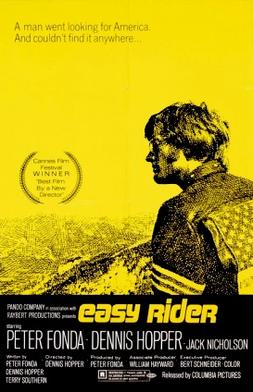
Happy Mardi Gras!
If you can’t get down to New Orleans today (because maybe you have a sprained ankle like me), fear not! Mardi Gras has been immortalized in a number of films. In fact, some have theorized that the whole reason 1969’s Easy Rider was filmed was because Dennis Hopper wanted to go to New Orleans.
The Mardi Gras sequence occurs towards the end of Easy Rider. After a long and eventful journey, Wyatt (Peter Fonda) and Billy (Dennis Hopper) reach New Orleans and experience Mardi Gras with two women that they met at a brothel (Karen Black and Toni Basil). However, the Mardi Gras scenes were actually amongst the first to be shot and Hopper actually filmed several hours of documentary footage of New Orleans’s most famous party. If you watch the footage, you can see bystanders looking directly at the camera. They were not extras hired for the film. They were people on the street who became a part of one of the most important indie films in the history of American cinema. These scenes were shot guerilla style, without permits or, by most reports, any advanced planning.
Hopper also filmed Fonda having an actual bad acid trip. For obvious reasons, Fonda was not happy about being filmed in that condition but he did say, in later interviews, that Hopper made the right decision to include the footage in the film.
For the record, I relate to Toni Basil in this film. She’s having fun and dancing no matter what.
The 1986 film, Invaders from Mars, opens with a dark and stormy night.
12 year-old David Gardner (Hunter Carson, son of actress Karen Black and filmmaker L.T. Kit Carson), who dreams of growing up to become an astronaut, witnesses something strange happening outside of his bedroom window. He watches as a spaceship lands on a nearby hill and apparently drills itself into the ground. The next morning, David convinces his father (Timothy Bottoms) to go out to the hill and see what he can find. When his father returns, he says that he didn’t see anything strange at the hill. However, he is now acting strangely, no longer showing emotion.
Soon, everyone in the small town is also acting strangely, from David’s mother (Laraine Newman) to his teacher (Louise Fletcher). David notices that everyone has a mysterious mark on the back of their neck. Even more alarmingly, he walks in on his teacher eating a mouse. Investigating the hill himself, David discovers that his father was lying about nothing being there. Instead, there’s a cavernous spaceship that is patrolled by aliens! A creature with a giant brain has taken control of almost everyone in David’s life. David discovers that the hill right outside of his house is now the headquarters of an intergalactic invasion. It’s a war of the worlds and David is stuck right in the middle.
Fortunately, David does have a few allies. The aliens have not managed to take control of everyone. The school nurse (Karen Black) believes David and helps him explore the spaceship. The surprisingly nice General Wilson (James Karen) is not only willing to launch a military operation on the advice of a 12 year-old but he also doesn’t have any problem allowing that 12 year-old to take de facto command of his soldiers. Can David save his community from the Martians?
A remake of the 1953 sci-fi classic, Invaders from Mars was directed by Tobe Hooper, the Texas-born director who was best known for The Texas Chainsaw Massacre and Poltergeist. At first, the deliberately campy Invaders from Mars might seem like an unexpected film from Hooper but actually, it has quite a bit in common with Hooper’s other credits. Like The Texas Chainsaw Massacre, it plays out like an increasingly surreal dream, one with an emphasis on isolation. Like Poltergeist, it’s ultimately a satire of suburban and small town conformity. (Indeed, one could argue that Invaders From Mars is Poltergeist without the interference of Steven Spielberg.) If the original Invaders From Mars was about the dangers of communism, the remake is about the danger of losing your childhood imagination and just becoming a mindless drone.
Invaders From Mars is often a deliberately silly film. Sometimes, it’s definitely a bit too silly for its own good, hence the guilty in guilty pleasure. That said, whenever I see it, I can’t help but smile at how quickly General Wilson starts taking orders from David. (James Karen plays the role with such earnestness that General Wilson seems to be less concerned with David’s age but instead just happy that he has someone around who can tell him what he needs to do.) But it makes sense when you consider that the film is meant to be a child’s fantasy of what would happen if there was an alien invasion. Who wouldn’t want to be the one telling the adults how to save the planet? For all the aliens and the mind control, this is a rather innocent film. Featuring entertaining performances from Hunter Carson, Timothy Bottoms, Karen Black, and the great James Karen, Invaders From Mars is an entertaining daydream of interstellar conquest.

Previous Guilty Pleasures
As some of our regular readers undoubtedly know, I am involved in a few weekly live tweets on twitter. I host #FridayNightFlix every Friday, I co-host #ScarySocial on Saturday, and I am one of the five hosts of #MondayActionMovie! Every week, we get together. We watch a movie. We tweet our way through it.
Tonight, for #ScarySocial, I will be hosting 1986’s Invaders from Mars! The Martians have invaded! Can Karen Black, the army, and a 12 year-old defeat them!? Join us to find out!
If you want to join us on Saturday night, just hop onto twitter, start the film at 9 pm et, and use the #ScarySocial hashtag! The film is available on Prime. I’ll be there co-hosting and I imagine some other members of the TSL Crew will be there as well. It’s a friendly group and welcoming of newcomers so don’t be shy.
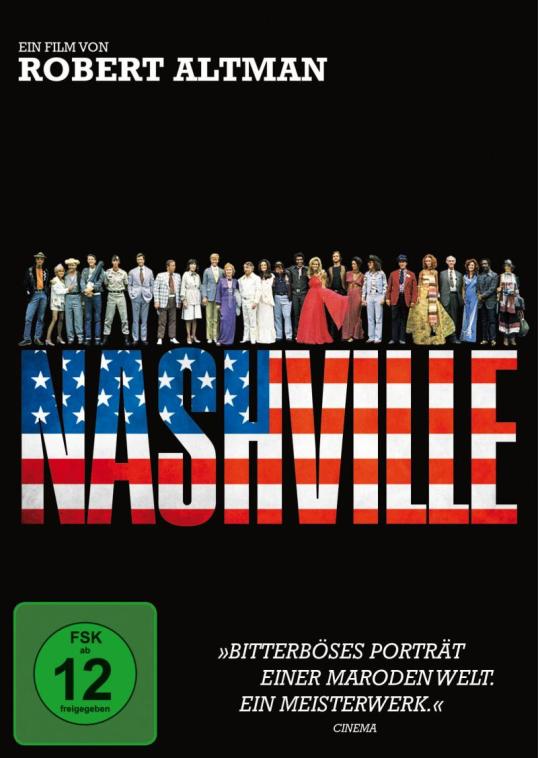
In this scene from Robert Altman’s 1975 masterpiece, Nashville, Julie Christie plays herself as a famous visitor to the city for which the film is named. She is introduced to Haven Hamilton (Henry Gibson), Haven’s lawyer, Delbert Reese (Ned Beatty), political advance man John Triplette (Michael Murphy), and country music star Connie White (Karen Black). Julie Christie may be a star in Hollywood but Connie is the star of Nashville.
Karen Black, who was born on this date in 1939, improvised her dismissive line about Julie Christine not even being able to comb her hair. It was a moment that reportedly shocked the rest of the cast and the crew but it was also a line that perfectly summed up both Connie as a character and Altman’s version of Nashville.
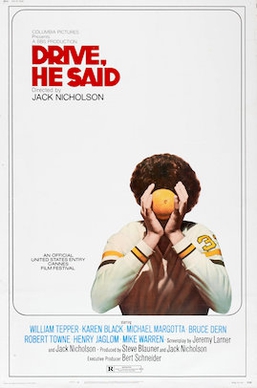
First released in 1971, Drive, He Said tells the story of two college roommates.
Hector (William Tepper) is a star basketball player who everyone expects to turn pro. His intense coach (Bruce Dern) is always yelling at him to stop fooling around on the court but Hector is more interested in fooling around elsewhere as he’s having an affair with Olive (Karen Black), the wife of a self-styled “hip” philosophy professor named Richard (Robert Towne).
Gabriel (Michael Margotta) is Hector’s best friend. They live together, even though Hector’s coach thinks that Gabriel is a bad influence. Gabriel is a self-styled campus radical. He has a devoted group of followers who will do just about anything that he tells them to do. Gabriel is big into guerilla theater and symbolic protests. Nothing he does seems to add up too much but, unlike Hector, he’s good at giving speeches.
Together, they worry about the draft!
Of course, they’re both worrying about two different types of drafts. Hector is worried about the NBA draft and whether he should enter it. He’s been playing basketball for as long as he can remember. The only thing that he’s really good at is playing basketball. And yet, Hector isn’t sure if he wants to spend the rest of his life taking orders from his coaches and devoting every minute to playing the game. However, Hector’s worked himself into a corner. When one NBA official asks him what he’s going to do if he’s not drafted, Hector admits that he doesn’t know. When asked what his major is, Hector replies, “Greek.”
Gabriel, on the other hand, is worried about being drafted into the military and being sent to Vietnam. Gabriel considers himself to be a revolutionary but it soon becomes clear that he really doesn’t have much of a plan for how to start his revolution. Indeed, the film suggests that his activism is more about his own insecurity over his own sexuality than anything else. Gabriel particularly seems to be obsessed with Hector’s affair with Olive. While Hector reaches new highs on the court, Gabriel comes closer and closer to having a psychotic break.
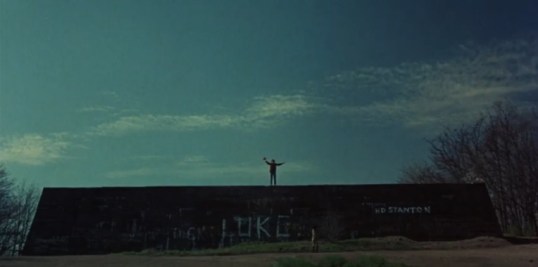
Director Jack Nicholson found a way to work in shout out to his friend, Harry Dean Stanton
Drive, He Said was one of the many “campus rebellion” films that were released in the early 70s and, much like Getting Straight, it’s definitely a product of its time. Today, it it’s known for anything, it’s for being the directorial debut of actor Jack Nicholson. (Nicholson has said that, before he was cast in Easy Rider, he was actually planning on abandoning acting and pursuing a career as a director.) The film features many of the flaws the are typically present in directorial debuts. The pacing is terrible, with some scenes ending too quickly while others seem to go on forever. At times, the film feels a bit overstylized as Nicholson mixes jump cuts, odd camera angles, and slow motion to little effect. It’s very much a film about men, so much so that the film’s ultra-masculinity almost verges on self-parody.
And yet, there are moments of isolated brilliance to be found in Drive, He Said. Some of the shots are genuinely impressive and the army induction scene shows that Nicholson could direct comedy, even if he does let the scene drag on for a bit too long. Though Nicholson doesn’t appear in the film, his approach to the story features his trademark cynicism and sense of fatalism. Though he was often associated with the counterculture, Nicholson was more a member of the Beat generation than of the hippies. As such, Drive, He Said has more in common with Jack Kerouac than Abbie Hoffman. Drive, He Said is definitely an anti-establishment film but, at the same time, it doesn’t make the mistake of glorifying Gabriel or his followers. Gabriel, with his constant demand that everyone join him in his ill-defined revolution, is almost as overbearing as basketball coach and, towards the end of the film, he commits an act of violence that leaves no doubt that his “revolution” is all about his own self-gratification. The film is less a polemic and more a portrait of people trying to find their identity during a time of political and cultural upheaval.
The film’s biggest flaw is that neither William Tepper or Michael Margotta really have the charisma necessary to carry a movie, especially one in which even the main characters often do unlikable things. Tepper is dull while Margotta overacts and, at times, comes across as if he’s trying too hard to imitate his director. It falls to the film’s supporting cast to provide the energy that Tepper and Margotta lack. Fortunately, Bruce Dern and Karen Black are both perfectly cast. Bruce Dern seems to be having a blast as the fanatical basketball coach while Karen Black brings a fierce intelligence to the role of Oliva, an intelligence that one gets the feeling wasn’t really in the original script. Considering how misogynistic every other character in the film is, it’s impossible not to cheer when Olive announces, “I’m not going with anybody, anywhere.”
(For whatever reason, there was a definite strain of misogyny that seemed to run through the majority of the late 60s and early 70s counterculture films. Just consider the amount of time Getting Straight devoted to Elliott Gould shouting at Candice Bergen.)
Drive, He Said is flawed but interesting. As a director, Nicholson understood how to frame a shot but he wasn’t quite sure how to tell a cohesive story. That said, the film itself is a definite time capsule of a very specific cultural moment.

Miriam Oliver (Karen Black) is a prim housewife who always keep her hair in a tight bun and who wears eyeglasses. After she starts to have dreams about going to her own funeral, Mrs. Oliver’s personality starts to change. Her husband, Greg (George Hamilton), can only watch as Mrs. Oliver puts on a blonde wig, ditches her eyeglasses, and starts to dress in revealing clothes. Greg wants to concentrate on starting a family but the new Mrs. Oliver only cares about going out and partying all night. She also wants to move into a new house, one that was previously owned by a woman named Sandy. Sandy, who was a student of the occult, died in a mysterious fire.
The Strange Possession of Mrs. Oliver is a good made-for-TV movie that gives viewers two Karen Blacks for the price of one! Black is undeniably sexy, whether she’s playing the prim Mrs. Oliver or the wild Sandy. But she also delivers a really good performance as she switches back and forth from being Mrs. Oliver and being Sandy. Richard Matheson provides an intelligent script while Gordon Hessler’s direction keeps you guessing as to whether Mrs. Oliver is truly possessed or if she’s just having a mental breakdown of some sort. This is an enjoyably twisty thriller with a good ending and a knockout performance from Karen Black.

On tonight’s episode of Ghost Story, Karen Black plays a widow who starts to get mysterious phone calls from a man who sounds just like her late husband. Black later expressed some regret that she ended up getting typecast a horror actress but she definitely did a good job in these roles.
This episode was co-written by Richard Matheson and originally aired on October 6th, 1972.
Happy March 1st!
Today is not only the 1st of March. It’s not only Texas Independence Day. It’s not only Zack Snyder’s birthday. It’s not only the day of Texas primaries. It’s not only the day when the State of the Union address is scheduled to be given (yawn!). It’s also Mardi Gras!
What a busy day!
For today’s scene that I love, here is the Mardi Gras/Cemetery sequence from 1969’s Easy Rider. Featuring Peter Fonda, Dennis Hopper, Karen Black, and Toni Basil walking through the streets of New Orleans, this scene was actually filmed during Mardi Gras. Those are real Mardi Gras floats and real Mardi Gras participants staring at the camera. That’s an actual citizen of New Orleans with whom Dennis Hopper appears to have nearly gotten into a fight. And, in the cemetery scene, that was real acid that Peter Fonda took.
Here is today’s scene. The scene is age-restricted so you’ll actually have to click on “watch on YouTube” to see it.
If you don’t want to click on “watch on YouTube,” here is a shorter version that just features the parade without the admittedly disturbing cemetery stuff.
I like how Toni Basil can’t help but dance, no matter what.
 Through the Shattered Lens