October True Crime: Looking for Mr. Goodbar (dir by Richard Brooks)


In 1977’s Looking for Mr. Goodbar, Diane Keaton plays Theresa Dunn.

A neurotic and single woman who has never emotionally recovered from her childhood struggle with scoliosis, Theresa is trying to find herself in the wild and promiscuous world of the 1970s.  After losing her virginity to a condescending college professor (Alan Feinstein), Diane goes on to have relationships with a needy social worker (William Atherton) and an hyperactive petty criminal (Richard Gere).  During the day, she teaches deaf children and she’s good at her job.  She even manages to win over the distrustful brother (Levar Burton) of one of her students.  At night, she hits the bars.  She buys drugs from the neighborhood dealer (Julius Harris).  She tries to read the book that she always carries with her.  (Some nights, it’s The Godfather and other nights, it’s something else.)  She picks up strange men and takes them to her roach-infested apartment.  One of those men, Gary (Tom Berenger), turns out to both be a bit insecure about his masculinity and also totally insane….

Looking for Mr. Goodbar is an adaptation of a novel that was inspired by the real-life murder of a New York school teacher named Roseann Quinn.  The book was best seller and, just as he had with a previous best-selling true crime novel, director Richard Brooks bought the rights and both wrote and directed the film.  Diane Keaton, who at that point was best-known for playing Kay Adams in The Godfather and for appearing in Woody Allen’s comedies, took on the demanding role of Theresa and, whatever one may think of the film itself, it can’t be denied that Keaton gives a brave performance as the self-destructive Theresa.  In fact, I would say it’s one of Keaton’s best performances, outside of her work with Woody Allen and The Godfather Part II.  If she had been played by a lesser actress, Roseann could have been unbearable.  As played by Diane Keaton, though, she’s everyone’s best friend who just need some time to find herself.  The viewer worries about her and wants to protect her as soon as they see her, making her ultimate fate all the more tragic.

As for film itself, I’ve watched Looking For Mr. Goodbar a few times and I’m always a little bit surprised by how bad the movie actually is.  The film actually gets off to a strong start.  The scenes between Theresa and the professor make for a sensitive portrait of a repressed young woman finally getting in touch with her sexuality and, in the process, discovering that she deserves better than the man she’s with.  But once Theresa moves into her apartment and starts hitting the bars at night, the film takes on a hectoring and moralistic tone that leaves the viewer feeling as if the film is blaming Theresa for the tragedy that’s waiting for her at the end of the story.  Diane Keaton and Tuesday Weld (who plays her sister) both give excellent performances but everyone else in the film either does too much or too little.  This is especially true of Richard Gere, who is very hyperactive but still strangely insubstantial in his role.  (Whenever Richard Gere appears on screen, one gets the feeling that they could just walk right through him.)  A scene where Gere jumps around the apartment is meant to be disturbing but it’s more likely to inspire laughter than chills.

It’s an overly long film and the moments in which Theresa has dark, sexually-charged fantasies are never quite as powerful as the film obviously meant for them to be.  (Brian Dennehy makes his film debut as a doctor who kisses Theresa’s breast during one of her fantasies.)  As opposed to the empathy that he brought to In Cold Blood, one gets the feeling that director Richard Brooks didn’t like anyone in this movie and that he was more interested in Theresa as a cautionary tale than as a human being.  With this film, Brooks seemed to be standing athwart the Sexual Revolution and shouting, “Stop!”  That said, the film’s final moments are genuinely disturbing and difficult to watch.  It’s the one moment where Brooks’s lack of subtlety pays off.  Those last minutes are about as horrific as anything you could expect to see.

As for Roseann Quinn, her killer was eventually arrested.  John Wayne Wilson hung himself in prison, 5 months after murdering her.
Retro Television Review: St. Elsewhere 1.11 “Graveyard”


Welcome to Retro Television Reviews, a feature where we review some of our favorite and least favorite shows of the past! On Fridays, I will be reviewing St. Elsewhere, a medical show which ran on NBC from 1982 to 1988.  The show can be found on Hulu and, for purchase, on Prime!

This week, a handful of doctors save two patients and lose one.

Episode 1.11 “Graveyard”

(Dir by Victor Lobl, originally aired on January 18th, 1983)

It’s the graveyard shift at St. Eligius.  The halls and the cafeteria are dark.  The ER is oddly calm.  There are only a few patients to be looked after and most of the doctors are playing poker and talking about the rather boring subject of Dr. Samuels’s love life.

Only a handful of the series regulars make an appearance in this episode but that’s fine.  This episode actually provides a nice break from having to keep track of where everyone is.  Unfortunately, as I already said, a lot of this episode is centered around the character of Dr. Samuels.  Nothing against the late David Birney, who did a perfectly acceptable job in the role, but Dr. Ben Samuels is just not that interesting of a character.  He’s a dedicated surgeon who feels too much, drinks too much, and wants to sleep with his colleagues.  That’s fine but I grew up watching General Hospital.  I’ve seen a hundred doctors just like Samuels on television.

To me, the far more interesting characters are the people like David Morse’s Jack Morrison or Ed Begley, Jr’s Victor Ehrlich or even Terence Knox’s Peter White.  They’re doctors who screw up and aren’t always brilliant and sometimes say the wrong things.  They feel like real people whereas Dr. Samuels just feels like a cliche, a holdover from some other medical show.  Samuels is not a particularly compelling character and, when I did some research, I was not surprised to discover that David Birney only appeared on one season of the show.

G.W. Bailey’s Hugh Beale also only appeared in the first season and that’s a shame because Bailey’s performance as Beale has been one of the first season’s real pleasures.  Bailey plays Beale as a compassionate man who often pretends to be more naive than he is.  As a Southerner, he’s an outsider on this Boston-set show and, being an outsider, he can often relate to the patients in the psych ward.  Of course, that still doesn’t stop Dr. Beale’s main patient, Ralph the Birdman, from throwing himself off the roof of the hospital in this episode.  To be honest, I already suspected things weren’t going to go well for Ralph on this show but his suicidal jump still upset me.  As annoying as the character was, he was also finally making some progress.  He finally admitted he wasn’t a bird.  And then he proved it by showing that he couldn’t fly.

While Ralph plunged to his death, Dr. Samuels saved a gunshot victim (played by Tom Hulce).  And Jack allowed the father (James Hong) of one of his comatose patients to perform a Chinese ritual that led to the patient waking up and eventually walking into the cafeteria, where the doctors were playing poker.  “Who ordered the Chinese?” Fiscus asked and …. ugh.  Not cool, Fiscus.

It was a night of triumph and tragedy.  Ralph died but Dr. Samuels and Dr. Paxton agreed to give their relationship another try which …. eh.  I don’t care about Samuels and Paxton.  For the most part, though, I liked this episode.  The smaller cast made it easier to keep track of things and the poker game banter reminded me that the doctors are all people too.  Still, I have to feel bad for Ralph.  All he wanted to do was fly.

Going Berserk (1983, directed by David Steinberg)


John Bourgignon (John Candy) is a man of many talents.  He’s a limo driver.  He’s a drummer.  He is an occasional actor, having starred in Kung Fu U. for his friend, director Sal DiPasquale (Eugene Levy).  John is also improbably engaged to Nancy Reece (Alley Mills), the daughter of Congressman and presidential candidate Ed Reese (Pat Hingle).  As the wedding approaches, John deals with a number of things.  He chauffeurs around a group of Spanish Beatles impersonators.  He finds himself handcuffed to a fugitive (Ernie Hudson) who dies at an inopportune time.  A cult leader (Richard Libertini) attempts to brainwash John into assassinating Ed, though the process might just turn John into a “schmuck.”

Going Berserk was John Candy’s first lead feature role and it was obviously designed to play to Candy’s popularity as one of the stars of SCTVGoing Berserk doesn’t gave a plot as much as it’s a collection of skits, some of which work better than others but all of which are held together by Candy’s comedic timing and amiable presence.  Going Berserk is disjointed and wildly uneven but it’s also frequently funny and that is a testament to Candy’s talent.  Even an overlong parody of The Blue Lagoon raises a smile because John Candy is just so committed to playing out the joke.

Going Berserk also features several familiar faces, like Richard Libertini, Pat Hingle, Ernie Hudson, Dixie Carter, Kurtwood Smith, Paul Dooley, and two of Candy’s SCTV co-stars, Eugene Levy and Joe Flaherty.  I especially liked Levy’s performance as the sleazy director who blackmails his way into filming the wedding.  Going Berserk was frequently stupid but, more often than not, it made me laugh.

Late Night Retro Television Review: Friday the 13th: The Series 2.19 “The Butcher”


Welcome to Late Night Retro Television Reviews, a new feature where we review some of our favorite and least favorite shows of the past! On Fridays, I will be reviewing Friday the 13th: The Series, a show which ran in syndication from 1987 to 1990. The show can be found on YouTube!

This week, it’s all about Jack!

Episode 2.19 “The Butcher”

(Dir by Francis Delia, originally aired on April 24th, 1989)

Horst Mueller (Colin Fox), a Nazi scientist, uses a magic amulet to bring back to life the fearsome Col. Rausch (Nigel Bennett), a Nazi war criminal who was infamous for using barb wire as a garotte whenever he was carrying out executions.  Rausch was killed during the war by a squad of soldiers led by a young lieutenant named Jack Marshak.  Once Rausch is brought back to life, he not only sets himself up as a radio talk show host but he also seeks revenge on the men who killed him.  One-by-one, he kills the members of the squad until eventually, only three are left alive, Simpson (Julius Harris), Shaw (John Gilbert), and Jack.

There were many episodes of Friday the 13th in which Jack was absent and described as being out-of-town while Micki and Ryan dealt with the latest cursed antique.  This, however, is the first episode to feature Jack on his own.  He mentions that Micki and Ryan are out-of-town, presumably because they’re tracking something down.  This leads Jack to face Rausch with only the help of Simpson and Shaw.  Watching this episode, one gets the feeling that Jack wouldn’t have it any other way.  While this episode features all of the usual blood and melodrama that we’ve come to expect from this show, it also serves as a tribute to the friendship between Jack and his comrades-in-arms.  Jack relates to Simpson and Shaw in a way that he can’t relate to the much-younger Micki and Ryan.  If Jack is usually cast as a fatherly figure, this episode finds him working with equals and fighting against a monster with whom he has a personal connection.  This is the rare episode to not feature any of Lewis’s cursed antiques.  Instead, the magic amulet is one of the many artifacts for which Heinrich Himmler and the SS spent much of the war searching.

It’s a change-of-pace episode that gives Chris Wiggins a chance to show off his considerable talents an actor.  Rarely has Jack been as haunted as he is in the episode and Wiggins’s sad eyes allow us to see what a lifetime of dealing with unbelievable evil would do to a person.  In this episode, Jack is not just aware of the evil in the world but he’s also aware that he and his comrades-in-arms, the members of the so-called “Greatest Generation,” are aging and their time is passing.  Jack and his friends are at an age where they should be enjoying their retirement.  Instead. they’re still fighting against the legacy of Hitler’s evil.

This was a good and melancholy episode of Friday the 13th.  This show could be uneven but episodes like this were good enough to make one mourn that the series did not last longer than just three seasons.

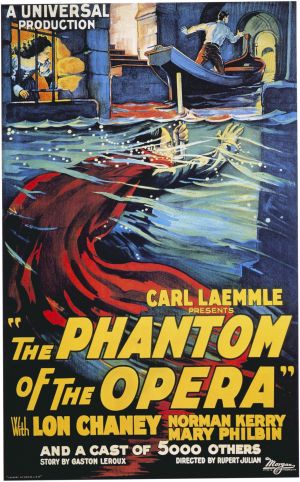
Horror On The Lens: The Phantom of the Opera (dir by Rupert Julian)


Today’s horror movie on the Shattered Lens is both a classic of silent era and one of the most influential horror films ever made.  It’s one that I previously shared in 2013, 2015, 2016, 2108, 2019, 2020, 2021, and 2022 but it’s such a classic that I feel that it is worth sharing a second (or fifth or even a sixth or perhaps an ninth) time.

First released in 1925, The Phantom of the Opera is today best known for both Lon Chaney’s theatrical but empathetic performance as the Phantom and the iconic scene where Mary Philbin unmasks him. However, the film is also a perfect example of early screen spectacle. The Phantom of the Opera was released during that period of time, between Birth of the Nation and the introduction of sound, when audiences expected films to provide a visual feast and Phantom of the Opera certainly accomplishes that. Indeed, after watching this film and reading Gaston Leroux’s original novel, it’s obvious that the musical was inspired more by the opulence of this film than by the book.

This film is also historically significant in that it was one of the first films to be massively reworked as the result of a poor test screening. The film’s ending was originally faithful to the end of the novel. However, audiences demanded something a little more dramatic and that’s what they got.

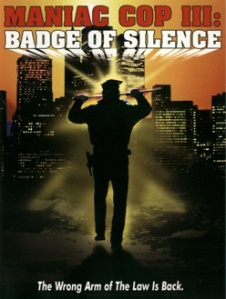
Maniac Cop III: Badge of Silence (1992, directed by William Lustig)


Despite finally getting his burial with honors at the end of Maniac Cop 2, Matt Cordell (Robert Z’Dar) returns for one last outing.  Raised from the dead by a voodoo houngan (Julius Harris), Cordell invades a hospital to seek vengeance for a comatose policewoman named Katie Sullivan (Gretchen Baker).  In a coma due to the wounds she received while thwarting a convenience store robbery, Katie is being framed by unscrupulous reporters and attorneys who claim that Katie was a bad cop who killed a clerk in cold blood.  Cordell sees Katie as being a fellow victim of anti-cop bias and he is not going to let anyone treat her with disrespect, which is something that two doctors (Robert Forster and Doug Savant) are unfortunate enough to discover.  Sean McKinney (Robert Davi) and Dr. Susan Lowery (Caitlin Dulany) try to figure out how to bring peace to the souls of both Cordell and Katie.

As opposed to the first two films, Maniac Cop III had a troubled production.  Lustig and screenwriter Larry Cohen wanted to set the film in a Harlem hospital and bring in an African-American detective to investigate Cordell’s activities.  The film’s Japanese producers insisted that Robert Davi return as the lead, even though the script’s lead character had little in common with the way Sean McKinney was portrayed in Maniac Cop 2.  Larry Cohen then refused to do any rewrites on the script unless he was paid more.  William Lustig filmed what he could and ended up with a 51-minute movie.  Extra scenes were directed by one of the film’s producers and the film was also padded out with outtakes from Maniac Cop 2.

The film is disjointed and there’s too much time devoted to Jackie Earle Haley playing a character who has much in common Leo Rossi’s serial killer from the second film.  (Haley’s performance is fine but the character feels superfluous).  But the movie’s hospital setting leads to some interesting kill scenes and Z’Dar and Davi both give good performances as two different types of maniac cops.  The supporting cast is full of good character actors like Haley, Forster, Savant, Julius Harris, Bobby Di Cicco, and Paul Gleason.  Despite the film’s flaws, Maniac Cop III is a solid ending for the trilogy.

Film Review: The Taking of Pelham One Two Three (dir by Joseph Sargent)


Welcome to New York in the 1970s!  While the intellectuals flock to the latest Woody Allen movie and the wealthy throw radical chic parties in Manhattan and disturbed young men drive taxis at night and pray for a real flood to clear away all the vermin, most of the city’s citizens are just trying to make it through the day.  For many of them, that means spending an hour or two riding the subway.  In some ways, the subway is the great equalizer.  The minute that you sit down on a filthy train car, it doesn’t matter how old you are or how you vote or the color of your skin.  All that matter is finding a way to avoid making eye contact with anyone else.

Four men, all wearing obvious disguised, board the downtown Pelham 1-2-3 train.  They all look suspicious but, this being New York, no one wants to make eye contact.  Everyone just wants to reach their next stop.  The men — who are known as Mr. Blue (Robert Shaw), Mr. Green (Martin Balsam), Mr. Grey (Hector Elizondo), and Mr. Brown (Earl Hindman) — have other plans.  Revealing that they’re armed, they take the 18 passengers of the first car hostage.  Their leader, Mr. Blue, has a simple demand.  He wants a million dollars to be delivered to the car within an hour.  If the money’s late, he will kill one hostage every minute, until he receives what he wants.

While the cold-stricken mayor (Lee Wallace) tries to figure out how to 1) raise a million dollars and 2) handle the situation without losing any potential votes in his reelection campaign, Lt. Zach Garber (Walter Matthau) communicates with Mr. Blue via radio.  With Mr. Blue underground and Zach above ground, the two of them establish a cautious rapport.  Robert Shaw plays Blue as being efficient, polite, but ruthless while Walter Matthau plays Garber with his usual rumpled but intelligent style.  As embodied by Matthau, Garber is New York City in human form while Shaw is perfectly cast as the outsider who, for at least an hour or two, has managed to bring the city to its knees.

Even though the original The Taking of Pelham One Two Three is often described as being a Walter Matthau film or a Robert Shaw film, the film’s main character actually is the city of New York City.  The film portrays the city as being chaotic, angry, and unpredictable but, at the same time, also resilient and strong.  Yes, Garber may spend a lot of time bickering with his co-workers but, in the end, he and Lt. Rico Patrone (Jerry Stiller, another great New York figure) work together to do what has to be done to resolve the situation.  For all the time that’s spent on how Mr. Blue and his compatriots take that train hostage, just as much time is spent focusing on how the police, the politicians, and the Transit Authority react to what’s happened.  Not having any firsthand knowledge of the New York subway system (beyond being told not to use it when I was in NYC a few years ago), I can’t say whether or not the film is realistic but what’s important is that it feels realistic.  Even though the film is full of familiar character actors, it still seems as if you’re just watching a bunch of New Yorkers having a very long day.  Though guns are fired and there is a runway train, The Taking of Pelham One Two Three takes a refreshingly low-key approach to its story.  There’s no huge action set pieces.  The film’s classic final shot hinges not on Garber’s marksmanship but instead on his ability to remember the small details.

The Taking of Pelham One Two Three is one of my favorite heist movies.  It’s well-acted.  It’s got an interesting plot.  It’s got a few moments of unexpected humor.  Robert Shaw is a great (and, at times, almost compelling) villain while Walter Matthau and Jerry Stiller make for a great detective team.  The great Martin Balsam also turns in a wonderful turn and, even though he’s playing a bad guy, it’s hard not to sympathize him.  You need only see his apartment to understand why exactly he felt the city of New York owed him more than it had given him.  Best of all, The Taking of Pelham One Two Tree is a tribute to a great American city.  The Taking of Pelham One Two Three celebrates New York City in all of its rude, messy, and brilliant glory.

A Cry For Help (1975, directed by Daryl Duke)


Harry Freeman (Robert Culp) is a radio talk show host in California who specializes in abusing his listeners.  They call in and they tell Harry their problems and their opinions and then Harry tells them that they’re stupid and whiny.  Despite (or maybe because of) his abrasive style, Harry is very popular.  Everyone on the California coast listens to him in the morning.

When a depressed teenage girl named Ingrid (Elayne Heilveil) calls his show and says that she’s going to kill herself, Harry doesn’t taker her seriously and tells her to go ahead and do it.  It’s only after he hangs up on her that he realizes that she might have actually been telling the truth.  When Harry calls the cops to tell them about the call, they treat him in much the same way that he treated Ingrid.  They refuse to take him or Ingrid seriously.

Not getting any help from the police, Harry turns to his listeners.  He asks them to help him track down Ingrid and to keep her from harming herself.  The film alternates between scenes of Ingrid meeting people throughout the day and then Harry in his studio, taking calls from those people.  Since Ingrid is no longer listening to Harry’s show, she has no idea that people are looking for her and it becomes a race against time to find her before she carries out her plans.

A Cry For Help is largely a showcase for Robert Culp, a talented actor whose career was often harmed by his own independence and reputation for being abrasive.  That reputation made him the perfect choice to play Harry and Culp gives a terrific performance as a not particularly nice man trying to do the right thing for once.  Interestingly, the film keeps it ambiguous as to whether Harry has really had an attack of conscience or if he’s just trying to save Ingrid for the publicity and the ratings.  Even at the end of the film, it’s hard to know if Harry was really worried about Ingrid ending her life or if he was just looking to promote himself.

Along with Culp, the film’s cast is a who’s who of 70s television actors.  Among those who Ingrid and Harry deal with during the day: Michael Lerner, Bruce Boxlietner, Ken Swofford, Chuck McCann, Julius Harris, and Gordon Jump.  Seeing Jump in the film was especially interesting since he would later star in another production about the potential power of radio, WKRP In Cincinnati.

A Cry For Help is a suspenseful made-for-TV movie from 1975.  It’s never been released on DVD but it is on YouTube.

That’s Blaxploitation! 13: BLACK CAESAR (AIP 1973)


gary loggins's avatarcracked rear viewer

1972’s blockbuster smash THE GODFATHER began an onslaught of gangster movies released to your neighborhood theaters and drive-ins trying to capitalize on that film’s success. American-International Pictures was right in the thick of it, and since Blaxploitation was all the rage at the time, why not combine the two hottest genres? Producer/director/genius Larry Cohen already had a script written for Sammy Davis Jr., but when Sammy backed out, AIP Boss of Bosses Samuel Z. Arkoff signed Fred “The Hammer” Williamson to star as the Godfather of Harlem, BLACK CAESAR.

BLACK CAESAR is a semi-remake of the 1932 classic LITTLE CAESAR starring Edward G. Robinson, updated for the Blaxploitation/Grindhouse crowd and spun around on it’s head by Larry Cohen. You already know how much I enjoy Cohen’s work, and the auteur doesn’t fail to deliver the goods with this one. Casting the charismatic former NFL star Williamson was a bonus, and…

View original post 358 more words

That Voodoo That You Do: Roger Moore as James Bond 007 in LIVE AND LET DIE (United Artists 1973) — cracked rear viewer


Three British agents are murdered, and James Bond is sent overseas to investigate the doings of Dr. Kananga, despot of the Carribean island nation of San Monique in LIVE AND LET DIE. But wait… that’s not Sean Connery as 007, or even George Lazenby. It’s Roger Moore , making the first of his seven appearences as […]

via That Voodoo That You Do: Roger Moore as James Bond 007 in LIVE AND LET DIE (United Artists 1973) — cracked rear viewer