Review: The Civil War (dir. by Ken Burns)


“We are not enemies, but friends. We must not be enemies. Though passion may have strained, it must not break our bonds of affection.” — Abraham Lincoln

Ken Burns’ The Civil War stands as one of those rare documentaries that completely reshapes how people think about both history and the craft of documentary filmmaking. Released in 1990, it’s been over three decades since it first aired, yet it still feels monumental in its reach and emotional resonance. Instead of serving as a dry classroom recounting of battles and dates, it’s an experience that makes you feel the war’s human dimension—the people who fought it, lived through it, and were changed forever by its violence and ideals. Burns manages to take America’s bloodiest conflict and give it a pulse, telling the story not only through historians and statistics but through letters, diaries, and voices that make you feel connected to the 1860s as if it all just happened yesterday.

One of the most defining parts of The Civil War is its look and rhythm. Burns’ now-famous visual style—those slow pans and zooms across black-and-white photographs—became such a signature technique that it’s now built into editing software as “the Ken Burns effect.” It might sound simple, but the way he moves those still images feels like breathing life into ghosts. Every slow zoom on a soldier’s uncertain face, every fade over an empty battlefield, has meaning. Before Burns, most historical documentaries presented facts through re-enactments or stiff academic interviews. Burns dared to make photographs speak on their own. The pacing he uses is hypnotic—deliberate, unwavering, and emotionally tuned to each shot. It’s a visual rhythm that invites reflection instead of speed. The whole thing feels like time itself has slowed down so history can whisper its fullest story.

The narration, provided by David McCullough, ties the sprawling story together with a sense of calm authority. His voice is warm, measured, and almost timeless, acting less like a narrator and more like an old friend who knows the past intimately but never overstates it. McCullough’s presence builds trust—no hype, no theatrics, just thoughtful storytelling. Burns pairs that voice with readings from letters, diaries, and contemporary accounts, delivered by a lineup of talented voice actors like Jason Robards, Sam Waterston, and Morgan Freeman. Their readings never feel like performances; they feel lived in, restrained, and sincere. This combination of voice and image creates a tone that is both haunting and beautiful, one that makes history feel alive but not romanticized.

A huge part of why the series feels so moving is Jay Ungar’s “Ashokan Farewell.” Oddly enough, it’s not a Civil War-era tune at all—it was written in the 1980s—but it fits so organically with the documentary’s mood that it’s impossible to think about the series without hearing it. The plaintive fiddle melody has a mournful warmth, evoking the loss and longing that defines the entire project. Burns and his team used it in just the right measure: when the music plays, it deepens emotion rather than dictating it. Combined with other period-appropriate folk songs, banjo pieces, and hymns, the soundtrack acts as the emotional current guiding the story through landscapes of death, courage, and change.

The structure of The Civil War is deceptively simple but brilliantly executed. Spanning nine episodes and over eleven hours in total, it charts the war from its earliest, uneasy beginnings in the political debates over slavery and statehood through to its catastrophic conclusion and fragile aftermath. Burns understood that history isn’t static; it’s emotional and cumulative. The early episodes almost feel optimistic—the tone of youthful bravado and national pride fills the air as both sides believe the conflict will end quickly. As the series progresses, though, the optimism curdles into fatigue, despair, and grief. By the time the war drags into its later years, the imagery, narration, and music all carry the weight of shared tragedy. You begin to see how idealism eroded into acceptance of horror. The careful pacing of each episode allows viewers to feel that arc not just intellectually but emotionally.

Among the many creative decisions Burns made, choosing to anchor the series around personal letters was perhaps the most effective. Through these letters, anonymous soldiers, wives, and family members speak across time. Their words carry more power than any historian’s commentary could. One of the most unforgettable moments comes from Union officer Sullivan Ballou’s letter to his wife, written shortly before he was killed. His words are devastating in their tenderness and resignation, summing up both love and mortality in a way that feels timeless. Burns threads similar letters throughout the series—from soldiers on both sides, from civilians caught in the middle, and from the enslaved people whose freedom hung in the balance. Their voices form the emotional backbone of the documentary, constantly reminding us that this was not just a war of strategy but a catastrophe of human consequence.

Alongside these voices, there’s a chorus of historians offering perspective and context. Shelby Foote, with his Southern drawl and gift for anecdote, became one of the documentary’s most recognizable figures. His storytelling bridges the gap between scholarship and folklore, even if some critics later accused him of romanticizing the Confederate perspective. Counterbalancing that, historian Barbara Fields provides some of the series’ most profound reflections, particularly regarding race and memory. Her insistence that the war’s legacy continues to shape American identity feels just as relevant now as it did in 1990. Their alternating viewpoints give the documentary balance—emotion on one side, intellect and conscience on the other.

Burns’ handling of tone is one of the most striking things on a rewatch. It’s both deeply romantic in its love of storytelling and brutally realistic in its depiction of suffering. It doesn’t sanitize the war, but it doesn’t exploit it either. You’re never shown battle reenactments, explosions, or gore. Instead, Burns conveys the violence and despair through letters, photos, and silence. He trusts the audience to fill in the horror. That’s uncommon in modern documentary work, where there’s often pressure to explain or dramatize everything. In The Civil War, silence becomes a storytelling device. The pauses between sentences, the long holds on a tattered flag or a battlefield grave, carry meaning. The documentary refuses to rush toward catharsis; it lingers in grief.

In today’s media landscape—where documentaries tend to move fast and fight for attention—Burns’ slower, more contemplative approach stands out. Back in 1990, it riveted viewers. An estimated 40 million people watched it on PBS, an unbelievable number for a historical series on public television. For many Americans, it became their most vivid introduction to their own national history. It made people talk about Gettysburg, Lincoln, emancipation, and the moral aftermath of the war in living rooms across the country. It even sparked renewed interest in Civil War books, memorials, and battlefield preservation. Burns had tapped into something rare: a collective need to understand who Americans are by understanding what nearly destroyed them.

Even decades later, The Civil War holds up both artistically and historically. Watching it now, its moral clarity about slavery as the war’s central cause feels vital, especially in a time when debates over monuments and racial politics remain heated. Burns never let the series fall into the “states’ rights” trap that muddied so many earlier narratives. He continually foregrounded the human cost of defending or destroying the institution of slavery. Still, modern viewers might wish for even more emphasis on the experiences of Black Americans, beyond the selected diaries and Douglass excerpts. The documentary touched these stories with respect but within the limits of its early-1990s format. Later historians have expanded upon what Burns began, but his foundation remains solid.

Technically, the documentary’s aged well. Restored versions bring new clarity to the old photographs, and the audio’s crisp enough to make the letters feel freshly read. The storytelling, slow-moving as it is, rewards patience. It’s not content to skim across major events; it expects you to sit with sorrow, fatigue, and loss. Watching all eleven hours feels like reading an epic novel: it’s best done gradually, letting each episode resonate before starting the next. The cumulative effect isn’t just historical understanding—it’s emotional exhaustion tempered by awe.

The Civil War remains one of the greatest nonfiction works ever broadcast. It’s not simply about battles or leaders but about the psychology of a country divided by ideals and identity. It asks questions rather than delivering verdicts—questions about sacrifice, belief, morality, and what it means to be American. Few documentaries manage to tell old stories in ways that still feel alive, but Burns achieved that through patience, empathy, and an unshakable faith in the power of storytelling. Even now, it’s hard to watch without feeling the echo of those voices—some hopeful, some broken—that seem to reach out from still photographs and faded ink. Burns didn’t just document history; he let history speak for itself. That’s why The Civil War endures.

Perhaps it’s even more important now than when it first aired. In a time when historical revisionism has begun to creep from the fringes into mainstream discourse and when the nation feels dangerously forgetful of its own moral and political lessons, Burns’ documentary serves as both a warning and a reminder. It shows what happens when ideology overtakes humanity and when a country forgets the cost of its own divisions. Watching The Civil War today feels less like revisiting the past and more like confronting the present—proof that the ghosts of that conflict remain, quietly urging us not to repeat what we once swore to never forget.
Film Review: Voyage of the Damned (dir by Stuart Rosenberg)


In 1939, an ocean liner named the MS St. Louis set sail from Hamburg.  Along with the crew, the ship carried 937 passengers, all of whom were Jewish and leaving Germany to escape Nazi persecution.  The ship was meant to go to Havana, where the passengers had been told that they would be given asylum.  Many were hoping to reunite with family members who had already taken the voyage.

What neither the passengers nor Captain Gustav Schroeder knew was that the entire voyage was merely a propaganda operation.  No sooner had the St. Louis left Hamburg than German agents and Nazi sympathizers started to rile up anti-Semitic feelings in Cuba.  The plan was to prevent the passengers from disembarking in Cuba and to force the St. Louis to then return to Germany.  The Nazis would be able to claim that they had given the Jews a chance to leave but that the rest of the world would not take them in.  Not only would the Jews be cast as pariahs but the Germans would be able to use the world’s actions as a way to defend their own crimes.

Captain Schroeder, however, refused to play along.  After he was refused permission to dock in Cuba, he then attempted to take the ship to both America and Canada.  When both of those countries refused to allow him to dock, Schroeder turned the St. Louis toward England, where he planned to stage a shipwreck so that the passengers could be rescued at sea.  Before that happened, Belgium, France, the Netherlands, and the United Kingdom jointly announced that they would accept the refugees.

Tragically, just a few days after the passengers disembarked, World War II officially began and Belgium, France, and the Netherlands all fell to the Nazi war machine.  It is estimated that, of the 937 passengers on the St. Louis, more than 600 of them subsequently died in the Nazi concentration camps.

The journey of the St. Louis was recreated in the 1976 film, Voyage of the Damned, with Max von Sydow as Captain Schroeder and a collection of familiar faces playing not only the ship’s passengers and crew but also the men and women in Cuba who all played a role in the fate of the ship.  In fact, one could argue that there’s a few too many familiar faces in Voyage of the Damned.  One cannot fault the performances of Max von Sydow, Malcolm McDowell, and Helmut Griem as members of the crew.  And, amongst the passengers, Lee Grant, Jonathan Pryce, Paul Koslo, Sam Wanamaker, and Julie Harris all make a good impression.  Even the glamorous Faye Dunaway doesn’t seem to be too out-of-place on the ship.  But then, in Havana, actors like Orson Welles and James Mason are awkwardly cast as Cubans and the fact that they are very obviously not Cuban serves to take the viewer out of the story.  It reminds the viewer that, as heart-breaking as the story of the St. Louis may be, they’re still just watching a movie.

That said, Voyage of the Damned still tells an important true story, one that deserves to be better-known.  In its best moments, the film captures the helplessness of having nowhere to go.  With Cuba corrupt and the rest of the world more interested in maintaining the illusion of peace than seriously confronting what was happening in Germany, the Jewish passengers of the St. Louis truly find themselves as a people without a home.  They also discover that they cannot depend on leaders the other nations of the world to defend them.

Defending the passengers falls to a few people who are willing to defy the leaders of their own country.  At the start of the film, Nazi Intelligence Chief Wilhelm Canaris (Denholm Elliott) explains that Captain Schroeder was selected specifically because he wasn’t a member of the Nazi Party and could not be accused of having ulterior motives for ultimately returning the passengers to Germany.  Canaris and his fellow Nazis assume that anti-Semitism is so natural that even a non-Nazi will not care what happens to the Jewish passengers.  Instead, Schroeder and his crew take it upon themselves to save the lives of the passengers.  It is not Franklin Roosevelt who tries to save the passengers of St. Louis.  Instead, it’s just a handful of people who, despite unrelenting pressure to do otherwise, step up to do the right thing.  Max von Sydow, who was so often cast in villainous roles, gives a strong performance as the captain who is willing to sacrifice his ship to save his passengers.

Flaws and all, Voyage of the Damned is a powerful film about a moment in history that must never be forgotten.

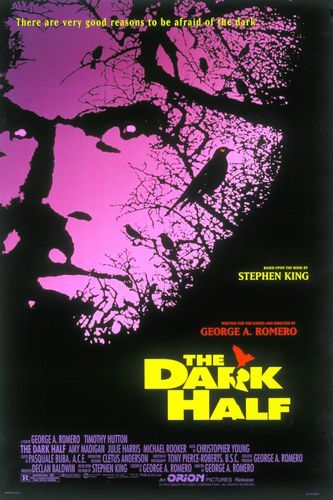
Horror Film Review: The Dark Half (dir by George Romero)


It will always fascinate me that Stephen King, one of the most popular writers in the world and one of the legitimate masters of horror, also has one of the least inspiring accounts on twitter.

Seriously, he may be the most popular author in the world but he tweets like a retiree who has just discovered the internet.  Go over to his twitter account and you won’t find memorable descriptions of small town hypocrisy.  You won’t find scenes of shocking psychological insight.  You won’t find moments of unexpected but laugh-out-loud dark humor.  Instead, you’ll find a combination of dad jokes, boomer nostalgia, and an unseemly obsession with wishing death on any public figure who is to the right of Bernie Sanders.  It’s odd because no one can deny that King’s a good storyteller.  At his best, Stephen King is responsible for some of the best horror novels ever written.  Everyone who is a horror fan owes him a debt of gratitude for the work that he’s done promoting the genre.  At his worst, he’s your uncle who retweets the article without reading it first.

Of course, someone can be great at one thing an terrible at something else.  I can dance but I certainly can’t sing.  Stephen King can write a best seller but a good tweet is beyond him.  That’s the dual nature of existence, I suppose.  That’s certainly one of the themes at the heart of both Stephen King’s The Dark Half and the subsequent film adaptation from George Romero.

Filmed in 1990 but not released for three years due to the bankruptcy of the studio that produced it, The Dark Half tells the story of Thad Beaumont and George Stark (both played by Timothy Hutton).  Thad is a professor who writes “serious” literature under his real name and violent, pulpy fiction under the name of George Stark.  No one reads Thad’s books but they love George Stark and his stories about the master criminal and assassin, Alexis Machine.  (Alexis Machine?  George Stark may be a good writer but he sucks at coming up with names.)  After a demented fan (played, with creepy intensity, by Robert Joy) attempts to blackmail him by threatening to reveal that he’s George Stark, Thad decides to go public on his own.  His agent even arranges for a fake funeral so that Thad can bury George once and for all.

Soon, however, Thad’s associates are turning up dead.  It seems as if everyone associated with the funeral is now being targeted.  Sheriff Alan Pangborn (Michael Rooker) suspects that Thad is the murderer.  However, the murderer is actually George Stark, who has come to life and is seeking revenge.  Of course, George has more problems than just being buried.  His body is decaying and he’s got a bunch of angry sparrows after him.  The Sparrows Are Flying Again, we’re told over and over.  Seeking to cure his affliction and to get those birds to leave him alone, Stark targets Thad’s wife (Amy Madigan) and their children.

The Dark Half has its moments, as I think we would expect of any film based on a Stephen King novel and directed by George Stark.  Some of the deaths are memorably nasty.  Hutton is believably neurotic as Thad and cartoonishly evil as Stark and, in both cases, it works well.  Rooker may be an unconventional pick for the role but he does a good job as Pangborn and Amy Madigan brings some unexpected energy to the thankless role of being the threatened wife.

But, in the end, The Dark Half never really seems to live up to its potential.  In the book, Thad was a recovering alcoholic and it was obvious that George Stark was a metaphor for Thad’s addiction.  That element is largely abandoned in the movie and, as a result, George goes from being the literal representation of Thad’s demons to just being another overly loquacious movie serial killer.  Despite having a few creepy scenes, the film itself is never as disturbing as it should be.  For all the blood, the horror still feels a bit watered down.  Take away the sparrows and this could just as easily be a straight-forward action film where the hero has to rescue his family from a smug kidnapper.  Comparing this film to Romero’s Martin is all the proof you need that Romero was best-served by working outside the mainstream than by trying to be a part of it.

Add to that, I got sick of the sparrows.  Yes, both the film and the book explain why the sparrows are important but “The Sparrows Are Flying Again” almost sounds like something you’d find in something written in a deliberate attempt to parody King’s style.  It’s a phrase that’s intriguingly enigmatic the first time that you hear it, annoying the third time, and boring the fifth time.

The Dark Half was a bit of a disappointment but that’s okay.  For King fans, there will always be Carrie.  (I would probably watch The Shining but apparently, King still hasn’t forgiven Stanley Kubrick for improving on the novel.)  And, for us Romero fans, we’ll always have Night of the Living Dead, Martin, Dawn of the Dead, and the original Crazies.  And, for fans of George Stark, I’m sure someone else will pick up the story of Alexis Machine.  It’s hard to keep a good character down.

Killer Christmas: HOME FOR THE HOLIDAYS (ABC-TV Movie 1972)


gary loggins's avatarcracked rear viewer

Four daughters reunite at the old family homestead during Christmas to visit their estranged, dying father. Sounds like the perfect recipe for one of those sticky-sweet Hallmark movies, right? Wrong, my little elves! HOME FOR THE HOLIDAYS, originally broadcast as part of ABC-TV’s “Movie of the Week” series (1969-1975) is part proto-slasher, part psycho-biddie shocker, and a whole lot of fun! It plays kind of like a 70’s exploitation film, only with a high-powered cast that includes Sally Field, Eleanor Parker, Julie Harris , and Walter Brennan, a script by Joseph (PSYCHO) Stefano, and direction courtesy of John Llwellyn Moxey (HORROR HOTEL, THE NIGHT STALKER).

Rich old Benjamin Morgan (Brennan) has summoned his daughters home on a dark and stormy Christmas Eve, claiming his second wife Elizabeth (Harris) is slowly poisoning him to death. Elizabeth was once ‘suspected’ of poisoning her first husband (though never proven) and spent some time…

View original post 442 more words

Growing Pains: YOU’RE A BIG BOY NOW (Warner Brothers 1966)


gary loggins's avatarcracked rear viewer

ybb1

Francis Ford Coppola  was still a UCLA film student when he made YOU’RE A BIG BOY NOW, the 1966 coming of age comedy he used as his MFA thesis. The young Coppola was 27, and had gained experience working for Roger Corman ; indeed, Corman gave him his first break when he hired Coppola to write and direct the horror quickie DEMENTIA 13. But YOU’RE A BIG BOY NOW was his first major studio release, and put him on the map as a talent to keep an eye on.

ybb2

Bernard Chanticleer is a 19 year old nerd with a way-overprotective mother and disinterested, authoritarian father. He works for Dad at a New York City library, and is constantly goofing up on the job. Dad thinks it’s time for Bernard to spread his wings and move on his own, much to Mom’s displeasure. She finds him a room at a house owned by Miss Thing, who’s tenants include conservative…

View original post 450 more words

Halloween Havoc!: THE HAUNTING (MGM 1963)


gary loggins's avatarcracked rear viewer

“No one will come in the night… in the dark!”

haunting1

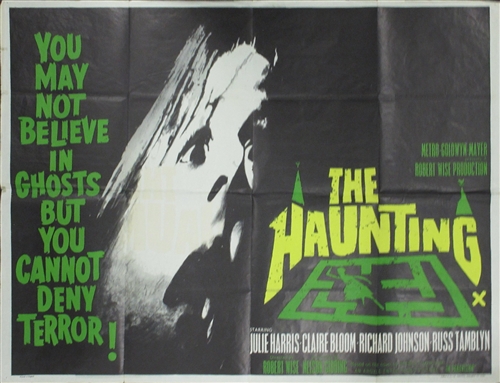
There’s nothing like a good haunted house movie, and 1963’s THE HAUNTING is one of the best ever. Producer/director Robert Wise cut his filmic teeth on Val Lewton shockers like THE BODY SNATCHER  and noirs such as BORN TO KILL  before graduating to mainstream movies like I WANT TO LIVE! and WEST SIDE STORY. In THE HAUNTING he returns to his dark roots to create a nightmarish vision of Shirley Jackson’s eerie novel The Haunting of Hill House.

haunting2

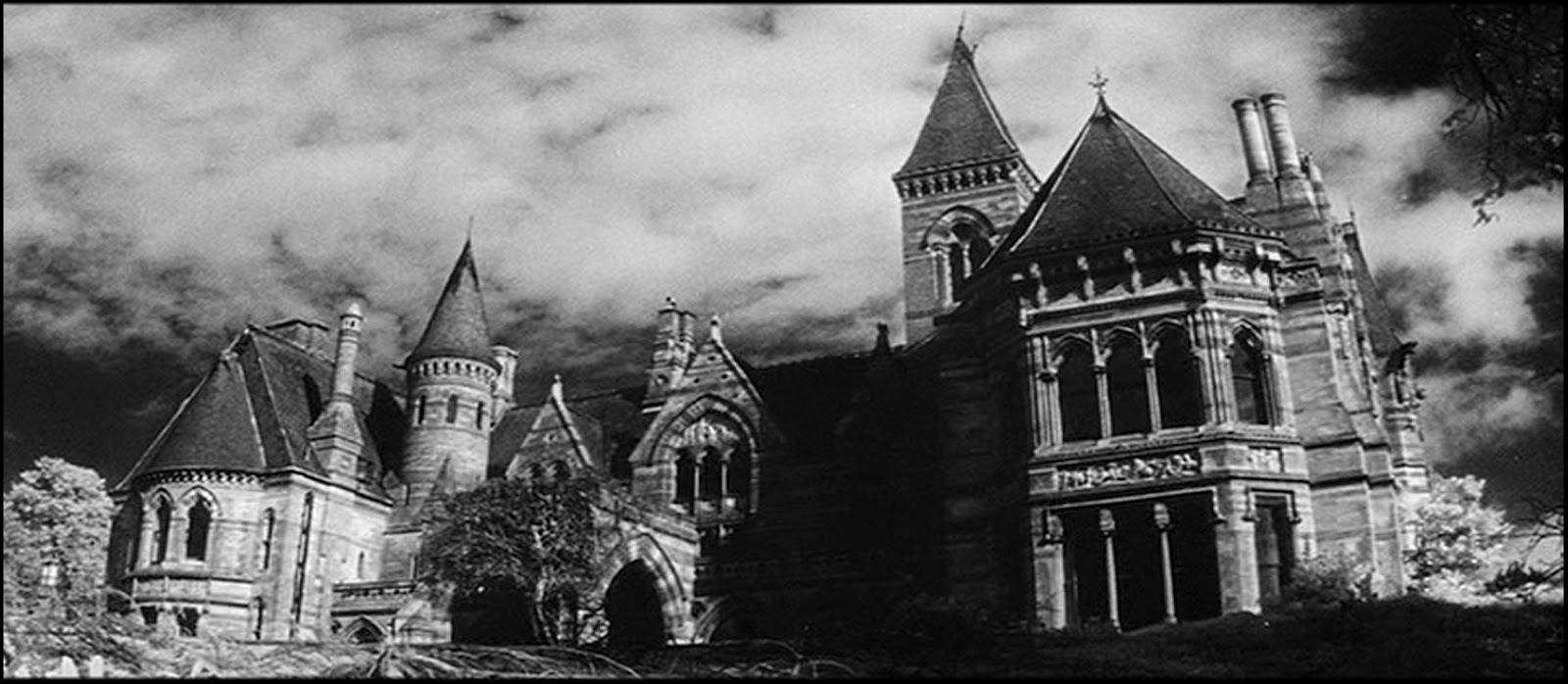
“Scandal, murder, insanity, suicide” have plagued Hill House for close to 100 years. The cursed Crain family were its original inhabitants, designed by eccentric Hugh Crain. The house is a darkly foreboding Gothic structure with oddly tilted angles both inside and out. Dr. John Markham, a paranormal investigator, visits proper Bostonian matron Mrs. Sanderson, the house’s current owner, asking to take a lease…

View original post 834 more words

Film Review: The Split (1968, directed by Gordon Flemyng)


The Split2The Split is one of the many films to be based on one of Donald Westlake’s Parker novels.  A classic antihero, Parker was a ruthless professional criminal who was only partially redeemed by being so much better at his job than all the other lowlifes around him.  In the movies, Parker has been played by everyone from Lee Marvin to Robert Duvall to Mel Gibson to Jason Statham.  In The Split, Parker is renamed McClain and he is played by Jim Brown.

McClain and his partner, Gladys (Julie Harris), have a plan to rob the Los Angeles Coliseum during a football game.  (Actual footage of the Rams playing the Falcons was used.)  McClain personally recruits a crew of criminals to help him pull off the heist.  Harry Kifka (Jack Klugman) is the getaway driver.  Bert Clinger (Ernest Borgnine) is the muscle.  Marty Gough (Warren Oates) is the electronic expert.  Dave Negli (Donald Sutherland) is the sharpshooter.

After pulling off the robbery, McClain stashes the money with his ex-girlfriend, Ellie (Diahann Carroll).  When her landlord, Herb Sutro (James Whitmore), finds out that Ellie has the money, he murders her and steals it.  When homicide detective Walter Brill (Gene Hackman) solves Ellie’s murder, he kills Herb and takes the money for himself.  Meanwhile, Gladys and the crew are convinced that McClain knows where the money is.  With everyone out to kill him, McClain tries to find the money.

The Split is mostly interesting because of its cast.  For all of his physical presence, Jim Brown was never much of an actor but the large supporting cast more than makes up for his limitations.  It’s fun to watch Sutherland, Borgnine, Harris, and Klugman compete to see who can steal the most scenes.  Meanwhile, a youngish Gene Hackman is as cantankerous as ever.  Then there’s the great Warren Oates.  Warren Oates was one of the greatest actors of all time and he spent his far too brief career stealing movies like The Split.

(The Split was released a year after Jim Brown, Ernest Borgnine, and Donald Sutherland had all appeared in The Dirty Dozen.  A year after The Split, Warren Oates and Ernest Borgnine would both be members of The Wild Bunch while Hackman and Brown would costar in Riot.)

The Split has some historical significance as the first film to ever be given an R rating.  Though tame by today’s standards, at the time of its release, The Split was considered to be extremely violent and audiences were also shocked by a brief flash of nudity.  Seen today, The Split is a conventional heist movie but it still shows what a group of good actors can do with so-so material.

The Split

Embracing the Melodrama Part II #33: Reflections in a Golden Eye (dir by John Huston)


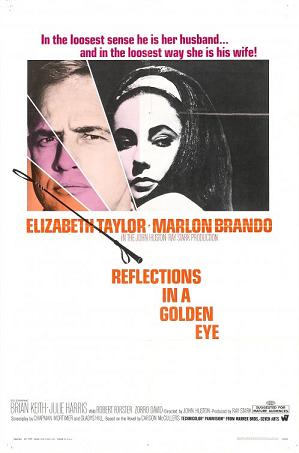
Reflections_in_a_golden_eyeFor the past two weeks, I’ve been reviewing, in chronological order, 126 cinematic melodramas.  I started in the 1920s with Sunrise and Wings and now, 33 reviews later, we have finally reached the end of the 1960s.  And what better way to end the 60s than by taking a mercifully brief look at the 1969 film, Reflections in a Golden Eye.

Now, before I get too critical of this film, I should acknowledge that there are some critics who absolutely love Reflections in a Golden Eye.  They think very highly of Marlon Brando’s performance as Maj. Weldon Penderton, a closeted homosexual who is stationed at a military base in the South.  They think that Elizabeth Taylor’s performance as Brando’s wife isn’t somewhat embarrassing.  And they think that the script isn’t overwritten and that director John Huston doesn’t try way too hard to prove himself worthy of the title auteur.  They feel that Reflections in a Golden Eye is a secret masterpiece that does not deserve to be known as an infamous flop.

I’m definitely not one of those people but they do exist.  There are some very respectable and intelligent critics who happen to love Reflections in a Golden Eye.

Well — vive la différence!

Earlier in this series, I pointed out that the 60s were not a great time for old school Hollywood directors trying to compete with both American television and European film.  It was a time when talented directors found themselves trying to keep up with the times and appeal to new audiences.  As a result, Joseph L. Mankiewicz ended up making Cleopatra.  Edward Dmytryk did The Carpetbaggers.  Elia Kazan directed The Arrangement.  William Wyler did The Liberation of L.B. Jones.  Stanley Kramer made RPM.  

And John Huston made Reflections in a Golden Eye.

This painfully slow film follows the affairs of six people on that Southern army base.  Brando is emotionally repressed and spend most of the movie mumbling in one of the worst Southern accents ever.  Taylor is obsessed with horses and spends most of the movie yelling in one of the worst Southern accents ever. Robert Forster is the object of Brando’s repressed desire, a soldier who likes to ride horses while naked and who is obsessed with sniffing Elizabeth Taylor’s underwear.  Brian Keith is in charge of the army base and is having an affair with Taylor.  Julie Harris is Keith’s suicidal wife.  Zorro David is Harris’s houseboy who, at one point, is nice enough to give this film a title by mentioning something about a golden eye.

What’s particularly insane is that Huston took the idea of making this film a reflection in a golden eye literally.  The entire film is tinted a sickly gold color.  Whenever the characters step outside, the sky looks like the sun has just exploded.  Whenever the characters are inside, they all look like they have jaundice.  On the one hand, you have to respect the fact that Huston so committed himself to potentially alienating the audience.  On the other hand, the yellow-tinting renders almost every image so grotesque that I actually found myself growing physically ill as I watched the film.

Watching Reflections in a Golden Eye, I could understand why The Godfather was such a huge comeback for Marlon Brando.  I wouldn’t necessarily say that Brando gives a bad performance here.  He’s watchable throughout the entire film.  But it’s still a performance that’s so strangely modulated (and which features a Southern accent that is just amazingly bad) that it ultimately distracts from the film itself.  If anything, Brando gives a performance that suggests what happens when a talented and eccentric man gets bored with what he’s doing.

(If you want to see a good Brando performance from 1969, see Burn.)

Reflections in a Golden Eye is a pretentious mess but fortunately, both Huston and American film would make a comeback in the 1970s.  We’ll start on that decade tomorrow.

http://www.youtube.com/watch?v=5U2NssXWO5Y

(Yes, this video is a spoiler but it’ll allow you to see the gold tinting.)

(The film was also released in an untinted version.)

Embracing the Melodrama #25: The People Next Door (dir by David Greene)


people_next_door

For the past week, I’ve been reviewing — in chronological order — fifty of the most, for reasons good and bad, memorable  film melodramas of all time.  I started with a film from 1916 called Where Are My Children? and now, as we reach the halfway mark, we also reach the 70s.  There were several reasons why I wanted to start the 70s with the 1970 drugs-in-the-suburbs melodrama, The People Next Door.  First off, not many people seem to have heard of it and I always enjoy discovering and sharing previously obscure films.  But, even more importantly, The People Next Door stars Eli Wallach, the great character actor who recently passed away at the age of 98.  Needless to say, Wallach is great in The People Next Door but then again, when wasn’t Wallach great?

At first glance, the Masons appears to be your typical suburban family.  Patriarch Arthur (Eli Wallach) may be a bit strict but he works hard to provide his family with a good life.  Wife Gerrie (Julie Harris) may seem to be a bit nervous at times but she still works hard to maintain a perfect home.  Son Artie (Stephen McHattie) may have long hippie hair and he does devote a lot of time to his band but otherwise, he seems to be a good kid.  And then there’s 16 year-old Maxie (Deborah Winters), who is blonde and pretty and overall the ideal American girl.  Even better the Masons live next door to the friendly Hoffmans, perfect David Hoffman (Hal Holbrook), his perfect wife Tina (Cloris Leachman), and their perfect teenage son, Sandy (Don Scardino).

But guess what?

Nobody’s perfect!

Arthur is actually a smug and overbearing bully whose constant bragging hides his own dissatisfaction with how his life has turned out.  He is jealous of his son’s future and his over protectiveness of his daughter takes on a distinctly disturbing tone as the film progresses.  Arthur is also having an affair with his secretary (Rue McClanahan).

Gerrie knows about Arthur’s affair but chooses to look the other way.  She goes through her day in a haze of smoke provided by the cigarettes that she is constantly smoking.  Like Arthur, she cannot understand her children.  Unlike Arthur, she does realize that she doesn’t have all the answers.

Artie may be a good kid but he feels totally and thoroughly alienated from the rest of the family and, because of his long hair, he is the constant subject of Arthur’s abuse.

And then there’s Maxie, who everyone believes to be perfect and wholesome until one night when she’s discovered tripping on LSD.  Arthur immediately assumes that Artie must have given his sister the drugs and kicks Artie out of the house.  However, what Arthur doesn’t realize, is that Maxie is actually getting the drugs from clean-cut Sandy.  Sandy doesn’t use himself but he has no problem with dealing.

To Arthur and Gerrie’s shock, Maxie tells them that she’s been using drugs for a while and she’s sexually active as well!  When Arthur subsequently discovers Maxie snorting cocaine and living with a naked biker, it’s naturally time for everyone to get into family therapy.  Unfortunately, the therapy doesn’t really help that much and soon, Maxie is again dropping acid and dancing naked on the front lawn…

As you can probably guess from the description above, The People Next Door is one of those families-in-crisis melodramas where everything that possibly can be wrong with a family is wrong with this family.  It’s always easy to dismiss well-intentioned films like this and The People Next Door has its share over-the-top moments.  But, at the same time, the film actually works better than most of the Suburban Hell melodramas of the early 70s.

That’s largely due to the performances, with Eli Wallach in particular giving an explosive performance as an all too plausible monster and Hal Holbrook and Cloris Leachman very believably bringing to life another family which turns out to be not quite as ideal as they first appear to be.  And then there’s Deborah Winters, who starts out as being so mannered that you think she’s going to give a bad performance but then, as the film progresses, you realize that Maxie is the one giving the performance because that’s the only way she can survive her “perfect” family.

I first came across The People Next Door on YouTube and, considering how much I love exposing people to obscure films, I was really looking forward to sharing it with you on this site.  But guess what?  In the three weeks between me watching this film and me staring this post, The People Next Door was taken down from the site.  I guess somebody is really dedicating to protecting the copyright on a film that hardly anybody in the world has actually heard of.

So, unfortunately, I can only share the trailer.

Watch it below!