Airplane II: The Sequel (1982, directed by Ken Finkleman)


It isn’t the past.  It isn’t the present.  It’s the future.

The moon has been colonized and, on Earth, the Mayflower II is preparing for its first international flight.  It will be carrying passengers from Houston to the lunar station.  Test pilot Ted Striker (Robert Hays) claims that the Mayflower II is not ready to make the trip but he’s been in the Ronald Reagan Hospital For The Mentally Ill ever since he had a nervous breakdown after losing his squadron during “the war.”

Aboard the Mayflower II is Ted’s ex-wife, Elaine (Julie Haggerty), and her new boyfriend, Simon (Chad Everett).  Simon says the Mayflower II is in perfect shape but he also turns into jelly whenever things get too rough.  Piloting the Mayflower II is Captain Clarence Oveur (Peter Graves) and waiting on the Moon is Commander Buck Murdock (William Shatner).  The crew of the Mayflower II is going to have a tough flight ahead of them.  Not only is the shipboard computer making plans of its own but one of the passengers (Sonny Bono) has a bomb in his briefcase.  Also, Ted has broken out of the hospital and is on the flight, boring people with his long stories.

Every successful film gets a sequel and when Airplane! was a surprise hit in 1980, it was inevitable that there would be an Airplane II.  Robert Hays, Julie Haggerty, Lloyd Bridges, Peter Graves, and Stephen Stucker all returned.  Unfortunately, Jim Abrahams, the Zucker brothers, Robert Stack, Kareem Abdul-Jabbar, and Leslie Nielsen did not.  (The directors and Nielsen were all working on Police Squad and their absence is strong felt.)  Airplane II recreates many of the same jokes as the first Airplane! but without the first film’s good nature or genuine affection for the disaster genre.  Airplane! was made for the love of comedy.  Airplane II was made for the love of money and, while there are more than a few amusing moments, the difference is obvious and there for all to see.

Not surprisingly, Airplane II is at its funniest whenever William Shatner is on screen.  In the role of Bud Murdock, Shatner pokes fun at his own image and shows himself to be a good sport.  He’s still not as funny as Leslie Nielsen or Robert Stack in the first film but that’s because, unlike Stack and Nielsen in their pre-Airplane! days, there had always been a hint of self-parody to Shatner, even in his most dramatic roles.  If Stack and Nielsen shocked people by showing that they could do deadpan comedy, Shatner’s performance just confirmed what most suspected, that he had always been in on the joke.  Still, he’s the funniest thing in Airplane II and, whenever I rewatch this movie, I am happy he was there.

Airplane II was a box office failure, which is why the world never got an Airplane III.  Fortunately, the world did get Hot Shots and The Naked Gun.

Airplane! (1980, directed by David Zucker, Jim Abrahams, and Jerry Zucker)


Airplane!, which may be the funniest movie ever made, has made me laugh every time that I’ve watched it.  And I’ve watched it a lot!

Whenever I’m getting ready to travel for my day job, I watch Airplane!  Whenever I’m going to Baltimore or West Virginia for the holidays, I watch Airplane!  Whenever I’m in a bad mood and I need something lighten me up, I watch Airplane!  Whenever I’m in a good mood and I want to be in an even better mood, I watch Airplane!

I can’t remember how old I was when I first saw Airplane! but I know I wasn’t yet ten.  While a lot of the humor went over my head at that young age, it did not matter because I laughed at all the sight gags, like the heart hopping around on the doctor’s desk and the line of passengers waiting to “calm down” the hysterical woman.  I laughed when Ted Stryker (Robert Hays) and Elaine (Julie Haggerty) got covered in seaweed while making out on the beach.  I laughed at the people dying while listening to Ted’s story, even though I didn’t fully understand that it was because of Ted boring them to death.  I loved it when Kareem Abdul-Jabbar got annoyed with the kid in the cockpit, even though young me really didn’t know who Kareem was other than he was a basketball player.  Otto the autopilot was the coolest character around.  Stephen Stucker’s Johnny made me laugh with his nonstop energy.  “Excuse me, stewardess, I speak Jive.”  “And don’t call me Shirley.”  “It looks like I picked the wrong time to stop sniffing glue.”  Every time I heard them, I laughed at all of those lines.  I didn’t have to understand why Lloyd Bridges was suddenly upside down.  I just knew it was funny.

As I got older and rewatched the film, I started to pick up on the humor that earlier went over my head.  I traveled to Turkey when I was twelve and our tour guide spent an hour telling us that Midnight Express was not a fair representation of her country.  After that, I suddenly understood why Captain Oveur (Peter Graves) wanted to know if Joey had ever been to a Turkish prison.  I came to appreciate Julie Hagerty and Lorna Patterson as the two flight attendants.  Airplane! still made me laugh but I came to understand that it was also a love story.  What adolescent boy watching Airplane! didn’t want to be Robert Hays, not only landing the plane but also getting kiss Julie Hagerty at the end of the movie?

And then, as I learned more about the movies, I realized that Airplane! was a pitch perfect parody of the disaster genre and I came to understand the brilliance of casting actors like Lloyd Bridges, Robert Stack, Peter Graves, and especially Leslie Nielsen in this film.  From the first time I saw the movie, Nielsen always made me laugh because he had the best lines and he delivered them with deadpan perfection.  But, as I got older, I came to understand that Nielsen was doing more than just saying funny things.  He was sending up his entire career.  I’m a part of the generation who grew up laughing at Leslie Nielsen the comedy superstar and it’s always strange for me to see him in one of his older, serious roles.  I have Airplane! to thank for that.

There’s so much to say about Airplane!  I could write a thousand words just talking about my favorite jokes and one-liners or how much I enjoyed Stryker’s flashbacks.  It’s my favorite movie and one that still makes me laugh even though I know all of the jokes by heart.  (I’ve always thought Howard Jarvis waiting for Stryker to return to the taxi was one of the best, though underrated, jokes in the movie.)  Airplane! is close to 50 years old and it’s still just as funny today as when I first saw it.

In fact, I think I’ll go watch it right now!

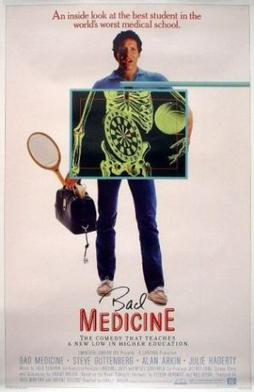
Bad Medicine (1985, directed by Harvey Miller)


Jeff Marx (Steve Guttenberg) is a smart but lazy pre-med student whose grades are so bad that he can’t get accepted to any of the good medical schools.  His father (Bill Macy), who is also a doctor and who wants Jeff to one day take over the family practice, arranges for Jeff to attend medical school in a fictional Central American country.  The head of the school, Dr. Ramon Madera (Alan Arkin), is also the country’s dictator.  Dr. Madera is happy to make money off of desperate Americans but he still enforces strict rules of behavior at the school.  He also makes it clear that none of the medical students are to treat the poor villagers who live near the school.

When Jeff arrives at his new school, he discovers that his classmates are, like him, all screw-ups.  They’re also played by a cast of actors who, like Guttenberg, epitomize the 80s ensemble comedy craze.  Curtis Armstrong, of Revenge of the Nerds and Risky Business, plays Jeff’s best friend.  Fast Times At Ridgemont High‘s Robert Romanus is the Italian medical student who is loved by all the ladies.  Airplane!‘s Julie Haggerty is the idealistic medical student who wants to take care of the local villagers.  Even Gilbert Gottfried is in this movie!  He plays Dr. Madera’s main assistant and hatchet man.

Bad Medicine was released in between the first and the second Police Academy films and it basically tells the same sort of story that made those two films unlikely hits.  Guttenberg and his fellow students start out as a screw-ups but, by the end of the movie, they’ve proven themselves as doctors.  Perhaps because it was based on a novel that was written by an actual doctor, Bad Medicine is a little more sincere than Police Academy.  In Police Academy, the scenes of the recruits doing police work were the biggest jokes of all and, even after he helped to save the city, you still never bought the idea that Steve Guttenberg would have stuck around after graduation so that he could wear a uniform and walk a beat everyday.  Though Bad Medicine is full of the usual Police Academy-style hijinks, it doesn’t treat the work that the doctors are doing as a joke.  Though regrettable stereotypes abound (this is a film that features Gilbert Gottfriend playing a character named Tony Sandoval, after all), Bad Medicine treats the villagers with respect.  Guttenberg gives a relaxed and likable performance, without making Jeff into as much of a wiseass of Police Academy‘s Cary Mahoney.  Julie Haggerty brings her usual spacey charm to her role.  Not surprisingly, it’s Alan Arkin who steals the film, though you do have to wonder how Dr. Madera has time to run both a country and a medical school while also falling in love with Julie Haggerty.  Give the man some credit for knowing how to multitask.

It ends, much like Police Academy, with the med students giving a chance to prove themselves in a crisis situation.  Unlike Police Academy, Bad Medicine was not a hit at the box office, though it did make a small profit.  As a result, there was never a Bad Medicine 2, which is unfortunate because we could always use more good doctors.

Lisa Reviews An Oscar Nominee: Marriage Story (dir by Noah Baumbach)


The Oscar nominations were announced earlier today and, as happens every year, some of the nominations were met with acclaim while others left observers scratching their heads.  Right now, on twitter, there’s a fierce debate going on between those who think Joker deserved all of its nominations and those who believe that the Academy has once again deliberately snubbed women and people of color.

As for me, I’m just shaking my head at all the nominations for Marriage Story.  I get the feeling that, out of all of the recently unveiled best picture nominees, Marriage Story is the one that we will have forgotten about within the next year.  It’s an acclaimed film and I’m happy that Scarlett Johansson finally got a nominations (two nominations, as a matter of fact, as she was also nominated for Best Supporting Actress for Jojo Rabbit) but, in the end, Marriage Story feels rather hollow.

Marriage Story is about the end of a marriage.  Charlie Barber (Adam Driver) is a New York-based theatrical director.  Nicole Barber (Scarlett Johansson) is his wife.  Nicole is an actress who, before she married Charlie, was best known for appearing topless in a teen comedy.  Charlie is often credited with having resurrected her career.  On the surface, they’re the perfect New York couple.  However, when we first meet them, their marriage is coming to an end.  Charlie, we learn, cheated on Nicole with a production assistant.  Nicole wants to go to Los Angeles so that she can star in a television series and have a career that’s not dependent upon her husband.  Caught in the middle of all this is their son, Henry (Azhy Robertson).

At first, Charlie and Nicole agree to an amicable split, one with no lawyers and no accusations.  That doesn’t last.  Nicole hires the cheerfully ruthless Nora Fanshaw (Laura Dern).  Charlie, after moving out to Los Angeles, finds himself torn between hiring either the the kindly (but ineffectual) Bert Spitz (Alan Alda, in a role he was born to play) or the somewhat sinister (but definitely effective) Jay Marotta (Ray Liotta, also in a role that he was born to play).  While both Charlie and Nicole try (and often) fail to maintain a civil relationship for Henry’s sake, their attorneys go to war.

There’s a lot of good things to be said about Marriage Story.  Though I think that his truly award-worthy work for 2019 was not in this film but instead in The Report, Adam Driver does a good job with role of Charlie.  Scarlett Johansson, who has so often been unfairly overlooked at awards time, again proves herself to be one of the best actresses around.  Dern, Alda, and Liotta are well-cast as three very different (but very recognizable) attorneys.  Noah Baumbach’s script has several good lines.  The scene where Nicole’s sister is awkwardly recruited to serve Charlie with the divorce papers is both funny and cringey.  The much-acclaimed scene where Charlie and Nicole go from having a polite (if awkward) conversation to yelling at each other is definitely effective even if it’s power has been diluted by it’s subsequent reinvention as a twitter meme.

That said, Marriage Story ultimately left me feeling dissatisfied.  It’s pretty much an open secret that the film is based on Noah Baumbach’s divorce from Jennifer Jason Leigh and, watching the film, you can’t help but feel that you’re only getting one side of a very complex story.  My first warning sign came when Nicole left for Los Angeles and the film cut to her on the set for her new television series.  Marriage Story goes so overboard in portraying Nicole’s show as being vapid and silly that you can’t help but feel that we’re meant to look down on Nicole for abandoning Charlie’s avant-garde theater productions to star in it.  We’re meant to say, “She gave up Broadway so she could star in some second-rate Marvel show!?”  From the claim that no one took Nicole seriously until Charlie married her to it’s portrayal of her being easily manipulated by her attorney, there’s a pettiness to the film’s portrayal of Nicole.

As for Charlie, he’s presented as being flawed but, as the film progresses, it’s hard not to notice that almost all of his flaws can also serve as a humble brag.  He’s a little dorky,  He’s too intense.  He works too hard.  Sometimes, he has a hard time not being the director.  Almost all of Charlie’s flaws are the type of stuff that people mention in job interviews whenever they’re asked to name their biggest weakness.  “Well, I guess I am a bit of a perfectionist, sometimes….” It’s hard not to feel that, despite a few scenes where Nicole gets to open up, the film is really only interested in Charlie’s perspective.  By the end of the film, Marriage Story reduces Nicole to merely being an obstacle standing in the way of Charlie and his son and it’s hard not to feel that both the character and the actress who plays her deserves better than that.  The film goes from being Marriage Story to simply being Charlie’s Story.

While you’re watching the film, it’s easy to get swept up in Driver and Johansson’s performances.  It’s only afterwards, when you really think about it, that you come to realize that Marriage Story doesn’t really add up to much.  It’s a good acting exercise and I’m sure that it will be popular among community theater actors who have been asked to prepare a monologue for their next audition.  But the whole is ultimately far less than the sum of its parts.

Here Are The 2019 Independent Spirit Award Nominees!


Here are the 2019 Indie Spirit Award nominations!  These nominations are meant to honor the best independent films of 2019 and their announcement marks the official beginning of awards season (at least as far as this sight is concerned!)  I hate to say it but I still need to see quite a few of the films nominated below so, for now, I’ll hold off on any editorial commentary.

For those looking for some sort of evidence of how the Oscar nominations can go, the Independent Spirit Awards can be an iffy precursor, just because several of the expensive, major studio contenders aren’t eligible to nominated.  (For instance, neither The Irishman nor Once Upon A Time In Hollywood were eligible.)  That said, for the record, the two biggest Spirit nominees are The Lighthouse and Uncut Gems.  Waves and The Farewell, which have been the center of considerable Oscar speculation, did not do as strongly in the nominations as many people apparently expected.  Make of that what you will!

Here are the nominees!

Best Supporting Female

  • Jennifer Lopez – HUSTLERS
  • Taylor Russell – WAVES
  • Zhao Shuzhen – THE FAREWELL
  • Lauren “Lolo” Spencer – GIVE ME LIBERTY
  • Octavia Spencer – LUCE
  • Best Supporting Male
  • Willem Dafoe – THE LIGHTHOUSE
  • Noah Jupe – HONEY BOY
  • Shia Labeouf – HONEY BOY
  • Jonathan Majors – THE LAST BLACK MAN IN SAN FRANCISCO
  • Wendell Pierce – BURNING CANE

Best Screenplay

  • Noah Baumbach – MARRIAGE STORY
  • Jason Begue, Shawn Snyder – TO DUST
  • Ronald Bronstein, Benny Safdie, Josh Safdie – UNCUT GEMS
  • Chinonye Chukwu – CLEMENCY
  • Tarell Alvin Mccraney – HIGH FLYING BIRD

Best First Screenplay

  • Fredrica Bailey, Stefon Bristol – SEE YOU YESTERDAY
  • Hannah Bos, Paul Thureen – DRIVEWAYS
  • Bridget Savage Cole, Danielle Krudy – BLOW THE MAN DOWN
  • Jocelyn Deboer, Dawn Luebbe – GREENER GRASS
  • James Montague, Craig W. Sanger – THE VAST OF NIGHT

Best Cinematography

  • Todd Banhazl – HUSTLERS
  • Jarin Blaschke – THE LIGHTHOUSE
  • Natasha Braier – HONEY BOY
  • Chananun Chotrungroj – THE THIRD WIFE
  • Pawel Pogorzelski – MIDSOMMAR

Best Editing

  • Julie Béziau – THE THIRD WIFE
  • Ronald Bronstein, Benny Safdie – UNCUT GEMS
  • Tyler L. Cook – SWORD OF TRUST
  • Louise Ford – THE LIGHTHOUSE
  • Kirill Mikhanovsky – GIVE ME LIBERTY

Best International Film

  • INVISIBLE LIFE, Brazil
  • LES MISERABLES, France
  • PARASITE, South Korea
  • PORTRAIT OF A LADY ON FIRE, France
  • RETABLO, Peru
  • THE SOUVENIR, United Kingdom

Best Documentary (Award given to the director and producer)

  • AMERICAN FACTORY
  • APOLLO 11
  • FOR SAMA
  • HONEYLAND
  • ISLAND OF THE HUNGRY GHOSTS

The John Cassavetes Award is presented to the best feature made for under $500,000 and is given to the writer, director, and producer. 2020 #SpiritAwards Nominees are:

  • BURNING CANE
  • COLEWELL
  • GIVE ME LIBERTY
  • PREMATURE
  • WILD NIGHTS WITH EMILY

Best Female Lead

  • Karen Allen – COLEWELL
  • Hong Chau – DRIVEWAYS
  • Elisabeth Moss – HER SMELL
  • Mary Kay Place – DIANE
  • Alfre Woodard – CLEMENCY
  • Renée Zellweger – JUDY

Best Male Lead 

  • Chris Galust – GIVE ME LIBERTY
  • Kelvin Harrison  Jr., – LUCE
  • Robert Pattinson – THE LIGHTHOUSE
  • Adam Sandler – UNCUT GEMS
  • Matthias Schoenaerts – THE MUSTANG

Best First Feature (Award given to the director and producer)

  • BOOKSMART
  • THE CLIMB
  • DIANE
  • THE LAST BLACK MAN IN SAN FRANCISCO
  • THE MUSTANG
  • SEE YOU YESTERDAY

Best Feature [award given to the producer(s)]

  • A HIDDEN LIFE
  • CLEMENCY
  • THE FAREWELL
  • MARRIAGE STORY
  • UNCUT GEMS

Best Director

  • Robert Eggers – THE LIGHTHOUSE
  • Alma Har’el – HONEY BOY
  • Julius Onah – LUCE
  • Benny Safdie, Josh Safdie – UNCUT GEMS
  • Lorene Scafaria – HUSTLERS

The Robert Altman Award is given to the ensemble cast, director & casting director of one film: MARRIAGE STORY – Noah Baumbach, Douglas Aibel, Francine Maisler, Alan Alda, Laura Dern, Adam Driver, Julie Hagerty, Scarlett Johansson, Ray Liotta, Azhy Robertson, Merritt Wever

The Truer Than Fiction Award, in its 25th year, is for emerging directors of non-fiction features and includes an unrestricted grant. Finalists:
Khalik Allah – BLACK MOTHER
Davy Rothbart – 17 BLOCKS
Nadia Shihab – JADDOLAND
Erick Stoll & Chase Whiteside – AMÉRICA

The Producers Award, now in its 23rd year, honors emerging producers who demonstrate creativity, tenacity and vision, despite highly limited resources. The award includes an unrestricted grant. These are the finalists:
Mollye Asher
Krista Parris
Ryan Zacarias

The Someone To Watch Award, in its 26th year, recognizes a talented filmmaker of singular vision and includes an unrestricted grant. The finalists are:
Rashaad Ernesto Green – PREMATURE
Ash Mayfair – THE THIRD WIFE
Joe Talbot – THE LAST BLACK MAN IN SAN FRANCISCO

The Bonnie Award will recognize a mid-career female director with a $50,000 unrestricted grant. The 2020 Film Independent #SpiritAwards Bonnie Award finalists are:
MarielleHeller
KellyReichardt
LuluWang