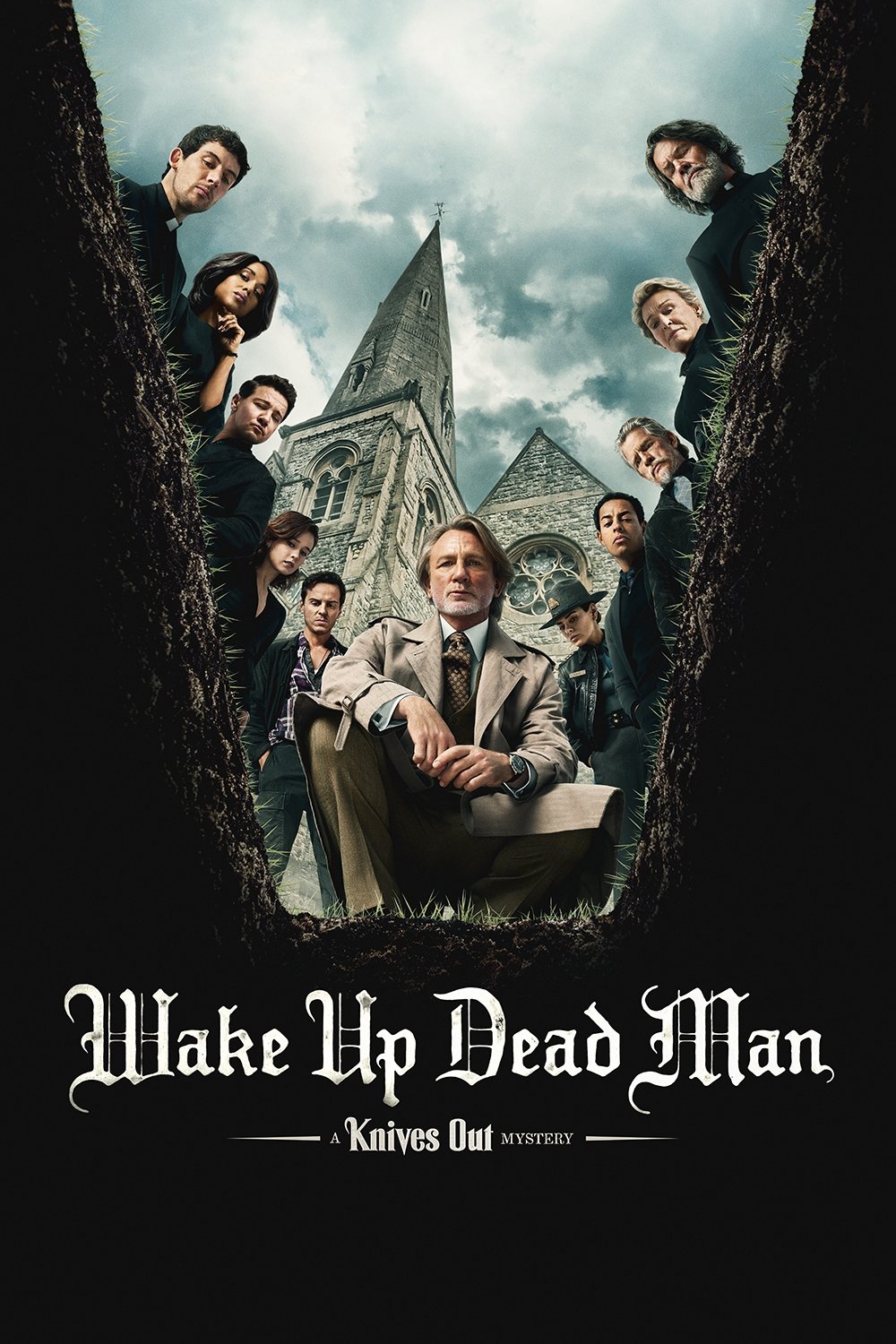
Review: Wake Up Dead Man (dir. by Rian Johnson)


“Grace isn’t cheap. It’s bought with blood and fire, not your weak-kneed handshakes with sin.” Monsignor Jefferson Wicks

Wake Up Dead Man: A Knives Out Mystery is Rian Johnson’s latest entry in his whodunit series. It reunites Daniel Craig with his charismatic detective Benoit Blanc. The film trades the intimate family drama of the first movie and the over-the-top glamour of the second for a tense, small-town tale of faith, secrets, and an impossible crime at a rural church. It’s an ambitious evolution. Yet it doesn’t always land every punch in the trilogy.

To appreciate where this fits, glance back at the predecessors. The original Knives Out from 2019 burst onto the scene. It updated classic mystery tropes cleverly. The story centered on the death of a wealthy author. The dysfunctional Thrombey family circled like vultures over his estate. Blanc’s folksy charm cut through the lies with surgical precision. He delivered razor-sharp twists. His commentary bit into privilege and entitlement. All this wrapped in a snug, stage-play setup. It felt like a modern And Then There Were None. Every character popped—from Chris Evans’ smirking man-child to Ana de Armas’ wide-eyed nurse. The script’s misdirections kept you guessing until the final gut-punch reveal. It was tight, surprising, and endlessly rewatchable. Humor, heart, and social satire blended into a perfect whodunit package.

Glass Onion: A Knives Out Mystery followed in 2022. It cranked up the scale dramatically. A billionaire’s private island became the playground. A squad of self-important influencers played at being geniuses. The satire shifted gears. It skewered tech elites and performative allyship. Bigger laughs came from set pieces like the glass onion puzzle. Wilder ensemble clashes featured Edward Norton’s bumbling Miles Bron. Blanc unraveled the chaos with gleeful theatricality. Sure, it leaned heavier into farce than the original’s grounded tension. But those oh-so-satisfying reveals kept the momentum roaring. Janelle Monáe’s layered turn helped too. Each film stands alone as a self-contained puzzle. Yet they build Blanc’s legend incrementally. They refresh the murder-mystery playbook. Johnson’s signature flair nods to Agatha Christie roots.

Wake Up Dead Man arrives a few years after those events. Blanc looks more rumpled—bearded and brooding. He carries the visible weight of prior investigations. These have chipped away at his unflappable facade. Detective Benoit Blanc dives into a fresh case. It orbits a magnetic priest, Monsignor Jefferson Wicks. His tight-knit parish sits at Our Lady of Perpetual Fortitude. This is a fading rural church in snow-dusted upstate New York. A baffling death strikes right in the middle of services. It’s a stabbing during a Good Friday ritual. The congregation watches it unfold. It’s framed as an impossible crime with no clear entry or escape. Blanc must sift through hidden motives. He navigates frayed bonds and simmering tensions in the flock. His goal is to expose the culprit. Young assistant priest Rev. Jud Duplenticy becomes an unlikely ally.

Josh O’Connor stands out as Jud. He’s the earnest, ex-boxer priest. He brings raw vulnerability and quiet intensity. This grounds the film’s more outlandish elements. The powerhouse lineup fuels suspicion and sparks. Josh Brolin plays the commanding, domineering Wicks. His sermons blend fire-and-brimstone charisma with manipulative control. Glenn Close is the loyal church pillar Martha Delacroix. She’s his steely right-hand woman. She hides decades of devotion and resentment. Mila Kunis is police chief Geraldine Scott. She’s tough and skeptical but out of her depth. Jeremy Renner plays local doc Dr. Nat Sharp. His bedside manner conceals shadier dealings. Kerry Washington is attorney Vera Draven. She’s sharp-tongued and protective. Thomas Haden Church is reserved groundskeeper Samson Holt. He observes everything with cryptic folksiness. Andrew Scott plays best-selling author Lee Ross. He peddles scandalous exposes on the parish. Cailee Spaeny is the disabled former concert cellist Simone Vivane. Her ethereal presence masks deeper pain. Daryl McCormack is aspiring politician Cy Draven. He’s ambitious and entangled in family webs. Noah Segan pops up as sleazy Nikolai. It’s a fun callback to his earlier roles. This adds series continuity without stealing focus. The ensemble ignites every scene. Clashing agendas and barbed dialogue keep the paranoia boiling.

This installment carves its own distinct path. It embraces a darker, more introspective tone. Think faith-versus-reason noir laced with locked-room impossibility. The setting is a snow-dusted upstate New York parish. This contrasts the polished puzzle-box feel of the originals. The church throbs with simmering divisions. They feel palpably real. Fiery sermons alienate younger parishioners. They drive attendance into the dirt. Whispers hint at buried family fortunes. These tie to the church’s crumbling foundations. Rituals mask exploitation, abuse of power, and grudges. All hide under a veneer of piety.

Cinematographer Steve Yedlin works masterfully. He captures stark contrasts. Candlelit services flicker against vaulted ceilings. Shadowy mausoleums hide grisly secrets. Fog-shrouded grounds host midnight confessions that turn sinister. A cold, wintry palette amplifies isolation. Nathan Johnson’s score blends ominous orchestral swells. It adds subtle choral hints and dissonant organ tones. This creates a haunting vibe. It underscores spiritual unease without overpowering dialogue. Blanc prowls with trademark wit and theatrical flourishes. But a deeper layer emerges. He grapples with existential questions. These involve belief, deception, and waking from illusions. The title ties in directly. It calls amid apparent miracles, staged resurrections, and devilish symbolism. This blurs divine intervention and human malice.

The storyline thrives on classic misdirection. It piles on clues like a stolen devil’s-head knife from the altar. Vanished evidence dissolves in acid. Eerie occurrences hint at the otherworldly. Ghostly apparitions and bleeding statues appear. Then it snaps back to human frailty and greed. The film peels back the parish’s seedy underbelly. Hypocrisy rules the pulpit. Opportunism infects the flock. Buried sins span generations. It avoids preachiness or heavy-handedness. Instead, it fuels interpersonal fireworks. These erupt in confessionals, potlucks gone wrong, and heated vestry arguments.

Highlights abound. Blanc holds probing chats during tense masses. A single hymn masks frantic whispers. Late-night graveyard prowls use flashlights. They reveal half-buried scandals. A pulse-pounding chase winds through labyrinthine catacombs. Jud’s raw confession scenes blend vulnerability with defiance. The unmaskings cascade like dominoes. They form a brilliantly orchestrated finale. This echoes the first film’s precision. But it adds emotional stakes. Themes of redemption, forgiveness, and blind faith’s cost hit hard. They linger longer.

Flaws exist. The runtime stretches past two hours, leading to noticeable drag in the back half where explanatory flashbacks overstay their welcome and blunt the mounting tension. The crowded suspect list feels star-studded to a fault, with the expanded cast and their distinct personalities—from Renner’s oily doc to Washington’s sharp lawyer—often coming across more as a parade of familiar cameos than fully fleshed-out suspects. This dilutes the razor-sharp individual motivations that made the earlier entries so airtight, as some characters blend into the background despite the name recognition.

Craig remains the beating heart. He refines Blanc into a weary yet unbreakable warrior. Twinkling eyes hide hard-earned cynicism and quiet scars. This bridges the series’ growth perfectly. He evolves from wide-eyed newcomer to seasoned truth-seeker. Notably, his performance dials back bombastic Foghorn Leghorn bluster. It drops the scenery-chewing antics from Glass Onion. Instead, it opts for nuanced eccentricities. Subtle drawl inflections shift from playful to piercing. Haunted pauses carry unspoken regrets. Layered glances reveal a detective worn by deceptions. He keeps infectious charm and deductive brilliance.

He bounces off O’Connor’s conflicted priest. Their electric, buddy-cop chemistry grounds the mystery. It adds human connection amid supernatural tinges. Brolin chews scenery as tyrannical Wicks. His booming voice and piercing stare dominate. Close brings steely devotion to Martha. She layers quiet menace under pious smiles. The ensemble delivers scene-stealing turns. Renner’s oily doc has subtle tics. Washington’s lawyer cuts through BS like a blade. Church’s groundskeeper drops cryptic wisdom. Spaeny’s cellist haunts the score. The group dynamic crackles. Suspicion, snark, and alliances build tension. It doesn’t fully match Knives Out‘s intimacy. Nor does it rival Glass Onion‘s ego clashes. Raw charisma and sharp writing carry it far. Tighter arcs would elevate it further.

Behind the camera, Johnson amps visual and thematic style. It reflects the trilogy’s arc masterfully. The debut had cozy, rain-lashed Thrombey manor confines. The sequel brought flashy, tropical island excess. This film offers brooding parish grit. Sacred spaces twist into battlegrounds. Production design captures ecclesiastical opulence turned sinister. Vibrant stained glass casts blood-red shadows. Ancient relics whisper curses. Fog-shrouded grounds pulse with menace. It avoids campy parody. The balance feels reverent yet unsettling.

Dialogue pops with Blanc’s poetic rants. Extended musings explore faith’s illusions. They mirror “dead men walking” through empty rituals. This weaves personal growth into procedural beats. It never halts the pace. Screenplay-wise, it remixes boldly. It expands from domestic squabbles to global posers. Now it targets a fractured flock in dogma and greed. Subtle nods hint at Blanc’s odyssey. No direct sequel hook burdens it. No franchise baggage weighs it down.

In the end, Wake Up Dead Man solidifies the saga. It spins timeless whodunits freshly and vitally. Each outing sharpens the social knife. Targets evolve—from greedy kin to tycoons to holy hypocrites wielding faith. Pacing hiccups hit the bloated third act. The overwhelming ensemble poses challenges. Still, it grabs from the opening sermon-gone-wrong. It rewards with twists, depth, and a hopeful close. This lingers like a benediction. Devotees find layers to chew. Mystery fans geek over mechanics. Newcomers benefit from earlier starts. But this standalone shines. Johnson’s vision evolves fearlessly. Craig’s magnetism deepens. The door cracks for more mayhem. Pop the popcorn. Dim the lights. Let confessions begin.
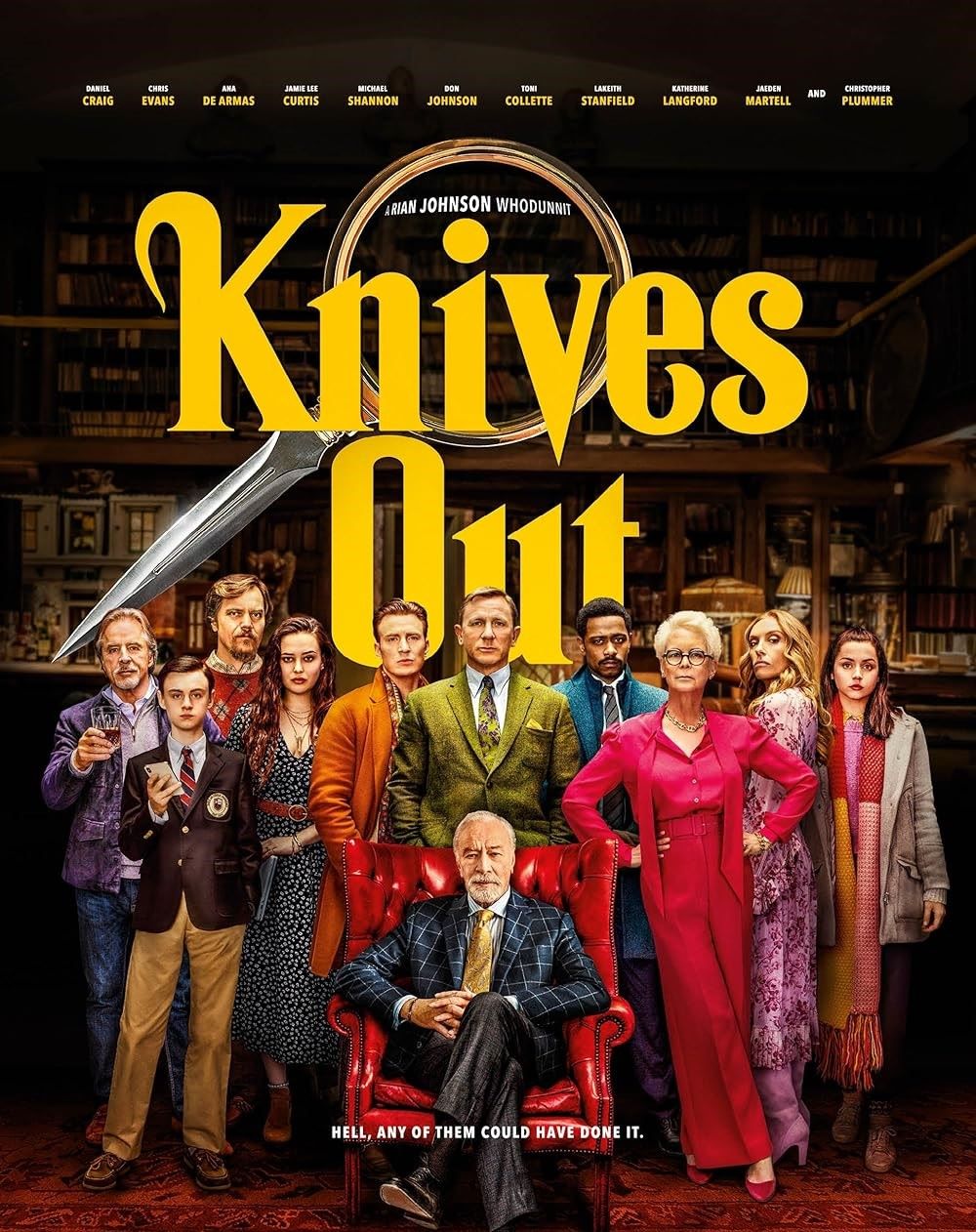
Review: Knives Out (dir. by Rian Johnson)


“The family is truly desperate. And when people get desperate, the knives come out.” — Benoit Blanc

After shaking up galaxies far, far away with Star Wars: The Last Jedi, Rian Johnson returned to solid ground in 2019 with Knives Out, a film so self-assured and inventive it practically felt like a director catching his breath while reminding the world what made him exciting in the first place. It was his first movie after that polarizing Star Wars entry, and he used the opportunity not to go bigger, but smarter—to take something intimate, character-driven, and refreshingly old-school and make it gleam again. Knives Out landed as a kind of palate cleanser for both him and the audience: a modern mystery that leaned into genre nostalgia while reinventing it with sharp humor and social bite. The result wasn’t just a change of pace—it was a confident display of craft from a filmmaker unbothered by his critics, operating with absolute control over every frame, every line, and every perfectly timed smirk.

The setup couldn’t be more classic: a wealthy family patriarch, Harlan Thrombey, turns up dead after his 85th birthday, leaving behind a tangled household of suspects, secrets, and strained smiles. His death looks like suicide, but something isn’t right. Enter Benoit Blanc, a Southern gentleman detective hired anonymously to snoop through the wreckage of lies and grievances. The scenario drips with vintage whodunit flavor, but Johnson’s genius lies in retooling that familiarity into something electrifyingly modern. The Thrombeys aren’t just eccentric millionaires—they’re avatars of American entitlement, each convinced of their own superiority while quietly dependent on the man they pretend to revere. By building his mystery around a clan that mirrors contemporary divisions of money, politics, and self-deception, Johnson injects wit and purpose into the genre without ever losing the fun of the game.

Jamie Lee Curtis plays the confident matriarch Linda, Michael Shannon the resentful son Walt, Toni Collette the spiritual grifter Joni, and Don Johnson the smirking son-in-law Richard—all of them playing heightened but recognizable shades of selfishness. Their sniping exchanges during the first act are among the film’s best sequences, packed with fast banter, political jabs, and casual hypocrisy. Johnson directs these moments like a verbal tennis match, letting personalities bounce and clash until the family’s shiny façade cracks enough for true frustrations to spill out. It’s sharp, funny, and chaotic, showing early on that no one in the Thrombey family is as self-made or self-aware as they claim to be.

Amid that colorful ensemble, the performance that most stunned audiences came from Chris Evans as Ransom Drysdale, Harlan’s playboy grandson and the family’s unapologetic black sheep. Coming off years of playing Marvel’s resolutely noble Steve Rogers, Evans dives into Ransom with visible glee, turning him into a figure of charm and mystery whose motives are never quite clear. He’s magnetic from the moment he appears—witty, cynical, a little dangerous—and Johnson clearly relishes using Evans’s clean-cut image to toy with expectations. Ransom strides into the story radiating confidence, but there’s a guarded, almost predatory intelligence behind his grin. His scenes crackle because the audience can’t quite decide where to place him: is he the rare Thrombey who sees through the family hypocrisy, or is he spinning his own kind of manipulation? That tension between self-awareness and deceit gives his every line an edge. Watching Evans in this role feels like a release for him and a thrill for viewers, a testament to both his range and Johnson’s intuitive casting.

Opposite that moral uncertainty stands Ana de Armas’s Marta Cabrera, Harlan’s kind and soft-spoken nurse who suddenly finds herself at the heart of the story. Marta grounds the entire film emotionally, her decency cutting through the Thrombeys’ arrogance like sunlight in a dusty room. She’s the migrant caretaker who everyone claims to love while casually condescending to, a detail Johnson uses to expose how often politeness masks prejudice. Marta’s inability to lie without vomiting, played initially for laughs, gradually becomes symbolic—a kind of moral honesty that makes her unique in a house ruled by deception. De Armas brings layered vulnerability to the role, balancing fear, guilt, and compassion with natural ease. Through her, Johnson turns the whodunit into something more human and emotionally resonant. She isn’t just a witness or a suspect; she’s the beating heart around which all the greed, paranoia, and privilege revolve.

Then there’s Daniel Craig’s Benoit Blanc, whose arrival shifts the film into another gear entirely. His Southern drawl—equal parts poetic and perplexing—sets the tone for what becomes one of Craig’s most playful performances. After years of portraying the stoic James Bond, he’s clearly having the time of his life as a detective who investigates with both intellect and intuition. Blanc operates less like a hard-nosed cop and more like a philosopher; he believes that solving a crime means understanding human weakness as much as evidence. His famous “donut hole” speech perfectly captures the balance Johnson strikes between earnestness and absurdity. Blanc may revel in his own melodrama, but he also brings heart to chaos, observing people’s contradictions without losing his sense of wonder. The result is a detective who’s less about revelation and more about revelation’s moral cost.

Visually, Knives Out belongs to a rare category of films that are so meticulously crafted they could be paused at any frame and still look compelling. Johnson and cinematographer Steve Yedlin transform Harlan’s mansion into a breathing character—an architectural echo chamber of secrets. The walls are lined with strange trinkets, elaborate paintings, and heavy mahogany furniture that suggest old money’s suffocating weight. There’s something both cozy and claustrophobic about the space, which mirrors the tension between family warmth and poisonous resentment. The camera glides through it with purpose, lingering on small details that gain meaning later, and the autumn-colored palette—deep reds, browns, and golds—wraps everything in an inviting melancholy. It’s as much a visual experience as it is a narrative one, and few modern mysteries feel as tactile.

Johnson’s writing keeps that sense of precision. The plot unfolds like clockwork, but the mechanics never feel mechanical. Instead, he keeps viewers off-balance by blending humor with genuine suspense. Instead of relying entirely on high-stakes twists, Johnson builds tension through empathy, giving us access to characters’ doubts and stakes rather than just their clues. The result is a mystery that keeps the audience guessing in emotional and moral dimensions, not just logical ones. Every revelation says as much about character as it does about the crime.

Underneath the quick humor and ornate mystery structure, Knives Out doubles as a satire of class and entitlement. Johnson sketches the Thrombeys as people who talk endlessly about fairness, morality, and self-reliance yet collapse into panic when their material comfort is threatened. Through them, he captures a peculiar American irony: the people most obsessed with earning their status are often those most insulated from real struggle. When the family gathers to argue over wealth and loyalty, Johnson doesn’t need to exaggerate—they expose themselves with every smug phrase and self-justified rant. It’s social commentary that’s biting but never heavy-handed because it plays out through personality instead of sermon.

Nathan Johnson’s score carries the story forward with playful precision, shifting from tension to whimsy in sync with the characters’ shifting loyalties. There’s something almost dance-like about the film’s rhythm: scenes of laughter can spiral into confession, and interrogations can dissolve into comedy without losing a beat. The editing supports that agility, cutting crisply between overlapping dialogue and close-ups that reveal just enough expression to keep us alert. Johnson’s sense of pacing feels theatrical in the best way—it’s about timing and tone rather than spectacle.

As with many of Rian Johnson’s works, contradiction fuels the story’s appeal. Knives Out is cynical about human greed but oddly hopeful about individual decency. It mocks arrogance but rewards empathy. Even when it toys with genre clichés, it does so out of affection, not scorn. Johnson clearly understands that mystery storytelling is as much about character and morality as deduction, and he uses humor and chaos as tools to explore who people become under pressure. The movie’s sophistication lies in how effortless it feels—its layers unfold smoothly, but the craft behind them is razor sharp.

The film’s ending closes with a visual that redefines power without needing words. After a story filled with deceit, pretension, and the scramble to control a legacy, it concludes on an image that says everything about perspective—who actually holds the moral high ground and how quietly dignity can win. Like the rest of the movie, it’s both playful and pointed, leaving you smiling while still turning the characters’ behavior over in your mind.

Looking back, Knives Out stands as a defining moment in Rian Johnson’s career. After the spectacle and dialogue storms of The Last Jedi, this lean, ensemble-driven mystery reaffirmed his strengths as a writer-director who thrives on structure, rhythm, and human contradictions. It’s a film that takes as much pleasure in observation as revelation, brimming with sly humor and performances that sparkle across the moral spectrum. Anchored by Ana de Armas’s poignant sincerity, Daniel Craig’s eccentric brilliance, and Chris Evans’s unpredictable charisma, it became one of the most purely enjoyable movies of its time. Witty without pretense, political without lecturing, and perfectly balanced between cynicism and heart, Knives Out remains proof that the old whodunit can still cut deep—and that Rian Johnson’s sharpest weapon is still his storytelling.

Axel Foley heads back West in the Beverly Hills Cop: Axel F Teaser!


Personally, I think we’ve milked the Nostalgia Train for all it’s worth, but if audiences are looking forward to it, maybe it’s a good thing. I forgot there was a third entry in the Beverly Hills Cop films, but then recalled it was the one with George Lucas in it. While we’re not sure why Detroit’s Axel Foley (Eddie Murphy) is returning to Beverly Hills, it’s good to see that most of his friends are there to greet him. It looks like they brought in Judge Reinhold, Paul Reiser, John Aston and even Bronson Pinchot along for the ride. New additions appear to be both Joseph Gordon-Levitt and Kevin Bacon.

The film is due out next March.

The Films of 2020: The Trial of the Chicago 7 (dir by Aaron Sorkin)


The Trial of the Chicago 7, the latest film from Aaron Sorkin, is a fairly mediocre and rather forgettable film.  Because of that mediocrity, it stands a pretty good chance of doing very well at the Oscars later this year.

Aaron Sorkin specializes in political fan fiction.  He writes plays, movies and television shows that address big and controversial issues in the most safely liberal way possible.  Whenever Sorkin writes about politics, there’s not a single debate that can’t be won by one long, overdramatic speech, preferably delivered in an office or a conference room while everyone who disagrees nervously stares at the ground, aware that they’ll never be able to match the rhetorical brilliance of their opponents.  It’s a rather dishonest way to portray the ideological divide but it’s one that’s beloved by people who want to be political without actually having to do much thinking.  Sorkin is the poet laureate of the keyboard activists, the people who brag about how their cleverly-worded tweets “totally owned the MyPillow guy.”  (One sure sign of a keyboard activist is the excessive pride over rhetorically owning people who are ludicrously easy to own.  These are the people who think that Tom Arnold arguing about the electoral college with Kirstie Alley is the modern-day equivalent of the Lincoln/Douglas debates.)

The Trial of the Chicago 7, which Sorkin not only wrote but also directed, deals with a real-life event, the 1969 trial of eight political activists who were charged with conspiracy and crossing state lines with the intention of inciting riots at the 1968 Democratic National Convention in Chicago.  (Black Panther Bobby Seale was ultimately tried separately from the other defendants, leading to the Chicago 8 becoming the Chicago 7.)  Sacha Baron Cohen plays Abbie Hoffman, the fun-loving activist who delights in upsetting the establishment.  Eddie Redmayne played Tom Hayden, who takes himself and his activism very seriously and who worries that Hoffman’s antics in the courtroom are going to discredit progressives for generations to come.  Hoffman ridicules Hayden for being a rich boy who is rebelling against his father.  Hayden attacks Hoffman for not thinking about how his actions are going to be perceived by the rest of America.  Sorkin the screenwriter is clearly on Hayden’s side while Sorkin the director keeps finding himself drawn to Hoffman, if just because Hoffman is the more entertaining character.  Hoffman gets to make jokes while Hayden has to spend the entire film with a somewhat constipated expression on his face.

As is typical of Sorkin’s political work, the film raises issues without really exploring them.  We learn that the defendants were all arrested during anti-war protests but the film never really explores why they’re against the war.  It’s mentioned that David Dellinger (John Carroll Lynch) is a pacifist who even refused to fight in World War II but at no point do we learn what led to him becoming a pacifist.  When Hoffman and Jerry Rubin (Jeremy Strong) talk about how they feel that the government holds people like them in contempt and that they shouldn’t have to fight in a war that they don’t believe in, Sorkin’s script has them speak in the type of simplistic platitudes that could just as easily have been uttered by a MAGA supporter talking about the war in Afghanistan.  If all you knew about these men was what you learned in this film, you would never know that Hayden, Hoffman, and the rest of the Chicago 7 were activists both before and after the Vietnam War.  You’d never know that there was more to their ideology than just opposition to the Vietnam War.  The film never really digs into anyone’s beliefs and motivations.  Instead, everyone might as well just have “Good” or “Evil” stamped on their forehead.

Sorkin’s simplistic approach is most obvious when it comes to Bobby Seale (Yahya Abdul-Mateen II).  With Seale, the film is more interested in how other react to him than in the man himself or his activism.  The film’s most shocking moment — when Judge Hoffman (Frank Langella) orders Seale to be literally bound and gagged in the courtroom — actually did happen but the film mostly seems to use it as an opportunity to show that even the lead prosecutor (played by Joseph Gordon-Levitt) is disgusted by the government’s heavy-handedness.  Seale and the Black Panthers are used more as symbols than as actual characters.

Since this is an Aaron Sorkin film, the action is male-dominated.  It’s justified as the Chicago 7 and their lawyers were all men. Still, it’s hard not to notice that the only prominent female characters are an undercover cop who betrays the protestors and a receptionist who is frequently reprimanded by the men in the film.  One black woman in a maid’s uniform does get a chance to reprimand Hayden for not speaking out when Bobby Seale was gagged but she’s never even given a name.  As often happens with women of color in films like this, she’s only there to remind the white heroes to do the right thing.

Watching The Trial of the Chicago 7, I found myself thinking about how lucky Aaron Sorkin was to get David Fincher as the director of The Social Network.  A smart director with a strong and unique style, Fincher was able to temper Sorkin’s tendency toward pompousness.  Unfortunately, as a director, Aaron Sorkin is no David Fincher.  While Sorkin has definitely established his own style as a writer, he directs like someone who learned how to stage a crowd-pleasing moment from watching Spielberg but who, at the same time, never noticed the sense of playfulness that Spielberg, especially early in his career, infused within the best of those scenes.  It’s all soaring rhetoric and dramatic reaction shots and cues to let us know when we’re supposed to applaud.  As a director, Sorkin never challenges the audience or lets the film truly come to any sort of spontaneous life.  Instead, he adopts a somewhat cumbersome flashback-laden approach.  The story never quite comes alive in the way that the similar courtroom drama Mangrove did.  It’s all very safe, which is one reason why I imagine The Trial of the Chicago 7 is as popular as it is.  It’s a film that allows the viewers to celebrate the fantasy of activism without having to deal with the messy reality of all the complications that come along with taking an actual stand.  It’s a film that encourages you to pat yourself on the back for simply having watched and agreeing that people have the right to protest.

I will say that Sorkin made some good casting choices.  Langella is memorably nasty of the judge and Joseph Gordon-Levitt does a good job as the prosecutor.  Eddie Redmaye is a bit of a drag as Tom Hayden but Alex Sharp is likable as Hayden’s friend, Rennie Davis.  Michael Keaton has an effective cameo as Ramsey Clark.  The film presents Clark as being a bit of a wise liberal and the film’s epilogue doesn’t mention that Clark went on to a lucrative career of providing legal aide to murderous dictators and anti-Semites.  (Lyndon LaRouche was one prominent Ramsey Clark client.)

The Trial of the Chicago 7 will probably do well come Oscar-time.  In many ways, it almost feels like a generic Oscar movie.  It’s about a historical event, it’s political without being radical, and it presents itself as being far more thoughtful than it actually is.  That’s been a winning combo for many films over the years.

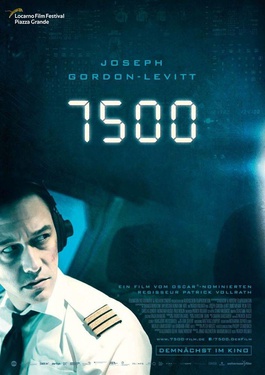
The Films of 2020: 7500 (dir by Patrick Vollrath)


7500 is about one man, sitting in a locked room and trying to prevent a disaster.

Tobias Ellis (Joseph Gordon-Levitt) is an American pilot who lives in Berlin.  From the minute we first see him entering the cockpit of the plane that he’s going to co-pilot from Berlin to Paris, he seems to be someone who has his life together.  He moves with the confidence of someone who knows how to do his job and who doesn’t have a single worry that anything could go wrong.  His girlfriend and the mother of his son, Gokce (Aylin Tezel), is a flight attendant on the plane but they both go out of their way to keep things strictly professional whenever they’re working.  In many ways, they seem like the perfect couple.  I’ve flown a lot and I would feel totally confident if I saw Tobias and Gokce working on my flight.

However, shortly after the plane takes off, things go terribly wrong.  Terrorists attempt to break into the cockpit.  Though Tobias is able to force them out and lock the cockpit door, he’s stabbed in the arm while doing so.  His co-pilot is also injured and quickly loses consciousness.  Now, while suffering from blood loss, Tobias has to fly the plane with one arm and negotiate with the terrorists, who are threatening to kill passengers and flight attendants (including Gokce) unless Tobias unlocks the door and allow them to enter the cockpit.

It’s an intense film.  With the exception of some airport security footage at the start of the film, all of the action takes place in that cockpit.  For the most part, we know only what Tobias knows.  We don’t know how many terrorists there are on the other side of the cockpit door.  We don’t know how serious they are when they threaten to start randomly killing passengers.  We also don’t know if Tobias is going to be able to safely land the airplane.  We certainly hope that he’ll be able to land it and the rules of Hollywood have conditioned us to expect a happy ending but, from the beginning, it’s established that 7500 is not a typical Hollywood action film.  Just because Tobias and Gokce are a likable couple and both are doing their best under the worst circumstances imaginable, there’s never any guarantee that they’re going to survive.

A lot of how you react to this film is going to depend on how much you like Joseph Gordon-Levitt.  He’s on-screen for the entire 92-minute running time.  We see all of the action through his eyes and we watch as he goes from being soft-spoken and confident to being increasingly desperate and emotional.  Gordon-Levitt gives a bravura performance, perfectly capturing not only Tobais’s fear but also his innate professionalism.  No matter how bad things get (and they do get pretty bad as the film progresses), he never forgets that everyone on the plane is depending on him to get them safely to the ground.

The film takes an interesting turn when Tobias shares a few moments when a younger terrorist who seems to be ambivalent about what he’s doing.  I wasn’t quite expecting that but it was a nice touch and Omid Memar did a good job of playing the character.  Ultimately, though, 7500 works best as a showcase for Joseph Gordon-Levitt and he delivers.

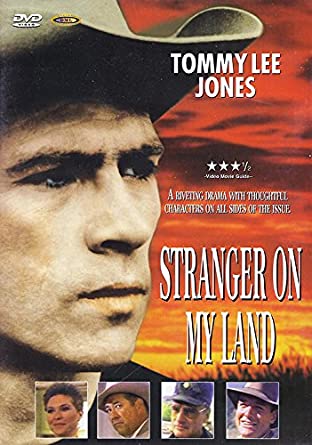
Stranger On My Land (1988, directed by Larry Elikann)


The Air Force wants to build a new air base in Utah but the Whitman family refuses to sell their ranch.  Bud Whitman (Tommy Lee Jones) served in Vietnam and he disapproved just as much of forcing Vietnamese villagers to move as he now disapproves of the idea of allowing the government to force American citizens to move.  When a judge rules that the Air Force can force the Whitmans to vacate their property under the rule of eminent domain, Bud announces that he still will not be moving.  With several of Bud’s old combat buddies showing up to support Bud, the villainous county surveyor, Connie Priest (Terry O’Quinn), prepares to take matters in his own hands.

Tommy Lee Jones vs. Terry O’Quinn?  That sounds like it should have the makings of a classic but Stranger On My Land is a largely forgettable made-for-TV movie.  A huge part of the problem is that O’Quinn’s character doesn’t have any real motivation beyond just being a prick and that seems like a waste when you consider the number of interesting villains that Terry O’Quinn has played over the years.  This is the actor who, in The Stepfather, actually made a multiple murderer seem a little bit likable.  Connie Priest seems like a villain that O’Quinn could have done a lot with if only the film’s script hadn’t been so simplistic.  Tommy Lee Jones is always well-cast as a modern day western hero but again, the script doesn’t do much with his character.  He’s just Tommy Lee Jones yelling at people to get off his property.  You could probably go to Tommy Lee Jones’s own ranch and have the exact same experience without having to sit through the rest of this movie.  Even Bud’s ethical objections to the Vietnam War feel like something that was just tossed in to assure the people watching at home that he’s not meant to be some sort of gun-toting militiaman.  The best performance in the movie comes from Ben Johnson, who is plays Tommy Lee Jones’s father.  That’s prefect casting.  If Ben Johnson wasn’t actually Tommy Lee Jones’s father, he probably should have been.

The main problem with Stranger On My Land is that it was made for television and it had to operate within the limits of what was acceptable for television in 1988.  The entire movie seems to be building up to a fierce battle between Bud and law enforcement but instead, it settles for a personal fight between Bud and Connie.  The film’s sudden ending doesn’t feel authentic but it does feel like what you’d expect to find on ABC in the late 80s.

Here Are The Satellite Nominations!


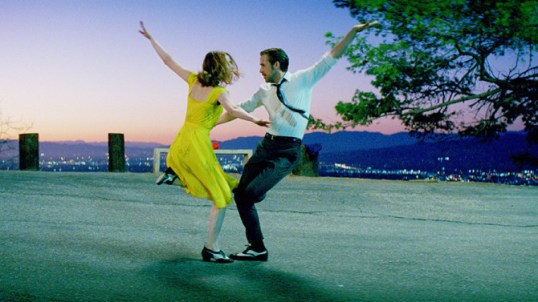
la-la-land

The International Press Academy — a.k.a. the Oscar precursor that nobody cares about — announced their nominees for the best of 2016 earlier today and it was a very good day for a film that I cannot wait to see, La La Land!

Here are the Satellite nominations!

Special Achievement Award Recipients

Mary Pickford Award- Edward James Olmos
Tesla Award- John Toll
Auteur Award- Tom Ford
Humanitarian Award- Patrick Stewart
Best First Feature- Russudan Glurjidze “House of Others”
Best Ensemble: Motion Picture- “Hidden Figures”
Best Ensemble: Television- “Outlander”

Actress in a Motion Picture

Annette Bening, “20th Century Woman”
Emma Stone, “La La Land”
Natalie Portman, “Jackie”
Ruth Negga, “Loving”
Taraji P. Henson, “Hidden Figures”
Meryl Streep, “Florence Foster Jenkins”
Isabelle Huppert, “Elle”
Amy Adams, “Nocturnal Animals”

Actor in a Motion Picture

Casey Affleck, “Manchester by the Sea”
Ryan Gosling, “La La Land”
Joseph Gordon-Levitt, “Snowden”
Viggo Mortensen, “Captain Fantastic”
Joel Edgerton, “Loving”
Andrew Garfield, “Hacksaw Ridge”
Tom Hanks, “Sully
Denzel Washington, “Fences”

Actress in a Supporting Role

Helen Mirren, “Eye in the Sky”
Michelle Williams, “Manchester by the Sea”
Nicole Kidman, “Lion”
Octavia Spencer, “Hidden Figures”
Naomi Harris, “Moonlight”
Viola Davis, “Fences”
 Actor in a Supporting Role

Jeff Bridges, “Hell or High Water”
Mahershala Ali, “Moonlight”
Dev Patel, “Lion”
Lucas Hedges, “Manchester by the Sea”
Eddie Murphy, “Mr. Church”
Hugh Grant, “Florence Foster Jenkins”

Motion Picture

“La La Land”
“Moonlight”
“Manchester by the Sea”
“Lion”
“Jackie”
“Hacksaw Ridge”
“Loving”
“Hell or High Water”
“Nocturnal Animals”
“Captain Fantastic”
“Hidden Figures”
“Fences”

 Motion Picture, International Film

“The Happiest Day in the Life of Olli Maki”- Finland
“Toni Erdmann”- Germany
“Julieta”- Spain
“A Man Called Ove”- Sweden
“The Salesman”- Iran
“The Ardennes”- Belgium
“Ma’ Rosa”- Philippines
“The Handmaiden”- South Korea
“Elle”- France
“Paradise”- Russia

Motion Picture, Animated or Mixed Media 
Title of Film
“Zootopia”
“Kubo and the Two Strings”
“Moana”
Finding Dory”
“My Life As a Zucchini”
“The Jungle Book”
“The Red Turtle”
“Miss Hokusai”
“Trolls”
“Your Name”

Motion Picture, Documentary

“Gleason”
“Life Animated”
“O.J.: Made in America”
“13th”
“The Ivory Game”
“The Eagle Huntress”
“Tower”
“Fire at Sea”
“Zero Days”
“The Beatles: Eight Days a Week”

Director

Barry Jenkins, “Moonlight”
Kenneth Lonergan, “Manchester by the Sea”
Mel Gibson, “Hacksaw Ridge”
Damien Chazelle, “La La Land”
Tom Ford, “Nocturnal Animals”
Pablo Larrain, “Jackie”
Denzel Washington, “Fences”

Screenplay, Original

Barry Jenkins, “Moonlight”
Damien Chazelle, “La La Land”
Kenneth Lonergan, “Manchester by the Sea”
Taylor Sheridan, “Hell or High Water”
Matt Ross, “Captain Fantastic”
Yorgos Lanthimos/Efthymis Filippou, “The Lobster”

Screenplay, Adapted

Andrew Knight/Robert Schenkkan, “Hacksaw Ridge”
Luke Davis, “Lion”
Kieran Fitzgerald/Oliver Stone, “Snowden”
Justin Marks, “The Jungle Book”
Allison Schroeder, “Hidden Figures”
Todd Komarnicki, “Sully”

Original Score

Rupert Gregson Williams, “Hacksaw Ridge”
Justin Hurwitz, “La La Land”
Lesley Barber, “Manchester by the Sea”
John Williams, “The BFG”
John Debney, “The Jungle Book”
Hans Zimmer, “Hidden Figures”

Original Song

“Audition”- ‘La La Land’
“City of Stars”- ‘La La Land’
“Dancing with Your Shadow”- ‘Po’
“Can’t Stop the Feeling”- ‘Trolls’
“I’m Still Here”- ‘Miss Sharon Jones’
“Running”- ‘Hidden Figures’

Cinematography

John Toll, “Billy Lynn’s Long Halftime Walk”
Linus Sandgren, “La La Land
James Laxton, “Moonlight”
Simon Duggan, “Hacksaw Ridge”
Jani-Petteri Passi, “The Happiest Day in the Life of Olli Maki”
Bill Pope, “The Jungle Book”

Visual Effects

“The Jungle Book”
“Billy Lynn’s Long Halftime Walk”
“Doctor Strange”
“The BFG”
“Sully”
“Deadpool”

Film Editing

Tom Cross, “La La Land
Joi McMillon/Nat Sanders, “Moonlight”
Tim Squyres, “Billy Lynn’s Long Halftime Walk”
Alexandre de Francheschi, “Lion”
John Gilbert, “Hacksaw Ridge”
Steven Rosenblum, “The Birth of a Nation”

Sound (Editing and Mixing)

La La Land
“Billy Lynn’s Long Halftime Walk”
“Hacksaw Ridge”
“The Jungle Book”
“Allied”
“13 Hours: The Secret Soldiers of Benghazi”

Art Direction and Production Design

David Wasco, “La La Land
Barry Robinson, “Hacksaw Ridge”
Jean Rabasse, “Jackie”
Christophe Glass, “The Jungle Book”
Gary Freeman, “Allied”
Dan Hennah, “Alice Through the Looking Glass”

Costume Design

Colleen Atwood, “Alice Through the Looking Glass”
Eimer Ní Mhaoldomhnaigh, “Love & Friendship”
Courtney Hoffman, “Captain Fantastic”
Madeline Fontaine, “Jackie”
Mary Zophres, “La La Land
Alexandra Byrne, “Doctor Strange”

Film Review: The Walk (dir by Robert Zemeckis)


The_Walk_(2015_film)_poster

If you didn’t get a chance to see Robert Zemeckis’s latest film, The Walk, in a theater and, at the very least, in 3D, you really missed out.

In fact, I’m actually a bit surprised that The Walk hasn’t gotten more attention than it has.  Over the past year, whenever I would see the trailer play before another movie, it always seemed like a palpable sense of excitement descended over the theater.  Then, The Walk was released, it got wonderful reviews, and …. nothing.  Down here in Dallas, it played in theaters for three weeks and then it went away.  Since I was on vacation for two of those weeks, I nearly missed it!

But I’m glad that I didn’t miss it.  I say this despite the fact that I’m beyond terrified of heights and The Walk is all about creating the experience of balancing on a wire that’s been suspended between two of the tallest buildings in the world.  As I watched the film, there were many times when I struggled to catch my breath.  I had to put my hands over my mismatched eyes a few times.  But I’m still glad that I saw the film.

The Walk is based on a true story.  In 1974, French street performer Philippe Patet (Joseph Gordon-Levitt, who is even more adorable here than usual if that’s possible) and a group of accomplices manage to suspend a high wire between the twin towers of the just constructed World Trade Center. High above New York City, Philippe walked across the wire a total of six times.  In the film, Philippe narrates the story while standing on top of the Statue of Liberty.  From the minute that we see Gordon-Levitt and he starts to speak in a theatrical (but never implausible) French accent, we immediately like and relate to Philippe.  By the end of the film, his triumph is our triumph.

At the same time, we also feel his sadness.  Up until the film’s final line, when Philippe makes a subtle reference to it, 9-11 is never explicitly mentioned in The Walk but the shadow of that monstrous attack still looms over frame of the film.  By recreating both Philippe’s act of daring and the Twin Towers themselves, Zemeckis attempts to reclaim the legacy of the World Trade Center from the asshole terrorists who destroyed it.

And The Walk really does put you right there on that wire.  If ever there’s been a film that you must simply see in 3D, it’s The Walk.  Just be prepared to watch some of the movie through your fingers.

Here’s a Really Scary Trailer For The Walk!


So right now, we’re in the middle of Oscar season and everyone’s wondering what will be nominated for best film of 2014?

What better time, then, to take a look at a trailer for a film that might be promoted for best film of 2015?  The Walk is directed by Robert Zemeckis and it features Joseph Gordon-Levitt up way high in the sky.

I’m terrified of heights so I have to admit that this trailer totally freaks me out.  However, I’ll still probably see the movie because it’s Joseph Gordon-Levitt after all.

It’s scheduled to come out in October of 2015, shortly before the start of Oscar season.

http://www.youtube.com/watch?v=eFXsDEB9iS0