Insomnia File #34: The Minus Man (dir by Hampton Fancher)


What’s an Insomnia File? You know how some times you just can’t get any sleep and, at about three in the morning, you’ll find yourself watching whatever you can find on cable? This feature is all about those insomnia-inspired discoveries!

Last night, if you were unable to sleep at one in the morning, you could have turned over to Starz and watched the 1999 film, The Minus Man!

The Minus Man is a strange little film about a rather odd man.  Vann (Owen Wilson) is a drifter.  He avoids questions about his past with the skill of someone who specializes in being whatever he needs to be at the moment.  When he rents a room from Doug and Jane Durwin (Brian Cox and Mercedes Ruehl), he tells them that he’s only drunk one beer over the course of his entire life, he always works, he always pays his rent on time, and that he’s never smoked “the dope.”  He says it so earnestly that it’s difficult to know whether you should take him seriously or not.  And yet, Vann is so likable and so charmingly spacey that you can’t help but understand why people automatically trust him.  Vann succeeds not because people believe him but because they want to believe him.

Vann’s new in town.  As he explains to a cop who pulls him over, he’s just interested in seeing the countryside.  From the minute that Vann shows up, he’s accepted by the community.  He goes to a high school football game and befriends the local star athlete (Eric Mabius).  He tries to help repair Doug and Jane’s marriage, which has been strained ever since the disappearance of their daughter.  With Doug’s aid, Vann gets a job at the post office and proves that he wasn’t lying when he said he was a hard worker.  Vann even pursues a tentative romance with the poignantly shy and insecure Ferrin (Janeane Garofalo).

In fact, it’s easy to imagine this film as being a sweet-natured dramedy where a drifter comes into town for the holidays and helps all of the townspeople deal with their problems.  However, from the first time we see him, we know that Vann has some issues.  As Detective Graves (Dennis Haysbert) puts it, Vann is a “cipher, a zero.”  There’s nothing underneath the pleasant surface.  Of course, Graves doesn’t really exist.  Neither does his partner, Detective Blair (Dwight Yoakam).  They’re two figments of Vann’s imagination.  They appear whenever Vann is doing something that he doesn’t want the world to find out about.

Whenever the urge hits him, Vann kills people.  When we first meet him, he’s picking up and subsequently murdering a heroin addict named Casper (Sheryl Crow).  Vann makes it a point to use poison because he says that it’s a painless death.  Vann also says that he’s doing his victims a favor, as he feels that the majority of them no longer want to live.  Vann is the type of killer who, after having committed his latest murder, sees nothing strange about volunteering to help search for the missing victim.

Like a lot of serial killer films, The Minus Man cheats by giving all of the best lines to the killer.  In real life, most serial killers are impotent, uneducated losers who usually end up getting caught as a result of their own stupidity.  In the movies, they’re always surprisingly loquacious and clever.  While Vann may not be a well-spoken as Hannibal Lecter, he’s still a lot more articulate than the majority of real-life serial killers.  As I watched the film, it bothered me that we didn’t really learn more about Vann’s victims.  (It would have been a far different film if someone had mentioned that Vann’s third, unnamed victim was “Randy, who was just having a bite to eat while shopping for a present for his little girl’s birthday.”)  Too often, The Minus Man seemed to be letting Vann off the hook in a way that a film like Henry: Portrait of a Serial Killer or even American Psycho never would.

That said, The Minus Man may be occasionally uneven but it’s still an intriguing and sometimes genuinely creepy film.  The Minus Man makes good use of Owen Wilson’s eccentric screen persona and Wilson gives a very good performance as a man who has become very skilled at hiding just how empty he actually is.  Much like everyone else in the film, you want to believe that there’s more to Vann than meets the eye because, as played by Wilson, he’s just so damn likable.  Over the course of the film, Vann and Doug develop this weird little bromance and, as good as Wilson is, Brian Cox’s performance is even more unsettling because we’re never quite sure what Doug may or may not be capable of doing.  Even Janeane Garofalo gives a touching and believable performance as a character who you find yourself sincerely hoping will not end up getting poisoned.

With all that in mind, I wouldn’t suggest watching this film if you’re trying to get over insomnia.  This is the type of unsettling film that will keep you awake and watching the shadows long after the final credits roll.

Previous Insomnia Files:

  1. Story of Mankind
  2. Stag
  3. Love Is A Gun
  4. Nina Takes A Lover
  5. Black Ice
  6. Frogs For Snakes
  7. Fair Game
  8. From The Hip
  9. Born Killers
  10. Eye For An Eye
  11. Summer Catch
  12. Beyond the Law
  13. Spring Broke
  14. Promise
  15. George Wallace
  16. Kill The Messenger
  17. The Suburbans
  18. Only The Strong
  19. Great Expectations
  20. Casual Sex?
  21. Truth
  22. Insomina
  23. Death Do Us Part
  24. A Star is Born
  25. The Winning Season
  26. Rabbit Run
  27. Remember My Name
  28. The Arrangement
  29. Day of the Animals
  30. Still of The Night
  31. Arsenal
  32. Smooth Talk
  33. The Comedian

Shattered Politics #63: Primary Colors (dir by Mike Nichols)


Primaryposter

Jack Stanton (John Travolta) is the charismatic governor of an unnamed Southern state.  After spending his entire life in politics, Jack is finally ready to run for President.  Even more ready is his equally ambitious wife, Susan (Emma Thompson).  Jack proves himself to be a strong candidate, a good speaker who understands the voters and who has the ability to project empathy for almost anyone’s situation. He’s managed to recruit a talented and dedicated campaign staff, including the flamboyant Richard Jemmons (Billy Bob Thornton), Daisy Green (Maura Tierney), and journalist Henry Burton (Adrian Lester).  Henry is the son of a civil rights leader and, as soon as they meet, Jack talks about the first time that he ever heard Henry’s father speak.  Within minutes of first meeting him, Henry believes in Jack.

The problem, however, is that there are constant hints that Jack may not be worthy of his admiration.  There’s the fact that he’s a compulsive womanizer who is given to displays of temper and immaturity.  When one of Jack’s old friends reveals that Jack may have impregnated his daughter, Jack and Susan respond with a pragmatic ruthlessness that takes Henry by surprise.

When one of Jack’s mistresses threatens to go public, Henry is partnered up with Libby (Kathy Bates) and sent to dig up dirt on her and her sponsors.  When the former governor of Florida, Freddie Picker (Larry Hagman), emerges as a threat to derail Jack’s quest for the nomination, Henry and Libby are again assigned to research Picker’s background.  Libby is perhaps the film’s most interesting character.  Recovering from a mental breakdown, Libby has no trouble threatening to shoot one political opponent but she’s still vulnerable and idealistic enough that it truly hurts her when Jack and Susan repeatedly fail to live up to her ideals.  As an out lesbian, Libby is perhaps the only character who has no trouble revealing her true self and, because of her honesty, she is the one who suffers the most.

First released in 1998 and based on a novel by Joe Klein, Primary Colors is an entertaining and ultimately rather bittersweet dramedy about the American way of politics.  John Travolta and Emma Thompson may be playing Jack and Susan Stanton but it’s obvious from the start that they’re meant to be Bill and Hillary Clinton.  And while it takes a few minutes to get used to Travolta’s attempt to sound Southern, this is ultimately one of his best performances.  As played by Travolta, Jack Stanton is charming, compassionate, self-centered, and ultimately, incredibly frustrating.  One reason why Primary Colors works is because we, as an audience, come to believe in Jack just as much as Henry does and then we come to be just as disillusioned as Libby.  Emma Thompson’s performance is a little less obviously based on Hillary.  Unlike Travolta, she doesn’t attempt to imitate Hillary’s voice or mannerisms.  But she perfectly captures the steely determination.

Primary Colors captures both the thrill of believing and the inevitability of disillusionment.  It’s definitely a film that I will rewatch in the days leading up to 2016.

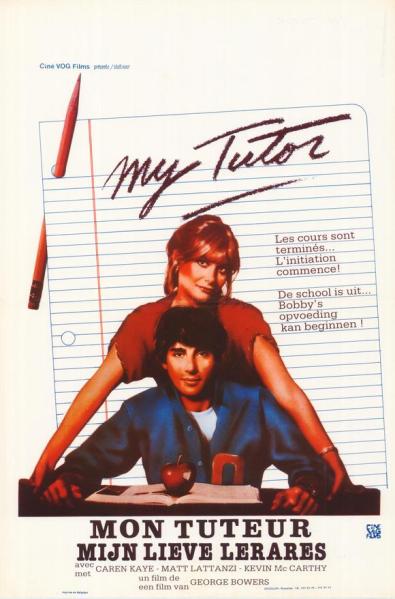
Back to School #30: My Tutor (dir by George Bowers)


my-tutor

It’s the house.

I was recently trying to figure out what it was exactly that I enjoyed about the 1983 teen comedy My Tutor and I finally realized that it all came down to the house.  Like almost every other teen film released in the 1980s, My Tutor is about rich people.  The main character, recent high school graduate and frustrated virgin Bobby Chrystal (Matt Lattanzi), lives in an absolutely gorgeous house.  There’s a huge pool in back and even the guest house appears to be bigger than any place that I’ve ever lived.  Bobby lives in the type of mansion that I’ve always wanted to live in.  For me, the best parts of My Tutor are the scenes that simply follow Bobby as he walks around the grounds of his home.

I just like seeing where people live.

I first came across My Tutor about two years ago when I got the Too Cool For School DVD box set from Mill Creek Entertainment.  My Tutor was one of the 12 movies included in the box set and it was one of the first that I watched, just because the title seemed to promise all sorts of sordid fun.  Looking back on the first time that I ever watched the film, my main impressions were that the film’s central plot — the affair between Bobby and his French tutor, Terry (Caren Kaye) — was actually handled with a surprising amount of sensitivity, that the great Kevin McCarthy was ideally cast as Bobby’s wealthy but sleazy father, and that the house was really nice.

Is that really proper teacher attire?

Is that really proper teacher attire?

When I rewatched the film for this review, I quickly discovered that I had either forgotten or managed to block from my mind about 5o% of the movie.  Because, before Bobby and Terry take the fateful midnight swim that leads to their affair, the movie largely focuses on the efforts of Bobby and his friend Jack (the reliably weird and nerdy Crispin Glover) to each lose his virginity.  The first half of the film is pretty much dominated by cartoonish scenes of Bobby passing out drunk at a brothel and Jack and his brother Billy (Clark Brandon) trying to pick up two female mud wrestlers.  (If you have bondage fantasies about Crispin Glover, I guess this is the film to see.)  At one point, all of the film’s action stops so that Bobby can have an elaborate fantasy about having sex with a girl that we’ve barely seen before and will never see again.

Bobby has problems beyond just his virginity.  A recent high school graduate, he still has to retake and pass a French exam if he’s going to have any hope of getting into Yale.  (Yale was where his father went to college.  Bobby says he wants to go to UCLA and study the skies, even though he doesn’t ever say anything about astronomy beyond that he wants to major in it.)  Bobby’s father hires him a tutor.  Terry is only ten years older than Bobby and has just recently broken up with her boyfriend.  She enjoys nude midnight swims, riding on motor scooters, and aerobic exercise.  Before you know it, Terry and Bobby are having an affair, Bobby’s father is hitting on Terry, and Terry’s ex-boyfriend keeps coming up to the house searching for her.

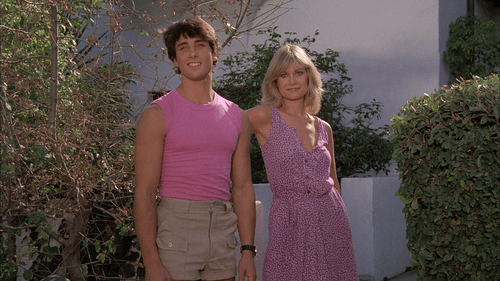
The perfect couple

The perfect couple

And what’s surprising is that, once Bobby and Terry become lovers, the film changes.  Well, it changes a little.  Don’t get me wrong — it doesn’t suddenly turn into a great (or even a good) movie or anything like that.  But the film really does make an attempt to realistically deal with the relationship between Bobby and Terry.  Terry doesn’t suddenly abandon her dreams or her plans just because she’s now secretly sleeping with Bobby.  Instead, Terry remains just as independent as before and, unlike a lot of films of the period, the film doesn’t condemn her for wanting a life of her own.  If anything, the film chastises Bobby whenever he gets overly possessive of her.  In the end, the movie suggests that the most important lessons Bobby learned weren’t about sex but instead, were about Terry’s right to live her own life.

Oddly enough, hiding within this typical teen comedy, there’s a surprisingly bittersweet film.  Perhaps less surprisingly, this film — like The Young Graduates, The Teacher, Trip With The Teacher, Coach, and Malibu High — was yet another teacher-student-sex film produced by Crown International Pictures.  Nobody handled potentially icky exploitation with quite the wit and grace of  Crown International.

CIP_Logo