4 Or More Shots From 4 Or More Films is just what it says it is, 4 shots from 4 of our favorite films. As opposed to the reviews and recaps that we usually post, 4 Shots From 4 Films lets the visuals do the talking!
Today would have been the birthday of director John Schlesinger. It’s time for….
4 Shots From 4 John Schlesinger Films
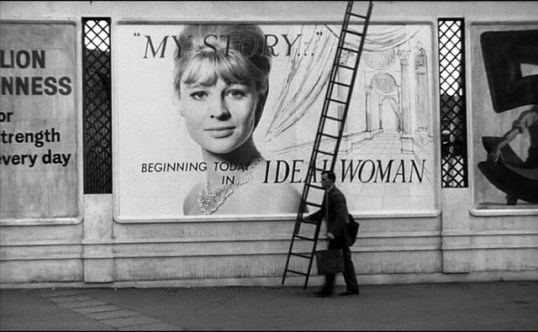
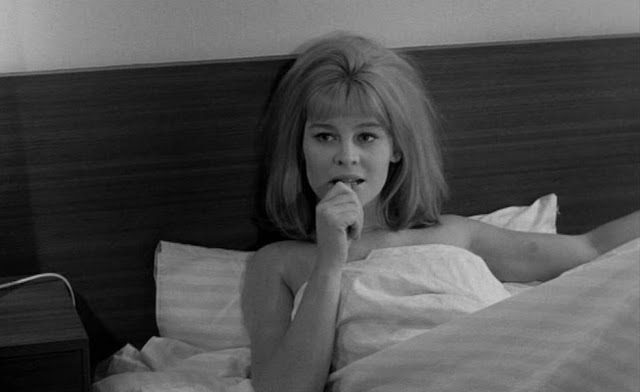
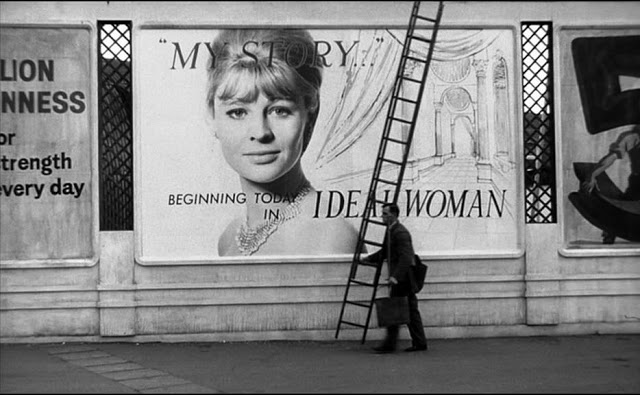
Darling (1965, dir by John Schlesinger, DP: Kenneth Higgins)
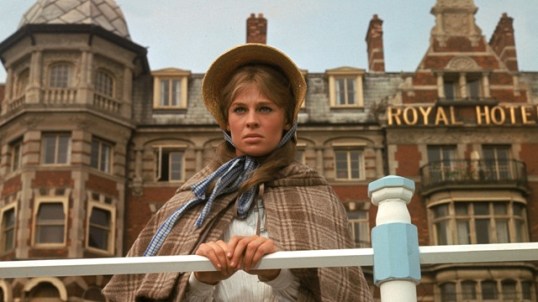
Far From The Madding Crowd (1967, dir by John Schlesinger, DP: Nicolas Roeg)
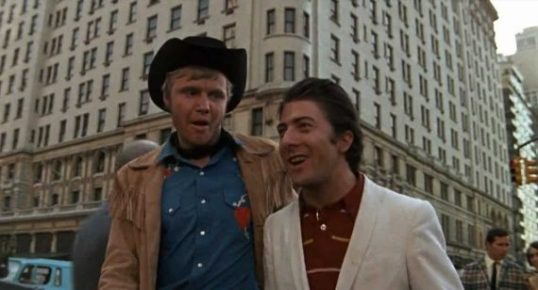
Midnight Cowboy (1969, dir by John Schlesinger, DP: Adam Holender)
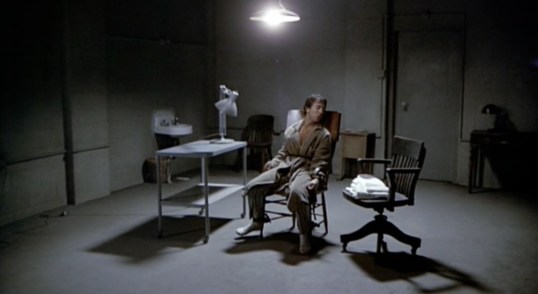
Marathon Man (1976, dir by John Schlesinger, DP: Conrad Hall)
4 Or More Shots From 4 Or More Films is just what it says it is, 4 shots from 4 of our favorite films. As opposed to the reviews and recaps that we usually post, 4 Shots From 4 Films lets the visuals do the talking!
95 years ago today, Robert Evans was born in New York City. He started out working in his brother’s clothing business but a chance meeting with actress Norma Shearer led to him becoming an actor. And while Evans, by his own account, was not a particularly good actor, he did prove himself to be very skilled at playing the games of Hollywood. Evans eventually moved from acting to production, first as an executive at Paramount and then as an independent producer.
He lived a life as glamorous and tumultuous as the stars of his pictures and his memoir, The Kid Stays In The Picture, is considered to be one of the classic show biz autobiographies. He hung out with cinematic rebels like Jack Nicholson and Robert Towne and counted Secretary of State Henry Kissinger as a friend. He suggested that Francis Ford Coppola should direct The Godfather and, when Paramount put pressure on Coppola to cut the film down to two hours, it was Evans who famously announced that a two-hour Godfather was nothing more than a trailer. He lost Ali MacGraw to Steve McQueen and, again by own account, he lost a lot of potentially productive years to cocaine. (The Cotton Club scandal is one of the wildest in the history of Hollywood, though it should be noted that Evans himself was never charged with any wrongdoing.) But, for all that he lost, Evans continues to gain admirers as being the epitome of the producer who was willing to take chances. For all of his flamboyance, Evans had an eye for good material and the willingness to protect his directors. In many ways, he was as important to the cinematic revolution of the 70s as the directors that he hired. When Evans passed away in 2019, it was truly the end of an era.
Here, in honor of the birth and legacy of Robert Evans, are 8 Shots from 8 Films that Evans produced, either as studio chief at Paramount or as an independent producer.
8 Shots From 8 Robert Evans Films
Rosemary’s Baby (1968, dir by Romnn Polanski, DP: William A. Fraker)
Love Story (1970, dir by Arthur Hiller, DP: Richard Kratina)
The Godfather (1972, dir by Francis Ford Coppola, Cinematography by Gordon Willis)
Chinatown (1974, dir by Roman Polanski, DP: John A. Alonzo)
Marathon Man (1976, dir by John Schlesinger, DP: Conrad Hall)
The Cotton Club (1984, dir by Francis Ford Coppola, DP: Stephen Goldblatt)
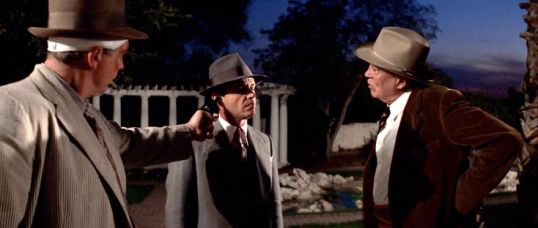
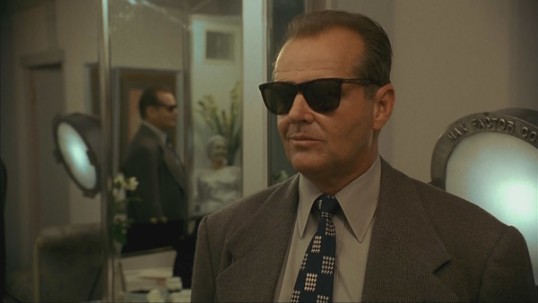
The Two Jakes (1990, dir by Jack Nicholson, DP: Vilmos Zsigmond)
Sliver (1993, dir by Phillip Noyce, DP: Vilmos Zsigmond)
4 Shots From 4 Films is just what it says it is, 4 shots from 4 of our favorite films. As opposed to the reviews and recaps that we usually post, 4 Shots From 4 Films lets the visuals do the talking!
Today, I’m using this feature to take a look at the history of the Academy Award for Best Picture. Decade by decade, I’m going to highlight my picks for best of the winning films. To start with, here are 4 shots from 4 Films that won Best Picture during the 1960s! Here are….
4 Shots From 4 Best Picture Winners: The 1960s
The Apartment (1960, dir by Billy Wilder, DP: Ernest Laszlo)
Lawrence of Arabia (1962, dir by David Lean, DP: Freddie A. Young)
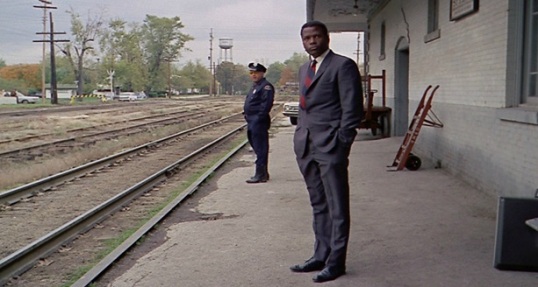
In The Heat of the Night (1967, dir by Norman Jewison, DP: Haskell Wexler)
Midnight Cowboy (1969; Dir by John Schlesinger, DP: Adam Holender)
When it comes to unfortunate and dumb ways to die, getting electrocuted while standing in a puddle of spilled milk would seem to rank fairly high on the list. Unfortunately, it’s exactly what happens to the wife of Cal Jamison (Martin Sheen) during the first few minutes of 1987’s The Believers.
Traumatized by his wife’s death (and probably also by all of the people asking, “Wait a minute, she was standing in milk?”), Cal relocates from Minneapolis to New York City. Accompanying him is his young son, Chris (Harley Cross). Upon arriving in New York, Cal starts a tentative new relationship with artist Jessica Halliday (Helen Shaver) and he also gets a job working a psychologist for the NYPD.
And several members of the NYPD are going to need a good psychologist because they are investigating a series of brutal and ritualistic murders. All of the victims are children around Chris’s age and the murders are so grisly that even a hardened cop like Lt. Sean McTaggart (Robert Loggia) finds himself traumatized. When Detective Tom Lopez (Jimmy Smits, in one of his first roles) discovers one of the bodies, he has an apparent mental breakdown and starts to rant and rave about an all-powerful cult that Tom claims is committing the murders.
After Tom commits suicide, his ravings are dismissed as being the product of a mentally ill man. However, Cal is not so sure and starts to investigate on his own. What he discovers is a cult made up of a motely mix of wannabe gangsters and members of high society. While his friends and lovers either die or lose their minds around him, Cal discovers that the cult is actually closer to both him and his son than he ever realized.
An odd film, The Believers. On the one hand, there’s plenty of creepy scenes, including one in which Jessica gets a truly disturbing skin condition. The scenes in which Cal discovers that his friends have lost their minds as a result of the Cult are frequently sad and difficult to watch. Robert Loggia has scene that brought tears to my eyes. The mix of street witchery and upper class power lust is nicely handled and, as always, Harris Yulin makes for an effective villain. The Believers creates an ominous atmosphere of paranoia, one in which you really do come to feel that no one in the film is quite who they say they are.
And yet, it’s obvious that director John Schlesinger — whose previous films included Darlingand the Oscar-winning Midnight Cowboy — had more on his mind than just making an effective Omen-style horror film. He also tries to deal with Cal coming to terms with the death of his wife and Chris coming to terms with the idea of Cal dating someone new and all of those scenes of straight-forward domestic drama feel out-of-place in what should have been an energetic and grisly B-movie. In those ploddingly earnest scenes, Schlesinger seems to be trying almost too hard to remind us that he’s not really a horror filmmaker and they just feel out of place.
If there was ever a movie that called for the unapologetic and wickedly sardonic directorial vision of David Cronenberg, it was The Believers. As it is, The Believers is an intriguing but frustratingly uneven mix of paranoia, witchcraft, and domestic melodrama.
4 Or More Shots From 4 Or More Films is just what it says it is, 4 shots from 4 of our favorite films. As opposed to the reviews and recaps that we usually post, 4 Shots From 4 Films lets the visuals do the talking!
92 years ago today, Robert Evans was born in New York City. He started out working in his brother’s clothing business but a chance meeting with actress Norma Shearer led to him becoming an actor. And while Evans, by his own account, was not a particularly good actor, he did prove himself to be very skilled at playing the games of Hollywood. Evans eventually moved from acting to production, first as an executive at Paramount and then as an independent producer.
He lived a life as glamorous and tumultuous as the stars of his pictures and his memoir, The Kid Stays In The Picture, is considered to be one of the classic show biz autobiographies. He hung out with cinematic rebels like Jack Nicholson and Robert Towne and counted Secretary of State Henry Kissinger as a friend. He suggested that Francis Ford Coppola should direct The Godfather and, when Paramount put pressure on Coppola to cut the film down to two hours, it was Evans who famously announced that a two-hour Godfather was nothing more than a trailer. He lost Ali MacGraw to Steve McQueen and, again by own account, he lost a lot of potentially productive years to cocaine. (The Cotton Club scandal is one of the wildest in the history of Hollywood, though it should be noted that Evans himself was never charged with any wrongdoing.) But, for all that he lost, Evans continues to gain admirers as being the epitome of the producer who was willing to take chances. For all of his flamboyance, Evans had an eye for good material and the willingness to protect his directors. In many ways, he was as important to the cinematic revolution of the 70s as the directors that he hired. When Evans passed away in 2019, it was truly the end of an era.
Here, in honor of the birth and legacy of Robert Evans, are 8 Shots from 8 Films that Evans produced, either as studio chief at Paramount or as an independent producer.
8 Shots From 8 Robert Evans Films
Rosemary’s Baby (1968, dir by Romnn Polanski, DP: William A. Fraker)
Love Story (1970, dir by Arthur Hiller, DP: Richard Kratina)
The Godfather (1972, dir by Francis Ford Coppola, Cinematography by Gordon Willis)
Chinatown (1974, dir by Roman Polanski, DP: John A. Alonzo)
Marathon Man (1976, dir by John Schlesinger, DP: Conrad Hall)
The Cotton Club (1984, dir by Francis Ford Coppola, DP: Stephen Goldblatt)
The Two Jakes (1990, dir by Jack Nicholson, DP: Vilmos Zsigmond)
Sliver (1993, dir by Phillip Noyce, DP: Vilmos Zsigmond)
The 1985 film, The Falcon and the Snowman, tells the story of two friends. They’re both wealthy. They’re both a little bit lost, with one of them dropping out the seminary and the other becoming a drug dealer who is successful enough to have a lot of money but inept enough to still be treated like a joke by all of other dealers.
Chris Boyce (Timothy Hutton) is the son of a former FBI agent (Pat Hingle). He has a tense relationship with his father. It’s obvious that the two have never really been sure how to talk to each other. While his father is sure of both himself and his country, Chris is far more sensitive and quick to question. While his father plays golf and attends outdoor barbecues, Chris becomes an expert in the sport of falconry and spends a lot of time obsessing about the state of the the world. While his father defends Richard Nixon during the Watergate investigation, Chris sees it as evidence that America is a sick and corrupt country. Because his father doesn’t want Chris sitting around the house all day, he pulls some strings to get Chris a job working at the “Black Vault,” where Chris will basically have the ability to learn about all sorts of classified stuff.
Daulton Lee (Sean Penn) was Chris’s best friend in school. Daulton’s entire life revolves around cocaine. He both sells and uses it. He’s managed to make a lot of money but his addiction has also left him an erratic mess. Daulton’s father wants to kick him out of the house. Daulton’s mother continually babies him. Chris and Daulton may seem like an odd pair of friends but they’re both wealthy, directionless, and have a difficult time relating to their fathers. It somehow seems inevitable that these two would end up as partners.
Chris Boyce and Daulton Lee, together …. THEY SOLVE CRIMES!
No, actually, they don’t. Instead, they end up betraying their country. (Boooo! Hiss! This guy’s a commie, traitor to our nation!) After Chris discovers that the CIA has been interfering in the elections of America’s allies (in this case, Australia), he decides to give information to the Russians. Since Daulton already has experience smuggling drugs over the southern border, Boyce asks Lee to contact the KGB the next time that he’s in Mexico. Despite being a neurotic and paranoid mess, Lee manages to do just that.
Of course, as Chris soon comes to discover, betraying your country while working with a greedy drug addict is not as easy as it seems. While Chris wants to eventually get out of the treason game, marry his girlfriend (Lori Singer), and finish up college, Daulton wants to be James Bond. The Russians, meanwhile, soon grow tired of having to deal with Lee and start pressuring Chris to deal with them directly….
And it all goes even further downhill from there.
Based on a true story, The Falcon and the Snowman tells the story of how two seemingly very different young men managed to basically ruin their lives. Boyce’s naive idealism and Lee’s drug-fueled greed briefly makes them a powerful duo but they both quickly discover that betraying your country isn’t as a simple as they assumed. For one thing, once you’ve done it once, it’s impossible to go back to your normal life. As played by Hutton and Penn, Chris and Daulton are two very interesting characters. Boyce is full of righteous indignation and sees himself as being a hero but the film hints that he’s mostly just pissed off at his Dad for never understanding him or caring that much about falconry. Daulton, meanwhile, is a lunatic but he seems to be aware that he’s a lunatic and that makes his oddly likable. At times, it seems like even he can’t believe that Chris was stupid enough to depend on him. The film provides a convincing portrait of two men who, because of several impulsive decisions, find themselves in over their heads with no possibility of escape.
The Falcon and the Snowman is an entertaining and occasionally thought-provoking time capsule of a different age. If the film took place in 2020, Daulton would be hanging out with the Kardashians and Chris would probably be too busy working for the Warren campaign to spy for America’s enemies. If only the two of them had been born a few decades later, all of this could have been of avoided.
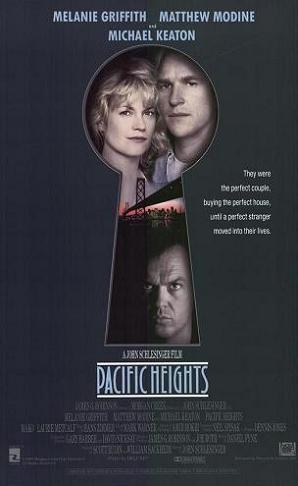
Michael Keaton is the tenant from Hell in Pacific Heights.
In San Francisco, Patty (Melanie Griffith) and Drake (Matthew Modine) have just bought an old and expensive house that they can not really afford. In order to keep from going broke, they rent out two downstairs apartments. One apartment is rented by a nice Japanese couple. The other apartment is rented by Carter Hayes (Michael Keaton). Carter convinces Patty and Drake not to check his credit by promising to pay the 6 months rent up front. The money, he tells them, is coming via wire transfer.
The money never arrives but Carter does. Once he moves into the apartment, Carter changes the locks so that no one but him can get in. At all hours of the day and night, he can be heard hammering and drilling inside the apartment. Even worse, he releases cockroaches throughout the building. When Drake demands that Carter leave, the police back up Carter. After goading Drake into attacking him, Carter gets a restraining order. Drake is kicked out of his home, leaving Patty alone with their dangerous tenant.
Pacific Heights is the ultimate upper middle class nightmare: Buy a house that you can not really afford and then end up with a tenant who trashes the place to such an extent that the property value goes down. As a thriller, Pacific Heights would be better if Drake and Patty weren’t so unlikable. (When this movie was first made, people like Patty and Drake were known as yuppies.) Much like Drake’s house, the entire movie is stolen by Michael Keaton’s performance as Carter Hayes. Carter was not an easy role to play because not only did he have to be so convincingly charming that it was believable that he could rent an apartment just by promising a wire payment but he also had to be so crazy that no one would doubt that he would deliberately infest a house with cockroaches. Michael Keaton has not played many bad guys in his career but his performance as Carter Hayes knocked it out of the park.
One final note: Keep an eye out for former Hitchcock muse (and Melanie Griffith’s mother) Tippi Hedren, playing another one of Carter’s potential victims. Her cameo here is better than her cameo in In The Cold of the Night.
Tonight, I watched the 1969 winner of the Oscar for Best Picture, Midnight Cowboy.
Midnight Cowboy is a movie about Joe Buck. Joe Buck is played by an impossibly young and handsome Jon Voight. Joe Buck — and, to be honest, just calling him Joe seems wrong, he is definitely a Joe Buck — is a well-meaning but somewhat dumb young man. He lives in Midland, Texas. He was raised by his grandmother. He used to go out with Annie (Jennifer Salt) but she eventually ended up being sent to a mental asylum after being raped by all of Joe Buck’s friend. Joe Buck doesn’t have many prospects. He washes dishes for a living and styles himself as being a cowboy. Being a Texan, I’ve known plenty of Joe Bucks.
Joe Buck, however, has a plan. He knows that he’s handsome. He’s convinced that all women love cowboys. So, why shouldn’t he hop on a bus, travel to New York City, and make a living having sex with rich women?
Of course, once he arrives in the city, Joe Buck discovers that New York City is not quite as inviting as he thought it would be. He lives in a tiny and dirty apartment. He can barely afford to eat. Walking around the city dressed like a cowboy (and remember, this was long before the Naked Cowboy became one of the most annoying celebrities of all time) and randomly asking every rich woman that he sees whether or not she can tell him where he can find the Statue of Liberty, Joe Buck is a joke. Even when he does get a customer (played, quite well, by Sylvia Miles), she claims not to have any money and Joe Buck feels so sorry for her that he ends up giving her his money.
As I watched the first part of the movie, it stuck me that the main theme of Midnight Cowboy appeared to be that, in 1969, New York City was literally Hell on Earth. But then Joe Buck has flashbacks to his childhood and his relationship with Annie and it quickly became apparent that Midland, Texas was Hell on Earth as well. Towards the end of the film, it’s suggested that Miami might be paradise but not enough to keep someone from dying on a bus.
Seriously, this is a dark movie.
Joe Buck eventually meets Ratso Rizzo (Dustin Hoffman). Ratso’s real name is Enrico but, after taking one look at him, you can’t help but feel that he’s a perfect Ratso. Ratso is a con man. Ratso is a petty thief. Ratso knows how to survive on the streets but New York City is still killing him. As a child, Ratso had polio and now he walks with a permanent limp. He coughs constantly, perhaps because he has TB. Ratso becomes Joe Buck’s manager and roommate (and, depending on how you to interpret certain scenes and lines, perhaps more) but only after attempting to steal all of his money.
Unfortunately, Ratso is not much of a manager. Then again, Joe Buck is not much of a hustler. Most of his customers are men (including a student played by a young but recongizable Bob Balaban), but Joe Buck’s own sexual preference remaining ambiguous. Joe Buck is so quick to loudly say that he’s not, as Ratso calls him, a “fag” and that cowboys can’t be gay because John Wayne was a cowboy, that you can’t help but suspect that he’s in denial. When he’s picked up by a socialite played by Brenda Vaccaro, Joe Buck is impotent until she teases him about being gay. In the end, though, Joe Buck seems to view sex as mostly being a way to make money. As for Ratso, he appears to almost be asexual. His only concern, from day to day, is survival.
Did I mention this is a dark movie?
And yet, as dark as it is, there are moments of humor. Joe Buck is incredibly dense, especially in the first part of the movie. (During the second half of the film, Joe Buck is no longer as naive and no longer as funny. It’s possible that he even kills a man, though the film is, I think, deliberately unclear on this point.) Ratso has a way with words and it’s impossible not to smile when he shouts out his famous “I’m walking here!” at a taxi. And, as desperate as Joe Buck and Ratso eventually become, you’re happy that they’ve found each other. They may be doomed but at least they’re doomed together.
There’s a lengthy party scene, one that features several members of Andy Warhol’s entourage. I was a bit disappointed that my favorite 60s icon, Edie Sedgwick, was nowhere to be seen. (But be sure to check out Ciao Manhattan, if you want to see what Edie was doing while Joe Buck and Ratso Rizzo were trying not to starve.) But, as I watched the party scene, I was reminded that Midnight Cowboy is definitely a film of the 60s. That’s both a good and a bad thing. On the positive side, the late 60s and 70s were a time when filmmakers were willing to take risks. Midnight Cowboy could only have been made in 1969. At the same time, there’s a few moments when director John Schlesinger, in the style of many 60s filmmakers, was obviously trying a bit too hard to be profound. Some of the flashbacks and fantasy sequences veer towards the pretentious.
Fortunately, the performances of Voight and Hoffman have aged better than Schlesinger’s direction. Hoffman has the more flamboyant role (and totally throws himself into it) but it really is Voight who carries the film. Considering that he’s playing a borderline ludicrous character, the poignancy of Voight’s performance is nothing short of miraculous.
Midnight Cowboy was the first and only X-rated film to win best picture. By today’s standards, it’s a PG-13.
What’s an Insomnia File? You know how some times you just can’t get any sleep and, at about three in the morning, you’ll find yourself watching whatever you can find on cable? This feature is all about those insomnia-inspired discoveries!
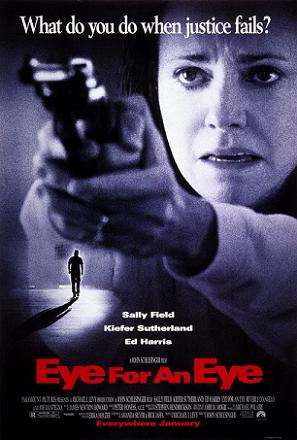
If you were awake at midnight and trying to get some sleep, you could have turned over to ThillerMax and watched the 1996 revenge thriller, Eye For An Eye. However, the film wouldn’t have helped you get to sleep. Eye For An Eye is not a film that you sleep through.
Eye For An Eye opens with Karen McCann (Sally Field) comforting her youngest daughter, Megan (Alexandra Kyle). Megan is terrified of a moth that has flown into her bedroom. “Kill it, mommy, kill it!” Megan shouts. Instead, Karen gently takes the moth in her hand and allows it to escape through an open window. In those first few minutes, the film tells us everything that it feels to be important about Karen. She’s a mother. She lives in a big house in the suburbs. And she wouldn’t kill a moth…
But — the name of the title is Eye For An Eye and that would seem to promise killing so we know that something terrible is going to happen to change Karen’s outlook on life.
And it does! The next afternoon, Karen is stuck in traffic and calls her oldest daughter, 17 year-old Julie (Olivia Burnette). In an extremely harrowing sequence that is pure nightmare fuel, Karen helplessly listens as Julie is raped and murdered.
A white trash deliveryman named Robert Doob is arrested for the crime and we immediately know that he’s guilty. First off, his name is Robert Doob and that’s a serial killer name if I’ve ever heard one. Secondly, he smirks at Karen and her husband (Ed Harris) and, in a particularly cruel moment that was especially upsetting to this former stutterer, he imitates Julie’s stammer. Third, Robert has tattoos and Satanic facial hair. And finally, Robert Doob is played by Keifer Sutherland. And usually, I find Keifer and his growl of a voice to be kinda sexy in a dangerous sorta way but in Eye For An Eye, he was so icky that he just made my skin crawl.
Robert Doob is obviously guilty but an evil liberal judge throws the case out on a technicality. After Karen gets over the shock of seeing justice perverted, she decides to take the law into her own hands. After meeting a professional vigilante (Philip Baker Hall, looking slightly amused no matter how grim he tries to act), Karen decides to learn how to use a gun so that she can get her revenge…
There’s not a single subtle moment in Eye For An Eye but that’s actually the main reason I enjoyed the film. Everything — from the performances to the script to the direction to the music to … well, everything — is completely and totally over-the-top. The symbolism is so heavy-handed and the film is so heavily stacked in favor of vigilante justice that the whole thing becomes oddly fascinating. It may not be a great film but it’s always watchable. It may not be subtle and it may even be borderline irresponsible in its portrayal of the American justice system but who cares? By the end of the movie, I was over whatever real world concerns I may have had about the film’s premise and I was totally cheering Karen on in her quest for vengeance. I imagine I’m not alone in that. Eye For An Eye is the type of film that elitist movie snobs tend to dismiss, even while secretly knowing that it’s actually kinda awesome.
In my previous post, I talked about Ship of Fools, a film that was nominated for best picture of 1965. As I pointed out in that post, when watched today, it’s difficult to imagine Ship of Fools as being worthy of that honor. However, there was another melodrama nominated for best picture in 1965. It not only clearly deserved that nomination but it probably should have won as well. That movie is a personal favorite of mine, the brilliant British film, Darling.
In Darling, the beautiful and glamorous Diana Scott (played, in an Oscar-winning performance, by Julie Christie) tells us her life story, with the events on screen occasionally standing in contrast to the tone of her narration. We learn how Diana went from being a somewhat successful model to being one of the most famous women in the world, a woman whose life is lived and obsessed over in three separate countries.
In England, Diana leaves her first husband for Robert Gold (Dirk Bogarde), a writer who also abandons his family so that he can be with Diana. They live in a dreary apartment and, over the course of one brilliant montage, we watch as Diana becomes increasingly disillusioned by Robert’s secluded lifestyle and Robert grows progressively annoyed with Diana’s hyperactivity. Even being chosen to be the face of a world hunger charity organization fails to relieve Diana’s boredom. (It does, however, give the film a chance to include a sharply satiric scene in which a bunch of rich white people socialize underneath pictures of starving African children.) Diana soon starts to find excuses to leave the apartment and pursue an affair with the hedonistic advertising executive Miles Brand (Laurence Harvey). In one of the film’s best scenes, Schlesinger shows us how long Diana and Miles have spent in a hotel room by focusing his camera not on the two of them but instead on the expiring parking meter outside.
In France, Diana and Miles take part in wild parties that involve lots of cross-dressing, stripping, mind games, and predatory members of the social and media elite. Diana is initially uneasy with this group of friends and it’s obvious that they have little respect for her. However, that starts to change when Diana takes advantage of one of the party games to mock Miles for being unable to truly love anyone but himself. Despite this, Miles still arranges for the disillusioned Diana to be selected as “The Happiness Girl” for the advertising campaign for a chocolate company.
In Italy, Diana’s best friend is Malcolm (Roland Curram) who is both her photographer and, as a gay man, is one of the few people in her life that Diana feels that she can trust. It’s also in Italy that Diana meets a charming nobleman named Prince Cesare (Jose Luis de Vilallonga), who offers Diana a chance to become none other than Princess Diana, on the condition that Diana convert to Catholicism and that she help raise his nine children, the oldest of whom is the same age as Diana.
To be honest, it’s difficult for me to provide a rational or balanced review of Darling because I simply love this film so much! I love it for the glamour, I love it for the melodrama, and I especially love it for its sharply satiric (and still very relevant) look at what it means to be famous for merely living. I suppose that it would only be natural to compare Darling to the world’s current obsession with the Khardashians but that’s not really fair to Darling. The Khardashians may be the natural end result of a world that obsesses over Diana Scott but, as played by Julie Christie, Diana Scott is everything — intelligent, witty, interesting, and, if not quite sympathetic, at least compelling — that a Khardashian could never hope to be.
In 1965, the Sound of Music won the award for best picture of the year but Darling is truly the movie that still has something to say about the way that we’re living today.








 Michael Keaton is the tenant from Hell in Pacific Heights.



 Through the Shattered Lens