Film Review: The Last Flight of Noah’s Ark (dir by Charles Jarrott)


I recorded the 1980 film, The Last Flight of Noah’s Ark, off of TCM because I looked at the title and the fact that it starred Elliott Gould and I figured that it would be a film about an expedition to recover the actual Noah’s Ark.  I figured that it would feature scenes of Elliott Gould and Christopher Plummer (who I just assumed would be in the movie) climbing Mount Ararat and having comical disagreements about all of the snow.  I also assumed that the movie would end with the real Noah’s Ark sliding down the mountain while Gould and Plummer tried to steer it.

Seriously, it sounded like fun!

Of course, it turned out that I was wrong.

http://www.youtube.com/watch?v=YwA4JZAcmlE

It turns out that The Last Flight of Noah’s Ark is about an out-of-work pilot named Noah Dugan (Elliott Gould) who has a gambling problem and owes a lot of money to the mob.  Normally, you’d be worried that this means Dungan has a contract out on his life but instead, it just means that a bald guy named Benchley (Dana Elcar) keeps popping up and saying that Dugan’s got a week to come up with the money.

Since this film was made before our current socialist moment, Dugan is forced to get a job.  Unfortunately, the only one that he can get involves flying a missionary (Genevieve Bujold) and a bunch of animals to a South Pacific island.  Dugan agrees but, because the plane is an old World War II bomber, he ends up having to make an emergency landing on a remote and uncharted desert isle.

Of course, it quickly turns out that Dugan, the missionary, and the animals aren’t alone!  First off, it turns out that two orphans (played by Ricky Schroder and Tammy Lauren) stowed away on the airplane.  And then, we discover that there are two Japanese soldiers stranded on the island as well!  They’ve been there since World War II!  Fortunately, one of them is named Cleveland (John Fukioka) and can speak English.

(As for Christopher Plummer, he’s nowhere to be seen because he’s not in the movie.)

Anyway, can you guess what happens?  If you think that Noah and the gang turn the plane into a big boat, you’re on the right track.  If you think that cynical Noah turns out to actually have a soft spot when it comes to children, you’re right.  If you think that Noah and the missionary embark on the most chaste romance in movie history …. oh my God, have you seen this movie before!?

Here’s the thing with The Last Flight of Noah’s Ark — the animals are cute.  I mean, the animals really are adorable.  There’s this one duck who has more screen presence than every human in this movie.  And normally, I’d say that cute animals can save just about any movie but this might be the exception to the rule.

I mean, I get it.  This was a movie for kids and that’s great.  But my God, this is a slow movie.  We start with Dugan getting threatened by the gamblers and then it’s another 25 minutes before Dugan even starts the engine on that plane.  I get that this is a family film but I imagine that even families in 1980 would have been bored to death by it.  Elliott Gould certainly seems to be bored, as he gives a performance that all but screams, “Where’s my paycheck!?”

What would have improved The Last Flight of Noah’s Ark?

Christopher Plummer, dammit.

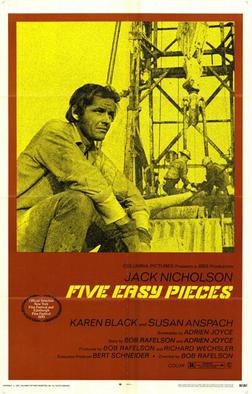
Lisa Reviews An Oscar Nominee: Five Easy Pieces (dir by Bob Rafelson)


First released in 1970, Five Easy Pieces tells the story of a lost man named Bobby Dupea (Jack Nicholson).

When we first meet Bobby, he’s working at a California oil field.  He likes to go bowling.  He has a girlfriend named Rayette (Karen Black), who is a country music-obsessed waitress.  His best friend is Elton (Billy “Green” Bush), a friendly redneck with a memorable laugh.  Bobby may have a girlfriend and Elton may be married but that doesn’t stop either one of them from going out at night, getting drunk, and trying to pick up women.

Bobby seems to be just another blue-collar guy with a grudge against the bosses but it doesn’t take long to realize that there’s something different about him.  Bobby may be friends with Elton but it’s obvious that the two of them come from very different background.  No matter how much he tries to hide it, Bobby is smarter than everyone else around him.  When he and Elton get stuck in a traffic jam, Bobby spots a piano sitting on the back of a pickup truck.  Getting out of his car, Bobby yells at everyone who is honking and then climbs up to the piano.  He sits down, he puts his fingers to the keys and he starts to play.  Knowing Bobby, you’re expecting him to just bang the keys and make noise.  Instead, he plays beautiful music.

Later, Bobby steps into a recording studio.  Paritia (Lois Smith), a neurotic woman, is playing the piano.  The recording engineers joke about her lack of talent.  Bobby glares at them, annoyed.  It quickly becomes apparent why Bobby is so protective.  Paritia is Bobby’s sister.

Bobby, it turns out, comes from a wealthy family of musicians.  Everyone in the family has dealt with the pressure to succeed differently.  Paritia continues to play, despite not having much talent.  Bobby’s older brother, the buffoonish Carl (Ralph Waite), plays violin and has staid home with their father (William Challee).  Bobby, on the other hand, ran away from home.  He’s spent his entire life trying to escape from both his talent and his family.  However, when Paritia explains that their father has suffered from two strokes and might not live much longer, Bobby reluctantly decides to return home and try to make some sort of peace with his father.

It’s not as easy a journey as Bobby would have liked.  For one thing, Rayette demands to go with him.  On the drive up to Washington, they pick up two hitchhikers (Helena Kallionetes and Toni Basil), one of whom is obsessed with filth.  In the film’s most famous scene, an attempt to get a simple lunch order modified leads to Bobby losing control.

See, that’s the thing with Bobby.  In many ways, he’s a jerk.  He treats Rayette terribly.  While his family is hardly perfect, the film doesn’t hide from the fact that Bobby isn’t always the easiest person to deal with.  And yet, you can’t help but sympathize with Bobby.  If he seems permanently annoyed with the world … well, that’s because the world’s annoying.  And, to Bobby’s credit, he’s a bit more self-aware than the typical rebel without a cause.  When one of the hitchhikers praises his temper tantrum at the diner, Bobby points out that, after all of that, he still didn’t get the order that he wanted.

In Washington, Bobby tells Rayette to stay at a motel and then goes to see his family.  Bobby seems as out-of-place among his wealthy family as he did hanging out in the oil fields with Elton.  He ends up cheating on Rayette with Carl’s fiancee, a pianist named Catherine van Oost (Susan Anspach).

And then Rayette shows up for dinner…

Five Easy Pieces is a sometimes funny and often poignant character study of a man who seems to be destined to always feel lost in the world.  Bobby spends the whole movie trying to find a place where he can find happiness and every time, reality interferes with his plans.  Nicholson gives a brilliant performance, playing Bobby as a talented guy who doesn’t really like himself that much.  Bobby’s search for happiness leads to a rather haunting ending, one that suggests that some people are just meant to spend their entire life wandering.

Five Easy Pieces was nominated for Best Picture but lost to Patton.

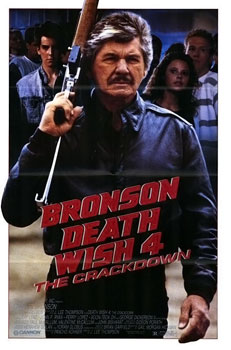
Bronson’s Rich: Death Wish 4: The Crackdown (1987, directed by J. Lee Thompson)


To quote The Main With No Name, “When a man’s got money in his pocket, he begins to appreciate peace.”
Two years have passed since Paul Kersey (Charles Bronson) last visited and cleaned up New York.  He is back in Los Angeles, the president of his own successful architectural firm.  Now a rich man, he has retired from killing criminals, though he still has dreams where he shoots muggers in parking garages.  Paul has a new girlfriend, journalist Karen Sheldon (Kay Lenz).  When Karen’s teenage daughter, Erica (Dana Barron), dies of a cocaine overdose, it’s time for Paul to get his gun out of storage and blow away a drug dealer.

Shortly after shooting that drug dealer, Paul finds a note on his front porch.  “I know who you are,” it reads.  Paul then gets a call from a mysterious man (John P. Ryan) who identifies himself as being a reclusive millionaire named Nathan White.  Nathan explains that his daughter also died of a cocaine overdose.  He wants to hire Paul to take out not just the drug dealers but also the men behind the dealers, the bosses.  Using his vast resources, Nathan has prepared a file on every major drug operation in Los Angeles.  He offers to share the information with Paul.

“I’ll need a few days to think about it,” Paul says but we all know he’s going to accept Nathan’s offer just as surely as we know that Nathan White has an ulterior motive that won’t be revealed until the movie’s final twenty minutes.

For the first time, Paul is no longer just targeting muggers and other street criminals.  This time, Paul is going after the guys in charge and trying to bring an end to drug trade once and for all.  (The idea that the best way to win the war on drugs was just to kill anyone involved in the drug trade was a very popular one in the late 80s.)  L.A.’s two major drug cartels are led by Ed Zacharias (Perry Lopez) and the Romero Brothers (Mike Moroff and Dan Ferro).  Along with their own activities, Paul and Young work the turn the two cartels against each other.

It’s not just the criminals that have changed in Death Wish 4.  Paul has changed, too.  Paul used to just shoot criminals and run away.  In Death Wish 4, he gets more creative.  He sneaks into Zacharias’s mansion and bugs the phone so that he can keep track of what’s going down.  When it comes time to kill a table full of drug dealers (one of whom is played by Danny Trejo), Paul doesn’t shoot them up.  Instead, he sends them a bottle of champagne that explodes when they open it.  By the end of the movie, Paul is blowing away the bad guys with a grenade launcher!  How many former conscientious objectors can brag about that?

The biggest difference between Death Wish 4 and the films that came before it is the absence of director Michael Winner.  Winner and Bronson had a falling out following Death Wish 3 and, as a result, Winner had little interest in returning to the franchise.  Instead, Winner was replaced by J. Lee Thompson, who had already directed Bronson in several other Cannon films.  As a result, Death Wish 4 is less “heavy” than the previous Death Wish films.  Whereas Winner’s direction often felt mean-spirited and exploitive, Thompson plays up the film’s sense of airy adventure.

Though it barely made a profit at the box office and has been dismissed by critics, Death Wish 4 is an enjoyable chapter in Paul’s story.  If you’re looking for mindless 80s mayhem, Death Wish 4 gets the job done with admirable efficiency.  It would have made a great ending for the franchise but Bronson would return to the role one last time.

Tomorrow: Death Wish V: The Face of Death!

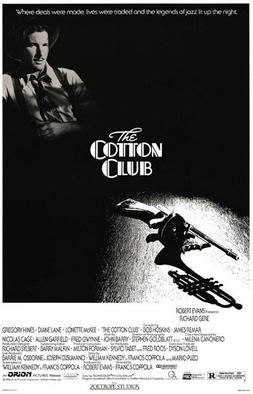
A Movie A Day #264: The Cotton Club (1984, directed by Francis Ford Coppola)


The time is the 1930s and the place is New York City.  Everyone wants to get into the Cotton Club.  Owned by British gangster Owney Madden (Bob Hoskins), the Cotton Club is a place where the stage is exclusively reserved for black performers and the audience is exclusively rich and white.  Everyone from gangsters to film stars comes to the Cotton Club.

It is at the Cotton Club that Dixie Dwyer (Richard Gere) meets everyone from Dutch Shultz (James Remar) to Gloria Swanson (Diane Venora).  Shultz hires Dixie to look after his girlfriend, Vera (Diane Lane).  Swanson arranges for Dixie to become a movie star.  Meanwhile, Dixie’s crazy brother, Vincent (Nicolas Cage), rises up through the New York underworld.  Meanwhile, dancing brothers Sandman and Clay Williams (played by real-life brothers Gregory and Maurice Hines) are stars on stage but face discrimination off, at least until Harlem gangster Bumpy Rhodes (Laurence Fishburne) comes to their aid.

The Cotton Club was a dream project of the legendary producer, Robert Evans, who was looking to make a comeback after being famously charged with cocaine trafficking in 1980.  Having commissioned a screenplay by his former Godfather collaborators, Mario Puzo and Francis Ford Coppola, Evans originally planned to direct the film himself.  At the last minute, Evans changes his mind and asked Coppola to direct the film.  After working with him on The Godfather, Coppola had sworn that he would never work with Evans again. (When he won an Oscar for The Godfather‘s screenplay, Coppola pointedly thanked everyone but Robert Evans.)  However, by 1984, a series of box office flops had damaged Coppola’s standing in Hollywood.  Needing the money, Coppola agreed to direct The Cotton Club.

Evans raised the film’s $58 million budget from a number of investors, including Roy Radin.  Roy Radin was best known for putting together Vaudeville reunions in the 70s and being accused of raping an actress in 1980.  Radin and Evans were introduced to each other by a drug dealer named Lanie Jacobs, who was hoping to remake herself as a film producer.  During the production of The Cotton Club, Radin was murdered by a contract killer who was hired by Jacobs, who apparently felt that Radin was trying to muscle her out of the film production.

While all of this was going on, Coppola fell into his familiar pattern of going overbudget and falling behind schedule.  This led to another investor filing a lawsuit against Orion Pictures and two other investors, claiming fraud and breach of contract.  When the film was finally released, it received mixed reviews, struggled at the box office, and only received two Oscar nominations.

With all of the murder and drama that was occurring offscreen, it is not surprising that the film itself was overshadowed.  The Cotton Club is a disjointed mix of gangster drama and big production numbers.  As always with post-Apocalypse Now Coppola, there are flashes of brilliance in The Cotton Club.  Some of the production numbers are impressive and visually, this movie has got style to burn.   However, among the leads, neither Richard Gere nor Diane Lane seem to be invested in their characters while the talented Hines brothers are underused.  The supporting cast is full of good character actors who are all in a search of a better script.  A few do manage to make an impression: James Remar, Bob Hoskins and Fred Gwynne as veteran gangsters, Nicolas Cage as the film’s stand-in for Mad Dog Coll, and Joe Dallesandro as Lucky Luciano.  The Cotton Club is sometimes boring and sometimes exciting but the onscreen story is never as interesting as what happened behind the scenes.


A Movie A Day #245: The Missouri Breaks (1976, directed by Arthur Penn)


After Tom Logan (Jack Nicholson) and his gang of rustlers (played by Randy Quaid, Frederic Forrest, and Harry Dean Stanton) rob a train, Logan uses the money to buy a small ranch.  Their new neighbor is Braxton (John McLiam), a haughty land baron who considers himself to be an ambassador of culture to the west but who is not above hanging rustlers and hiring gunmen.  One such gunman is the eccentric Robert E. Lee Clayton (Marlon Brando), a “regulator” who speaks in a possibly fake Irish brogue, is a master of disguise, and uses a variety of hand-made weapons.  Braxton hires Clayton to kill Logan and his men, despite the fact that his daughter (Kathleen Lloyd) has fallen in love with Logan.
A flop that was so notorious that it would be five years before Arthur Penn got a chance to direct another film, The Missouri Breaks is best remembered for Marlon Brando’s bizarre performance.  Brando reportedly showed up on the set late and insisted on largely improvising his part, which meant speaking in a comical Irish accent, singing an impromptu love song to his horse, and disguising himself as an old woman for one key scene.  (According to Patrick McGilligan’s Jack’s Life: A Biography of Jack Nicholson, co-star Harry Dean Stanton grew so incensed at Brando’s behavior that he actually tried to rip the dress off of Brando, saying that he simply would not be “killed’ by a man wearing a dress.)  Brando’s later reputation for being a disastrously weird performer largely started with the stories of his behavior on the set of The Missouri Breaks.

I had heard so many bad things about Brando and The Missouri Breaks that I was surprised when I finally watched it and discovered that it is actually a pretty good movie.  For all of his notoriety, Brando does not enter this leisurely paced and elegiac western until after half a hour.  The majority of the movie is just about Jack Nicholson and his gang, with Nicholson giving a low-key and surprisingly humorous performance that contrasts well with Brando’s more flamboyant work.  While Arthur Penn may not have been able to control Brando, he still deftly combines moments of comedy with moments of drama and he gets good performances from most of the supporting cast.  Quaid, Stanton, Forrest, and Nicholson are all just fun to watch and the rambling storyline provides plenty of time to get to know them.  Whenever Brando pushes the movie too close to self-parody, Nicholson pulls it back.   The Missouri Breaks may have been a flop when it was released but it has aged well.

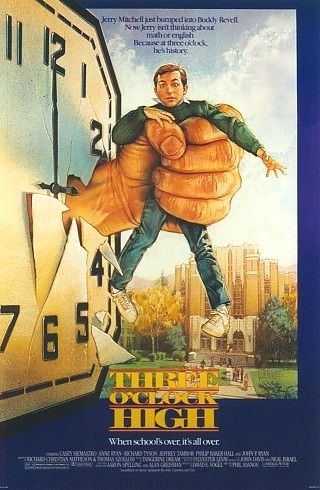
Back to School Part II #22: Three O’Clock High (dir by Phil Joanou)


Three_o_clock_high_p

For the next entry in my back to school series of reviews, I want to say a few words about the 1987 comedy, Three O’Clock High.

I have no idea how Three O’Clock High did when it was originally released into theaters.  I know, I know — I could just look it up on Wikipedia or the imdb but I’m lazy and, besides, I hate that whole idea that box office success is somehow synonymous with quality.  That said, Three O’Clock High is one of those films that seems to be in a permanent cable rotation (seriously, it always seems to be playing somewhere and there’s always a few people on twitter talking about how excited they are about coming across it) and I kind of hope that it did well when it was originally released.  It’s an entertaining and genuinely funny little high school comedy.

Three O’Clock High tells the story of Jerry (Casey Siemaszko).  Jerry is a high school student, one of those kids who is a bit anonymous.  He’s kind of a nerd but so much of a nerd that he painfully sticks out of the crowd at this school.

You know who does stick out of the crowd?  Buddy Revell (Richard Tyson).  Buddy is the new kid at school.  He’s a big, hulking, and rather intimidating figure and he comes with quite a fearsome repuations.  All anyone can talk about are the stories that they’ve heard about Buddy’s dangerous past.  The one thing that the rumors all have in common is that Buddy does not like to be touched.  In fact, it appears that his aversion to being touched has made him the most dangerous high school student in the country.

The first hour of Jerry’s school day is spent working at the school newspaper and, of course, his teacher has a bright idea.  Why not welcome Buddy to the school by interviewing him!?  Sure, why not!?  Everyone loves to be interviewed!  And why not get Jerry to do the interview?

The problem is that Buddy doesn’t want to be interviewed.  And, once he realizes that Buddy not only doesn’t want to talk to him but is actually getting rather annoyed with him (this may be because Jerry chooses to approach Buddy in the boy’s bathroom), Jerry asks Buddy to forget that he even bothered him and then reaches over and punches him on the arm.

Of course, this leads to Buddy announcing that he and Jerry are going to have a fight.  At 3 pm.  In the school parking lot…

The rest of the film plays out like a surrealistic, teen-centered parody of High Noon, with Jerry desperately trying to figure out a way to avoid the fight.  He tries to frame Buddy by placing a switchblade in his locker, just to have Buddy use the knife to disable his car, effectively trapping Jerry at the school.  He tries to help Buddy cheat on a test.  He tries to get the principal to kick him out of school.  He even tries bribery!

But ultimately, three o’clock arrives and Jerry must face his destiny…

Three O’Clock High is cheerfully cartoonish and rather entertaining little film.  Director Phil Joanou pays homage to a countless number of other films, often framing the high school action like a Spaghetti western stand-off and, when the final fight arrives, it’s just as wonderfully over-the-top and silly as you could hope for.  Casey Siemaszko, who was also in Secret Admirer, is perfectly cast as Jerry and Richard Tyson is both funny and intimidating as Buddy.  Meanwhile, ineffectual adults are played by everyone from Philip Baker Hall to Jeffrey Tambor to Mitch Pileggi.  There’s a not a subtle moment to be found in Three O’Clock High but the relentless stylization definitely works to the film’s advantage.

I’d keep an eye out for the next time that Three O’Clock High shows up on Showtime.  It’s an entertaining film about teens doing what teens have to do.