The Eric Roberts Collection: Best of the Best (dir by Bob Radler)


“No!” James Earl Jones says towards the end of 1989’s The Best of the Best, his already deep voice made even more imposing by the use of slow motion.

“No, Tommy, no!” Eric Roberts joins in as he watches martial artist Tommy Lee (Phillip Rhee) internally struggle with whether or not to strike a blow that will definitely kill his opponent and, if James Earl Jones is all gravitas and stern wisdom, Eric Roberts is all emotion and desperation.

The Best of the Best is a bit of an oddity, in that the script features just about every martial arts tournament cliche imaginable (right down to the other “bad” team having a history of killing people in the ring) but those cliches are all acted out by a surprisingly distinguished cast.  I counted four Oscar nominees (and one winner) in the cast.  James Earl Jones (nominated for The Great White Hope) plays Coach Couzo, who gets a team of Americans prepared to fight in an international tournament.  Sally Kirkland (nominated for Anna) plays their trainer, who worries not just about the team’s physical health but also their mental burdens.  Eric Roberts (nominated for Runaway Train) is Alex Grady, the former martial arts champion-turned-auto worker who makes the team despite having a bad shoulder.  Louise Fletcher (who won for One Flew Over The Cuckoo’s Nest) plays Alex’s mother, who looks after his son while Alex is off getting ready to face the Korean team.  And then there’s Chris Penn  (who seems like, if not for his early death, he would have eventually been nominated for something) as the arrogant Travis, a cowboy who can throw a punch.

(The American team is filled out by John Dye as Virgil, an intellectual Buddhist, David Agresta as Sonny “I’m Italian” Grasso, and Phillip Rhee, who not only plays Tommy but also wrote the film’s script.)

Roberts gets top-billing in this and he does get a lot of important moments, including a scene where he breaks the Coach’s rules so that he can visit his son in the hospital.  That said, the story centers around Phillip Rhee’s Tommy.  Tommy’s older brother was killed in the ring by the one-eyed Dae Han Park (Simon Rhee) and — wow, what a coincidence! — that just happens to be who Tommy needs to beat for the Americans to win the big tournament.  Both of the Rhee brothers actually are martial artists and they are very convincing in the fight scenes, which is good because neither Phillip nor Simon Rhee were particularly strong actors.  Eric Roberts is not a particularly convincing martial artist but it doesn’t matter because he acts the Heck out of every scene in which he appears.  What happens when you bring method intensity to the type of martial arts film that Jean-Claude Van Damme would later make his specialty?  You get scenes of a heavily-bruised Eric Roberts crying but, because Roberts is a good actor, the tears feel earned.  Still, whenever I saw Alex’s eyes starting to glisten, I imagined James Earl Jones saying, “Noooooooo!”  How can you win the world’s greatest tournament when you’re constantly on the verge of tears?  Well, maybe you don’t need to win.  Maybe you just need to show that you have more honor than anyone else there.

Best of the Best is a classic of its kind.  There’s nothing surprising about it but it’s entertaining in its own dumb way and, in the end, it reminds us that America doesn’t need medals to be the best.  It just needs Eric Roberts.

Previous Eric Roberts Films That We Have Reviewed:

  1. Star 80 (1983)
  2. Runaway Train (1985)
  3. Blood Red (1989)
  4. The Ambulance (1990)
  5. The Lost Capone (1990)
  6. Love, Cheat, & Steal (1993)
  7. Voyage (1993)
  8. Love Is A Gun (1994)
  9. Sensation (1994)
  10. Dark Angel (1996)
  11. Doctor Who (1996)
  12. Most Wanted (1997)
  13. Mercy Streets (2000)
  14. Raptor (2001)
  15. Rough Air: Danger on Flight 534 (2001)
  16. Wolves of Wall Street (2002)
  17. Border Blues (2004)
  18. Mr. Brightside (2004)
  19. Six: The Mark Unleased (2004)
  20. We Belong Together (2005)
  21. Hey You (2006)
  22. Depth Charge (2008)
  23. Amazing Racer (2009)
  24. In The Blink of an Eye (2009)
  25. Bed & Breakfast (2010)
  26. Enemies Among Us (2010)
  27. The Expendables (2010) 
  28. Sharktopus (2010)
  29. Beyond The Trophy (2012)
  30. The Dead Want Women (2012)
  31. Deadline (2012)
  32. The Mark (2012)
  33. Miss Atomic Bomb (2012)
  34. Assault on Wall Street (2013)
  35. Bonnie And Clyde: Justified (2013)
  36. Lovelace (2013)
  37. The Mark: Redemption (2013)
  38. The Perfect Summer (2013)
  39. Self-Storage (2013)
  40. A Talking Cat!?! (2013)
  41. This Is Our Time (2013)
  42. Inherent Vice (2014)
  43. Road to the Open (2014)
  44. Rumors of War (2014)
  45. Amityville Death House (2015)
  46. Deadly Sanctuary (2015)
  47. A Fatal Obsession (2015)
  48. Las Vegas Story (2015)
  49. Stalked By My Doctor (2015)
  50. Enemy Within (2016)
  51. Joker’s Poltergeist (2016)
  52. Prayer Never Fails (2016)
  53. Stalked By My Doctor: The Return (2016)
  54. The Wrong Roommate (2016)
  55. Dark Image (2017)
  56. Black Wake (2018)
  57. Frank and Ava (2018)
  58. Stalked By My Doctor: Patient’s Revenge (2018)
  59. Clinton Island (2019)
  60. Monster Island (2019)
  61. The Reliant (2019)
  62. The Savant (2019)
  63. Seven Deadly Sins (2019)
  64. Stalked By My Doctor: A Sleepwalker’s Nightmare (2019)
  65. The Wrong Mommy (2019)
  66. Exodus of a Prodigal Son (2020)
  67. Free Lunch Express (2020)
  68. Her Deadly Groom (2020)
  69. Top Gunner (2020)
  70. Deadly Nightshade (2021)
  71. The Elevator (2021)
  72. Just What The Doctor Ordered (2021)
  73. Killer Advice (2021)
  74. Night Night (2021)
  75. The Poltergeist Diaries (2021)
  76. The Rebels of PT-218 (2021)
  77. A Town Called Parable (2021)
  78. Bleach (2022)
  79. My Dinner With Eric (2022)
  80. 69 Parts (2022)
  81. D.C. Down (2023)
  82. Aftermath (2024)
  83. Bad Substitute (2024)
  84. Devil’s Knight (2024)
  85. The Wrong Life Coach (2024)
  86. When It Rains In L.A. (2025

The Eric Roberts Collection: Runaway Train (dir by Andrei Konchalovsky)


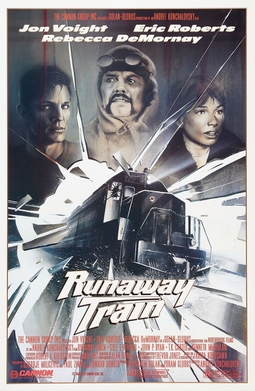
In 1985’s Runaway Train, Eric Roberts plays Buck McGeehy, a prisoner at Stonehaven Maximum Security Prison in Alaska.

Like the majority of the prisoners, Buck looks up to Manny (Jon Voight), a bank robber who has just been released from spending three years in solitary confinement.  Manny is a tough guy who refuses to allow the prison system to beat him down.  Warden Ranken (John P. Ryan) views Manny as being a threat to his authority and he’s especially angry that it was the courts that ordered that Manny finally be released from solitary.  When Ranken tries to arrange for Manny to be assassinated at a prison boxing match, it’s Buck who saves Manny’s life.  When Manny later manages to escape from the prison, Buck tags along.

Manny and Buck are a study in contrasts.  Manny is as cold as the Alaskan landscape.  He’s ruthless and doesn’t allow himself to get too close to anyone but, at the same time, he does live by a definite code.  Buck is simple-minded, an earnest guy who talks too much and who probably wouldn’t have survived a day in prison if it wasn’t for his skill as a boxer.  Buck and Manny manage to make their way across the frozen wilderness but, when they hop on a train, they soon find themselves trapped on the out-of-control locomotive, along with a railroad engineer named Sara (Rebecca De Mornay).  The three of them have to find a way to either escape from or stop the train.  At the same time, the obsessed Warden Ranken is determined to recapture Manny and, if that means flying a helicopter over the train so that Ranken can lower himself onto it, so be it.

Runway Train, which was based on a script by Akira Kurosawa, was one of the few Cannon films to find success with not just critics but also audiences and the industry.  The Golden Globes nominated it for Best Film.  The Academy didn’t go quite that far but they did nominate the film for Best Editing, along with also nominating Jon Voight for Best Actor and Eric Roberts for Best Supporting Actor.  While Voight is a multiple-Oscar nominee (and one-time winner for Coming Home), Runaway Train is, so far, the only film for which Eric Roberts has been nominated.  (He should have been nominated for Star 80 but his character in that film was a bit too realistically sleazy for the Academy to honor.)  Roberts has described Runaway Train as being one of his favorite films and he even used the title for his autobiography.  It was on this film that he met Danny Trejo, who not only trained Roberts for the boxing scenes but also helped Roberts kick his addiction to cocaine.

And Roberts has every reason to be proud.  Runaway Train is a fast-moving, visually stunning thrill ride, a masterpiece of the pulp imagination.  Yes, the symbolism of the runaway train is a bit obvious.  Yes, the philosophical edge of the film’s dialogue can sometimes feel a bit out-of-place.  Who cares?  John Voight and Eric Roberts sell their characters with such skill that you don’t care that they’re both criminals who have done terrible things.  From the minute we see that frozen jail and the prisoners tossing burning pieces of paper at the guards, we know why both Manny and Buck have to escape.  John P. Ryan turns the warden into everyone’s worst nightmare of a small, pretty man with power, an authoritarian who uses the system to control the lives of others and who resents anyone who does not bow down before him.  Even though her role is largely limited to reacting to what everyone else does around her, Rebecca de Mornay still turns Sara into a compelling character and never allows her to become merely a damsel in distress.  Runaway Train is a heart-pounding action film and one that still holds up today.

Previous Eric Roberts Films That We Have Reviewed:

  1. Star 80 (1983)
  2. Blood Red (1989)
  3. The Ambulance (1990)
  4. The Lost Capone (1990)
  5. Love, Cheat, & Steal (1993)
  6. Voyage (1993)
  7. Love Is A Gun (1994)
  8. Sensation (1994)
  9. Dark Angel (1996)
  10. Doctor Who (1996)
  11. Most Wanted (1997)
  12. Mercy Streets (2000)
  13. Wolves of Wall Street (2002)
  14. Mr. Brightside (2004)
  15. Six: The Mark Unleased (2004)
  16. Hey You (2006)
  17. Amazing Race (2009)
  18. In The Blink of an Eye (2009)
  19. Enemies Among Us (2010)
  20. The Expendables (2010) 
  21. Sharktopus (2010)
  22. The Dead Want Women (2012)
  23. Deadline (2012)
  24. The Mark (2012)
  25. Miss Atomic Bomb (2012)
  26. Bonnie And Clyde: Justified (2013)
  27. Lovelace (2013)
  28. The Mark: Redemption (2013)
  29. Self-Storage (2013)
  30. A Talking Cat!?! (2013)
  31. This Is Our Time (2013)
  32. Inherent Vice (2014)
  33. Road to the Open (2014)
  34. Rumors of War (2014)
  35. Amityville Death House (2015)
  36. A Fatal Obsession (2015)
  37. Stalked By My Doctor (2015)
  38. Enemy Within (2016)
  39. Joker’s Poltergeist (2016)
  40. Prayer Never Fails (2016)
  41. Stalked By My Doctor: The Return (2016)
  42. The Wrong Roommate (2016)
  43. Dark Image (2017)
  44. Black Wake (2018)
  45. Frank and Ava (2018)
  46. Stalked By My Doctor: Patient’s Revenge (2018)
  47. Clinton Island (2019)
  48. Monster Island (2019)
  49. The Savant (2019)
  50. Seven Deadly Sins (2019)
  51. Stalked By My Doctor: A Sleepwalker’s Nightmare (2019)
  52. The Wrong Mommy (2019)
  53. Exodus of a Prodigal Son (2020)
  54. Free Lunch Express (2020)
  55. Her Deadly Groom (2020)
  56. Top Gunner (2020)
  57. Deadly Nightshade (2021)
  58. The Elevator (2021)
  59. Just What The Doctor Ordered (2021)
  60. Killer Advice (2021)
  61. The Poltergeist Diaries (2021)
  62. The Rebels of PT-218 (2021)
  63. A Town Called Parable (2021)
  64. Bleach (2022)
  65. My Dinner With Eric (2022)
  66. Aftermath (2024)
  67. The Wrong Life Coach (2024)

Lisa Marie Reviews An Oscar Nominee: The Right Stuff (dir by Philip Kaufman)


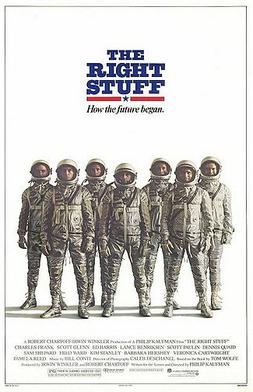
There’s a brilliant scene that occurs towards the end of 1983’s The Right Stuff.

It takes place in 1963.  The original Mercury astronauts, who have become a symbol of American ingenuity and optimism, are being cheered at a rally in Houston.  Vice President Lyndon Johnson (Donald Moffat) stands on a stage and brags about having brought the astronauts to his supporters.  One-by-one, the astronauts and their wives wave to the cheering crowd.  They’re all there: John Glenn (Ed Harris), Gus Grissom (Fred Ward), Alan Shephard (Scott Glenn), Wally Schirra (Lance Henrisken), Deke Slayton (Scott Paulin), Scott Carpenter (Charles Frank), and the always-smiling Gordon Cooper (Dennis Quaid).  The astronauts all look good and they know how to play to the crowd.  They were chosen to be and sold as heroes and all of them have delivered.

While the astronauts are celebrated, Chuck Yeager (Sam Shepard) is at Edwards Air Force Base.  Yeager is the pilot who broke the sound barrier and proved that the mythical “demon in the sky,” which was whispered about by pilots as a warning about taking unnecessary risks, was not waiting to destroy every pilot who tried to go too fast or too high.  Yeager is considered by many, including Gordon Cooper, to be the best pilot in America.  But, because Yeager didn’t have the right image and he had an independent streak, he was not ever considered to become a part of America’s young space program.  Yeager, who usually holds his emotions in check, gets in a jet and flies it straight up into the sky, taking the jet to the edge of space.  For a few briefs seconds, the blue sky becomes transparent and we can see the stars and the darkness behind the Earth’s atmosphere.  At that very moment, Yeager is at the barrier between reality and imagination, the past and the future, the planet and the universe.  And watching the film, the viewer is tempted to think that Yeager might actually make it into space finally.  It doesn’t happen, of course.  Yeager pushes the jet too far.  He manages to eject before his plane crashes.  He walks away from the cash with the stubborn strut of a western hero.  His expression remains stoic but we know he’s proven something to himself.  At that moment, the Mercury Astronauts might be the face of America but Yeager is the soul.  Both the astronauts and Yeager play an important role in taking America into space.  While the astronauts have learned how to take care of each other, even the face of government bureaucracy and a media that, initially, was eager to mock them and the idea of a man ever escaping the Earth’s atmosphere,  Chuck Yeager reminds us that America’s greatest strength has always been its independence.

Philip Kaufman’s film about the early days of the space program is full of moments like that.  The Right Stuff is a big film.  It’s a long film.  It’s a chaotic film, one that frequently switches tone from being a modern western to a media satire to reverent recreation of history.  Moments of high drama are mixed with often broad humor.  Much like Tom Wolfe’s book, on which Kaufman’s film is based, the sprawling story is often critical of the government and the press but it celebrates the people who set speed records and who first went into space.  The film opens with Yeager, proving that a man can break the sound barrier.  It goes on to the early days of NASA, ending with the final member of the Mercury Seven going into space.  In between, the film offers a portrait of America on the verge of the space age.  We watch as John Glenn goes from being a clean-cut and eager to please to standing up to both the press and LBJ.  Even later, Glenn sees fireflies in space while an aborigines in Australia performs a ceremony for his safety.  We watch as Gus Grissom barely survives a serious accident and is only rescued from drowning after this capsule has been secured.  The astronauts go from being ridiculed to celebrated and eventually respected, even by Chuck Yeager.

It’s a big film with a huge cast.  Along with Sam Shepherd and the actors who play the Mercury Seven, Barbara Hershey, Pamela Reed, Jeff Goldblum, Harry Shearer, Royal Dano, Kim Stanley, Scott Wilson, and William Russ show up in roles both small and large.  It can sometimes be a bit of an overwhelming film but it’s one that leaves you feeling proud of the pioneering pilots and the brave astronauts and it leaves you thinking about the wonder of the universe that surrounds our Earth.  It’s a strong tribute to the American spirit, the so-called right stuff of the title.

The Right Stuff was nominated for Best Picture but, in the end, it lost to a far more lowkey film, 1983’s Terms of Endearment.  Sam Shepard was nominated for Best Supporting Actor but lost to Jack Nicholson.  Nicolson played an astronaut.

DEATH WISH 4: THE CRACKDOWN – a missed opportunity in my life!


I’m on Day 4 of my discussion of Charles Bronson’s DEATH WISH series in chronological order. This series has brought me countless hours of entertainment over the last 40 years, so enjoy and let me know your thoughts!

DEATH WISH 4: THE CRACKDOWN was a bit of a missed opportunity in my early years of Bronson fandom. Let me explain. In the mid-80’s I became Charles Bronson’s biggest fan, an honor I possibly share with a few others. As a part of that fandom, a 14-year-old Brad would scour every available source for information about my hero, which at that time was mainly the entertainment section of the Arkansas Democrat, my grandma’s tabloids, and, when I could get a ride, the magazine rack at the Hastings Entertainment Superstore. This in-depth search for information eventually lead to me discovering that DEATH WISH 4: THE CRACKDOWN would be playing at the movie theater in Conway, AR in November of 1987. I was so excited that I might actually get to see Charles Bronson on the big screen for the first time ever. Unfortunately, there were several factors working against me. First, it was rated R, so I was completely dependent on an adult taking me. Second, it was released in November which was in the heart of basketball season, and the only thing that was above Bronson in my life was the basketball court, especially since my dad was my coach. And third, my parents would only consider taking me to the movies on “dollar night,” which was Tuesday and almost always conflicted with my basketball game schedule. I remember driving by the theater and seeing DEATH WISH 4: THE CRACKDOWN listed on the marquee and longing to go see it.  Alas, the stars, and the factors above, all aligned against me, and I would not be able to watch the film during its 2-week run in Conway, Arkansas. At this point in his career, Cannon would give Bronson’s films a short theatrical release and then release them to the home video market where Bronson was still a true moneymaking superstar.  DEATH WISH 4 earned the equivalent in today’s dollars of around $20,000,000 at the box office before going on to sale over 100,000 VHS cassettes to rental stores. It was Bronson’s most successful rental release of the franchise.  

DEATH WISH 4: THE CRACKDOWN opens with Paul Kersey (Charles Bronson) having nightmares about the man he has become after a decade of meting out vigilante justice. He has moved back to Los Angeles where he keeps himself busy with his work as an architect, as well as his relationship with his new lady friend, Karen (Kay Lenz). When Karen’s daughter Erica dies of a drug overdose, Kersey immediately finds the drug dealer who sold her the stuff and shoots him dead. Unfortunately, soon after it seems that someone has pictures of Kersey doing his vigilante deeds, and he finds himself being coerced by millionaire Nathan White (John P. Ryan) into pitting the two primary criminal drug organizations against each other in a turf war in an attempt to get them to take each other out. Nathan White’s own granddaughter had been destroyed by drugs, and this is his way of getting back at the criminals responsible for her death. Kersey begins killing drug dealers, suppliers, day laborers, security detail, you name it; if you’re associated with drugs in any way, whether it be at a video store, fish packing plant, fine restaurant, or skyscraping apartment complex, you are fair game for death. Kersey is able to sufficiently convince the heads of the competing drug organizations that they are at war with each other. This all culminates at the oil fields, where Kersey, armed with a high-powered rifle, is perched above the meeting of the two gangs. With one fateful shot, he is able to ignite the all-out war he and Nathan White have been looking for. Finally, the streets of Los Angeles are free from the drugs that are sucking the life out of its citizens, right. Or are they?

It was on VHS in April of 1988 that I finally got to see DEATH WISH 4: THE CRACKDOWN. It’s the first movie in the series not directed by Michael Winner. J. Lee Thompson took over the reins and created a slick action film that lacked the odd, but interesting touches that Winner provided, but made up for it with stronger craftmanship. DEATH WISH 4 is a balls to the wall action extravaganza that barely rests long enough for the audience to catch their breath. My personal favorite scene of the film is the oil field shootout that produced some really cool, iconic images of Bronson walking with his rifle as he was finishing off the bad guys. I’ve heard DEATH WISH 4 referred to as the “lost Death Wish” film because it is spoken of less than parts 1, 2, or 3, and that may even be true, but it’s actually a very strong entry in the series.  

As Paul Harvey might say, this is the “rest of the story” of me finally getting to see Charles Bronson on the big screen.  After DEATH WISH 4 ended its run, I don’t know of another Bronson film playing at my local theater from that point forward, and I would have to settle to watch MESSENGER OF DEATH, KINJITE, THE INDIAN RUNNER, and DEATH WISH V all on home video. Then, in the summer of 2022, I became aware that the Mahoning Drive-In in Lehighton, PA was programming a Charles Bronson night featuring THE MECHANIC, MR. MAJESTYK and DEATH WISH 3.  My wife and I drove 17 hours from our home in Arkansas to watch those three movies on the big screen.  It was the greatest “movie-night” of my life and something I’ll never forget.  So, all’s well that ends well!

BONUS: Jesse Dabson had a part in DEATH WISH 4: THE CRACKDOWN. Jesse was interviewed on the THIS WEEK IN CHARLES BRONSON PODCAST, where he told my partner Eric Todd, and fellow Buchinsky Boys Chris Manson and Ryan Voss, about his experiences working on DEATH WISH 4, as well as other projects like PLATOON LEADER and ONE FALSE MOVE. Give it a listen if you get a chance!

Blood River (1991, directed by Mel Damski)


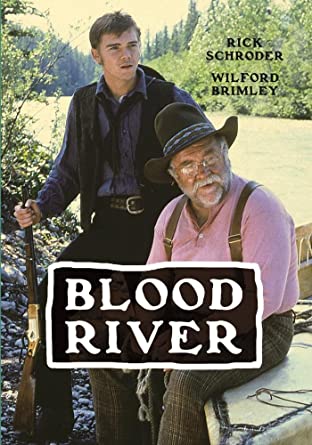
In the old west, Jimmy Pearls (Ricky Schroder), a seemingly dissolute young man, kills the three men who he hold responsible for the murder of his parents.  Unfortunately for Jimmy, one of those men was the son of powerful rancher Henry Logan (John P. Ryan) and Logan is now determined to track down Jimmy and get some revenge of his own.

Jimmy only his one ally in his attempt to make it to safety and that’s Winston Culler (Wilford Brimley).  In his younger days, Culler was a legend.  He tamed the frontier and he lived with the Indians and everyone knew better than to get in his way.  Now, Winston is older and no one give him the respect that he deserves.  Winston allows Jimmy to stay with him but Winston has more than just Jimmy’s safety in mind.  Winston has his own reasons for wanting to get revenge on Logan and, despite their constant bickering, he and Jimmy are soon working as a team.

Adrienne Barbeau has a cameo as a madam and, while she’s always a welcome sight in any film, I imagine her casting has to do with the fact that this film was actually written by John Carpenter.  Yes, that John Carpenter!  Carpenter actually wrote the script for what would become Blood River in 1971.  When he wrote it, he pictured John Wayne as Winston and either Elvis Presley or Ron Howard as Jimmy.  (The Duke and Elvis in the same film?  That would have been something, regardless of how the film itself turned out.)  Carpenter sent copies of the script to both John Wayne and director Howard Hawks but neither one responded.  It would be 19 years before the script was finally filmed.

Blood River is an amiable western.  It was ultimately produced for television and it first aired on CBS.  Despite the fact that the film was originally written to be a theatrical film, it plays more like a pilot than a film.  You could imagine a weekly series featuring Winston and Jimmy riding from town to town and getting into adventures.  The plot is nothing special but Ricky Schroder and Wilford Brimley make for a good team.  Brimley is especially ornery, even for him.  Blood River may be a simple film but it will be appreciated by those looking for a likable and old-fashioned western.

An Offer You Can Take or Leave #13: Hoffa (dir by Danny DeVito)


The 1992 film, Hoffa, opens in 1975, with two men sitting in the backseat of a station wagon.  One of the men is the controversial labor leader, Jimmy Hoffa (Jack Nicholson).  The other is his longtime best friend and second-in-command, Bobby Ciaro (Danny DeVito).  The two men are parked outside of a roadside diner.  They’re waiting for someone who is late.  Jimmy complains about being treated with such disrespect and comments that this would have never happened earlier.  Jimmy asks Bobby if he has his gun.  Bobby reveals that he does.  Jimmy asks him if he’s sure that there’s a loaded gun in the diner, as well.  Bobby goes to check.

Jimmy Hoffa, of course, was a real person.  (Al Pacino just received an Oscar nomination for playing him in The Irishman.)  He was a trucker who became a labor leader and who was eventually elected president of the Teamsters Union.  He was a prominent opponent of the Kennedys and that infamous footage of him being interrogated by Bobby Kennedy at a Senate hearing seems to sneak its way into almost every documentary ever made about organized crime in the 50s.  Hoffa was linked to the Mafia and was eventually sent to prison.  He was freed by the Nixon administration, under the condition that he not have anything to do with Teamster business.  When he disappeared in 1975, he was 62 years old and it was rumored that he was planning on trying to take over his old union.  Everyone from the mob to the CIA has been accused of having had Hoffa killed.

Bobby Ciaro, however, was not a real person.  Apparently, he was a composite character who was created by Hoffa’s screenwriter, David Mamet, as a way for the audience to get to know the enigmatic Jimmy Hoffa.  Bobby is presented as being Hoffa’s best friend and, for the most part, we experience Jimmy Hoffa through his eyes.  We get to know Jimmy as Bobby gets to know him but we still never really feel as if we know the film’s version of Jimmy Hoffa.  He yells a lot and he tells Bobby Kennedy (a snarling Kevin Anderson) to go to Hell and he talks a lot about how everything he’s doing is for the working man but we’re never really sure whether he’s being sincere or if he’s just a demagogue who is mostly interested in increasing his own power.  Bobby Ciaro is certainly loyal to him and since Bobby is played by the film’s director, it’s hard not to feel that the film expects us to share Bobby’s admiration.  But, as a character, Hoffa never really seems to earn anyone’s loyalty.  We’re never sure what’s going on inside of Hoffa’s head.  Jack Nicholson is always entertaining to watch and it’s interesting to see him play a real person as opposed to just another version of his own persona but his performance in Hoffa is almost totally on the surface.  With the exception of a few scenes early in the film, there’s doesn’t seem to be anything going on underneath all of the shouting.

The majority of Hoffa is told via flashback.  Scenes of Hoffa and Bobby in the film’s present are mixed with scenes of Hoffa and Bobby first meeting and taking over the Teamsters.  Sometimes, the structure of the film is a bit cumbersome but there are a few scenes — especially during the film’s first thirty minutes — that achieve a certain visual poetry.  There’s a scene where Hoffa helps to change a man’s flat tire while selling him on the union and the combination of falling snow, the dark city street, and Hoffa talking about the working man makes the scene undeniably effective.  The scenes where Hoffa spars with Bobby Kennedy are also effective, with Nicholson projecting an intriguing blue collar arrogance as he belittles the abrasively ivy league Bobby.  Unfortunately, the rest of the movie doesn’t live up to those scenes.  By the time Hoffa becomes a rich and influential man, you realize that the film isn’t really sure what it wants to say about Jimmy Hoffa.  Does it want to condemn Hoffa for getting seduced by power or does it want to excuse Hoffa’s shady dealings as just being what he had to do to protect the men in his union?  The film truly doesn’t seem to know.

Hoffa is definitely not an offer that you shouldn’t refuse but, at the same time, it’s occasionally effective.  A few of the scenes are visually appealing and the cast is full of character actors like John C. Reilly, J.T. Walsh, Frank Whaley, and Nicholas Pryor.  It’s not a disaster like The Gang Who Couldn’t Shoot Straight.  Hoffa is an offer that you can take or leave.

Previous Offers You Can’t (or Can) Refuse:

  1. The Public Enemy
  2. Scarface
  3. The Purple Gang
  4. The Gang That Could’t Shoot Straight
  5. The Happening
  6. King of the Roaring Twenties: The Story of Arnold Rothstein 
  7. The Roaring Twenties
  8. Force of Evil
  9. Rob the Mob
  10. Gambling House
  11. Race Street
  12. Racket Girls

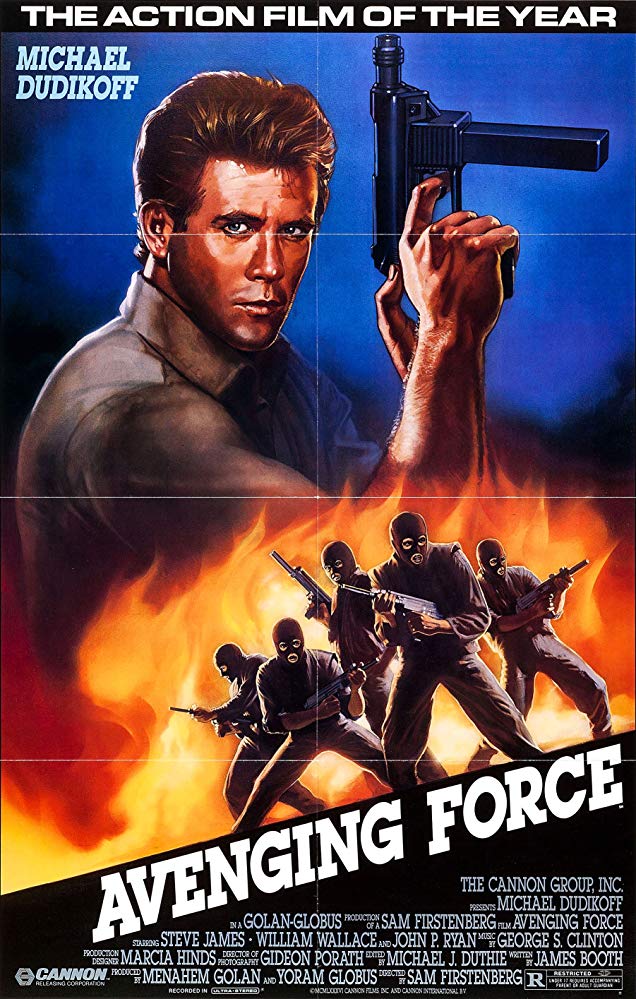
Avenging Force (1986, directed by Sam Firstenberg)


If you think this year’s elections are messed up, just watch Avenging Force and see what happens when two martial artists run against each other for a seat in the U.S. Senate.

Steve James plays Larry Richards, a former military commando who is now running for the Senate in Louisiana.  His opponent is Wade Delaney (Bill Wallace), who is described as being “the South’s youngest senator” and who is also secretly one of the world’s greatest martial artists.  Wade is a member of Pentangle, a Neo-Nazi cult that is made up of wealthy businessmen and other politicians.  When Larry and his family are invited to ride a float in the most sedate Mardi Gras parade of all time, the Pentangle attempts to assassinate him.  While Larry escapes injury, his oldest son does not.

Larry’s best friend, Col. Matt Hunter (Michael Dudikoff), is also in town and Hunter just happens to be another one of the world’s greatest martial artists.  (This film leave you wondering if there’s anyone in Louisiana who isn’t secretly a ninja.)  Matt tries to protect Larry and the remaining members of his family from Pentangle.  Matt fails miserably.  With Larry and the entire Richards family now dead, Matt goes deep into the Louisiana bayou, seeking both to rescue his sister (who has been kidnapped and is set to be sold at some sort of Cajun-run sex auction) and avenge Larry’s death.

As you probably already guessed, Avenging Force is a Cannon Film and it’s crazy even by that company’s fabled standards.  It’s not often that you come across a movie about a U.S. Senator who is also a neo-Nazi ninja who spends his spare time stalking people through the bayous.  What makes this plot point even more memorable is that no one in Avenging Force seems to be shocked by it.  Matt isn’t surprised in the least when an elected official suddenly lunges out of the fog and attempts to drown him in swamp water.  Of course, Senator Delaney isn’t the only villain in the film.  In fact, he’s not even the main bad guy.  That honor goes to Prof. Elliott Glastenbury (John P. Ryan), who lives in a huge mansion and who sees himself as a real-life version of The Most Dangerous Game‘s General Zaroff.  He not only wants to secretly rule the world but he also wants to hunt human prey in the bayou.  When Matt shows up at Glastenbury’s mansion, he is greeted by a butler who complains that Matt hasn’t bothered to wipe the blood off his shirt before showing up.

Avenging Force was originally planned as a sequel to Invasion U.S.A., with Chuck Norris reprising the role of Matt Hunter.  When Norris declined to appear in the film, the connection to Invasion U.S.A. was dropped and Michael Dudikoff of the American Ninja films was cast in the lead role.  (Of course, they didn’t bother to change anyone’s name in the script so the hero of Avenging Force is still named Matt Hunter, even if he’s not meant to be the same Matt Hunter from Invasion U.S.A.)  What Dudikoff lacked in screen presence, he made up for in athleticism and Avenging Force features some Cannon’s best fight scenes.  The plot may be full of holes but the idea of ninjas in the bayou is so inherently cool that it carries the film over any rough patches.

The critics may not have loved Avenging Force when it was first released but it holds up well as a fast-paced and weird action film.  It is perhaps the best Cajun ninja film ever made.

Delta Force 2: The Colombian Connection (1990, directed by Aaron Norris)


Cocaine is flooding the United States and only one man is to blame!  Ramon Cota (Billy Drago) is so evil that, after killing a group of DEA agents, he appears on closed-circuit television just so he can taunt their superior, John Page (Richard Jaeckel).  When Ramon drives through his home country of San Carlos, he kills the peasants, rapes their women, and murders their babies, just because he can.  He’s one bad dude.

Ramon is untouchable as long as he stays in San Carlos but occasionally he does have to leave the country so he can conduct business.  A frequent flyer, Ramon always buys every seat in first class so that he and his bodyguards can have privacy.  However, what Ramon didn’t count on, was Delta Force’s Col. Scott McCoy (Chuck Norris!).  McCoy and his partner, Maj. Chavez (Paul Perri), aren’t intimidated by that curtain separating first class from the rest of the plane.  As soon as Ramon’s flight enters American air space, they burst out of coach, knock out Ramon’s bodyguards, and then toss Ramon out of the plane.  Being an experienced skydiver (not to mention that he’s also Chuck Norris), Col. McCoy is able to catch up to Ramon and grab him before he plummets all the way to the Earth.

Unfortunately, arresting Ramon in America means that you run the risk of a liberal, Carter-appointed judge setting a low-enough bail that Ramon can go free.  Having taken advantage of America’s own legal system, Ramon murders Chavez and returns to San Carlos, leaving Col. McCoy and the rest of the Delta Force to seek vengeance for their fallen comrade.

Only Chuck Norris returns for this sequel to the greatest movie ever made.  Unfortunately, Lee Marvin died shortly after the release of the first Delta Force.  Even though John P. Ryan (as General Taylor) and Richard Jaeckel both seem to be attempting to channel Marvin’s grim, no-nonsense spirit in their performances, it’s just not the same.  What made the first Delta Force so memorable was the mix of Marvin’s cool authority and Chuck Norris’s general badassery.  Norris is as tough as always but the film still has a Lee Marvin-size hole in the middle of it and, without Marvin glaring at the bad guys and barking at the Washington pencil pushers who think they know how to keep America safe, Delta Force 2 could just as easily be a sequel to one of Norris’s Missing In Action films.  This is a Chuck In The Jungle movie, with drug dealers replacing the usual Vietnamese POW camp commandants.

If you can see past the absence of Lee Marvin, Delta Force 2 is an okay Chuck Norris action movie.  It’s typical of the movies that he made for Cannon but the fight scenes are well-directed by Chuck’s brother and Billy Drago is a loathsome drug lord who gets what he deserves.  Chuck gets a few good one-liners and you’ve got to love the film’s final shot.  Delta Force 2 never comes close to matching the original but at least it’s got Chuck Norris doing what he does best.

It’s No Westworld: Futureworld (1976, directed by Richard T. Heffron)


Two years after the Westworld “incident,” (in which a group of robots malfunctioned and murdered hundreds of humans), Delos Amusement Park has reopened and is accepting guests.  Westworld has been permanently shut down but guests can still go to Romanworld and Medeivalworld (despite the fact that it was in Medievalworld that the whole robot rebellion started in the first place).  Delos has added two new worlds: Spaworld and Futureworld.  Spaworld is a spa for people who want to think young and Futureworld is the world of the future, which looks much like 1976, the year that this film was made.

Two reporters, Chuck Browning (Peter Fonda) and Tracy Ballard (Blythe Danner), have been invited to cover the grand reopening of Delos and to hopefully generate some good publicity.  Chuck, however, has reason to believe that there’s something sinister happening at Delos.  While Tracy is busy fantasizing about Yul Brynner, Chuck discovers that Delos is using Futureworld to clone diplomats.

At the end of Futureworld, Peter Fonda gives everyone the finger and that’s really cool but otherwise, this is a forgettable sequel to Westworld.  The whole point of the original Westworld was that the robots didn’t know they were robots but, in Futureworld, the robots not only know what they are but they’re also superfluous to the plot.  There’s no robot revolution in Futureworld nor is there any of Crichton’s concerns about technology run amok.  Instead, it’s all about clones and a predictable political conspiracy.

The main issue facing the makers of this film was how could they do a sequel to Michael Crichton’s unexpected hit when Westworld‘s main attraction, Yul Brynner’s robot gunslinger, was thoroughly destroyed at the end of the first film.  It would not make any sense for anyone to have reactivated the robot.  Their solution was to bring Brynner in for a cameo in which he appeared in one of Tracy’s dreams.  Sadly, why they thought it was a good idea to have Tracy develop an erotic fixation on a killer robot and then, just as abruptly, abandon the idea is not for us to know.  They would have been better off leaving Brynner out of the film entirely because his presence just reminds us that Futureworld is no Westworld.

Robots With A Cause: Class of 1999 (1990, directed by Mark L. Lester)


The year is 1999 and John F. Kennedy High School sits in the middle of Seattle’s most dangerous neighborhood.  Teenage gangs have taken over all of the major American cities and just going to school means putting your life in danger.  However, Dr. Bob Forest (Stacy Keach!), the founder of MegaTech, has a solution.  He has taken former military androids and reprogrammed them to serve as educators.  JFK’s principal, Miles Langford (Malcolm McDowell!!), agrees to allow his school to be used a testing ground.  Soon, Miss Conners (Pam Grier!!!) is teaching chemistry.  Mr. Byles (Patrick Kilpatrick) is teaching gym.  Mr. Hardin (John P. Ryan) is teaching history.  When they’re not teaching, these robots are killing truant students and manipulating two rival street gangs into going to war.

Imagine mixing Rebel With A Cause with The Terminator and you get an idea of what Class of 1999 is like.  Two of the only good teenagers (played by Bradley Gregg and Traci Lind) figure out that the teachers are killing their classmates but they already know that they won’t be able to get anyone to listen to them because they’re just kids who go to school in a bad neighborhood.  Meanwhile, the teachers have been programmed to do whatever has to be done to keep the peace in the school.  Why suspend a disruptive student when you can just slam his head into a locker until he’s dead?  Director Mark L. Lester (who previously directed Class of 1984) is an old pro when it comes to movies like this and he’s helped by a better-than-average cast.  Any movie that features not only Stacy Keach and Malcolm McDowell but also Pam Grier is automatically going to be cooler than any movie that doesn’t.

When Class of 1999 was made, 1999 was considered to be the future and, in many ways, the movie did prove to be prophetic.  We may not have robot teachers (yet) but the idea of arming teachers and expecting them to double as cops has become a very popular one over the past few years.  Personally, I wouldn’t want to send my children to a school where the teachers all have to carry a gun while teaching but that may just be me.