Here’s The Trailer for Orson Welles’s The Other Side of The Wind!


Listen, I know that some people are excited about the new Predator film.

And some people can’t wait to see If Beale Street Could Talk.

And a few of you are going crazy over the remake of Suspiria.

But, for me, the movie that I’m most looking forward to seeing is Orson Welles’s The Other Side of the Wind!

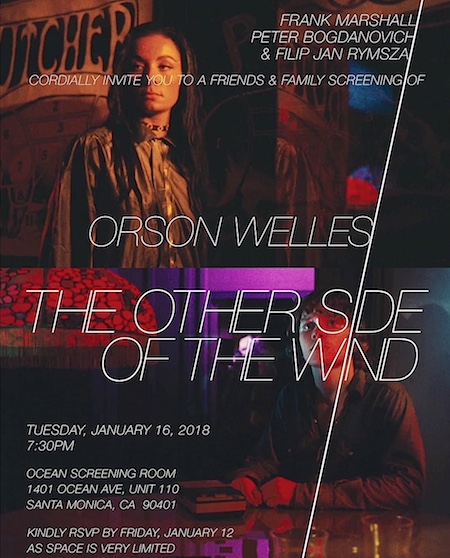
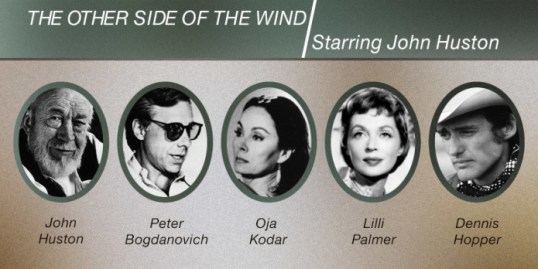
That’s right.  After a 40-year production period that saw the death of almost everyone involved with the film (including director Orson Welles and star John Huston), The Other Side of the Wind is finally going to be released!  It’ll be premiering on Netflix on November 2nd and it better get a helluva an Oscar campaign.

Before seeing the film, I recommend reading a book about the making of it, Orson Welles’s Last Movie.  It’s a book that Gary reviewed a few months ago…

Way back in 2010, I listed The Other Side of the Wind as one of ten movies that I hoped to see before dying.

Here’s the trailer.


4 Shots From 4 Marilyn Monroe Films: All About Eve, Don’t Bother To Knock, Bus Stop, The Misfits


4 Shots from 4 Films is just what it says it is, 4 shots from 4 of our favorite films. As opposed to the reviews and recaps that we usually post, 4 Shots from 4 Films lets the visuals do the talking!

If only she hadn’t been destroyed by the Kennedys, Marilyn Monroe would be 92 years old today.  Though Marilyn died in 1962, her performances will live forever.  This is…

4 Shots From 4 Marilyn Monroe Films

All About Eve (1950, dir by Joseph L. Mankiewicz)

Don’t Bother To Knock (1952, dir by Roy Ward Baker)

Bus Stop (1956, dir by Joshua Logan)

The Misfits (1961, dir by John Huston)

Lisa’s Way Too Early Oscar Predictions for April


Hi, everyone!

Well, it’s that time again!  It’s time for me to post my very early Oscar predictions.  I do this on a monthly basis.  I always make it a point to acknowledge that, this early in the year, this is something of a pointless exercise.  We’re still not far into 2018 and but, surprisingly, several excellent films have already been released.  Who knows what the rest of the year will be like!

So, as always, the predictions below are a combination of instinct and random guesses.  This month, I’ve kind of let my imagination run wild.  And you know what?  That’s the way it should be.  What’s the point of trying to predict stuff if you can’t have fun?

So, without further ado, here are my predictions for April!

(Click to see my predictions for January, February, and March!)

Best Picture

Annihilation

Black Panther

Boy Erased

First Man

The Happytime Murders

If Beale Street Could Talk

Mary, Queen of Scots

The Other Side of the Wind

A Quiet Place

Widows

Best Director

Ryan Coogler for Black Panther

Barry Jenkins for If Beale Street Could Talk

John Krasinski for A Quiet Place

Steve McQueen for Widows

Orson Welles for The Other Side of the Wind

Best Actor

Steve Carell in Beautiful Boy

Willem DaFoe in At Eternity’s Gate

Matt Dillon in The House That Jack Built

Ryan Gosling in First Man

John Huston in The Other Side of the Wind

Best Actress

Cate Blanchett in Where’d You Go, Bernadette?

Viola Davis in Widows

Melissa McCarthy in Can You Ever Forgive Me?

Saoirse Ronan in Mary, Queen of Scots

Kristin Stewart in JT LeRoy

Best Supporting Actor

Peter Bogdanovich in The Other Side of the Wind

Russell Crowe in Boy Erased

Michael B. Jordan in Black Panther

David Tennant in Mary, Queen of Scots

Forest Whitaker in Burden

Best Supporting Actress

Laura Dern in JT Leroy

Claire Foy in First Man

Nicole Kidman in Boy Erases

Regina King in If Beale Street Could Talk

Margot Robie in Mary, Queen of Scots


4 Shots From 4 Films: A Streetcar Named Desire, Reflections in a Golden Eye, The Godfather, Last Tango in Paris


4 Shots from 4 Films is just what it says it is, 4 shots from 4 of our favorite films. As opposed to the reviews and recaps that we usually post, 4 Shots from 4 Films lets the visuals do the talking!

In honor of Marlon Brando’s birthday, here’s…

4 Shots From 4 Films

A Streetcar Named Desire (1952, dir by Elia Kazan)

Reflections in a Golden Eye (1967, dir by John Huston)

The Godfather (1972, dir by Francis Ford Coppola)

Last Tango in Paris (1973, dir by Bernardo Bertolucci)

Moanin’ Low: On Claire Trevor and KEY LARGO (Warner Brothers 1948)


gary loggins's avatarcracked rear viewer

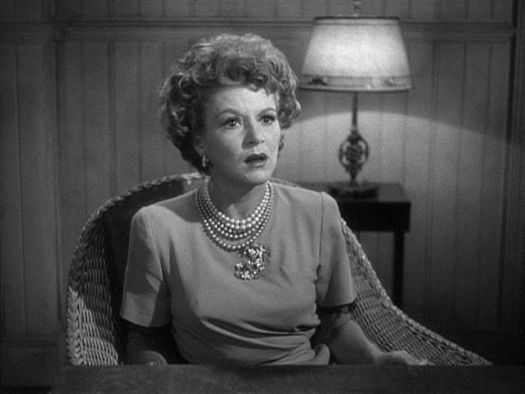
John Huston’s filmnoir KEY LARGO is a personal favorite, and a bona fide classic in its own right that works on many different levels. Much of its success can be credited to the brilliant, Oscar-winning performance of Claire Trevor as Gaye Dawn, the alcoholic ex-nightclub singer and moll of gangster Johnny Rocco (played with equal brilliance by Edward G. Robinson ). The woman dubbed by many “Queen of Noir” gives the part a heartbreaking quality that makes her stand out among the likes of scene stealers Robinson, Humphrey Bogart , Lauren Bacall , and Lionel Barrymore .

Claire Trevor (1910-2000) arrived in Hollywood in 1933, and almost immediately became a star. Her early credits include playing Shirley Temple’s mom in BABY TAKE A BOW (1934), the title role in the Pre-Code drama ELINOR NORTON (also ’34), Spencer Tracy’s wife in the bizarre DANTE’S INFERNO (1935), and the reporter out…

View original post 685 more words

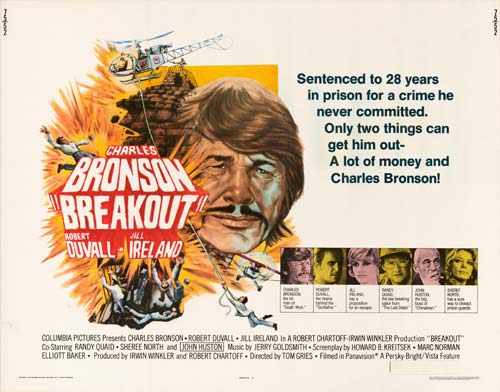
Let’s Go to the Drive-In with Charles Bronson in BREAKOUT (Columbia 1975)


gary loggins's avatarcracked rear viewer

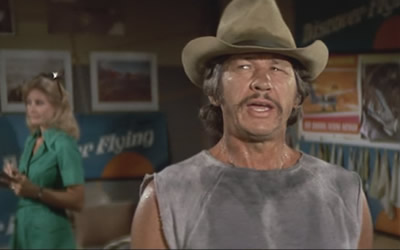
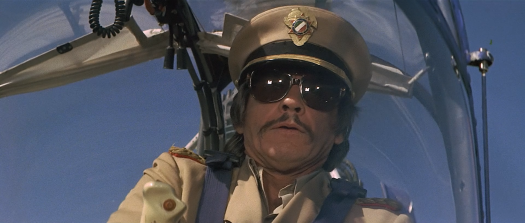
Charles Bronson  finally achieved superstar status in the 1970’s after years of toiling in supporting parts thanks to drive-in fare like THE MECHANIC, MR. MAJESTYK, and the DEATH WISH films. 1975’s BREAKOUT had a bigger budget, a better than average cast, and major studio support, but at it’s heart it’s still a drive-in movie, albeit a cut above the usual action flick.

Bronson casts aside his normal stoic, stone-faced screen persona as Nick Colton, a somewhat shady pilot/mercenary who’ll do anything for a buck. Charlie’s quite a charmer here, displaying a sense a humor and talking a lot more than usual. He’s in rare form, getting to display his acting chops, honed through over two decades in the business, and is obviously having a good time in the role.

Nick is hired by Ann Wagner to rescue  her husband Jay, framed by his own grandfather and sentenced to a ruthless Mexican pennitentary…

View original post 399 more words

Classic Film Lovers Rejoice! Here’s The Trailer for Five Came Back!


If you love classic movies, you’re going to love this trailer for the new Netflix documentary, Five Came Back!

Based on Mark Harris’s brilliant non-fiction book, Five Came Back takes a look at the work that five great directors — Frank Capra, William Wyler, John Huston, George Stevens, and John Ford — did during World War II.  It’s a fascinating story and it was a fascinating book.  I just hope this documentary does it justice.

We’ll find out on March 31st!

(Incidentally, Five Came Back is narrated by Meryl Streep so expect to see her nominated for Best Actress next year…)

Cleaning Out The DVR #25: The Maltese Falcon (dir by John Huston)


(For those following at home, Lisa is attempting to clean out her DVR by watching and reviewing 38 films by this Friday.  Will she make it?  Keep following the site to find out!)

220px-Falconm

I would love to see a remake of The Maltese Falcon with Bill Murray in the role of Sam Spade.  Well, maybe not the Bill Murray of today because he’s getting a little bit too old to play a hard-boiled private detective who is as good with his fists as his brain.  Instead, I’m thinking more of Lost In Translation era Bill Murray, when he was no longer young but could still probably beat up any sniveling punk who came at him with a gun.

Now, that may sound crazy to some but think about it.  Bill Murray is one of the great deadpan snarkers and so is Sam Spade.  Last night, when I watched the famous 1941 version of The Maltese Falcon (the story was filmed twice before, once with Bette Davis as the femme fatale), I was struck by how much of the film really was a comedy.  It may have been a murder mystery that featured death and betrayal and a lot of people getting beaten up but, ultimately, The Maltese Falcon is really about Sam Spade reacting to all of the crazy and strange people around him.  No matter how weird things get, Spade always responds with a smirk and a quip.  It’s a role that, at times, seems to be tailor-made for an actor like Bill Murray.

Bill Murray wasn’t around in 1941 but fortunately, Humphrey Bogart was.  Humphrey Bogart may have grown up wealthy and attended private schools but, on screen, nobody was tougher than Humphrey Bogart and nobody was better at delivering sarcastic, snark-filled dialogue.  After spending years as a villainous supporting actor, Humphrey Bogart got his first starring role when he played Sam Spade in The Maltese Falcon.  His performance, of course, would set the standard by which all future cinematic private eyes would be judged.

And, of course, Spade was tough and he was cynical and he has that wonderful moment at the end of the film where he explains that nobody’s going to make a “sap” out of him.  But for me, Bogart’s best moments come when Spade is alone and thinking.  It’s at those times that Spade suddenly becomes a human being.  A slight smirk comes to his lips, almost as if he’s sharing a private joke with the audience.  You can tell that he’s thinking to himself, “Can you believe how weird my life is?”

And it is indeed a weird life.  The film opens with Spade’s partner, Miles Archer (Jerome Cowan), being murdered.  The police believe that Archer was murdered by a man named Thursby and that Thursby was subsequently murdered by Spade.  Spade, however, suspects that both Archer and Thursby were killed by his latest client, a woman who introduced herself as Ruth Wonderly (Mary Astor).  Except, of course, that’s not her real name.  Her real name is Brigid O’Shaughnessy and, as she admits to Spade, Thursby was her partner.  She claims that Thursby must have murdered Archer but that she doesn’t know who could have possibly killed Thursby.

What’s particularly interesting about all this is that no one really seems to be that upset about Archer’s death.  Spade’s main motivation for investigating the murder is to clear his name and there are several lines of dialogue that reveal how little regard he had for Miles.  In fact, when Archer’s widow (Gladys George) suggests that Spade might be Archer’s killer, you can understand why she might think that.  But then again, that’s the world of The Maltese Falcon.  Only the tough survive.  Getting sentimental or allowing yourself to care is the biggest mistake you can make.

The murders are connected to the hunt for a valuable statue of a bird.  (This is the famous Maltese Falcon of the title.)  As Spade tries to clear his name in the two murders, he also finds himself getting caught up with a strange group of treasure hunters.  There’s the obsequious Joel Cairo (Peter Lorre).  There’s the ruthless “fat man,” Kasper Gutman (Sidney Greenstreet).  And then there’s Wilmer (Elisha Cook, Jr.), Gutman’s young henchman who spends the entire film trying to convince everyone that he’s tougher than he appears.  Wilmer is a born patsy.  Whenever Spade gets annoyed, he beats up Wilmer.  And he usually smiles afterward.

Along with being the directorial debut of John Huston, The Maltese Falcon was also one of the first great film noirs.  It’s one of the most influential films ever made and, even seen today, it’s a lot of fun.  You really can’t go wrong with Bogart, Astor, Greenstreet, Lorre, and Cook all in the same movie.  Bill Murray may never get a chance to play Sam Spade but that’s okay.  Humphrey Bogart’s the only Sam Spade we really need.

The Maltese Falcon was nominated for best picture.  However, it lost to How Green Was My Valley, a film that literally seems to take place in an entirely different universe from The Maltese Falcon.

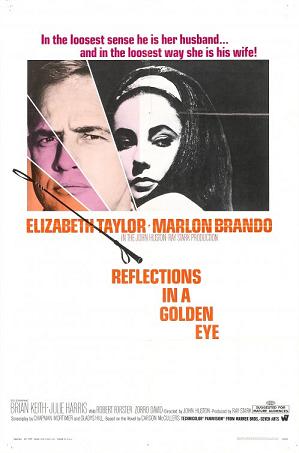
Embracing the Melodrama Part II #33: Reflections in a Golden Eye (dir by John Huston)


Reflections_in_a_golden_eyeFor the past two weeks, I’ve been reviewing, in chronological order, 126 cinematic melodramas.  I started in the 1920s with Sunrise and Wings and now, 33 reviews later, we have finally reached the end of the 1960s.  And what better way to end the 60s than by taking a mercifully brief look at the 1969 film, Reflections in a Golden Eye.

Now, before I get too critical of this film, I should acknowledge that there are some critics who absolutely love Reflections in a Golden Eye.  They think very highly of Marlon Brando’s performance as Maj. Weldon Penderton, a closeted homosexual who is stationed at a military base in the South.  They think that Elizabeth Taylor’s performance as Brando’s wife isn’t somewhat embarrassing.  And they think that the script isn’t overwritten and that director John Huston doesn’t try way too hard to prove himself worthy of the title auteur.  They feel that Reflections in a Golden Eye is a secret masterpiece that does not deserve to be known as an infamous flop.

I’m definitely not one of those people but they do exist.  There are some very respectable and intelligent critics who happen to love Reflections in a Golden Eye.

Well — vive la différence!

Earlier in this series, I pointed out that the 60s were not a great time for old school Hollywood directors trying to compete with both American television and European film.  It was a time when talented directors found themselves trying to keep up with the times and appeal to new audiences.  As a result, Joseph L. Mankiewicz ended up making Cleopatra.  Edward Dmytryk did The Carpetbaggers.  Elia Kazan directed The Arrangement.  William Wyler did The Liberation of L.B. Jones.  Stanley Kramer made RPM.  

And John Huston made Reflections in a Golden Eye.

This painfully slow film follows the affairs of six people on that Southern army base.  Brando is emotionally repressed and spend most of the movie mumbling in one of the worst Southern accents ever.  Taylor is obsessed with horses and spends most of the movie yelling in one of the worst Southern accents ever. Robert Forster is the object of Brando’s repressed desire, a soldier who likes to ride horses while naked and who is obsessed with sniffing Elizabeth Taylor’s underwear.  Brian Keith is in charge of the army base and is having an affair with Taylor.  Julie Harris is Keith’s suicidal wife.  Zorro David is Harris’s houseboy who, at one point, is nice enough to give this film a title by mentioning something about a golden eye.

What’s particularly insane is that Huston took the idea of making this film a reflection in a golden eye literally.  The entire film is tinted a sickly gold color.  Whenever the characters step outside, the sky looks like the sun has just exploded.  Whenever the characters are inside, they all look like they have jaundice.  On the one hand, you have to respect the fact that Huston so committed himself to potentially alienating the audience.  On the other hand, the yellow-tinting renders almost every image so grotesque that I actually found myself growing physically ill as I watched the film.

Watching Reflections in a Golden Eye, I could understand why The Godfather was such a huge comeback for Marlon Brando.  I wouldn’t necessarily say that Brando gives a bad performance here.  He’s watchable throughout the entire film.  But it’s still a performance that’s so strangely modulated (and which features a Southern accent that is just amazingly bad) that it ultimately distracts from the film itself.  If anything, Brando gives a performance that suggests what happens when a talented and eccentric man gets bored with what he’s doing.

(If you want to see a good Brando performance from 1969, see Burn.)

Reflections in a Golden Eye is a pretentious mess but fortunately, both Huston and American film would make a comeback in the 1970s.  We’ll start on that decade tomorrow.

http://www.youtube.com/watch?v=5U2NssXWO5Y

(Yes, this video is a spoiler but it’ll allow you to see the gold tinting.)

(The film was also released in an untinted version.)

Horror Film Review: The Visitor (dir by Giulio Paradisi)


The_Visitor_1979_film_poster

Do you want to see a strange horror film?

Just check out The Visitor, a 1979 Italian film that has recently been re-released by Drafthouse Films and occasionally shows up on TCM.  In many ways, The Visitor is a total and complete mess.  But, as is so often the case with Italian horror films, that very messiness — combined with some genuinely imaginative narrative and directorial choices — serves to make The Visitor into one of the most memorable films that you (possibly) have never heard of.

Like many of the Italian exploitation films released in the 70s and 80s, The Visitor is a rather blatant rip-off of a successful American film.  What makes The Visitor unique is the amount of different movies that it rips off.  The Visitor takes films that you would assume had no connection and mixes them together to create something wonderfully odd.
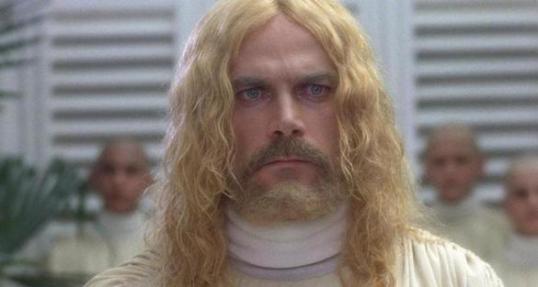
Franco Nero as Jesus in The Visitor

Franco Nero as Jesus in The Visitor

Much like Close Encounters of the Third Kind and 2001: A Space Odyssey, The Visitor opens with the idea that intergalactic beings have been visiting Earth for centuries and are subtly influencing the development of humanity.  The Visitor literally opens with Jesus Christ (played by Franco Nero!) sitting on a satellite and telling a version of the creation story to a bunch of bald children.  He explains that, long ago, he battled an evil intergalactic demon known as Sateen.  Sateen (who, the film implies, is better known on Earth as Satan) was eventually blown up but his genes were spread throughout humanity.  The bald children surrounding him are the descendants of Sateen.  Whenever one of them is born, Jesus sends an old man named Jerzy Colsowicz (played by director John Huston) to Earth so that Jerzy can bring the child to the satellite.  Of course, whenever Jerzy isn’t kidnapping kids for Jesus, he spends his time hanging out in a psychedelic dimension.

Yes, you did read that correctly.
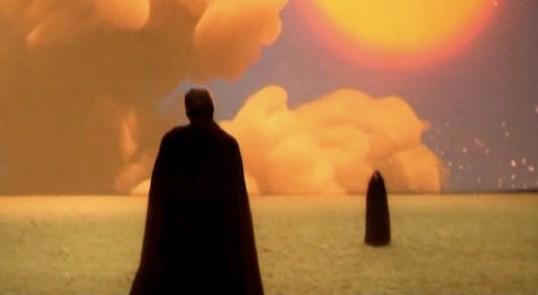
This is where Jerzy lives.

This is where Jerzy lives.

Once you get past the intergalactic part of the story, The Visitor is a pretty obvious rip-off of both The Omen and Damien: Omen II, with the main difference being that the demon child here is not a cherubic little boy but instead is a rather bratty 8 year-old little girl named Katy (Paige Collins).  However, Katy is not the Antichrist.  Instead, her job is to mate with a male child who also has Sateen’s genes and then her baby will be the Antichrist.  In order to get this male child, Katy is pressuring her mother (Joanne Nail) to have sex with businessman Raymond Armstead (Lance Henriksen, who was also in Damien II: The Omen) so that Katy can have a half-brother to mate with.  (Ewwwwwwww!)  Raymond is a follower of Sateen and, adding to the film’s already odd feel, he also happens to own a basketball team.

(So, along with everything else going on, The Visitor also features a lot of basketball footage, which I guess would be exciting if I knew anything about basketball.)

Despite being a pretty powerful figure in the Sateenist hierarchy Raymond is not the head Sateenist.  No, the head Sateenist is played by Mel Ferrer, an actor who was once married to Audrey Hepburn and who will be familiar to anyone who has ever watched an Italian horror film.  (You can spot Ferrer in Zombie Holocaust, for example.)  Ferrer and the other Sateenists are all old, distinguished looking white men who spend all of their time meeting in an ornate corporate boardroom.

So, Jerzy comes down to Earth  to, with the help of a nanny played Shelley Winters, try to kidnap Katy but, for some reason, he doesn’t just do that.  Instead, he spends most of his time just watching Katy do destructive things.

Much as in The Omen, anyone who gets too close to discovering the truth about Katy ends up dying an elaborate and bloody way.  Often times, their death involves black crows, who the film suggests might actually be all of those little bald kids in animal disguise. So is Jesus sending those crows to kill people?  Seriously, this movie is weird.
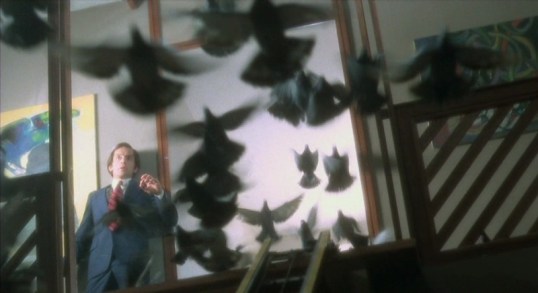
Beware the Crows

Beware the Crows

Meanwhile, Katy’s mom is having doubts about both Raymond and her daughter.  She even goes and talks to her ex-husband, an abortionist who is played by yet another film director, in this case Sam Peckinpah.  Katy gets annoyed with her mom and, after happening to come across a gun hidden away inside of a birthday presents, shoots her in the back and leaves her paralyzed.

And did I mention that Katy is telekinetic, much like Carrie?  That’s right!  During my favorite scene, Katy goes skating at the local mall’s ice rink and, after a group of boys bully her, she uses her powers to send those bullies flying all over the mall.  Oddly enough, nobody seems to notice this chaos.  Except, of course, for Jerzy who just stands off in the corner and watches without doing anything…

Seriously, I love The Visitor.  Along with being surprisingly well-acted and visually inventive, the film is just so weird!  In many ways, it epitomizes everything that I love about the old Italian exploitation films.  While it is rather shameless about ripping off other movies, the film still brings its own unique spin to everything.

Normally, I’d say that The Visitor is a good film for Halloween but you know what?  Anytime is a good time for an Italian horror film!

Welcome

Welcome