Welcome to Retro Television Reviews, a feature where we review some of our favorite and least favorite shows of the past! On Mondays, I will be reviewing Miami Vice, which ran on NBC from 1984 to 1989. The entire show is currently streaming on Tubi!
This week is all about boats!
Episode 1.9 “The Great McCarthy”
(Dir by Georg Stanford Brown, originally aired on November 16th, 1984)
The people behind Miami Vice really liked speedboats.
That’s the best explanation that I come up with for The Great McCarthy, an episode in which the majority of the running time is taken up by scenes of people racing boats. Even after Crockett, Tubbs, and Zito (John Diehl, getting to do more than usual) figure out how Louis McCarthy (William Gray Espy) is using his boats to smuggle drugs into Miami, their main concern remains winning the race that they’ve entered.
And there’s certainly nothing wrong with that. After a run a grim and dark episodes, The Great McCarthy was a nice change of pace, a reminder that it’s okay to have a little bit of fun. For the most part, this was a light and airy episode, featuring scenes of boats skimming across the ocean while Born To Be Wild plays on the soundtrack. This episode also featured a very 80s party scene and not one but two weaselly informants!
The first informant was Izzy Moreno (Martin Ferrero), a talkative thief who, it turned out, had done some work for Louis McCarthy. The second informant was Dale Gifford (Charles McCaughan), a crooked accountant who is helping to launder money for not just Louis but also Louis’s girlfriend, Vanessa (Maria McDonald). Izzy will apparently be returning in the future. Gifford will not as he ended up getting shot in the back of the head. Crockett and Tubbs originally assumed McCarthy was the killer but, as Izzy reveals towards the end of the episode, it was actually Vanessa.
By this time, of course, Vanessa has already moved on from McCarthy and is now sleeping with Tubbs. Crockett warns Tubbs that he’s getting in too deep with Vanessa but Tubbs replies that he’s got it all under control, almost as if he doesn’t remember that almost the exact same thing happened when they went down to the Bahamas to take out Calderone. When the police show up to arrest Vanessa, Tubbs insists on doing it himself. “I have to,” he tells her. He’s a cop, after all.
Okay, so that ending was a little bit downbeat but, for the most part, this was just a fun episode of MiamiVice, one that didn’t require too much thought and which kept the existential dread to a minimum. Probably the best scene in the episode didn’t even involve McCarthy or Vanessa but instead centered around Gina and Trudy arresting a philosophy professor who sold cocaine on the side. (The professor was played by Richard Liberty, who also appeared in George Romero’s The Crazies and Day of the Dead.) Gina and especially Trudy have been underused on this show so it was nice to finally see them getting to do their jobs and proving themselves to be just as effective as Tubbs and Crockett.
I do have to admit that I’m still kind of confused as to how Crockett is managing to maintain his cover as a criminal when almost every other petty criminal in Miami knows that he’s actually a cop. If Izzy could figure it out, why not Louis McCarthy? Perhaps McCarthy wasn’t so great after all.
Welcome to Retro Television Reviews, a feature where we review some of our favorite and least favorite shows of the past! On Mondays, I will be reviewing Miami Vice, which ran on NBC from 1984 to 1989. The entire show is currently streaming on Tubi!
This week, Bruce Willis comes to Miami!
Episode 1.8 “No Exit”
(Dir by David Soul, originally aired on November 9th, 1984)
Tony Amato is a complete monster.
He’s an arms dealer, one who is responsible for machine guns showing up all over Miami. When he’s not selling guns to drug dealers, he’s plotting to sell rocket launchers to terrorists. He’s a crude and a violent man who has suddenly gotten very wealthy and who likes to show off his money. He lives in a pink, art deco mansion. He has a beautiful wife named Rita (Katherine Borowitz), who he regularly abuses. Miami Vice wants to arrest him to get the guns off the street. The federal government wants to arrest him so that they can get their rocket launchers back. And Rita …. well, Rita just wants to hire someone to kill him.
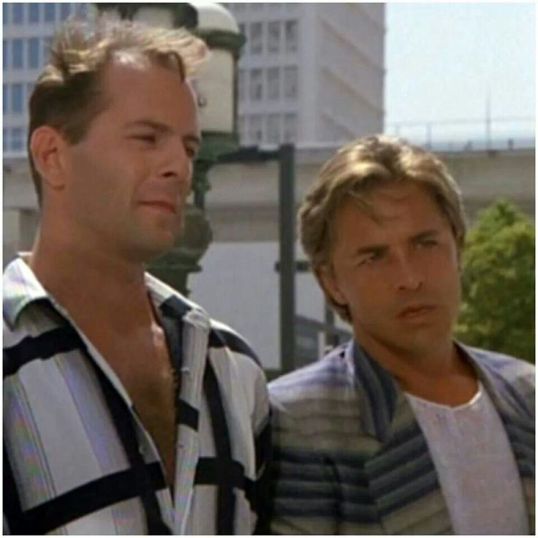
Tony Amato is a memorable character because of just how thoroughly evil he actually is. He’s a criminal because he enjoys it and it doesn’t bother him that his weapons can lead to innocent people dying. Tony is also memorable because he’s played by Bruce Willis. This was Willis’s first credited acting role. (He had appeared as an extra in a few movies before this.) Willis got the role on the recommendation of Don Johnson, who remembered Bruce as being the bartender at one of his favorite New York bars. Though there’s not a lot of depth to the role, Willis does get to show off the cocky confidence that would later become his trademark.
As for the episode, it’s dark even by the standards of Miami Vice. The episode opens with a violent chase and gunfight in the streets of Miami and it ends, just as the previous episode did, with an abused spouse probably throwing their life away to get revenge. We watch as Tubbs, Crockett, and Lester (Julio Oscar Mechesco) sneak into Tony’s mansion and manage to bug the place before Tony returns home. They set up their survelliance operation on Crockett’s boat. Of course, things pretty much fall apart as soon as the federal agents show up and demand to be allowed to oversee the operation.
While the Miami cops and the federal agents fight over jurisdiction, Crockett tries to help Rita escape from her husband. He approaches her while she’s waiting to meet with a hitman and convinces her to let the cops handle it. He promises her that he will put Tony away, even though he knows nothing is ever that simple. Both Katherine Borowitz and Don Johnson do a good job in their scenes together. Deep down, Crockett knows that he’s giving Rita false hope but he can’t bring himself to admit it.
Tubbs, once again, gets to break out his Jamaican accent as he goes undercover as a terrorist who is in the market for Tony’s rocket launchers. Through Tubbs’s hard work, Tony is arrested but, on the steps of the courthouse, two new government agents demand that Tony be released because they’ve determined him to be a potential asset in their own Central American operations. Tony smirks as his handcuffs are removed. Rita appears on the steps, demanding to know why Tony is being set free. She pulls a gun from her purse. We got a freeze frame of Sonny shouting, “NO!” as a gunshot echoes on the soundtrack. Tony may be dead (and we never specifically see whether Rita’s aim was true or not) but his guns are still on the streets, the people he sold to are still free, and the only person going to prison is going to be an abused wife.
Like I said, this was a dark episode. This is one of those episodes that left the viewer to wonder why Cockett and Tubbs even bothered to make the effort. In the end, all their hard work added up to nothing. For Crockett, the case became about saving Rita but the government was more concerned about their own shady schemes that protecting its citizens. Of course, even if Tony had been sent to prison, someone else would have taken his place. That’s life in Miami.
Welcome to Retro Television Reviews, a feature where we review some of our favorite and least favorite shows of the past! On Mondays, I will be reviewing Miami Vice, which ran on NBC from 1984 to 1989. The entire show is currently streaming on Tubi!
This week, Vice gets a new leader!
Episode 1.7 “One Eyed Jack”
(Dir by Lee H. Katzin, originally aired on November 2nd, 1984)
Oh, that Sonny Crockett. He’s got problems!
For one thing, animal control is still showing up at the harbor and trying to repossess his pet alligator, Elvis. Sonny manages to talk them out of it by explaining that Elvis is actually employed by the Miami Police Department. Sonny even flashes his badge as proof, which I found strange since I thought the whole idea of Sonny living on the boat was so that he could convince everyone that he was actually a big time drug dealer. For someone who is supposed to be deep undercover, Sonny never seems to make much of an effort to hide the fact that he’s a cop.
Crockett and Tubbs have been assigned to stakeout a bookie in the hope that it’ll lead to the arrest of his boss, a supposedly “untouchable” gangster named Al Lombard (Dennis Farina, who was always a totally convincing gangster despite actually being a Chicago cop). Crockett is shocked to see his ex-girlfriend, Barbara (Janet Constable), begging the bookie for more time to pay off her gambling debts. Apparently, Barbara is so far in debt that Lombard’s second-in-command, Vince DeMarco (played by former Andy Warhol superstar, Joe Dallesandro), has stolen the tools that Barbara’s husband needs to make a living.
Seeking to help out his ex, Crockett approaches Vince and requests that he return the tools. Vince explains that the tools have already been destroyed and then offers Crockett an envelope full of cash as payment for them. Crockett takes the envelope and is promptly arrested by Internal Affairs Detective Schroeder (Dan Hedaya, as wonderfully sleazy as ever). It turns out that Vince agreed to expose a dirty cop in return for being granted immunity on some racketeering charges.
Everyone knows that Crockett has been framed. In the past, Lou Rodriguez would have stood by Crockett but Rodriguez died two episodes ago and the new head of vice is Lt. Martin Castillo (Edward James Olmos). Accurately described as being “Charles Bronson by way of Havana,” by Tubbs, Castillo is an enigmatic figure, one who rarely speaks or shows the slightest hint of emotion. He has a withering stare that can be terrifying in its intensity. When Tubbs, feeling that Castillo isn’t being properly supportive of Crockett, demands to know, “Whose side are you on?,” Castillo replies, “Don’t ever come up to my face like this again, Detective,” and the viewer is left with no doubt that Castillo is perhaps the most terrifying man in Miami.
After Barbara turns up dead, Tubbs goes undercover. After meeting with DeMarco, Tubbs works his way up to Lombard. Tubbs claims to be a gangster from Philadelphia who is looking to get in on the action in Miami. (“If Miami doesn’t have it,” DeMarco assures him, “nobody’s thought of it yet.”) Lombard takes a liking to Tubbs and hires him to deal with his Black and Spanish “clientale.” Soon, Tubbs and DeMarco are hitting the cockfights and going to the club with Lombard. Tubbs also frames DeMarco for the theft of $2,000. Realizing that Lombard is probably going to try to kill him, DeMarco not only signs a paper exonerating Crockett but he also wears a wire the next time that he and Tubbs visit Lombard’s yacht.
Good news, right? Well, it would be …. except that Barbara’s husband Jerry (Jimmie Ray Weeks) sneaks onto the yacht and shoots DeMarco dead before Lombard says anything incriminating. Jerry goes to prison and Lombard goes free. Crockett and Tubbs end up on Crockett’s boat, fishing at ten o’clock at night. Crockett says that it’s the only way to stay sane.
What a dark episode! Crockett was exonerated but his otherwise perfect plan fell apart. This episode truly presented Miami as being a decadent playground, one that could make someone rich just as easily as it could destroy them. While Jerry and Barbara lived in a small, run-down house, DeMarco wore expensive suits and Lombard lived on an expensive yacht and neither one gave much thought to the people whose lives were destroyed by their activities. With Crockett sidelined by the IA investigation, Tubbs finally got his chance to shine and Philip Michael Thomas did a good job of capturing the adrenaline rush of becoming a part of Lombard’s world. As opposed to the cynical and weary Crockett, Tubbs seems like he could be seriously tempted to switch sides in the war on crime. In the end, Tubbs outsmarted DeMarco not by being better than him but instead by being even more ruthless. And yet, for all the dark vibes to be found in this episode, the glamour of life in Miami was undeniably appealing. Where else, the episode asked, can you arrest the bad guys while also working on your tan and hanging out on the beach?
Indeed, I find myself feeling a bit jealous of Gina (played by Saundra Santiago). So far, she hasn’t gotten to do much on the show beyond being Sonny’s sometime girlfriend. But she still gets to wear the best clothes and hang out with the coolest people and she gets to do it all while carrying a gun. What more could one ask for?
Next week, Bruce Willis makes his television debut!
Welcome to Retro Television Reviews, a feature where we review some of our favorite and least favorite shows of the past! On Mondays, I will be reviewing Miami Vice, which ran on NBC from 1984 to 1989. The entire show is currently streaming on Tubi!
This week, the squad loses a member!
Episode 1.5 “Calderone’s Return: The Hit List”
(Dir by Richard A. Colla, originally aired on October 19th, 1984)
This episode opens with Sonny Crockett …. shaving!
That’s right. After four episodes featuring Sonny with stubble, he finally shaves in this one. Tubbs is shocked to see it. However, Sonny has a good reason for shaving because he is due in divorce court, where he hopes that he can keep his soon to be ex-wife from taking his son to Georgia.
At the courthouse, Sonny and Caroline (Belinda Montgomery) take one look at each other and realize that they don’t want to give up on their marriage. They cancel the hearing and fire their attorneys. Caroline says that she’ll find a job in Miami and the Crockett family will stay together.
Yay! It’s a good thing Sonny shaved.
Unfortunately, the pilot’s main bad guy, Calderone, wants to return to Miami and he’s sent an assassin (Jim Zubiena) to not only take out his potential rivals but also to kill the cops who he blames for his downfall. When Tubbs and Rodriguez discover that Crockett is the 8th name on the assassin’s hit list and that six of the previous names are already dead, Rodriguez orders Crockett to go into productive custody. Knowing that Crockett has trouble with following orders, Lt. Rodriguez personally escorts Sonny to his boat so that Sonny can pack. When Rodriguez spots the reflection of a muzzle on a nearby building, Rodriguez pushes Sonny out of the way just as the Assassin pulls the trigger. Rodriguez takes the bullet that was meant for Sonny.
And I have to admit that I was a bit upset by Rodriguez getting shot, despite the fact that Rodriguez wasn’t a particularly well-developed character. He was the typical tough chief with a secret heart of gold and, for the most part, his brief role on the show consisted of barking at Sonny to do things by the book. But still, Gregory Sierra was a likable actor and, as a result, Rodriguez always came across as being nice even when he was angry at Crockett. Technically, the reason Rodriguez sacrificed his life was because Sierra requested to be written off the show. In the world of Miami Vice, though, Rodriguez’s death gave both Crockett and Tubbs even more motivation to seek revenge on Calderone.
But, before Crockett and Tubbs can head down to the Bahamas to get Calderone, they have to take care of the Assassin. After an hour of chases, misdirections, and one wonderfully over-the-top nightclub brawl, Crockett and the Assassin face each other in Crockett’s house, firing bullets at each other while Crockett’s wife and son cower in another room. It’s an exciting fight, containing one particularly memorable moment when the Assassin appears to be firing his machine gun directly at the camera. The Assassin was played by Jim Zubiena, who is a professional marksman and was a gun advisor on the set. The Assassin doesn’t say one word but he’s still terrifying precisely because he obviously knows how to handle a gun. In the end, it takes the entire Vice Squad to gun him down and it’s nice to see Crockett and Tubbs finally being helped out in a gunfight by Gina, Trudy, Switek, and Zito.
The Assassin may be dead but Calderone still lives. After Crockett tells his shaken wife that he’ll reschedule their divorce hearing, he and Tubbs head for the Bahamas as part one of Calderone’s Revenge comes to a close.
In 1983, a one-eyed, illiterate drifter named Henry Lee Lucas was arrested by the Texas Rangers. Lucas was arrested for unlawful possession of a firearm but, once in custody, he confessed to murdering 82 year-old Kate Rich and his 15 year-old girlfriend, Becky Powell. Upon being transferred to the Williamson County Jail, Henry Lee Lucas confessed to one murder and then another and then another and then …. well, soon, ol’ Henry Lee Lucas had confessed to over 300 murders. According to Lucas, he had spent the past decade traveling the country with his friend and lover, Ottis Toole, and killing just about everyone they met. (Ottis, who was already in prison in Florida, was Becky’s uncle.) He claimed that he was a member of a nationwide Satanic Cult. At one point, he even confessed to killing Jimmy Hoffa.
Soon, cops from across the county were traveling down to Texas and asking Lucas if he had killed anyone in their state. Lucas’s confessed to almost every murder that he was asked about and often times, he provided details that were considered to be close enough to what happened that his confessions were considered to be credible. The police were happy because they got to take a lot of unsolved murders off the books. Lucas was happy because he was getting to travel the country, he was getting a lot of media attention, and he was being kept out of the general prison population. Indeed, many of the Texas Rangers who escorted Lucas from crime scene to crime scene would testify that, the murders aside, Henry Lee Lucas was usually polite, soft-spoken, and genial company. They would buy him a milkshake. He would confess to a murder.
It was only after Lucas had confessed to so many murderers that he had gained a reputation for being the most prolific serial killer in history that people started to take a good look at all of Lucas’s confessions. What quickly became apparent was that it would have been next to impossible for Lucas to have been everywhere that he claimed to be when he claimed to be there. Many of Lucas’s confessions fell apart under closer investigation. Lucas may have dropped out of the sixth grade but he was very good at picking up on details and manipulating people. He told the police what they wanted to hear. Even worse, it soon turned out that some of the cops were letting him look at their case files before getting his formal confession, allowing Lucas to learn details that only the killer would know. When confronted with this, Lucas recanted all of his confessions.
How many people did Lucas kill? It’s know that he killed his abusive mother when he was a teenager. And, even after he recanted, most legal observers agreed that he killed Kate Rich and Becky Powell. While some continue to insist that Lucas killed hundreds, it’s actually more probable that Lucas, as sick as he was, only killed three people. That didn’t stop Henry Lee Lucas and his confessions from serving as the basis of John McNaughton’s terrifying classic, Henry: Portrait of a Serial Killer.
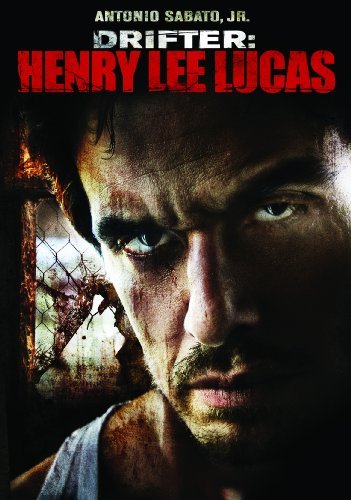
2009 saw the release of another film loosely based on the confessions of Henry Lee Lucas. Drifter: HenryLee Lucas opens with Lucas (played by Antonio Sabato, Jr.) being interrogated as to why he confessed to so many murders that he didn’t commit. The movie then flashes back to Lucas killing Becky Powell (Kelly Curran) before then flashing forward to Lucas confessing to a murder and asking for a milkshake in return and then, once again, it flashes back to Lucas’s Hellish childhood in West Virginia. That’s a lot of time jumps for just the start of the movie and it’s an early indication of just how jumbled the narrative of Drifter turns out to be. To a certain extent, the jumbled narrative is appropriate. It captures the feeling that, in many ways, Lucas is simply making up his life story as he goes along.
Physically, Henry Lee Lucas and Ottis Toole were two incredibly ugly people. Drifter casts Antonio Sabato as Henry and Kostas Sommer as Ottis, both of whom are notably better-looking than the two men that they’re playing. Sommer, in particular, is a hundred-time more handsome that Ottis Toole. (The real Toole looked like one of the toothless hillbillies from Deliverance.) Even if one overlooks their looks, both Sabato and Sommer are a bit too articulate to be believable as two backwoods murderers. Sabato does a good job of capturing Lucas’s one-eyed squint but never once do you buy that he’s someone who grew up in the backwoods of West Virginia. Meanwhile, as Becky, Kelly Curran is shrill and a bit annoying. A lot of that is due to how Becky is written but still, it doesn’t make any easier to deal with her character.
Narratively, the film avoids taking a firm position on whether or not Lucas was lying. We do see Lucas commit a few murders but they’re all told as a part of his narration, leaving open the possibility that Lucas could be lying. Unfortunately, Henry’s stories aren’t that interesting. What was interesting was that so many people chose to believe his stories, despite the fact that the majority of them fell apart under even the slightest amount of scrutiny.
In the end, Drifter reminded me that Henry Lee Lucas is far less interesting than how people reacted to Henry Lee Lucas and his willingness to confess to every crime that he was asked about. There’s a great film to be made about the people who enabled Henry Lee Lucas’s lies. Henry, himself, was far less interesting.
Welcome to Retro Television Reviews, a feature where we review some of our favorite and least favorite shows of the past! On Mondays, I will be reviewing Miami Vice, which ran on NBC from 1984 to 1989. The entire show is currently streaming on Tubi!
This week, Crockett and Tubbs gain an informant!
Episode 1.4 “Cool Runnin'”
(Dir by Lee H. Katzin, originally aired on October 5th, 1984)
One of the main themes of Miami Vice was that, no matter how many drug lords that Crockett and Tubbs got off the streets, there was always someone in the wings waiting to replace them. The drug trade was (and is) big business and there was always someone willing to step into the vacuum that was left by the downfall of any of the major players. For all of their efforts, Crockett and Tubbs were essentially fighting a war on drugs that could not be won.
Cool Runnin’ features an early example of this. With Calderone having fled Miami for Colombia, he’s been replaced by Desmond Maxwell (Afemo Omilami), a Jamaican who is willing to murder just about anyone who gets in his way. When he’s first seen, he and the members of his gang are gunning down a group of rival drug dealers in a mall parking lot. Later, Desmond kills one undercover cop and seriously wounds another.
Another major theme in Miami Vice is that Crockett (and, to a lesser extent, Tubbs) are willing to put others at risk to take down their targets. The majority of this episode deals with Nugart Neville ‘Noogie’ Lamont (Charlie Barnett), a talkative thief and speed freak who is recruited, somewhat against his will, to be an informant. When Crockett and Tubbs discover that Noogie served time with Desmond, they use Noogie to set up a meeting with Desmond. When Crockett tells Desmond that he wants to buy from him and that he’ll be waiting for him at Noogie’s apartment, Tubbs points out that Crockett is putting Noogie’s life in danger without even bothering to tell Noogie beforehand.
(Crockett, it should be noted, isn’t thinking straight for most of this episode because his wife has filed for divorce and wants to take his son to Georgia.)
At first, it appears that Noogie is going to get a reprieve when a calls comes in that the man who killed the undercover cops has been arrested. It doesn’t take long for Crockett (and the audience) to figure out that the man who has been arrested is not Jamaican (instead, he’s Haitian) and that he’s been beaten by the racist cop who arrested him.
Instead, the killers are now at Noogie’s apartment, where they are waiting for Crockett and Tubbs to show up so that they can kill both the cops and their informant. It all leads to final shoot-out, one that is shown almost entirely in slow motion and which is surprisingly effective.
This was a good episode about the human cost of getting involved as law enforcement, whether as a cop or a criminal. While Desmond Maxwell was not a particularly nuanced character, he was appropriately intimidating and the audience never had any doubt that he would coldly kill anyone who he viewed as being a threat. (One of the more haunting moments of the episode features the Vice Squad listening to the tape of shooting in which Desmond gunned down two detectives.)
The episode was largely dominated by Charlie Barnett’s performance as Noogie. Barnett was a stand-up comedian who first came to prominence performing in Central Park. He was nearly cast on SaturdayNight Live until it was discovered that he struggled with reading. Barnett was replaced, at the last minute, by another New York comedian, Eddie Murphy. As Noogie. Barnett never stops moving, talking, and performing. It’s actually exhausting just watching him. But, as the episode proceeds, Barnett starts to calm down and, by the end of it, the audience is actually happy that he wasn’t killed in the shoot-out.
Unfortunately, next week, a major character will be killed in a shootout. Who? Find out next Monday!
Welcome to Retro Television Reviews, a feature where we review some of our favorite and least favorite shows of the past! On Mondays, I will be reviewing Miami Vice, which ran on NBC from 1984 to 1989. The entire show is currently streaming on Tubi!
This week, Crockett and Tubbs drive into the abyss and discover what happens when you lose yourself in vice.
Episode 1.3 “Heart of Darkness”
(Dir by John Llewellyn Moxey, originally aired on September 28th, 1984)
The third episode of Miami Vice appears to be take place at least a month or two after the end of the pilot. Tubbs is not only now a member of the Miami Vice Squad but he and Crockett are now best friends. Gone is all the animosity and mistrust that characterized their initial relationship. Now, Crockett is willing to open up to Tubbs and Tubbs is willing to defend Crockett’s pet alligator, Elvis, when Sonny briefly flies into rage mode and threatens to throw away its favorite blanket.
(Sonny is upset because Elvis, who doesn’t like being left on the boat alone, ate one of Sonny’s records.)
Though Tubbs has been accepted by the Vice Squad, he’s still struggling to adjust to Miami, which is a bit more laid back than New York. Early on, he complains to Lt. Rodriguez about his apartment. Rodriguez just rolls his eyes. Sorry, Tubbs. Only one Miami cop gets to live with an alligator on a houseboat. Everyone else is stuck with a one-bedroom.
Crockett and Tubbs’s current assignment is to penetrate the world of Southern Florida porn kingpin, Walter Kovics (Paul Hecht). Kovics is involved with the Mafia and is suspected of having ordered several murders. When one of his actresses (played by Suzy Amis, making her television debut) is not only murdered but also turns out to be an underage runaway from Kansas, the case becomes personal. Crockett and Tubbs want to take down Kovics but the only way to get to Kovics is through his second-in-command, Artie Rollins. At first glance, Artie seems to be a typical coked up criminal but, upon further investigation, Crockett and Tubbs learn that Artie Rollins is actually Arthur Lawson, an FBI agent who has spent the last few years of his life working undercover. Now, no one is sure if Artie is still working undercover or if he’s truly gone over to the other side. Artie claims that he’s still working to bring down Kovics but when Kovics discovers that Crockett and Tubbs are undercover cops, Artie is the one who is ordered to shoot them. Which side is Artie on? Not even he seems to know for sure.
Artie is played by Ed O’Neill. The future star of Married With Children and Modern Family star was in his mid-thirties when he appeared in Miami Vice and this was one of his earliest television roles. O’Neill gives an unpredictable performance, one that is often frightening and sometimes even a bit poignant. As played by O’Neill, Arthur is a man who has truly lost himself and the character is compelling because Arthur himself doesn’t seem to know what he’s going to do from minute-to-minute. He may want to take down Kovics but he’s also spent so many years in Kovics’s world that he knows he won’t ever be able to adjust to anything else. In the end, Arthur does the right thing but he sacrifices his soul as he does it and his joy at gunning down Kovics is almost as disturbing as the look he had in his eyes when he was previously considering whether to execute Crockett and Tubbs. The show’s final moments find Crockett and Tubbs sitting in a cop bar. Crockett confesses that he saw a lot of himself in Arthur Lawson. Rodriguez approaches them and informs them that, while being debriefed at FBI headquarters, Arthur committed suicide.
This was an interesting episode. The plot was a bit conventional but it was elevated by Ed O’Neill’s performance as the unstable Arthur. (O’Neill kept the viewer guessing, along with Crockett and Tubbs, as to who Arthur really was.) And, of course, just when it seems like everyone’s gotten their happy ending, Rodriguez reminded us that happy endings are never guaranteed. Everything comes with a price. Indeed, that’s one of the major themes of Miami Vice. Arthur sacrificed his identity, his soul, and ultimately his life to see that justice was done but, in the end, someone will quickly replace Kovics and the business of vice will continue with little interruption. Arthur will be largely forgotten and only mentioned as a cautionary tale. Can anyone blame Sonny for wanting to spend all of his time on a boat with an alligator?
Welcome to Retro Television Reviews, a feature where we review some of our favorite and least favorite shows of the past! On Mondays, I will be reviewing Miami Vice, which ran on NBC from 1984 to 1989. The entire show is currently streaming on Tubi!
This week, we learn who Tubbs really is and one scene changes television forever.
Episode 1.2 “Brother Keeper: Part Two”
(Directed by Thomas Carter, originally aired on September 16th, 1984)
The pilot for Miami Vice originally aired as a two-hour made-for-TV movie but, when it was released in syndication, it was split into two separate episodes. That’s the way it’s usually aired on the retro stations and that’s also the way that it’s featured on Tubi. And, as you can tell, that’s the way that I’ve decided to review it for this site.
Picking up where the first half ended, Brother’s Keeper: Part Two finds Sonny and Tubbs searching through the deceased Leon’s apartment. Calderone’s men obviously visited the place and ransacked it before Sonny and Tubbs arrived but Sonny still manages to find Leon’s collection of important phone numbers. Tubbs is surprised to discover that Leon lived in a very nice apartment but that’s the way things work in Miami. Cocaine means big money and any one willing to take the risk can live like a king. While the cops and the regular people go home to small apartments and houses that they can barely afford, the successful criminal lives a life of relative luxury. The question is less why so many people are dealing drugs as why so many people aren’t.
While searching the apartment, Tubbs suddenly realizes that Sonny Crockett used to be a football star with the University of Florida. (“You were a funky honky!” Tubbs exclaims.) Apparently, Sonny was one of the best but a series of injuries ended his NFL dreams and, instead of going pro, Sonny did two tours of duty in Vietnam. (The South Asian conference, Sonny calls it.) Myself, I’m wondering how a semi-famous former football player can also be an undercover detective, working under a false name. Wouldn’t he always be worried that a drug dealer would recognize him from the college days and figure out that Sonny Burnett was actually Sonny Crockett?
Sonny’s co-worker and girlfriend, Gina (Saundra Santiago), takes a break from working the undercover prostitution detail and lets Sonny know that she did a background check on Raphael Tubbs and he’s dead! Raphael was a New York cop who was killed in shootout weeks before the other Tubbs landed in Miami. When Sonny confronts him about this, Tubbs admits that he’s actually Ricardo, Raphael’s younger brother. Raphael was a decorated Brooklyn detective. Rico Tubbs, on the other hand, was a Bronx beat cop who forged a lot of documents in order to come down to Florida and convince Vice to allow him to work the Calderone case. Sonny isn’t happy about being lied to but he has a lot more to worry about because, the night before, he apparently rolled over to Gina and whispered his ex-wife’s name in her ear! Needless to say, things are a bit awkward between just about everyone.
Actually, awkward doesn’t even begin to describe what happens when Tubbs suggests that Lt. Rodriguez could be Calderone’s mole. Sonny refuses to consider it until he overhears Rodriguez talking about enrolling his son in a pricey private school. Fortunately, Rodriguez is innocent and the real mole’s number is found in Leon’s apartment. Unfortunately, that number belongs to Sonny’s former partner, Scott Wheeler (Bill Smitrovich)!
After getting Wheeler to confess and turning him over to Rodriguez, Sonny and Tubbs drive down the dark streets of Miami at night, heading towards a rendezvous with Calderone. They don’t say much. Tubbs loads his shotgun. Sonny stops and makes a call to his ex-wife, something that his former partner Eddie didn’t get to do before he was killed. The neon of Miami glows menacingly in the darkness. Meanwhile, in the background, Phil Collins sings In the Air Tonight….
And it’s an absolutely beautiful sequence. Between the surreal menace of Miami at night, the atmosphere of impending doom, and the moody song playing in the background, this sequence plays out like a surreal dream. Both Tubbs and Crockett know that they are quite possibly driving to their death but, at this point, they have no other choice. Too many people have died to turn back. Neither Sonny nor Tubbs has anything in their life at that moment, beyond arresting Calderone.
And they do manage to arrest Calderone, along with killing quite a few of his associates. However, Calderone is released by a crooked judge and flies away in a private airplane while Sonny and Tubbs can only stand on the runway and watch. Sonny says that Calderone will return eventually. Tubbs replies that he probably doesn’t have a job anymore. Sonny asks Tubbs if he’s interested in a “career in Southern law enforcement.”
The second part of the pilot was dominated by that one scene of Tubbs and Sonny driving down the street. And that scene was so strong and it made such an impression that it’s easy to ignore that the rest of Brother’s Keeper Part Two was not quite as exciting as Part One. If the first part of the pilot set up Miami as a hedonistic playground of the rich and corrupt, the second part felt a bit more conventional in its approach. Or, at least, it did until Phil Collins started to sing and play the drums. One cannot understate the importance of that one scene. That one scene, done with next to no dialogue, pretty much told the viewer everything that they needed to know about the show, about Miami, and about Crockett and Tubbs as partners. In that scene, the show reminded us that no one is guaranteed to get out alive.
Next week: Crockett and Tubbs infiltrate an undercover pornography ring and Ed O’Neill appears as an FBI agent who may have gone over to the dark side.
Welcome to Retro Television Reviews, a feature where we review some of our favorite and least favorite shows of the past! On Mondays, I will be reviewing Miami Vice, which ran on NBC from 1984 to 1989. The entire show is currently streaming on Tubi!
Legend has it that Miami Vice was originally pitched as being “MTV Cops.” That may or may not be true but what is known is that it was a show that, for many people, continues to epitomize the 80s. Its cynical and frequently surrealistic portrait of life in Miami continues to be influential to this day. With Florida currently being at the center of so many discussions, it just seemed like a natural pick for Retro Television Reviews.
(Up until a few days ago, the mayor of Miami was running for President and two other Florida residents are currently the front runners for one party’s presidential nomination. As I sit here writing this, national politics are often described as Florida vs California. Even more than in the past, America revolves around Florida.)
Though Miami Vice is often describe as being a Michael Mann production, the show itself was actually created by Anthony Yerkovich, who felt that Miami in the 80s had become the American equivalent of Casablanca during World War II. Mann served as executive producer and he played a big role in creating the show’s trademark visual style. And, of course, the theme song was provided by Jan Hammer:
Episode 1.1 “Brother’s Keeper, Part One”
(Dir by Thomas Carter, originally aired on September 16th, 1984)
Though the show is considered, to this day, to be the epitome of the Southern Florida aesthetic, Miami Vice actually begins in New York City.
On a dark and wet New York Street, a detective named Tubbs (Philip Michael Thomas) sits in his car. When a group of young men approach the car and demand that Tubbs give them some money, Tubb responds by coolly pointing a shotgun at them. The men take the message and leave.
Tubbs is staking out a Colombian drug dealer named Calderone (Miguel Pinero). Tubbs follows Calderone and his associates to a club, the type of place where even the neon lighting seem to be shadowy. When Tubbs gets into a fight with some of Calderone’s bodyguards, Calderone flees into the dark night.
The action moves to Miami, which is as bright and sunny as New York was cold and dark. Undercover vice cop Sonny Crockett (Don Johnson), wearing a white suit and a green t-shirt, gives advice to his partner, Eddie Rivera (a young and charismatic Jimmy Smits, making his television debut). Eddie talks about how his wife is nervous about him being a cop. Sonny tells Eddie to call her after they get finished dealing with a local drug dealer named Corky.
Corky knows Crockett as “Sonny Burnett” and he believes Eddie is a buyer from California. When Corky arrives, they drive out to an underpass. Corky and Eddie walk over to another car to check out Corky’s product. Sonny spots the bomb that’s been taped under car’s hood but he’s too late to keep it from blowing up both Corky and Eddie.
When Lt. Rodriguez (Gregory Sierra) arrives on the scene, he’s not amused to discover two of his detectives — Stan Switek (Michael Talbott) and Larry Zito (John Diehl) — joking about how the police dogs are going to get hooked on all of the cocaine residue. However, he’s even more annoyed with Sonny, who is quickly established as being the type of cop who does not “do it by the book!” Rodriguez also says that Sonny hasn’t changed since his “football days.” Sonny says that Eddie was killed by a mysterious dealer known as The Colombian. Rodriguez replies that Sonny can’t even prove that the Colombian exists. Rodriguez is particularly angered when Sonny says that there must be a mole working in the department.
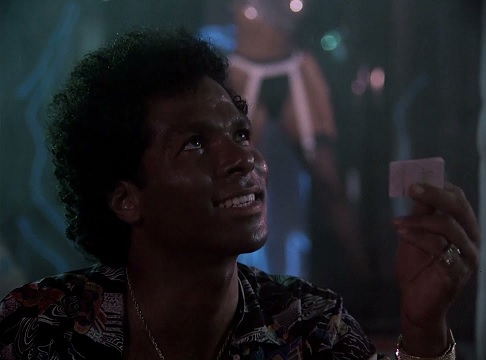
While Sonny tells Eddie’s wife the bad news and then heads over to his son’s birthday party (it’s established that Sonny is divorced), Tubbs lands in Miami. Hanging out at a strip club and doing an elaborate dance to Rockwell’s Somebody’s Watching Me, Tubbs is approached by a man named Scott Wheeler (Bill Smitrovich). Pretending to be a Jamaican named Teddy Prentiss, Tubbs arranges to meet a drug dealer that Wheeler claims to know.
What Tubbs doesn’t know is that Wheeler is an undercover DEA agent and that he’s also Sonny Crockett’s former partner. Sonny is the “dealer.” That night, Sonny and a real-life drug dealer, Leon (Mykelti Williamson) show up at the meeting with Wheeler and “Teddy.” Unfortunately, Zito and Switek show up earlier than expected and they end up arresting everyone before Leon can lead Sonny to the Colombian. Tubbs makes a run for it, jumps into the boat that Sonny drove to the meeting, and speeds away. Sonny jumps into his own car and chases the boat while the Miami Vice theme song plays in the background. (Trust me, it’s a supercool scene.)
Finally confronting Tubbs on a bridge, Sonny reveals that he’s a detective. Tubbs produces his own badge and introduces himself as Raphael Tubbs of the NYPD. He explains that he’s in Miami because he’s after a Colombian drug dealer named Calderone. Sonny explains that he’s too busy searching for the Colombian to worry about Tubbs’s search. Finally, Lt. Rodriguez shows up and helps them to understand that they’re both looking for the same guy. Rodriguez suggests that they work together but Sonny refuses.
The next morning, Tubbs tracks Sonny down on the houseboat on which he lives. It’s a tense meeting, with Sonny punching Tubbs for suggesting that he wasn’t a good enough cop to save Eddie’s life. Sonny apologizes afterwards and Tubbs accepts the apology and then punches Sonny so that they’ll be even. Sonny then introduces Tubbs to his pet alligator, Elvis. It’s male-bonding, 80s style!
Sonny and Scott head over to the courthouse so that they can be “arraigned,” along with Leon. I really liked the performance of Howard Bergman, who played the eccentric judge, Clarence Rupp. At one point, the lights went out in the courtroom and when they came back, everyone from the judge to the bailiffs to the court reporter had drawn a gun. After mentioning his appreciation of the second amendment, Judge Rupp announces that Leon is free to go without bail because he’s cooperating with the police. A panicked Leon yells that he’s not cooperating.
Later, a fearful Leon calls Rodriguez and offers to cooperate in return for protective custody. Leon is hiding out at the beach, where Tubbs is keeping an eye on him. When Sonny arrives, he’s not amused to see Tubbs there. Meanwhile, a hitman who has disguised himself as a woman shoots and kills Leon while Girls Just Want To Have Fun plays on the soundtrack.
And so ends part one of Brother’s Keeper. And you know what? Even after all this time, it’s still easy to see why Miami Vice took off and why it continue to inspire a slew of imitators. The pilot was genuinely exciting, with the perfect mix of music, visuals, and charismatic performances. Jimmy Smits broke my heart in his tiny role. Mykelti Williamson made Leon into an almost sympathetic character as he realized that the cops were willing to sacrifice him to get at his boss. From the start, Don Johnson’s gruff performance as Sonny feels like a perfect match for Philip Michael Thomas’s more earnest portrayal of Tubbs. If Sonny is a cynic, Tubbs seems to feel that he can make a difference by taking down men like Calderone. We’ll have to see how long that lasts.
Next week, we’ll finish up the pilot with part two of Brother’s Keeper!
Mikey (Brian Bonsall) is a little boy who kills people. Over the course of this movie, he kills eight people. He gets away with it because everyone that he meets is extremely stupid. When his teacher notices that Mikey is drawing pictures based on his previous murders, no one thinks anything of it. When she sees that Mikey is now pushing thumbtacks into his arm, no one is too concerned. When the principal goes looking for Mikey, he takes a gun which he then leaves unattended on the kitchen counter. When Mikey tells his teacher that he wants her to teach him “how to die,” everyone figures out that something’s wrong with Mikey but, by then, it’s too late.
For a few years, Mikey had a strong cult following because of the killer kid theme and a few scenes of Josie Bissett in a hot tub. But it really is a dumb movie and Brian Bonsall gave a lousy performance as Mikey. It takes a good deal of stupidity for an adult to get murdered by a ten-year old and this movie proves it.




 Dumb. Just dumb.
 Through the Shattered Lens