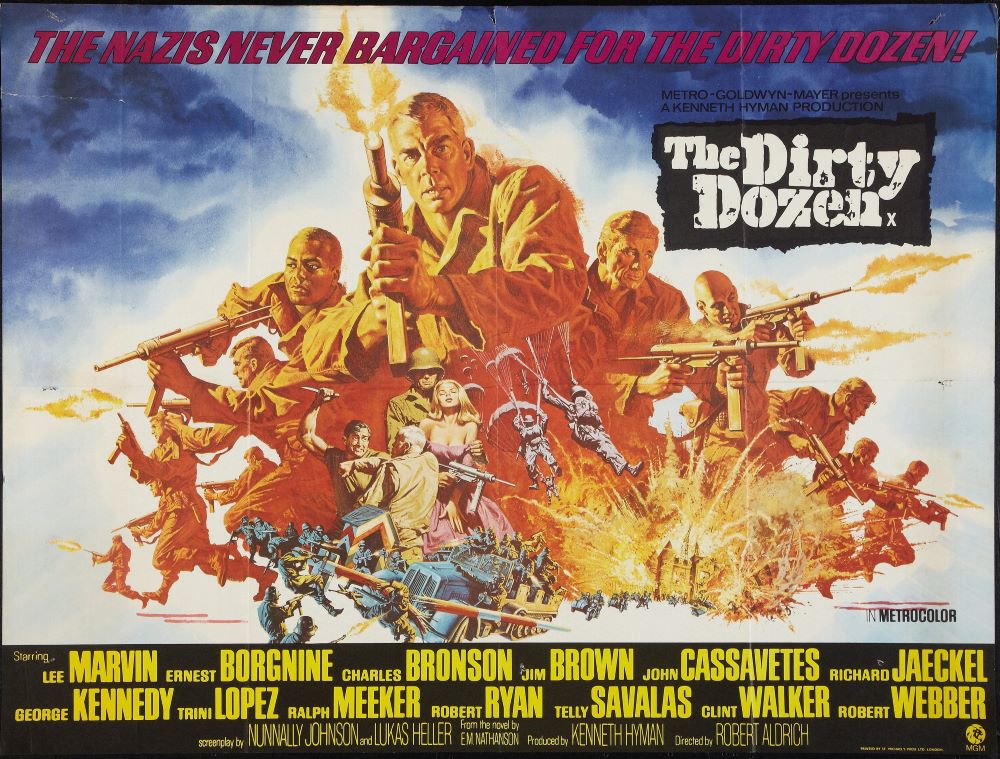
Happy Birthday in cinema heaven to John Cassavetes!


Actor/writer/director John Cassavetes was born on this day in 1929. While he had an amazing career, I first saw him in his Oscar nominated performance as doomed military convict Victor Franko in THE DIRTY DOZEN. In celebration of what would have been his 96th birthday, enjoy this scene from Director Robert Aldrich’s classic World War II film! All I can say is, if you’re going to get your ass kicked in a movie, you might as well get it kicked by Charles Bronson, Jim Brown and Clint Walker!

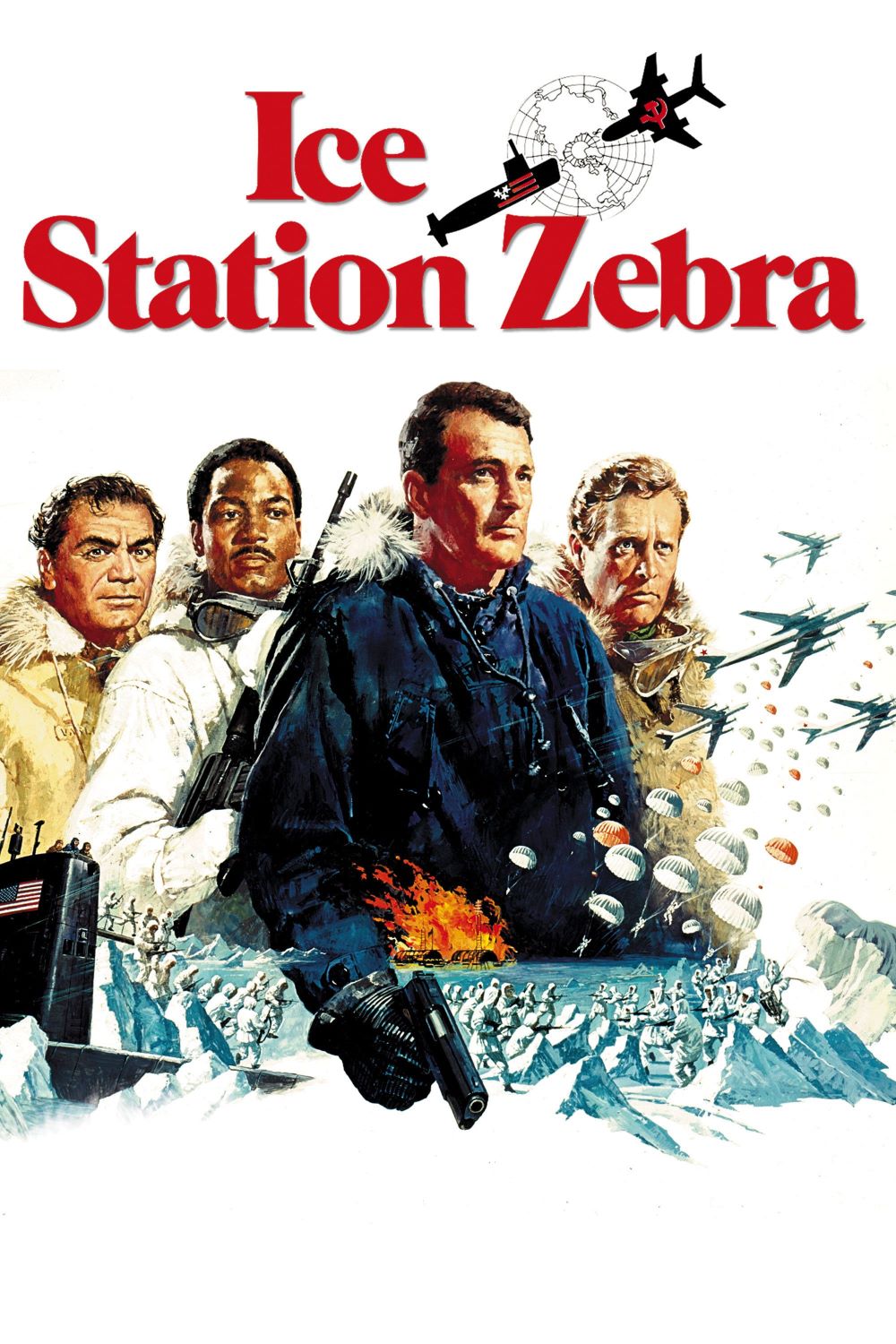
Guilty Pleasure No. 90: Ice Station Zebra (dir. by John Sturges)


Ice Station Zebra, directed by John Sturges in 1968, slides into guilty pleasure territory like a submarine slipping under polar ice—full of big Cold War ambitions, shadowy spy games, and submarine peril that tease something epic, but so loaded with pacing hiccups, studio shortcuts, and earnest overreach that it ends up a lopsided, lovably messy ride. Sturges had already cemented his rep with crowd-roaring hits like The Magnificent Seven, where a ragtag posse of gunslingers delivered razor-sharp tension and quotable showdowns, or The Great Escape, a WWII breakout yarn crackling with clever schemes, sweaty escapes, and Steve McQueen’s motorcycle glory. Those films moved like a well-oiled engine, every scene stacking stakes and character beats into unforgettable momentum. By contrast, Ice Station Zebra feels like Sturges chasing that same high-wire ensemble vibe—a U.S. nuclear sub, the USS Tigerfish, barreling toward a trashed Arctic outpost—but bloating into a 148-minute sprawl that swaps tight plotting for endless red-lit corridor glares and withheld mission secrets. It’s not in the same league as his earlier triumphs, lacking their propulsive drive and lived-in grit, yet that very shortfall turns it into quirky comfort viewing for fans who dig flawed ’60s spectacle.

The setup hooks you quick: Commander James Ferraday, Rock Hudson’s square-jawed everyman at the helm, gets tapped for a hush-hush run to Ice Station Zebra after a satellite supposedly carrying spy photos crashes nearby. No full briefing for him, just orders to play it cool while three mystery passengers board—Mr. Jones, a buttoned-up British agent with evasive smirks; Boris Vaslov, Ernest Borgnine’s barrel-chested Russian turncoat oozing fake bonhomie; and Captain Anders, Jim Brown’s steely Marine barking orders over a squad of jarheads. As the Tigerfish dives under thickening ice floes, the sub’s innards come alive with flickering sonar pings, steam-hissing valves, and crewmen hunched over gauges in perpetual sweat. It’s claustrophobic gold at first, the hull creaking like it’s got a bad case of frostbite, echoing the trapped dread Sturges nailed in his POW camp classic but without the same spark of rebellion. Then sabotage strikes—a flooded missile bay, a wild plunge toward crush depth—and fingers start pointing. Who tampered with the ballast? Jones with his locked trunk of gadgets? Vaslov’s too-friendly vodka toasts? The Marines itching for a fight? The scene builds real sweat, divers suiting up in the nick of time, but Sturges lets the fallout drag, turning interrogation into a tea party of suspicions rather than the cutthroat blame game his best films thrived on.

These early stumbles set the tone for a film that’s promising yet perpetually off-kilter, far from the seamless revenge rhythm of The Magnificent Seven‘s dusty trails. Production fingerprints show everywhere: rumors swirl of Navy brass forcing script tweaks to glorify their boats, last-minute casting shifts from bigger names to Hudson, and a roadshow rollout with overture, intermission, and 70mm pomp that screams overambition. The Arctic plunge delivers tense highlights—the sub ramming upward through ice chunks like a whale breaching, sparks flying from shorted panels, crew barking damage reports—but lulls follow with tech jargon dumps and characters circling motives without committing to conflict. Hudson anchors it all with unflappable poise, barking commands like a TV dad in a crisis, but he lacks McQueen’s sly charisma or Yul Brynner’s brooding fire. Borgnine hams it up as Vaslov, his accent flipping from gravelly growl to vaudeville schtick during mess-hall ribbing, while McGoohan brings the sharpest edge as Jones, his dry barbs hinting at deeper layers. Brown’s Anders gets muscle but little nuance, leading a Marine crew that feels like stock tough guys waiting for their cue.

Pushing topside, the flaws bloom into full charm. The ice cap arrival unfolds in sweeping widescreen vistas—endless white expanses, howling gales whipping snow devils—but close-quarters betray the soundstage: actors plodding through “blizzards” in lightweight jackets, no puffing breath in the deep freeze, sets that wobble if you squint. It’s the kind of earnest cheesiness that sinks modern blockbusters but endears this relic, especially when the station siege erupts. Soviets drop from the sky in parachutes like deadly snowflakes, scouring the charred ruins for a buried film capsule packed with NATO missile coords. Americans fan out in white camo, trading potshots amid smoke grenades and collapsing tunnels, loyalties cracking as Vaslov’s true colors flash. Ferraday’s cool bluff seals a three-way stalemate, denying everyone the prize in a nod to mutually assured secrets. Michel Legrand’s score surges here, horns blaring over the chaos like a war drum, giving Sturges’ action chops a late workout. Yet even this payoff sprawls, talky standoffs eating screen time where his peak films would’ve sprinted to the finish.

What seals Ice Station Zebra‘s guilty pleasure status is embracing its dated quirks as features, not bugs—hammy all-male bravado, Cold War jitters turned quaint, plot gaps you could park a destroyer in. Sturges conjures submerged panic and frosty fireworks that nod to his glory days, the sub’s practical effects holding up better than some CGI today, but without the narrative steel of The Great Escape‘s tunnel triumphs or The Magnificent Seven‘s mythic standoffs, it coasts on atmosphere over precision. Clocking 148 minutes, it tests patience with filler like extended sail sequences and coy reveals, yet rewards surrender: grin at Borgnine’s bear hugs masking menace, chuckle at the Navy polish glossing gritty potential, savor the sheer balls of staging Arctic Armageddon on a backlot. Howard Hughes reportedly looped it endlessly in his casino screening rooms, and you get why—it’s hypnotic in its wonkiness, a time capsule of late-’60s Hollywood flexing before New Wave grit crashed the party.

Pop this on a stormy night with cocoa and zero expectations, and Ice Station Zebra shines as cozy flawed fun. Sturges’ touch keeps the chills coming amid the clunkers, delivering submarine squeezes, betrayals under the aurora, and a finale with enough brinkmanship bang to forgive the bloat. It’s no peer to his earlier masterpieces, more a quirky footnote, but that’s the hook: imperfect promise wrapped in icy spectacle, begging a rewatch to spot every goofy grace note. For ’60s thriller buffs, submarine nuts, or anyone needing a break from slick reboots, it’s a frosty, flawed feast worth the dive.

Previous Guilty Pleasures

  1. Half-Baked
  2. Save The Last Dance
  3. Every Rose Has Its Thorns
  4. The Jeremy Kyle Show
  5. Invasion USA
  6. The Golden Child
  7. Final Destination 2
  8. Paparazzi
  9. The Principal
  10. The Substitute
  11. Terror In The Family
  12. Pandorum
  13. Lambada
  14. Fear
  15. Cocktail
  16. Keep Off The Grass
  17. Girls, Girls, Girls
  18. Class
  19. Tart
  20. King Kong vs. Godzilla
  21. Hawk the Slayer
  22. Battle Beyond the Stars
  23. Meridian
  24. Walk of Shame
  25. From Justin To Kelly
  26. Project Greenlight
  27. Sex Decoy: Love Stings
  28. Swimfan
  29. On the Line
  30. Wolfen
  31. Hail Caesar!
  32. It’s So Cold In The D
  33. In the Mix
  34. Healed By Grace
  35. Valley of the Dolls
  36. The Legend of Billie Jean
  37. Death Wish
  38. Shipping Wars
  39. Ghost Whisperer
  40. Parking Wars
  41. The Dead Are After Me
  42. Harper’s Island
  43. The Resurrection of Gavin Stone
  44. Paranormal State
  45. Utopia
  46. Bar Rescue
  47. The Powers of Matthew Star
  48. Spiker
  49. Heavenly Bodies
  50. Maid in Manhattan
  51. Rage and Honor
  52. Saved By The Bell 3. 21 “No Hope With Dope”
  53. Happy Gilmore
  54. Solarbabies
  55. The Dawn of Correction
  56. Once You Understand
  57. The Voyeurs 
  58. Robot Jox
  59. Teen Wolf
  60. The Running Man
  61. Double Dragon
  62. Backtrack
  63. Julie and Jack
  64. Karate Warrior
  65. Invaders From Mars
  66. Cloverfield
  67. Aerobicide 
  68. Blood Harvest
  69. Shocking Dark
  70. Face The Truth
  71. Submerged
  72. The Canyons
  73. Days of Thunder
  74. Van Helsing
  75. The Night Comes for Us
  76. Code of Silence
  77. Captain Ron
  78. Armageddon
  79. Kate’s Secret
  80. Point Break
  81. The Replacements
  82. The Shadow
  83. Meteor
  84. Last Action Hero
  85. Attack of the Killer Tomatoes
  86. The Horror at 37,000 Feet
  87. The ‘Burbs
  88. Lifeforce
  89. Highschool of the Dead

Late Night Retro Television Review: Highway to Heaven 3.14 “All That Glitters”


Welcome to Late Night Retro Television Reviews, a feature where we review some of our favorite and least favorite shows of the past!  On Thursdays, I will be reviewing Highway to Heaven, which aired on NBC from 1984 to 1989.  The entire show is currently streaming on Tubi and several other services!

This week, a conman seeks refuge in a church.

Episode 3.14 “All that Glitters”

(Dir by Michael Landon, originally aired on January 7th, 1987)

There’s a fire raging in the city and elderly homeowners are being forced to evacuate.  “Father” Jonathan and “Father” Mark open up an abandoned church so that the people have some place to stay while the fires are burning.  Good for them and also good for this show for finally acknowledging Catholicism.

Also hiding out in the church and disguised as a priest is Charley Trapola (John Pleshette), a con artist who, despite his criminal profession, actually has a good heart.  Charley has a briefcase with him, one that is full of money.  A group of criminals want the briefcase back but, at least initially, they know better than to try anything in the church.  Instead, they decide to wait for Charley to come out.  Inside the church, Charley gets to know Wanda (Didi Conn), a shy but kind-hearted woman who goes to Confession every day.

This episode was okay.  Usually, when Jonathan and Mark go undercover as clergyman, they’re portrayed as being wishy-washy Episcopalians or vaguely liberal Methodists so I was happy that they were Catholic for this episode.  John Pleshette and Didi Conn were both well-cast as this episode’s guest stars.  They eventually made for a very sweet and likable couple.  My main issue with this episode is that it tried to do a bit too much.  Not only did we have Charley being chased by the gangsters but we also had Wanda dealing with her shyness and Mark and Jonathan dealing with the people were seeking shelter and looking for their loved ones.  This episode — and not that weird marriage counseling episode — would have benefitted from an extra hour.  As it was, it just felt a bit overstuffed.  As well, this is another episode in which Jonathan reveals early on that he’s angel and, oddly enough, Charley has no hesitation about believing him.  I always prefer the episodes where Jonathan doesn’t reveal who he really is.  When Jonathan reveals that he’s an angel, it almost seems like cheating.  The show is always more effective when people decide to open up their hearts on their own as opposed to doing so because they feel they’ve been ordered to.

There’s an odd scene where the three thugs break into the church and pull a gun on Jonathan.  After Jonathan gives them fair warning about “the boss,” the main thug attempts to shoot Jonathan.  Needless to say, the bullets don’t have any effect on an angel.  However, a sudden blue lights fills the church and suddenly, the three men are apparently zapped out of existence.  Jonathan later jokes that he’s not sure where the three men are but that they probably aren’t happy.  So, did the three men go straight to Hell?  Are they dead?  I understand the logic behind the scene but it’s not really something you expect from a show where the main theme is usually that everyone has a chance for redemption.

Next week, Dick Van Dyke plays a homeless puppeteer …. uh oh.  This sounds like it could a little bit cringey …. well, we’ll see.


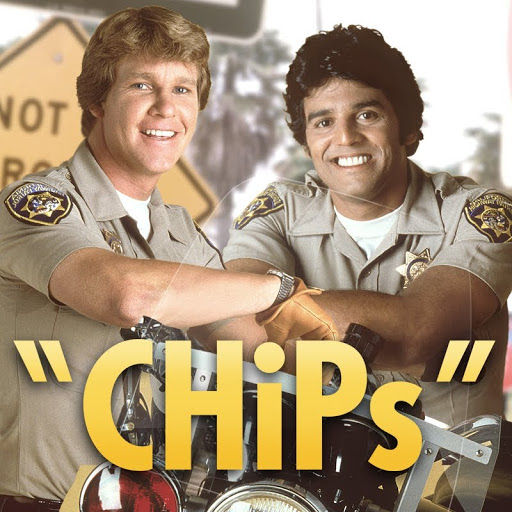
Late Night Retro Television Review: CHiPs 3.1 and 3.2 “Roller Disco”


Welcome to Late Night Retro Television Reviews, a feature where we review some of our favorite and least favorite shows of the past!  On Mondays, I will be reviewing CHiPs, which ran on NBC from 1977 to 1983.  The entire show is currently streaming on Prime!

This week, season three begins with a classic episode!

Episode 3.1 and 3.2 “Roller Disco”

(Dir by Don Weis, originally aired on September 22nd, 1979)

It’s the roller disco episode!

From the moment that I first announced that I would be watching and reviewing CHiPs for this feature, people have been telling me about the legendary roller disco episode.  Having finally reached it, I can say that it lived up to the hype.  You’re not likely to see anything more 70s than the third season premiere of CHiPs.

Now, this was a two-hour episode so there were actually quite a few subplot going on, all of which were typical CHiPs storylines.  In no particular order:

  1. A kid named Mark (Bobby Rolofson) is roller skating around the beach and idolizing three criminals.  Can Baker show him that the good guys always win?
  2. The three criminals are Lita (Helena Kallianiotes), Ty (Fred Williamson), and Romo (Jim Brown).  Lita sets up the targets.  Ty and Romo steal their purses and their wallets and then escape on roller skates.  Ty and Romo are tired of breaking the law.  Lita demands that they continue to steal.  Eventually, it falls to Baker and Ponch to arrest them.
  3. Carlin (Larry Linville) and Franco (Larry Storch) continually cause accidents on the highway.
  4. Rock star Jimmy Tyler (Leif Garrett) is so tired that he sleeps through one of those accidents.  Looking to break free from his well-meaning but overbearing manager (Bill Daily), Jimmy decides to manage his own affairs while staying at Jon Baker’s apartment.

There’s a lot going on but the main plotline is Ponch trying to find celebrities to take part in the annual highway patrol fund raiser.  Even with his big smile, Ponch struggles to charm the celebs.  He pulls over Ed McMahon at one point but fails to recognize him until McMahon drives off.  Gatraer tells Ponch that police work comes first but also tells him that he has to find celebrities.  Gatraer’s been giving Ponch a hard time ever since the first season.  Some things never change.

Fortunately, Jimmy feels guilty for overstaying his welcome at Baker’s apartment and he makes it up to Baker and Ponch by asking his celebrity friends to take part in the fund raiser.  It’s time for a roller disco with the stars!

It all leads to this classic scene:

I recognized a few of the stars, though certainly not all of them.  I recognized Victor French because I’ve been reviewing Highway to Heaven.  I’ve also seen enough old sitcoms that I immediately recognized Robert Mandan, who was apparently the best roller skater in Hollywood.  Melissa Sue Anderson, I knew from Happy Birthday To Me.  Cindy Williams, who got two shout-outs, I knew from American Graffiti.  Is it just me or did Nancy Kulp look kind of lost?  Neither Melissa Sue Anderson nor Cindy Williams seemed to want to talk to her.

The roller disco actually goes on for fifteen minutes, which I appreciated.  The show promised a roller disco and it delivered.  It was like stepping into a time machine and traveling to the 70s.  It was a great way to start season three!

Because of the holidays, this is going to be my final CHiPs review of 2024.  My reviews of this show will return on January 6th!

The TSL Grindhouse: Killing American Style (dir by Amir Shervan)


Filmed in 1988 but apparently not released until 1990, Killing American Style is a low-budget variation on The Desperate Hours.

The film opens with a ruthless criminal named Tony Stone (Robert Z’Dar, of Maniac Cop fame) leading a daring robbery of an ice cream truck depot.  All of the ice cream trucks have come back for the day and, when Tony and the boys show up, the money is still being counted.  Tony quickly takes control of the situation, intimidating everyone with both his weaponry and his amazing jawline.

Unfortunately, for Tony, the robbery is not as successful as he thought.  Yes, he gets away with a lot of money but the police quickly track him down to his home, where he’s in the process of having sex with his stepmother.  Tony is arrested and, in record time, sentenced to a maximum security prison.  (Seriously, the arrest, conviction, and sentencing all seem to happen on the same day.)  Tony is put on a prison bus but then the bus itself stops to help out a stranded motorist.  The motorist turns out to be Tony’s brother, Jesse (Bret Johnston).  In the resulting shootout, all of the guards are killed but Jesse is wounded.  Tony and his associate, Lynch (John Lynch …. hey, I wonder if that’s just coincidence?), take Jesse to a nearby ranch house.

The house belongs to John Morgan (Harold Diamond), who is a long-haired kickboxing champion.  When Tony arrives, John is out of the house and beating up the dad of a kid who bulled Morgan’s son, Brandon.  John is not happy to come home and discover Tony holding his entire family hostage.  For that matter, Morgan’s son isn’t amused by it either.

Because they are being pursued by a grim and determined police detective (played by Jim Brown …. yes, the same Jim Brown who starred in countless blaxploitation films in the 70s), Tony and his men do not want to run the risk of leaving the house to retrieve the loot from the robbery themselves.  So, they send Morgan out to pick up the suitcase from Tony’s stepmother.  I guess they assume that Morgan will be able to move around inconspicuously despite the fact that Morgan is a 6’1 kick boxer with long hair.  I mean, there’s no way that Morgan is going to be able to move around without being noticed by the cops.

Of course, before Morgan can get the money, he also has to get a doctor for Jesse.  Dr. Fuji (Joselito Rescober) agrees to help, despite the fact that he never seems to be quite sure what’s actually going on with all the angry men who keep pointing guns at each other.  When Dr. Fuji mentions that he wants to kill Tony “Japanese style,” Morgan promises that he’s going to kill Tony “American style.”  It’s never really made clear what the difference is between the two styles, though the American version does seem to involve a bit more kickboxing.

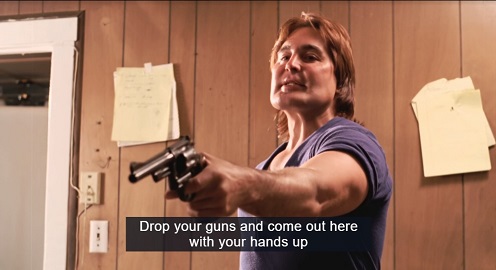
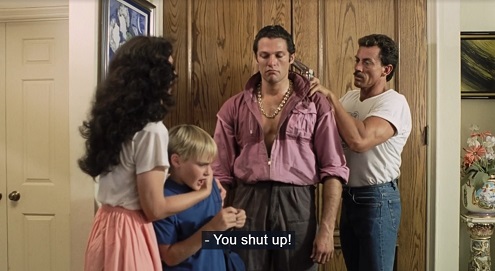
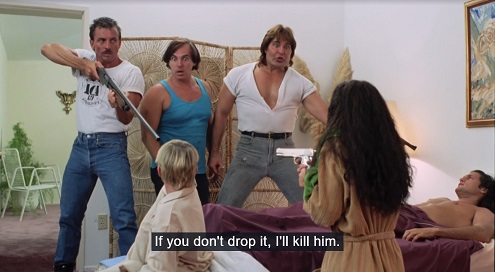
Anyway, this is an incredibly cheap and dumb movie but Robert Z’Dar seems like he’s having fun as Tony and …. well, to be honest, Robert Z’Dar is really the only reason to recommend this film.  He gives an enjoyably over-the-top performance, one that certainly contrasts with the more subdued performance of Harold Diamond.  (For his part, Diamond often seems to be struggling to stay awake.)  Hostage movies usually bore me to tears and this one had a lot of slow spots but it also had shots like the one below:

Eh.  Let’s call it even.

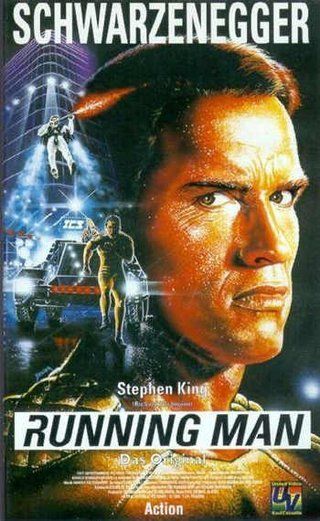
Guilty Pleasure No. 60: The Running Man (dir by Paul Michael Glaser)


“Killian, here’s your Subzero… now plain zero!”

Uhm, excuse me, Mr. Schwarzenegger, but a man just died.  He probably had a family who just watched you kill him on national television….

Oh well, it happens!  In the role of Ben Richards, Arnold Schwarzenegger kills quite a few people over the course of the 1987 film, The Running Man, but they were all bad.  In fact, when we first meet Ben Richards, he’s a cop who is trying to save lives.  His superiors want him to open fire on a bunch of protestors who simply want enough food to eat.  When Richards refuses to do it, he is framed for perpetrating “the Bakersfield Massacre” and is sent to prison.  When he is recaptured after escaping, he is given a chance to compete on America’s number one game show, The Running Man!  Hosted and produced by Damon Killian (Richard Dawson, oozing smarm in a performance that — in a fair world — would have received Oscar consideration), The Running Man is a show in which prisoners are given a chance to win prizes like a trial by jury or maybe even a pardon.  While the audience cheers and puts down bets, the prisoners are stalked by professional killers like Buzzsaw (Gus Rethwisch), Dynamo (Erland Van Lidth), Fireball (Jim Brown), and Sub-Zero (Professor Toru Tanaka).  Along with Killian, Captain Freedom (Jesse Ventura) provides commentary and analysis on how the game is going.  Ben soon finds himself joined by Amber (Maria Conchita Alonso), who proves herself to be just as tough as he is.

Seen today, The Running Man feels more than a bit prophetic.  Due to worldwide economic collapse, the poor are getting poorer while the rich are getting richer.  The American government has become both increasingly corporate and increasingly authoritarian.  The citizens are entertained and manipulated by “reality” programming.  On camera, Killian is a charismatic host who delivers his lines with faux sincerity and who loves to meet and give away prizes to the public.  (There’s something both undeniably creepy and also rather familiar about the way that Killian sniffs the hair, rubs the shoulders and holds the arms of the audience members to whom he’s speaking.  It’s all very calculated and one gets the feeling that Killian washes his hands as soon as the camera are off of him.)  Behind the scenes, he drinks, smokes, curses, and is full of contempt for everyone around him.  He may not be happy when Ben outsmarts and kills the show’s stalkers but he definitely cheers up when he hears how good the ratings are.  The film is set in 2017, which was 30 years in the future when The Running Man was first released.  Seen today, The Running Man’s 2017 feels a lot like our 2017….

That said, The Running Man is also a big, flamboyant, and undeniably entertaining film.  It’s also surprisingly funny, at times.  Living in a dystopia ahs turned everyone into a quip machine.  None of the bad guys die without Schwarzenegger making a joke about it.  (“Buzzsaw?  He had to split.”  Yes, he did.)  The show’s vapid studio audience, who go from cheering the prospect of witnessing a bloody death to crying when their favorite stalker is killed, is both disturbing and humorous.  (Also memorable is the faux somber dance number that is performed while the show memorializes all the dead stalkers.)  For all the costumed heroes and villains, the film is practically stolen by an older woman named Agnes who becomes Ben Richards’s favorite fan.  The gaming “quads” may be dark and dangerous and full of angry people but they’re also full of advertisements for Cadre Cola.  Dey Young of Rock and Roll High School and Strange Behavior fame has a cameo as Amy, who pays six dollars for a can of Cadre.  (That may seem like a lot for a can of anything but Cadre is the official cola of The Running Man!  Damon Killian endorses it!  And, of course, when The Running Man was produced, the studio was owned by Coca-Cola so the jokes about Cadre’s corporate dominance also serve as a “take that” towards the corporation who put up money for the film.  Either that or Cadre is stand-in for Pepsi.)

It’s easy to compare The Running Man to The Hunger Games films but The Running Man is infinitely more fun, if just because it doesn’t make the mistake of taking itself as seriously as The Hunger Games did.  (Add to that, The Running Man manages to wrap up its story in 90 minutes, whereas The Hunger Games needed four movies.)  Like The Hunger Game, The Running Man is based on a book, in this case a very loose adaptation of one of the pulpy novels that Stephen King wrote under the name of Richard Bachman.  While King said that he enjoyed the film, he also asked that his real name not be listed in the credits because the film had little in common with his book, which is fair enough.  The Running Man may have been inspired by a Stephen King novel but it’s an Arnold Schwarzenegger production through-and-through.

Previous Guilty Pleasures

  1. Half-Baked
  2. Save The Last Dance
  3. Every Rose Has Its Thorns
  4. The Jeremy Kyle Show
  5. Invasion USA
  6. The Golden Child
  7. Final Destination 2
  8. Paparazzi
  9. The Principal
  10. The Substitute
  11. Terror In The Family
  12. Pandorum
  13. Lambada
  14. Fear
  15. Cocktail
  16. Keep Off The Grass
  17. Girls, Girls, Girls
  18. Class
  19. Tart
  20. King Kong vs. Godzilla
  21. Hawk the Slayer
  22. Battle Beyond the Stars
  23. Meridian
  24. Walk of Shame
  25. From Justin To Kelly
  26. Project Greenlight
  27. Sex Decoy: Love Stings
  28. Swimfan
  29. On the Line
  30. Wolfen
  31. Hail Caesar!
  32. It’s So Cold In The D
  33. In the Mix
  34. Healed By Grace
  35. Valley of the Dolls
  36. The Legend of Billie Jean
  37. Death Wish
  38. Shipping Wars
  39. Ghost Whisperer
  40. Parking Wars
  41. The Dead Are After Me
  42. Harper’s Island
  43. The Resurrection of Gavin Stone
  44. Paranormal State
  45. Utopia
  46. Bar Rescue
  47. The Powers of Matthew Star
  48. Spiker
  49. Heavenly Bodies
  50. Maid in Manhattan
  51. Rage and Honor
  52. Saved By The Bell 3. 21 “No Hope With Dope”
  53. Happy Gilmore
  54. Solarbabies
  55. The Dawn of Correction
  56. Once You Understand
  57. The Voyeurs 
  58. Robot Jox
  59. Teen Wolf

Live Tweet Alert: Join #FridayNightFlix for The Running Man!


As some of our regular readers undoubtedly know, I am involved in a few weekly live tweets on twitter.  I host #FridayNightFlix every Friday, I co-host #ScarySocial on Saturday, and I am one of the five hosts of #MondayActionMovie!  Every week, we get together.  We watch a movie.  We tweet our way through it.

Tonight, at 10 pm et, I will be hosting the first #FridayNightFlix of 2022!  The movie? 1987’s The Running Man!

If you want to join us this Friday, just hop onto twitter, start the movie at 10 pm et, and use the #FridayNightFlix hashtag!  It’s a friendly group and welcoming of newcomers so don’t be shy.

The Running Man is available on Prime and Paramount!  See you there!

Film Review: Fingers (dir by James Toback)


Welcome to method actor Hell!

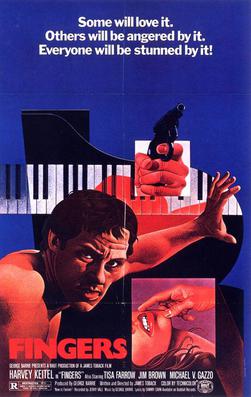
The 1978 film, Fingers, tell the story of Jimmy “Fingers” Angelilli (Harvey Keitel).  Jimmy is a creep who works as a debt collector for his father, a small-time loan shark named Ben (Michael V. Gazzo).  Jimmy is violent and brutal and often wanders around with a disturbingly blank-look on his face but we’re supposed to like him because he’s a talented pianist and he’s got a recital interview coming up at Carnegie Hall.  Jimmy carries a radio with him wherever he goes and he’s obsessed with the song Summertime.  He’s the type who will sit in a crowded restaurant and play the song and then get upset when someone tells him to turn off his radio.  By the end of the movie, I was really hoping that someone would take Jimmy’s radio and smash into a hundred pieces.

Jimmy is in love with Carol (Tisa Farrow, who was a far better actress than her sister Mia and who would later appear in Lucio Fulci’s classic, Zombi 2), who doesn’t really seem to all that into him.  Despite being in love with Carol, Jimmy still hits on every woman that he meets and, because this is a 70s films, he’s constantly getting laid despite being kind of a charmless putz.

Jimmy meets a former boxer named Dreems (Jim Brown).  Carol is apparently one of Dreems’s mistresses.  Jimmy silently watched while Dreems knocks two women’s heads together.  Jimmy stands there with his little radio and a blank expression on his face.  Is anything going on inside of Jimmy’s head?  It’s hard to say.

Eventually, Jimmy finds out that a gangster (Tony Sirico) owes his father money but is refusing to pay.  It all leads to violence.

As a film, Fingers is pretty much full of shit but that shouldn’t come as a surprise because it was the directorial debut of James Toback and there’s no American filmmaker who has been as consistently full of shit as James Toback.  Fingers has all of Toback’s trademarks — gambling, crime, guilt, classical music, and a juvenile view of sexuality that suggests that James Toback’s personal development came to a halt when he was 16 years old.  It’s a pretentious film that really doesn’t add up too much.  Again, you know what you’re getting into when James Toback directs a film.  Don’t forget, this is the same director who made a documentary where he was apparently shocked to discover that no one wanted to finance a politically-charged remake of Last Tango in Paris starring Alec Baldwin and Neve Campbell.

Fingers is a bit of an annoying film and yet it’s not a total loss.  For one thing, if you’re a history nerd like I am, there’s no way that you can’t appreciate the fact that the film was shot on location in some of New York’s grimiest neighborhoods in the 70s.  While I imagine it was more of a happy accident than anything intentional on Toback’s part (because, trust me, I’ve seen Harvard Man), Fingers does do a good job of creating an off-center, dream-like atmosphere where the world constantly seems to be closing in on its lead character.  Jimmy is trying to balance his life as violent mobster with being a sensitive artist and the world around him is saying, “No, don’t count on it, you schmuck.”

As well, Harvey Keitel gives a …. well, I don’t know if I would necessarily say that it’s a good performance.  In fact, it’s a fairly annoying performance and that’s a problem when a film is trying to make you feel sympathy for a character who is pretty unsympathetic.  That said, there’s never a moment in the film where Keitel is boring.  In Fingers, Keitel takes the method to its logical end point and, as a result, you actually get anxious just watching him simply look out of a window or sit in a corner.  Even though Jimmy eyes rarely shows a hint of emotion, his fingers are always moving and, just watching the way that he’s constantly twitching and fidgeting, you get the feeling that Jimmy’s always on the verge of giving out a howl of pain and fury.  It doesn’t really make Jimmy someone who you would want to hang out with.  In fact, I spent the entire movie hoping someone would just totally kick his ass and put him in the hospital for a few weeks.  But it’s still a performance that you simply cannot look away from.  Watching Keitel’s performance, you come to realize that Fingers is essentially a personal invitation to visit a Hell that is exclusively populated by method actors who have gone too far.

Anyway, my feelings about Fingers were mixed.  Can you tell?  It’s an interesting movie.  I’ll probably never watch it again.

I Escaped From Devil’s Island (1973, directed by William Whitney)


The year is 1918 and the French penal colony, Devil’s Island, is renowned as the world’s most brutal prison.  Hidden away from mainland Europe, it is populated by the worst of the worst.  The prisoners have been sentenced to either spend their life on the island or to die at the blade of guillotine and the guards are all sadists.  Le Bras (Jim Brown) has been sentenced to die but he impresses his fellow inmates by putting up a fight on his way to have his head chopped off.  He doesn’t succeed in escaping but, fortunately for him, the death penalty is abolished mere moments before the blade falls.

Le Bras is alive but he’s still been condemned to spend the rest of his life on Devil’s Island, under the sadistic eye of the head guard, Maj. Marteau (Paul Richards).  However, Le Bras has no intention of being anyone’s prisoner.  He teams up with two other prisoners, a pacifist named Davert (Christopher George) and Jo-Jo (Richard Ely), who, because he is gay, is abused by both the guards and the other prisoners.  The three of them manage to escape from the prison but they still have to make their way through the jungle.  Along the way, they visit a leper colony and Le Bras takes some time to get busy with a native woman.  Meanwhile, Marteau remains hot behind them, determined to capture them and send them back to the prison.

If I Escaped From Devil’s Island sounds familiar, that may be because you’ve seen Steve McQueen and Dustin Hoffman in Papillon.  Papillon was a major studio production with big stars, a huge budget, and an epic running time.  I Escaped From Devil’s Island was a low-budget film starring B-movie stars and with a 90-minute running time that was the exact opposite of epic.  Roger Corman produced I Escaped From Devil’s Island to capitalize on the expected success of Papillon and he started production early enough that I Escaped From Devil’s Island actually beat Papillon to theaters by a matter of weeks.  Corman originally tried to hire Martin Scorsese to direct I Escaped From Devil’s Island.  When Scorsese decided to follow John Cassavetes’s advice and do a personal film instead, Corman ended up hiring William Whitney to direct.  (Scorsese’s personal film turned out to be Mean Streets, so he probably made the right decision.)

I Escaped From Devil’s Island is an entertaining B-movie.  It doesn’t have the epic sweep of Papillon but it does have a fun cast and all the action that you would expect from a 70s Corman production.  Jim Brown was never a great actor but he never claimed to be.  What Brown had was a tremendous physical presence and a confident movie star charisma and both of those are put to good use in I Escaped From Devil’s Island.  Whether he was playing football or beating up bad guys, Jim Brown was always the epitome of cool and that’s especially true in this film.  Christopher George has some good scenes as a pacifist who believes in non-violent resistance and Paul Richards is a great villain but this is a movie that you watch for Jim Brown and he doesn’t disappoint.

As of today, Jim Brown is 84 years old.  As anyone who has seen him interviewed recently can tell you, Jim Brown is still the epitome of cool.  When Jim Brown speaks, whether people agree with him or not, they still shut up and listen.  Happy birthday, Jim Brown!

Black Gunn (1972, directed by Robert Hartford-Davis)


A war has broken out in Los Angeles.

The Black Action Group (B.A.G.) has robbed a Mafia bookmaking operation.  The Mafia, led by used car dealer Russ Capelli (Martin Landau, in his slumming it years), is less concerned with the money as they are with the fact that one of the militants, a Vietnam vet named Scott Gunn (Herbert Jefferson, Jr.), has also stolen a set of ledgers that could reveal every detail of their organization.  Capelli sends the psychotic Ray Kriley (Bruce Glover, father of Crispin) on a mission to track down Scott and kill him.

What the Mafia didn’t count on is that Scott’s older brother, Gunn (Jim Brown), is the owner of Los Angeles’s hottest nightclub.  When Scott approaches his brother, Gun tells him that he doesn’t care about the B.A.G. or any of their politics.  Still, Gunn allows Scott to stash the ledgers at his club and to hide out at his place.  When Scott still ends up getting murdered by Kriley, Gunn sets out to get revenge.

For the most part, Black Gunn is a standard blaxploitation movie with all of the usual elements, a cool nightclub, the mob, black militants,an anti-drug scene and a speech about why it’s important to not sell out to the man, and a hero played by an actor who may not have been able to show much emotion but who still radiated coolness.  Not surprisingly, Jim Brown is the main attraction here and he delivers everything that his fans have come to expect from him.  Blaxploitation regulars Bernie Case and Brenda Sykes also appear in the film.  Casey plays the head of B.A.G. while Sykes is wasted in a one-note role as Gunn’s girlfriend.  Among the villains, it’s fun to watch the glamorous Luciana Paluzzi plays a gangster’s niece and Bruce Glover is just weird enough to make Kriley interesting.  Though Martin Landau would end his career with a deserved reputation for being one of America’s greatest character actors, he spent most of the 70s sleepwalking through roles in low-budget action and horror films and his performance in Black Gunn is no different.  Having Capelli be both a car salesman and a gangster is a nice touch but otherwise, he’s just not that interesting of a character and Landau is only present to get a paycheck.

Black Gunn has some slow spots but the final shoot-out between the militants and the gangsters is exciting and so brutal that it will be probably take even the most jaded blaxploitation fan by surprise.  Black Gunn is hardly a classic but, like its hero, it gets the job done.