Airport ’77 is the one where the plane ends up underwater.
If the first two Airport movies emphasized the competence of the the crew in both the airplane and the airport, Airport ’77 takes the opposite approach. The first of the Airport films to be released after Watergate, Airport ’77 is a cynical film where no one seems to be particularly good at his or her job. Viewers should be concerned the minute they see that Jack Lemmon is playing Captain Don Gallagher, the pilot of the soon-to-be-submerged airplane. As opposed to Charlton Heston or even the first film’s Dean Martin, Jack Lemmon was always a very emotional actor. He excelled at playing characters who were frustrated with modern life. Just as with Heston and Martin, Lennon plays a pilot who is having an affair with a flight attendant. The big difference is that, this time, the pilot is the one who desperately wants to get married while the flight attendant (played by Brenda Vacarro) is the one who doesn’t want to get tied down. As an actor, Lemmon didn’t have the arrogance of a Heston or the unflappability of Dean Martin. Instead, Jack Lemmon was the epitome of midlife ennui. He’s disillusioned and he’s beaten down. He’s America at the tail end of the 70s.
Another sign that Airport ’77 is a product of the post-Watergate era is the character of co-pilot Bob Chambers (Robert Foxworth). Chambers might seem like a nice and friendly professional but actually, he’s the one who comes up with the plan to knock out all of the passengers with sleeping gas and fly the plane into the Bermuda Triangle so that his partners-in-crime can steal the valuable art works in the cargo hold. Chambers plans is to land the plane on an unchartered isle so that he and Banker (Monte Markham) can make their escape before the rest of the people on the plane even wake up. Instead, Chambers turns out to be as incompetent a pilot as he is a criminal. He crashes the plane into the ocean, where it promptly sinks to the bottom. The impact wakes up the passengers, all of whom can only watch in horror as the ocean envelopes their plane. With the water pressure threatening to crush the plane, Captain Gallagher and engineer Stan Buchek (Darren McGavin) try to figure out how to get everyone to the surface.
As usual, the passengers are played by a collection of familiar faces. Olivia de Havilland and Joseph Cotten play former lovers who are reunited on the flight. Christopher Lee is a businessman who is unhappily married to alcoholic Lee Grant. Grant is having an affair with Lee’s business partner, Gil Gerard. A young Kathleen Quinlan plays the girlfriend of blind pianist Tom Sullivan. Robert Hooks is the bartender who ends up with a severely broken leg. As the veterinarian who is called to doctor’s duty, M. Emmet Walsh gives the best performance in the film, if just because he’s one of the few characters who really gets to surprise us. Actors like George Furth, Michael Pataki, and Tom Rosqui all wander around in the background, though I dare anyone watching to actually remember the names of the characters that they’re playing. Airport ’77 has the largest number of fatalities of any of the Airport films, largely because even the good guys aren’t really sure about how to reach the surface.
George Kennedy returns as Joe Patroni, though his role is considerably smaller in this film than it was in the first two. He shares most of his scenes with James Stewart, who plays the owner of the plane. Fortunately, neither Stewart nor Kennedy were on the plane when it crashed. Instead, they spend most of the movie in a control room, getting updates about the search. They don’t get to do much in the film but it’s impossible not to smile whenever Jimmy Stewart is onscreen, even if he is noticeably frail.
Airport ’77 is the best-made of all of the Airport films. The crash is well-directed and the scenes of water dripping into the plane are properly ominous. There’s not much depth to the characters but Jack Lemmon and Darren McGavin are likable as the two main heroes and Christopher Lee seems to be enjoying himself in a change-of-pace role. Olivia de Havilland and Joseph Cotten, two old pros, are wonderful together. That said, Airport ’77 is never as much fun as the first two films. Even with the plane underwater, it can’t match the spectacle of Karen Black having to fly a plane until Charlton Heston can be lowered into the cockpit.
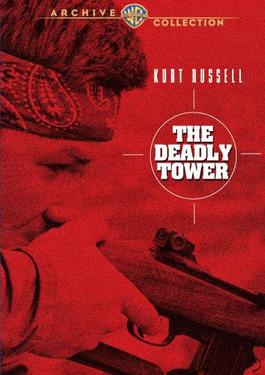
Made for television, The Deadly Tower is a recreation of the terrible day in 1966 that a 25 year-old former Marine named Charles Whitman shot his wife and mother and then climbed to the top of the tower at the University of Texas in Austin and started to indiscriminately firing on the people below. It was one of the first mass shootings of its kind. What drove All-American boy Charles Whitman, who was eventually taken down by the police, to start his rampage is not known though the autopsy revealed that he did have a small brain tumor at the time of his death.
The Deadly Tower focuses mostly on the efforts of the policeman Ramiro Martinez (Richard Yinguez) and civilian Allan Crum (Ned Beatty) to get to the top of the tower and stop Whitman’s shooting rampage. (Pernell Roberts, John Forsythe, and Clifton James all appear as other police officials, trying to deal with what was then an almost unheard of occurrence.) Martinez risks his life to stop Whitman’s rampage while Allan worries that other shootings will follow. One of the first examples of a true crime event being turned into a movie for television, The Deadly Tower a tense and effective docudrama. Kurt Russell, who was then still known for being Disney’s top-paid star, plays Whitman. Russell doesn’t have much dialogue in the film. He’s blandly friendly while buying bullets and, when he’s sitting up in the tower with his rifle, he could just as easily pass for a teenager out hunting with his father during deer season. Russell’s clean-cut appearance made him ideal for playing the role of someone who no one would have ever suspected could be capable of committing such a terrible crime. It took courage to cast an actor then known for Disney films as one of America’s worst mass murderers and it also took courage for Russell to accept a role that was the total opposite of his family-friendly image.
The Deadly Tower used to show up on television frequently when I was a kid. It’s still a scary movie, even if you know how it’s going to end. Whitman may have been one of the first of his kind but sadly, he wouldn’t be the last.
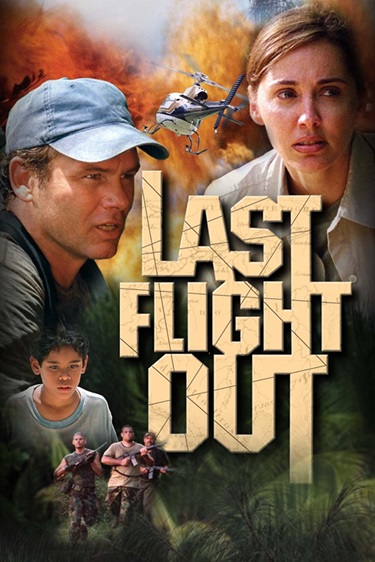
The 2004 film, Last Flight Out, tells the story of Dan (Richard Tyson) and Anne (Bobbie Phillips).
Once upon a time, Dan and Anne were in love. Perhaps they were attracted by the fact that their names rhymed. “Dan and Anne” is just one of those phrases that just rolls off the tongue. Unfortunately, it takes more than rhyming names to make a relationship work. Dan was a cynic and Anne wanted to make the world a better place and, in the end, she decided she could do that better without him than with him.
Now, Anne is missionary, working with Dr. Matteo Barrero (Adriano Gonzalez) at a village in a South American country that is, more or less, ruled by a drug cartel. And Dan is a pilot, flying missions throughout the world and trying not to get emotionally connected with anyone. Anne’s mentor, Tony Williams (Cliff de Young), approaches Dan with a job. The village where Anne is working is currently under siege from a drug lord who demands that all the villagers come to work for him. The payment that drug lord offers for their work is simple. If they work for him, he will reward them by not killing them. If they don’t work for him …. well, you get the idea.
Dan flies to the village, mostly to try to get Anne to safety. But Anne explains that she won’t abandon the villagers to the drug lord. Eventually, Anne is able to convince the village’s chief that the entire villages needs to be moved to safety. That’ll mean putting all twenty of them on Dan’s plan and flying them away from the drug lord’s army. Dan explains that, even if they take all the seats out of the plane, they’ll still be overweight and unable to take off. Both Anne and Matteo tells Dan to have a little faith.
And, while the drug lord’s army fires at them from the ground, the plane does manage to take off! But Matteo is left behind. Back in civilization, everyone is convinced that Matteo is dead. Dan, however, is determined to go back and, if possible rescue Matteo. That, of course, will mean flying straight back into the gunfire and once again, risking his life for another person. And, in this case, his name doesn’t even rhyme with Matteo’s!
Last Flight Out isn’t a bad little film. Of course, those tempted to watch the film on Tubi should be aware that it is a faith-based production, so Matteo is very outspoken in his belief in God and the film does feature prayers while in flight. Naturally, Dan is the atheist who changes his position after witnessing the bravery of the missionaries. That said, the film is smart to emphasize action over preaching and Richard Tyson gives a likable performance as Dan. In the end, one need not be filled with faith to know that slave labor is wrong. Director Jerry Jameson, who directed a host of disaster films in the 70s and the 80s, keeps the action moving at a steady pace and, the end result, is a watchable action film.
Welcome to Retro Television Reviews, a feature where we review some of our favorite and least favorite shows of the past! On Sundays, I will be reviewing the made-for-television movies that used to be a primetime mainstay. Today’s film is 1975’s The Secret Night Caller! It can be viewed on YouTube!
Though the show pretty much guaranteed that he would forever be a part of the American pop cultural landscape, Robert Reed was not a fan of The Brady Bunch. Onscreen, Reed played Mike Brady, the stern patriarch who always knew the right thing to do and who, as a result, was named father of the year by the local chamber of commerce. (Of course, even though she was responsible for him getting the reward, Mike still grounded Marcia for sneaking out to mail in his nomination forms.) Offscreen, Reed was notoriously difficult, complaining that the scripts for the show were juvenile and shallow. Reed was correct and it should be noted that all of the actors who played the Brady kids have said that Reed never took out his frustration on the cast and actually became a bit of a surrogate father to all of them. Still, you have to wonder what Reed was expecting when he signed up for a show that was created by the man responsible for Gilligan’s Island.
The Brady Bunch was cancelled in 1974, temporarily setting Robert Reed free from the burden of playing Mike Brady. (Of course, he would later return to the role in The Brady Bunch Hour and we all know how that turned out.) One of the first post-Brady movies that Reed starred in was The Secret Night Caller.
In this film, Reed plays a seemingly mild-mannered IRS (booo!) agent named Freddy Durant. Freddy has a good career and a nice home but he’s deeply unsatisfied. He barely communicates with his wife, Pat (Hope Lange). He freaks out over his teenage daughter, Jan (Robin Mattson), wearing a bikini. He fantasies about hitting on almost every woman that he sees. He hangs out at a strip club and, when he’s really feeling unsatisfied, he makes obscene phone calls! Because this is a made-for-TV movie from the 70s, we never actually get to hear what Freddy says on the phone but he manages to disgust and/or horrify everyone who has the misfortune to answer his call. He even calls a woman who works in his office, scaring Charlotte (Arlene Golonka) so much that she subsequently has an auto accident. Unfortunately, for Freddy, one of his victims, a stripper named Chloe (Elaine Giftos), recognizes his voice and tries to blackmail him. Freddy’s life is falling apart. Can his psychiatrist (played by Michael Constantine) help him put it all back together again?
Freddy Durant is obviously meant to come across as being the exact opposite of Mike Brady. (Of course, many of us who have seen The Brady Bunch have our suspicions about what Mike was actually doing in his office….) Whereas Mike Brady was the perfect father, Freddy is cold, distant, and repressed. Reed is convincingly uptight as Freddy and he’s surrounded by a fine supporting cast, including Sylvia Sidney as his disapproving mother-in-law. That said, it’s still impossible to watch this show without thinking to yourself, “There’s Mike Brady making an obscene phone call.” That’s the difficulty of typecasting unfortunately. For all of his efforts to escape the shadow of the Brady Bunch, it’s impossible not to associate Robert Reed with the show, even when he’s talking dirty on the phone.
Welcome to Retro Television Reviews, a feature where we review some of our favorite and least favorite shows of the past! On Sundays, I will be reviewing the made-for-television movies that used to be a primetime mainstay. Today’s film is 1974’s The Elevator! It can be viewed on YouTube!
Marvin Ellis (Roddy McDowall) hates his job. He’s been assigned to be the manager of a new high-rise office building. Parts of the building are still under construction but that hasn’t stopped the company that owns it from selling out office space. When Mrs. Kenyon (Myrna Loy) comes by and asks to look at the top floor penthouse, Ellis agrees. In public, Ellis is always friendly and always courteous. It’s only under the most stressful of circumstances that Ellis reveals that he feels as if the building has been built of out lies and cheap material.
Ellis and Kenyon soon find themselves in a stressful situation when they are trapped in an elevator. Of course, they’re not alone in the elevator. There’s also Dr. Reynolds (Craig Stevens), his wife (Teresa Wright), and his mistress (Arlene Golonka). And then there’s Robert Peters (Barry Livingston), a teenager who has inherited a fortune. And finally, there’s Eddie Holcomb (James Farentino). Eddie has a suitcase full of money that he’s stolen from an office in the building. He’s also got a loaded gun. And, perhaps worst of all, he has an intense fear of tight places. The longer that he’s trapped in the elevator, the worse his claustrophobia becomes.
Because the building isn’t really finished yet, the elevator’s alarm button doesn’t really work. Other than the passengers trapped inside, the only people who know about the stalled elevator are Eddie’s partners-in-crime. Irene (Carol Lynley) is Eddie’s girlfriend and she just wants to get the situation resolved with as little violence as possible. Pete (Don Stroud) is Eddie’s sociopathic friend. Pete is not only determined to rescue Eddie and retrieve the suitcase. He’s also determined to take care of any potential witnesses by killing everyone on the elevator.
The Elevator is a disaster film, along the lines of Airport and The Towering Inferno. Due to the hubris of a faceless corporation, a group of people find themselves trapped in a potentially catastrophic situation. Some of them react with bravery. Some of them react with cowardice. All of them get a chance to reveal a bit of who they are on the inside. Some might say that being trapped in an elevator is not quite as bad being trapped in a fiery skyscraper or being a passenger on a airplane that’s being held hostage by a mad bomber. Technically, they’re right but I am also going to admit right now that I absolutely hate elevators and I try to avoid them whenever I can. I always say that this is because running up and down several flights of stairs is a good way to keep my legs looking good and certainly that’s part of it. But an even bigger reason is that I dread the thought of being stuck in a confined space with a bunch of strangers. If I was on an elevator that was stuck between floors, I would probably lose my mind. I have a hard enough time just standing in line for longer than 3 minutes. As directed by Jerry Jameson, The Elevator does as good job of capturing the feeling of being trapped in a small space. It’s not a film to watch if you have claustrophobia.
As for the cast, Myrna Loy is a delight as the eccentric Mrs. Kenyon. And seriously, how can you dislike any film that gives Roddy McDowall a monologue about how much he hates skyscrapers? It’s an entertaining, if undemanding, film. After watching The Elevator, I’ll keep taking the stairs.
One year after throwing his tin star to the ground and riding out of town in disgust at the cowardice of the citizens who he once served, former Marshal Will Kane (Lee Majors, stepping into the role that won Gary Cooper an Oscar) returns to Hadleyville with his bride, Amy (Katherine Cannon).
Hadleyville has a new sheriff. When Kane angrily left, he was replaced by J.D. Ward (Pernell Roberts), a corrupt tyrant who runs the town with an iron fist and who is more interested in making money than upholding the law. Ward is determined to collect the bounty on Ben Irons (David Carradine), a reformed outlaw who swears that he’s innocent. Kane decides to try to help Ben escape from Ward and his posse, which leads to potentially disastrous consequences for him. Will the town finally show the courage necessary to stand behind Kane or will he once again be forced to go it alone?
High Noon, Part II is a made-for-TV movie. It was obviously designed to be a pilot for a potential television series, one that would have featured the weekly adventures of Will Kane in Hadleyville. As far as made-for-TV westerns are concerned, it’s about average, neither particularly good nor bad. Lee Majors may not have been a great actor but he was believable in western roles and both Pernell Roberts and David Carradine give good performances as well. Jerry Jameson directs in a workmanlike manner. The story’s predictable but it’s a western so what do you expect?
The main problem with the film is that it’s set up to be a sequel to a film that never needed one. When Gary Cooper threw that star in the dust and climbed up on that wagon with Grace Kelly in High Noon, the whole point of the story was that Will Kane was never going to return to Hadleyville because the citizens of Hadleyville deserted him when he most needed them. Hadleyville didn’t deserve Will Kane. That’s what set High Noon apart from other westerns. Having Kane return to Hadleyville and once again pick up the tin star negates everything that made High Noon so effective. The whole point of the ending was that Will Kane was never going to return but, according to this movie, he did and forgave the town for the unforgivable. It’s impossible to watch High Noon II without thinking about how it goes against everything that the first High Noon was all about.
Oddly enough, the film’s forgettable screenplay was written by the great Elmore Leonard. Leonard did better work before this film and he would do better work afterwards.
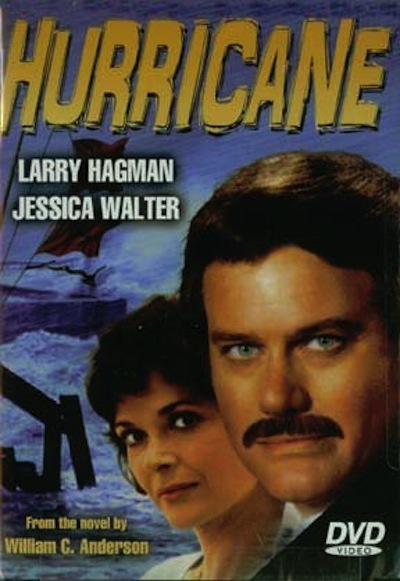
Hurricane Hilda is crashing down on the Gulf Coast and everyone in its path is about to get all wet. While Will Geer and Michael Learned try to warn everyone about the approaching hurricane, coast guard pilot Martin Milner observes the storm from the air and tires to rescue everyone in its path. Some people listen and some people don’t. Milner’s own father, played by Barry Sullivan, ends up getting stranded in a cabin while Larry Hagman and Jessica Walter play a married couple on a boat who find themselves sailing straight into the storm. On temporarily dry land, Frank Sutton (a.k.a. Gomer Pyle’s Sgt. Carter) plays a homeowner who refuses to evacuate because he’s convinced that he knows everything there is to know about hurricanes. He and the neighbors have a drunken party while waiting for the storm. When Patrick Duffy and his wife announce that they’re heading for safety, Sutton demands that they come in and have a beer with him. When Hilda finally makes landfall, some survive and some don’t.
Hurricane is a by-the-numbers disaster movie. It was made after The Poseidon Adventure and during the same year as The Towering Inferno and it hits all the usual disaster movie beats. Survival is determined by karma, with Hilda going after anyone who was too big of a jerk during the first half of the movie. It’s predictable stuff but it does feature footage from an actual hurricane so it’s at least not too dragged down by any of the bad special effects that always show up in made-for-TV disaster films.
This is one of those films where the cast was probably described as being all-star, even though most of them were just TV actors who needed a quick paycheck. Seen today, the film feels like a MeTV reunion special. Years before they played brothers in Dallas, both Larry Hagman and Patrick Duffy appeared in Hurricane, though neither of them shares any scenes. Will Geer and Michael Learned were starring on The Waltons when they appeared in this movie and they’re in so few scenes that they probably shot their scenes over a weekend before returning to Walton’s Mountain. The best performance is from Frank Sutton, who died of a heart attack just a few weeks after this movie aired. He’s a convincing hothead, even if he doesn’t have Gomer around to yell at.
Hurricane may be bad but it’s still not as terrible as most made-for-TV disaster movies. People who enjoy watching TV actors pretending to stare at a tidal wave of water about to crash down on them will find this film to be an adequate time waster.
Yay! Brianne O’Neill (Lynda Carter) has a got a new job, working at a crisis hotline!
Boooo! The serial called known as the Barber is now obsessed with calling her!
The Barber is known as the Barber because he cuts his victims’s hair before killing them, which as far as I’m concerned, make him even worse than a normal serial killer. You have to wonder if he resents being known as the Barber as opposed to The Stylist.
Anyway, it’s up to Brianne to figure out why The Barber keeps calling her and to hopefully discover his identity. For whatever reason, no one else seems to be that concerned about it.
That’s the plot of Hotline, a 1982 made-for-TV movie that is today’s horror on the lens. It’s not a bad film, though it does inspire a certain amount of snarkiness while you’re watching it. For the most part, though, it’s well-acted and effectively directed. If you’ve got 95 minutes to kill, why not kill them with Lynda Carter, The Barber, and Frank Stallone?
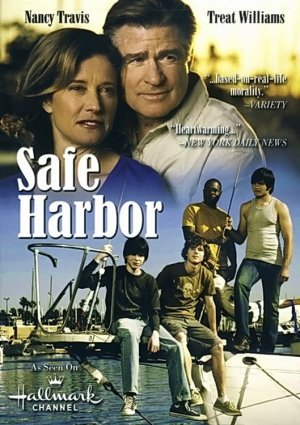
Safe Harbor (2009) – As far as Hallmark movies go, this was one of the best I’ve seen. Although, it’s almost like it’s 20 years past when it should have been released. It’s about a retired couple played by Nancy Travis and Treat Williams. One day a judge shows up who knows Williams and just dumps a couple of toubled kids on them who need a place to stay. It’s a little of the blue, but okay cause Williams gives a bit of background later. Turns out Williams once punched a cop after that officer shot his dog. Apparently, Williams had been living under a bridge. It’s after that he joined the Merchant Marine. Quite a lot of important information that his wife apparently didn’t know after all those years. I almost expected him to say I also used to go by the name Arnold Friend and did something really bad once.
Of course the judge finds a way to dump a few more kids on them. The couple steps up and decides to take care of them. They meet a little resistance from a lady in Social Services, some of the locals, especially after a fire, and one of their mothers, but for the most part it’s just getting the kids over their issues. Doing that, the movie works. It just feels like something that should have been released in 1989 as it feels reminiscent of episodes of MacGyver.
Since Mystery Woman: Game Time felt the need to censor the word “butt” in the phrase “pain in the butt”, I was rather shocked that not once, but twice, Travis and Williams try to have sex before being interrupted by the kids.
This is one of the good ones.
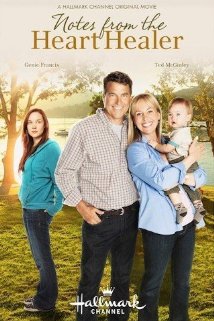
Notes from the Heart Healer (2012) – This has to be the most forgettable of the Hallmark movies I have watched so far. It’s a movie technically, but barely. It’s the third film in a trilogy and I’ve only seen this one. It’s about a writer who seems to be an advice columnist type. A lady turns up at one of her book signings. She has been fired, has no place to stay, and has a baby she can’t take care of. She tries to turn to the writer for help, but when the writer’s husband shows up, she runs away. Later on she drops the baby off at the writer’s doorstep.
What follows is a very forgettable story of the writer mulling over a child she had to give up for adoption and what to do with the baby she now has in her hands. There were only two parts that were memorable. First, during the film the writer jots down some diary entries and in one she mentions that cutting the baby in two story. Honestly, I’m not sure why, but what was memorable was that she felt the need to refer to it as a decision made by “Biblical” King Solomon. A war on Christmas type thing where we want to make sure you don’t divorce the widely known story from it being in the bible? I’m really just guessing. It just stuck with me like hearing someone say “up twice down twice” when saying the Konami code. Just not something I think I’ve ever heard someone feel the need to do when that story is referenced. The second thing is when the husband reacts to something about the baby in kind of an asshole manner, for lack of a better word. But it doesn’t really go anywhere.
There, that those are the things I strongly remember tells you how forgettable this one is. Maybe the first two were better. I’ll probably find out eventually.
Mystery Woman: Vision of a Murder (2005) – Once again, we join Kellie Martin and Clarence Williams III for another murder mystery. I haven’t mentioned her in my earlier reviews of these movies, but there is a character played by Nina Siemaszko who is basically Martin’s Beth Davenport from The Rockford Files. She’s an attorney who is frequently part of the case and definitely is in this one. In this one Martin joins Siemaszko to go to a spa and take photographs of the place. Siemaszko is going there for the spa. It’s not just a spa, but a place that does plastic surgery and other such beauty treatments.
It’s run by Charles Shaughnessy so you know something is up. But just in case you didn’t, Felicia Day is in this looking and acting like “the dog who gets beat” in that lyric from the Alice In Chains’ song Man In The Box. She might as well be wearing a sign around her neck that says “I’ve got secrets to tell.”
Describing much more is spoiling it. A dead body turns up at the spa and Day turns out to be psychic. There is a funny scene where Kellie Martin pretends to be a doctor. Funny, since she’s most famous for her role on ER. And finally, that when you get near the ending, no, it isn’t clever enough to end the way you hope.
Still, decent entry in the series and one of two of them that Kellie Martin directed herself.
Second Chances (2013) – Yet another Hallmark romance, right? Well, not exactly. Don’t get me wrong, there is a couple, but that’s not really where the story is. The story is with her kids. It’s also a Larry Levinson Production so apparently that means they must include goofs with technology. Not sure why that’s a thing, but it seems to be.
But let’s back up here. The story begins with a firefighter and a 911 dispatcher. They kind of know each other from going back and forth on the radio during calls, but they’re really still strangers. He gets injured and needs to spend some serious downtime according to his doctor played by James Eckhouse of Beverly Hills, 90210 fame. He’s quite good and makes the most of the few scenes he’s in. The dispatcher gets her hours cut back and decides to rent out a room at her house to make up the difference. The firefighter decides to move in. That’s this movie’s excuse for the boy and girl to spend time together.
However, this is when the kids kind of take over the movie. They know that their Mom needs money so they decide to start charging residents of a nursing home a dollar for reading to them. These parts are the best parts of the film. It’s actually a shame that there had to be other parts cause if they had made that the whole film and let it go deeper then it could have been even better. But they don’t, so we do get a little romance between the two as well as some backstory on them. It really isn’t worth going into because you’re watching this for the kids and the two tech goofs.
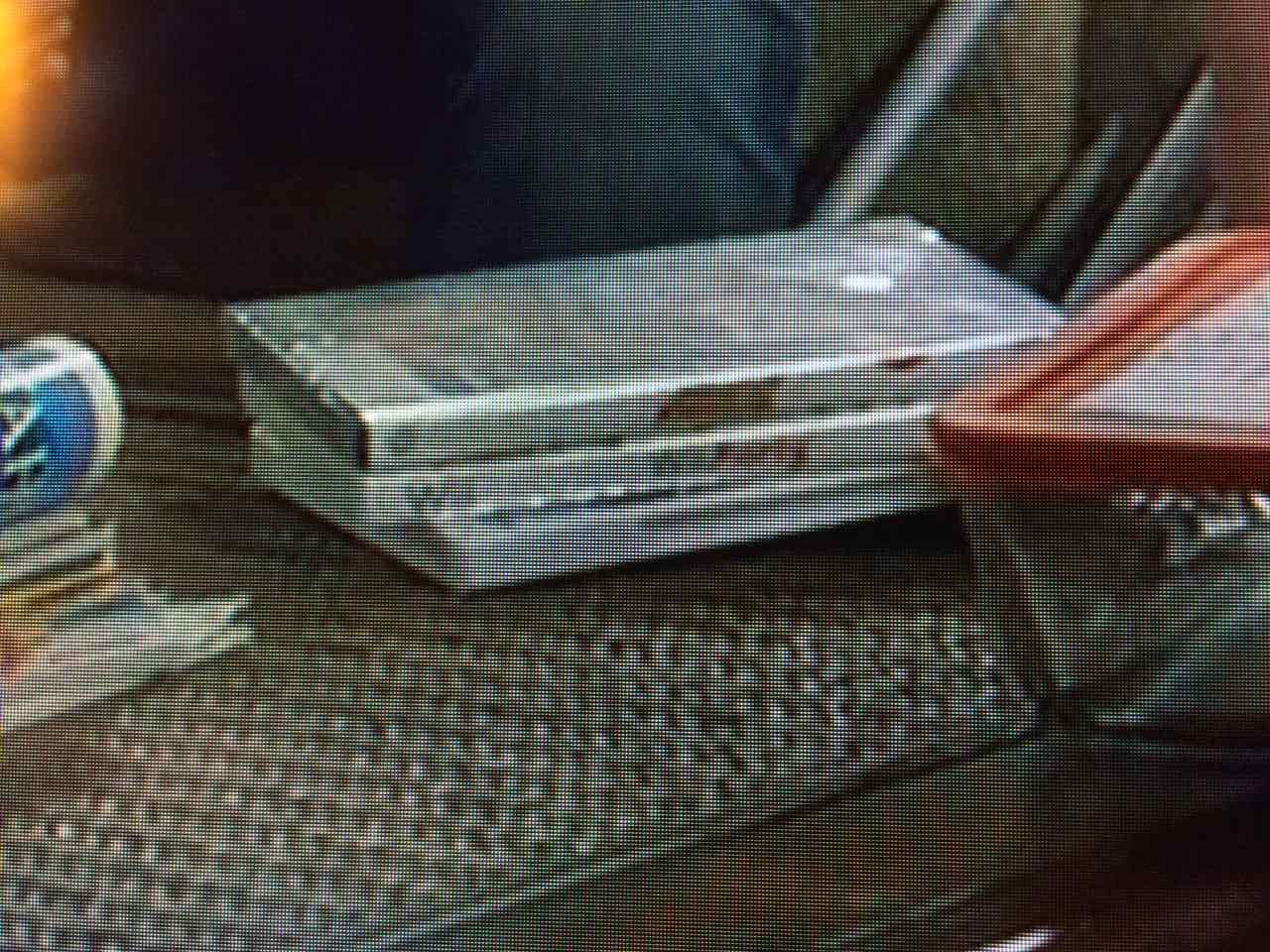
The first tech goof comes really early in the movie. They obviously thought no one would notice and I don’t blame them here, but considering what it would have taken to make it right, it’s pretty stupid. If you have a better version of this then the one I watched on TV and can prove me wrong, then I’m all ears, but the firefighter picks up a sealed copy of a game the kid is supposedly playing from their living room table and talks to the kid about it. The kid isn’t a collector or anything. That sealed copy of the game is what he is supposedly playing. It’s weird because the two games under it are open. Again, if you have a higher definition copy and see differently, then tell me. But here’s what I was able to capture.
Notice the top of the box that shouldn’t be shining if it were really open.
The second goof, there’s no mistake. Throughout the movie there is a fake 911 dispatch screen. Fake because it’s in a Hallmark movie, but not fake because it looks ridiculous. That is, until for reasons beyond me, they felt the need to give us a closeup of the terminal portion of it where we can see that it’s a DOS command line. It’s open to a directory called “C:\Users\Art Department\” and apparently someone has been typing random crap in and trying to execute it only to get error messages.
Like I said though, this is one of the better Hallmark movies, and the credit goes to the story with the kids.
Sometimes, you have to be careful which films you choose to watch over the course of the day.
Such as, last Friday night, I heard the news that Jill Clayburgh had died and I ended up watching An Unmarried Woman. This, along with the fact that I also watched the Black Swan trailer, led to me dancing around the house in my underwear, en pointe in bare feet, and doing a half-assed pirouette in the living room. And I felt pretty proud of myself until I woke up Saturday morning and my ankle (which I don’t think has ever properly healed from the day, seven years ago, that I fell down a flight of stairs and broke it in two places) literally felt like it was on fire. That was my body’s way of saying, “You ain’t living in a movie, bitch. Deal with it.”
So, come Sunday, I decided to play it safe by watching something that I was sure wouldn’t lead to any imitative behavior on my part. Since I had previously reviewed Earthquake on this site, I decided that I would devote some time to the movies that started the entire 1970s disaster movie genre — Airport. Watching Airport led to me watching Airport’s three sequels.
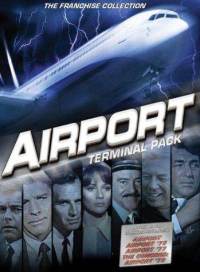
I was able to do this largely because I own the Airport Terminal Pack, a two-disk DVD collection that contains all four of the Airport films and nothing else. There’s no special features or commentary tracks. That’s probably a good thing because these films are so extremely mainstream that I doubt the commentary tracks would be all that interesting except to people who love “Me and Jennings Lang had the same lawyer…” style stories.
The movies are a mixed bag of ’70s sexism, mainstream greed, and casts that were described as being “all-star” despite the fact that they featured very few stars. They’re all worth watching as time capsules of a past time. Some of them are just more worthy than others.
Below are my thoughts on each individual film in the collection…
Airport (directed by George Seaton)
First released in 1970, Airport was nominated for 10 Academy Awards (including best picture), broke box office records, and started the whole 70s disaster movie trend. It also has to be one of the most boring, borderline unwatchable movies ever made. The fact that I managed to sit through the whole thing should be taken as proof that I’m either truly dedicated to watching movies or I’m just insane. Take your pick.
Anyway, the film is painstakingly detailed account of the every day operations of an airport. Yeah, sounds like a lot of fun, doesn’t it? Burt Lancaster runs the airport. His brother-in-law Dean Martin flies airplanes. Both of them have mistresses but we’re told that’s okay because Lancaster’s wife expects him to talk to her and Martin’s wife is cool with him fucking around as long as he comes home at night. I would be tempted to say that this is a result of the film having been made in 1969 and released in 1970 but actually, it’s just an introduction to the sexual politics of the typical disaster film. Men save the day while women get in the way. And if you think things have changed, I’d suggest you watch a little film calledf 2012…
The only interesting thing about the film is that Lancaster’s mistress is played by Jean Seberg who, ten years earlier, had helped change film history by co-starring in Jean-Luc Godard’s classic film Breathless. Nine years later, after years of being hounded by the American press and the FBI for her radical politics, Seberg committed suicide.
Airport 1975 (directed by Jack Smight)
As opposed to its predecessor, Airport 1975 is actually a lot of fun in its campy, silly way. This is the one where a small private plane (flown by Dana Andrews, the star of the wonderful film noir Laura) collides with a commercial airliner. The entire flight crew is taken out and head stewardess Karen Black has to pilot the plane despite the fact that she’s obviously cross-eyed. Luckily, since Black is a stewardess, she has a pilot boyfriend who is played by Charlton Heston. Heston talks her through the entire flight despite the fact that she was earlier seen trying to pressure him into not treating her like an idiot. Anyway, Heston does his usual clench-jaw thing and if you need a drinking game to go with your bad movie, just take a shot every time Heston calls Black “honey.” You’ll be drunk before the plane lands.
There’s some other stuff going on in this movie (for instance, Gloria Swanson appears as “herself” and doesn’t mention Sunset Boulevard or Joseph Kennedy once!) but really, all you need to know is that this is the film where Karen Black acts up a storm and random characters keep saying, “The stewardess is flying the plane!?”
Odd trivia fact: Airport 1975 was released in 1974.
Airport ’77 (directed by Jerry Jameson)
In Airport ’77, a group of art thieves attempt to hijack an airplane which, of course, leads to the airplane crashing into the ocean and somehow sinking down to the ocean’s floor without splitting apart. The crash survivors have to try to figure out how to get to the surface of the water before they run out of oxygen.
In this case, our resident sexist pilot is Jack Lemmon who has a really ugly mustache. He wants to marry head stewardess Brenda Vaccarro. Vaccarro doesn’t understand why they have to get married to which Lemmon responds, “Because I want a wife and kids!” The film also gives us Lee Grant as a woman who is married to Christopher Lee but who is having an affair with another man. She also drinks a lot and dares to get angry when she realizes that the airplane is underwater. While this sort of behavior is acceptable from Dean Martin, Charlton Heston, and Jack Lemmon, the film punishes Lee Grant by drowning her in the final minutes.
Technically, Airport ’77 is probably the best of the Airport films. The cast does a pretty good job with all the melodrama, the film doesn’t drag, and a few of the scenes manage to generate something resembling human emotion. (For instance, when the blind piano player died, I had a tear in one of my freaky, mismatched eyes.) Unfortunately, the movie’s almost too good. It’s not a lot of fun. Everyone plays their roles straight so the silly plot never quite descends into camp and the key to a good disaster film is always camp. This film also has the largest body count of the series, with most of the cast dead by the end of the movie. (And, incidentally, this film did nothing to help me with my fear of water…)
The Concorde: Airport ’79 (directed by David Lowell Rich)
The last Airport movie is also the strangest. Some people have claimed that this film was meant to be a satire of the previous Airport films. I can understand the argument because you look at film like Concorde and you say, “This must be a joke!” However, the problem with this theory is that there are moments of obvious “intentional” humor in this film (i.e., J.J. from Good Times smokes weed in the plane’s bathroom, another passenger has to go to the bathroom whenever she gets nervous) and none of them show any evidence of the type of wit and outlook necessary to come up with anything this silly on purpose. Add to that, the film’s story is credited to Jennings Lang, a studio executive. Studio execs do not take chances. (Plus, the actual script was written by Eric Roth, who went on to write the amazingly humorless The Curious Case of Benjamin Button).
No, this film is meant to be taken seriously and oh my God, where do I start?
Our pilots are George Kennedy and Alain Delon. The head stewardess (and naturally, Delon’s girlfiend) is played by Sylvia “Emanuelle” Kristel who, at one point, says, “You pilots are such men!” “Hey, they don’t call it a cockpit for nothing, honey,” Kennedy replies.
Meanwhile, Robert Wagner is trying to destroy the Concorde because one of the passengers is his girlfriend who has proof that Wagner has been selling weapons to America’s enemies. So, he attempts to blow the plane up with a guided missile and when that fails, he sends a couple of fighter planes after them. Kennedy responds by opening up the cockpit window — while breaking the sound barrier mind you — and firing a flare gun at their pursuers.
After this, there’s stop over in Paris where Delon arranges for Kennedy to sleep with a prostitute who assures Kennedy that he made love “just like a happy fish.”
The next day, everyone returns to the exact same Concorde — despite the fact that just a day earlier they’d nearly been blown up by a squadron of fighter planes — and take off on the second leg of the flight. Let me repeat that just to make sure that we all understand what this film is asking us to believe. After nearly getting blown up by a mysterious squad of fighter planes, everybody shows up the next morning to get on the exact same plane.
Oh, and it never occurs to Wagner’s ex-girlfriend that Wagner might have something to do with all of this.
Now sad to say, Concorde is the one of those films that’s a lot more fun to talk about than to actually watch. It should be a lot more fun in its badness than it actually is. Still, the movie has just enough camp appeal to make it fun in a “what the fuck…” sorta way.
And that’s how the Airport series comes to an end.




 Through the Shattered Lens