Brad reviews THE HANGOVER PART II (2011), directed by Todd Phillips!


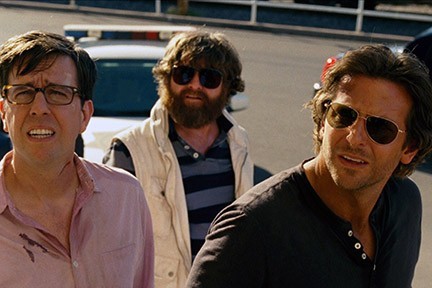
In director Todd Phillips’ THE HANGOVER PART II, the night before his wedding, groom-to-be Stu (Ed Helms), his two best friends, Phil and Doug (Bradley Cooper and Justin Bartha), Stu’s soon-to-be brother-in-law Teddy (Mason Lee) and Doug’s brother-in-law Alan (Zach Galifianakis), sit on a beach in Thailand for a toast to the bride and groom. After cracking open sealed bottles of beer in the beautiful setting, the movie screen goes black, and soon we see Phil, Stu and Alan wake up in a seedy room in Bangkok with absolutely no memory of what happened the previous night. The room is trashed, there’s a monkey wearing a denim Rolling Stones jacket, a naked Chow (Ken Jeong) is sleeping under a pile of blankets, Alan’s head is completely shaved, Stu has a face tattoo, and both Doug and Teddy are nowhere to be found! Doug calls and he’s back at the resort, but the only trace of Teddy is his severed finger, which is now in possession of the monkey. With the wedding just hours away, the three friends follow any clues they can find in a frantic search for Teddy. The search leads to the surprise discovery that Stu had intimate relations with a transsexual stripper, a tattoo parlor run by Nick Cassavetes, a dangerous and duplicitous American gangster named Kingsley (Paul Giamatti), and an arrested, ancient Buddhist monk who’s taken a vow of silence and who’s also confused for the 16-year-old, Teddy. Hell, at one point Mike Tyson shows up and sings the classic Murray Head single, “One Night in Bangkok.” Most importantly though, will the friends find Teddy alive and still have time to get back to the resort in time for Stu’s wedding?!!

A massive box office hit in the summer of 2011, THE HANGOVER PART II became the highest grossing R-rated comedy up to that time, with a worldwide gross of $586 million, against an $80 million budget. It was also the highest grossing R-Rated film to have opened over Memorial Day weekend, raking in over $118 million in its first four days. The story went to the well again with its still clever, but not quite as unique premise, comprised of a mystery-driven plot line where we follow the investigative adventures of Phil, Stu, and Alan and discover what happened the night before at the same time that they do. This allows for another series of outrageous, raunchy, surprising, and funny moments that escalate in absurdity over the course of the film’s 102-minute running time, culminating with another secret roll of pictures on Teddy’s camera that fill in the crazy events from their wild night in Bangkok. Based on the familiarity with the characters and the types of situations, I didn’t laugh out loud quite as frequently this time around, but the film still has its share of amusing moments, and I enjoyed revisiting the film again after a number of years. One of the things that I noticed about THE HANGOVER PART II is that it does not have the re-quotability factor going for it like the first film does. Alan and Chow have some funny lines, but honestly, I don’t think I’ve ever re-quoted a single one of them. I will agree with Alan on one point though, “When a monkey nibbles on a penis, it’s funny in any language.” I’d say that this film is more about mining comedy out of the extreme and absurd situations that our heroes are put in and less about clever, quotable quips. 

THE HANGOVER PART II works because of the outrageous situational comedy, as well as the exceptional chemistry between Bradley Cooper, Ed Helms, and Zach Galifianakis. Ken Jeong has a bigger part this time around as Mr. Chow, and of course he’s hilarious. I did get some solid laughs from its combination of shock-value, sight gags and character interplay. The Bangkok we see here also makes for a seedy, raunchy and dangerous background to the crazy action. Of course the biggest negative of the film, as is the case with many sequels, is the fact that it’s practically a remake of the first HANGOVER, just set in Bangkok instead of Vegas. Think Charles Bronson’s DEATH WISH (New York) versus DEATH WISH II (Los Angeles). Also like the first two DEATH WISH films, THE HANGOVER PART II pushes the boundaries even farther, with even more graphic nudity and just overall harder material in general. Sequels always up the ante, but lose a little of what makes them so special in the process, and that’s definitely going on here.

Ultimately, while THE HANGOVER PART II was even more financially successful than the original, it’s not quite as fun because we’ve seen it before in the first film. But I loved the first film, so I enjoyed this one as well, just not quite as much. 

Brad reviews THE HANGOVER (2009), directed by Todd Phillips!


It seems kind of strange in today’s world of non-stop streaming, but there was a time when you would purchase a blu-ray of a movie, and they’d give you a free “digital” copy of the movie. In 2009, I purchased the blu-ray for THE HANGOVER and added the digital copy of the movie to my laptop that I kept at my tax and accounting office. Every night during the 2010 tax season, I would go home around 5:00 for dinner, and then I’d go back to the office at 7:00 to continue my work. When I’d get back to the office, I would always play two copies of digital movies on my laptop… first, I’d play THE HANGOVER and next, I’d play ZOMBIELAND. When those two movies would end, usually by around 11:00, I’d head home. Needless to say, I got to know each of these movies very well and love them both.  

In director Todd Phillips’ THE HANGOVER, the night before his wedding, groom-to-be Doug (Justin Bartha), his two best friends, Phil and Stu (Bradley Cooper and Ed Helms), and his soon-to-be brother-in-law Alan (Zach Galifianakis), head to Las Vegas for a wild and exciting bachelor party. After taking some Jagermeister shots on the roof of Caesar’s Palace, the movie screen goes black, and soon we see Phil, Stu and Alan wake up in their hotel room with absolutely no memory of what happened the previous night. The room is trashed, there’s a tiger in the bathroom, a baby in the closet, Alan doesn’t have on any pants, Stu is missing his lateral incisor, and Doug is nowhere to be found! With the wedding just hours away, the three friends follow any clues they can find in a frantic search for Doug. The search leads to the surprise discovery of a new stripper wife for Stu, the naked and dangerous Asian gangster Chow (Ken Jeong), who jumps out of the trunk of their car and attacks Phil with a crowbar, and Alan being tasered in the face by a kid visiting the Vegas police station. Hell, at one point Alan even gets punched out by Mike Tyson! More importantly, though, will they find Doug alive and have time to get him back to Los Angeles for his wedding?!!

A massive box office hit in the summer of 2009, THE HANGOVER became the highest grossing R-rated comedy up to that time, with a worldwide gross of $469 million against a budget of $35 million. One of the keys to the film’s success is its clever and unique premise, comprised of a mystery-driven plot line where we follow the detective-like adventures of Phil, Stu, and Alan and discover what the hell happened the night before at the same times that they do. This allows for a series of outrageous, raunchy, surprising, and hilarious comedic moments that escalate in absurdity over the course of the film’s 100-minute running time, culminating with an almost unbelievable roll of pictures on Stu’s camera that fill in the crazy events from their wild night in Vegas. Most movies, even comedies, don’t result in me laughing out loud. I laughed out loud frequently that first time I watched THE HANGOVER back in 2009, and I still do. It’s also a movie that, since that 2010 tax season, I have quoted endlessly in my personal life, whether it be “Classic,” to “Thanks a lot, Bin Laden,” and even “It’s not a purse, it’s called a satchel. Indiana Jones wears one.” I never know exactly when something will happen in my personal life that reminds me of THE HANGOVER, but if the time is right for an “in the face,” I’m always ready!  

Of course, the comedy in THE HANGOVER would not work without the great direction from Todd Phillips, as well as the exceptional performances and chemistry between Bradley Cooper, Ed Helms, and Zach Galifianakis. Phillips moves things along at a perfect pace, allowing for tons of laughs, while propelling the story forward to its conclusion. He also seems to capture the chaos and “what happens in” feeling of an out-of-control night in Vegas. And when I watched the film, I was reminded of people in my own life who share certain traits with some of the characters, especially those played by Cooper and Helms. As such, the interactions between the characters seems natural and familiar to me, which makes it even funnier. Luckily, I can’t think of any friends like Galifianakis’ eccentric character, but that’s probably a good thing for my real life. In the context of the movie, however, he steals the film with his deadpan delivery.   

Ultimately, THE HANGOVER became a cultural phenomenon that launched a series of three films that grossed over $1.4 billion worldwide. It’s blend of clever writing, great casting and performances, and most importantly, great comedic moments, makes it one of my favorite comedies of the 21st century.

Review: The Accountant (dir. by Gavin O’Connor)


“What I do is not against the law. What I don’t do… is.” — Christian Wolff

The Accountant is a 2016 action thriller that mixes elements of character drama, crime mystery, and family dynamics into a unique storyline. The movie follows Christian Wolff, a man with autism and exceptional math and accounting skills, who works as a freelance accountant for criminal organizations. Raised by a strict military father who pushed him to develop precision and discipline, Christian has a rigid moral code that guides his actions. As Christian unravels financial fraud within a robotics company, he finds himself hunted by a Treasury agent. The film blends intellectual mystery with high-stakes action, presenting a different take on the typical thriller formula.

Ben Affleck leads as Christian Wolff, bringing a quiet intensity that captures the character’s inner complexities and unique worldview. Anna Kendrick plays Dana Cummings, the robotics company accountant whose discovery of financial irregularities kicks off the central conflict, offering a relatable and warm counterpoint. J.K. Simmons portrays Raymond King, the sharp Treasury agent on Christian’s trail, adding layers of tension and moral ambiguity. Jon Bernthal embodies Braxton Wolff, Christian’s estranged brother and a rugged former military operative, whose presence heightens the family drama. The brothers’ strict and demanding father is portrayed by Rob Treveiler, who appears mainly in flashbacks that showcase the rigorous military-style training and discipline shaping Christian’s development. These performances ground the film’s ambitious mix of genres, making the characters feel lived-in and believable.

Christian Wolff stands out as a well-rounded character whose autism shapes his personality without becoming a mere plot device. The film shows his struggles alongside his strengths, like sensory sensitivities, social awkwardness, and laser focus on details. He relies on strict routines and coping tools to handle his surroundings, mirroring real experiences on the autism spectrum. Affleck’s portrayal draws from this backstory—those intense father-son training montages with Treveiler—to explain Christian’s discipline and guarded emotions, giving audiences a clear window into what drives him.

At the movie’s core sits Christian’s personal moral compass. He might balance the books for shady clients, but he draws a hard line at true ethical breaches, stepping in with his own form of justice. This anti-hero vibe keeps things gray and intriguing. His bond with Dana, played by Kendrick, offers rare moments of connection amid the chaos, though it stays somewhat surface-level and misses chances for deeper emotional pull.

The plot tracks Christian’s dive into massive fraud at the robotics firm, all while dodging Simmons’ relentless agent. The accounting scenes impress with their detail—Christian pores over ledgers, spotting irregularities that expose embezzlement on a grand scale. This cerebral side contrasts sharply with the brutal action, like the raw fights between Affleck’s Christian and Bernthal’s Braxton, which mix physical showdowns with buried family pain. Those brotherly clashes tie back to their shared traumatic past, ramping up the stakes beyond just numbers and guns.

The Accountant handles autism with real care, steering clear of clichés. It spotlights Christian’s sensitivities, routine needs, and social hurdles while celebrating his smarts and toughness. Affleck makes these traits feel authentic, turning what could be quirky into profoundly human. This approach avoids stereotypes, letting viewers connect with Christian on a deeper level and appreciate how his mind works in high-pressure situations.

The film has room for refinement in a few spots. It crams in crime plots, sibling secrets, and shadowy ops, which can jumble the pace as it bounces from fights to feels to financial deep dives. Relationships like Christian and Dana’s, or the Wolff brothers’, might hit harder with extra screen time to build that emotional core and make the risks feel more intimate.

Tonally, The Accountant strikes a balance—serious stakes lightened by Christian’s offbeat interactions and fresh outlook. Autism never turns into a joke; instead, it builds empathy. The ethical murk in his world—cooking books for crooks one day, punishing them the next—flips hero tropes on their head, keeping you guessing.

Overall, The Accountant shines by fusing brainpower and brawn in its lead and narrative, transcending standard shoot-’em-ups as a thoughtful character piece that honors its hero’s nuances. It probes unconventional strengths and ethics in a murky reality while illustrating thriving with distinct abilities and hurdles in a harsh landscape, all while clinging to personal principles—delivering thrills with substance on neurodiversity and payback. Fans of smart action will dig this blend of suspense, puzzles, and character depth, even if the threads tangle at times, making it a solid pick for thriller seekers wanting more than explosions.

Retro Television Reviews: The Love Boat 6.21 “The Captain’s Crush/Out Of My Hair/Off-Course Romance”


Welcome to Retro Television Reviews, a feature where we review some of our favorite and least favorite shows of the past!  On Wednesdays, I will be reviewing the original Love Boat, which aired on ABC from 1977 to 1986!  The series can be streamed on Paramount Plus!

Welcome aboard, it’s love!

Episode 6.21 “The Captain’s Crush/Out Of My Hair/Off-Course Romance”

(Dir by Ted Lange, originally aired on February 19th, 1983)

Kathy Costello (Stella Stevens) is looking forward to taking a cruise with her husband, Joe (Monte Markham).  However, at the last minute, Joe decides that he would rather go to a golf tournament than take a vacation with his wife.  The angry Kathy boards the boat and immediately runs into her ex-boyfriend, Ted Cole (Ron Ely).  Kathy enjoys spending time with Ted but then suddenly, Joe shows up on the cruise.  He’s not happy to discover his wife is spending time with her ex.  The main problem with this story is that there’s no one to root for.  Kathy is cheating but her husband is being a jerk.  It’s rare that I ever watch an episode of The Love Boat and say, “This should end with divorce,” but this episode inspired me.

Meanwhile, Lydia (Delta Burke) boards the boat with her wealthy fiancé (Jeffrey Tambor).  Lydia’s ex-boyfriend (Richard Gilliland) also boards the boat, hoping to break up their engagement.  This storyline felt oddly similar to the other storyline and it suffered from the same problem.  There was no one to root for.  None of these people deserved to get married.

Finally, movie star Janine Adams (Joan Collins) boarded the boat and ate dinner with the Captain.  The next day, the tabloid news wires are full of speculation that the Captain is going to become Jane’s tenth husband and the Captain starts to think that maybe he’d like to be Jane’s tenth husband.  Go for it, I say!  Seriously, Janine and the Captain are as close to a likable couple as this episode has so they might as well get married.  Of course, they don’t get married.  I guess that’s a good thing.  It’s hard to imagine The Love Boat without Captain Stubing at the helm.

This episode was directed by Ted Lange and, as usual, he gets good performances from the cast.  Unfortunately, this cruise is let down by two weakly-written stories.

Film Review: …. And Justice For All (Dir by Norman Jewison)


First released in 1979, ….And Justice For All will always be remembered for one scene.

Yell it with me, “YOU’RE OUT OF ORDER!  THE WHOLE TRIAL IS OUT OF ORDER!  THEY’RE OUT OF ORDER!”

When attorney Arthur Kirkland (Al Pacino) starts screaming in the middle of the courtroom, it’s a cathartic moment.  We’ve spent nearly two hours watching as Arthur deals with one insane situation after another.  One of Arthur’s partners, Warren (Larry Bryggman), cares more about his car than actually delivering the right documents to a judge.  Another of Arthur’s partners, Jay (Jeffrey Tambor), has a nervous breakdown and, after shaving his head, ends up throwing cafeteria plates at people in the courthouse.  Arthur has three clients, one of whom is indigent, one of whom is innocent, and one of whom is a wealthy and despised judge (John Forsythe) who has been accused of a rape that Arthur suspects he committed.  The system offers no mercy for Arthur’s innocent (or, at the very least, harmless) clients while going out of it’s way to defend the judge.  Meanwhile, another judge (Jack Warden), is driven to take suicidal risks, like flying a helicopter until it runs out of fuel and comes down in a nearby harbor.  The assistant district attorney (Craig T. Nelson) only cares about his political ambitions and finally, after one incident after another, Arthur snaps.  And it’s cathartic because we’re all on the verge of snapping as well.

That final moment, with its signature Al Pacino rant, is such a strong and iconic scene that it’s easy to forget that the film itself is actually rather uneven.  The script, by Barry Levinson and Valerie Curtin, owes a good deal to the work of Paddy Chayefsky.  Just as Chayefsky often wrote about men being driven mad by institutional failure, ….And Justice For All features character after character snapping when faced with the screwed-up realities of the American justice system.  The final “out of order” speech is obviously meant to be this film’s version of Howard Beale’s “I’m as mad as Hell and I’m not going to take it!” speech from Network and, much like George C. Scott in the Chayefsky-written The Hospital, Arthur spends a lot of time talking about what he doesn’t like about his job.  The thing that sets ….And Justice For All apart from the best works of Chayefsky is that Levinson, Curtin, and director Norman Jewison all take Arthur Kirkland at his word while one gets the feeling that Chayefsky would have been a bit more willing to call out Arthur on his self-righteousness.  Arthur has every right to be angry when Warren forgets to give a judge an important document while Warren is substituting for him in court.  At the same time, Arthur is the one who trusted Warren to do it.  In the end, the document was not about one of Warren’s client.  In fact, Warren knew absolutely nothing about the case or Arthur’s client.  The document was about Arthur’s client and Arthur was the one who decided trust someone who had consistently shown himself to not be particularly detailed-orientated.  One gets the feeling that Chayefsky would not have let Arthur off the hook as easily as Levinson, Curtin, and Jewison do.  Arthur’s perpetual indignation can sometimes be a little hard to take.

It’s a very episodic film.  Arthur goes from one crisis to another and sometimes, you do have to wonder if Arthur has ever had any human or legal interactions that haven’t ended with someone either going insane or dying.  There’s no gradual build-up to the film’s insanity, it’s right there from the beginning.  And while this means the narrative often feels heavy-handed, it also makes that final speech all the more cathartic.  It’s an uneven film and, of all of the characters that Pacino played in the 70s, Arthur is probably the least interesting.  But that final rant makes up for a lot and, fortunately, Pacino was just the actor to make it memorable.  For all it’s flaws, the final few minutes of ….And Justice For All make the film unforgettable.


Film Review: The Death of Stalin (dir by Armando Iannucci)


2017’s The Death of Stalin opens in Moscow in 1953.  Joseph Stalin (Adrian McLoughlin) calls into Radio Moscow and demands that he be sent a recording of the piano concerto that has just been performed live.  The only problem is that no one bothered to record it while it was being performed.  In a panic, the head of Radio Moscow announces that no one — not the musicians, not the exhausted conductor, and certainly not the audience — is allowed to leave until the orchestra has performed again.

Indeed, one of the recurring themes of The Death of Stalin is that everyone is terrified of their beloved dictator.  The orchestra fears being executed for failing to recreate their performance.  The members of the Central Committee fear being the next person to be purged from the ranks of Stalin’s government.  The two guards that are posted outside of Stalin’s bedroom are so terrified of interrupting Stalin and getting on his bad side that they don’t investigate when they hear Stalin collapsing to the floor.  When Stalin is found unconscious, the only doctors available are young and inexperienced because Stalin recently exiled all of the good doctors from Moscow.  Even after Stalin dies from a cerebral hemorrhage, his reign of terror continues as all the members of his household staff are promptly executed to keep anyone from learning either the exact details of Stalin’s death or the way that the members of the Central Committee responded to his passing.

The Death of Stalin is a dark comedy that follows the members of the Central Committee as they scramble to protect their own positions after Stalin’s death.  The humor comes from watching historical figures like Nikita Khrushchev, Vyacheslav Molotov, Lavrenti Beria, and Georgy Malenkov act like panicked junior executives who are desperately trying to save their own jobs during a corporate takeover.  Of course, the stakes are a bit higher.  Whoever succeeds Stalin will undoubtedly want to execute every other contender for the post.  As with so many of Armando Iannucci’s works, the humor comes from watching very powerful people act in very immature and petty ways.  While Malenkov (Jeffrey Tambor) tries to convince people that he actually is in charge, the brutal Beria (Simon Russell Beale) tries to bully his way into power and the wily Khrushchev (Steve Buscemi, giving one of his best performances) waits for his moment to strike.  (Beria, it should be noted, is one of history’s greatest monsters and the film, while a comedy, does not shy away from his depravity.)  Molotov (a hilarious Michael Palin) is so loyal to the Party that he says that Stalin was absolutely correct to have his wife executed just to then have Beria show up and reveal that Molotov’s wife is still alive.  Meanwhile, Stalin’s idiot son (Rupert Friend) claims that it’s all an American plot while the rest of the Central Committee laughs at him behind his back.  Only Georgy Zhukov (Jason Isaacs) seems to have full control of his emotions and his actions and it’s not a surprise to learn that, long after the events depicted in this film, purged from the Party.  In The Death of Stalin, the leaders of Russia are obviously scared of anyone who is too competent at their job.

The Death of Stalin is not only a satiric portrayal of petty bureaucrats.  It’s also a darkly humorous look of life in a dictatorship, where everyone is at the whim of whoever happens to be in charge at any given time.  The film is full of power-hungry narcissists who use their ideology and their nationalism as a shield for their own ambitions.  Everyone wants to control someone else.  Even as mourners pass by Stalin’s coffin, they’re given orders on how to properly grieve and move.  The film ends with a series of pictures of various people either having their faces scratched or, in some cases, just vanishing.  In a free country, failure leads to humiliation.  In a dictatorship,  it leads to non-existence as the formerly prominent are suddenly erased from a history that no longer has a place for them.  Ironically, of all the original leaders of communist Russia, it was Molotov who lived the longest.  He was 96 when he died in 1986.  If not for Stalin’s sudden death, he probably would have been purged and executed at the age of 63.

On this May Day, with so many people currently trying to rehabilitate the reputations of the 20th Century’s worst dictators, The Death of Stalin is must-watch.


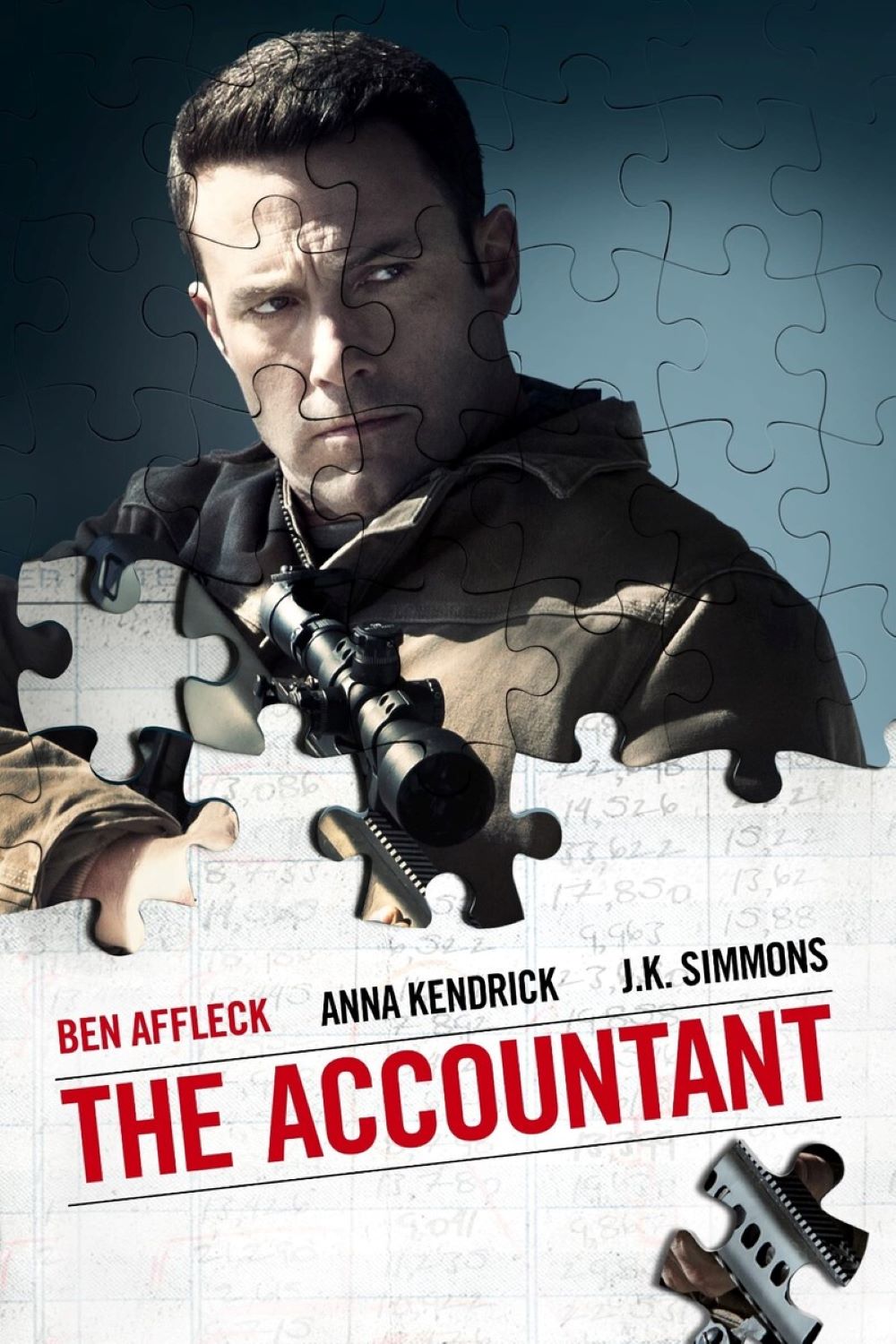
#MondayMuggers presents THE ACCOUNTANT (2016) starring Ben Affleck!


Every Monday night at 9:00 Central Time, my wife Sierra and I host a “Live Movie Tweet” event on X using the hashtag #MondayMuggers. We rotate movie picks each week, and our tastes are quite different. Tonight, Monday April 21st, we celebrate the end of my tax season by watching THE ACCOUNTANT (2016) starring Ben Affleck, Anna Kendrick, J.K. Simmons, Jon Bernthal, Jeffrey Tambor, Cynthia Addai-Robinson, John Lithgow, and Jean Smart. 

Contrary to popular belief, THE ACCOUNTANT is not based on the life of Little Rock-based CPA Bradley Crain, although there are many obvious similarities. Rather, it’s the story of Christian Wolff, a math savant who often plies his trade for some of the world’s most dangerous criminal organizations. When he takes on a legitimate client and discovers discrepancies in the company’s books involving millions of dollars, a group of hitmen try to kill him and the company’s accountant Dana Cummings (Anna Kendrick). Will they live long enough to discover the person behind the embezzlement, or will they just become another set of death statistics? I don’t want to give too much away, but I will go ahead and address the elephant in the room… THE ACCOUNTANT 2 opens on Friday night, April 25th.

So, join us tonight for #MondayMuggers and watch THE ACCOUNTANT! It’s on Amazon Prime. The trailer for THE ACCOUNTANT is included below:

Life Stinks (1991, directed by Mel Brooks)


Goddard Bolt (Mel Brooks), the massively wealthy CEO of Bolt Enterprises, wants to buy up a huge area of Los Angeles’s slums and tear them down, transforming the area into a chic neighborhood and moving all of the poor residents and street people out.  Rival businessman Vaughn Craswell (Jeffrey Tambor), who grew up in the slum and dreams of destroying it himself, has the same plan.  He and Bolt make a bet.  If Bolt can survive for 30 days on the streets, Craswell will allow Bolt to have the property.  Bolt agrees and soon, he is penniless and sleeping in alleys.  While Bolt befriends Sailor (Howard Morris) and Fumes (Theodore Wilson) and falls in love with a former dancer named Molly (Lesley Ann Warren), Craswell schemes to take over Bolt’s company and keep Bolt on the streets permanently.

Life Stinks was one of Mel Brooks’s attempts to make a straight comedy that wasn’t a parody and which had a serious message underneath the laughs.  The mix of comedy and drama doesn’t really gel,  because the drama is too dark and the comedy is too cartoonish.  Life Stinks is often guilty of romanticizing living on the streets.  With the exception of two muggers, everyone whom Bolt meets is a saint.  It is still interesting to see Brooks creatively at his most heartfelt and humanistic.

Life Stinks does feature some of Mel Brooks’s best work as an actor and it’s also features an excellent turn from Lesley Anne Warren.  At first, I thought Warren would be miscast as a woman who spent her days in a soup kitchen and her nights sleeping in an alley.  But she actually gives a very sweet and believable performance.

No matter what else, Mel Brooks is a true mensch.


Retro Television Review: The Love Boat 4.13 “Isaac’s Teacher/Seal of Approval/The Curse of Dumbrowskis”


Welcome to Retro Television Reviews, a feature where we review some of our favorite and least favorite shows of the past!  On Wednesdays, I will be reviewing the original Love Boat, which aired on ABC from 1977 to 1986!  The series can be streamed on Paramount Plus!

Get ready for a very odd cruise!

Episode 4.13 “Isaac’s Teacher/Seal of Approval/The Curse of the Dumbrowskis”

(Dir by Bob Sweeney, originally aired on January 10th, 1981)

This is a weird episode.

Harriet (Florence Henderson) boards the ship with her husband, Harold Rogers (Jeffrey Tambor).  Now, the idea of Florence Henderson and Jeffrey Tambor as a married couple may sound strange but it’s even stranger when you actually see it.  Henderson and Tambor have absolutely zero chemistry together.  Tambor looks more like Henderson’s no-good stepson than her husband.

Harriet is convinced that she is destined to die at an early age so she continually pressures Harold to find a woman that he can marry after she’s gone.  In fact, Harriet thinks that maybe Harold could marry another passenger on the boat, Cindy (Christina Hart).  Harold is getting frustrated with the pressure that Harriet is putting on him to find a new lover.  Doc Bricker suggests that maybe Harold should make Harriet jealous by cheating on her with Cindy.  What?  I mean, I’m not surprised that Doc would make that suggestion but it is a bit odd that the show itself seems to think that this is a good idea.  Harold goes along with the idea because, even if Harriet doesn’t get jealous, he’ll still get to sleep with Cindy.  Wait.  What?

Harriet is okay with Harold cheating on her until Harold says that he wants to give her favorite necklace to Cindy.  Harriet realizes that she’s not okay with Harold giving her jewelry to his adulterous lover and she decides that she’ll no longer pressure Harold to find a new wife.  They leave the ship with their marriage stronger than ever.  Doc saves the day!

Meanwhile, Karen (Georgia Engel) boards the boat and immediately falls for Oscar Tilton (Donald O’Connor).  Now, as mismatched as Florence Henderson and Jeffrey Tambor are, they seem like soulmates compared to Georgia Engel and Donald O’Connor.  For one thing, O’Connor appears to be about 20 years older than Georgia Engel.  Secondly, Donald O’Connor’s ebullient style clashes wildly with Georgia Engel’s inability to speak above a whisper.

Oscar is an entertainer who is traveling with his seal, Shirley.  When Shirley sees that Oscar and Karen are falling in love, Shirley gets jealous and throws herself overboard.  She leaves behind her rubber ball, apparently as a way to taunt Oscar.  Oscar is depressed.  How can he do his act without Shirley?  Karen encourages him by telling him that he doesn’t need the seal to be entertaining.  Gopher even helps out by playing the horns that Shirley would have played had she not jumped into the ocean….

I am not making this up.

Anyway, good news all around.  Shirley survives jumping into the ocean and swims back to Oscar’s beach house.  Shirley shows up when the boat docks in Los Angeles.  Oscar tells Shirley that Karen is going to be a part of his life from now on.  Shirley claps her fins, indicating that she approves.

NO, I AM NOT MAKING THIS UP!

All I can say is thank goodness for Lillian Gish.  Gish plays Mrs. Williams, who boards the boat with her hulking nephew (Reb Brown).  Mrs. Williams is also Isaac’s former teacher.  Isaac is insecure about just being a bartender and pretends, with Gopher’s help, to be the ship’s first officer.  Captain Stubing is not amused.  Isaac tells Mrs. Williams the truth and Mrs. Williams replies that she is proud of Isaac, no matter what he does for a living.

Awwwwwwww!

This was a really simple story but it was sweet.  Lillian Gish’s natural class provided a balance to Jeffrey Tambor cheating on Florence Henderson and Donald O’Connor’s seal trying to scare off Georgia Engel.  And Ted Lange — seriously, episodes like this remind the viewer of how lucky The Love Boat was to have him.  Yes, everyone knows that pointing thing that he does.  But Lange also played Isaac as being a genuinely nice guy.  I don’t drink but if I did, I would want Isaac to be my bartender.

Again, this episode was weird but at least it gave Lillian Gish and Ted Lange a chance to shine.

Retro Television Review: 1775 1.1 “The Pilot”


Welcome to Retro Television Reviews, a feature where we review some of our favorite and least favorite shows of the past!  On Thursdays, I will be reviewing 1775, which aired on CBS in 1992.  The entire show is currently streaming on YouTube!

This week, we take a trip into the past.  Welcome to 1775!

Episode 1.1 “Pilot”

(Dir by David Trainer, originally aired on September 5th, 1992)

The year is 1775 and the streets of Philadelphia are awash in rumors of war and revolution.  While some prepare for war and others continue to declare their loyalty to the British Empire, Jeremy (Ryan O’Neal) and Annabelle Proctor (Lesley-Anne Down) just try to run their inn and find suitable husbands for their three daughters.  The youngest daughter (Danielle Harris, of Halloween fame) wants a horse because all of her friends have a horse.  She also wants to run off with a patriot and is offended when the pro-British Governor Massengill (Jeffrey Tambor) stops by the inn.

The Proctors know that one way to marry off their daughters would be to have them attend a fancy ball.  Unfortunately, that would require paying money that they don’t have.  Jeremy may have to ask his smug brother-in-law for cash.  His brother-in-law’s name?  George Washington.  Who plays George Washington?  Somewhat inevitably, Adam West.

Now, I know Adam West playing a smug and superficial George Washington might sound like a lot of fun but West only shows up for one scene and it’s a short one at that.  And he really doesn’t get any fun lines or really any opportunity to do any of his trademark Westing.  It’s a bit of a wasted opportunity.

Actually, the entire show feels like a wasted opportunity.  Reportedly, 1775 was an attempt to do a Blackadder for America but the pilot lacks all of Blackadder’s lacerating wit.  Instead of poking fun at American history and traditions in the way that Blackadder did to the Brits, 1775 is just a typically lame family sitcom that happens to take place in 1775.  The youngest daughter wants a horse …. BECAUSE IT’S 1775!  If it was the modern era, she would want a car.  That’s the entire joke.

As for the show’s cast, Lesley-Anne Down delivers a few snarky put-downs with elan but Ryan O’Neal appears to be lost in the main role.  Have you seen that famous clip of Ryan O’Neal saying, “Oh man, oh God,” over and over again?  Well, that’s the level of his performance here.  O’Neal sleepwalks through the show, delivering his lines in the weary voice of someone who needs the paycheck but otherwise could hardly care less.  When he gets exasperated with his daughters, he sounds numbly homicidal.  It’s not a pleasant performance and it features none of the fierce intelligence that Rowan Atkinson brought to countless incarnations of Edmund Blackadder.

Not surprisingly, only one episode of the show aired before it was canceled.  The series didn’t even reach the start of the Second Continental Congress but that’s okay.  We all know how that went.