1987’s Cellar Dweller opens with Jeffrey Combs playing an artist.
Sitting in his art studio (located in the cellar of his home), Combs draws a picture of a monster and he adds a few Lovecraftian occult symbols and — uh oh! — the monster comes to life and start to destroy everything that Combs holds dear. Combs discovers that he can stop the monster by setting his drawings on fire but, in the process, Combs also destroys himself.
This ten minute prologue features Jeffrey Combs at his best, bringing his neurotic Re-Animator energy to the role of the artist who discovers just how dangerous an active imagination can be. One reason why Combs is a horror icon is that he can win your sympathy even while playing a character who does some objectively stupid and terrible things. Unfortunately, once the prologue is over, so is Jeffrey Combs’s role in the film. He may be first-billed but he doesn’t appear after the opening credits.
The film jumps forward to 1987. Cartoonist Whitney Taylor (Debrah Farentino) is the latest artist to take residence at Mrs. Briggs’s Institute For The Arts, which just happens to be in the same house that was once home to Jeffrey Combs’s artist. Mrs. Briggs (Yvonne DeCarlo) is a noted critic of modern art. In fact, Whitney and Mrs. Briggs disagree so vehemently about art that you really do wonder why Whitney would apply to the Institute in the first place.
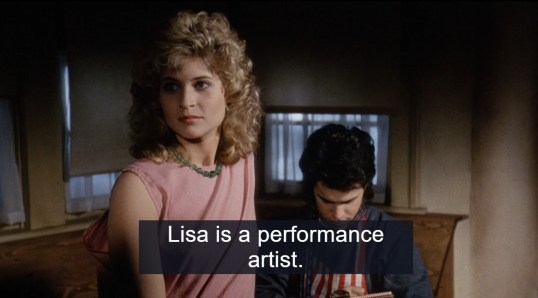
There’s a few artists at the Institute. Norman (Vince Edwards) is a tough guy writer. Philip (Brian Robbins) is a bad boy artist. Amanda (Pamela Bellwood) is a former rival of Whitney’s and the two still hate each other. (Whitney seems to rub a lot of people the wrong way.) Best of all, there’s a performance artist named …. LISA!
Lisa is played by Miranda Wilson.
Frustrated with Amanda, Whitney gives into her worst instincts and draws a cartoon the features a monster killing her rival. Uh-oh. Soon, the monster has reemerged from the cellar and Amanda has disappeared. One-by-one, the other residents are picked off and their deaths appear in Whitney’s cartoons. The monster claims that he dwells wherever there is imagination but Whitney is convinced she’s figure out a way to destroy him and bring everyone back. Has she? You’ll have to watch the film to find out!
Produced by Charles Band’s Empire Pictures, Cellar Dweller is an enjoyably macabre little tale. It’s only 77 minutes long and the fast pace makes the film feel like an extended episode of a horror anthology series. The monster and the plot feel like they could have been lifted from a 50s horror comic and the other artist are all memorably eccentric. The cast appears to be having a ball. It’s a fun treat for horror fans like you and me.
Cellar Dweller was directed by special effects specialist John Carl Buechler and he does a good job with the monster. It’s both intimidating and kind of goofy at the same time. A year after Cellar Dweller, Buechler directed his best known film, Friday the 13th Part VII — The New Blood. That film too was likably goofy.
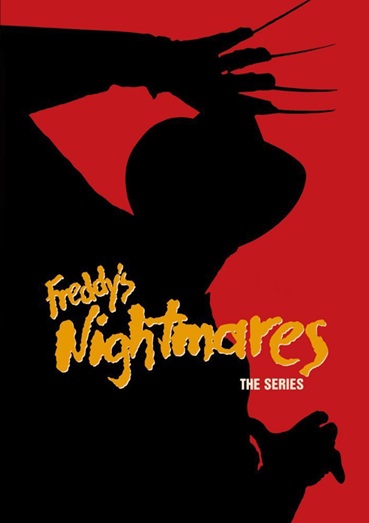
Welcome to Late Night Retro Television Reviews, a feature where we review some of our favorite and least favorite shows of the past! On Fridays, I will be reviewing Freddy’s Nightmares, a horror anthology show which ran in syndication from 1988 to 1990. The entire series can be found on Tubi!
This week, dreams continue to come true in Springwood, Ohio. Freddy continues to show up in very short host segments because I guess he doesn’t have anything better to do. And I continue to find ways to pad out my reviews for a show that there’s really not much to be said about. It happens. Some shows are interesting and take chances and other shows just recycle the same thing over and over again. Anyway, let’s get to it….
Episode 1.17 “Love Stinks”
(Dir by John Lafia, originally aired on February 26th, 1989)
Adam (John Washington) is a high school jock who has a chance to join the White Sox and who has a girlfriend named Laura (Tamara Glyn). When his parents go out of town, Adam throws a house party. The party goes wrong when he finds himself unable to say the words “I love you,” to Laura. Laura leaves him and Adam has a one-night stand with Loni (Susanna Savee). Soon, Adam finds himself drifting in-and-out of a dream state. He sees Laura chopping him up with meat cleaver. He sees his parents come home and he notices that his father is missing a finger. Loni ruins his interview with the baseball scout. It’s all because Adam can’t say “I love you,” but suddenly, Adam wakes up in bed and hears the party still going on downstairs and realizes it was all a dream. He runs downstairs and grabs Laura and says, “I love you!” Except, Laura now looks like Loni. And when his parents show up and say they brought someone to meet him, it turns out to be Loni except Loni now looks like Laura.
Meanwhile, Adam’s slacker friend Max (Georg Olden) gets a job at Mr. Cheesy Pizza. He’s working for his hated uncle, Ralph (Jeffery Combs). When Max’s girlfriend disappears, Max is horrified to discover that she’s become a part of the special sauce that Ralph uses to make the pizza’s so memorable. Don’t worry, it’s all just a dream. Except, in the waking world, the pizza oven explodes and kills Ralph. Max apparently decides to take a lesson from his dream and makes tasty use of Ralph’s remains.
By the admittedly low standards of Freddy’s Nightmares, this episode wasn’t that bad. Though the first story was incoherent, it still captured the feeling of being scared of commitment. The second story was predictable but at least it featured Jeffrey Combs doing his sociopathic nerd thing. This episode held my interest. That said, almost every episode pretty much has the exact same “It was just a dream” plot twist. At this point, it’s no longer a shock when someone suddenly opens their eyes and breathes a sigh of relief. Even Freddy seems kind of bored with it all.
“You’re diving deeper than any sane man ever should.” — Dr. Katherine McMichaels
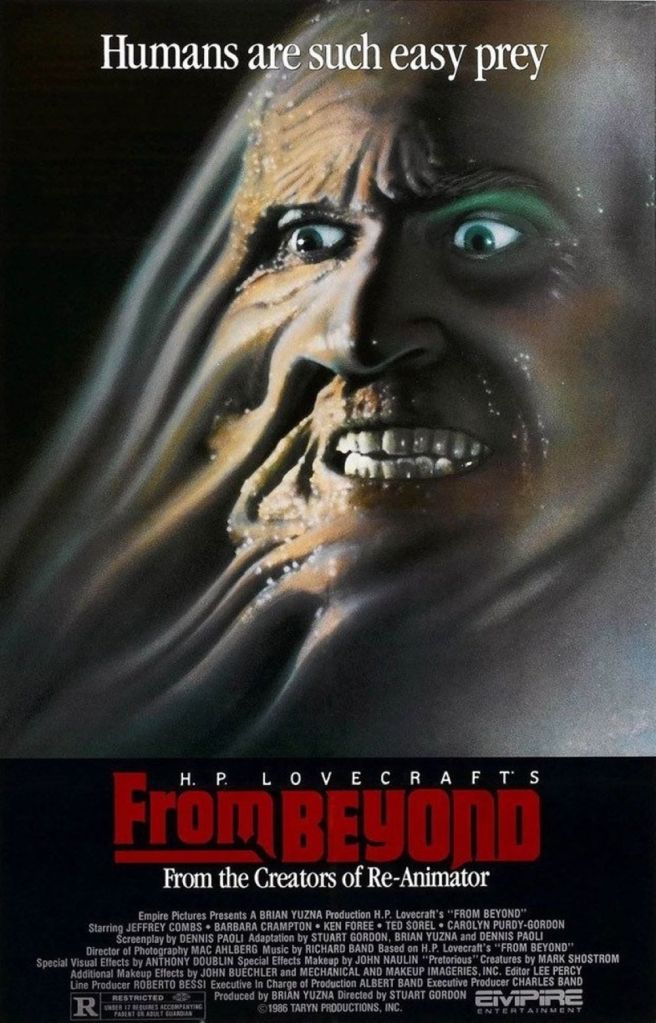
Stuart Gordon’s From Beyond (1986) stands as a darker, moodier follow-up to his breakout Lovecraft adaptation, Re-Animator (1985). At its core is the Resonator, a bizarre scientific contraption designed to stimulate the pineal gland—allowing its users to glimpse eerie creatures and dimensions normally invisible to the naked eye. When Dr. Crawford Tillinghast (Jeffrey Combs) activates the device, it unleashes horrors not just upon the world but also within the minds and bodies of those involved, blurring the line between reality and nightmare in a way both terrifying and hypnotic.
Just like with Re-Animator, Gordon used H.P. Lovecraft’s short story From Beyond as a foundation but expanded the narrative significantly by injecting his own creative vision and filling in what Lovecraft left unexplored. Lovecraft’s original story is a brief, eerie vignette about stimulating the pineal gland to perceive alternate dimensions and terrifying alien creatures—minimalistic and atmospheric, leaving much to the imagination. Gordon reimagines this premise into a fully fleshed-out narrative, adding complex characters like the obsessive Dr. Edward Pretorius and the rational yet vulnerable Dr. Katherine McMichaels. He enriches the story with body horror, psychological torment, and a deeper thematic exploration of sexuality, obsession, and the fragility of the mind. This creative expansion transforms the story into something far more personal and tangible, blending cosmic horror with primal human fears and desires.
This tonal shift stands in stark contrast to Re-Animator, which thrives on anarchic gore, slapstick comedy, and a playful mad-scientist energy. From Beyond trades much of the humor for a somber, unsettling atmosphere drenched in slime, grotesque transformations, and claustrophobic dread. The characters are more grounded in psychological trauma, and the film’s pacing emphasizes creeping unease rather than chaotic spectacle. Gordon’s use of stark, hallucinatory lighting and saturated colors enhances this otherworldly feeling, while practical effects bring a tactile horror to life that heightens the visceral and emotional impact. The horror isn’t just external—it’s internal, a fracture of reality and self.
One of the most notable ways From Beyond separates itself from Gordon’s earlier work is in its overt intertwining of sexuality and horror. The Resonator doesn’t just expose alien creatures; it unlocks primal lust and repressed desires in its users. Scenes imbued with uneasy erotic tension, especially involving Barbara Crampton’s character, make sexuality a core source of vulnerability and terror. This blend of eroticism and nightmare adds depth and psychological complexity, exploring how intimate human experiences can be distorted into something terrifying. It’s a thematic boldness that would become highly influential beyond Western cinema.
Indeed, the film’s fusion of sexual subtext, body horror, and psychological unease foreshadowed themes embraced by late 1980s and early 1990s Japanese horror hentai anime. Works such as Angel of Darkness (Injū Kyōshi) combined explicit eroticism, grotesque body transformations, and supernatural horror in ways reminiscent of From Beyond’s style and tone. This synergy helped define a subgenre of adult horror anime where the boundaries between pleasure and terror, desire and monstrosity, are constantly blurred—cementing From Beyond not only as a cult classic in horror but also as an inspirational bridge to pioneering adult animation in Japan.
Visually and atmospherically, the film is a masterpiece of practical effects and immersive storytelling. The slime-drenched creatures, anatomically warped bodies, and constant visual flow between nightmare and distorted reality create a hallucinatory experience. The climax offers a frenetic, visceral battle that embodies the film’s core themes of madness, transformation, and cosmic terror, leaving viewers with a lingering sense of unease and wonder.
Stuart Gordon’s direction also employs incredibly effective subjective perspectives, with many scenes shot from the characters’ points of view. This technique immerses viewers in the unfolding madness and heightens the sensory overload that defines the film’s experience. There is a famously unsettling point-of-view shot from the mutated Crawford as he perceives a brain inside a doctor’s head and gruesomely attacks. Such moments amplify the film’s exploration of altered perception and the treacherous expansion of human senses.
Despite these strengths, the film is not without flaws. Ken Foree’s character, Bubba Brownlee, while providing moments of grounded streetwise humor, sometimes comes off as a caricature that leans into stereotypical portrayals of Black men as taboo or outlier figures in horror cinema. This portrayal feels somewhat jarring against the film’s otherwise nuanced tone and may evoke discomfort.
Additionally, From Beyond can feel comparatively stiff and sluggish next to Re-Animator, lacking some of the earlier film’s darkly comic energy. The story often relies on a series of increasingly grotesque set pieces that feel more like shock showcases than a cohesive narrative arc. Some performances, including Jeffrey Combs’ lead, occasionally seem overly intense without sufficient emotional variation, and the film sometimes slips into melodrama that undercuts its impact. Furthermore, although ambitious in visualizing Lovecraftian horrors, budgetary constraints are occasionally evident, diminishing some of the awe those moments seek to inspire.
Ultimately, Gordon’s From Beyond is a significant Lovecraft adaptation that showcases the power of expanding upon source material with bold creativity. Moving beyond Lovecraft’s sparse prose, Gordon infuses the story with rich characters, psychological depth, explicit body horror, and mature explorations of sexuality. This results in a haunting, distinctly unsettling film that not only stands as a high point in Gordon’s career but also resonates far beyond its American horror roots, shaping international horror aesthetics and inspiring future genres. It is a disturbing, thrilling journey to the dark spaces just beyond human perception—a cinematic experience that lingers in the mind long after the screen fades to black.
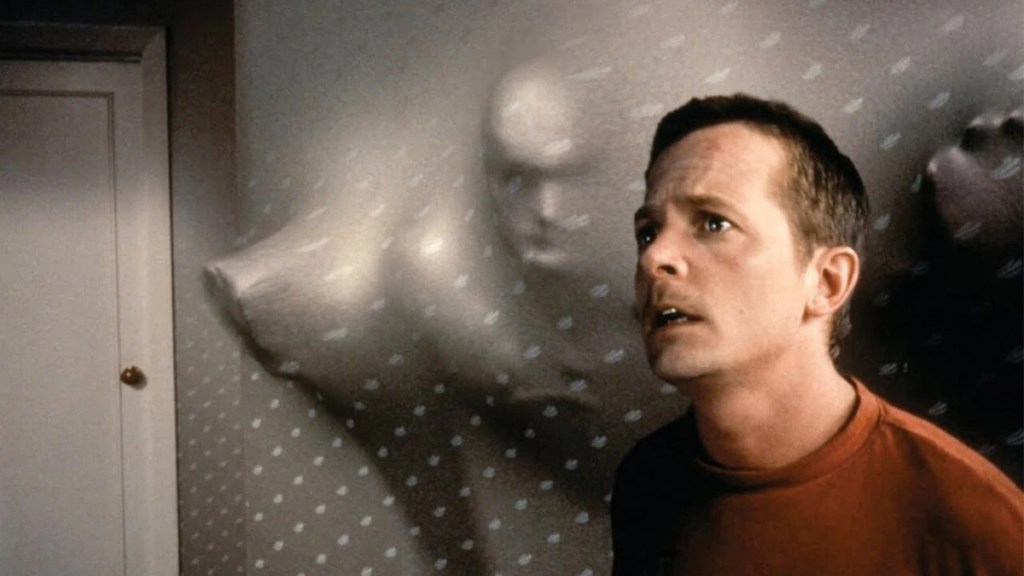
In the 1980’s I was a huge fan of Michael J. Fox. Alex P. Keaton was my hero, and BACK TO THE FUTURE and TEEN WOLF are two of my favorite 80’s movies. In the early 2000’s I became a huge fan of Director Peter Jackson due to his LORD OF THE RINGS trilogy. Made in 1996, THE FRIGHTENERS is the only Peter Jackson film I had seen prior to the LORD OF THE RINGS trilogy. I saw THE FRIGHTENERS at the movie theater in 1996, and I loved it. It was different than I was expecting going in, but it has one hell of cast. I had not seen any of Jeffrey Combs’ work prior to this movie, and he totally cracked me up. Throw in a ghostly Chi McBride whose character even references Charles Bronson* at one point, and I’m hooked. Peter Jackson directing Michael J. Fox. Now that’s a match made in heaven!
*BONUS – Chi McBride as Cyrus :
“All right, man, this is it. We gotta be hard. No mercy. We’re going in like professionals, like Charles Bronson. We don’t stop till the screaming starts, you dig?”
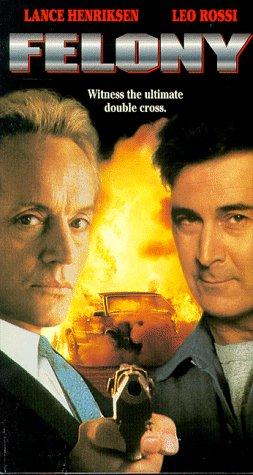
In New Orleans, a drug raid gone wrong leads to eleven cops being gunned down and then blown up. The disastrous raid was being filmed for a Cops-like reality show The show’s producer, Bill Knight (Jeffrey Combs) finds himself being pursued through New Orleans by a collection of rogue intelligence agents, cops, and gangsters, all of whom want the tape of the massacre.
It’s a simple direct-to-video premise and the film’s plot hits every chase film cliche, while keeping the action moving at a decent pace. Bill Knight is not supposed to be a typical action hero. He’s just a television producer who was in the wrong place at the wrong time. Yet Knight proves himself to be as indestructible as any Arnold Schwarzenegger hero. He gets shot, twice. He falls from a great height. He crashes through a window. He repeatedly gets hit over the head. And yet, his injuries never seem to really slow him down or even hurt that much. He does hook up with a nurse (Ashley Laurence) but still, it’s hard to believe anyone could take that much punishment and keep running. Jeffrey Combs, the brilliant star of films like Re-Animator, is miscast as Knight but he’s still always entertaining to watch.
In fact, the cast is the main thing that Felony has going for it. David Prior was able to assemble a true group of B-movie all-stars. Lance Henriksen and David Warner are the evil intelligence agents who are determined to kill Knight. (Warner finally gets to handle a grenade launcher and we’re all the better for it.) Leo Rossi and Charles Napier are the two New Orleans cops who are investigating the drug raid. Joe Don Baker is the rogue intelligence agent who dresses like a cowboy and who is trying to clean up everyone else’s mess. The cast keeps the action moving and there are enough eccentric personalities in this film that it’s always watchable. I think this might be the only film to feature Joe Don Baker and Lance Henriksen performing opposite each other. If nothing else, it deserves to be watched for that!
(The cover for Felony features Lance Henriksen and Leo Rossi but not Jeffrey Combs, even though Combs is the lead in the film and Rossi’s role is actually pretty small. Henriksen also doesn’t have blonde hair in the movie. There are plenty of double crosses in the movie but I can’t think of any that really qualify as the “ultimate double cross.”)
Even with its miscast lead and its cliche-heavy plot, Felony is what direct-to-video action movies should be all about, fact-paced action and a cast unlike any other,
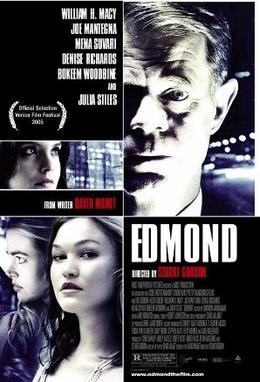
Based on a one-act play by David Mamet, 2005’s Edmond tells the story of Edmond Burke (William H. Macy).
Edmond shares his name (if not the actual spelling) with the philosopher Edmund Burke. Edmund Burke was a strong believer that society had to put value in good manners to survive and that religious and moral institutions played an important role in promoting the idea of people treating each other with respect and decency. Edmund Burke knew what he believes and his writings continue to influence thinks to this day. Edmond Burke, on the other hand, doesn’t know what he believes. He doesn’t know who he wants to be. All he knows is that he doesn’t feel like he’s accomplished anything with his life. “I don’t feel like a man,” he says at one point to a racist bar patron (played by Joe Mantegna) who replies that Edmond needs to get laid.
On a whim, Edmond steps into the shop of a fortune teller (Frances Bay), who flips a few Tarot cards and then tells Edmond that “You’re not where you’re supposed to be.” Edmond takes her words to heart. He starts the night by telling his wife (played by Mamet’s wife, Rebecca Pidgeon) that he’s leaving their apartment and he won’t be coming back. He goes to the bar, where he discusses his marriage with Mantegna. He goes to a strip club where he’s kicked out after he refuses to pay $100 for a drink. He goes to a peep show where he’s frustrated by the glass between him and the stripper and the stripper’s constant demand that he expose himself. He gets beaten in an alley by three men who were running a three-card monte scam. Edmond’s problem is that he left home without much cash and each encounter leads to him having less and less money. If he can’t pay, no one wants to help him, regardless of how much Edmond argues for a little kindness. He pawns his wedding ring for $120 but apparently, he just turns around and uses that money to buy a knife. An alley-way fight with a pimp leads to Edmond committing his first murder. A one-night stand with a waitress (a heart-breaking Julia Stiles) leads to a second murder after a conversation about whether or not the waitress is actually an actress leads to a sudden burst of violence. Edmond ends up eventually in prison, getting raped by his cellmate (Bookem Woodbine) and being told, “It happens.” Unable to accept that his actions have, in one night, led him from being a businessman to a prisoner, Edmond says, “I’m ready to go home now.” By the end of the film, Edmond realizes that perhaps he is now where he was meant to be.
It’s a disturbing film, all the more so because Edmond is played by the likable William H. Macy and watching Macy go from being a somewhat frustrated but mild-mannered businessman to becoming a blood-drenched, racial slur-shouting murderer is not a pleasant experience. Both the play and the film have generated a lot of controversy due to just how far Edmond goes. I don’t see either production as being an endorsement of Edmond or his actions. Instead, I see Edmond as a portrait of someone who, after a lifetime of being willfully blind to the world around him, ends up embracing all of the ugliness that he suddenly discovers around him. He’s driven mad by discovering, over the course of one night, that the world that is not as kind and well-mannered as he assumed that it was and it all hits him so suddenly that he can’t handle it. He discovers that he’s not special and that the world is largely indifferent to his feelings. He gets overwhelmed and, until he gets his hands on that knife, he feels powerless and emasculated. (The knife is an obvious phallic symbol.) It’s not until the film’s final scene that Edmond truly understands what he’s done and who he has become.
Edmond is not always an easy film to watch. The second murder scene is truly nightmarish, all the more so because the camera remains on Edmond as he’s drenched in blood. This is one of William H. Macy’s best performances and also one of his most disturbing characters. That said, it’s a play and a film that continues to be relevant today. There’s undoubtedly a lot of Edmonds out there.
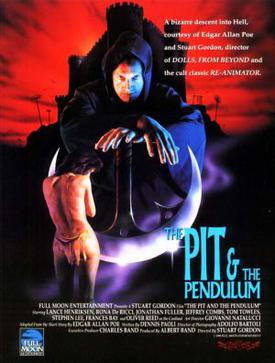
That was my reaction when I watched the 1991 film, The Pit and the Pendulum. Based very narrowly on several Edgar Allan Poe short stories, The Pit and the Pendulum takes place at the height of the Spanish inquisition. Despite the objections of the Pope, Grand Inquisitor Torquemada (Lance Henriksen) is leading a reign of terror though 15th Century Spain. In his torture chambers, Torquemada forces confessions from accused witches and other criminals. The dirty prison cells are full of starving and beaten partners. Witches are burned at the stake and explode while the crazed citizenry calls for blood and Torquemada tests out new torture devices.
Torquemada presents himself as being a grim and emotionless man, someone who is above all sin and who is allowed to sit in judgment of the people who are brought before him. However, Torquemada is hardly the sinless figure that he portrays himself as being. His actions are fueled by his repressed lust and his anger. Maria (Rona De Ricci) has been brought before him, accused of being a witch and Torquemada is determined to get her to confess. Maria’s refusal to be broken by Torquemada only increases Toquemada’s anger but, at the same time, Torquemada has also decided that he’s in love with Maria. While Maria waits in the prison and takes advice from the witch Esmerelda (Frances Bay), Maria’s husband, Antonio (Jonathan Fuller), attempts to break Maria out of prison. When Antonio is captured, Torquemada decides to try out his latest device, a swinging and sharpened pendulum that hangs in a pit….
The Pit and the Pendulum is not always an easy movie to watch. I have to admit that I spent the majority of the movie with my hands over my eyes, not wanting to watch the extremely graphic torture scenes. Like many of director Stuart Gordon’s film, The Pit and the Pendulum is gripped by an atmosphere of pervasive corruption and the movie captures the feeling of not being able to escape from the worst place on Earth. Poor Maria spends a good deal of the movie naked and chained to various devices but Rona De Ricci gives such a strong and such a committed performance as Maria that, instead of being offended by the obvious exploitation element of the scenes, you instead find yourself admiring Maria and her strength.
It’s probably not a coincidence that Oliver Reed shows up in the film as a Cardinal because The Pit and the Pendulum, with its portrayal of blood frenzy and hypocrisy, is definitely influenced by Ken Russell’s The Devils. The imagery is graphic and often disturbing but the most memorable thing about the film is Lance Henriksen’s intense performance as the evil Torquemada. Henriksen plays Torquemada as being a hateful and self-loathing figure, a man who deals with his own demons by bringing his fury down on the innocent. It’s a truly frightening villainous performance, one that carries shades of Vincent Price’s excellent performance in The Witchfinder General.
The Pit and the Pendulum is not an easy film to watch and I doubt I’ll watch it a second time. In the end, it’s a disturbing film but one that definitely leaves an impression.
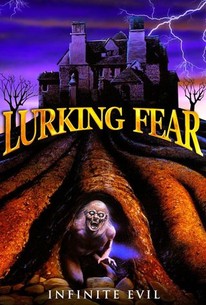
For years, the town of Leffert’s Corners has lived in fear of the criminal Martense family. The family’s youngest son, John (Blake Bailey), has just been released from prison and now he’s returning home. He knows that, before he died, his father arranged for a thousand dollars to be buried in the cemetery. After the town mortician (Vincent Schiavelli, in a too brief cameo) tells him where it is, John heads to the cemetery. Unfortunately, he’s followed by crime boss Bennett (Jon Finch) and his thugs.
Cathryn (Ashley Laurence) and Dr. Haggis (Jeffrey Combs) are already at the cemetery, though not for the money. It turns out that subterranean monsters (all of whom are descended from one John’s relatives) are living underneath the cemetery grounds and terrorizing the town. Cathryn and Haggis are planning on blowing up the graveyard but that plan is put on hold when John and Bennett arrive. Underground monsters or not, Bennett is planning on getting that money and if that means holding everyone hostage in a church while the monsters prepare to attack, that is exactly what he is going to do.
As is evident by the welcome presence of Jeffrey Combs, The Lurking Fear is another Full Moon production that was loosely adapted from a H.P. Lovecraft short story. The premise has promise and the cast is full of talent but the film’s direction is flat, the script is shallow, and the monsters themselves look good but there’s nothing that set them apart from a dozen other monsters that have appeared in Full Moon productions. (The monsters resemble the dungeon dweller from Castle Freak but they are never as scary.) It’s too bad because The Lurking Fear is one of Lovecraft’s best short stories and it seems like one that would make a great movie. But, as a movie, The Lurking Fear, like so many other Full Moon productions, doesn’t seem to know what to do with itself whenever the monsters aren’t around. Hopefully, someday, Lovecraft’s The Lurking Fear will get the film adaptation that it deserves.
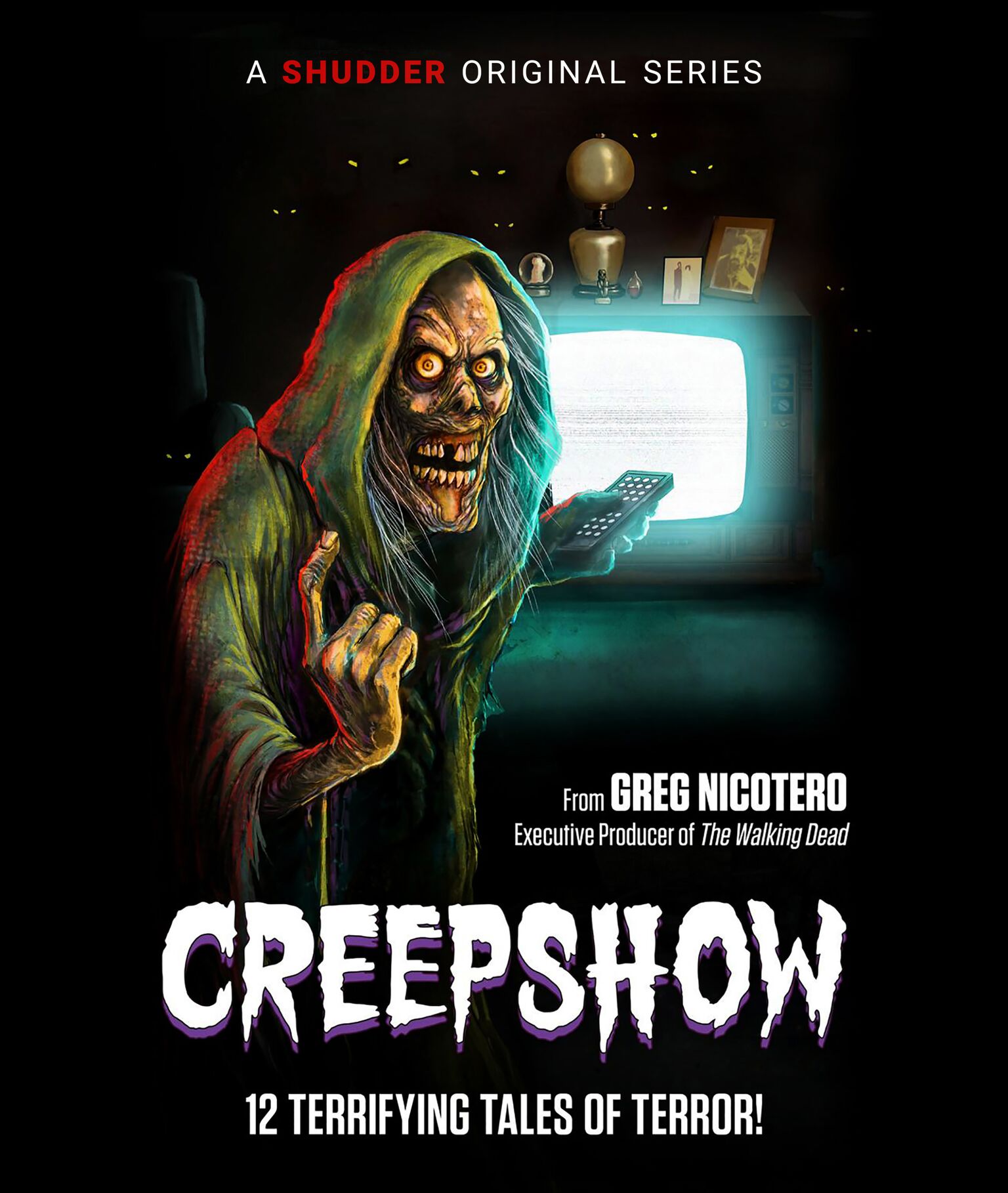
Happy Halloween Havoc!!!! Is it enough for horror to just be fun and even funny? YES! American Werewolf in London or anything by John Landis really proves that. Creepshow on Shudder is all about just sitting back and having some gory fun. This show is so wonderfully over the top that the 90s have returned. Let’s all put away our black turtle necks and put on some Hammerpants and watch some great horror.
Bad Wolf Down is a werewolves in World War II story…Really! It was a lot of fun. Then, when I saw Jeffrey Combs (Re-Animator) playing a Nazi, I realized this show is THE AWESOMENESS! An american platoon gets trapped behind enemy lines and takes refuge in an abandoned police station. They find a woman in the jail who is a french werewolf. This seems relevant because they really spend a lot of time translating.
The Head Nazi (Jeffrey Combs) finds the american platoon and will wipe them out, but the platoon gets the french werewolf to turn them into werewolves and they go and kill a bunch of Nazis. That’s it…Really!
The Finger is your lonely guy adopts a self-regenerating-human-eating-Alien story. I know…I know .. another one?! Clark Wilson (DJ Qualls) is a twice divorced down and out guy who has nothing going for him- until he finds a finger. The finger looks alien and when he spills beer on it, it re-generates into a medium-sized alien and becomes his pet. He calls the alien Bob. Bob becomes Clark’s best friend and as any best friend would do, Bob eats all of Clark’s enemies. He also brings back body parts from the kill like my old cat did. Sidenote: I had a cat who used to bring me squirrel heads. He’d line them on my porch. Bob is like that. The police eventually arrest Clark for the murders, but Bob might break him out.
The finger is told by Clark in real-time narration, which really adds to the comedy. He looks dead into the camera, talking directly to us. Also, it’s especially fun watching DJ Qualls hang out with a bro-alien- Brolien. If you wanna chill, watch this!!!!
 Through the Shattered Lens