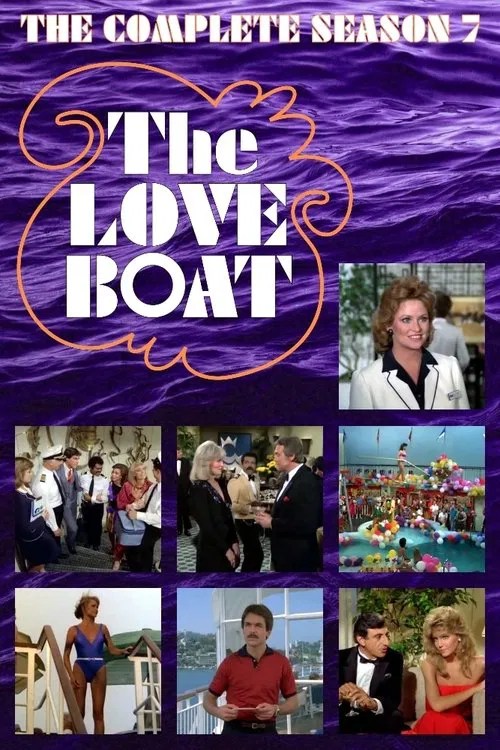
Welcome to Retro Television Reviews, a feature where we review some of our favorite and least favorite shows of the past! On Wednesdays, I will be reviewing the original Love Boat, which aired on ABC from 1977 to 1986! The series can be streamed on Paramount Plus!
This week, it’s a very special cruise of The Love Boat!
Episodes 7.7 and 7.8 “When Worlds Collide/The Captain and the Geisha/The Lotter Winners/The Emperor’s Fortune”
(Dir by Jerome Courtland, originally aired on November 5th, 1983)
The Love Boat is sailing to Japan!
Lila (Heather Thomas) is a photographer whose father is in a wheelchair due to the injuries that he received during World War II. She meets and falls for Bud O’Hara (Tony Danza). It seems like love at first sight but how will she react when they arrive in Japan and she discovers that Bud’s father (James Shigeta) is Japanese!? At first, Lila cannot get over her prejudice but then Bud’s father reveals that his own parents were killed at Hiroshima and that he has also struggled with forgiveness. “I am proud to be Japanese,” Tony Danza declares.
Martha Chambers (Mariette Hartley) is a professor in Asian studies who has a crush on the Captain. When she finds out that the Captain is fascinated by the culture of Japan, Martha pretends to be a geisha.
Barney (Ted Knight) and his wife (Rita Moreno) have just won five million dollars in the lottery and they spend almost the entire cruise showing off how much money they have. The crew isn’t comfortable dealing with the nouveau riche. Myself, I’m just happy that this storyline didn’t feature Ted Knight or Rita Moreno pretending to be Japanese.
Celia (Jean Hoffman) and her daughter, Joanie (Nancy Morgan), own one piece of an embroidered silk artwork. Ben Cummins (John Ritter) owns another piece. They’ve all been invited to Japan by a businessman named Yamamoto. Yamamoto claims to have the third piece and says that, when all the pieces are together, they will form a treasure map. Ben falls for Joanie. Celia falls for Harvey (Harvey Korman), a businessman who happens to be on the cruise. When the other two silk pieces are stolen, it doesn’t take long for Ben to figure out that Harvey is the one who took them. Harvey explains that he is Yamamoto and that he’s a career criminal. However, because he’s fallen in love with Celia, he returns all three of the silk pieces to her.
This two-hour episode was a travelogue. The Love Boat did one or two of these type of episodes every season. The show would leave the sound stages of Los Angeles and instead be filmed on an actual boat during an actual cruise. With these two hour episodes, the storylines were usually just an excuse for the Love Boat crew and their guest stars to see the sights. That’s certainly the case here. Captain Stubing gets a full tour of Japan. (Captain Stubing also has a lengthy fantasy sequence where he imagines himself as a shogun. It’s definitely not the show’s finest moment.)
It’s a good thing that the scenery is lovely in this episode because the stories themselves are nothing special and, in some cases, they’re actually difficult to watch. The Love Boat attempted to make a plea for tolerance and forgiveness and that’s definitely a good thing. But then the show cast Tony Danza as a half-Japanese man named Bud O’Hara and that was more than a bit cringey. There’s nothing about Tony Danza that is the least bit Japanese. For that matter, there’s nothing particularly Irish about him either.
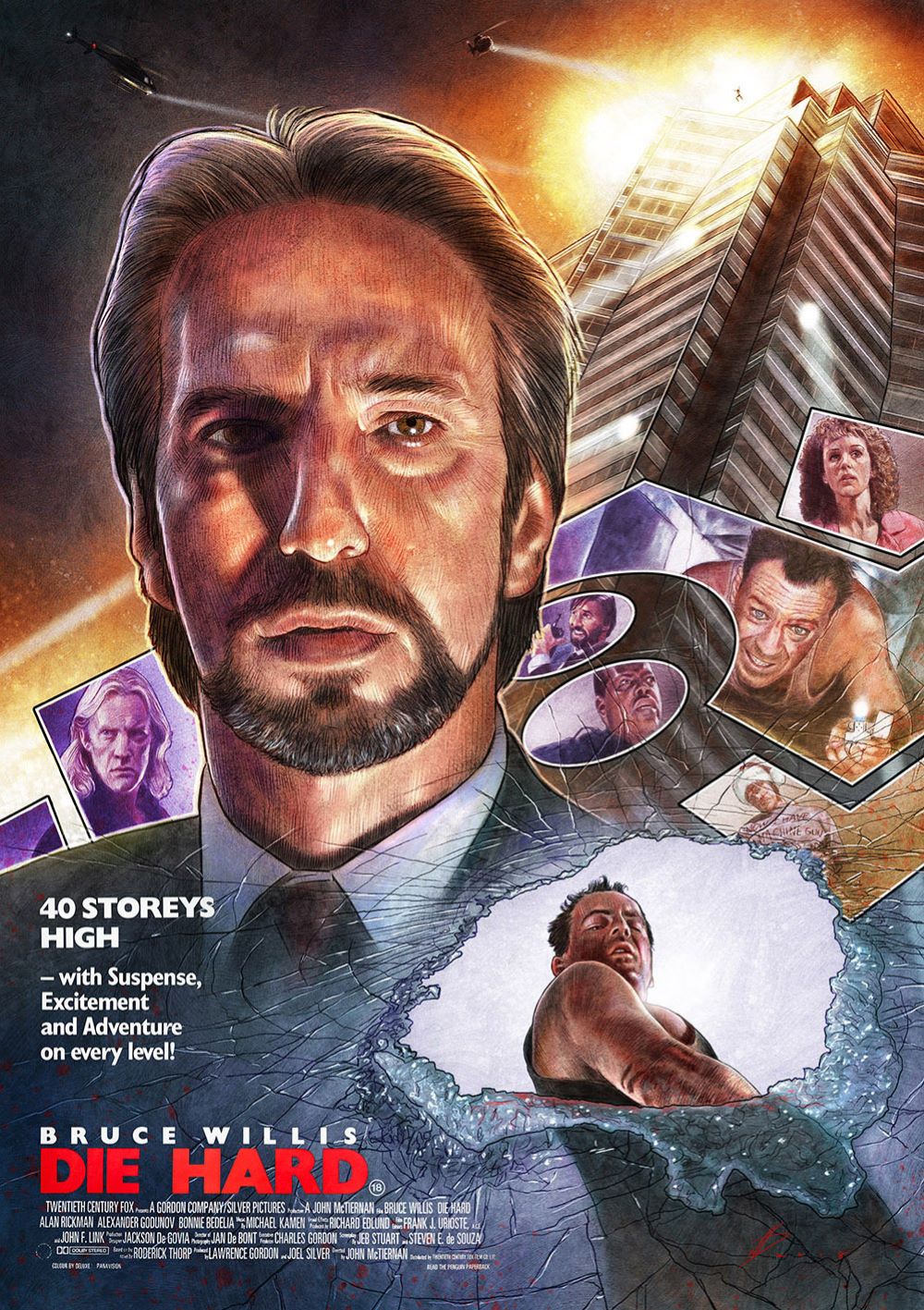
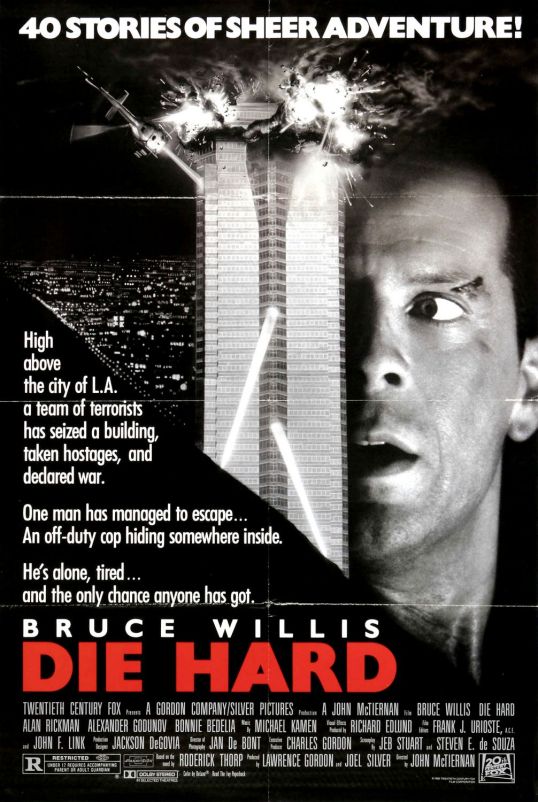
Die Hard is the ultimate Christmas film (though not the greatest) disguised as an action thriller, blending holiday cheer with high-stakes mayhem in a way that has sparked endless debates and turned it into a seasonal staple for millions. It stands as a landmark action movie and a sharp, character-driven thriller that continues to set the standard for the genre. The film mixes bombast with genuine heart, balancing tension, wit, and raw emotion so effectively that its imperfections only add to its enduring appeal.
Released in 1988 under John McTiernan’s direction, Die Hard follows New York cop John McClane (Bruce Willis) arriving in Los Angeles during the holidays to reconcile with his estranged wife Holly at her office Christmas party in Nakatomi Plaza. He’s fresh off a transcontinental flight, nursing a cocktail of jet lag and marital tension, hoping a festive gathering might thaw the ice between them after her career move to the West Coast has strained their family life. No sooner has he kicked off his shoes—famously leaving him barefoot for most of the chaos—than a disciplined crew of armed robbers, masquerading as terrorists under the command of Hans Gruber (Alan Rickman), storms the building, holding the revelers captive and forcing McClane to fight back shoeless and outgunned amid the towering offices. This lean setup—one man, one skyscraper, one chaotic evening—drives the story’s relentless pace, with straightforward spatial awareness keeping viewers locked into the rising peril. The Christmas setting isn’t just window dressing; twinkling lights, carols on the soundtrack, and a rooftop Santa sleigh add layers of irony and warmth to the gunfire, making the film a peculiar but perfect yuletide watch.
The movie refreshingly casts its action lead as an everyday underdog, full of sarcasm and frailty rather than invincible machismo. McClane takes real damage—he’s slashed by glass, battered by falls, and wheezing from asthma attacks—freaks out under pressure, second-guesses himself constantly, and limps through the ordeal covered in cuts and shards while grumbling about his lousy luck. These moments of raw vulnerability humanize him in a genre often dominated by perfect physiques and unflappable cool. Bruce Willis brings a rumpled, relatable edge to the role, drawing from his TV background on Moonlighting to infuse McClane with quick-witted banter and hangdog charm, making his pigheaded risks and desperate quips—like his tense radio chats or infamous air vent shuffle—land as the outbursts of an ordinary Joe desperate for survival and a way out. Willis’s casting was a gamble at the time, pivoting from wisecracking detective to gritty hero, but it paid off by redefining what an action star could be: flawed, funny, and fiercely determined.
Hans Gruber remains a standout antagonist, living up to every ounce of his legendary status—and remarkably, this was Alan Rickman’s very first film role, launching him into stardom with a performance that still defines screen villainy. Fresh from stage work, Rickman infuses him with suave detachment and subtle menace, his silky British accent dripping with condescension as he portrays a criminal mastermind who approaches the heist like a hostile merger, his cultured facade slipping just enough to reveal cold ruthlessness. Lines like his mocking “Mr. Mystery Guest” taunts or his gleeful disdain for American excess have become iconic, delivered with a theatrical precision that elevates Gruber above typical thugs. Clever writing highlights his contempt for yuppie excess and delight in red tape, while McTiernan’s direction turns their encounters into personal showdowns brimming with verbal sparring beyond mere firepower, turning cat-and-mouse into a battle of intellects as much as endurance.
A strong ensemble bolsters the narrative without bogging down the momentum. Bonnie Bedelia’s Holly exudes quiet strength, proving herself a sharp professional unafraid of bosses or bandits, which elevates her rapport with McClane above clichéd rescue tropes—she’s calling shots from the hostage room and holding her own in tense negotiations. Reginald VelJohnson’s Sergeant Al Powell elevates a stock radio contact into the story’s heartfelt core, offering McClane solace and shared regrets during their poignant nighttime talks about lost family and second chances, creating an unlikely but touching bromance across police lines. Figures like Hart Bochner’s smarmy Ellis, with his coke-fueled deal-making, or William Atherton’s pushy journalist Richard Thornburg, chasing scoops with ruthless ambition, add biting commentary on greed and sensationalism, sharpening the film’s take on ’80s excess and how corporate snakes and media vultures complicate the crisis. Even smaller roles, like the hapless deputy chief or the bickering SWAT team, paint a vivid picture of institutional incompetence that McClane must navigate alone.
Die Hard excels in choreographing escalating clashes within tight quarters, turning the skyscraper into a multi-level chessboard. McTiernan masterfully exploits Nakatomi’s design—raw construction levels with exposed beams, service elevators for ambushes, fire stairs slick with tension, upper decks for sniper duels, and cubicle warrens for close-quarters chaos—to distinguish every skirmish from rote shootouts, ensuring each fight feels unique and earned. Precise editing weaves between McClane’s scrambles, captive dread, robber schemes, and external responders, layering suspense without devolving into explosive filler; the cross-cutting builds dread as plans intersect disastrously. Standout sequences thrill because of careful buildup around deadlines and official blunders, like ill-timed interventions that raise the stakes sky-high. The practical effects—real stunts, squibs, and pyrotechnics—give the action a tangible weight that CGI-heavy modern films often lack, grounding the spectacle in sweat and physics.
Blending laughs with savagery proves the film’s toughest feat, yet it mostly triumphs. McClane’s biting comebacks, taped to dead bodies or barked into walkie-talkies, and the dark comedy amid cop-thug banter sustain levity amid dire threats and mounting casualties, preventing the film from tipping into grim slog. Gags like the executive’s C4 “gift” or Powell’s Twinkie diet poke fun at excess without diffusing danger. Certain gags and era-specific jabs feel dated—like mockery of inept brass or overzealous feds—but this institutional skepticism fuels the plot, portraying red tape and hubris as lethal as automatic weapons, a theme that resonates in any age of bloated bureaucracies.
The film’s action overload, ironically its signature strength, occasionally trips it up. Later stretches bombard with relentless blasts and ballets, prompting some to decry the carnage’s intensity or plot holes from initial reviews, where critics noted the escalating body count’s numbing effect. Elements like tactical decisions by authorities or vault breach logistics falter on nitpicks, relying now and then on lucky breaks to align the chaos, such as perfectly timed discoveries or overlooked details in the heist plan. Fans of taut caper tales might see the wilder antics as indulgence over invention, prioritizing popcorn thrills over airtight logic. Yet these are minor quibbles in a runtime that clocks in under two hours, keeping energy high without exhaustion.
Yet a solid emotional arc lends depth beyond mere spectacle. Fundamentally, it’s about a bullheaded officer confronting his marital neglect, enduring brutal comeuppance while seeking redemption amid the tinsel and terror. His raw confessions to Powell inject humanity that heightens the personal stakes, turning isolated survival into a quest for reconnection. The script, adapted from Roderick Thorp’s novel Nothing Lasts Forever, weaves family drama into the frenzy without halting the pace, making quieter moments—like shared vulnerabilities over radio—punch harder than any explosion.
Technically, Die Hard brims with assured flair bordering on swagger. Cinematographer Jan de Bont’s lenses capture glassy surfaces, mirrors for disorienting reflections, and soaring perspectives to render the tower both glamorous and hostile, a glassy trap turned warzone that mirrors the characters’ fractured relationships. Crisp cuts allow pauses for character amid the rush, preserving brisk tempo without shortchanging development; McTiernan’s post-Predator confidence shines in rhythmic pacing that breathes. Michael Kamen’s soundtrack fuses orchestral surges with jingly carols like “Let It Snow,” amplifying the bizarre fusion of festivity and fusillades that forever fuels “Christmas movie” arguments—ho-ho-hos interrupted by hails of bullets.
Die Hard‘s influence reshaped action cinema, birthing the “Die Hard in a [location]” trope for enclosed thrillers, from buses to battleships, spawning endless imitators chasing its formula. Sequels amplified scale at the cost of grounded heroism, proving surface mimics—snark, stunts, scheming foes—miss the original’s vulnerable punch, as later entries piled on global threats and gadgets. Detractors note it paved paths for bloated pyrotechnics in successors, but that’s on copycats, not this taut gem; its box-office success—over $140 million worldwide—proved audiences craved smart spectacle.
All told, Die Hard delivers razor-sharp, hilarious, masterfully built blockbuster entertainment that ages like fine whiskey. Pairing a rugged everyman lead, suave nemesis, and geography-smart sequences, it raises a benchmark few match. Flaws like overkill blasts or shaky rationale aside, its tension, depth, and gritty laughs cement its throne in action lore, a holiday gift that keeps on giving.
As with so many stories, it all starts with Vietnam.
In 1969, soldier Billy Thomas (Lou Ferrigno) heroically saves the life of his captain, Scott Monroe (Reb Brown). Unfortunately, while their helicopter is taking off, Billy takes a bullet to the head. While he survives the wound, he is left with the mind of a child. Scott dedicates his life to taking care of Billy and, after the war, they open a bar together. However, mobster Tony Baccola (Michael Dante) feels that Billy would be the perfect contestant for a series of fight-to-death cage matches that have been set up by Chinese gangster Tin Lum Yin (James Shigeta). In desperate need of money, Tony kidnaps Billy and forces him to fight, telling him that it’s what Scott needs him to do. Billy doesn’t want to fight and, when he first enters the cage, he says, “Hi, how are you?” and tries to shake his opponent’s hand. But when his opponents try to hit Billy, he has no choice but to defend himself. It’s up to Scott to rescue his friend.
The plot of this movie is pretty dumb but I’m not embarrassed to say that the film itself won me over. The fights were decent but the main reason why the movie works is because of Lou Ferrigno and Reb Brown, who made their friendship and their bond feel very real. Ferrigno was especially good in this film. How can you not root for a guy who just wants to be everyone’s friend and who, even after his twelfth cage match, still gets upset over having to hit people?
A pure B-movie all the way, Cage also features familiar faces like Branscombe Richmond, Al Leong, and Danny Trejo. Most of the critics may not have liked it but Ferrigno has described Cage as being his his favorite film performance and I agree.
During the month of October, we like to share classic episodes of horror-themed television. That was easier to do when we first started doing our annual October Horrorthon here at the Shattered Lens because every single episode of the original, black-and-white Twilight Zone was available on YouTube. Sadly, that’s no longer the case.
However, there is some good news! Twilight Zone may be gone but there are other horror shows on YouTube! For instance, I’ve discovered that there are several episodes of The Hitchhiker on YouTube! The Hitchhiker was an American/French/Canadian co-production that aired on HBO from 1983 to 1987 and on the USA Network from 1989 to 1991. It was an anthology show, one in which each story was introduced by a mysterious hitchhiker (played by Page Fletcher).
Let’s get things started with Perfect Order, an episode featuring Virginia Madsen as a model who works with a famous but eccentric photographer named Simon (Steve Inwood). It turn out that Simon’s eccentricity includes an obsession with death. Along with featuring good performances from Madsen and the underrated Inwood, this episode both satirizes the world of New York fashion and it features a climax that is full of laser beams. What more could one want for the beginning of October?
This episode originally aired on February 17th, 1987.
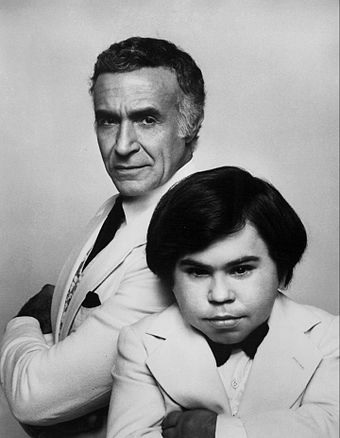
Welcome to Retro Television Reviews, a feature where we review some of our favorite and least favorite shows of the past! On Tuesdays, I will be reviewing the original Fantasy Island, which ran on ABC from 1977 to 1986. The entire show is currently streaming on Tubi!
This week, we’ve got a weird one!
Episode 2.19 “Spending Spree/The Hunted”
(Dir by George McCowan, originally aired on February 24th, 1979)
What a weird episode! This week, we have two fantasies, neither one of which belongs with the other.
The first fantasy is this silly thing where two best friends win a shopping spree. In order to win a bigger prize, Sally Glover (Diana Canova) and Esther Bolling (Lola Falana) have to spend several thousand dollars in Fantasy Island’s shopping district.
(It’s always strange to me how some episodes present Fantasy Island as being a resort while others present it as being a thriving little nation with its own economy, culture, cities, and villages. If you’re a citizen of Fantasy Island who doesn’t work for Mr. Roarke, do you still call the place Fantasy Island or does it have a real name? Do you tell people, “I was born on Fantasy Island but then I came to mainland when I was 11 to study the culinary arts?” My hope is that the natives of Fantasy Island are called Fantasians.)
Sally and Esther are excited to spend their money but then Mr. Roarke adds a twist. They will be competing against each other. The first one to spend all of her money gets a prize. The other one gets nothing. If they both fail to spend all of their money, they both lose. So, of course, Sally and Esther go crazy competing against each other. In the end, though, they both realize that they would rather be friends than for one of them to be a loser.
That’s a nice message but I’m really not sure what their fantasy was to begin with. It seems like Mr. Roarke invited two lifelong friends to the Island and then decided to play games with them for his own amusement. In this episode, we get a return of the vaguely sinister Mr. Roarke who appeared in some of the early first season episodes.
Speaking of sinister, the other fantasy involves Stuart Whitman in the role of Charles Wesley, the world’s most famous big game hunter. (I assume he inherited the title after Darren McGavin died last season.) Whitman’s fantasy is to take part in a great adventure. So, Mr. Roarke hands Wesley a camera and tells him to “shoot a picture” of dictator General Lin Shun (James Shigeta). General Lin Shun rules the national of Chung Tu with an iron fist but he apparently spends all of his time at his compound of Fantasy Island.
Wesley gets the picture but also gets captured by Lin Shun’s men. Lin Shun explains that he will now hunt Wesley through the jungles of Fantasy Island. It’s like a game. In fact, you might call it The World’s Most Dangerous Game! Wesley learns what it’s like to be hunted. Fortunately, at the last minute, Col. Chen (Khigh Dhiegh), the general’s aide, turns against Lin Shun and arrests him. Interestingly enough, it appears that Mr. Roarke is the one who told the colonel to arrest Lin Shun and take over the nation of Chung Tu. Charles Wesley tosses away his rifle and swears that he’ll never hunt again but I’m more interested in the fact that Mr. Roarke has apparently taken over another country.
Like I said, this was a weird episode. The shopping spree stuff didn’t really seem to fit in with Stuart Whitman desperately running through the jungle. This episode also found Mr. Roarke in an uncommonly manipulative and foul mood. This episode left me wondering just what exactly is going on behind the scenes of the resort.
Daniel Grudge (Sterling Hayden) is a wealthy American industrialist who served in World War II and who, despite seeing first hand the horrors of Hiroshima, still believes that war is sometimes the only answer. He spends his Christmas Eve sitting in darkened study, thinking about his dead son (who was killed in combat) and listening to an old record. When his nephew, Fred (Ben Gazzara), stops by, it leads to an argument about American foreign policy. (Who stops by their uncle’s house on Christmas Eve to argue politics?) Fred is do-gooder. Daniel Grudge hates do-gooders.
So, naturally, it’s time for Daniel Grudge to be visited by three ghosts! The Ghost of Christmas Past (Steve Lawrence) takes Grudge first to a troop ship that is full of coffins, representing the dead of World War I. Then he forces Grudge to relive his own callous reaction to Hiroshima. Grudge sees how his actions upset the nurse (Eva Marie Saint) who was traveling with him. The Ghost of Christmas Present (Pat Hingle) invites Grudge to eat a feast in front of a camp full of refugees. The Ghost of Christmas Future (Robert Shaw) takes Grudge to the future where, after a devastating nuclear war, a buffoonish leader (Peter Sellers) encourages his followers to continue to make war and to live only for themselves. Grudge watches as his former butler (Percy Rodriguez) is murdered for advocating for peace. Back at his mansion, Fred shows up again and Grudge must now decide …. will he support the work of the United Nations?
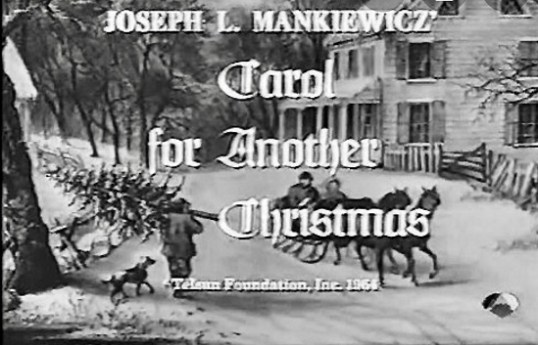
YEEEEESH! What a heavy-handed movie! Really, I guess I shouldn’t be surprised at how unsubtle the film’s message was. Originally made for television, A Carol For Another Christmas was actually co-produced by the United Nations. It was the first of four UN-produced films that aired on ABC between 1964 and 1966. Seen today, with all that we know about the UN’s signature mix of corruption and incompetence, the film’s message seems almost laughably naïve. “Only the UN can bring peace,” the film says. Tell that to Israel, the next time that the UN passes a resolution condemning it for existing and defending itself. Say that only the UN can make the world a better place when some of the worst dictatorships on the planet are sitting on the Human Rights council.
The heavy-handed message aside, A Carol For Another Christmas was full of talent both behind and in front of the camera. This was the only TV movie to be directed by Joseph L. Mankiewicz and, whatever else one might say about the film, he was responsible for some intriguingly moody shots. The script was written by Rod Serling who, unfortunately, allowed his didactic tendencies to get the better of him and wrote a film where characters didn’t have conversations as much as they just gave speeches. The cast, however, is uniformly strong. Sterling Hayden, Robert Shaw, and Steve Lawrence are obvious stand-outs. Pat Hingle does fine until his role is diminished to one long harangue. Playing the so-called “Imperial Me,” Peter Sellers brings so much needed unpredictability to the film, even if his character is saddled with the film’s most heavy-handed moment. The Imperial Me teaches his followers that the individual is more important than the state and that everyone should focus on “me” instead of “we.” Cutting-edge satire this is not and again, there’s something rather offensive about the UN being held up as humanity’s last hope against rampant individualism.
This is very much a film of its time. The fear of nuclear war runs through every frame. The disillusionment that came with the assassination of John F. Kennedy is present in the film’s open-ended conclusion. What good is convincing one man when the rest of the world continues to think for itself? the film seems to be asking. Dickens, I think, would probably say that Serling missed the point of A Christmas Carol and it’s hard not to feel that Dickens would be correct.
And, in an alternative universe, it was a Frank Sinatra movie.
Released into theaters in 1988, Die Hard was based on a novel called Nothing Lasts Forever. Nothing Lasts Forever told roughly the same story as Die Hard, with one of the big exceptions being that the cop fighting the terrorists was not the youngish and quippy John McClane but instead was a weary, aging and retired detective named Joe Leland. Leland previously appeared in another novel called The Detective. In 1968, The Detective was turned into a film and the role of Leland was played by Frank Sinatra. As a part of his contract, Sinatra had the right to play Leland in any sequels to The Detective. When Die Hard was in pre-production, Sinatra could have demanded that the film be a Joe Leland film and that he be allowed to star in it. Fortunately, Sinatra did not do that and Joe Leland was instead transformed into John McClane. And, after the role was was turned down by Arnold Schwarzenegger, Sylvester Stallone, Clint Eastwood, Nick Nolte, Mel Gibson, Don Johnson, Harrison Ford, Burt Reynolds, Paul Newman, James Caan, Al Pacino, and Richard Dean Anderson, popular television actor Bruce Willis finally received the role.
Seriously, just consider that. Bruce Willis was not only not the first choice for John McClane but even Richard Dean Anderson was offered the role before the filmmakers finally went with Willis. It’s hard to imagine anyone else starring in Die Hard because, to most of us, Bruce Willis is John McClane. Growing up and watching Die Hard on television every Christmas, it was very easy to assume that Willis probably spent all of his spare time fighting terrorists and coming up with snarky quips. Definitely, it’s difficult to imagine Stallone and Schwarzenegger in the role. What made McClane such a compelling hero was that he wasn’t superhuman. He was just a blue collar guy who hurt his feet, got tired, and had his moments of frustration just like everyone else. He was the relatable action hero. It didn’t matter how many stories that one heard about Bruce Willis having an ego or occasionally being difficult to work with. Bruce Willis was John McClane and, after everything that McClane had been though, he had every right to occasionally be difficult.
You’ll notice that I haven’t really discussed the plot of Die Hard because …. well, everyone knows that plot. I mean, this is one of those films that has such a permanent place in pop cultural history that even people who somehow haven’t seen the film still know what it’s about. John McClane is an NYPD cop who flies to Los Angeles to see his estranged wife, Holly, for Christmas. Holly (Bonnie Bedelia) works for the Nakatomi Corporation. During the company’s Christmas party, terrorists led by Hans Gruber (Alan Rickman) take over the skyscraper. The terrorists claim to be politically-motivated but, actually, they just want to break into the building’s vault and make off with a lot of money. McClane makes his way through the unfinished skyscraper, killing the terrorists one-by-one. He only has two allies. Al Powell (Reginald VelJohnson) is an LAPD sergeant who is outside the building and who communicates with McClane via radio. Argyle (De’Veroux White) is the friendly limo driver who spends almost the entire siege oblivious in the parking garage. (The first time I ever watched Die Hard, I was so worried something bad would happen to Argyle.)
McClane has a lot of enemies and not all of them are terrorists. The Deputy Chief of the LAPD (Paul Gleason) thinks that McClane is making the situation worse. Two FBI agent, both named Johnson (and played by Robert Davi and Grand L. Bush), seem to view the entire siege as being a game with the older Johnson talking about how much it reminds him of Vietnam. A reporter (William Atherton) makes the situation worse with his on-the-spot reports. Meanwhile, there’s Harry Ellis (Hart Bochner). A coke-addled executive, Ellis actually thinks that he’s helping McClane by trying to negotiate with Gruber. I know that some people can’t stand Ellis but I always feel sorry for him. In his way, he was trying to help and you could tell that he was so proud of himself for not telling Gruber that McClane was in Los Angeles to see Holly.
Needless to say, there’s a lot of action in Die Hard. A lot of people die. One thing that I appreciate the movie is that the bad guys get as upset over their friends and family being killed as McClane gets over Holly being threatening. No one in the film is one-dimensional and even the bad guys have their own distinct personalities. Theo (Clarence Gilyard) gets so excited about the idea of opening the vault that you can’t help but relate. Karl (Alexander Godonuv) appears to be nearly indestructible. Hans Gruber may be totally evil but he has a quick wit and there’s something intriguing about how confident he is. Alan Rickman, famously, was not happy that his first role led to him being typecast as an international villain and one can’t blame him. Still, almost every action movie villain who has followed has owed something to Alan Rickman. Just as it’s difficult to imagine anyone other than Bruce Willis as John McClane, it’s impossible to imagine anyone other than Alan Rickman as Hans Gruber.
(That said, I’m sure there’s another alternate universe out there, right next to the Sinatra universe, where Blade Runner was not as troubled a production as it was and, as a result, Die Hard was made with Ridley Scott directing, Harrison Ford starring as McClane, and Rutger Hauer playing Hans.)
For all of the action, there’s also a lot of moments that make me laugh out loud and I’m not just talking about McClane’s one liners. The two FBI agents don’t get much screentime but Davi and Bush make the most of what they have. Paul Gleason is wonderfully deadpan as the clueless Chief Robinson. Even Rickman gets his share of laughs. “I read about them in Time Magazine” indeed.
Die Hard is a Christmas tradition with my family and a lot of other families as well. Does Die Hard count as a Christmas movie? I would say yes. The terrorists may not respect the holiday but John McClane does. No one ruins McClane’s Christmas!

 Through the Shattered Lens