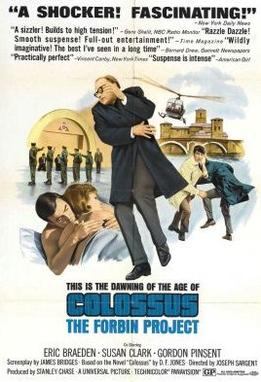
Colossus: The Forbin Project (1970, directed by Joseph Sargent)


Deep in a complex that is hidden away in the Rocky Mountains, Dr. Charles Forbin (Eric Braeden) has put together and programmed a computer called Colossus.  A super computer, Colossus has been designed to control the nuclear arsenal of the United States and its allies.  Colossus will not only keep America safe but it was also remove the chance of human error or human hesitation.  No longer will two men sitting in a silo with a key have to make the decision whether to obey the orders coming from the commander in chief.  No longer will people have to make the split-second decision that could plunge the world into war.

To Forbin’s surprise, the Soviet Union has developed their own super computer, called Guardian.  Colossus asks to be “linked” to Guardian and the Russians agree to allow it as a gesture of good will.  What no one realizes is that both computer systems have become sentient and that they soon decide that humans cannot be trusted to not destroy themselves and the planet.  To Forbin’s horror, Colossus starts to take over the world.

Based on a novel by Dennis Feltham Jones, Colossus was originally filmed in 1968 but it wasn’t released until 1970.  The film looks dated with its gigantic computer but it feels prophetic with its storyline about an AI taking over the world and deciding that it knows better than its makers.  Director Joseph Sargent adroitly mixes science fiction with Bond-style intrigue as Charles Forbin tries to reason with his creation and both the CIA and the KGB try to take down the computers.  The film even tosses a bit of 70s-style paranoia, with both the American and the Soviet governments trying to keep the public from discovering that the supercomputers are trying to take over the world.

Colossus: The Forbin Project is an intelligently written and thought-provoking science fiction film.  Eric Braeden does a great job as Charles Forbin, the engineer who goes from being arrogant and cocky to desperate to finally defiant as his creation slips out of his control.  William Schallert, so often cast as a nice father figure, turns in a good performance as the head of the CIA as does Susan Clark, cast as a colleague who has to pretend to be Forbin’s mistress just so she and Forbin can talk and plot without being monitored by Colossus.

Colossus is a smart sci-fi film that is more relevant than ever.

Retro Television Review: Miami Vice 4.9 “The Rising Sun of Death”


Welcome to Retro Television Reviews, a feature where we review some of our favorite and least favorite shows of the past!  On Mondays, I will be reviewing Miami Vice, which ran on NBC from 1984 to 1989.  The entire show can be purchased on Prime!

This week, the Yakuza invades Miami.

Episode 4.9 “The Rising Sun of Death”

(Dir by Leon Ichaso, originally aired on May 27th, 1988)

Castillo is concerned.  The murder of an American businessman leads him to suspect that the Yakuza has come to Miami and it turns out that he’s right.  Riochi Tanaka (James Hong), a World War II war criminal-turned-mobster, is trying to take over the Miami underworld.  While corrupt Homicide Detective Haskell (R. Lee Ermey) tries to convince everyone that the Yakuza is just a myth, Castillo teams up with Japanese detective Kenji Fujitsu (Cary-Hiroyuki Tagawa) to takes down Tanaka and his right-hand man, Agawa (Danny Kamekoa).  Needless to say, this leads to a fight with samurai swords, a lot of talk of honor, and a seppuku to close the case.

This episode hit every Yakuza cliche and the plot itself felt as if it had been put together at the last minute.  (This is one of those episodes where every plot hole is dismissed as being a cultural difference.)  We’re expected to believe that Tanaka could outsmart the Allies during World War II but he couldn’t outsmart the Miami Vice Squad.  As well, of the major Japanese characters, only one was played by Japanese actor.  Danny Kamekoa is a Hawaiian while James Hong is of Chinese descent.

That said, this episode was shot and filmed with a lot of style and it found an excuse to play Billy Idol’s Flesh For Fantasy during one of the early scenes.  There’s something to be said for that.  Neither Crockett nor Tubbs really did much in this episode but we did get to see Crockett house hunting with Cailtin.  It’s mentioned that everyone thinks that Caitlin’s new husband is named Sonny Burnett instead of Sonny Cockett.  That’s fine …. except for the fact that Sonny Crockett has previously been established as a bit of a minor celebrity, a college football star who would have gone on to the NFL if he hadn’t injured his knee.  Every time this show tries to convince me that Crockett has fooled everyone into thinking he’s Sonny Burnett, it just further convinces me that there’s no way Crockett and Tubbs should still be doing undercover assignments.

This episode was stylish but empty but, considering some of the other episodes that have aired during this season, at least it was entertaining.

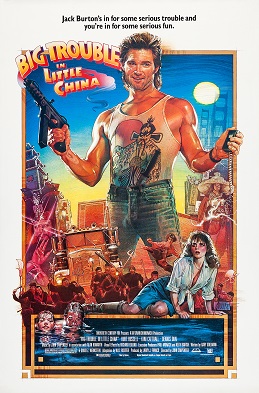
Big Trouble In Little China (1986, directed by John Carpenter)


Jack Burton (Kurt Russell) is not a complicated person.  He drives a truck for a living.  He’s loyal to his friends.  He likes a good beer and a pretty girl.  He tries to do the right thing so when the fiancée of his best friend, Wang Chi (Dennis Dun), is kidnapped, he teams up with Wang to rescue her.  And when Jack’s truck gets stolen after he runs over an evil, ancient Chinese sorcerer named Lo Pan (James Hong), Jack just wants to get his truck back.  Instead, Jack finds himself in the middle of an ancient battle between good and evil as Lo Pan searches for a green-eyed woman to sacrifice so that he can defeat a curse that was put upon him centuries ago.

Big Trouble In Little China is one of John Carpenter’s most exuberant films.  It mixes kung fu action with special effects and a good dose of physical humor from Kurt Russell.  When Lisa and I watched this movie a few months ago, Lisa commented that this film was Kurt Russell’s “Bruce Campbell movie,” and the more I think about it, the more I agree.  Russell plays Jack with a mix of cockiness and klutziness that should be very familiar to anyone who has followed the adventures of Ash Williams.  While Dennis Dun gets to do the typically heroic stuff that you would expect from the star of a movie like this, Russell is just someone who wants to get his truck back and who is consistently weirded-out by the magic around him.  Carpenter makes sure that the movie is full of action as he pays tribute to the kung fu films that he watched when he was still in film school. James Hong is great villain and the rest of the cast, including Kim Cattrall as lawyer Gracie Law, all match the energy of Russell, Hong, and Dun.  Complete with flying swordsmen, demons with glowing eyes, and a lightning-wielding warrior that probably inspired Mortal Kombat‘s Raiden, Big Trouble In Little China is a fun slice of 80s action.

Unfortunately, the film was not appreciated when it was first released.  Stung by the critical reaction to the film, Carpenter abandoned working for the studios and instead become an  independent filmmaker.  Big Trouble In Little China, however, has stood the test of time and has become better appreciated with age.  Today, it’s rightly viewed as one of Carpenter’s best films.

Retro Television Review: St. Elsewhere 1.11 “Graveyard”


Welcome to Retro Television Reviews, a feature where we review some of our favorite and least favorite shows of the past! On Fridays, I will be reviewing St. Elsewhere, a medical show which ran on NBC from 1982 to 1988.  The show can be found on Hulu and, for purchase, on Prime!

This week, a handful of doctors save two patients and lose one.

Episode 1.11 “Graveyard”

(Dir by Victor Lobl, originally aired on January 18th, 1983)

It’s the graveyard shift at St. Eligius.  The halls and the cafeteria are dark.  The ER is oddly calm.  There are only a few patients to be looked after and most of the doctors are playing poker and talking about the rather boring subject of Dr. Samuels’s love life.

Only a handful of the series regulars make an appearance in this episode but that’s fine.  This episode actually provides a nice break from having to keep track of where everyone is.  Unfortunately, as I already said, a lot of this episode is centered around the character of Dr. Samuels.  Nothing against the late David Birney, who did a perfectly acceptable job in the role, but Dr. Ben Samuels is just not that interesting of a character.  He’s a dedicated surgeon who feels too much, drinks too much, and wants to sleep with his colleagues.  That’s fine but I grew up watching General Hospital.  I’ve seen a hundred doctors just like Samuels on television.

To me, the far more interesting characters are the people like David Morse’s Jack Morrison or Ed Begley, Jr’s Victor Ehrlich or even Terence Knox’s Peter White.  They’re doctors who screw up and aren’t always brilliant and sometimes say the wrong things.  They feel like real people whereas Dr. Samuels just feels like a cliche, a holdover from some other medical show.  Samuels is not a particularly compelling character and, when I did some research, I was not surprised to discover that David Birney only appeared on one season of the show.

G.W. Bailey’s Hugh Beale also only appeared in the first season and that’s a shame because Bailey’s performance as Beale has been one of the first season’s real pleasures.  Bailey plays Beale as a compassionate man who often pretends to be more naive than he is.  As a Southerner, he’s an outsider on this Boston-set show and, being an outsider, he can often relate to the patients in the psych ward.  Of course, that still doesn’t stop Dr. Beale’s main patient, Ralph the Birdman, from throwing himself off the roof of the hospital in this episode.  To be honest, I already suspected things weren’t going to go well for Ralph on this show but his suicidal jump still upset me.  As annoying as the character was, he was also finally making some progress.  He finally admitted he wasn’t a bird.  And then he proved it by showing that he couldn’t fly.

While Ralph plunged to his death, Dr. Samuels saved a gunshot victim (played by Tom Hulce).  And Jack allowed the father (James Hong) of one of his comatose patients to perform a Chinese ritual that led to the patient waking up and eventually walking into the cafeteria, where the doctors were playing poker.  “Who ordered the Chinese?” Fiscus asked and …. ugh.  Not cool, Fiscus.

It was a night of triumph and tragedy.  Ralph died but Dr. Samuels and Dr. Paxton agreed to give their relationship another try which …. eh.  I don’t care about Samuels and Paxton.  For the most part, though, I liked this episode.  The smaller cast made it easier to keep track of things and the poker game banter reminded me that the doctors are all people too.  Still, I have to feel bad for Ralph.  All he wanted to do was fly.

The Art Of War (2000, directed by Christian Duguay)


In The Art of War, Wesley Snipes plays Neil Shaw, an UN operative who is framed for the assassination of a Chinese diplomat and who must uncover the real conspiracy while also proving his innocence.  Proving his innocence means engaging in a lot of conflict while using investigation techniques that were cribbed from the Mission Impossible films.

Featuring a lot of war but not much art, The Art of War has a few good action scenes and an overly convoluted storyline that sometimes makes the film feel like a retread of another film in which Snipes was framed for a crime he did not commit, U.S. Marshals.  It’s hard to take seriously any action hero who works for the United Nations but Wesley Snipes is credible in the action scenes and he could deliver a one-liner with the best of them.  (Of all the bad things you can say about the IRS, the worst is that it put one of our best action stars in prison.  Unforgivable!)  The supporting cast is good, featuring Donald Sutherland, Maury Chaykin, Anne Archer, and Michael Biehn.  The final battle between Snipes and the person who is revealed to be the main villain is exciting but, overall, The Art of War is overlong and overcomplicated.  Neil Shaw is cool but he’s no Blade.

Airplane! (1980, directed by David Zucker, Jim Abrahams, and Jerry Zucker)


Airplane!, which may be the funniest movie ever made, has made me laugh every time that I’ve watched it.  And I’ve watched it a lot!

Whenever I’m getting ready to travel for my day job, I watch Airplane!  Whenever I’m going to Baltimore or West Virginia for the holidays, I watch Airplane!  Whenever I’m in a bad mood and I need something lighten me up, I watch Airplane!  Whenever I’m in a good mood and I want to be in an even better mood, I watch Airplane!

I can’t remember how old I was when I first saw Airplane! but I know I wasn’t yet ten.  While a lot of the humor went over my head at that young age, it did not matter because I laughed at all the sight gags, like the heart hopping around on the doctor’s desk and the line of passengers waiting to “calm down” the hysterical woman.  I laughed when Ted Stryker (Robert Hays) and Elaine (Julie Haggerty) got covered in seaweed while making out on the beach.  I laughed at the people dying while listening to Ted’s story, even though I didn’t fully understand that it was because of Ted boring them to death.  I loved it when Kareem Abdul-Jabbar got annoyed with the kid in the cockpit, even though young me really didn’t know who Kareem was other than he was a basketball player.  Otto the autopilot was the coolest character around.  Stephen Stucker’s Johnny made me laugh with his nonstop energy.  “Excuse me, stewardess, I speak Jive.”  “And don’t call me Shirley.”  “It looks like I picked the wrong time to stop sniffing glue.”  Every time I heard them, I laughed at all of those lines.  I didn’t have to understand why Lloyd Bridges was suddenly upside down.  I just knew it was funny.

As I got older and rewatched the film, I started to pick up on the humor that earlier went over my head.  I traveled to Turkey when I was twelve and our tour guide spent an hour telling us that Midnight Express was not a fair representation of her country.  After that, I suddenly understood why Captain Oveur (Peter Graves) wanted to know if Joey had ever been to a Turkish prison.  I came to appreciate Julie Hagerty and Lorna Patterson as the two flight attendants.  Airplane! still made me laugh but I came to understand that it was also a love story.  What adolescent boy watching Airplane! didn’t want to be Robert Hays, not only landing the plane but also getting kiss Julie Hagerty at the end of the movie?

And then, as I learned more about the movies, I realized that Airplane! was a pitch perfect parody of the disaster genre and I came to understand the brilliance of casting actors like Lloyd Bridges, Robert Stack, Peter Graves, and especially Leslie Nielsen in this film.  From the first time I saw the movie, Nielsen always made me laugh because he had the best lines and he delivered them with deadpan perfection.  But, as I got older, I came to understand that Nielsen was doing more than just saying funny things.  He was sending up his entire career.  I’m a part of the generation who grew up laughing at Leslie Nielsen the comedy superstar and it’s always strange for me to see him in one of his older, serious roles.  I have Airplane! to thank for that.

There’s so much to say about Airplane!  I could write a thousand words just talking about my favorite jokes and one-liners or how much I enjoyed Stryker’s flashbacks.  It’s my favorite movie and one that still makes me laugh even though I know all of the jokes by heart.  (I’ve always thought Howard Jarvis waiting for Stryker to return to the taxi was one of the best, though underrated, jokes in the movie.)  Airplane! is close to 50 years old and it’s still just as funny today as when I first saw it.

In fact, I think I’ll go watch it right now!

Film Review: Kung Fu Panda 4 (dir by Mike Mitchell)


Po (voice by Jack Black), that Panda Bear who knows kung fu is back.

After finding fame as a Dragon Warrior and defending the Valley of Peace from numerous threats, he’s been told by his master, Shifu (Dustin Hoffman), that it is time for him to give up being the Dragon Warrior and move on to becoming the Spiritual Leader of the Valley of Peace.  Po doesn’t really want to do that so, after being passive aggressive about auditioning replacements, Po goes on a quest with a plucky corsac fox and thief named Zhen (voiced by Awkwafina).  Together, they head out to defeat a new threat, the Chameleon (voice of Viola Davis).  The Chameleon is summoning past villains from the Spirit Real and stealing their kung fu powers.

Meanwhile, Po’s two dads — one biological (voiced by Bryan Cranston) and the other a goose who adopted Poe when he was young (voiced by James Hong) — also set out on a quest to try to keep Poe from getting into trouble.  It’s actually kind of sweet, even if I did have a hard time telling all the various Panda Bears apart.  Actually, so did everyone else in the movie so at least I felt a little bit less dumb.

Kung Fu Panda 4 is a typical Dreamworks animated film.  The characters are cute and kid-friendly.  The humor is self-referential and occasionally, an adult joke will slip in  but it’s never anything that would threaten the film’s G-rating.  The plot is pretty predictable and by-the-numbers but then again, this is a Kung Fu Panda film that we’re talking about here.  There’s only so much that you can do with that.  That said, the animation is nicely done and the voice actors all do a good job of bringing their characters to life.  I especially liked Dustin Hoffman as Master Shifu.  It’s an entertaining movie, even if it does ultimately feel a bit generic.

The release of a new animated film, even one as low-key as Kung Fu Panda 4, used to be a huge event.  Now, we kind of take animated films and their star-studded casts for granted.  It’s a bit of a shame that we’ve lost that excitement.

Retro Television Reviews: Fantasy Island 4.8 “Crescendo/Three Feathers”


Welcome to Retro Television Reviews, a feature where we review some of our favorite and least favorite shows of the past!  On Tuesdays, I will be reviewing the original Fantasy Island, which ran on ABC from 1977 to 1986.  Almost the entire show is currently streaming is on Youtube, Daily Motion, and a few other sites.

This week, we get one good fantasy and one bad fantasy and a reminder that anything can happen on Fantasy Island!

Episode 4.8 “Crescendo/Three Feathers”

(Dir by Michael Preece, originally aired on December 20th, 1980)

This episode confirms that Fantasy Island is the strangest place on Earth.

Our first fantasy features Toni Tennille as a world-famous singer named Susan Lohmann.  Susan has been invited meet her favorite composer and songwriter, Edmund Dumont (Monte Markham).  Dumont lives in seclusion on Fantasy Island, in an estate that is surrounded by wild animals and where he is tended by a blind butler (James Hong).

Susan is excited to meet Edmund, until she walks in on him playing his piano and discovers that he’s a …. BEAST!  Though he has the body of a human, he has the face of a wolf.  It turns out that Edmund lives in seclusion because he feels that the world would never accept his appearance.  And Susan promptly proves him correct by screaming and demanding to leave.  Susan flees the estate.

Susan’s manager is glad that Susan is free because now she can appear in concert in London.  However, Mr. Roarke informs Susan that Edmund suffers from a curse and the only thing that could have cured him would have been the love of Susan.  Edmund is now determined to die, surrounded by the animals on his estate, the only creatures who accepted him.  Susan, realizing that she was a little bit hard on a guy who couldn’t help his appearance, returns to the estate, gives Edmund a kiss, and Edmund turns into a handsome guy.  Yay!

So, there’s a huge problem here.  Susan Lohmann is incredibly unlikable.  Yes, Edmund may look different.  But all Edmund did was invited her to his estate so that he could express his appreciation for the way the she sings his songs.  Susan claims that Edmund should have told her, in advance, about the way he looked.  Yes, Susan, God forbid someone unattractive appreciate your talent or have any talent of his own.  Seriously, Susan was the worst.

Slightly more likable is Alan Colshaw (Hugh O’Brian), a pilot who has spent a year feeling like a coward.  He was piloting a plane that crashed in the jungle.  Alan went for help and, according to the three other passengers (played by Diane Baker, James Wainwright, and Peter Lawford), he never returned and, instead, he ran off with a stash of diamonds that was on the plane.  Alan says that he is sure he didn’t intentionally desert them but he can’t remember for sure because he’s been suffering from memory loss.

Mr. Roarke gives Alan a medallion, one that will allow him and the others to see what happened when the plane crashed.  As for Alan, he brings along three white feathers, which he plans to give to each of the survivors as a way to symbolize that he’s not the coward that they think he is.  (Yes, it doesn’t make much sense to me, either.)

Lena (Diane Baker) is the first to forgive Alan.  Alan realizes that he’s in love with Lena and he tells Mr. Roarke that he wants to change his fantasy.  He just wants to spend the rest of his life with Lena.  Roarke informs Alan that he can’t do that because …. ALAN IS DEAD!  He died while trying to get help after the crash.  Alan has come back to life for the weekend so that his spirit can find peace.

That’s a pretty neat twist and, to its credit, the show sticks with it.  Alan eventually proves that he wasn’t a coward and that another one of the passengers stole the diamonds and then he vanishes into the afterlife.

“Boss,” Tattoo says, “you mean he was a …. g-g-ghost!?”

“Oh, Tattoo!” Roarke snaps, “Please do not tell me that you are prejudiced!”

Fantasy Island may be a strange place but some things — like Roarke passive aggressively attacking Tattoo — never change.

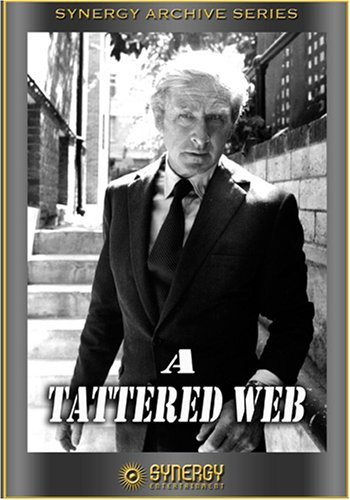
Retro Television Reviews: A Tattered Web (dir by Paul Wendkos)


Welcome to Retro Television Reviews, a feature where we review some of our favorite and least favorite shows of the past!  On Sundays, I will be reviewing the made-for-television movies that used to be a primetime mainstay.  Today’s film is 1971’s A Tattered Web!  It  can be viewed on YouTube!

Sgt. Ed Stagg (Lloyd Bridges) is a good cop and an overprotective father.  Ever since his wife left him, Ed has been determined to make sure that his daughter, Tina (Sallie Shockley), has a good life.  So, as you can probably guess, Ed is not amused when he finds out that Tina’s husband, Steve (Frank Converse), has been cheating on her with Louise Campbell (Anne Helm).  Ed has never liked Steve and would love it if his daughter left him.  But, Ed still doesn’t want want Tina to have to go through the pain of knowing that her husband is seeing another woman.

Ed decides to drop by Louise’s apartment and talk to her himself.  Louise, however, is not willing to let some old stranger tell her how to live her life.  After all, she’s heard from Steve about what a terrible and judgmental father-in-law Ed is.  Ed gets frustrated and shoves Louise.  Louise stumbles back, hits her head, and …. uh-oh.  Louise is dead!  To be honest, it didn’t really look like she hit her head that hard.  In fact, I had to rewatch the scene to see if she actually hit her head at all.  But no matter.  Louise is dead and Ed’s responsible.

The next morning, when Ed and his partner, Joe (Murray Hamilton), are called in to investigate Louise’s homicide, Ed is approached by Louise’s neighbor (John Fiedler), who gives him a description of a  young man who he says he frequently saw going up to Louise’s apartment.  The description perfectly describes Steve.  The police sketch artist draws a picture that looks like just like Steve.  Joe thinks that Steve is responsible.  Not wanting his daughter to think that her husband’s a murderer, Ed decides to frame Willard Edson (Broderick Crawford), an alcoholic who frequently comes into the station and confesses to crimes so that he can have a place to sleep for the night.

Yes, it’s a tattered web indeed.  Ed is able to talk Edson into confessing to the crime but then Steve does his own detective work and realizes that Edson couldn’t be the murderer.  Ed tells Steve that he should just let the police arrest Edson because, otherwise, they’re going to come after Steve.  Steve, however, says that he would rather be arrested and be given a chance to prove his innocence than just stand by idly while an innocent man goes to jail.  Being a veteran cop, Ed wasn’t expecting everyone to be so damn honest!

A Tattered Web isn’t bad for a 70-minute made-for-TV movie.  The film’s main strength is the cast, with Lloyd Bridges, Murray Hamilton, and especially Broderick Crawford giving strong performances.  The scene where Ed talks Edson into confession is especially well-done, with Crawford giving a performance of growing desperation while Bridges himself appears to be on the verge of tears as Ed realizes what his life has become.  Like his sons Jeff and Beau, Lloyd Bridges is such a likable actor that it’s hard not to care about what happens to the characters that he’s playing, even when he’s playing a murderer.  A Tattered Web is an effective thriller that reminds viewers that guilt cannot be escaped.

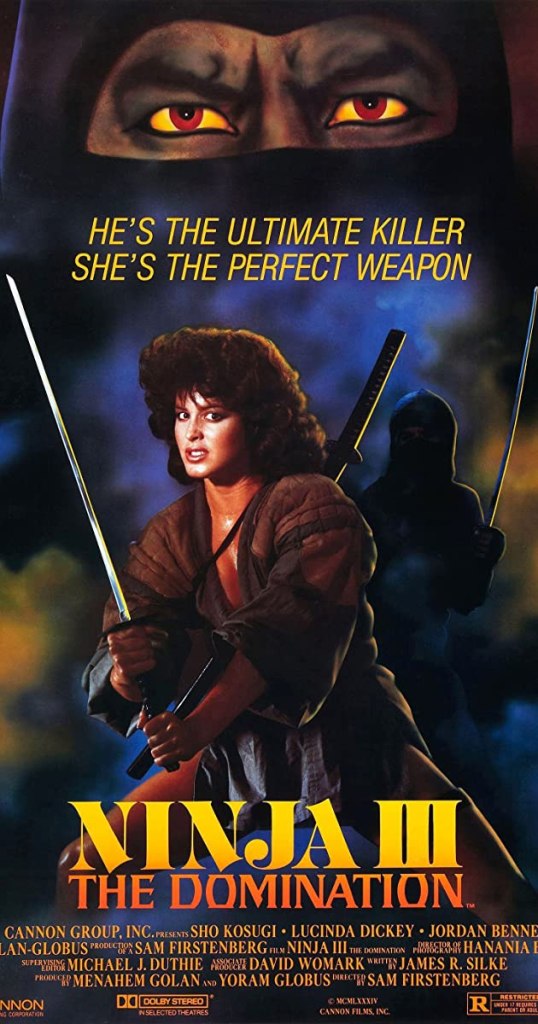
The TSL’s Horror Grindhouse: Ninja III: The Domination (dir by Sam Firstenberg)


This 1984 film is brilliant.

Basically, it tells the story of Christie Ryder (Lucinda Dickey), who appears to have everything that someone could want out of life.  Not only does she have a really nice place to live but she also repairs phone lines for a living!  (That might not sound glamorous but she lives in California, which means that there’s always a nice view when she’s working.)  She also teaches an aerobics class because this film is from 1984 and, in 1984, everyone taught their own aerobics class.  At least, that’s the impression that I’ve gotten from watching movies of the era.

Christie only has one problem.  She’s been possessed.  She hasn’t been possessed by any ordinary old demon, either.  Instead, she’s been possessed by a dead ninja.  Hanjuro (David Chung) came to America because there were some people on a golf course who needed to be killed.  Unfortunately, no sooner had he killed everyone on the back 9 then he found himself surrounded by cops.  It took a lot of bullets to take down Hanjuro but down he went.  However, his spirit went up and entered Christie’s body.

Now, Christie spends her time teaching aerobics, working on phone lines, and murdering everyone who Hanjuro feels has wrong him.  Hanjuro wants to kill all of the cops who shot him.  Unfortunately, one of those cops, Billy Secord (Jordan Bennett), is now dating Christie.  Once Billy finally figures out why Christie is acting so strangely, he takes her to an exorcist (James Hong) who explains that it’s going to take more than just an ordinary exorcism to defeat the ninja lurking within Christie.  It’s going to require the help of another ninja, the noble Goro Yamada (Sho Kosugi).  It’s time to go to Japan!

I may not be a huge ninja movie fan (unless, of course, they feature Franco Nero) but I have to say that I absolutely loved Ninja III.  That really shouldn’t come as a surprise.  This film is such an utterly weird mishmash of tones and genres that there’s no way that I couldn’t love it.  It starts out as a typical kung fu film, just to suddenly turn into The Exorcist before then becoming Flashdance before returning to being The Exorcist.  Finally, for the last few minutes of the film, it transforms back into a kung fu film.  As I watched the film, I found myself thinking about all of the other films throughout history that could have been livened up by a demonic or spiritual possession subplot.  For that matter, think about how much more crazy The Exorcist would have been if Father Karras and Father Merrin had been Ninja Karras and NInja Merrin.

Anyway, in all seriousness, Ninja III is exactly what an exploitation film should be.  It’s unapologetically strange and over-the-top and it makes absolutely no apologies for being what it is.  It’s a film that says, “I’m here to tell a story about a woman possessed by a dead ninja and if that’s not good enough for you, you need to figure out what’s wrong with your heart.”  Ninja III is brilliant, wonderful, and definitely a film that you must watch this October.  It’s on Prime so go watch it.  Do it now.