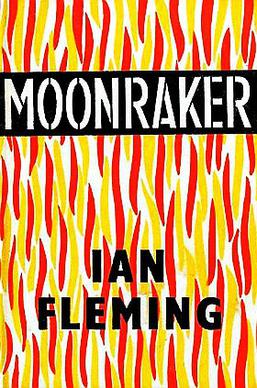
Book Review: Moonraker by Ian Fleming


First published in 1955, Moonraker was the third of the original James Bond novels and it was also the first of the series to be totally set in Great Britain.  At no point does Bond leave his home country.  In fact, he spends a great deal of the book in his office.  (If you’ve ever wondered what Bond’s job entails when he’s not on a mission, this is the book to check.)  That said, it’s appropriate that Moonraker remains in Bond’s home country because it starts with a very British problem.

Hugo Drax is the most popular man in Britain.  Drax was horribly disfigured during the Second World War but, despite all of the scars and a somewhat boorish manner, he has managed to make himself into one of the most important industrialists in the world.  Drax is building an immensely powerful nuclear missile, the Moonraker.  His missile will keep Britain safe from both the USSR and the USA.  At the start of the novel, even Bond admires Drax.  Except…

…DRAX CHEATS AT CARDS!

It turns out that M and Drax both play cards at the same club and M is sure that Drax must be cheating.  Why would such a powerful man feel the need to cheat?  Even more importantly, how can a man be trusted with Britain’s security when he can’t even be trusted to play bridge?  Both to prevent a public scandal and to make sure that Drax really can be trusted, M bring Bond to the club so that Bond can beat Drax at his own game.

One bridge game later and suddenly, Bond has been assigned to work at Drax’s laboratory.  Already on the case and working as Drax’s secretary is Special Branch officer Gala Brand.  Bond being Bond, he discovers that Drax is at the head of a nefarious scheme.  He also tries to figure out why Gala Brand is apparently the only woman in the world who is not won over by his manly charm…

Moonraker is one of my favorite Bond novels.  Drax is an interesting villain and Fleming makes a good decision by having Bond initially admire the man.  Fleming takes a lot of joy in describing both Drax’s bad manners and grotesque appearance.  Drax started a tradition of Bond having to face physically unappealing bad guys.  After playing a minor role in the first two books, M takes a more central role in Moonraker and we also get a chance to explore his paternal but strict relationship with 007.  Gala is one of the few of the so-called Bond girls to be portrayed as being an equal to Bond and the book’s final scene between her and Bond is considerably more poignant than it has any right to be.  Finally, Fleming’s love of Britain is evident on every page.  If Fleming spent Casino Royale and Live and Let Die being snarky about the places that Bond visited, Moonraker finds both the author and his most famous creation in a surprisingly sentimental mood.

Moonraker came close to being the first James Bond novel to make it to the big screen.  In 1955, American actor John Payne pursued the rights to the book, hoping to star as Bond in the film version.  However, it would be another 24 years before Moonraker was adapted to film.  Other than featuring Drax as a villain, the film version would have little do with the original novel.

Book Review: Live and Let Die By Ian Fleming


(Minor Spoilers)

Having recovered from both the horrific torture he suffered in Casino Royale and the suicide of Vesper Lynd, British secret agent James Bond is ready to return to the field.  His latest mission takes him to America, where his job is to investigate Mr. Big.  Mr. Big is Harlem-based gangster who is suspected of helping to finance Russian operations through his criminal enterprises.

(Specifically, Mr. Big has been selling 17th Century gold coins that are believed to be a part of a legendary pirate treasure that was buried somewhere in Jamaica.  Ian Fleming knew his pirate lore and devotes a good deal of the beginning of the book to discussing Sir Henry Morgan.)

In America, Bond partners up with his old friend Felix Leiter but he soon discovers that taking down Mr. Big is not as easy as he thought it would be.  Using the fear of voodoo to control his minions, Mr. Big has agents all across America.  As well, Mr. Big also has the services of Solitaire, a beautiful Creole fortune teller.  The case takes Bond and Felix from New York to Florida to Jamaica.  It also costs one of them a leg and an arm.  In order to maintain some suspense, I will refrain from revealing who gets attacked by a shark.

Reading the original James Bond novels can be enjoyable but it can also lead to a good deal of culture shock.  Because Bond is constantly changing in the movies and the role is regularly recast, we tend to forget just how long the character of James Bond has been around.  In the movies, Bond is forever the same age and his villains and their plots continually change to reflect whatever’s going on in the world.  In SPECTRE, Blofeld was even reinvented as a bored Christoph Waltz.

The books, however, are frozen in time.  They all reflect the attitudes and concerns of the time period in which they were written.  That can often make for a fascinating read but it can also leave modern readers cringing.  Ian Fleming was a man of his time and he shared both the strengths and the weaknesses of his time and his class.  That’s a polite way of saying that, in the Bond novels, Fleming tends to treat anyone who is not British, white, and male with, at best, a patronizingly condescending attitude.  (At worst, Fleming treats them with outright disdain.)  That’s especially obvious in Live and Let Die, in which Mr. Big and all of his henchmen are black.

Live and Let Die was first published in 1954.  Interestingly enough, Fleming doesn’t come across as being as prejudiced as some of his contemporaries.  For instance, even when the action moves the American south, the n-word never appears in the book.  (Then again, neither do any redneck sheriffs.)  I wouldn’t call Fleming a racial progressive but, at the same time, it’s obvious that he means it to be the highest compliment when Bond describes Mr. Big as being the “first great Negro criminal.”  But then Fleming introduces us to two sympathetic black characters who do nothing but happily take orders from Bond and then he starts writing dialogue in phonetic dialect and you just find yourself cringing and saying, “Oh my God, Ian, stop it!”

Here’s what does work as far as Live and Let Die is concerned: Mr. Big is a great villain, far less of a wimp than Casino Royale‘s Le Chiffre.  As well, James Bond is a far more active character in this book and less whiny than he was in Casino Royale.  Bond once again gets tortured but he doesn’t threaten to quit the service just because his finger gets broken.  Instead, he seeks revenge.

As an American, it was interesting for me to read Fleming’s thoughts on my home country.  While Bond seems quite comfortable in New York, both he and Felix are absolutely miserable in Florida.  In fact, Fleming portrays Florida as being Hell on Earth, hot and full of ill-tempered old people.  It’s impossible not to be amused by just how viscerally Fleming disliked Florida.

Finally, Fleming’s skills as a storyteller were even stronger in Live and Let Die than in Casino Royale.  I mean, whatever else you might say about the book, who can resist that perfect one line dismissal of a opponet: “He disagreed with something that ate him.”

Tomorrow, we take a look at Moonraker!

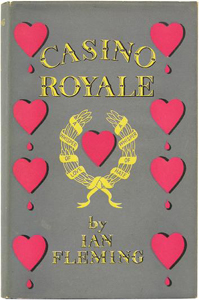
Book Review: Casino Royale by Ian Fleming


(SPOILERS)

Earlier this year, I decided to reread all of Ian Fleming’s James Bond novels.  On this site, I’ve written many times about how much I love all of the James Bond films so I thought it would be interesting, especially since a few years have passed since I originally read them, to reread the original novels.

The first Bond novel was Casino Royale.  First published in 1953, Casino Royale introduced the world to not only MI6’s James Bond but also to the CIA’s Felix Leiter, the sinister assassins of SMERSH, and the tragic Vesper Lynd.

The story starts with a deceptively simple mission.  James Bond has been sent to the Casino Royale, with specific orders to play against and humiliate Le Chiffre, a union boss who works for the Russians.  Bond succeeds at his mission but quickly discovers that Le Chiffre is not the type to accept the loss of eighty million francs gracefully.  Bond ends up undergoing a truly horrific torture, one that is described in harrowing details by Fleming.  While it’s not a spoiler to reveal that Bond survives (after all, Casino Royale was followed by 11 novels and 2 short story collections), it comes at the cost of a terrible scar and a terrible tragedy.

In his first appearance, Bond already possesses several of the traits for which he’s best known.  He’s a meticulous eater, a frequent drinker, and a chain smoker.  He’s ruthless and is described as being cruelly handsome.  When Vesper Lynd first meets him, she exclaims that he looks like Hoagy Carmichael, the British musician who Fleming originally hoped would play Bond in the films.

At the same time, while rereading Casino Royale, I was surprised by how passive Bond was for the majority of the book.  Beyond the scene where he plays baccarat with Le Chiffre, Bond really doesn’t take a very active role in his first novel.  When he’s captured and tortured, he doesn’t escape through his wits.  In fact, he doesn’t escape at all.  He’s rescued by SMERSH, who have decided that they no longer need Le Chiffre to launder money for them.  After being rescued, he decides to retire from intelligence work and marry Vesper Lynd.  Vesper Lynd is a double agent but Bond never figures that out on his own.  He only discovers this fact from Vesper’s suicide note.

(Which, of course, leads to the novel famous and bitter final line: “The bitch is dead.”)

In fact, there are times when Bond almost seems to be … well, dorky.  Early on, we’re informed that he hopes to create and make a fortune off of a new drink.  (Minutes after meeting Vesper, he announces that he’s going to name the drink after her.)  When he’s in the hospital recovering from being beaten, he’s hardly the Bond we all know and love.  Instead, he’s rather petulant.  When he explains that he’s quitting the service, he comes across like an angry teenager announcing that he’s not going to go to school anymore.

As for the novel itself, it’s a quick read and, even after all these years, I can see why it caused a stir when it was originally released.  It’s not just that Fleming was telling a spy story that was full of intrigue and deceit.  It’s also the Fleming was giving readers a glimpse into a glamorous world that they probably would never have a chance to experience for themselves.  Fleming describes the casino with such care and attention to detail that you literally feel like you’re there, watching Bond gamble.

For the record, here’s my favorite line from the book.  It occurs shortly after Bond first meets Felix Leiter and discovers that Felix is from my homestate:

“Bond reflected that good Americans were fine people and that most of them seemed to come from Texas.”

And finally, here’s the ingredient for Bond’s drink, the Vesper:

“Three measures of Gordon’s, one of vodka, half a measure of Kina Lillet. Shake it very well until it’s ice-cold, then add a large thin slice of lemon peel.”

(Apparently, some of these ingredients are out-of-date.  I rarely drink so I have no idea.)

Casino Royale was followed by Live and Let Die, which I’ll review tomorrow.

That Voodoo That You Do: Roger Moore as James Bond 007 in LIVE AND LET DIE (United Artists 1973) — cracked rear viewer


Three British agents are murdered, and James Bond is sent overseas to investigate the doings of Dr. Kananga, despot of the Carribean island nation of San Monique in LIVE AND LET DIE. But wait… that’s not Sean Connery as 007, or even George Lazenby. It’s Roger Moore , making the first of his seven appearences as […]

via That Voodoo That You Do: Roger Moore as James Bond 007 in LIVE AND LET DIE (United Artists 1973) — cracked rear viewer

The Man Who Would Be Bond (Almost): RIP John Gavin


gary loggins's avatarcracked rear viewer

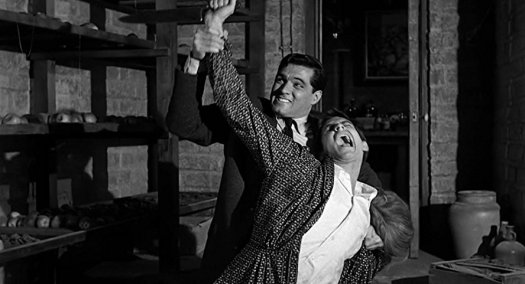
Most people know John Gavin, who died today at age 86, as the nominal hero of Alfred Hitchcock’s PSYCHO, who saves Vera Miles from a ghastly fate at the hands of maniacal Anthony Perkins. What most people don’t know is Gavin was once signed, sealed, and ready to go as the movie’s most popular secret agent of them all, James Bond!

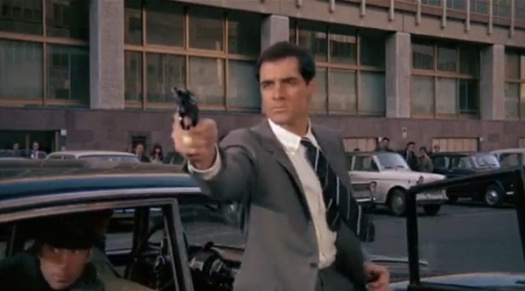
Gavin in “OSS 117- Double Agent” (1968)

It’s true! Gavin had signed the contract with producers Harry Saltzman and Albert Broccoli to star as 007 in 1971’s DIAMONDS ARE FOREVER , taking over the role from George Lazenby. He would have been the first (and only) American actor to portray MI-6’s suave secret agent, except the powers that be at United Artists wanted someone with more star power to take the role. Saltzman and Broccoli then threw an enormous (at the time) sum of money at original Bond Sean…

View original post 354 more words

Celebrate National Trivia Day With The Actors Who Could Have Been James Bond!


Today is National Trivia Day so I thought why not share some trivia?  I love film trivia.  I especially love trivia about who was considered for certain films.  Hell, one of my most popular posts on the Shattered Lens dealt with all of the actors who were considered for the Godfather!

(I even came up with an alternative cast for The Godfather, even though I consider the actual film to be the best cast film in history.)

I also happen to love the James Bond films.  (Well, not so much the recent Bond films.  I’ve made my feelings on SPECTRE clear.)  As a franchise, I absolutely love them.  So, with all that in mind, here is a look at the actors who could have been Bond.  I’ve compiled this article from many sources.  And yes, you could probably just find a lot of the information on Wikipedia but then you’d miss out on my editorial commentary.

Hoagy Carmichael

Ian Fleming himself always said that his pick for Bond would have been the musician, Hoagy Carmichael.  He even made a point, in Casino Royale, of having Vesper Lynd exclaim that Bond looked like Hoagy Carmichael.  Of course, the first actor to actually play Bond was Barry Nelson in a 1954 television adaptation of Casino Royale.  Nelson is probably best remembered for playing Mr. Ullman in Stanley Kubrick’s The Shining.

Barry Nelson, the first James Bond

When Dr. No went into production in 1961, many actors were considered for the role before Sean Connery was eventually cast.  Many of them were very well-known actors and, had they been cast, Dr. No would not have been remembered as a Bond movie.  Instead, it would be remembered as a star vehicle for … well, let’s take a look at some of the better-known possibilities:

Among the famous actors who were mentioned for Bond in 1961: Cary Grant, Richard Burton, James Mason, Trevor Howard, Stanley Baker, George Baker, Jimmy Stewart, Rex Harrison, and David Niven.  (Of that list, I think Burton would have made for an interesting Bond.  If the Bond films had been made in the 1940s, Grant would have been my first choice.  Trying to imagine Jimmy Stewart as a British secret agent is … interesting.)

Once it became obvious that a star was not going to play Bond, the role was offered to Patrick McGoohan and Rod Taylor.  McGoohan had moral objections to the character.  Rod Taylor reportedly felt that the film would flop.  Steve Reeves, the American body builder who became famous for playing Hercules in Italy, was reportedly strongly considered.  At one point, director Terrence Young wanted to offer the role to Richard Johnson, who later played Dr. Menard in Lucio Fulci’s Zombi 2.

Of course, the role went to Sean Connery and made Connery a huge star.  In 1967, after Connery announced that he would no longer play the world’s most famous secret agent, there was a huge and widely publicized search for his replacement.  Some of the names that were considered are intriguing.  Others are just bizarre.

Oliver Reed

To me, perhaps the most intriguing name mentioned was that of Oliver Reed.  Reed definitely would have brought a rougher edge of the role than some of the other actors considered.  However, that’s one reason why Reed wasn’t picked.  Apparently, it was felt that he did not have the right public image to play the suave Mr. Bond.

Somewhat inevitably, Michael Caine was sought out for the role.  Caine, however, refused to consider it because he had already starred in three back-to-back spy thrillers and didn’t want to get typecast.  Caine’s former roommate, Terrence Stamp, was another possibility but wanted too much control over the future direction of the Bond films.  Future Bond Timothy Dalton was considered to be too young.  Another future Bond, Roger Moore, didn’t want to give up his television career.  Eric Braeden has the right look for Bond but was German.  Rumor has it that producer Cubby Broccoli even considered Dick Van Dyke for the role, though I find that hard to believe.  An even more surprising possibility was the nobleman Lord Lucan, who was offered a screen test in 1967 and who, ten years later, would vanish after being accused of murdering his children’s nanny.

Lord Lucan

Among the actors who auditioned before George Lazenby was cast in On Her Majesty’s Secret Service: Michael Billington, Jeremy Brett, Peter Purves, Robert Campbell, Patrick Mower, Daniel Pilon, John Richardson, Anthony Rogers, Hans De Vries, and Peter Snow.

After the mixed reception of both Lazenby’s performance and On Her Majesty’s Secret Service, Lazenby was soon out as James Bond.  Even today, there’s a lot of controversy about what led to Lazenby being dismissed from the role.  Some say Lazenby demanded too much money.  Some say that Lazenby was merely used a pawn to try to get Sean Connery to return to the role.  Regardless, Lazenby only made one film as Bond.  (Of course, On Her Majesty’s Secret Service has retroactively been recognized as being one of the best of the series.)

With Connery still claiming that he would never return to the role, the film’s producers went through the motions of looking for a new Bond.  Once again, Roger Moore and Timothy Dalton were considered.  Connery suggested that a talk show host named Simon Dee should play the role.  An actor named Roger Green auditioned.  So did Michael Gambon, though he later said he was turned down because, in his own words, he “had tits like a woman.”  Interestingly, several Americans were mentioned.  Clint Eastwood as James Bond?  Burt Reynolds?  Adam “Batman” West? The mind boggles but their names were mentioned.

John Gavin

And interestingly enough, an American was cast.  John Gavin is best known for playing Sam Loomis in Psycho but he was also, briefly, James Bond.  After Gavin accepted he role and signed a contract, Sean Connery announced that he would be willing to return to the role.  Gavin was paid off and Connery went on to star in Diamonds are Forever.

After Diamonds, Connery left the role for a second time and, once again, Bond was recast.  This time, Roger Moore would finally accept the role.  However, before Moore was cast, several other actors were considered.  Some of the regular possibilities were mentioned again: John Gavin, Simon Oates, Timothy Dalton, and Michael Billington.  Others considered included Jon Finch, Ranulph Fiennes, Peter Laughton, and Guy Peters.  Some of those names are probably as unknown to you as they are to me but it’s intriguing to think that Guy Peters may not be a well-known name but, at one time, there was a possibility that he could suddenly become one of the biggest stars in the world.

Looking over the history of the Bond franchise, it’s interesting to see the number of times that Moore tried to leave the role, just to be talked into returning.  Every time that Moore considered quitting, a new group of actors would be considered for the role of Bond.  In 1979, when Moore said he might not return after Moonraker, Timothy Dalton, Michael Jayston, Patrick Mower (who was also considered for On Her Majesty’s Secret Service), and Michael Billington were all considered as replacements.  So was Julian Glover.  Ironically, when Moore did agree to return to the role, Glover was cast as the villain in For Your Eyes Only.

David Warbeck

To me, the most intriguing actor mentioned as a replacement for Roger Moore was David Warbeck.  Warbeck was a television actor and model who subsequently had a nearly legendary film career in Italy.  Not only did he play a key role in Sergio Leone’s Duck You Sucker!, but he also starred in Lucio Fulci’s The Black Cat and The Beyond.  He also appeared in the best of Italian Apocalypse Now rip-offs, The Last Hunter.  In interviews, Warbeck claimed that he was under contract to Cubby Broccoli to step into the role in case Roger Moore ever walked off the set.  The likable and rugged Warbeck would have been an interesting Bond.

In 1983, when Moore again said he might not return to the role, Michael Billington (who actually did appear in a Bond film when he played a KGB agent killed at the start of The Spy Who Loved Me) would be once more considered as a replacement.  British TV actors Lewis Collins and Ian Ogilvy were also considered for the role.  In a repeat of what happened with John Gavin in Diamonds are Forever, American actor James Brolin was actually put under contract until Moore agreed to play the role in Octopussy.

James Brolin, in a screen test for Octopussy

After A View To A Kill, Moore left the role for the final time.  Famously, future Bond Pierce Brosnan was actually cast as his replacement until the surge of interest created by his casting led to the renewal of Remington Steele, the American television show in which Brosnan was starring.  Once the show was renewed, Brosnan could no longer work the Bond films into his schedule.

Among the other names mentioned: Sean Bean, Simon MacCorkindale, Andrew Clarke, Finlay Light, Mark Greenstreet, Neil Dickson, Christopher Lambert, Mel Gibson, and Antony Hamilton.  Sam Neill was another possibility and reportedly came very close to getting the role.  Watch any of the films that Neill made when he was younger and you can definitely see hints of Bond.

Sam Neill

In the end, Timothy Dalton finally accepted the role.  Ironically, for an actor who spent 20 years being courted for the role, Dalton turned out to be a bit of a flop as Bond.  He made two movies (both of which were considered to be disappointing when compared to the previous Bond films) and then left the role.

Looking over the contemporary reviews of Dalton as Bond, one thing that comes through clearly is that a lot of people resented him for taking a role that they felt should have gone to Pierce Brosnan.  When the Bond films resumed production with Goldeneye in 1994, Brosnan finally stepped into the role.  Reportedly, if Brosnan had turned down the role, the second choice was Sean Bean.  Much like Julian Glover, Bean may have lost out on 007 but he did end up playing the villain.

Sean Bean

Among the other actors who were reportedly considered before Brosnan accepted the role: Mark Frankel, Paul McGann, Liam Neeson, Russell Crowe, and Lambert Wilson.  Ralph Fiennes, who has been M since Skyfall, was also considered.

As opposed to his predecessors, Brosnan seemed to be very comfortable with the idea of playing Bond and never threatened to leave the role.  Looking over the Bond-related articles that were published from 1995 to 2004, I found the occasional speculation about whether Rupert Everett would be the first gay James Bond or if Sharon Stone would be the first female James Bond but I found very little speculation about Brosnan actually leaving the role.  Indeed, when Brosnan officially retired as Bond in 2004, it was less his decision and more at the prodding of the franchise’s producers, who felt that the series needed to be rejuvenated with a new (and younger) actor.  After Brosnan left, the series was rebooted and Daniel Craig played the role in Casino Royale.

In the past, I’ve made it clear that Daniel Craig is hardly my favorite Bond.  I loved Skyfall (and I consider it to the 2nd best Bond film, after From Russia With Love) but, even in that case, I felt that the film succeeded despite Craig instead of because of him.  With Casino Royale, we were supposed to be seeing a young and inexperienced Bond.  That’s never come through to me, probably because Craig looked like he was nearly 50 years old when he made Casino Royale.

Among the actors who were mentioned for the role before Craig received the role: Ralph Fiennes (again), Colin Salmon, Ewan McGregor, Henry Cavill, Rupert Friend, Julian McMahon, Alex O’Laughlin, Clive Owen, Dougray Scott, and Goran Visjnic.  Dominic West, who I think would have been great in the role, reportedly ruled himself out because he heard a rumor that Brosnan would be returning to the role.

Dominic West

Daniel Craig, of course, has been talking about leaving the role ever since he was first cast.  I think Skyfall would have been a perfect movie for him to leave on.  (It would have saved the world from SPECTRE.)  However, Craig has apparently agreed to do at least one more Bond film.  Maybe two.

When Craig does leave, who will replace him?  Idris Elba, of course, is probably the most widely discussed possibility.  James Norton has also been named as a possibility.  Others that I’ve seen mentioned: Tom Hardy, Jack Huston, Aidan Turner, Tom Hiddleston, Michael Fassbender, Jamie Bell, and Henry Cavill (again).

My personal choice?  Dominic Cooper.  He’d be an off-center Bond but I think it would still be an intriguing pick.

Dominic Cooper

Who knows what the future may hold for 007?  All I know is that I look forward to the speculation.

Happy National Trivia Day, everyone!

The Return of 007: Sean Connery in DIAMONDS ARE FORVER (United Artists 1971)


gary loggins's avatarcracked rear viewer

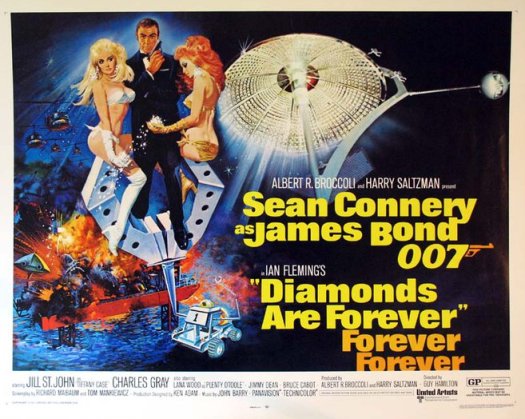
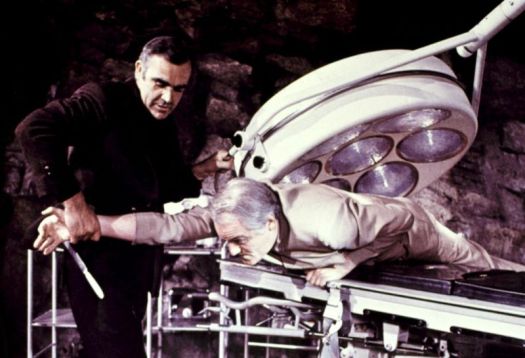
007 fans all over the world cheered when Sean Connery returned to the role that made him famous in DIAMONDS ARE FOREVER, the 6th James Bond screen outing. Connery left the series in 1967 (YOU ONLY LIVE TWICE), and was replaced by George Lazenby for 1969’s ON HER MAJESTY’S SECRET SERVICE. Lazenby was actually pretty good, if a bit boring, but he was one-and-done, choosing not to be typecast as cinema’s most famous spy (how’d that work out, George?). Producers Albert Broccoli and Harry Saltzman offered Connery an unprecedented $1.25 million dollars to come back, which the smart Scotsman snapped up in a heartbeat… who wouldn’t? Well, except for George Lazenby.

The opening sequence has Bond searching the globe to fins Ernst Stavro Blofeld, SPECTRE’s megalomanical leader who ordered the death of Bond’s wife in the previous movie. 007 hunts down his arch nemesis and ends his villainous career in…

View original post 538 more words

My Favorite Spy: Sean Connery as James Bond in GOLDFINGER (United Artists 1964)


gary loggins's avatarcracked rear viewer

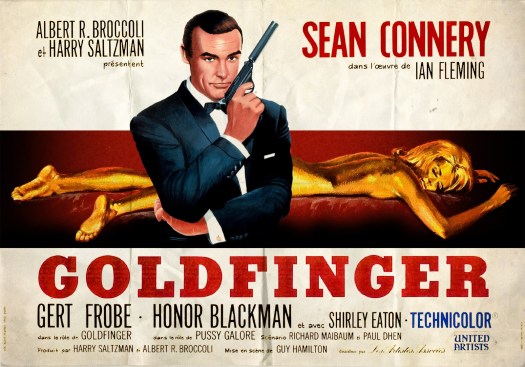
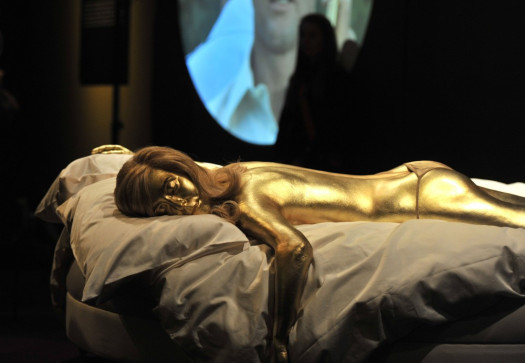
For my money, GOLDFINGER is the ultimate James Bond movie, serving as the blueprint for spy sagas to come. The action begins right off the rip as a scuba diving 007 infiltrates an oil refinery in an unnamed Latin American country, plants some plastique explosives, and changes into a tux as the whole shebang blows, then attends to some “unfinished business” with a beautiful Latina who sets him up to be killed by a bad guy, electrocuting his foe in a tub and wittily remarking “shocking, positively shocking” – all before the opening credits roll and Shirley Bassey belts out the immortal title tune by Anthony Newley and Leslie Bricusse!

Our Man Bond is then off to Miami to meet with his CIA pal Felix Leiter. He’s put on the trail of one Auric Goldfinger, a legit gold bullion dealer suspected of illegal activities. The avaricious Goldfinger isn’t above running…

View original post 607 more words

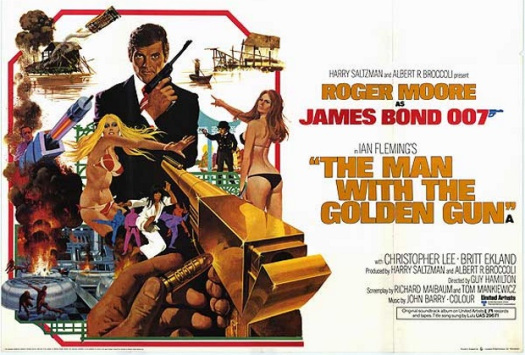
Remembering Roger Moore: THE MAN WITH THE GOLDEN GUN (United Artists 1974)


gary loggins's avatarcracked rear viewer

I didn’t realize Sir Roger Moore was 89 years old when I first heard he’d passed away on May 23. But as Mick Jagger once sang, time waits for no one, and Moore’s passing is another sad reminder of our own mortality. It seemed like Roger had been around forever though, from his TV stardom as Simon Templar in THE SAINT (1962-69) though his seven appearances as James Bond, Agent 007.

There’s always been a rift  between fans of original film Bond Sean Connery and fans of Moore’s interpretation. The Connery camp maintains Moore’s Bond movies rely too much on comedy, turning the superspy into a parody of himself. Many point to his second, THE MAN WITH THE GOLDEN GUN, as an example, but I disagree. I think the film strikes a good balance between humor and suspense, with Roger on-target as 007, and the great Christopher Lee (who’d guest starred in Moore’s syndicated…

View original post 482 more words

6 James Bond Films That Should Have Been Nominated For Best Picture


James Bond and Jaws

Other than a few song nominations (and wins) and the occasional technical mentions, the Academy has tended to snub the James Bond franchise.

However, I love the Bond films so here are 6 times that I think 007’s latest adventure should have been nominated for best picture!

From Russia With Love

  1. From Russia With Love (1963)

I not only think that From Russia With Love should have been nominated for best picture, I also think that it should have won.  This film featured Sean Connery at his best and it’s one of the few Bond films to work not only as an adventure but as a romance as well.

Skyfall

2. Skyfall (2012)

I’m not a huge fan of Daniel Craig’s interpretation of the character.  If Connery was Killer Bond and Roger Moore was Charming Bond, Craig often seems to be Whiny Bond.  That said, Skyfall was not only one of the best Bond films but one of the best films of 2012 as well.

The Spy Who Loved Me

3. The Spy Who Loved Me (1977)

Nobody does it better!  Not only was this Roger Moore’s best Bond film but it’s a wonderful piece of pop art.

on_her_majestys_secret_service1

4. On Her Majesty’s Secret Service (1969)

This is one of the most underrated of all of the Bond films.  Ignore all the gossip over how George Lazenby came to play James Bond and you’ll discover that it is a Skyfall for the 60s.

goldfinger-movie-poster-1964-1010189635

5. Goldfinger (1964)

“No, Mr. Bond, I expect you to die!”  Goldfinger is over the top perfection.

LiveandLetDie

6. Live and Let Die (1973)

Live and Let Die will probably never be acclaimed as the other Bond films but I don’t care.  I love it.  It’s the closest the Bond franchise ever came to achieving the anything-goes insanity of a classic grindhouse film.

Will a James Bond film ever receive a best picture nomination?  Normally, I’d say no.  But Mad Max: Fury Road changed the rules (for the better).  Given the right Bond, the right director, the right story, and the right year, who knows what could happen?