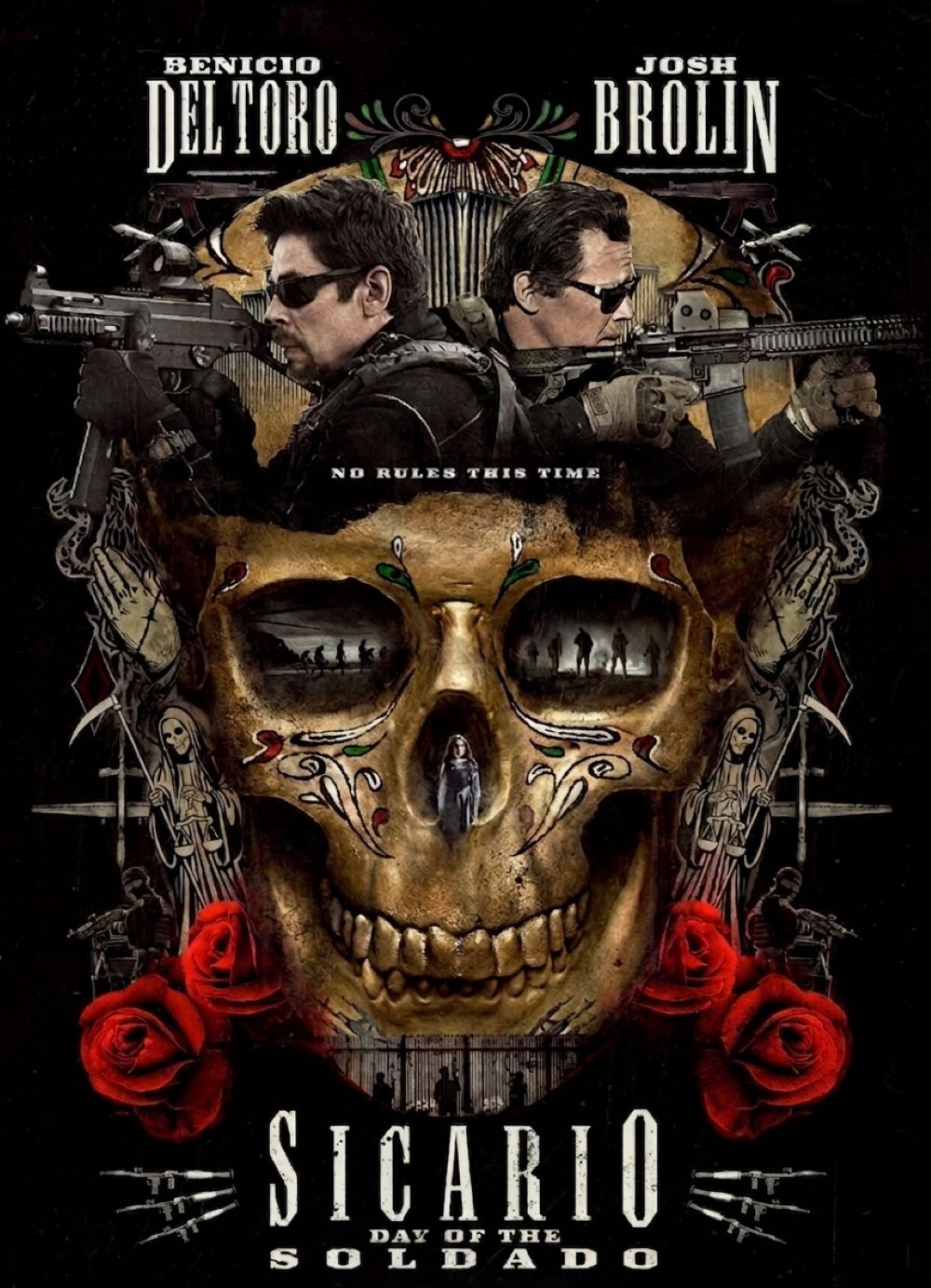
Sicario: Day of the Soldado (dir. by Stefano Sollima) Review


“I mean, I wouldn’t take out a cartel leader. Turn one cartel into 50. Besides, killing kings doesn’t start wars, it ends them.” — Matt Graver

Sicario: Day of the Soldado is a tense, often entertaining follow-up that never quite reaches the same level of dread, complexity, or visual identity as the first Sicario. It’s a movie that knows how to hit hard in the moment, but it doesn’t linger in the mind the same way, and a big reason for that is how much it shifts from being a layered border thriller into something more like a blunt-force crime action movie.

What stands out right away is that the film still has strong ingredients. Taylor Sheridan’s script gives Josh Brolin and Benicio Del Toro plenty of room to do what they do best, and both actors make this thing watchable even when the movie itself starts feeling thinner than it should. Brolin brings that loose, swaggering menace to Matt Graver, making him feel like the kind of guy who smiles while ordering something morally awful. Del Toro, meanwhile, gives Alejandro a cold, haunted intensity that fits the character perfectly. He doesn’t need much dialogue to sell the idea that this man is basically a weapon walking around in human form.

But that’s also where the movie’s biggest issue starts to show. For all the credit Sheridan deserves for keeping the world of Sicario alive, the absence of Denis Villeneuve in the director’s chair is obvious. The first film had this slow-burning, oppressive grip on you; every scene felt like it was pulling you deeper into a nightmare that had structure, purpose, and a real sense of moral unease. Here, that layered feeling is much weaker. The sequel becomes more interested in forward motion, shootouts, and tension-by-incident than in developing the deeper political and thematic weight that made the original so memorable.

That doesn’t mean Sicario: Day of the Soldado is empty. It just feels like it has less on its mind than the first film. The original Sicario was about systems, corruption, compromise, and the way law enforcement and criminal violence blur together until nobody gets to stay clean. This sequel touches on similar territory, but it often feels like the movie is more focused on creating a harsh atmosphere around its two lead men than on really digging into what all of it means. In that sense, it starts to feel like a vehicle for Brolin and Del Toro first, and a larger statement second.

Stefano Sollima does a solid job with the action, and to his credit, he understands that this world should feel mean, chaotic, and stripped of comfort. There’s a gritty professionalism to the violence that works well enough, and the film certainly doesn’t shy away from brutality. Still, the action doesn’t always carry the same weight as it did in the first movie because the buildup isn’t as rich. The tension is there, but the emotional and thematic buildup behind it is thinner, so some of the set pieces land more as effective genre beats than as moments that actually deepen the story.

The film’s biggest strength, beyond the performances, is its atmosphere of moral corrosion. Nobody in Day of the Soldado feels especially noble, and that’s part of what keeps it interesting. Brolin’s Graver is still the kind of operator who treats human lives like pieces on a board, while Del Toro’s Alejandro remains a deeply damaged figure who seems to exist somewhere between avenger, assassin, and ghost. Their relationship gives the movie a sharp edge, because you’re never really sure whether these guys are working together, manipulating each other, or simply following the same dark logic from different angles.

Still, the movie’s structure is less satisfying than the first one’s. It leans harder into a straightforward escalation of events, and once that happens, some of the mystery and suspense gives way to a more familiar crime-thriller rhythm. That isn’t automatically a bad thing, but it does mean the film loses some of the special quality that made Sicario feel so bracing. The sequel is darker in tone, sure, but not necessarily deeper. It’s more aggressive than observant, more kinetic than reflective.

A lot of this is why the movie works best when it keeps its focus on the two men at the center. Brolin and Del Toro are compelling enough to hold attention even when the screenplay starts feeling a little schematic. Their characters are so insulated by violence and secrecy that they almost seem to belong to a different kind of movie than everyone else around them. The downside is that this also makes the surrounding story feel less important. The first film balanced character and theme in a way that felt inseparable; this one often feels like it is using theme as a backdrop for the characters rather than letting the ideas shape the entire film.

Even so, Sicario: Day of the Soldado isn’t a failure. It’s a good-looking, well-acted, often tense sequel that knows how to stay nasty and efficient. It just doesn’t have the same confidence in its own ideas. The result is a film that is entertaining in a hard-edged, grim way, but also one that makes you think about what it could have been with a stronger directorial voice pulling everything together. Taylor Sheridan’s fingerprints are still all over it, but Villeneuve’s absence leaves a noticeable gap in the film’s pulse and perspective.

In the end, the movie feels like a solid but diminished return to a brutal world. It gives you Brolin and Del Toro doing sharp, controlled work inside a story that never fully rises to match them. That’s enough to make it worthwhile, but not enough to make it essential. Compared to the first Sicario, this one is more of a hard-nosed spin-off in spirit than a true continuation of the original’s power, and that difference is felt in almost every scene.
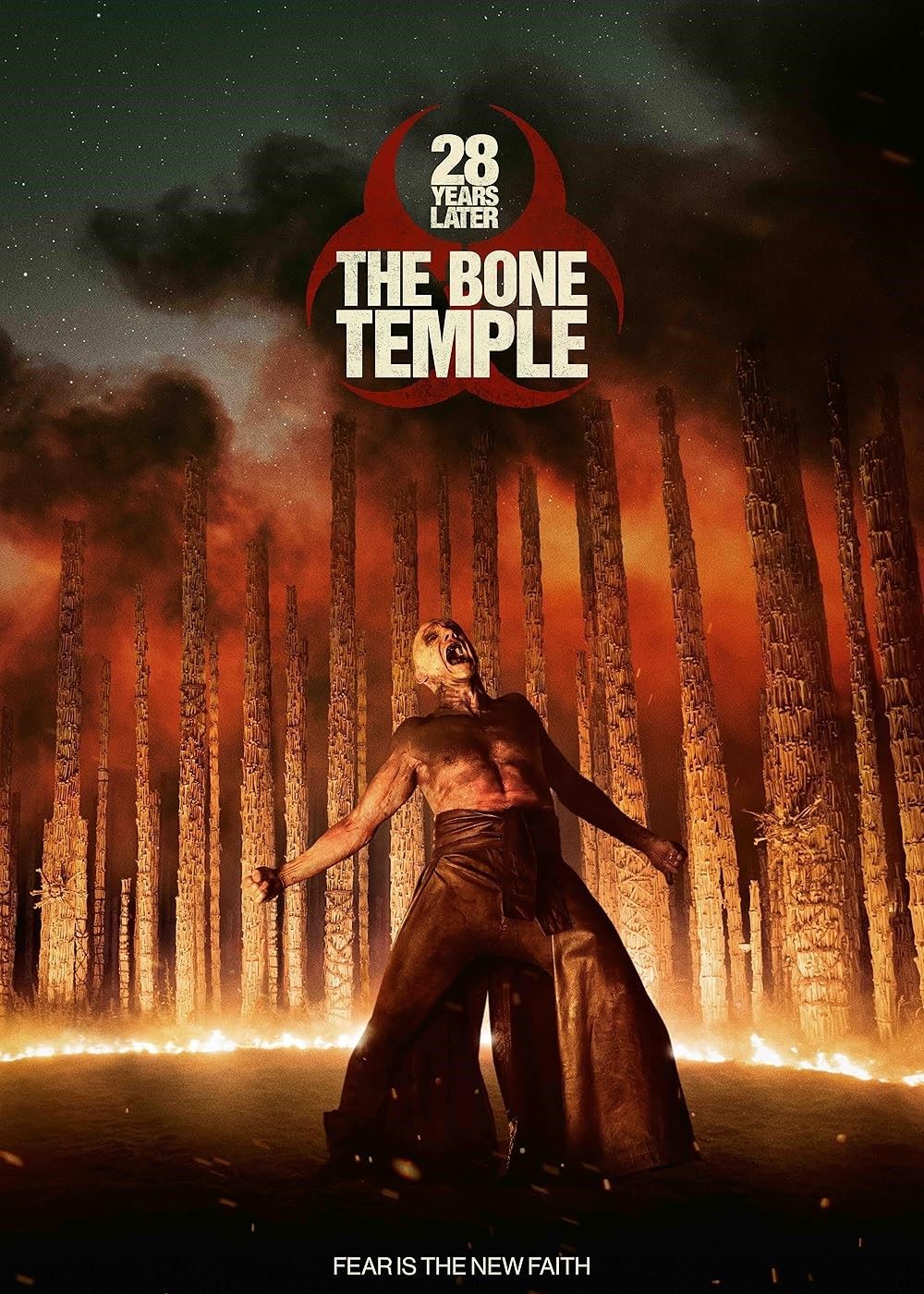
28 Years Later: The Bone Temple (dir. by Nia DaCosta) Review


“Every skull is a set of thoughts. These sockets saw and these jaws spoke and swallowed. This is a monument to them. A temple.” — Dr. Ian Kelson

28 Years Later: The Bone Temple crashes into 2026 with the force of a Rage-infected sprint, claiming its spot as one of the year’s top films right out of the gate, flaws and all. Directed by Nia DaCosta, the film continues to showcase her evolving command as a filmmaker, building directly on the promise of her 2025 character study Hedda, where she dissected emotional isolation with surgical precision and atmospheric tension. Where The Marvels in 2023 felt like a worthy attempt hampered by a screenplay that couldn’t decide on a tone—swinging between quippy banter and high-stakes drama while beholden to the cinematic universe’s endless interconnections—The Bone Temple unleashes DaCosta at full throttle, free from franchise baggage to craft a horror epic that’s visually poetic, thematically fearless, and rhythmically assured.​

Yeah, it revels in bleakness that can border on exhausting, and its structure wanders more than it charges forward, but those imperfections only underscore how fiercely original and alive it feels compared to the rote horror sequels we’re usually fed. Decades past the initial outbreak that defined 28 Days Later and 28 Weeks Later, the apocalypse here isn’t a fresh crisis anymore—it’s infrastructure, a grim new normal etched into the landscape. Survivors haven’t rebuilt so much as repurposed the ruins, carving out rituals and monuments that say as much about lingering trauma as they do about adaptation. The Rage virus still turns people into feral killers, ripping through flesh in those signature bursts of speed and savagery, but the infected have evolved in intriguing ways that deepen the world’s mythology without overshadowing the human core. The spotlight swings to human extremes: towering bone architectures raised as memorials, nomadic gangs treating murder like liturgy, and lone figures wrestling with whether dignity even matters when bodies pile up unmarked. This pivot lets the film breathe in ways the earlier entries couldn’t, expanding a zombie-adjacent thriller into something folk-horrific and introspective.

Dr. Ian Kelson embodies that shift, and Ralph Fiennes delivers what might be his meatiest role in years—a reclusive physician-architect whose Bone Temple dominates the story like a character itself, adding a profound level of tragic humanity that stands in stark, poignant contrast to the nihilistic worldview of Sir Lord Jimmy Crystal and his blindly devoted followers. Picture spires of meticulously arranged skulls and femurs, bleached white against misty Scottish skies, lit at night like profane altars: it’s production design that hits you visually first, then sinks in thematically as Kelson’s obsession with cataloging the dead. Fiennes plays him not as a villain or eccentric, but as a man fraying at the edges—tender when easing a dying woman’s passage (Spike’s mother, in a flashback that sets the whole narrative in motion), ruthless in his logic about preserving memory over sentiment. “Every skull is a set of thoughts,” he murmurs in one standout line, sockets staring empty, jaws frozen mid-word—a perfect encapsulation of the film’s meditation on legacy amid oblivion. Those quiet scenes, where Kelson debates ethics with survivors or observes the infected Samson with clinical curiosity shading into something paternal, ground the movie’s wilder swings and prove Fiennes can carry horror on sheer presence alone.​

Spike, our entry point into this madness, carries scars from that childhood brush with the Temple and his mother’s end, propelling him toward Jimmy Crystal’s orbit like fate’s cruel magnet. He’s no square-jawed lead; he’s reactive, watchful, hardening through trials that test his humanity without fully erasing it. That arc collides with Jimmy’s cult—a roving pack of devotees renamed his “seven fingers,” all aping the leader’s bleach-blond hair, loud tracksuits, and flashy trinkets in a uniformity that’s both comic and chilling. Jack O’Connell chews the scenery as Jimmy, a pint-sized prophet whose charisma masks profound damage: twitchy grins, boyish rants blending kids’ TV catchphrases with fire-and-brimstone, devotion to his “Old Nick” devil figure turning every kill into theater. The Savile visual parallels—those garish outfits evoking the real-life abuser’s predatory fame—add a layer of cultural poison, implying charisma survives apocalypse by mutating into something even uglier, with institutions gone but the hunger for idols intact. O’Connell makes Jimmy magnetic and monstrous, a performance that elevates the cult from trope to tragedy.​

If the film’s greatness shines through performances and visuals, its violence tests that shine—deliberately, one suspects. Infected attacks deliver franchise-expected chaos: heads torn free, eyes clawed out, bodies pulped in handheld frenzy. But Jimmy’s rituals amp the sadism—knife duels extended into endurance ordeals, flayings half-glimpsed but fully heard, victims’ pleas dragging until empathy fatigues. It’s grueling, sometimes overlong, risking audience burnout, yet it serves the theme: in a Rage world, human-inflicted torment outlasts viral rage because it feeds on belief. DaCosta pulls punches visually (smart cuts, shadows over gore) but lingers on emotional fallout, making cruelty feel earned rather than exploited— a maturation from The Marvels‘ tonal whiplash into controlled, purposeful discomfort. Counterpoints pierce through: Jimmy Ink’s furtive kindnesses toward Spike, Ian and Samson’s drug-hazy field dances blurring monster and man, fragments of backstory humanizing even Jimmy’s frenzy. These glimmers don’t redeem the world—they make its harshness sting deeper, proving flickers of connection persist as defiant accidents.

Technically, the film flexes non-stop, with DaCosta’s post-Hedda assurance evident in every frame. Anthony Dod Mantle’s cinematography weds gritty digital shakes to sweeping drone shots, turning Highlands into deceptive idylls ruptured by whip-pans and flame flares. Sound design hums with menace—whistling winds masking howls, train rumbles underscoring rituals, screams echoing into silence for maximum unease. Editing mirrors the narrative’s spiral: episodic loops around Spike’s hardening, Ian’s doubt, Jimmy’s collapse, eschewing linear escalation for dream-logic dread that suits a “settled” apocalypse. The Temple centerpiece ritual explodes into metal-thrash worship, cultists moshing amid pyres—a grotesque stadium parody where faith meets fandom in blood-soaked ecstasy. Even the score pulses with restraint, letting ambient horror fill gaps better than bombast ever could.

Tonally, it juggles masterfully: tender Kelson vignettes abut cult carnage, philosophical riffs on atheism versus delusion frame gore-fests, folk-horror monuments clash with infection thriller roots. Themes of faith-as-coping, grief-as-art, ideology’s pitfalls land without preaching—Kelson’s secular duty versus Jimmy’s ecstatic nihilism debates through action, not monologue. The ending circles back to series emotional cores (survival’s cost, hope’s fragility) while forging ahead, teasing Spike’s grim purpose without cheap uplift.

Flaws? The runtime sags in cult stretches, bleakness borders masochistic, sprawl might frustrate plot-chasers. But these are risks of ambition, not laziness—choices that make triumphs (Fiennes’ gravitas, O’Connell’s feral spark, visuals’ poetry) land harder, all under DaCosta’s steady hand that Hedda honed and The Marvels tested. In January 2026, amid safe genre retreads, The Bone Temple towers: a sequel philosophically dense, actor-propelled, unafraid to wound deeply then whisper mercy. It hurts because it sees us clearly—craving structure in chaos, building temples from bones, real or imagined. One of the year’s best, period, for daring to evolve rather than echo.