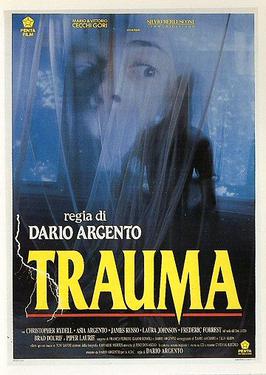
In 1993’s Trauma, Dario Argento tells a story of giallo horror, complete with a killer who wears black gloves, a camera that stalks through the streets of a rainy city, and plenty of eccentric red herrings. The story is set and was filmed in Minneapolis, Minnesota, making this one of the two Argento films to be completely shot in America.
Trauma was also the first of Argento’s films to star his daughter Asia Argento. Asia, who was 16 at the time of filming, plays Aura Petrescu, the daughter of Adriana (Piper Laurie) and Stefan (Dominique Serrand). Aura is a bulimic drug addict, with track marks up and down her arms. Having recently escaped from a mental hospital run by the eccentric Dr. Judd (Frederic Forrest), Aura is preparing to jump off a bridge and end her life when she’s grabbed by David (Christopher Rydell). David works as a headline writer and an artist for a local TV news station. David is also a recovering addict who takes sympathy on Aura and buys her breakfast. Aura thanks David by stealing his wallet and running out of the restaurant.
After being caught by the police, Aura is then returned to her home, a baroque mansion where Adriana works as a fake psychic. When Aura arrives, Adriana is preparing for a séance. She’s been hired to contact the spirit of a victim of The Head Hunter, a serial killer who has been chopping off people’s heads in Minneapolis. As a storm rages outside, Aura again flees from the house. Stefan and Adriana chase after her. Soon, while a terrified Aura screams in the rain (in a scene that will remind some of Asia’s mother, Daria Nicolodi, freaking out at the end of Tenebrae), the Head Hunter is holding up what appeas to be the heads of her parents.
Terrified for her life, Aura goes through David’s wallet, finds his number, and calls him. After setting Aura up at his house, David investigates who is chasing her and how those people are connected to The Head Hunter. David also falls in love with Aura and Aura falls for him. Unfortunately, as so often happens in the films of Dario Argento, the world is full of people who don’t care how in love two people are. The people who are after Aura are determined to get her and if that pushes David back into the world of drug abuse, so be it.
Trauma is middle-of-the-road Argento, featuring some scenes that are touched with genius and other scenes that just feel a bit bland. The cast is an interesting mix of veteran performers like Piper Laurie, Frederic Forrest, and Brad Dourif and younger actors like Christopher Rydell and Asia Argento. Dario Argento is known for being a director who prefers for his actors to come in, hit their marks, and deliver their lines with a minimum amount of fuss and he’s complained about American method actors (like Tenebrae’s Anthony Franciosa, with whom Argento had a notoriously difficult relationship) who want to discuss every little detail of their character and their performance. One can only imagine how he handled working with actors as outspoken and creative as Laurie, Forrest, and Dourif. It must be said that those three actors all give memorable performances but none of them seem to be acting in the same film as Rydell and Asia Argento. Rydell and Asia give rather earnest and straight-forward performances while Laurie, Forrest, and Dourif are all a bit more eccentric in the way they interpret their characters. Piper Laurie, in particular, rejects subtlety and delivers her lines with all of the melodramatic force she can summon. (It should be said that this is absolutely the right approach for the character that she’s playing.) That said, it’s Fredric Forrest who truly seems to be on a different planet from everyone else, giving a performance that can only be described as weird. Again, much as with Laurie’s self-aware melodrama, Forrest’s approach works well enough for his odd character, who I assume was named for the Dr. Judd who appears in Cat People.
The most controversial aspect of the film was the casting of Asia Argento as Aura, with some complaining of nepotism and others accusing Dario of exploiting his own daughter. Personally, I think Asia does a perfectly acceptable job in the lead role, even if it’s obvious that she still had room to develop as an actress. At the time the film was made, Asia was herself bulimic and the film’s most powerful scenes are the ones dealing with Aura’s own fragile sense of self-worth. Along with being hunted by a serial killer and having lost her entire entire family, Aura is also an outsider in America. The film paints a portrait of a society that doesn’t care about those living on the fringes. The only person that Aura has to look out for her is David, himself a former resident of the fringe. Christopher Rydell gives a good performance of David, playing him as someone who is trying to do the right thing and protect the victimized, even at the risk of his own sobriety.
(That said, there is one scene in which David receives a panicked phone call from Aura and Rydell’s underreaction suggests that the actor was not informed of just how desperate Asia Argento would sound when she later dubbed in her part of the conversation.)
Argento’s camera glides down dark hallways and through the streets of the city. He films Minneapolis in the same way that many directors would film New Orleans and, as such, the film becomes a vision of Middle America through European eyes. Because there’s a few issues with pacing and some clunky dialogue that was probably due to the Italian script being translated into English, Trauma is not Argento’s best. It’s middle-of-the-road Argento but it remains intriguing, nonetheless.
The (Reviewed) Films of Dario Argento:

 Through the Shattered Lens