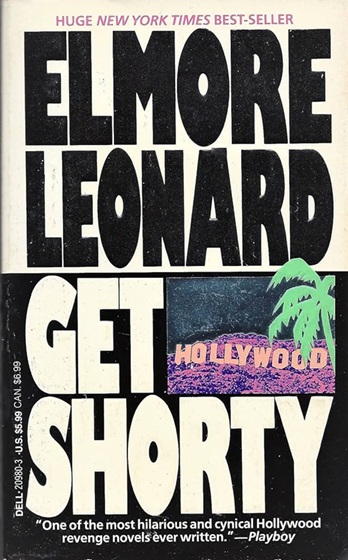
Book and Film Review: Get Shorty (by Elmore Leonard and dir by Barry Sonnenfeld)


In 1995’s Get Shorty, John Travolta stars as Chili Palmer.

Chili is a loan shark for the mob, an effortlessly cool guy who lives in Miami and who loves to watch old movies.  Chili may work for the Mafia and he may make his living by intimidating people but he doesn’t seem like such a bad guy, especially when compared to someone like Ray “Bones” Barboni (Dennis Farina).  Bones is an uncouth and rather stupid gangster who steals Chili’s leather jacket from a restaurant.  Chili reacts by breaking Bones’s nose with just one punch.  Bones reacts by trying to shoot Chili but instead, he gets shot by Chili himself.  (The bullet only grazes his forehead.)  Chili can do all this because he’s protected by Momo (Ron Karasbatsos) but, after Momo drops dead after having to walk up several flights of stairs just to then be given a surprise birthday party, Chili suddenly finds himself working for Bones.  (This all happens in the first few minutes of this perfectly paced film.)

Bones, eager to humiliate Chili, sends him to Vegas to collect on a debt owed by a dry cleaner named Leo (David Paymer).  Leo is thought to be dead but Bones wants to collect the money from Leo’s widow.  It’s not the sort of thing that Chili likes to do so instead, he ends up going to Hollywood to collect a debt from B-movie director Harry Zimm (Gene Hackman).  Chili  happens to like Harry’s movies.  He also likes Harry’s current girlfriend and frequent co-star, actress Karen Flores (Rene Russo).

Chili ends up in Hollywood, a town where everyone has some sort of hustle going.  Chili finds himself dealing with drug dealers (Delroy Lindo), egocentric film stars (Danny DeVito), stuntmen-turned-criminals (James Gandolfini), and the widow (Bette Midler) of a screenwriter.  Chili also finds himself looking to escape from the debt collection business by becoming a film producer.  Harry has a script that he wants to make.  Chili proposes a film based on the story of Leo the dry cleaner.  Danny DeVito’s Martin Weir wants to be a “shylock” in a movie just so he can show off his intimidating stare.  (“Is this where I do the look?” he asks while listening to the pitch.)  Get Shorty is a whip-smart satire of Hollywood, one in which the gangsters want to be film people and all of the film people want to be gangsters.  It features wonderful performances from the entire cast, with Travolta epitomizing cool confidence as Chili Palmer.  Hackman, Russo, DeVito, Gandolfini, and Lindo are all excellent in their supporting roles but I have to admit my favorite performance in the film is probably given by Dennis Farina, who turns Bones Barnobi into a very believable (and a believably dangerous) buffoon.

Get Shorty is based on a book by Elmore Leonard.  First published in 1990, the book is a quick and entertaining read, one that reminds us that Leonard was one of the best “genre” writers of his time.  When I read that book, I was surprised to see how closely the movie stuck to the book’s plot.  Much of the film’s dialogue is right there in the book.  It’s a book that practically shouts, “Turn me into a movie!” and fortunately, director Barry Sonnenfeld did just that.

Film Review: KIMI (dir by Steven Soderbergh)


KIMI, the latest addition to Steven Soderbergh’s interesting but frustratingly inconsistent filmography, stars Zoe Kravitz as Angela Childs.  Angela is an agoraphobic tech worker who is living in Seattle during the COVID pandemic.  A sexual assault survivor, Angela spends her days and nights safely locked away in her apartment.  She works from home.  She always keeps her mask some place near.  Occasionally, she’ll have a video session with her therapist.  Her mom calls and scolds her for not going outside.  She exchanges texts and occasionally more with Terry Hughes (Byron Bowers), an attorney who lives across the street.

And, she’s watched by Kevin (Devin Ratray).  Kevin also lives across the street and, throughout the film, he’s occasionally seen watching her from his top floor apartment.  It’s creepy but it’s not surprising.  KIMI is a film in which everyone is being watched by someone else.  Sometimes, they realize it and often they don’t.  Welcome to the Surveillance State, where privacy is the ultimate illusion.

Angela works for the Amygdala Corporation.  Under the leadership of CEO Bradley Hasling (Derek DelGuado), Amygdala has created KIMI, the virtual assistant that is superior to Alexa because all of KIMI’s errors are corrected not by a pre-programmed algorithm but instead by human workers who are constantly listening to KIMI’s data stream and correcting errors.  Angela is one of those engineers.  Usually, her job consists of programming KIMIs to play individual Taylor Swift songs as opposed to building Taylor Swift playlists.  When one owner calls KIMI a peckerwood, Angela programs the KIMI to understand that peckerwood is an “insult; vulgar.”  However, one data stream contains the sounds of what Angela believes to be a sexual assault and a subsequent murder.

Uniquely, for a film like this, Angela’s struggle is not to get people to believe that she heard what she heard.  Instead, her struggle is to get the evidence to the people who need to hear it for themselves.  Angela is terrified of leaving her apartment and, once she finally does, the outside world confirms all of her fears.  KIMI is a film about paranoia, a portrait of a world where everyone can be tracked and no one — from Angela’s too-helpful boss (Rita Wilson) to the man who casually walks by with an umbrella — can be trusted.

As I’ve said in the past, Steven Soderbergh has always been hit and miss for me.  It’s remarkable how many Soderbergh films that I love but it’s equally remarkable just how many Soderbergh films I absolutely loathe.  At his best, he can be a clever stylist and, at his worst, he can be painfully pretentious.  And yet, regardless of anything else, you do have to respect Soderbergh’s willingness to experiment with different genres and styles.  Soderbergh never stops working, despite the fact that he announced his retirement years ago.  Despite getting off to a slow start, KIMI is one of Soderbergh’s more entertaining thrillers, one that does a great job creating an atmosphere of paranoia and one that is also blessed with excellent performances from Zoe Kravitz and Rita Wilson, who makes good use of her limited screen time.  KIMI is a well-made Hitchcockian thriller and, along with No Sudden Move, it’s a return to form for Soderbergh after the two terrible movies that he made with Meryl Streep, The Laundromat and Let Them All Talk.  Yes, Soderbergh can be inconsistent but when he’s good …. he’s very, very good.  (Sometimes, he’s even brilliant.)  Narratively, KIMI may be a relatively simple film by Soderbergh standards but it’s undeniably effective.

Along with being a portrait of our paranoid age, KIMI is very much a pandemic thriller.  Angela mentions that her relationship with Terry started during the lockdowns, a time when no one found it strange that someone would be unwilling to leave their apartment.  When Angela does finally step out of her apartment, she is, of course, fully masked up and her paranoia about being followed severs as a metaphor for the paranoia that many people felt (and continue to feel) during the pandemic.  KIMI is not the first pandemic thriller and it certainly won’t be the last.  Still, what’s interesting to me that the pandemic subtext will probably be more noticeable to those who lived in states with mask mandates and aggressively regulated lockdowns than it will be for those of us who live in states that never had mandates and which, for lack of a better term, re-opened last year.  Half the people viewing KIMI will nod in recognition as Angela grabs her mask before walking up to her front door and as she quickly dashes down the street, careful not get too close to anyone else.  The other half will feel as if they’re watching some sort of dystopian science fiction film.  It all depends on where you’ve lived for the past two years.

Airborne (dir. by Rob Bowman)


Airborne

1993’s Airborne is a guilty pleasure kind of film for me. It’s not a spectacular film by any means, but it has just about everything I adore from the 1990s.. Hockey, Rollerblades, Music, and a fun cast. Sometime last year, I was able to rent it off of Amazon, but it’s no longer available. I’m assuming it will eventually make the move over to HBO Max, but in the meantime, it’s available for rental on Youtube.

Airborne was Director Rob Bowman’s first feature after working on such shows as Star Trek: The Next Generation and Parker Lewis Can’t Lose. He’d later go on to become a producer/director on The X-Files before eventually directing the first motion picture for the series, X-Files: Fight the Future. He’s since directed Reign of Fire and produced the ABC detective comedy, Castle.

Airborne is the tale of Mitchell Goosen (Shane McDermott, Swan’s Crossing), a kid who loves surfing and rollerblading more than anything. When his parents win a trip to Australia for six months, they send Mitchell to live with his cousin in Cincinnati. Of course, he’s a little out of place, but his cousin Wiley (Seth Green, Without a Paddle) tries to make things a little easier for Mitch.  Mitch’s laid back surfer attitude is a hit with the ladies, but the guys aren’t really liking his style. Jeff (Chris Conrad, The Next Karate Kid) has it out for Mitch, especially when Mitch meets Nikki (Brittany Powell, Fled) and costs Jeff’s hockey team a win against the annoying prep squad. Punishment for losing the hockey game is pretty messed up by high school standards, with the usual pranks laid out for both Mitch and Wiley.  Will Mitch be able to adjust to Cincinnati life, make new friends and live without his surfboard? I enjoyed the way Mitch finds a solution to his problem that fit his style.

There’s not a lot to say about the casting here. Among the leads, there’s a lot of young talent that went on to greater work. Some other notable faces are Jack Black (Jumanji: The Next Level), Alanna Ubach (Bombshell), and Jacob Vargas (Devil). They round out the cast well, but you don’t get to know too much about them.

Being 1993, Airborne took place just as the Internet was getting really started. This meant that outside of playing a Super Nintendo or Sega Genesis after homework was done, you went outside and played something like Stickball, skateboarding, basketball, street hockey or rollerblading. I think the nostalgia of it all is what brings me back to Airborne over time (especially now with so many limits on going outside). The rollerblading scenes in the film are great for the time period, thanks in part to Team Rollerblade. We have close-ups of riding, along with action shots that capture all of the intensity of riding in traffic. Stunt skaters slide under trucks, down along stairs , leap over cars and make some great moves in the big race.

Airborne is not without some cheesy moments. The music, while fun, is very dated. It’s the same kind of music you’d expect from 1990’s Teenage Mutant Ninja Turtles or Cool as Ice. The film has a number of filler scenes where Mitch is lost in a musical montage. Some tracks include the classic Right Said Fred’s “I’m Too Sexy”. and Jeremy Jordan’s “My Love is Good Enough”. There’s not a whole lot to be said about it. It was the Nineties. Additionally, it would be cool to find out what happened to Mitch after the six months. Did he decide to stay in Ohio for a while? Did he return to his parents, but still keep in touch with everyone on the skate crew? I suppose Mitchell Goosen’s future is left somewhere in the fan fiction world.

Overall, Airborne is a time capsule of a film, focusing on a time just before the Internet captivated everyone and going outside to play was the norm. It’s a good watch if you have a few hours to burn.

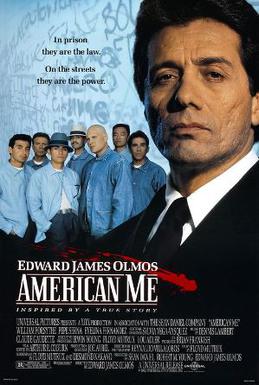
Film Review: American Me (1992, directed by Edward James Olmos)


American Me tells the story of Montoya Santana (Edward James Olmos).  Conceived during the Zoot Suit Riots of the 1940s, Santana is first arrested when he’s just 14 years old.  It’s only a breaking-and-entering charge but, on his first night in juvenile hall, Santana is raped by another inmate.  When Santana retaliates by murdering his rapist, his fate is set.  As soon as he’s 18, he’s transferred to Folsom Prison but, by that time, he and his friend J.D. (William Forsythe) have already formed what will become La Eme, the Mexican Mafia.  Running things from their cells, Santana and J.D. not only control the prison’s drug trade but they also keep an eye on who, from their old neighborhood, is going to be joining them behind bars.  Santana establishes early on that the punishment for any sign of weakness or disloyalty is death.

When Santana is finally released from prison, he finds that the world has changed since he was first incarcerated.  La Eme has become powerful both inside and outside of prison and nearly everyone in Santana’s old neighborhood looks up to him.  But Santana, himself, is lost.  In prison, Santana was feared and respected but, on the outside, he’s a 34 year-old man who has never had a job or a relationship.  He’s never even learned how to drive.

After meeting and falling in love with Julie (Evelina Fernandez) and seeing firsthand the damage that the drug trade is doing to his community, Santana starts to have second thoughts about La Eme.  But, according to the rules that he previously established, trying to leave La Eme is punishable by death.

American Me is a classic gangster film and I’m always surprised that it doesn’t have a bigger following than it does.  Along with starring in the film, Olmos made his directorial debut with American Me and he provides an unflinchingly brutal look at the drug trade and the violence that goes along with it.  Olmos was allowed to film inside Folsom Prison and even used actual prisoners are extras, bringing a touch of neorealist verisimilitude to the prison scenes. Early on, there’s a sequence that follows a baggie of heroin from one orifice to another until it finally reaches it destination in the prison.  It leaves you with no doubt that if people are willing to go through that much trouble to get drugs, it’s going to take something more than just zero tolerance laws to dissuade them.

Once Santana is released, Olmos does a good job, as both an actor and director, of showing just how lost he is.  In prison, Santana was in charge and feared but, when dealing with people in the real world, he’s just as awkward as he was when he was a teenager on his way to juvenile hall.  Olmos gives a tightly-wound, subtle performance as a man who is as much a prisoner of his outlook as he is of the state of California.

The men who served as the real-life inspiration for Olmos’s film were reportedly outraged by American Me.  They weren’t upset by the film’s portrayal of the drug trade or their callous disregard for the members of their community.  Instead, the film’s crime was suggesting that their organization was founded by someone who had been previously raped in prison.  (That Santana subsequently killed his rapist made no difference.)  Three people associated with the Mexican Mafia, all of whom has served as consultants to American Me, were subsequently murdered in the days immediately following the release of the film.

As for Edward James Olmos, he has remained busy as an actor.  One generation got know him on Miami Vice and then the next came to know him from Battlestar Galactica.  He’s subsequently directed four other films.  For me, his strongest work, as both an actor and a director, remains American Me.

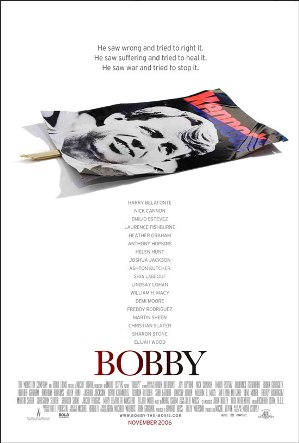
Shattered Politics #80: Bobby (dir by Emilio Estevez)


Bobby_poster

A few years ago, I was on twitter when I came across someone who had just watched The Breakfast Club.  

“Whatever happened to Emilio Estevez?” she asked.

Being the know-it-all, obsessive film fan that I am, I tweeted back, “He’s a director.”

Of course, I could not leave well enough along.  I had to send another tweet, “He directed a movie called Bobby that got nominated for bunch of Golden Globes.”

“Was it any good?” she wrote back.

“Never seen it,” I wrote back, suddenly feeling very embarrassed because, if there’s anything I hate, it’s admitting that there’s a film that I haven’t seen.

However, Shattered Politics gave me an excuse to finally sit down and watch Bobby.  So now, I can now say that I have watched this 2006 film and … eh.

Listen, I have to admit that I really hate giving a film like Bobby a lukewarm review because it’s not like Bobby is a bad film.  It really isn’t.  As a director, Emilio Estevez is a bit heavy-handed but he’s not without talent.  He’s good with actors.  Bobby actually features good performances from both Lindsay Lohan and Shia LaBeouf!  So, give Estevez that.

And Bobby is a film that Estevez spent seven years making.  It’s a film that he largely made with his own money.  Bobby is obviously a passion project for Estevez and that passion does come through.  (That’s actually one of the reasons why the film often feels so heavy-handed.)

But, with all that in mind, Bobby never really develops a strong enough narrative to make Estevez’s passion dramatically compelling.  The film takes place on the day of the 1968 Democratic California Presidential Primary.  That’s the day that Robert F. Kennedy won the primary and was then shot by Sirhan Sirhan in the kitchen of the Ambassador Hotel.  However, it never seems to know what it wants to say about Kennedy or his death, beyond the fact that Estevez seems to like him.

(Incidentally, it’s always interesting, to me, that Dallas is still expected to apologize every day for the death of JFK but Los Angeles has never had to apologize for the death of his brother.)

Estevez follows an ensemble of 22 characters as they go about their day at and around the Ambassador Hotel.  As often happens with ensemble pieces, some of these characters are more interesting than others.

For instance, Anthony Hopkins plays a courtly and retired doorman who sits in the lobby and plays chess with his friend Nelson (Harry Belafonte).  It adds little to the film’s story but both Hopkins and Belafonte appear to enjoy acting opposite each other and so, they’re fun to watch.

Lindsay Lohan plays a woman who marries a recently enlisted soldier (Elijah Wood), the hope being that his marital status will keep him out of Vietnam.  The problem with this story is that it’s so compelling that it feels unfair that it has to share space with all the other stories.

Christian Slater plays Darrell, who runs the kitchen and who spends most of the movie talking down to the kitchen staff, the majority of whom are Hispanic.  Darrell is disliked by the hotel’s manager (William H. Macy) who is cheating on his wife (Sharon Stone).

And then, you’ve got two campaign aides (Shia LaBeouf and Brian Geraghty) who end up dropping acid with a drug dealer played by Ashton Kutcher.  Unfortunately, Estevez tries to visualize their trip and it brings the film’s action to a halt.

Estevez himself shows up, playing the husband of an alcoholic singer (Demi Moore).  And Estevez’s father, Martin Sheen, gets to play a wealthy supporter of Kennedy’s.  Sheen’s wife is played by Helen Hunt.  She gets to ask her husband whether she reminds him more of Jackie or of Ethel.

(Actually, Martin Sheen and Helen Hunt are cute together.  Much as with Lohan and Wood, you wish that more time had been devoted to them and their relationship.)

And there are other stories as well.  In fact, there’s far too many stories going on in Bobby.  It may seem strange for a girl who is trying to review 94 films in three weeks to say this but Emilio Estevez really tries to cram too much into Bobby.

At the same time, too much ambition is better none.  Bobby may have been a misfire but at least it’s a respectable misfire.

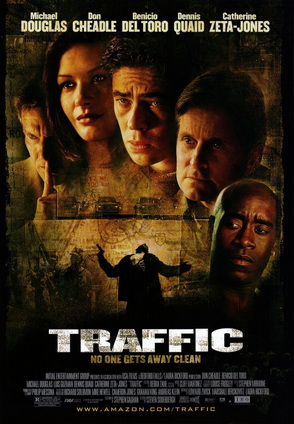
Shattered Politics #69: Traffic (dir by Steven Soderbergh)


Traffic2000Poster

I have mixed feelings about Steven Soderbergh.  On the one hand, his talent cannot be denied and you have to respect the fact that he’s willing to take chances and make films like The Girlfriend Experience and The Informant.  On the other hand, he’s also the director who has been responsible for overrated messes like Contagion and utter pretentious disasters like Haywire.  And it doesn’t help that Soderbergh’s fanbase seems to be largely made up of the type of hipsters who end up leaving comments under the articles at The A.V. Club.  Some people mourned Soderbergh’s retirement.  Personally, I think he made the right decision.  He retired before his misfires ended up outnumbering all of his masterpieces.

The thing about Soderbergh is that his good films are so good that it makes it all the more frustrating to watch his failures.  If Soderbergh was just your typical bad director than a film like Contagion wouldn’t be as annoying.  But this is the man who also gave us Traffic!

And Traffic is a very good film.

First released in 2000, Traffic attempted to deal with the American war on drugs, a war that the film suggests might not even be worth fighting.  (Full disclosure: I support the legalization of drugs and, for that matter, just about everything else.  And yes, I am biased towards films that agree with me.  So is every other film critic out there.  The difference is that I’m willing to admit it.)  Traffic won four Oscars, including Best Director and Best Supporting Actor for Benicio Del Toro.  It was also nominated for best picture but lost to Gladiator.

Traffic tells three, barely connected stories.  Each story is given its own distinct look, feel, and color scheme.  And while it takes a few minutes to get used to film’s visual scheme, it ultimately works quite well.  Though all of the film’s characters share the same general existence, they live in different worlds.  The only thing linking them together is drugs.

Judge Andrew Wakefield (Michael Douglas) is a judge on the Ohio Supreme Court who has recently been named as the new drug czar.  However, while Judge Wakefield is going around the country and talking to politicians (Harry Reid shows up playing himself and is just as creepy as always), his daughter Caroline (Erika Christensen) is dating Seth (Topher Grace) and getting addicted to cocaine and heroin.  When Caroline run away, Judge Wakefield recruits Seth and, using him as a guide, searches the ghetto for his daughter.

The Wakefield scenes are bathed in cold and somber blues.  They’re beautiful to look at but, in some ways, they’re also some of the weakest in the film.  The whole plotline of Caroline going from being an innocent honor’s student to being a prostitute who sells her body for heroin feels a lot like the notorious anti-drug film Go Ask Alice.  At the same time, it’s interesting and a little fun to see Topher Grace playing such a little jerk.  Grace gets some of the best lines in the film, especially when he attacks Wakefield’s feelings of smug superiority.

In the film’s second storyline, two DEA Agents (Don Cheadle and Luis Guzman) arrest drug trafficker Eddie Ruiz (Miguel Ferrer).  Eddie works for the Ayala syndicate and, once he’s arrested, he turns informant.  Drug lord Carlos Ayala (Steven Bauer) is arrested.  While Carlos sits on trial, his pregnant wife (Catherine Zeta-Jones) and his sleazy business associate (Dennis Quaid) struggle to hold together the business and find a way to kill Ruiz before he can testify.

This storyline is filmed in bright and vibrant colors and why not?  The Ayalas are rich and, unlike the Wakefields, they don’t feel the need to hide their material wealth.  This is actually probably my favorite storyline, largely because it’s the best acted and the most entertaining.  Miguel Ferrer, in particular, steals every scene that he’s in.  The scene where he explains the economics of being a drug trafficker is fascinating to watch.

The Ayala storyline may be my favorite but the film’s most thought-provoking storyline is the third one.  Taking place in Mexico, it stars Benicio Del Toro as Javier Rodriguez, a casually corrupt police officer who gets recruited to work for General Salazar (Tomas Milian), who is heading up Mexico’s war on the cartels.  Following the orders of Salazar, Javier captures assassin Frankie Flowers (Clifton Collins, Jr.) who is then savagely tortured by Salazar until he turns informer.  Javier comes to realize that Salazar is actually working for one of Mexico’s cartels.  When he decides to inform on Salazar, he puts his own life at risk.

The Mexico storyline is also the harshest and visually, it reflects that fact.  The heat literally seems to be rising up from the desert and the streets of Tijuana.  It takes a few minutes to adjust to the look of the Mexico scenes but, once you do, they become enthralling.

And Traffic, as a film, is undeniably enthralling as well.  Soderbergh deftly juggles the multiple storylines and brings them together to create a portrait of a society that’s being destroyed by the efforts to save it.  Hopefully, if Soderbergh ever does come out of retirement, he’ll give us more films like Traffic and less films like Contagion.