In the year 1979, a young Steven Spielberg attempted to conquer comedy in the same way that he previously conquered horror with Jaws and science fiction with Close Encounters of The Third Kind. Working from a script written by Robert Zemeckis and Bob Gale, Spielberg made a film about the days immediately following Japan’s attack on Pearl Harbor. The name of the film was 1941 and it remains Steven Spielberg’s only attempt to direct a full-out comedy. There’s a reason for that.
The film follows a large group of characters over the course of one day and night in 1941. It’s been six days since Pearl Harbor was attacked and the streets of Los Angeles are full of young men who are preparing to ship out and older man who are paranoid about when the next attack is going to come. However, Major General Joseph Stilwell (Robert Stack) just wants to see Dumbo at the local theater. Meanwhile, his womanizing aide (Tim Matheson, giving the same performance here that he did in National Lampoon’s Animal House) just wants to get Stillwell’s aviation-lusting secretary (Nancy Allen) into an airplane.
Elsewhere, Ward Douglas (Ned Beatty) is happy to allow Sgt. Tree (Dan Aykroyd) and his men (including John Candy) to set up on an anti-aircraft gun in his front yard. Ward’s daughter, Betty (Dianne Kay), is only concerned about entering a dance contest with her friend, Maxine (Wendie Jo Sperber). Cpl. Sitarski (Treat Williams) and dishwasher Wally Stephens (Bobby D iCicco) both hope to be Betty’s partner and their rivalry leads to a massive (and seemingly never-ending) brawl.
While Ward deals with the gun in his front yard, another concerned citizen — Claude Crumm (Murray Hamilton) — keeps watch from atop of Ferris wheel, along with amateur ventriloquist Herbie Kazlminsky (Eddie Deezen).
But that’s not all! Susan Backilinie recreates her role from a previous Spielberg film, skinny dipping while the Jaws theme plays in the background and running straight into a submarine that is commanded by Commander Akiro Mitamura (Toshiro Mifune, trying to maintain his dignity). Mifune decides to attack Hollywood but no one on the submarine is sure where that is. Christopher Lee appears as an arrogant German who is along for the ride. Slim Pickens shows up as a lumberjack who is temporarily captured by the Japanese. John Belushi plays Wild Bill Kelso, who flies his airplane through Los Angeles. Warren Oates yells and laughs. Dick Miller, Elijah Cook Jr. and Lionel Stander show up in small roles.
“Since when is Steven funny?” According to Peter Biskind’s Easy Riders, Raging Bulls, this was the reaction that most of Spielberg’s friends had when he announced that his next film would be a screwball comedy set during World War II. Watching the film, one gets their point. The majority of the film’s humor comes from people looking at the camera and screaming. There’s a lot physical comedy, which would undoubtedly work in small amounts but which grows rather tiring when it’s dragged out to the extent that Spielberg’s drags it out. (A brawl at a USO show seems like it should be funny but Spielberg allows it to go on for too long and the careful choreography takes away any element of spontaneity.) The film attempts to duplicate the style of Animal House (and it’s probably not a coincidence that Matheson, Belushi, and director John Landis all have roles in the film) but Spielberg often seems as if he’s trying too hard. There’s nothing subversive about the humor. It’s more antic than funny.
A huge problem is that there really isn’t much of a story here. Spielberg, who is normally one of Hollywood’s best storytellers, attempts to do a loose, Altman-style ensemble film and the result is that none of the characters feel alive and there’s never any sense of narrative momentum. There are a few performers who manage to make an impression amongst all the explosions and the yelling. John Belushi has the advantage of not having to share the majority of his scenes with anyone else. Warren Oates’s manic energy is more than welcome. Wendie Jo Sperber deserved more screentime. Murray Hamilton and Eddie Deezen frequently made me laugh. There’s a wonderful moment where Robert Stack’s intense general cries while watching Dumbo. But, for the most part, the film never comes together.
That said, 1941 is definitely a Steven Spielberg film. It received three Academy Award nominations, for Cinematography, Sound, and Visual Effects. (All three of those categories, not surprisingly, are more associated with spectacle than with comedy.) The film looks great! Spielberg’s attention to detail is there in the production design and the costumes. Watching 1941, you can see Spielberg’s talent while also seeing why he never directed another comedy.
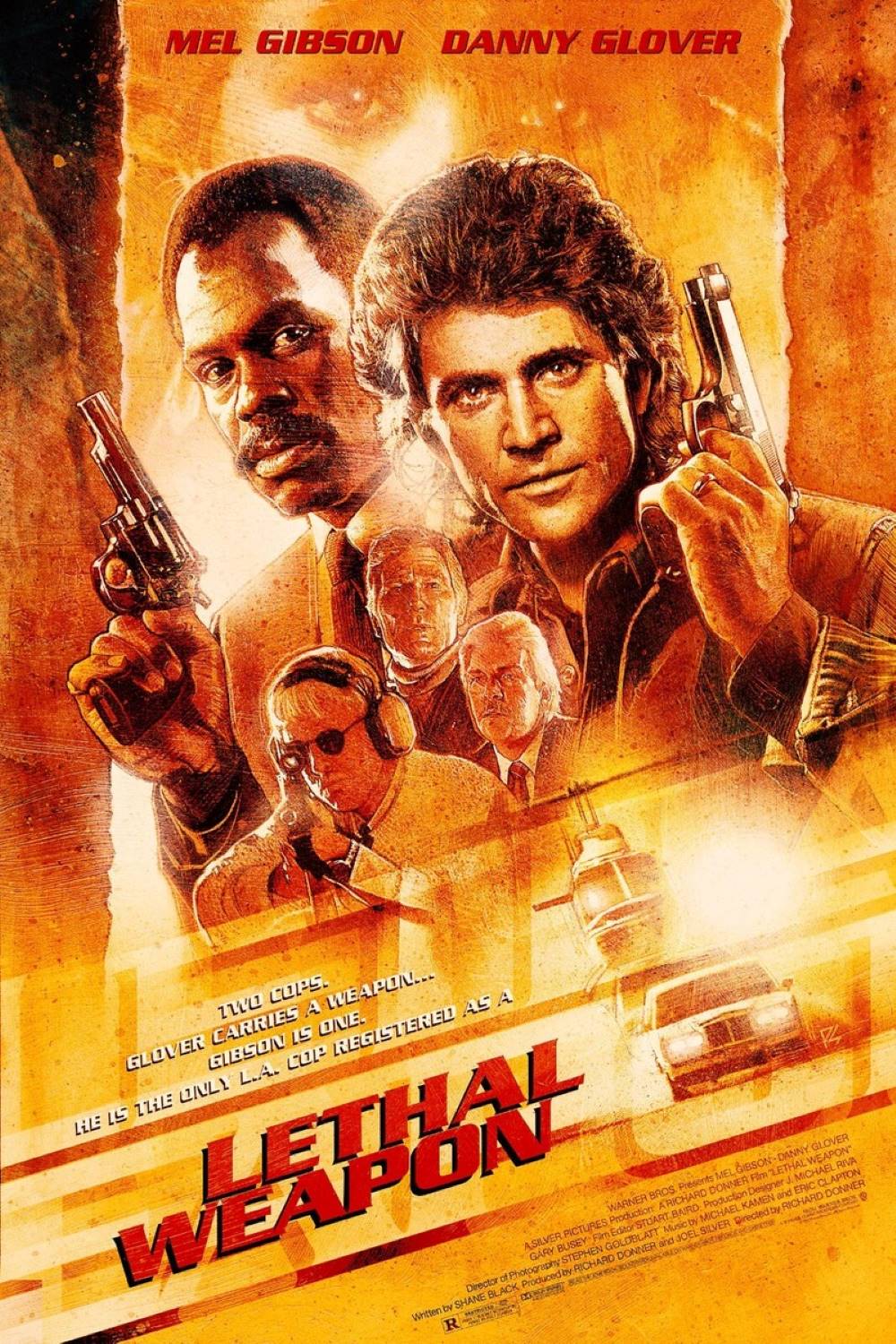
Lethal Weapon is one of those action movies that looks like pure genre formula on paper but somehow plays like lightning in a bottle on screen. From the opening moments, it feels like a film that knows exactly what kind of ride it wants to deliver and leans into that mission with confidence, attitude, and just enough heart to make the bullets and explosions actually matter.
The premise itself is as straightforward as they come, and that simplicity is part of the charm. Martin Riggs is the textbook “cop on the edge,” a former special forces sniper whose life has completely fallen apart after the death of his wife. He’s volatile, depressed, and teetering on the edge of suicidal, which gives everything he does an extra layer of danger. On the other side of the pairing is Roger Murtaugh, a seasoned detective staring down his 50th birthday, trying to balance a long career in homicide with the quiet, constant pull of his family at home. When these two are thrown together and assigned to a case involving drugs, dead bodies, and shady ex-military criminals, the story plays out across familiar beats: suspicious deaths, escalating confrontations, close calls, and a trail that leads them deeper into a dangerous operation. The crime plot is pulpy and direct rather than twisty, but the film uses it as a sturdy framework rather than the main point of interest, keeping the investigation moving while the characters come into focus. Much of that sharp setup and snappy progression comes from Shane Black’s script, which crackles with knowing genre savvy, pitch-perfect banter, and a keen eye for how personal pain fuels action-hero antics.
What really makes Lethal Weapon feel alive is how much time it spends letting Riggs and Murtaugh exist as people before they fully morph into the “classic duo” that pop culture remembers. The film doesn’t rush past the small stuff. Riggs is introduced living in a rundown trailer on the beach with his scruffy dog for company, drinking and stumbling through life with the casual recklessness of someone who genuinely doesn’t care if he sees tomorrow. Those early moments of him alone, flirting with self-destruction, give his later heroics a sense of tragic context: he’s not just fearless, he’s half-convinced he has nothing left to lose. Murtaugh’s introduction is a complete contrast: a crowded home, kids, a loving wife, and the kind of loud, chaotic domestic life that’s full of relatable irritation and warmth. Seeing him grumble through birthday milestones or awkwardly handle family situations does more for his character than any speech about his years on the force could. These slices of everyday life build a strong emotional foundation so that when the bullets start flying, there’s something at stake beyond catching bad guys. Black’s writing shines here, weaving those intimate details into the thriller beats without ever feeling forced or preachy.
The chemistry between Mel Gibson and Danny Glover is the film’s true secret weapon. Gibson plays Riggs as an unpredictable live wire, able to flip from goofy physical comedy to chilling seriousness in an instant. He sells the idea that this is a man barely keeping it together, yet still razor-sharp when it comes to the job. There’s a constant sense that his jokes and antics are a flimsy barrier over something very raw. Glover, by contrast, keeps Murtaugh grounded and human; his performance is packed with little sighs, muttered reactions, and weary facial expressions that speak volumes. He comes across as a guy who has seen too much, loves his family, and genuinely wants to do the right thing, but is exhausted by how hard that is in practice. Their initial friction hits the expected “mismatched partners” beats: Murtaugh thinks Riggs is unstable and dangerous, while Riggs treats Murtaugh like a fussy old man who doesn’t get it. Yet as they move through stakeouts, interrogations, and gunfights, their banter evolves from pure irritation into an easy rhythm filled with barbs, mutual respect, and eventually real affection. Shane Black’s dialogue is the glue for all of it—witty, profane, and laced with just enough vulnerability to make the laughs land harder and the tension feel real.
Richard Donner’s direction is a huge part of why all of this clicks as well as it does. He has a knack for blending big, commercial genre instincts with an eye for character detail, and Lethal Weapon is a textbook example of that balance. He stages action scenes with clear geography and rhythm, so even when things get loud and chaotic, you always know where you are and what everyone is trying to do. At the same time, he’s just as interested in the quiet beats: a pause on Riggs’ face after a joke lands flat, Murtaugh’s body language when he walks into his noisy home after a brutal day, the way a conversation in a car can shift from banter to confession in a couple of lines. Donner keeps the film moving at a brisk pace, but he knows when to let a shot linger or a silence hang long enough to tell you what the characters can’t quite say out loud. His tonal control—jumping from dark to funny to tense without completely losing the thread—is a big reason the movie doesn’t collapse under its own genre juggling, and it pairs beautifully with Black’s script that sets up those shifts so precisely.
Tonally, Lethal Weapon walks a tricky line, and that’s a big part of its identity. On one hand, this is a story with genuinely dark undercurrents. Riggs’ suicidal impulses are not a throwaway character quirk; the film gives time to scenes where he nearly acts on them and struggles in a very raw way with his grief and loneliness. The case they’re working breaks open into territory involving drugs, exploitation, and violence that’s sometimes nasty rather than cleanly heroic. On the other hand, the film is full of humor, ranging from quick one-liners to broad physical bits. The Murtaugh household provides a lot of that levity: awkward conversations with his kids, Riggs stumbling through family dynamics, and the contrast between domestic calm and the chaos of the streets. The movie often jumps from heavy emotional beats to comedic ones and back again, and while the transitions can be abrupt, that mixture is part of what keeps it from feeling like just another grim cop story. The laughter doesn’t erase the darker material, but it does give the movie a sense of momentum and charm that keeps it entertaining instead of oppressive. Black’s screenplay nails this push-pull, using humor as both release valve and revelation.
As an action film, Lethal Weapon delivers a steady run of sequences that are energetic, clear, and tactile. The action is built around physical stunts, dangerous-looking falls, and gunfights that feel chaotic without becoming incoherent. One memorable sequence has Riggs dealing with a jumper on a rooftop in a way that instantly tells you everything about his mentality and willingness to risk himself. Another set piece in a more open, exposed environment lets the film escalate tension step by step before violence finally erupts. Through it all, Donner keeps a strong sense of spatial clarity; you can track where the characters are, what they’re trying to do, and how each decision raises the stakes. The fights feel scrappy and painful rather than overly slick, and that slightly rough quality actually works in the movie’s favor, making each impact land harder. Riggs, especially, moves like a human weapon, hurling himself into situations with a recklessness that ties directly into his psychological state, all fueled by Black’s clever plotting that makes those risks feel personal.
Underneath the gunfire and explosions, there’s a surprisingly sturdy emotional core tying everything together. Riggs’ grief isn’t just window dressing; it’s the lens through which his every decision makes sense. The movie doesn’t lecture you about what he’s feeling, but it shows it—through quiet moments alone, through the anger that erupts at all the wrong times, and through the way he throws his body into danger almost as if daring the world to take him out. Murtaugh’s arc is more subtle but still strongly drawn. He’s at an age where he has to confront the reality that he can’t keep pace with younger, more reckless colleagues forever, and yet his sense of duty keeps pulling him into situations where his family might lose him. Throughout their investigation, Murtaugh’s protective instincts—toward his loved ones, toward Riggs, and toward innocent people caught in the crossfire—become as important as his skills as a detective.
The relationship that develops between Riggs and Murtaugh is the heart of the film and the main reason it sticks in the memory. At first, Murtaugh just wants to survive partnering with a man he genuinely believes might be unhinged, while Riggs seems to treat their pairing as just another chaotic twist in a life already off the rails. As they trade confessions, back each other up in tight spots, and slowly understand what the other is carrying, their bond shifts into something like brotherhood. Murtaugh becomes a kind of anchor for Riggs, offering not just backup in a fight but also a place at the table, both literally and figuratively. Riggs, in turn, forces Murtaugh out of his comfort zone, reminding him that he still has plenty of courage and fire left in him. The film doesn’t turn their connection into a sentimental soapbox, but it lets small moments—a shared laugh after a narrow escape, a quiet conversation after the chaos—do the emotional lifting, with Black’s words giving those scenes their understated power.
If there’s a clear weak spot, it’s that the villains are fairly thinly drawn, operating more as looming threats than fully realized characters. They are dangerous and organized, capable of serious brutality and clearly involved in serious criminal operations, but the movie doesn’t spend much time exploring their motivations or inner lives. They’re the kind of antagonists designed to be obstacles: formidable enough to make the heroes’ victories feel earned, but not so complex that they distract from the central duo. For a character-driven action film, that trade-off mostly works. When Lethal Weapon is firing on all cylinders, the tension doesn’t come from wondering what the bad guys will do next so much as from seeing how Riggs and Murtaugh will handle whatever gets thrown at them and what that reveals about who they are.
Structurally, the film keeps a tight pace, always nudging the story forward even when it pauses for character beats. Expository scenes rarely feel like dry info dumps; they’re often laced with jokes, personal jabs, or subtle shifts in how the two leads relate to each other. The downtime moments—a quiet drink, a shared meal, a conversation in a car between partners who would rather pretend they’re fine—are as important as the louder ones. By the time the case ramps up to its most intense passages, there’s been enough time with these characters to care less about the mechanics of the plot and more about whether these two damaged, stubborn men can come out the other side with something to hold onto.
What ultimately makes Lethal Weapon work so well is that it doesn’t settle for being just a checklist of genre requirements. Yes, it has gunfights, dark humor, car chases, and tough-guy posturing. But wrapped around all of that is a story about grief, aging, loyalty, and how unlikely partnerships can change the trajectory of a person’s life. Donner’s steady hand behind the camera, Shane Black’s razor-sharp script, and the powerhouse performances turn what could have been a forgettable cop thriller into something much more memorable. For anyone who enjoys action movies that care as much about the people pulling the triggers as the bullets they fire, Lethal Weapon stands out as a defining entry in the buddy-cop mold, powered by the messy, heartfelt dynamic at its center and the sure-footed craftsmanship that brings it all together.
1979’s Apocalypse Now reimagines the Vietnam War as pop art.
Jim Morrison sings The End in the background as slow-motion helicopters pass in front of a lush jungle. The jungle erupts into flame while in a dingy hotel room, Captain Benjamin Willard (Martin Sheen) gets drunks, practices his karate moves, and smashes a mirror before collapsing to the floor in tears. The next morning, the hung-over and bandaged Willard ends up at a U.S. military base where he has a nice lunch with Lt. General Corman (G.D. Spradlin) and Col. Lucas (Harrison Ford) and a nearly silent man wearing an undone tie. Willard is asked if it’s true that he assassinated an enemy colonel. Willard replies that he did not and that the operation was classified, proving that he can both lie and follow military protocol. Willard is told that a Col. Walter Kurtz (Marlon Brando) has gone rogue and his mission is to go into Cambodia and terminate his command with “extreme” prejudice. It’s a famous scene that features G.D. Spradlin delivering a brilliant monologue about good and evil and yet it’s often missed that Willard is getting his orders from Roger Corman and George Lucas.
(Roger Corman was the mentor of director Francis Ford Coppola while the pre-Star Wars George Lucas was Coppola’s business partner. Indeed, Apocalypse Now was originally somewhat improbably planned to be a George Lucas film.)
Up the river, Willard heads on a patrol boat that is populated with characters who could have come out of an old World War II service drama. Chief (Albert Hall) is tough and no-nonsense. Lance (Sam Bottoms) is the goofy comic relief who likes to surf. Clean (Laurence Fishburne) is the kid who is obviously doomed from the minute we first see him. Chef (Fredric Forrest) is the overage, tightly-wound soldier who just wants to find mangoes in the jungle and who worries that, if he dies in a bad place, his soul won’t be able to find Heaven. The Rolling Stones are heard on the boat’s radio. Soldiers on the other patrol boats moon the boat and toss incendiary devices on the roof. It’s like a frat prank war in the middle of a war.
Colonel Bill Kilgore (Robert Duvall) is a badass calvary officer whose helicopter raids are legendary amongst the enemy and a dedicated surfer who tries to turn every night into the equivalent of an AIP Beach Party film. He’s a brilliant warrior who speaks with Malibu accent (“Charlie don’t surf!”) and who doesn’t flinch when a bomb goes off near him. “I love the smell a napalm in the morning,” he says and, for a few moments, you really wish the film would just abandon Willard so we could spend more time with Kilgore. “Some day this war is going to end,” he says with a reassuring nod, showing a non-neurotic attitude that is the opposite of Kurtz’s. Willard says that he could tell Kilgore was going to get through the war without even a scratch and it’s true. Kilgore doesn’t try to rationalize or understand things. He just accepts the reality and adjusts. He’s a true surfer.
The film grows progressively more surreal the closer the boat heads up the river and gets closer to Cambodia. A USO show turns violent as soldiers go crazy at the sight of the Playboy Bunnies, dressed in denim outfits and cowboy hats and twirling cap guns like the love interest in a John Wayne western. A visit to a bridge that is built every day and blown up every night is a neon-lit, beautiful nightmare. Who’s the commanding officer? No one knows and no one cares.
The closer Willard gets to Kurtz, the stranger the world gets. Fog covers the jungles. A tiger leaps out of nowhere. Dennis Hopper shows up as a photojournalist who rambles as if Billy from Easy Rider headed over to Vietnam instead of going to Mardi Gras. Scott Glenn stands silently in front of a temple, surrounded by dead bodies that feel as if they could have been brought over from an Italian cannibal film. Kurtz, when he shows up, is an overweight, bald behemoth who talks in riddles and who hardly seem to be the fearsome warrior that he’s been described as being. “The horror, the horror,” he says at one point in one of the few moments that links Apocalypse Now to its inspiration, Joseph Conrad’s Heart of Darkness.
Directed by near-communist Francis Ford Coppola and written by the unapologetically right-wing John Milius, Apocalypse Now is actually less about the reality of Vietnam and more about how the images of the war shaped pop culture the world over. It’s a reminder that Vietnam was known for being the first television war and that counterculture was not just made up of dropouts but also of writers, actors, and directors. Kurtz may say that Willard’s been sent by grocery store clerks but actually, he’s been sent by the B-movie producers who first employed and mentored the directors and the actors who would eventually become the mainstays of the New Hollywood. The film subverts many classic war film cliches but, at the same time, it stays true to others. Clean dying while listening to a tape recording of his mother telling him not to get shot and to come home safe is the type of manipulative, heart-tugging moment that could have appeared in any number of World War II-era films. And while Coppola has always said the film was meant to be anti-war, Col. Kilgore remains the most compelling character. Most viewers would probably happily ride along with Kilgore while he flies over Vietnam and plays Wagner. The striking images of Vietnam — the jungle, the explosions, the helicopters flying through the air — stay in the mind far more than the piles of dead bodies that appear in the background.
It’s a big, messy, and ultimately overwhelming film and, while watching it, it’s hard not to get the feeling that Coppola wasn’t totally sure what he was really trying to say. It’s a glorious mess, full of stunning visuals, haunting music, and perhaps the best performance of Robert Duvall’s legendary career. The film is too touched with genius to not be watchable but how one reacts overall to the film will probably depend on which version you see.
The original version, which was released in 1979 and was nominated for Best Picture, is relentless with its emphasis on getting up the river and finding Kurtz. Willard obsesses on Kurtz and really doesn’t have much to do with the other people on the boat. It gives the story some much-needed narrative momentum but it also makes Kurtz into such a legendary badass that it’s hard not to be disappointed when Willard actually meets him. You’re left to wonder how, if Kurtz has been living in the jungle and fighting a brutal and never-ending guerilla war against the communists, he’s managed to gain so much weight. Brando, who reportedly showed up on set unprepared and spent days improvising dialogue, gives a bizarre performance and it’s hard to view the Kurtz we meet as being the Kurtz we’ve heard about. As strong as the film is, it’s hard not to be let down by who Kurtz ultimately turns out to be.
In 2001 and 2019, Coppola released two more versions of the film, Redux and The Final Cut. These versions re-inserted a good deal of footage that was edited out of the original cut. Most of that footage deals with Willard dealing with the crew on the boat and it’s easy to see why it was cut. The scenes of Willard bonding with the crew feel out of character for both Willard and the rest of the crew. A scene where Willard arranges for Clean, Lance, and Chef to spend time with the Playboy bunnies seems to go on forever and features some truly unfortunate acting. Worst of all, Redux totally ruins Kilgore’s “I love the smell of napalm in the morning” monologue by having Willard suddenly steal his surf board. Again, it’s out of character for Willard and it actually feels a bit disrespectful to Duvall’s performance to suddenly turn Kilgore into a buffoon.
But then there are moments that do work. I actually like the lengthy French Plantation scene. By the time Willard, Lance, and Chef stumble into the plantation, the journey upriver has gotten so surreal that it makes a strange sort of sense that they would run into a large French family arguing politics while a clown tries to keep everyone distracted. The new versions of the film are undeniably disjointed but they also shift the focus off of finding Kurtz and place it more on Willard discovering how weird things are getting in Vietnam. As such, it’s less of a disappointment when Kurtz actually shows up. Much as with the French Plantation scene, the journey has become so weird that Kurtz being overweight and pretentious feels somehow appropriate.
What all the versions of the film have in common is that they’re all essentially a neon-lit dream of pop cultural horror. Is Apocalypse Now a horror film? Critic Kim Newman argued that it owed a lot to the genre. Certainly, that’s the case when Willard reaches the temple and finds himself surrounded by corpses and and detached heads. Even before that, though, there are elements of horror. The enemy is always unseen in the jungle and, when they attack, they do so quickly and without mercy. In a scene that could almost have come from a Herzog film, the boat is attacked with toy arrows until suddenly, out of nowhere, someone throws a very real spear. Until he’s revealed, Kurtz is a ghostly figure and Willard is the witch hunter, sent to root him out of his lair and set his followers on fire. If the post-60s American horror genre was shaped by the images coming out of Vietnam then Apocalypse Now definitely deserves to be considered, at the very least, horror-adjacent.
Apocalypse Now was controversial when it was released. (It’s troubled production had been the talk of Hollywood for years before Coppola finally finished his film.) It was nominated for Best Picture but lost to the far more conventional Kramer vs Kramer. Robert Duvall was the film’s sole acting nominee but he lost the award to Melvyn Douglas’s turn in Being There. Douglas was very good in Being There and I imagine giving him the Oscar was also seen as a way of honoring his entire career. That said, Duvall’s performance was amazing. In his relatively brief screen time, Duvall somehow managed to take over and ground one of the most unruly films ever made. The Oscar definitely should have gone to him.
As for the film itself, all three versions, flaws and all, are classics. It’s a film that proves that genius can be found in even the messiest of productions.
In this 1980 sequel to EveryWhichWayButLoose, Philo and his orangutan Clyde are still living next door to Orville (Geoffrey Lewis) and his mother (Ruth Gordon). Philo is still working as a truck driver but he’s becoming far better known as a bare-knuckles brawler. In fact, when another famous fighter named Jack Wilson (William Smith), moves to the area, everyone assumes that Jack wants to challenge Philo. It turns out that Jack’s actually a pretty nice guy. He and Philo become jogging buddies.
Remember Lynn Halsey-Taylor (Sondra Locke), the extremely self-centered singer who broke Philo’s heart in the first film? Well, she’s back and she’s changed her ways. When she and Philo meet in a bar, Lynn apologizes to him for her past behavior and soon, she and Philo are a couple again. Booo! Seriously, Eastwood and Locke somehow have even less chemistry here than they did in the first film. (Again, Locke and Eastwood were in a relationship at the time, which makes their total lack of chemistry even more interesting to consider.) Everyone in the film is surprisingly forgiving of Lynn, considering that she was portrayed as being nearly sociopathic in the previous film. Even Clyde seems to be happy to have her back. Of course, Clyde gets to have a romance of his own, with another orangutan. Clyde has sex with his partner while Philo and Lynne fool around in the room next door. It’s …. kind of weird.
Anyway, the Mafia really wants Philo and Jack to fight so they decide to kidnap Lynn in order to force the fight to happen. Instead, Jack and Philo team up to rescue Lynn and to put those gangsters in their place. That might sound dramatic but this film is very much a redneck comedy so these are probably the least intimidating mafia soldier that I’ve ever seen. Just as the previous film’s outlaw bikers (and they also make a return appearance in this film) were too buffoonish to be truly menacing, the same is true of the Mafia in this film.
In the end, Philo and Jack do have a fight but it’s under their own terms and, afterwards, they accompany each other to the hospital. It’s kind of a nice moment, really. Even after beating the hell out of each other and causing more than a few broken bones, Philo and Jack are still friends. It’s a nice touch that Jack was played by William Smith, who was a bit of a low-budget version of Clint Eastwood.
Indeed, with Geoffrey Lewis relegated to a supporting role and Sondra Locke abducted by the mafia, the friendship between Philo and Jack becomes the heart of the film and if there is really anything that makes this film memorable, it’s the scenes that Eastwood shares with William Smith. These two tough guys actors seem to have a natural understanding of each other and their friendship and mutual respect feels real. They may fight but it’s only out respect for each other. It’s a shame that Eastwood and Smith didn’t team up for more films.
AnyWhichWayYouCan is an amiable comedy. It’s not as much fun as EveryWhichWayButLoose. Beverly D’Angelo’s Echo is missed but she was presumably busy filming CoalMiner’sDaughter at the time. The film works best as a buddy movie. Clint Eastwood, William Smith, Geoffrey Lewis, and an orangutan. What a team!
Welcome to Retro Television Reviews, a feature where we review some of our favorite and least favorite shows of the past! On Mondays, I will be reviewing Miami Vice, which ran on NBC from 1984 to 1989. The entire show can be purchased on Prime!
This week, Crockett loses it!
Episode 3.6 “Shadows In The Dark”
(Dir by Christopher Crowe, originally aired on October 31st, 1986)
Crockett and Tubbs are assigned to work with Lt. Ray Gilmore (Jack Thibeau) in investigating a series of burglaries. The burglar has broken into several houses. Each time, he eats whatever meat is in the house, he draws a picture on the wall, and then he steals a pair of pants. Gilmore is convinced that the burglar is working his way towards doing something even more serious and deadly.
Crockett and Tubbs soon discover that Gilmore is suffering from intense burnout. Years spent getting inside the minds of burglars and working nights have left Gilmore angry and erratic. When Gilmore finally snaps and starts shooting an icebox, Crockett and Tubbs assume that the investigation is over. Instead, Castillo informs them that, with Gilmore now committed to a mental hospital, they will now be in charge of the investigation.
Soon, Crockett finds himself becoming just as obsessed as Gilmore. He starts staying up late. The few instances in which he does sleep, he’s woken up by intense nightmares. Crockett becomes obsessed with the mysterious burglar, to the extent that Castillo and the rest of the Vice Squad start to worry that he’s losing his mind. In the end, Crockett does manage to figure out what house the Shadow (Vincent Caristi) will be targeting next. Both the Shadow and Crockett break into the house at the same time, leaving the homeowner terrified as the two men fight.
“I’m a cop! I’m a cop!” a desperate and wild-eyed Crockett shouts at her while holding up his badge.
This was a dark episode, one that played out more like a mini-horror movie than a typical episode of Miami Vice. (Appropriately, this episode aired on Halloween and was clearly made with the scary season in mind.) While I do think Crockett’s descent into madness happened a bit too quickly, I can’t deny that Don Johnson did a great job as the unhinged Sonny Crockett. When he desperately yelled “I’m a cop!,” it was obvious that he was trying to convince himself as much as the poor woman who owned the house. Though this episode was definitely a showcase for Don Johnson, Edward James Olmos did get plenty of opportunities to employ the Castillo stare as Crockett grew more and more unstable. Finally, Vincent Caristi was truly frightening as the Shadow.
Interestingly enough, the episode’s plot is similar to Manhunter, which came out earlier that year. The episode even features a scene where Crockett, Tubbs, and Gilmore visit a former burglar so that they can get his insights on their current prey. (Manhunter, of course, was the first film to feature Dr. Hannibal Lecter being consulted about a serial killer.) MiamiVice‘s producer and creator, Michael Mann, directed Manhunter and, though he didn’t direct this episode, it’s clear that Shadow In The Dark was meant to be a bit of an homage to the film.
Season three has, so far, been a bit uneven but this was a good and offbeat episode.
The 1979 film, Escape from Alcatraz, opens with Clint Eastwood and a group of policeman taking a barge across San Francisco Bay, heading towards Alcatraz Island. As any fan of Eastwood’s 1970s film work can tell attest, this is hardly the first time that Eastwood has gone across the bay to Alcatraz. In The Enforcer, Eastwood went to Alcatraz to kill a bunch of hippies and save the Mayor of San Francisco. It wasn’t easy but, fortunately, Clint found a rocket launcher.
However, in Escape from Alcatraz, it’s hard not to notice that Clint is wearing handcuffs. And the cops beat him up while traveling to the island. And once they reach the prison …. oh my God, they’re making Clint Eastwood walk down a prison hallway naked and shoving him into a cell! Is this some early form of 60 Days In or could it be that Clint Eastwood is playing a convict? After starting the 70s in the role of Dirty Harry Callahan, Clint Eastwood ended the 70s playing one of the people who Callahan would have arrested. (Or, if we’re going to be totally honest, shot.)
Specifically, Clint Eastwood is playing Frank Morris. The real-life Morris was a career criminal. He had a genius IQ but he loved to steal and he spent most of his known life in prison. He was specifically sent to Alcatraz because he had a history of escaping from other prisons. Because Alcatraz was sitting on an island in the middle of the difficult-to-cross San Francisco Bay, it had a reputation for being inescapable and, indeed, every previous escape attempt had failed and led to someone getting gunned down by the guards. Morris, of course, immediately started to plot his escape. Working with three other prisoners, Morris managed to tunnel his way out of the prison. (Famously, Morris and his accomplices also managed to create papier-mâché dummy heads, which were left in their beds and kept the guards from realizing that they had escaped from their cells.) No one knows whether Morris and his accomplices managed to cross the bay, though I think most people would prefer to think that they made it to freedom. Our natural tendency is to root for the underdog, even if they are a group of car thieves fleeing from a federal prison.
For the most part, Escape from Alcatraz sticks to the facts of Morris’s escape. Of course, because Frank Morris is played by Clint Eastwood, there’s never really much doubt as to whether or not he’s going to figure out a way to get out of the prison. There’s not a prison in the world that could hold 70s-era Clint Eastwood!
The casting of Eastwood, however, adds another layer to the story because Eastwood, especially at the time that Escape from Alcatraz was made, was the ideal representation of individualism. From the minute the smug warden (played by Patrick McGoohan) tells Morris that it will be impossible to escape from Alcatraz, it becomes obvious why Morris has no other option but to escape. The warden thinks that he can tell the prisoners what to do, when to talk, and what to think. The warden expects his prisoners to live and act like monks who have taken a vow of silence but, instead of offering the hope of salvation, the warden is more concerned with exercising his own power. The warden doesn’t flinch at taking away the rights of the prisoners, even after his actions lead to an otherwise harmless prisoner having a mental breakdown and chopping off his own fingers. As such, Escape from Alctraz is not just another mid-budget, 70s action movie. Instead, it’s the story of the State (represented by McGoohan) vs the Individual (represented by Eastwood). It’s a film that says that yes, Frank Morris may be a criminal but he still has a right to his humanity. Society may want to forget about the prisoners in Alcatraz but Frank Morris has no intention of being forgotten,
Escape from Alcatraz was Eastwood’s final collaboration with the director Don Siegel. Siegel instinctively understood how to best use Eastwood’s laconic presence. Siegel previously directed Eastwood in Dirty Harry, another film that featured a conflict between the State and the Individual. Perhaps even more importantly, Siegel directed the original Invasion of the Body Snatchers, another film in which one man struggles to maintain his humanity and his sense of self. In many ways, both Alcatraz’s warden and the alien body snatchers are portrayed as having the same goal. They both want to eliminate free will and human emotion. In the end, the viewer doesn’t just want Morris to escape because he’s Clint Eastwood. Instead, the viewer knows that Morris has to escape before he’s robbed of his soul.
(Sadly, Siegel and Eastwood had a bit of a falling out during the direction of Escape from Alcatraz, with Siegel apparently buying the rights to the story before Eastwood could purchase them in order to make sure that Siegel and not Eastwood would be credited as the film’s producer. This led to a rift between the two men, one that was wasn’t healed before Siegel’s death in 1991. However, even after their rift, Eastwood continued to say that everything he knew about directing, he learned from watching Sergio Leone and Don Siegel. Unforgiven was dedicated to both of them.)
Escape from Alcatraz is an enjoyable and entertainingly tense action film, one that convinces us that prison is Hell and which also features one of Eastwood’s best performances. (Like many actors, Eastwood seems to have more fun playing a rule-breaking rebel as opposed to an upholder of law and order.) The supporting cast is also great, with McGoohan turning the warden into a truly hissable villain. Fred Ward, Jack Thibeau, and Larry Hankin all make good impressions as Morris’s accomplices while Roberts Blossom will break your heart as a prisoner who just wants to be allowed to paint.
Personally, I don’t know if Frank Morris survived his escape attempt but I know that Clint Eastwood definitely did.
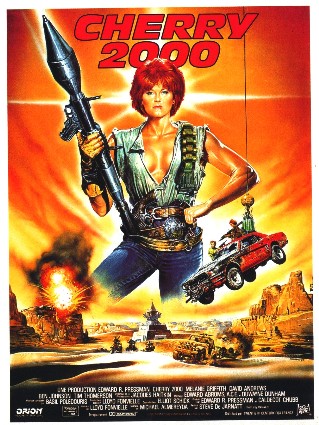
Remember how, a few nights ago, I watched and reviewed something called Prison Planet? No? Well, I don’t blame you. I wish I could forget about it too. Anyway, the movie that aired right before Prison Planet was yet another futuristic tale that was largely set in a desert wasteland. This movie was originally released in 1988 and the title was Cherry 2000.
Cherry 2000 takes place in 2017, or perhaps I should say that it takes place in 2017 as imagined by someone in 1988. In this film’s version of 2017, both the economy and the environment are a mess, America is divided into warring urban and rural zones, and all human emotion and creativity is being stifled by government bureaucracy. In short, Cherry 2000‘s version of 2017 is a lot like the real world’s version of 2017…
In the future, everyone’s still obsessed with getting laid but all of the bureaucratic red tape has made things difficult. Having sex now means first getting a lawyer to draw up a contract. In order to avoid all of the legal complications, men are now marrying specially designed sex robots. Again, this probably seemed way out there in 1988 but, in the current world, it just looks like my twitter timeline.
(Do they have sex robots for women in the world of Cherry 2000? As far as I could tell, all of the sex robots in the film were designed for men’s pleasure, which doesn’t seem quite fair.)
Anyway, Sam Treadwell (David Andrews) is a business executive who thinks that he is deeply in love with his robot wife, Cherry 2000 (Pamela Gidley). However, a mix of sex and a broken washing machine causes Cherry to short-circuit. When Sam tries to get her repaired, he’s told that it’s a lost cause. Cherry is beyond repair. Add to that, apparently the Cherry 2000 model is no longer being manufactured. If Sam wants a new Cherry, he’s going to have to go into Zone 7 and get one out of an abandoned factory.
So, of course, that’s what Sam does. The only problem is that Sam is a business guy and Zone 7 is the most dangerous place in the world. Why is it so dangerous? Because it’s ruled by a warlord named …. Lester. (No offense meant to anyone named Lester but that’s not exactly the most intimidating name in the world.) Lester is played by B-movie mainstay Tim Thomerson, who appears to be having fun whenever he appears on-screen.
To help guide him through Zone 7, Sam hires E (Melanie Griffith). E is the film’s saving grace, largely because she kicks everyone’s ass. The great thing about E is that, from the minute she first appears, she makes no secret of the fact that she finds Sam and his sex robot to be just as pathetic and ridiculous as we do. Griffith plays the role with just the right mix of humor and annoyance. If I ever have to guide anyone through a desert wasteland to a sex robot factory, I hope that I can do it with half as much style and panache as E.
Anyway, Cherry 2000 is a weird little mix of the western and science fiction genres. For a film about sex robots, it actually has a rather goofy and almost innocent feel to it. It’s a film that raises a lot of issues but which is also smart enough not to spend too much time on any of them. Director Steve De Jarnatt also directed one of my favorite 80s movies, the charming apocalyptic love story Miracle Mile. Cherry 2000 may be a mess but it’s definitely a watchable mess.



 Through the Shattered Lens