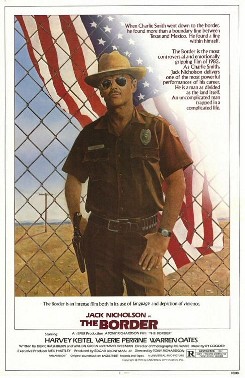
The Border (1982, directed by Tony Richardson)


Charlie Smith (Jack Nicholson) gets a job with the Texas border patrol and goes from scrounging in a California trailer park to living the high life in a duplex in El Paso.  His wife (Valerie Perrine) is looking forward to spending all the money that he’ll be making as a border agent.  But then Charlie discovers that his bigoted superior (Warren Oates!) and his partner (Harvey Keitel) are running a human smuggling ring.  When the baby of a young Mexican woman (Elpidia Carrillo) is kidnapped and sold to an illegal adoption ring, Charlie is finally forced to take a stand.

The Border seems to be one of Jack Nicholson’s forgotten films and it really can’t compete with some of the other movies that Nicholson was making around the same time.  Compared to films like The Shining, Terms of Endearment, and The Postman Always Rings Twice, The Border really does feel and look like a poorly paced made-for-TV movie.  British director Tony Richardson doesn’t really seem to know what type of movie he wanted The Border to be or what he wanted to say about immigration.  This is the type neo-Western that Sam Peckinpah could have worked wonders with but Tony Richardson just doesn’t seem to have any feel for the material.

Still, Jack Nicholson is pretty good here, playing the type of weary character that he specialized in during the pre-Batman portion of his career.  I especially liked the scenes that he shared with Valerie Perrine, who gave a good performance as someone who viewed buying a waterbed as being the height of luxury.  Harvey Keitel’s performance sometimes felt too familiar.  He’s played a lot of similar villains but he and Nicholson act well together.

And finally, Warren Oates in this movie, bringing his rough-hewn authenticity to his role.  This was the last of Oates’s films to be released before his premature death.  Blue Thunder and Tough Enough were both released posthumously.  Warren Oates is an actor who was only 52 when he died.  Whenever I see him onscreen, I think of all the great performances he would have given if he had only made it through the 90s.

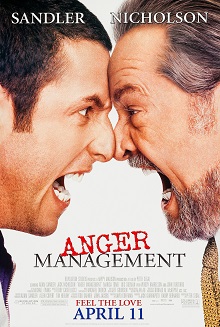
Anger Management (2003, directed by Peter Segal)


Dave (Adam Sandler), a timid man who has never gotten over being humiliated when he was a teenager, is sentenced to anger management after a slight argument on a plane is blown out of proportion by a taser-wielding shy marshal.  His therapist is Dr. Buddy Rydell (Jack Nicholson), whose techniques only seem to exacerbate Dave’s growing anger.  Among Dr. Rydell’s methods are giving Dave an unstable “anger buddy” named Chuck (John Turturro), ordering Dave to get revenge on the guy (John C. Reilly) who humiliated on his as a teenager, and also encouraging Dave to cheat on his girlfriend Linda (Maria Tomei) with a woman (Heather Graham) that they meet at bar.  Dave goes from timid to angry, Dr. Rydell starts dating Linda, and the whole thing is wrapped up with a totally implausible ending.

The idea of the star of Chinatown and Five Easy Pieces co-starring in an Adam Sandler comedy sounds like it should be exhibit #1 when it comes to talking about the decline of American cinema but I’ve always liked Anger Management.  Casting Jack Nicholson as the seemingly insane Dr. Rydell was an inspired choice and Nicholson gives a real performance in the film as opposed to just coasting on his already-established persona.  Anger Management came out a year after Adam Sandler’s first dramatic film, Punch-Drunk Love, and, even though Anger Management is a raunchy comedy from the start to finish, Sandler’s performance actually finds the reality in Dave’s situation.  Sandler plays Dave as being someone who is sincerely trying his best to get through his court-mandated anger management without losing control.  Nicholson and Sandler make for a surprisingly good team.

Of course, it’s an Adam Sandler comedy so it’s not for everyone.  The humor is often crude and the film’s final twist is so ridiculous that it can actually leave you feeling like you might need anger management.  But Anger Management does show how Jack Nicholson improves anything that he’s involved with and it also shows that Adam Sandler can act when he feels like it.  Anger Management also gave us the meme of Jack Nicholson nodding his approval, meaning the film and the performance will live forever.

Film Review: Carnal Knowledge (dir by Mike Nichols)


First released in 1971, Carnal Knowledge is the story of two friends, Jonathan (Jack Nicholson) and Sandy (Art Garfunkel).

Jonathan and Sandy meet in the late 40s, when they’re both assigned to be roommates at Amherst College.  They’re both smart, handsome, and obviously from well-off families.  They both believe that they have a wonderful future ahead of them and why shouldn’t they?  World War II is over.  America is the leader of the world and Jonathan and Sandy both appear to be future leaders of America.  Sandy is shy and sensitive.  When he meets Susan (Candice Bergen), he struggles to talk to her and when they date, he doesn’t know how far he should go with her.  (When he tells Jonathan about getting a hand job from her, it’s obvious that Sandy didn’t previously realize such a thing was possible.)  Jonathan, on the other hand, is confident and aggressive.  He can be a braggart and he can be insensitive but there’s something undeniably attractive about someone who knows what he wants and is determined to get it.  Soon, Susan finds herself torn between the two roommates, though Sandy is clueless that Jonathan is even interested in her.

Carnal Knowledge is divided into three separate parts, each taking place in a different decade and each shot in its own individual style.  (The film was written by playwright Jules Feiffer and the script does very much feel like a three-act play.)  As a character, Susan disappears after the first act but her relationship with Jonathan and Sandy haunts every bit of the second and third acts.  By the end of the film, Sandy is no longer sensitive and Jonathan is no longer virile and one can’t help but feel that Susan, wherever she may be, is definitely better off without either one of them.

The second act is dominated by Jonathan’s relationship with Bobbie, played by Ann-Margaret.  Bobbie is beautiful and heart-breakingly insecure.  Her relationship with Jonathan starts with a dash of romance and then quickly becomes a trap for both of them.  Jonathan is not ready (or mature enough) to settle down.  Bobbie is desperate for him to marry her and willing to go to extremes to make that happen.  The scenes where Jonathan and Bobbie fight are some of the most powerful in the film, with both Nicholson and Ann-Margaret giving the viewer raw and honest portrayals of two insecure people who are totally wrong for each other but also incapable of getting away from each other.

By the time the third act comes around, Jonathan has been reduced to paranoid ruminations about “ball-breakers” and can only get it up when he’s feeling like he’s the one in power.  (Rita Moreno has a cameo as a very patient prostitute.)  Meanwhile, middle-aged Sandy is dating an 18 year-old (Carol Kane) and clearly trying to live the free-spirited youth that he never had.  Who is more pathetic?  Jonathan, who bitterly realizes he’s never going to be young again, or Sandy, who is trying to deny the fact that he’s getting older?

Carnal Knowledge is a dark film and indeed, it sometimes feels like it’s a bit too dark for its own good.  Even the worst people occasionally have a laugh.  The script is full of sharp lines and the characters are interesting, even if they are for the most part unlikable.  Still, there’s a staginess to the film’s narrative and director Mike Nichols never quite breaks free from it.  That said, I still highly recommend this film.  Not only is it a portrait of a culture-in-transition but it also features some wonderful performances, especially from Ann-Margaret and Jack Nicholson.  (In most ways, Jonathan is definitely worse than Sandy but we still have more sympathy for Jonathan because Jack Nicholson is a considerably better actor than Art Garfunkel.)  Ann-Margaret honestly portrays the heart-breaking insecurity that comes from being repeatedly told that you have nothing but your looks to offer.  Meanwhile, Nicholson throws himself into playing the charismatic but immature Jonathan.  We may not like Jonathan but we do, in the end, understand why he’s become the person that he has.  It takes a certain amount of courage to play a character like Jonathan and, in this film, Nicholson shows every bit of that courage.

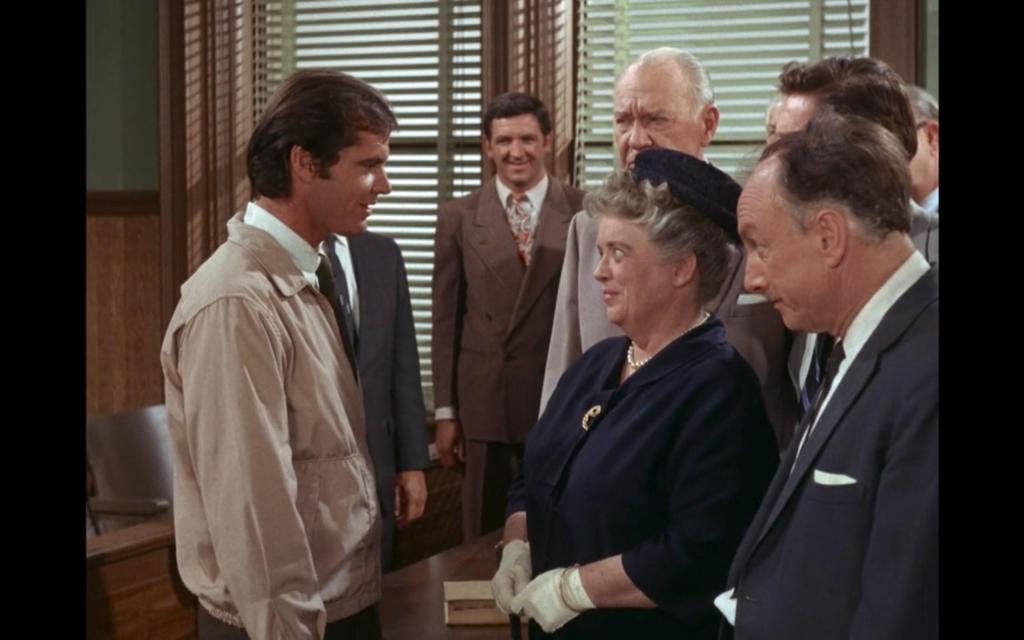
Jack Nicholson guest stars on THE ANDY GRIFFITH SHOW: Season 8, episode 7 – “Aunt Bee, the Juror” – originally aired on October 23rd, 1967!


Aunt Bee (Frances Bavier) serves on a jury where the case involves a man named Marvin Jenkins (Jack Nicholson) who’s been accused of stealing appliances from a department store in Mount Pilot, North Carolina. While the evidence against Mr. Jenkins appears to be overwhelming, Aunt Bee isn’t ready to convict him because he “seems like such a sweet man.” The rest of the jury is getting sick of her so they press her to explain why she doesn’t think he’s guilty. Her answer, “have you noticed his eyes, pure hazel! I just don’t feel like he did it.” The jury decides to take a break for the evening. The next day she brings brownies and wants to continue discussing the case. Needless to say, the remaining jury members aren’t happy as they are ready to be done. They’re quite rude to Aunt Bee and the case finally ends with a hung jury because Aunt Bee refuses to give in to their pressure. Marvin Jenkins, happy to be free, thanks Aunt Bee for believing in him. Meanwhile there’s a guy hanging around the court that seems way too interested in the outcome of the case, especially when Jenkins gets set free. Based on a couple of things he says, Andy (Andy Griffith) figures out that he’s the one who actually stole the items at the store, and it turns out that Aunt Bee was right the whole time. Even better, the episode ends with the judge writing a letter to Aunt Bee requesting her recipe for brownies! 

“Aunt Bee, the Juror” is the second of two episodes where Jack Nicholson appeared on The Andy Griffith Show. He first appeared in season 7, episode 10, “Opie Finds a Baby.” It’s a very short appearance where he shows up at the very end as the father of the found baby. In this episode, Nicholson again has a pretty small role as the man on trial. He answers some questions from the lawyers and Aunt Bee believes him even though no one else does. At the end he happily thanks Aunt Bee for thinking the best of him and not finding him guilty. Most of the episode focuses on Aunt Bee holding out for what she believes in. Based on his short appearance in this episode, it’s hard to believe that Nicholson was on the verge of superstardom. He had already filmed THE SHOOTING (1966), RIDE THE WHIRLWIND (1966), and HELL’S ANGELS ON WHEELS (1967), with EASY RIDER (1969) and FIVE EASY PIECES (1970) just a couple of years away. For me, it’s just fun to see an actor of his caliber on one of my favorite shows of all time.

Happy 88th Birthday, Mr. Nicholson. Thanks for a lifetime of wonderful performances! 

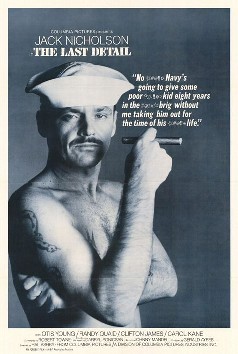
The Last Detail (1973, directed by Hal Ashby)


Billy “Badass” Buddusky (Jack Nicholson) and Richard Mulhall (Otis Young) are two Navy lifers stationed in Virginia.  On shore patrol, they’ve been assigned to transport a 18 year-old seaman to a Naval prison in Maine.  The kid has been dishonorably discharged and sentenced to eight years in the brig for trying to steal $40 from a charity box.  (The charity was a favorite of the wife of his commanding officer.)  Buddusky and Mulhall are expecting to find a hardened punk but instead, they end up escorting Larry Meadows (Randy Quaid), a timid teenager who suffers from kleptomania and who doesn’t seem to understand just how bad things are going to be for him for the rest of his life.  Not only is he going to do eight years in the brig, surrounded by hardened criminals, but his dishonorable discharge is going to follow him for the rest of his life.

Resenting having to take Meadows to prison and also feeling that he’s getting a raw deal, Buddusky and Mulhall decide to make a few stops on their way to Maine, so that Larry can enjoy what little time he has left and hopefully lose his virginity before being locked up.  In between brawling with Marines, visiting a brothel (where a young Carol Kane plays one of the prostitutes), and hanging out with a group of hippies (one of whom is played by Gilda Radner), Meadows comes to think of Buddusky and Mulhall as being his best friends.  Unfortunately, for Meadows, both Buddusky and Mulhall have their job to do.

Hal Ashby’s road picture is a character study of three men who are all lifers, even if they don’t realize that.  Both Buddusky and Mulhall hate the Navy but they also can’t relate to anyone who isn’t a member of the service.  Meadows’s entire future has been pre-determined because he tried to steal $40 but he doesn’t realize it until its too late.  When the film came out, it was controversial due to its “colorful” language.  In an interview, screenwriter Robert Towne defended the frequent profanity because, as he put it, when you’re in a situation you hate, “that’s what you do.  You bitch.”  Hal Ashby’s loose direction captures the road trip feel as the three leads reluctantly head to their ultimate destination.

The Last Detail features one of Jack Nicholson’s best performances.  Buddusky is cynical and doesn’t trust anyone other than Mulhall but even he knows that Larry Meadows deserves better than to spend eight years in the brig.  Along with lending his star power to the film and standing by director Hal Ashby when Ashby was arrested for marijuana possession, Nicholson also played a big role in the casting of Randy Quaid as Larry Meadows.  (The other final contender for the role was John Travolta but Nicholson insisted on Quaid).  The 6’5 Quaid towers of Nicholson and Young, making him look as if he could escape any time that he wants.  But Larry is so naive that he doesn’t want to make any trouble for his “friends.”  Though this wasn’t his first film, The Last Detail is the film that made Quaid one of the busiest character actors of the 70s and 80s and it also, at least temporarily, made him a part of the Jack Nicholson stock company.

Both sad and funny, The Last Detail is one of the best films of the 70s and features Jack Nicholson at his most unforgettable.

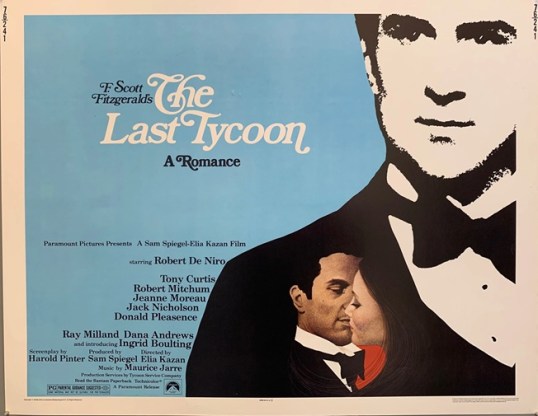
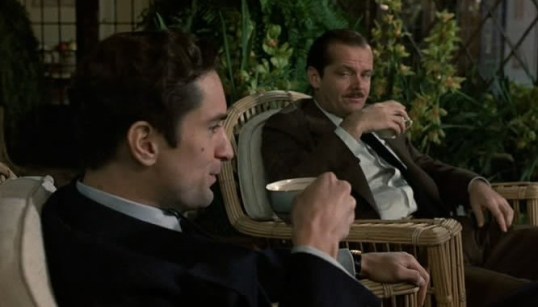
Icarus File No. 23: The Last Tycoon (dir by Elia Kazan)


Based on the final (and unfinished) novel by F. Scott Fitzgerald, 1976’s The Last Tycoon tells the story of Monroe Stahr (Robert De Niro).

Monroe Stahr is the head of production at a film studio during the early days of Hollywood.  Stahr is an unemotional and seemingly repressed man who only shows enthusiasm when he’s talking about movies.  He may not be able to deal with real people but he instinctively knows what they want to see on the big screen.  Stahr is a genius but he’s working himself to death, ignoring his health concerns while trying to create the perfect world through film.  He’s haunted by a lost love and when he meets Kathleen Moore (Ingrid Boulting, giving a remarkably dull performance), he tries to find love with her but, naturally, he doesn’t succeed.  Meanwhile, he has to deal with his boss (Robert Mitchum), his boss’s daughter (Theresa Russell), a neurotic screenwriter (Donald Pleasence), an impotent actor (Tony Curtis), and a lowdown dirty communist labor organizer (Jack Nicholson)!  Sadly, for Stahr, McCarthyism is still a few decades away.

There’s a lot of talented people in The Last Tycoon and it’s undeniably interesting to see old school stars — like Mitchum, Curtis, Dana Andrews, Ray Milland — acting opposite a Method-driven, 30-something Robert De Niro.  This is one of those films where even the minor roles are filled with name actors.  John Carradine plays a tour guide.  Jeff Corey plays a doctor.  This is a film about Golden Age Hollywood that is full of Golden Age survivors.  It’s a shame that most of them don’t get much to do.  The Last Tycoon is a very episodic film as Stahr goes from one crisis to another.  Characters show up and then just kind of disappear and we’re never quite sure how Stahr feels about any of them or how their existence really shapes Stahr’s worldview.  Robert De Niro may be a great actor but, as portrayed in this film, Monroe Stahr is a boring character and De Niro’s trademark tight-lipped intensity just makes Stahr seem like someone who doesn’t have much to offer beyond employment.  This is one of De Niro’s least interesting performances, mostly because he’s playing a not-particularly interesting person.  Mitchum, Pleasence, and the old guard all make an impression because they’re willing to coast by on their bigger-than-life personalities.  De Niro is trapped by the Method and a total lack of chemistry with co-star Ingrid Boulting.

Still, this is the only film to feature both De Niro and Jack Nicholson.  (The Departed was originally conceived as a chance to bring De Niro and Nicholson together, with De Niro being the original choice for the role eventually played by Martin Sheen.)  Nicholson’s role is small and he doesn’t show up until the film is nearly over.  He and De Niro have an intense table tennis match.  Nicholson doesn’t really dig deep into Brimmer’s character.  Instead, he flashes his grin and let’s the natural sarcasm of his voice carry the scene.  It’s nowhere close to being as emotionally satisfying as the De Niro/Pacino meeting in Heat.  That said, Jack Nicholson at least appears to be enjoying himself.  His natural charisma makes his role seem bigger than it actually is.

Why was The Last Tycoon such a disappointment?  Though unfinished, the book still featured some of Fitzgerald’s best work and there’s a huge amount of talent involved in this film.  The blame mostly falls on Elia Kazan, who came out of retirement to direct the film after original director Mike Nichols left the project.  (Nichols reportedly objected to casting De Niro as Stahr.  While it’s tempting to think that Nichols realized that De Niro’s intense style wouldn’t be right for the role, it actually appears that Nichols and De Niro sincerely disliked each other as Nichols also abandoned the next film he was hired to direct when he was told that De Niro wanted the lead role.  Nichols choice for Monroe Stahr was Dustin Hoffman, which actually would have worked.  If nothing else, it would have provided a Graduate reunion.)  Kazan later said that he did the film solely for the money and it’s obvious that he didn’t really care much about the film’s story.  The film has some good scenes but, overall, it feels disjointed and uneven.  Kazan doesn’t really seem to care about Monroe Stahr and, as a result, the entire film falls flat.

Previous Icarus Files:

  1. Cloud Atlas
  2. Maximum Overdrive
  3. Glass
  4. Captive State
  5. Mother!
  6. The Man Who Killed Don Quixote
  7. Last Days
  8. Plan 9 From Outer Space
  9. The Last Movie
  10. 88
  11. The Bonfire of the Vanities
  12. Birdemic
  13. Birdemic 2: The Resurrection 
  14. Last Exit To Brooklyn
  15. Glen or Glenda
  16. The Assassination of Trotsky
  17. Che!
  18. Brewster McCloud
  19. American Traitor: The Trial of Axis Sally
  20. Tough Guys Don’t Dance
  21. Reach Me
  22. Revolution

A Scene That I Love: Jack Nicholson Sings In Tommy


Today’s scene that I love comes from 1975’s Tommy.  Based on The Who’s rock opera and directed by Ken Russell, Tommy featured several actors who weren’t necessarily known as singers.  Oliver Reed is the most obvious example.

And then there’s Jack Nicholson!  Jack’s role is pretty small.  He’s the therapist who examines Tommy and who eye flirts with Ann-Margaret.  And, of course, he gets his check.

4 Shots From 4 Films: Special Jack Nicholson Edition


4 Shots From 4 Films is just what it says it is, 4 shots from 4 of our favorite films. As opposed to the reviews and recaps that we usually post, 4 Shots From 4 Films lets the visuals do the talking!

Today is Jack Nicholson’s 88th birthday!

Though he has pretty much retired from acting, Jack Nicholson remains a screen icon with a filmography that is a cinema lover’s dream.  He’s worked with everyone from Roger Corman to Stanley Kubrick to Milos Forman to Martin Scorsese and, along the way, he’s become a symbol of a very American-type of rebel.  Though often associated with the counter-culture, his style has always been too aggressive and idiosyncratic for him to be a believable hippie.  Instead, he’s one of the last of the beats, an outsider searching for meaning in Americana.

Over the course of his career, Nicholson has won three Oscars and been nominated for a total of 12.  He’s the only actor to have been nominated in every decade from the 1960s to the 2000s.  He is an actor who epitomizes an era in filmmaking, actually several eras.  It’s been 15 years since he last appeared in a movie but Jack Nicholson will never be forgotten.

4 Shots From 4 Jack Nicholson Films

Psych-Out (1968, dir by Richard Rush, DP: Laszlo Kovacs)

Carnal Knowledge (1971, dir by Mike Nichols, DP: Giuseppe Rotunno)

The Shining (1980, dir by Stanley Kubrick, DP: John Alcott)

The Departed (2006, dir by Martin Scorsese, DP: Michael Ballhaus)

Scenes That I Love: Philip Stone In The Shining


The Shining (1980, dir by Stanley Kubrick)

Today would have been the 101st birthday of character actor Philip Stone.  While Stone appeared in a lot of films, he’ll probably always be best-remembered for his subtly menacing turn as the ghostly Grady in 1980’s The Shining.  Here he is, having a conversation with Jack Torrance (Jack Nicholson) and letting him know that he’s always been caretaker.

(Fair warning to those who may not have seen this scene before or who perhaps have forgotten about it, Grady does use a racial slur at one point.  It’s a moment that’s true to his villainous character, even if it’s a bit jarring to hear today.)