David Hall (Matthew Faison) is an obnoxious horror writer who invites a group of associates and former friends to spend the night at a “haunted” hotel. He’s invited them because all of them are on the verge of suing him for writing about them in his latest book, The Resort. Over the course of the night, he plays cruel practical jokes on all of them. Finally, someone gets fed up and tosses him over a railing. The police arrest publisher Jordan White (Robert Stack) and charge him with the murder. It’s a good thing that Jordan’s best friend is Perry Mason (Raymond Burr).
Perry uses a cane in this movie and is not that active outside of the courtroom. That means that it’s up to Paul Drake, Jr. (William Katt) to do most of the investigating. As usual, Paul falls for an attractive, younger woman, in this case the hotel’s owner, Susan Warrenfield (Kim Delaney). Every movie features Paul falling for someone and then we never hear about them again. Does Paul have commitment issues?
I enjoyed this Perry Mason mystery. The hotel was a great location and I appreciated that the movie tried to add some horror elements to the story. The Perry Mason movies can be predictable so I always like it when they at least try to do something a little bit different. This was a fun entry in Perry Mason’s career.
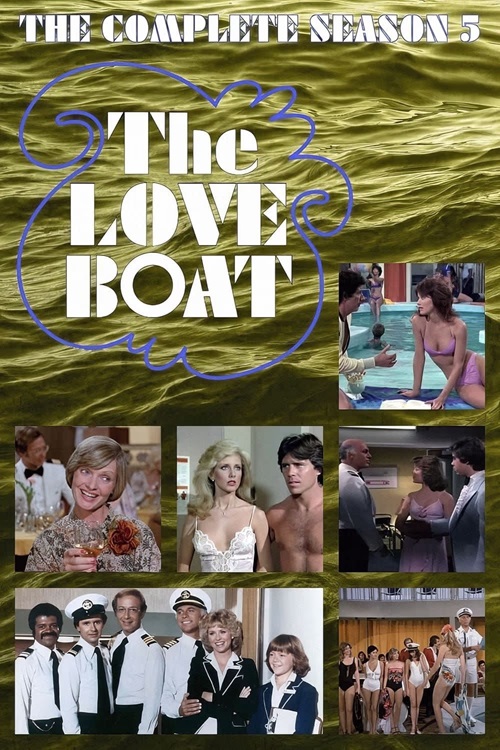
Welcome to Retro Television Reviews, a feature where we review some of our favorite and least favorite shows of the past! On Wednesdays, I will be reviewing the original Love Boat, which aired on ABC from 1977 to 1986! The series can be streamed on Paramount Plus!
The Love Boat is back for a new year of reviews!
Episode 5.11 “He’s My Brother/Zeke and Zelda/Teach Me Tonight”
(Dir by Bruce Bilson, originally aired on December 5th, 1981)
This week, Doc Bricker’s brother boards the Love Boat and boy, does he turn out to be a jerk! Fred Bricker (Jack Bannon) is bitter because their father paid for Doc to go to medical school while Fred had to stay behind on the farm. Now, Fred is married to Nancy (Elaine Joyce) and worried about how he’s going to afford to send his own son to college. Convinced that Doc is rich, Fred thinks that Doc should pay for his nephew’s college tuition. Doc agrees. Fred still acts like an ungrateful jackass but, when he learns that Doc has actually taken out a loan to pay the tuition, Fred realizes that Doc may not be rich but he is a good man.
The weird thing about this storyline is that Fred didn’t have enough money to send his kid to college but apparently, he did have enough money to take an expensive cruise on a luxury liner. The other strange thing is that Fred didn’t know that Doc worked on the ship until he saw him in the lobby. Fred just happened to buy a ticket for the same ship that his brother worked on. Every episode of The Love Boat featured its share of implausible coincidences but this episode really pushes suspension of disbelief to its breaking point. On a positive note, this story did allow us to see another side of Doc. Bernie Kopell is always more believable when he gets to play Doc as being a nice guy as opposed to playing him as being an irredeemable lech.
Speaking of money, two old vaudevillians (played by Milton Berle and Martha Raye) haven’t had much of it ever since their style of performing went out of fashion. Berle and Raye stowaway on the ship and then attempt to freeload their way through the cruise by pretending to be another set of passengers, Zeke and Zelda Van Buren (played by Herb Edelman and Elinor Donahue). The captain is not amused when he finds out that someone is breaking the law on his boat but then Milton and Martha sing a duet of For Me And My Gal and all is forgiven. The Captain arranges for them to get a job as entertainers on another ship. I’ve noticed that the Captain never really seems to punish any of the many stowaways who have taken a trip on The Love Boat. And you know what? Good for him! There’s a place for mercy in this cold world of ours.
Finally, romance novelist Michael Scott (Daryl Anderson) has a one night stand with teacher Emily Parker (Susan Richardson). Michael — and yes, it’s impossible not to think of The Office whenever anyone mentions the character’s name — is stunned when Emily gets emotional after their night together. “You’re acting like you’ve never done this before….” Michael says and, of course, it turns out that she hasn’t. This was a pretty bleh storyline but it did lead to a funny scene where Michael attempts to have a conversation with Emily while two old ladies eavesdrop and freak out every time they hear the word “virgin.”
I enjoyed this cruise, mostly because it gave Bernie Kopell a chance to actually do some real acting for once. I always like it when Doc turns out to be a nice guy. Milton Berle and Martha Raye are, to put it lightly, an acquired taste but both of them give good performances in this episode and even manage to pull off their duet without making it too cringey. As for the third storyline, it was defeated by the lack of chemistry between Daryl Anderson and Susan Richardson. Still, two out of three is not bad.
Welcome to Retro Television Reviews, a feature where we review some of our favorite and least favorite shows of the past! On Fridays, I will be reviewing St. Elsewhere, a medical show which ran on NBC from 1982 to 1988. The show can be found on Hulu!
This week’s episode made me cry.
Episode 1.4 “Cora and Arnie”
(Dir by Mark Tinker, originally aired on November 23rd, 1982)
While orderly Luther (Eric Laneuville) practices his karate moves in the hallway and anesthesiologist Vijay (Kavi Raz) composes a letter to his family in India and Dr. Fiscus continues his sex-only relationship with Kathy Martin, four patients learn about life and death at St. Eligius.
One of them is an unnamed man (Lionel Mark Smith) who comes in with a complaint of backpain. Fiscus examines him and discovers that the man has been shot in the back. The man announces that he’s on parole and he doesn’t feel like going back to prison. Fiscus offers to admit him under an assumed name but the man says he already gave his real name to the front desk. The man tries to leave the hospital but collapses from pain and blood loss. Later, when the man wakes up, Fiscus tells him that the bullet has been removed and he’ll be fine. The man says he won’t be fine because he’s going to go back to prison as soon as he leaves the hospital.
Meanwhile, Kathleen McAllister, who has been in a coma ever since Andrew Reinhardt set off a bomb at a bank, finally dies. Reinhardt, when he’s informed of the news, sneers. He doesn’t care that she died. He’s all about the class struggle. (If this show was made today, he’d have thousands of followers on Bluesky.) When Dr. Beale tries to examine him to determine if he’s mentally ill, Reinhardt spits in his face. Reinhardt is convinced that nothing will ever happen to him but, after Kathleen dies, he’s informed that he’s being taken to prison. As Reinhardt is rolled out of his hospital room, Kathleen’s husband (Jack Bannon) appears in the hallway and shoots him dead.
George (Bernard Behrens) and Lillian Rogers (Anne Gerety) are tourists who are visiting Boston. When Lillian faints in her hotel room, George rushes her to the hospital. Lillian says she’s feeling fine but she still goes through a series of tests to determine why she fainted. In the end, the tests are inconclusive. No one can figure out why she fainted so she’s told to just see her family doctor when she returns home. When George and Lillian check out of the hospital, they are presented with the bill for all the tests. George freaks out when he sees that he’s being charged …. $1,380.90!
Now, admittedly, that is $1,380.90 in 1982 money. If George received the same bill today, it would be for $4,517.10. Still, considering all the tests that Lillian had done, that seems remarkable cheap, even by today’s standards. My father died in August and the majority of his medical costs were covered by insurance but his estate is still receiving bills from various hospitals, specialists, and ambulance services. I’ve been told that the same thing happened when my mom passed away in 2008. (Personally, I think if someone dies while in your care, you’ve forfeited your right to be paid.) By today’s standards, having to pay less that $5,000 feels like a bargain!
Finally, and most heart-breakingly, Dr. Morrison takes care of a homeless woman named Cora (Doris Roberts), who comes into the hospital with her companion, Arnie (James Coco). Due to a head injury, Arnie is almost childlike. While Cora learns that a case of gangrene is going to kill her unless she gets her foot amputated, Arnie repeatedly asks, “Can we go now?” In the end, Cora chooses not to have the surgery, leaving the hospital with Arnie. As she explains to Dr. Morrison, someone has to take care of Arnie and she can’t do that with just one foot. When Morrison tells Cora that she’s probably going to die in a year, Cora shrugs and says it won’t be any great loss.
OH MY GOD! Seriously, I was in tears at the end of this episode. The Cora and Arnie story had the potential to be a bit too schmaltzy for its own but Doris Roberts and James Coco both gave such incredibly moving performances that I couldn’t help but get emotionally involved in their plight. And I understood why Cora made the decision that she did. Having been rejected by both her family and society, Cora knew that there wouldn’t be anyone around to take care of her after the operation. So, she decided to accept things the way that they were and spend her last year with the one person who didn’t judge her, Arnie. (I’m getting teary-eyed just writing about it.) Playing out against all the other petty dramas going on at the hospital, this storyline was emotionally devastating.
This was a powerful episode. Watching it, I understood why St. Elsewhere is so often described as being one of the best medical shows of all time.
Welcome to Retro Television Reviews, a feature where we review some of our favorite and least favorite shows of the past! On Fridays, I will be reviewing St. Elsewhere, a medical show which ran on NBC from 1982 to 1988. The show can be found on Hulu!
This week, we get to know a very bad doctor.
Episode 1.3 “Down’s Syndrome”
(Dir by Mark Tinker, originally aired on November 16th, 1982)
St. Eligius is home to several doctors, some of whom are good at their job and some of whom are really, really bad.
One of the bad ones appears to be Dr. Peter White (Terrence Knox), a resident who was in the background during the previous two episodes but who was at the center for a good deal of this episode. Peter has a terrible bedside manner, absolutely no social skills, and his knowledge of medicine appears to be subpar at best. When a homeless man comes in and complains of pain, Peter gives him a dose of potassium that nearly kills him. (Only the quick thinking of Dr. Ehrlich — who himself hardly appears to be the perfect doctor — keeps the patient alive.) Dr. White seems to be overwhelmed and it certainly doesn’t help that his wife is constantly calling the hospital and demanding to speak to him about every little thing. That said, it’s hard to have much sympathy for Dr. White. Yes, he’s overwhelmed but his mistakes nearly kill a man.
I have to admit that, as I watched Dr. Peter White on this week’s episode, I kept thinking about some of the doctors who treated my father after he had his car accident in May. Whenever I spoke to them, they would brusquely answer my questions, usually in technical language that reflected that it had been a long time since they talked anyone who hadn’t gone to medical school. At the time, I made the same excuses for them that I just made for Dr. White. They were young, they were busy, and they were overwhelmed. After my father died, though, I stopped making excuses for them and I instead just accepted that they weren’t very good at their job. And perhaps Dr. White should admit the same.
It doesn’t help that Dr. White is contrasted with Dr. Auschlander, a kind and elderly liver specialist who is battling cancer but who still manages to treat all of his patients with kindness and respect. The episode made it clear that all of the residents should hope to become a doctor like Dr. Auschlander. While Peter snaps at his patients and nearly kills a man, Auschlander takes the time to play cards with a woman who is dying. We should all be so lucky as to have an Auschlander in our life.
Finally, Brian Whitehill (Tony Bill) and his pregnant wife, Denise (Maureen Whitehill) are informed that their baby will be born with Down’s Syndrome. In a scene that brings to mind Icelandic eugenics, Brian suggests that Denise get an abortion but Denise refuses, especially when she learns that she’s going to have a son. (She already has two daughters.) A day later, Brian comes home from work and tells Denise that he’s realized that she’s right and he’s prepared to be the father of a special needs child. Denise replies that she had the abortion earlier in the day. Seriously, what a depressing story! That said, I respected what the show was doing here. The patients are just as important as the doctors.
(And while Denise is getting an abortion, Dr. Morrison is learning that he’s going to be a father and, in contrast to Brian Whitehill, joyfully cheering in the hospital stairwell.)
As with the previous episode, there was a lot going on in the background. Dr. Beale attempted to analyze terrorist Andrew Reinhardt (Tim Robbins), who is still basically acting like an arrogant prick. Kathleen McAllister, the victim of Reinhardt’s attack, is still in a coma. Dr. Westphall gave a tour of the hospital to two community leaders who both suggested that St. Eligius should shut down and move its operations to a wealthier neighborhood. Dr. Fiscus got a blow job in an elevator from Kathy Martin. (“Going down?” Fiscus asked the next guy who got on the elevator.) It was a busy day at the hospital! It was a good episode, even if it didn’t really have any of the big wow moments that the previous two episodes featured. This episode was more about following a few days in the life of a hospital and the emphasis was on the nonstop flow of patients and doctors, some of whom were doing their best and some of whom were on the verge of giving up. In the end, the main thing I took away from this episode was that there may not be enough Aucschlanders to make up for all the Peter Whites.
Welcome to Retro Television Reviews, a new feature where we review some of our favorite and least favorite shows of the past! On Fridays, I will be reviewing St. Elsewhere, a medical show which ran on NBC from 1982 to 1988. The show can be found on Hulu!
This week, William Daniels claims the show as his own.
Episode 1.2 “Bypass”
(Dir by Thomas Carter, originally aired on November 9th, 1982)
“Hey, it’s Tim Robbins!”
Yes, the future Oscar winner shows up in the second episode of St. Elsewhere, playing a rich kid-turned-terrorist named Andrew Reinhardt. Reinhardt, who no doubt learned all about Marxism during his first semester away at college, set off a bomb in a bank, killing two people and putting a woman named Kathleen McCallister into a coma. Both Reihnhardt and McCallister have been brought to St. Eligius. While Kathleen’s husband, Stephen (Jack Bannon), sobs in the hallway, Reinhardt acts like a petulant brat in his hospital room.
With the nurses refusing to change his sheets or even give him his morphine shots, it falls to Dr. Morrison to take care of him. Reinhardt is not at all appreciative and Morrison finds himself conflicted. How is he supposed to give proper medical treatment to someone who he despises? Morrison is so conflicted that he even goes to Dr. Westphall. Westphall responds by telling a long story about a time that he fell in love with a patient. I’m getting the feeling that Morrison feeling conflicted and Westphall telling long stories are both going to be regular features on this show.
(The correct answer to Morrison’s question about how he can take care of a bad person is as follows: It’s your job and you’re getting paid to do it.)
This episode also gave the viewer a chance to get to know Dr. Craig, the very talented but very egotistical head of surgery who is played by the great William Daniels. Dr. Craig holds a press conference to inform reporters about the conditions of both Reinhardt and Kathleen McCallister and declares that, despite its bad reputation, “St. Eligius is the place to be!” He then proceeds to get angry when the press is more interested in talking to the surgeon who actually saved Kathleen’s life than to him.
Dr. Craig browbeats a Mr. Broadwater (Robert Costanzo) into getting bypass surgery done. The surgery appears to have been a success but it’s hard to ignore that Craig essentially bullied the guy into getting a major operation, one that could have killed him if the least little thing had gone wrong. Resident Victor Ehrlich (Ed Begley, Jr.) assists in the operation and, at one point, Dr. Craig intentionally head butts him when Ehrlich cannot name all of the arteries leading into the heart. It’s a bit aggressive but, on the plus side, Ehrlich does learn all of the names. Afterwards, Dr. Craig brags about how his own son is following in his footsteps and tells Mr. Broadwater’s son that some day, a new Dr. Craig will operate on him. In other words, Dr. Craig is kind of a jerk but he’s good at what he does and he’s played by William Daniels so it’s hard to hold anything against him.
There were other subplots playing out in the background, the majority of which just seemed to be there to remind us that St. Elsewhere is an ensemble show and that, just because someone isn’t a major character in this episode, that doesn’t mean they won’t be important later on. Psychiatrist Hugh Beale (G.W. Bailey) attempted to learn how to swim and ended up taking a class with a bunch of children. Dr. Fiscus (Howie Mandel, the least convincing doctor ever) held court in the cafeteria and claimed that the hormones used in processing food were causing children to develop earlier than ever before. Dr. Peter White (Terrence Knox) wandered around with a bunch of X-rays and begged everyone he met to help him understand what he was (or wasn’t) seeing. If nothing else, this episode did a good job of capturing the idea of the hospital as being a place that’s always busy.
For the most part, though, it was Dr. Craig who carried this episode. While Morrison and Westphall ponderously considered the implications of doing their jobs, Craig was an arrogant, angry, and brilliant dynamo and William Daniels’s high-energy performance was a pleasure to watch. Whenever the episode started to slow down, Dr. Craig would liven things up by yelling at someone. The hospital was lucky to have Dr. Craig and St. Elsewhere was lucky to have William Daniels.
The 2014 film, The Imitation Game, takes place in three very different time periods.
The majority of the film takes place during World War II. While the Germans are ruthlessly rolling across and conquering huge swaths of Europe, the British are desperately trying to, at the very least, slow them down. A key to that is decrypting the secret codes that the German forces use to communicate with each other. Since the Germans change the code every day, the British not only have to break the code but also predict what the next day’s code will be.
Working out of a 19th century mansion called Bletchley Park, a small group of mathematicians, chess players, and spies work to design a machine that will be able to decode the German messages. Heading up this group is a man named Alan Turing (Benedict Cumberbatch). Alan is a remote and, at times, rather abrasive figure, a man who appears to be more comfortable dealing with equations than with other human beings. The people working under him occasionally chafe at Alan’s lack of social skills. Commander Denniston (Charles Dance) suspects that Alan’s a Russian spy and would just as soon close down the entire operation. At first, the only person who seems to have any faith in Alan’s abilities appears to be Winston Churchill himself.
It’s only when Joan Clarke (Kiera Knightley) joins Alan’s team that they start to make progress. Joan brings Alan out of his shell and teaches him how to deal with other human beings. When Joan’s parents object to her being away from home, Alan even offers to marry her. Of course, Alan also explains that it would just be a marriage of convenience, one that will last until they get Christopher up and working.
Christopher is the name that Alan has given to his encryption machine. Why Christopher? Throughout the film, we get flashbacks to Alan’s time in boarding school and his close friendship to another student, a boy named Christopher.
And finally, serving as a framing device to both the World War II intrigue and Alan’s relationship with Christopher, is a scene that’s set in 1951. Alan’s home has been broken into and, as the police investigate the matter, they come to realize that Alan is hiding something about both his past and his present. Their initial assumption is that Alan must be a communist spy. The truth, however, is that Alan is gay. And, in 1951 Britain, that is a criminal offense….
The Imitation Game is based on a true story. During World War II, Alan Turing actually was a codebreaker and he did play a pivotal role in creating the machine that broke the German code. After World War II, Turing was arrested and charged with “gross indecency.” Given a choice between imprisonment or probation and chemical castration. Turing selected the latter and committed suicide in 1954. Alan Turing’s work as a cryptographer is estimated to have saved 14 million lives during World War II but he died a lonely and obscure figure, a victim of legally sanctioned prejudice.
Admittedly, The Imitation Game does take some liberties with history. For one thing, most of the people who worked with Turing described him as being eccentric but not anti-social. Though the film pretty much portrays the decoding machine as solely being Turing’s creation, it was actually a group effort. Perhaps the biggest liberty that the film takes is that the machine was never called Christopher. Instead, it was called Victory.
That said, The Imitation Game is still a strong and effective film. Anchored by a brilliant lead performance from Benedict Cumberbatch, The Imitation Game is a film that manages to be both inspiring and infuriating at the same time. It’s impossible not to get caught up in the team’s joy as they realize that they actually can beat the Germans at their own encryption game and, after spending 90 minutes listening to everyone doubt Alan’s abilities, you’re more than ready to see him and his unorthodox methods vindicated. And yet, because of the film’s framing device, you already know that Alan is not going to get the credit that he deserves for his hard work. Instead, he’s going to be destroyed by the laws of the very country that he worked so hard to save. Success and tragedy walk hand-in-hand throughout The Imitation Game and the end result is a very powerful and very sad movie.
I have to admit that it was a bit jarring when the opening credits appeared onscreen and the first words that I read were “The Weinstein Company Presents.” It’s only been a year and a half since Harvey Weinstein was finally exposed and forced out of power but it’s still easy to forget just how much the Wienstein Company used to dominate every Oscar season. In many ways, with its historical setting and its cast of up-and-coming Brits, The Imitation Game feels like a typical Weinstein Company Oscar contender. In this case, The Imitation Game was nominated for a total of 8 Oscars, including Best Actor for Benedict Cumberbatch, Best Supporting Actress for Keira Knightley, Best Director for Morten Tyldum, Best Adapted Screenplay for Graham Moore, and Best Picture. In the end, only Moore won his category. In a decision that continues to confound me, the Academy named Birdman the best film of the year.
Much like Thriller, Night Gallery is an old horror anthology series that I’ve recently discovered thanks to reruns on Me-TV. Airing in the early 70s and hosted by Twilight Zone‘s Rod Serling, Night Gallery usually featured two or three stories per episode and even provided a few early credits for director Steven Spielberg.
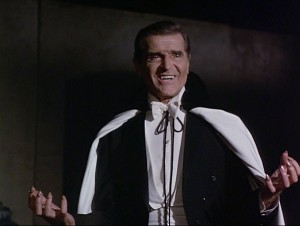
Of course, Spielberg didn’t direct the episode below but that’s okay. It’s still pretty good. It tells two stories. In A Question of Fear, Leslie Nielsen plays a mercenary who takes a bet to spend the night in a haunted house. In The Devil Is Not Mocked, Dracula talks about how he fought the Nazis during World War II. Interestingly enough, Dracula is played by Francis Lederer who, 13 years later, played the same role in The Return of Dracula.
The episode of Night Gallery was originally broadcast on October 27th, 1971.


 Through the Shattered Lens