Retro Television Review: The Love Boat 6.11 “The Tomorrow Lady/Father, Dear Father/Still Life”


Welcome to Retro Television Reviews, a feature where we review some of our favorite and least favorite shows of the past!  On Wednesdays, I will be reviewing the original Love Boat, which aired on ABC from 1977 to 1986!  The series can be streamed on Paramount Plus!
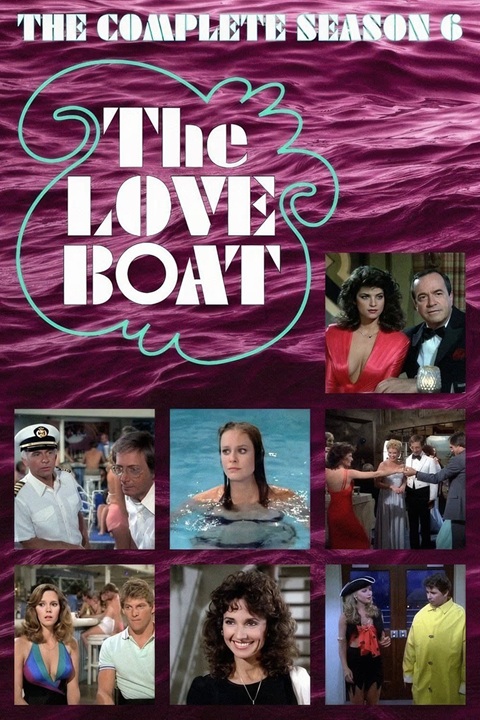
This week, a man tells a terrible lie, Greer Garson can see the future, and Isaac is losing his hearing!  Come aboard, we’re expecting you….

Episode 6.11 “The Tomorrow Lady/Father, Dear Father/Still Life”

(Dir by Richard A. Wells, originally aired on December 4th, 1992)

This episode of The Love Boat features one of the worst stories ever.  Ken Miller (Lawrence Pressman) wants to date Sarah Curtis (Kim Darby).  However, Sarah is on the cruise as a member of the Single Parents Group and, when Sarah first sees Ken, she assumes that Ken is a single father because he’s standing with Libby McDonald (played by the one-named Louanne), who is the daughter of Ken’s friend, Tom (Jim Stafford).  So, Ken just decides to lie about being a father.

Eventually, Sarah finds out.  When she notices that Libby is spending all of her time with Tom, the gig is up.  Sarah, however, FORGIVES Ken and accepts his marriage proposal!  (“Looks like I won’t be a member of Single Parents anymore….”)  Lady, he lied to you about having a daughter!  He recruited a little girl to pretend to be his daughter!  THIS IS NOT THE WAY TO START A MARRIAGE!

The other two stories were better.  One featured Greer Garson (in her final screen performance before retiring) as a woman who was a self-described “good guesser.”  She met a struggling businessman (Howard Duff) who wanted to use her power to play the stock market but eventually, he fell in love with her for her and not her powers.  Howard Duff’s character was not particularly likable but Greer Garson seemed to be having fun.

The other story featured Isaac struggling with a double ear infection and fearing that he would permanently lose his hearing.  He didn’t, which is good considering that he’s the ship’s head bartender and he’s the guy who everyone comes to with their problems.  (It always amuses me how a passenger will just automatically start talking to Isaac as if they’re best friends when they’ve only been on the boat for a couple of hours.)  What made this story work, though, was the performance of Ted Lange.  He was so believably scared of losing his hearing that you just wanted someone to hug him and reassure him that it would all be okay.  When his hearing finally came back, I breathed a sigh of relief.  Obviously, playing Isaac was probably not the most challenging roll of Ted Lange’s career.  I mean, the man has played Othello!  Still, Lange gave a really good and honest performance in this episode.  He didn’t use the fact that he was acting on The Love Boat as an excuse to just coast.

This cruise …. it was kind of forgettable.  Still, at least Ted Lange got a chance to shine!
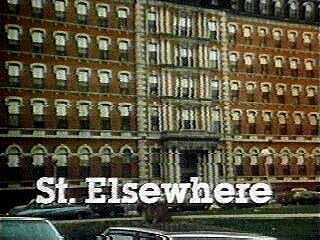
Retro Television Review: St. Elsewhere 1.22 “Addiction”


Welcome to Retro Television Reviews, a feature where we review some of our favorite and least favorite shows of the past! On Fridays, I will be reviewing St. Elsewhere, a medical show which ran on NBC from 1982 to 1988.  The show can be found on Hulu and, for purchase, on Prime!

This week, the first season comes to a close.

Episode 1.22 “Addiction”

(Dir by Mark Tinker, originally aired on May 3rd, 1983)

“To life,” Dr. Auschlander toasts towards the end of the finale of St. Elsewhere’s first season and the sentiment could not be more called for.

While Auschlander has spent the episode hanging out with a friend of his and getting into fights with disrespectful street punks, Dr. Morrison’s wife has been giving birth to their son.  While someone breaks into the supply room and takes off with a huge supply of drugs, Dr. White is sobbing and telling his estranged wife that he knows he has to get help for his addictions.  While one drug addict (Ralph Seymour) commits suicide by injecting an air bubble into his veins, Dr. Craig’s cocky son, Stephen (Scott Paulin), visits from medical school and turns out to be quite a weed-smoking, pill-popping drug user himself.  Ehrlich, assigned to show Stephen around the hospital and teach him what it’s like being a resident, considers telling Dr. Craig that his son has a drug problem but apparently decides not to.  Dr. Craig is very proud that his son is going to follow the family tradition of becoming a surgeon.  Meanwhile, Dr. Fiscus cheats on Shirley Daniels with Kathy Martin.  Fiscus, you idiot.

Life goes on at St. Eligius.  That’s was the theme of the finale and it’s also been the theme of the first season.  For all the bad things that happen, there are also good things.  Some patients die.  Some doctors are incompetent.  But babies are born and doctors like Morrison and Ehrlich and Chandler haven’t given up and are still trying to make the world a better place.  Dr. Auschlander may be terminally ill with cancer but he embraces life and we should all do the same.

It’s a good ending for an overall good first season.  There were a few weak episodes.  Dr. Samuels was a pretty annoying character and I’m a bit relieved to see that David Birney left the show after this season.  Ed Flanders can be a bit overly somber as Dr. Westphall and Howie Mandel is still one of the least convincing doctors that I’ve ever seen.  That said, Morrison, Ehrlich, Chandler, Nurse Daniels, and even Dr. White are interesting characters and I look forward to seeing what happens with them during season 2.  The season’s stand-out was definitely William Daniels as the pompous yet still likable Dr. Craig.  Other than the terrible storyline where he cheated on his wife (and I still claim that was a dream episode, like almost all of the stuff with Dr. Samuels), Dr. Craig was this season’s standout character.

Next week, we start season 2!

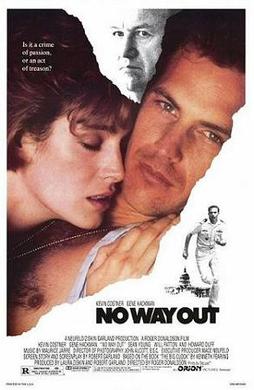
14 Days of Paranoia #7: No Way Out (dir by Roger Donaldson)


Trust no one in Washington would seem to be the message of this 1987 thriller.

Kevin Costner plays Lt. Commander Tom Farrell, a Naval Intelligence officer who is hailed as a hero after saving a shipmate who falls overboard.  In Washington, Tom is recruited by a friend from college, Scott Pritchard (Will Patton), to work for Secretary of Defense Brice (Gene Hackman).  Brice doesn’t trust the head of the CIA (played by future senator, Fred Dalton Thompson) and he wants Tom to serve as his mole within the service.  What Brice doesn’t know is that Tom is sleeping with Brice’s mistress, Susan Atwell (Sean Young).

Still, Brice does suspect that the woman with whom he is cheating is also cheating on him.  When he confronts her about it, their argument leads to him accidentally pushing Susan over an upstairs railing.  Pritchard, who is implied to be in love with Brice, takes charge of the cover-up and decides to push the story that Susan was killed by a possibly mythical Russian agent who is known only by the name “Yuri.”

Tom assists with the investigation of her death, both because he wants to know who killed Susan and also because he knows that there’s evidence in Susan’s apartment that could be manipulated to make him look guilty of the crime.  For instance, Susan took a picture of Tom shortly before her death.  The picture failed to develop but, through the use of what was undoubtedly cutting edge technology in 1987, Naval Intelligence is slowly unscrambling the picture.  For Tom, it’s a race against time to find the actual killer before the picture develops and he’s accused of both killing Susan and being Yuri.

Everyone has an agenda in No Way Out, from the ambitious Brice to the fanatical Scott Pritchard to the head of the CIA, who wants Brice to approve funding for a costly submarine.  Even the film’s nominal hero has an agenda, which has less to do with finding justice for Susan and everything to do with protecting himself and his future.  In fact, as is revealed in the film’s enjoyable if slightly implausible twist ending, some people in Washington have multiple agendas.  The film portrays Washington as being a place where, behind the stately facade, everyone is a liar and everyone is ultimately a pawn in someone else’s game.  If you have the right connections, you can even get away with murder.  Loyalty is rewarded until you’re no longer needed.

It’s an enjoyably twisty thriller, one that makes good use of the contrast between Kevin Costner’s All-American good looks and his somewhat shady screen presence.  The film introduces Costner as being a character who, at first glance, seems almost too good to be true and then spend the majority of its running time suggesting that is indeed the case.  Gene Hackman is well-cast as the weaselly cabinet secretary, as is Sean Young as the woman who links them all together.  In the end, though, the film is stolen by Will Patton, who plays Scott Pritchard as being someone who has unknowingly given his loyalty to a man who is incapable of returning it.  As played by Patton, Scott is an outsider who desperately wants to be an insider and who is willing to do just about anything to accomplish that goal.  He’s a version of Iago who never turned against Othello but instead devoted all of his devious tricks to trying to cover up the murder of Desdemona.

Even with an over-the-top final twist, No Way Out holds up well as a portrait of how the lust for power both drives and corrupts our political system.

14 Days of Paranoia:

  1. Fast Money (1996)
  2. Deep Throat II (1974)
  3. The Passover Plot (1976)
  4. The Believers (1987)
  5. Payback (1999)
  6. Lockdown 2025 (2021)

Retro Television Reviews: In Search of America (by Paul Bogart)


Welcome to Retro Television Reviews, a feature where we review some of our favorite and least favorite shows of the past!  On Sundays, I will be reviewing the made-for-television movies that used to be a primetime mainstay.  Today’s film is 1971’s In Search of America!  It  can be viewed on YouTube!

College student Mike Olson (young Jeff Bridges) returns home and informs his mother (Vera Miles) and his father (Carl Betz) and his annoyingly quirky grandmother (Ruth McDevitt) that he’s dropped out of college.  He apologizes for wasting all the money that they spent on tuition but hey, maybe he can make it up to them by taking them on a journey as he drives across America in an old bus.

Uhmmm….

Now, let me just repeat this so that there is no confusion.  This absolutely schmuck took his parents’ money, wasted it, dropped out of college, and now he expects everyone to travel with him across America because he’s decided that he’s a part of the counterculture.

And, instead of telling him to go to Hell and get a job, his family agrees.

Oh sure, Mom is a little bit hesitant about Mike’s idea.  But Dad is really enthusiastic.  He understands the kids and he wants a chance to relive his own youth, before he got tied down with things like paying bills and being a responsible human being.  And, of course, if the Hippies were famous for anything, it was their love of upper class, middle-aged people.  Just ask the LaBiancas.

And, of course, grandma is totally excited about it because she’s an old person in a made-for-TV movie.

So, they all board the bus and Mike takes them to a music festival so that they can meet some of his friends.  For instance, there’s Nick (Sal Mineo), a drop-out who says that he’s more burned out than turned on.  There’s Annie (Tyne Daly), who is going to need someone to help deliver her baby.  There’s Bodhi (Glynn Turman), who is some sort of doctor.  He and grandma bond of their shared quirkiness.  And then there’s Kathy (Renne Jarrett), who is at the music festival despite the fact that she’s really sick and on the verge of dying. When Kathy’s parents (Howard Duff and Kim Hunter) show up looking for her, Mike has to decide whether to save her life or respect her wish to do her own thing.

This was obviously meant to be a pilot for a show where the family would travel around the country and I guess get involved in different adventures each week.  The main problem is that, while Jeff Bridges seems to be a bit of a hippie in real life, he’s not particularly convincing in this film.  He’s way too clean-cut and his family’s decision to follow him across the country never makes the least bit of sense.  As for the hippies themselves, they come across as being so shallow that I found myself wanting to donate money to the Nixon campaign.

Retro Television Reviews: Fantasy Island 1.4 “Family Reunion/Voodoo”


Welcome to Retro Television Reviews, a feature where we review some of our favorite and least favorite shows of the past!  On Tuesdays, I will be reviewing the original Fantasy Island, which ran on ABC from 1977 to 1996.  The entire show is currently streaming on Tubi!

Smiles, everyone!  We have two very strange fantasies this week and a few memorable guest stars!

Episode 1.4 “Family Reunion/Voodoo”

(Directed by George McGowan, originally aired on February 18th, 1978)

Finally!  After four weeks of trying to figure out how exactly the island works, I finally watched an episode that explained what Tattoo’s actual job is.  Apparently, Tattoo is an accountant.  It’s his job to keep track of how much money the island has in its treasury and to order stuff for the resort.  It’s also his job to rent things for the fantasies.  This episode, he mentions that it’s not cheap to rent a bear.  Mr. Roarke gives him a slightly disapproving look but no matter.  Tattoo’s correct.  Bears are not cheap.

As for the fantasies, they’re both kind of strange in this episode.

The more peaceful of the fantasies involves Tony (Tom Fridley) and Ann (Kathy Kurtzman) and their desire for their parents, Harry (John Gavin) and Evelyne (Juliet Mills), to get back together.  The fantasy involves tricking Harry and Evelyne into returning to the summer camp where they first met and having them fall in love all over again.  (Yes, it’s The Parent Trap, all over again.)  Unfortunately, Harry and Evelyne are accompanied by their new significant others, Stuffy McBorington (David Hedison) and Slutty LaGolddigger (Mary Frann.)  Actually, I guess those weren’t really their names but they might as well have been.  Fortunately a sudden rain storm and a visit from the expensive bear convinces Harry and Evelyne to dump Stuffy and Slutty and give love another chance.  Yay!

Meanwhile, on the other side of the island, Mr. Roarke has recreated a Haitian rubber plantation!  Jane Howell (Lauren Tewes, who I’ve also been watching on The Love Boat) is an amnesiac who might be the daughter of the plantation’s owner.  She, her adoptive parents (Howard Duff and Marjorie Lord), and her fiancé (Gary Collins) spend the night at the plantation.  However, it turns out that they’re not alone.  Mr. Roarke has also brought over a voodoo priest (Ernie Hudson!) who is determined to drive Jane mad!  It’s a really weird story that ends with not one twist but two.  It’s also an effectively creepy story, which makes it all the stranger that it’s paired with a light-hearted Parent Trap homage.

To me, the most interesting thing about this episode is that so many of the guest stars were veterans of the horror (or at least, the supernatural) genre.  The Family Reunion storyline features Juliet Mills (Beyond The Door), David Hedison (The Fly), and John Gavin (Psycho).  (Interestingly enough, David Hedison played Felix Leiter in two James Bond films while Gavin would have played Bond in Diamonds are Forever if Sean Connery hadn’t agreed to return to the role.)  Meanwhile, Voodoo features Lauren Tewes (who appeared in Eyes of a Stranger and Twin Peaks: The Return) and Ernie Hudson (Ghostbusters).  It’s an interesting mix of actors and it’s fun to see them all wandering around the island at the same time.

I enjoyed this episode.  Family Reunion was agreeably silly while Voodoo was creepy and melodramatic.  Add to that, Ricardo Montalban seemed to be having a genuinely good time as the mysterious Mr. Roarke.  He made the island seem like a fun place to visit, even with the bears and the voodoo hijinks.

Next week, more fantasies!  And more smiles!

Retro Television Review: A Little Game (dir by Paul Wendkos)


Welcome to Retro Television Reviews, a feature where we review some of our favorite and least favorite shows of the past!  On Sundays, I will be reviewing the made-for-television movies that used to be a primetime mainstay.  Today’s film is 1971’s A Little Game.  It  can be viewed on YouTube!

Twelve year-old Robert Mueller (played by 13 year-old Mark Gruner, who would later go on to play one of Chief Brody’s kids in Jaws) just hasn’t been the same since his father died.  Robert idolized his father, who was an architect who built bridges and reportedly pushed his workers to take a lot of dangerous risks to get the job done.  Perhaps that explains why Robert is not getting along with his new stepfather, Paul Hamilton (Ed Nelson).  Robert’s mother, Elaine (Diane Baker), is convinced that Robert will eventually come to accept Paul but Paul isn’t so sure.

Robert is a student at a private military academy.  When he comes home for the holidays, he brings his “best friend” with him.  Stu Parker (Christopher Shea) is friendly and polite but he’s also easily led and has a difficult time standing up for himself.  Paul immediately sees that Robert is bullying Stu.  Elaine, however, thinks that Paul is being too critical.  That’s just the way boys are!

In his diary, Robert has written that he killed someone and that he’s sure that he got away with it.  When Paul comes across the entry, he worries that Robert might be telling the truth.  Paul goes as far as to hire a private detective (Howard Duff) to investigate whether there’s been any mysterious deaths at Robert’s school.  Stu, meanwhile, explains that he and Robert sometimes play “a little game” where they imagine that best way to murder someone and get away with it.  But Stu assures Paul that it’s just a game.  They don’t actually kill anyone.

Is Stu telling the truth or is Robert just as dangerous as his deceased father, a man who Paul claims was a psychopath?  Or is Paul himself the one who has become delusional with jealousy of his stepson?

The answer to those questions is pretty obvious from the minute that Robert and Stu show up at the house.  In fact, it’s so obvious that it kind of leaves the viewer wondering how everyone else in the film could be so clueless.  On the one hand, it’s understandable that Elaine would not want to admit that there is something seriously wrong with her son.  On the other hand, how many times can anyone close their eyes to a very obvious truth?  From the minute that Robert shows up, wearing his uniform and curtly ordering around the family’s maid (played by High Noon‘s Katy Jurado, who deserved a better role), he might as well have psychopath tattooed on his forehead.

That said, evil children movies are always somewhat effective, even the ones that are a bit too obvious in their approach.  Psychologically, we’ve been conditioned to always associate children with innocence, optimism, and hope.  Children are the future, so the saying goes. As such, it does carry some impact when they’re portrayed as being a force of danger.  As I watched this film, I did find myself wondering if there was any hope for Robert.  With all that he had done, could someone still reach him and turn him around?  Or was he destined to go from being an evil child to an evil adult?  It really does get to the question of whether evil is a real, almost supernatural force or if it’s something that’s created by a combination of environment and social taboos.  Was Robert born evil or did he become evil?  A Little Game doesn’t answer that question but I doubt that anyone could.  Some questions are destined to be forever unanswered.

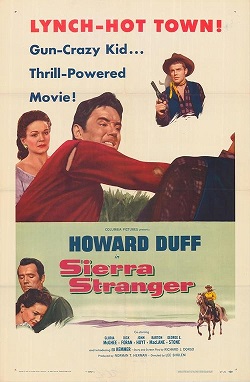
Sierra Stranger (1957, directed by Lee Sholem)


Sierra Stranger starts with a familiar western situation.  Jess Collins (Howard Duff), a penniless but honorable drifter, comes across two men tying another man to the back of a horse.  The two men claim that Sonny Grover (Ed Kemmer) is an outlaw and a claim jumper and not to be trusted. Sonny says that he’s innocent and the two men are actually the claim jumpers.  Jess does what many a western hero has done.  He sides with the underdog and saves Sonny.  To thank him, Sonny gives Jess a part of his claim.

Jess rides into the nearby town to claim his new property.  He meets and befriends Sonny’s half-brother, Bert (Dick Foran).  He also meets and falls in love with Bert’s fiancée, Meg (Gloria McGeehee).  However, soon after arriving, Jess discovers that he made a mistake and he saved the wrong man.  Sonny really is the dangerous outlaw that everyone says he is.  After Sonny robs a stagecoach and murders the driver, Jess risks his new friendship with Bert by trying to bring Sonny to justice.

Howard Duff appeared in his share of B-westerns in the 50s.  He was always a solid hero, even if he didn’t really have the screen presence of some of the other stars of the genre.  He’s pretty good in Sierra Stranger and the fact that, for once, the town is right while the drifter is wrong is an interesting twist on an otherwise standard story.  This is the rare western where the hero makes a pretty big mistake and then has to spend the rest of the movie trying to make up for it.  If you’re not a western fan, this is not the type of B-movie that’s going to change your mind.  But, for those who do like the genre, it’s an interesting twist on what we’ve been led to naturally expect.

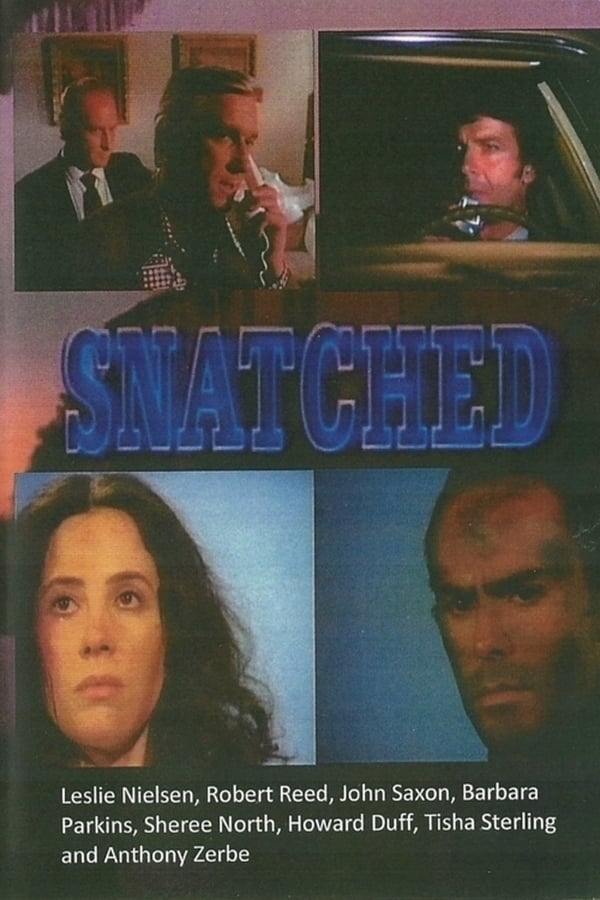
Snatched (1973, directed by Sutton Roley)


Three women have been kidnapped and are being held prisoner in a lighthouse.  Robin Wood (Tisha Sterling), Kim Sutter (Sheree North), and Barbara Maxvill (Barbara Parkins) are married to three wealthy men and the kidnappers (one of whom is played by the great Anthony Zerbe) assume that the husband will be willing to pay whatever is necessary to get back their wives.  Paul Maxvill (John Saxon) and Bill Sutter (Leslie Nielsen!) are willing to put up the money but Duncan Wood (Howard Duff) scoffs at the idea of paying a million dollars just to see his adulterous wife again!

It sounds like the set-up for a Ransom of Red Chief-type of comedy but Snatched is actually a very serious and intelligent thriller, one that will definitely keep you on your toes as you try to keep up with who is working for who.  Kim is diabetic and is growing weaker every minute that she’s being held in the lighthouse.  Paul, Bill, and police detective Frank McCloy (Robert Reed) try to get Duncan to pay his share of the ransom but Duncan is convinced that his wife has been cheating on him and he refuses to pay for her.  On top of that, it turns out that one of the wives might be in on the scheme.  When she tells the kidnappers that she’s actually the one who came up with the plan, is she just trying to protect the other wives or is she telling the truth?  It leads to betrayal and a surprisingly downbeat ending.

Snatched is a well-produced made-for-TV movie.  The mystery will keep you guessing and the cast is made up of a collection of old pros.  Leslie Nielsen, cast here long before he reinvented himself as a comedic actor, is especially good as Bill Sutter and John Saxon gives one of his better performances as Paul.  Even Robert Reed gives a good performance.  Snatched is a classic made-for-TV mystery.

Monster Chiller Horror Theatre: Deadly Companion (1980, directed by George Bloomfield)


Deadly Companion starts with John Candy sitting in a mental institution and snorting cocaine while happily talking to his roommate, Michael Taylor (Michael Sarrazin).  Michael has been in the institution ever since the night that he walked in on his estranged wife being murdered.  Because of the shock, he can’t remember anything that he saw that night.  When his girlfriend Paula (Susan Clark) comes to pick Michael up, Michael leaves the institution determined to get to the truth about his wife’s murder.  Once Michael leaves, John Candy disappears from the movie.

Michael suspects that his wife was killed by her lover, Lawrence Miles (Anthony Perkins) but there is more to that night than Michael is remembering.  Deadly Companion is a typical low-budget shot-in-Toronto thriller from the early 80s, with familiar Canadian character actors like Michael Ironside, Al Waxman, Kenneth Welsh, and Maury Chaykin all playing small roles.  Michael Sarrazin is a dull lead but Anthony Perkins gets to do what he did best at the end of his career and plays a thoroughly sarcastic bastard who gets the only good lines in the film.

What’s interesting about Deadly Companion isn’t the predictable plot and it’s certainly not Michael Sarrazin.  Instead, what’s strange is that several cast members of SCTV show up in tiny supporting roles, though none of them get as much of a chance to make as big an impression as John Candy.  Deadly Companion is a serious thriller that just happens to feature Candy, Joe Flaherty, Eugene Levy, Catherine O’Hara, and Dave Thomas.  It’s strange to see Michael Sarrazin trying to figure out who killed his wife while Eugene Levy loiters in the background.  It leaves you waiting for a punchline that never comes.

The SCTV people are in the film because it was directed by George Bloomfield, who also directed several episodes of SCTV.  Since this film was made before SCTV really broke into the American marketplace, it was probably assumed that no one outside of Canada would ever find the presence of John Candy in a dramatic murder mystery distracting.  Of course, when Deadly Companion was later released on VHS in the late 80s, Candy and the SCTV crew were all given top billing.

Let’s Talk About Sex: BOYS’ NIGHT OUT (MGM 1962)


gary loggins's avatarcracked rear viewer


“Sex farces” were extremely popular during the late 50’s/early 60’s. They were filled with martinis, smarmy innuendoes, and smutty jokes, though no sex ever really happens. The comedies of director Frank Tashlin and the Doris Day/Rock Hudson teamings helped popularize this rom-com subgenre. A good example is BOYS’ NIGHT OUT, a humorous take on suburban mores starring James Garner and Kim Novak.

The premise is pretty simple: four friends commute every day from suburban Connecticut to New York City. They are divorced Garner and his married buddies Howard Duff , Howard Morris , and the ubiquitous Tony Randall, who made a career appearing in these type of films. When the “boys” catch Garner’s boss out with his mistress, they start to daydream what it would be like to get their own love shack going, away from their wives and equipped with a beautiful blonde to do their bidding. Garner balks…

View original post 352 more words