Horror Book Review: Best Friend 2 by R.L. Stine


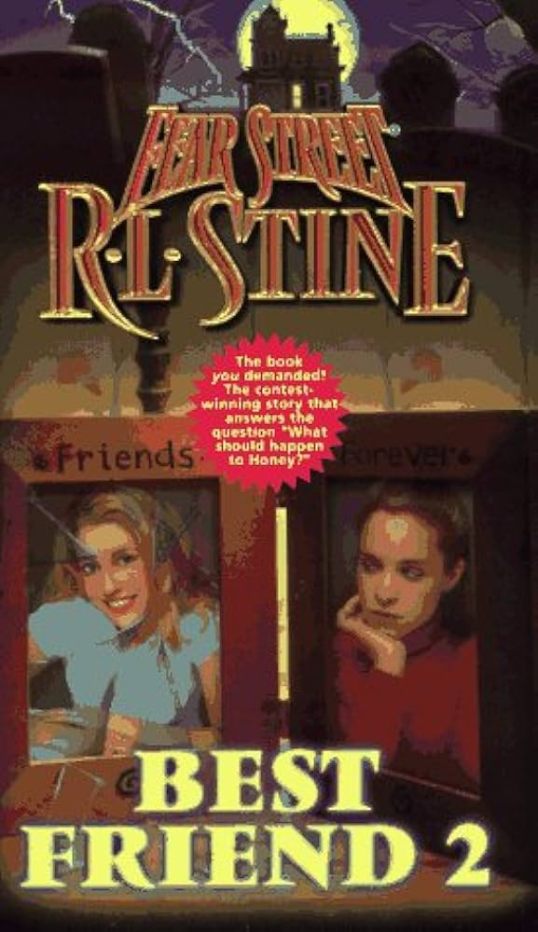
Apparently, R.L. Stine’s readers who so upset over the brilliant (but dark) ending of Best Friend, Stine felt the need to not only give them a sequel but to hold a contest to allow his readers to chime in and have a say in what should happen in the sequel.  (To be honest, that sounds like more of a publicity stunt than anything else but hey, whatever works.)  The contest was won by a girl in Wisconsin, which should be perfect evidence that the contest was rigged because everyone knows that Wisconsin is a made up place.

Anyway, in 1997 — something like five years after the publication of Best Friend so, seriously, how long did this contest last — Stine gave the world Best Friend 2.

Best Friend ended with Honey Perkins apparently murdering Bill with Becka’s knife and then promising to testify that Becka killed Bill in self-defense in return for Becka being her best friend and Becka …. agreeing!  (Woo hoo!  Way to go, Stine!)  However, the girl from Wisconsin decided that 1) Bill wasn’t really dead (despite the fact that he certainly appeared to be dead at the end of the previous book) and 2) Becka went back on her word and reported Honey to the police.  Honey was put in a mental hospital but, as this novel begins, Honey has broken out of the hospital and enrolled at a school near Shadyside.  Honey tells everyone that she’s Becka and then she tracks down Eric, who was Becka’s boring boyfriend who was dumped for Bill in the first book.  Eric was so heart-broken that he had to transfer to a new school.  (Awwwww, poor Eric!)  Honey puts Eric out of his memory by murdering him.

At Shadyside, Becka is still trying to recover from the trauma that Honey put her through.  Becka is in therapy and she even discovers the true origins of why Honey is so obsessed with her.  That’s right, it turns out that Honey is motivated by more than just a fanatical desire for Becka to be her friend and it’s actually kind of lame.  Seriously, I hope that girl in Wisconsin never ever wrote anything else because she’s one of those writers who had to overexplain everything.

Anyway, Becka finds herself being stalked again and getting threatening phone calls and all of the usual stuff.  Eventually, the stalker is revealed and it’s another twist and …. ugh.  It’s a super lame twist.  This is why you don’t let contest winners write books.  Basically — should I reveal this?  What the Hell, this book is over twenty years old.  Consider this to be your SPOILER WARNING but basically it turns out that Honey is not the one doing the stalking this time but instead, it’s Becka’s best friend from the previous book who is upset over the fact that Becka never visited her in the hospital after Honey injured her.  But there’s nothing about the character, from what we’ve seen of her, that suggests that this sort of thing would drive her mad.  This is just a twist that comes out of nowhere.  I mean, what are the chances that Becka is going to have two people in her life stalking her because they feel that she wasn’t a good enough friend?

(That said …. why wouldn’t you visit a friend who was put in the hospital by someone who was stalking you?  Becka is kind of selfish but still, everyone in this book overreacts.  Most people would just say, “Okay, I guess I’ll go find a better friend.”)

Anyway, Best Friend was Stine at his best but this sequel is lame and I blame the imaginary state of Wisconsin.
October True Crime: The Case of the Hillside Stranglers (dir by Steve Gethers)


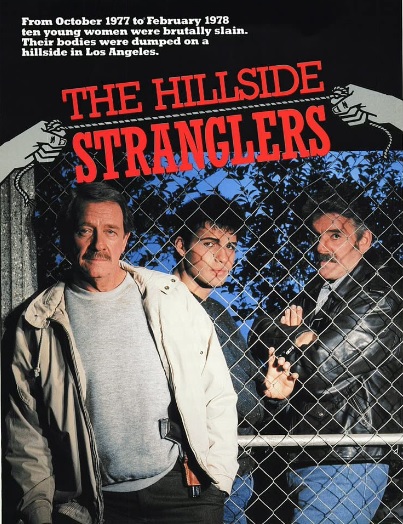
1989’s The Case of the Hillside Stranglers is based on the killing spree of Angelo Buono and Kenneth Bianchi, two cousins who terrorized Los Angeles in the late 70s.  Buono owned his own garage and aspired to be a tough and macho pimp.  Bianchi was an aspiring police officer who supported himself as a security guard.  Over the course of just five months, they murdered ten women.  They probably would never have been caught if not for the fact that Buono eventually tired of Bianchi and kicked him out of his house.  Bianchi moved up to Washington where he committed two murders on his own.  When he was arrested, he attempted to convince the cops that he was suffering from dissociative identity disorder and that the murders were committed by his other personalities.

The Case of the Hillside Stranglers starts with the murder spree already in progress.  Buono is played by Dennis Farina while Bianchi is played by a very young Billy Zane.  Both of them are well-cast, with Farina especially making an impression as a misogynistic bully who thinks that he is untouchable.  (In real life, Farina spent 18 years as a Chicago cop and, watching his performance in this film, it’s hard not to get the feeling that he had to deal with more than one guy like Angelo Buono over the course of his time on the force.) For all of their cockiness, the film emphasizes that neither Angelo nor Kenneth were particularly clever.  The fact that they got away with their crimes for as long as they did was largely due to a combination of luck and witnesses who did not want to get involved.  Early on in the film, one woman who is harassed and nearly abducted by Buono and Bianchi refuses to call the police afterwards because she doesn’t want to relive what happened.

That said, the majority of the film actually focuses on Bob Grogan (Richard Crenna), the tough veteran detective who heads up the Hillside Strangler taskforce and who becomes so obsessed with tacking down the elusive killers that he soon finds himself neglecting both his family and his own health.  Whenever we see Grogan trying to enjoy any quality time with his children, we know that his beeper is going to go off and he’s going to have to search for a telephone so that he can call into headquarters.  (Remember, this film was set in the 70s.)  His children are a bit miffed about it, which I can understand though I really do have to say that his son, in this film, really does come across as being a brat.  (“Just ignore it, Dad,” he says, as if there aren’t two serial killers murdering innocent people in the city.)  The recently divorced Grogan pursues a tentative romance with a woman (played by Karen Austin) who, at one point, decides to investigate Angelo on her own.  Crenna, not surprisingly, is sympathetic as Grogan.  The film works best as an examination of what it does to one’s soul to spend all day investigating the worst crimes that can be committed.  Grogan gets justice but, the film suggests, he does so at the sacrifice of his own peace of mind.

It’s a well-made and well-acted film, one that will probably appeal more to fans of the police procedural genre as opposed to those looking for a grisly serial killer film.  In real life, Bianchi is serving a life sentence and Angelo Buono died in prison.  And the real Bob Grogan?  He appeared in this movie, slapping the handcuffs on Billy Zane.

4 Shots From 4 Horror Films: Special Michele Soavi Edition


4 Shots From 4 Films is just what it says it is, 4 shots from 4 of our favorite films. As opposed to the reviews and recaps that we usually post, 4 Shots From 4 Films is all about letting the visuals do the talking.

This October, I am going to be using our 4 Shots From 4 Films feature to pay tribute to some of my favorite horror directors, in alphabetical order!  That’s right, we’re going from Argento to Zombie in one month!

Today’s director: the brilliant Michele Soavi!

4 Shots From 4 Michele Soavi Films

Stage Fright (1987, dir by Michele Soavi, DP: Renato Tafuri)

The Church (1989, dir by Michele Soavi, DP: Renato Tafuri)

The Sect (1991, dir by Michele Soavi, DP: Franco Fraticelli)

Dellamorte Dellamore (1994, dir by Michele Soavi, DP: Mauro Marchetti)

The Eric Roberts Horror Collection: Black Wake (dir by Jeremiah Kipp)


In this film from 2018 (which is largely made up of “found footage”), authorities are confused by a series of mysterious, beachside deaths.  The dead seem to have little to no connection with each other, besides having died near the Atlantic Ocean.  Some think that the murders are the result of a cult.  However, Dr. Luiza Moreira (Nana Gouvea) is convinced that the death are being caused by some sort of parasite that is transferred from host to host.  Her boss (Eric Roberts) doesn’t buy it and he thinks that Dr. Moreira is becoming unhinged in her obsession with her theory.  But soon, the streets are full of zombiefied killers, all of whom seem to be determined to reach the ocean.

As for Dr. Moreira, her boss may actually have a point about her behavior.  Much of the film is made up footage of Dr. Moreira speaking straight to the camera, explaining her theory and also discussing how everyone that she works with is either too foolish or too in denial to understand that its right.  Soon, she almost seems to be taking a bit of joy in just how out-of-control the situation has become.  Meanwhile, she finds herself suffering from terrible headaches and occasional hallucinations.  Two government agents follow her and watch her every move, ominously talking about how she doesn’t realize what is really happening.  When she tries to go to her family to warn them about what is happening, she discovers that the situation is even more extreme than she originally thought.

Black Wake is a low-budget slice of Cthulhu-style horror, one that works because it embraces its low budget and basically tosses in every weird twist and situation that it can come up with.  It’s an enjoyably weird movie and, if nothing else, it captures the extent to which some people will go to pretend that there’s nothing strange happening around them.  My favorites were the dumbass frat guys who just had to pick up a hitchhiker, despite the fact that she was obviously homicidal and disturbed.  One of the frat guys points out that it might not be a good idea to pick up a stranger while there’s a wave of mass murders occurring at the beach, one of his friends rationalizes the decision by saying, “She’s a chick.”  Drunk frat boys so desperate to get laid that they’ll risk being murdered?  That’s probably the most realistic moment in the entire film.

Eric Roberts appears in three scenes, playing an unsympathetic bureaucrat.  (Is there any other type?)  He’s not the only actor making a cameo here.  Chuck Zito plays a sheriff.  Vincent Pastore plays a doctor who memorably says, “Fuck this!” when confronted with the walking dead.  And Tom Sizemore has two effective scenes as an unstable homicide detective.

Previous Eric Roberts Films That We Have Reviewed:

  1. Star 80 (1983)
  2. Blood Red (1989)
  3. The Ambulance (1990)
  4. The Lost Capone (1990)
  5. Love, Cheat, & Steal (1993)
  6. Love Is A Gun (1994)
  7. Sensation (1994)
  8. Dark Angel (1996)
  9. Doctor Who (1996)
  10. Most Wanted (1997)
  11. Mr. Brightside (2004)
  12. Six: The Mark Unleased (2004)
  13. Hey You (2006)
  14. In The Blink of an Eye (2009)
  15. Enemies Among Us (2010)
  16. The Expendables (2010) 
  17. Sharktopus (2010)
  18. The Dead Want Women (2012)
  19. Deadline (2012)
  20. Miss Atomic Bomb (2012)
  21. Lovelace (2013)
  22. Self-Storage (2013)
  23. This Is Our Time (2013)
  24. Inherent Vice (2014)
  25. Road to the Open (2014)
  26. Rumors of War (2014)
  27. Amityville Death House (2015)
  28. A Fatal Obsession (2015)
  29. Stalked By My Doctor (2015)
  30. Joker’s Poltergeist (2016)
  31. Prayer Never Fails (2016)
  32. Stalked By My Doctor: The Return (2016)
  33. The Wrong Roommate (2016)
  34. Dark Image (2017)
  35. Stalked By My Doctor: Patient’s Revenge (2018)
  36. Clinton Island (2019)
  37. Monster Island (2019)
  38. Seven Deadly Sins (2019)
  39. Stalked By My Doctor: A Sleepwalker’s Nightmare (2019)
  40. The Wrong Mommy (2019)
  41. Exodus of a Prodigal Son (2020)
  42. Free Lunch Express (2020)
  43. Her Deadly Groom (2020)
  44. Top Gunner (2020)
  45. Deadly Nightshade (2021)
  46. Just What The Doctor Ordered (2021)
  47. Killer Advice (2021)
  48. The Poltergeist Diaries (2021)
  49. A Town Called Parable (2021)
  50. My Dinner With Eric (2022)

Horror Film Review: Old (dir by M. Night Shyamalan)


An odd film, Old.

Seriously, 2019’s Old is so odd that I feel the need to point out repeatedly just how strange it is.  As I watched the film, I respected it’s dedication to being odd but, at the same time, I was a bit surprised that it was directed by M. Night Shyamalan.  For all of the fame that he’s gained for his twist endings and his suspenseful films, Shyamalan has always aspired to being a member of the Hollywood mainstream.  As such, his films are usually twisty without being transgressive.  He’s usually careful about alienating the audience.

But then, he makes something like Old, which features a group of people going to the beach and aging a year every 30 minutes.  This group includes middle-aged people (and wow, are they ever in trouble) but it also includes young children who quickly become teenager and then quickly become adults and, by the end of the film, are middle-aged and walking around in ill-fitting swim suits.  Along the way, there’s a 10-minute pregnancy, a baby that only lives for a few seconds because it’s aging too quickly, and a blood infection that kills within seconds.  Eyesight and hearing fades.  Bones snap.  Bodies quickly decay.  Aging sucks.

It’s not a happy film at all.  Yes, the movie does end with a minor victory but it still leaves the remaining characters in a sort of mental and emotional limbo, the type that you know they’re never going to escape.  The majority of the characters die and often, they die graphically and painfully.  Under normal circumstances, they would have died over the course of several years and, at the very least, people would have time to grieve in between.  On the cursed beach of Old, people die one after the other and there’s no time to grieve.  Two character do manage to make some sort of peace with themselves before they age to death but the majority of the characters go out railing against that dark night.  One of the most disturbing things about the film is that the characters have no control over what is happening to them.  Even when they try to leave the beach, they pass out and reawaken on the sand, a few years older.  I guess it’s like life.  There is no escape and there’s no way to prevent getting older.  Some will age well and live a full life.  Others will randomly get sick and die and, in the end, there’s no way to control which will be which.

Seriously, that’s depressing!  I’m not used to M. Night Shyamalan being that depressing!  But then I discovered that this movie was based on a French-language graphic novel and it all made sense.

The people on the beach are played by a talented group of actors, with several different performers playing the rapidly aging children over the course of the film.  Rufus Sewell gives a good performance as a surgeon who cracks under the pressure.  I was happy to see one of my favorite actors, Ken Leung, on the beach but I wasn’t particularly happy with what happened to his character.

It’s a strange film.  Say what you will about Shyamalan and his career has definitely been uneven, he can still deliver when he has the right material.

Horror Film Review: The Raven (dir by Roger Corman)


“Shall I ever see the rare and radiant Lenore again?” — Dr. Erasmus Craven (Vincent Prince)

“How they Hell should I know?” — Dr. Adolphus Bedlo (Peter Lorre)

This exchange comes from Roger Corman’s 1963 film, The Raven, and it pretty much epitomizes the film.  Very loosely based on the poem by Edgar Allan Poe, The Raven was one of the many Poe adaptations that Corman did with Vincent Price.  As opposed to the other films in Corman’s Poe cycle, The Raven was a flat-out comedy, one that parodied the other films in the cycle.  Reportedly, Peter Lorre improvised his response to Vincent Price’s question about Lenore.  In fact, Lorre improvised a good deal of his performance and his jokes sometimes even took Corman by surprise.  As a result and despite the fact that Richard Matheson did write a script for the film, The Raven is one of those films that feels like it was made up while the camera was rolling.

The Raven is a film about three sorcerers who are always fighting and arguing with each other.  Dr. Erasmus Craven (Vincent Price) spends his time mourning the late Lenore.  The evil Dr. Scarabus (a frail-looking Boris Karloff) has his own castle where he lives with the ghost of the late Lenore (Hazel Court).  Dr. Adolphus Bedlo (Peter Lorre) is a sarcastic ne’er-do-well who saw Lenore in Scarabus’s castle and was transformed into a talking raven as a result.

In raven form, Dr. Bedlo flies over to Craven’s castle and convinces Craven to transform him back into human form.  After informing Craven that Scarabus has Lenore’s ghost in his castle, the heart-broken Craven decides to head over to Scarabus’s castle and get some answers.  Accompanying the group is Craven’s daughter, Estelle (Olive Sturgess) and Bedlo’s son, Rexford (Jack Nicholson, looking somewhat lost in the role of a boring young man).

At the castle, Scarabus puts on an act of being a friendly and gracious host but the opposite soon turns out to be true.  In fact, the entire castle is full of secrets and it quickly turns out that hardly anyone — with the exception of Estelle and Rexford — are who they actually claim to be.  It leads to a battle in magic between Craven and Scarabus.  I nearly described their battle as being “epic” but that’s probably not the right world.  It’s epic by the standards of Roger Corman but actually, the big battle is just as jokey as the rest of the film.

The Raven is definitely not a film that’s meant to be taken seriously.  One gets the feeling that Corman knew that the presence of Price, Karloff, and Lorre would make the film a success no matter what the film was like so he decided to have some fun with it.  (Price and definitely Lorre appear to have been in on the joke while Karloff was perhaps a bit less so.)  To be honest, the film’s only earnest moments come courtesy of Oliva Sturgess and Jack Nicholson but, because Nicholson is Nicholson, you watch those earnest moments waiting for Rexford to arch an eyebrow or flash that devilish grin.  Unfortunately, he doesn’t.  Jack is pretty boring here.

The Raven, if we’re going to be honest, is probably too jokey for its own good but it’s still hard to resist the charm of Price, Lorre, and Karloff.  The film is a chance to see three horror icons acting opposite each other and, as a result, it’s a fun film for horror fans.  Vincent Price breaks the fourth wall at the end of the film and it’s hard not to love it.

Horror On The Lens: Messiah of Evil (dir by Willard Huyck)


MOE Mariana HillWith only five days left until Halloween, I wanted to make sure that I continued an important tradition here at the Shattered Lens by sharing this film with our faithful and wonderful readers.  Messiah of Evil was first released in 1973 and, since it’s in the public domain, it has since been included in a countless number of bargain box sets from Mill Creek.

I can still remember the first time that I saw Messiah of Evil.  It was on a Monday night, many years ago.  I had recently picked up a 10-movie DVD box set called Tales of Terror and I was using the movies inside to try to deal with a bout of insomnia.  I had already watched The Hatchet Murders (a.k,a. Deep Red) and The House At The Edge of the Park and, at two in the morning, I was faced with a decision.  Should I try to sleep or should I watch one more movie?

Naturally, I chose to watch one more movie and the movie I chose was Messiah of Evil.  So, there I was at two in the morning, sitting at the edge of my bed in my underwear and watching an obscure horror movie while rain fell outside.

And, seriously — this movie totally FREAKED me out!

Messiah of Evil tells the story of Arletty (Marianna Hill), a neurotic woman who drives to an isolated California town in order to visit her father.  Her father is an artist who specializes in painting eerie pictures of large groups of black-clad people.  However, once she arrives at his home, Arletty discovers that her father has vanished and left behind a diary where he claims that a darkness has overtaken the town.

Meanwhile, a mysterious man named Thom (Michael Greer) is wandering about town with two groupies (played by Anita Ford and Joy Bang) and interviewing random townspeople.  One crazed man (Elisha Cook, Jr.) explains that “the dark stranger” is returning.  After meeting Arletty, they all end up moving into her father’s house.

But that’s not all.   There’s also an odd albino man who shows up driving truck and who eats mice….

Messiah of Evil is literally one of the strangest films that I’ve ever seen.  It’s shot in a dream-like fashion and the much of the film is left open to the viewer’s interpretation.  There are two classic scenes — one that takes place in a super market and one that takes place in a movie theater and the movie’s worth watching for these two scenes alone.

Messiah of Evil is a film that will be appreciated by all lovers of surrealism and intelligent horror and I’m happy to share it with you today.