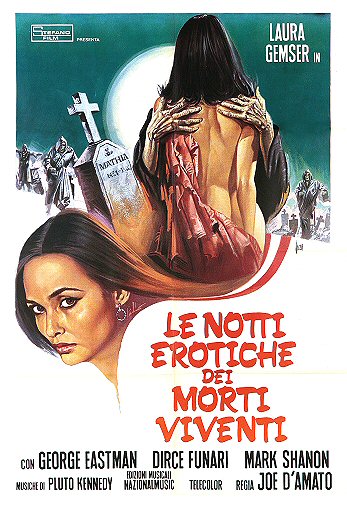
The TSL’s Daily Horror Grindhouse: The Erotic Nights of the Living Dead (dir by Aristide Massaccesi)


erotic_nights_of_the_living_dead

It is too a real movie!

Yes, I know that The Erotic Nights of the Living Dead sounds like something that someone made up but the movie totally exists and you probably won’t be surprised to know that it really doesn’t live up to the brilliance of the name.  There is a lot sex but most of it involves a really unattractive guy with a mustache and a perm that makes him look like he should be a part of Anchorman‘s Channel 5 Action News Team so it’s debatable how erotic it is.  The living dead do show up and, let’s give credit where credit is due, the zombie effects are undeniably well done.  They really do look like the dead come back to life.  However, none of the zombies are particularly sexual.  There is a ghost who, in close-up, castrates a man while giving him a blow job but, since she’s a ghost, it’s debatable whether or not she can truly be considered one of the living dead.  Finally, the title promises us “nights of the living dead” but it’s really more of an evening of the living dead.

Details matter.

Released in 1980, The Erotic Nights of the Living Dead was directed by Aristide Massaccesi, a filmmaker who was better known by the name Joe D’Amato.  D’Amato had a deserved reputation for directing some of the sleaziest Italian exploitation flicks of all time, though he also directed one of my personal favorites, Beyond the Darkness.  (For the record, Joe D’Amato was not the only alias used by Massaccesi.  Over the course of his long career, he was credited under at least 43 different names.  Also, for the record, I’ve read several interviews from people who worked with Massaccesi and, without fail, all of them have reported that he was one of the nicest and most generous people that one could hope to work with during the Italian horror boom of the 1980s.)

The Erotic Nights of the Living Dead is really two bad films in one.  The first film features a land developer named John Wilson (Mark Shannon).  Wilson has purchased an island and wants to build a luxury hotel on the island.  However, he’s having some trouble convincing anyone with a boat to give him a ride out to his property.  It seems that the location has a bad reputation.  John finally convinces local boat captain and adventurer, Larry O’Hara (George Eastman), to take him to the island.  Accompanying them is Fiona (Dirce Funari) who is either John’s girlfriend or just didn’t have anything better to do.  (To be honest, it was kind of hard to follow.)  Before heading out for the island, John takes a long shower with two prostitutes and Larry languidly watches as a stripper does a dance that involves popping a champagne cork without using her hands.

The second movie involves the trip to the island.  It turns out that the island isn’t as deserted as Mark assumed.  There’s an old man with a massive bump on his head.  There’s also the man’s mysterious daughter, played by Laura Gemser who also starred in D’Amato’s Black Emanuelle films.  The old man and his daughter warn everyone that they should leave the island but, of course, people are stupid.

Anyway, there are two good things about The Erotic Nights of the Living Dead.  First off, the great George Eastman gets a lengthy scene in which he giggles like a madman and it’s fun to watch because Eastman truly throw himself into the performance.  Secondly, the arrival of the zombies is heralded by a mysterious black cat.  The cat has the most Hellish meow that you’ll ever hear but he’s a black cat so he’s cute.

In the end, though, the best thing about The Erotic Nights of the Living Dead is the title.
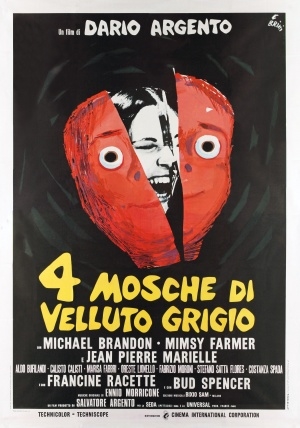
The Films of Dario Argento: Four Flies On Grey Velvet


quattro_mosche

After the good but somewhat generic Cat o’Nine Tails, Dario Argento returned to form with his third film, 1971’s Four Flies on Grey Velvet.

It’s not particularly easy to describe the plot of Four Flies because, much like The Bird With The Crystal Plumage, the storyline is less important than the way that Argento tells it.  The film tells the story of Roberto Tobias (Michael Brandon), a drummer with an up-and-coming rock band in Rome.  In many ways, Roberto is a typical drummer.  He’s the guy who, even though he’s often obscured in the background, keeps things balanced.  He has a loving wife, Nina (Mimsy Farmer), a nice house, and worldly, politically woke friends who smoke weed and praise art.  Admittedly, one of those friends does tell a rather gruesome story about witnessing a beheading in Saudi Arabia which leads to Roberto having a reoccurring nightmare but otherwise, Roberto would appear to have a great life.

(Incidentally, Roberto’s nightmares are Argento at his best.)

So, why is this stable and easy-going guy suddenly being followed by a mysterious man in a suit?  And why, when Roberto confronts the man, does he discover that there’s yet another mysterious figure — this one wearing a mask — following him and taking pictures?

That’s the mystery that opens Four Flies on Grey Velvet but it’s not the only mystery to be found in the film.  In fact, this movie finds Argento at both his most macabre and his most playful.  At times, he literally seems to be seeing just how far he can push and how complicated he can make things before totally losing his audience.  The film may start with Roberto being followed and having nightmares but eventually, it comes to involve everything and everyone from Nina’s enigmatic cousin, Dalia (Francine Racette) to a beatnik named God (played by none other than spaghetti western mainstay, Bud Spencer) to a flamboyant private investigator (Jean-Pierre Marielle).  (By today’s standards, the portrayal of the gay detective has a few cringey moments but you have to remember that Four Flies On Grey Velvet was made in 1971.  It was nothing less than revolutionary for an Italian film of that era to portray an openly gay contemporary character in any type of positive light.)  To top it all off, the solution to the film’s main mystery is discovered through optography, the long-since discredited idea that an eye will “save” the last image seen before death.  It’s ludicrous but Argento pulls it off with a cheerfully over-the-top style that perfectly matches the film’s twisted plot.  After the toned down Cat o’Nine Tails, Four Flies was Argento’s way of reminding viewers of who he truly was as a filmmaker.

The film’s brilliant opening sets the tone for the entire film.  Watch it below and thank me later:

It’s rare that anyone every really discusses the acting in an Argento film.  Argento has himself admitted that he doesn’t worry much about actors and many of his films have been released in badly dubbed versions, which often makes it difficult to fairly judge any of the performances.  That said, Roberto Tobias is one of my favorite Argento protagonists and it’s all due to Michael Brandon’s performance.  Brandon makes Roberto into such a nice guy and does such a good job of capturing his descent into paranoia that it’s impossible not to get caught up in his story.  (I would even argue that the long-haired and politically concerned Roberto is almost an autobiographical stand-in for Argento himself.)  Though I can’t really explain why without running the risk of spoiling a major part of the movie, Mimsy Farmer is also excellent.  Reportedly, Argento originally wanted to cast Mia Farrow and you can imagine a post-Rosemary’s Baby pre-Woody Allen Farrow in the role.  But I’m glad that Argento couldn’t get her because Mimsy Farmer gives a close to perfect performance.

Four Flies was the third and final part of Argento’s “animal trailer,” and, at the time, Argento declared that Four Flies would also be his final giallo film.  He followed up Four Flies with The Four Days, a historical comedy that was considered to be such a failure that, after its release, Argento returned to the safety of the giallo genre and gave the world one of his greatest triumphs, Deep Red.  However, if The Four Days had been a success and Four Flies had been Argento’s final giallo film, it would have been a triumphant note to go out on.

Here’s the very misleading trailer that was used for Four Flies On Grey Velvet‘s American release.

And here’s the even more obscure European trailer!

Horror Film Review: Ghost Story (dir by John Irvin)


ghoststory

A Fred Astaire horror movie!?

Yes, indeed.  Ghost Story is a horror movie and it does indeed star Fred Astaire.  However, Fred doesn’t dance or anything like that in Ghost Story.  This movie was made in 1981 and Fred was 82 years old when he appeared in it.  Fred still gave an energetic and likable performance and, in fact, his performance is one of the few things that really does work in Ghost Story.

Fred Astaire isn’t the only veteran of Hollywood’s Golden Age to appear in Ghost Story.  Melvyn Douglas, John Houseman, and Douglas Fairbanks, Jr. all appear in the movie as well.  They play four lifelong friends, wealthy men who have formed an informal little club called The Chowder Society.  They gather one a week and tell ghost stories.  Myself, I’m wondering why these four intelligent and accomplished men (one is a lawyer, another a doctor, another a politician, and another is Fred Astaire) couldn’t come up with a better name than Chowder Society.

(But I guess that’s something that people do up north.  Harvard has something called the Hasty Pudding Club, which just sounds amazingly annoying.)

Unfortunately, the members of the Chowder Society have a deep, dark secret.  Way back in the 1930s, the boys listening to too much jazz and they all ended up lusting after the mysterious and beautiful Eva Galli (Alice Krige).  As Astaire explains it, “We killed her, the Chowder Society.”

(Of course, there’s more to the story.  It was more manslaughter than murder but either way, it was pretty much the fault of the Chowder Society.)

And now, decades later, a woman named Alma (Alica Krige, again) has mysteriously appeared.  When she sleeps with David (Craig Wasson), the son of a member of the Chowder Society, David falls out of a window and ends up splattered on the ground below.  David’s twin brother, Don (also played by Craig Wasson), returns to their childhood home and attempts to make peace with his estranged father.

However, now the member of the Chowder Society are starting to die.  One falls off a bridge.  Another has a heart attack in the middle of the night.  Fred Astaire thinks that Eva has come back for revenge.  John Houseman is a little more skeptical…

I pretty much went into Ghost Story with next to no knowledge concerning what the film was about.  I thought the plot desription sounded intriguing.  As a classic film lover, I appreciated that Ghost Story was not only Fred Astaire’s final film but the final film of Douglas and Fairbanks as well.  Before he deleted his account, I had some pleasant interactions with Craig Wasson on Facebook.   I was really hoping that Ghost Story would be a horror classic.

Bleh.

Considering all the talent involved, Ghost Story should have been great but instead, it just fell flat.  Alice Krige is properly enigmatic as both Alma and Galli and really, the entire cast does a pretty good job.  But, with the exception of exactly three scenes, the film itself is never that scary.  (Two of those scary scenes involve a decaying corpse and it’s not that hard to make decay scary.  The other is a fairly intense nightmare sequence.)  Largely due to John Irvin’s detached direction, you never really feel any type of connection with the characters.  I mean, obviously, you don’t want to see the star of Top Hat die a terrible death but that has more to do with the eternal charm of Fred Astaire than anything that happens in Ghost Story.

Add to that, Ghost Story‘s special effects have aged terribly.  There are two scenes in which we watch different characters fall to their death and both times, you can see that little green outline that always used to appear whenever one image was super imposed on another.  It makes it a little hard to take the movie seriously.

Sadly, Ghost Story did not live up to my expectations.  At least Fred Astaire was good…

Horror On The Lens: House On Haunted Hill (dir by William Castle)


I was actually planning on waiting until closer to Halloween before I posted this film but … well, why save the best for last?  Seriously, it’s always a good time watch the original House on Haunted Hill.  Be sure to check out Gary’s review by clicking here!

Now, I will admit that I previously shared this film two Halloweens ago.  However, the YouTube video that I embedded in that post no longer exists.  So, I figured, why not post it again?

Below is what I wrote the previous time that I shared this movie:

“Released in 1959, House On Haunted Hill tells the story of how an eccentric millionaire (played by Vincent Price, of course) rented out a “haunted” mansion for a party. invited over five guests, and offered each of them $10,000 on the condition that they manage to spend the entire night in the house.  Along for the ride is Price’s unhappy wife (Carol Ohmart) and the house’s wonderfully neurotic caretaker (played by Elisha Cook, Jr, who played a lot of neurotic caretakers over the course of his long career).

House on Haunted Hill remains one of the classic B-movies.  This is largely because of Price’s wonderfully over-the-top lead performance and William Castle’s equally over-the-top direction.

Back in 1959, theaters were equipped so that a plastic skeleton would appear to fly over the heads of the audience during some of the film’s more shocking moments.  So, grab yourself a skeleton, take a seat, and enjoy House on Haunted Hill!”


Horror On TV: Tales From The Crypt 2.1 “Dead Right” (dir by Howard Deutch)


For tonight’s excursion into televised horror, we present the first episode of the 2nd season of HBO’s Tales From The Crypt!

In Dead Right, Demi Moore plays a secretary named Cathy who is told two things by a psychic.  First, she’ll lose her job.  Next, she’ll marry a man who will inherit a fortune and then violently die shortly afterward.  After losing her job, Cathy meets the grotesque Charlie (Jeffrey Tambor) and she marries him when she finds out that he comes from a wealthy family.

Of course, since this is Tales From The Crypt, there’s a twist.  The medium’s prediction turns out to be true but not quite in the way that Cathy was expecting…

Dead Right is pretty good.  Demi Moore is almost too plausible as a golddigger and Jeffrey Tambor turns Charlie into a truly memorable character, one who is both pathetic and intimidating.  And the story’s twist ending carries a properly nasty punch, as well.

Dead Right originally aired on April 21st, 1990.

Enjoy!

The TSL’s Daily Horror Grindhouse: Werewolf Woman (dir by Rino Di Silvestro)


hqdefault

Since I earlier reviewed The Wolf Man, it only made sense to me that tonight’s entry in daily horror grindhouse should be the 1976 Italian horror film, Werewolf Woman.  I’d had Werewolf Woman on DVD for a while now but I had yet to get around to watching it.  I actually knew next to nothing about it.  The only reason why I bought the DVD was because of the title.

So, last night, I watched the movie and I quickly discovered that, in the best tradition of grindhouse cinema, Werewolf Woman‘s title actually had very little do with the actual film.  The title character may go around ripping out throats with her teeth but it’s not because Daniella Neseri (Annik Borel) is a werewolf.  Instead, it’s just because she’s gone insane.

When Daniella was thirteen years old, she was raped by a family friend.  She has now grown up to be a young woman who fears sex and rarely leaves her family’s decaying estate.  Her aging father, Count Neseri (Tino Carraro), is extremely protective of Daniella but, at the same time, he also tells her stories about how one of her ancestors was rumored to be a werewolf so you really have to wonder how good of a father he actually is.

When Daniella’s younger sister, Elena (Dagmar Lassander), comes home with her fiancée, Daniella hides out in the hallway and listens while they make love.  Later that night, Daniella is wandering around outside when she runs into the fiancée.  She proceeds to rip out his throat with her teeth and then leave him for dead.  The police are convinced that he was murdered by a wild animal but Elena and Count Neseri both believe that Daniella was responsible.

So, Daniella ends up in an insane asylum but it takes more than just four walls and a locked door to hold Daniella prisoner.  One of her fellow patients is a predatory lesbian (yes, this is very much a 70s movie) who tries to seduce Daniella.  Unfortunately, any and all sexual thoughts cause Daniella to mentally (if not physically) transform into a werewolf.  Soon, the patient has had her throat ripped out and Daniella has escaped.

The rest of the film follows Daniella as she makes her way across the Italian countryside, stopping to kill anyone who causes her to become aroused or to even think about sex.  Or, at least, that is until she meets Luca (Howard Ross), who is a sensitive man and lover.  Daniella and Luca have a falling in love montage.  They make love without Daniella feeling the urge to rip out his throat.  Things are going to be okay, right?

Nope.  Inevitably, a biker gang shows up and violently destroys their happiness.  In the spirit and style of I Spit On Your Grave, it’s up to Daniella to get revenge.

Now, when talking about a movie like Werewolf Woman — one that links lycanthropy with both sexual repression and a sexual awakening — it’s easy to read too much into the plot.  I’ve been tempted to do just that while writing this review.  Whether it was what the director’s intended it or not, there is a potentially intriguing theme running through Werewolf Woman, in which Daniella imagines herself as a werewolf because it’s the only way that she can survive in a world that is determined to sexually exploit, demean, and oppress her.  Daniella’s mental transformation is ultimately the result of her own repressed emotions and fears and I’m sure that many would argue that Werewolf Woman, in the tradition of Repulsion and Ms. 45, is taking a stand against a patriarchal and repressive society (never mind that Daniella ultimately kills almost as many women as men).

And you know what?  If this was a Jess Franco film, I’d give it the benefit of the doubt.

But ultimately, Werewolf Woman is no Ginger Snaps.  Instead, it’s a somewhat slow soft core flick that doesn’t really add up to much.  (Any and all subtext is definitely present by accident only.)  That said, Annik Borel does a good job in the lead role and loves of Euroshock will enjoy seeing familiar faces like Howard Ross and Dagmar Lassander in the cast.  Add to that, I always enjoy any film the features a woman getting bloody revenge on misogynists, even if this film ultimately left me feeling more icky than empowered.

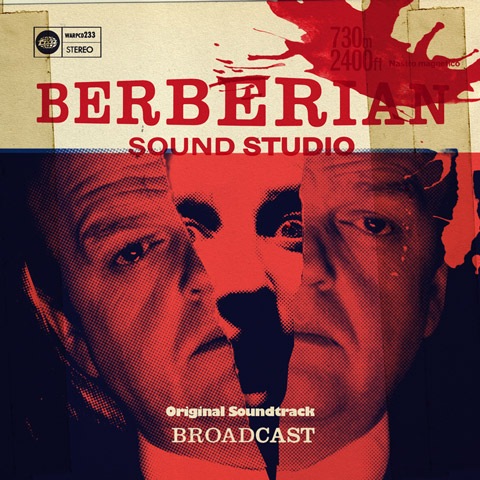
Review of Berberian Sound Studio, ALT Title: Huh? I mean, Huh?


bsstudio

I was considering posting this review later in the month because I didn’t want to do two negative reviews in a row. I’m starting to feel like an old curmudgeon with a sciatica issue, but here we are.  I didn’t write, direct, or produce this steaming pile of shit, but again… here we are.  I’m not writing that every film should have three distinct acts that are easily defined and understood, but this film sure could have used some structure or a beginning, a middle, or (if they really felt wild) an ending.

We open with Gilderoy (Tobey Jones) starting a job as a foley artist for a Giallo film.  He is immediately shocked at the graphic nature of the film that he will be looping.  This is where the movie grinds to a halt – minute 7.  Either through a lack of budget or imagination, the film takes place in the sound studio, his apartment, and a hallway – that’s it.  You’d think that this would establish tension…nope; no more than sitting in the DMV for 90 minutes establishes tension.  There are no subtitles and everyone’s speaking Italian and screaming a lot to loop the spooky film that you never see.  Again, you’d think that perhaps this would create tension or alienation because we don’t know what’s being said in 85% of the film….nope; no more than watching Raiuno (Italian Basic Cable).   Keep in mind, I’m very proud of my very sexy Italian roots, but not everything we make is a winner- even our towers lean over sometimes.

Gilderoy proceeds to obsess over getting reimbursed for his travel and when he doesn’t get reimbursed, he mopes … a lot and smashes fruit to mimic bludgeoning sounds. At one point he does get upset about it, but then goes back to doing what he does best – moping and fruit smashing.  There are two producers Francesco and Santini who spend the majority of the film bullying Gilderoy around and just when you think he’ll snap, he doesn’t because his moping around and fruit smashing won’t get done by itself.

Gilderoy slowly makes a quasi-friendship with Elena a voiceover artist who hints at something sinister being afoot, but it never materializes. Snore.  Later in the film, Santini sexually assaults her off-screen and she wrecks the studio this is also off-screen.  Since all of the action takes place off-camera, it really makes you wonder if they ever wanted to film a movie.  Elena’s departure necessitates the need to hire new voiceover actress to replace her.

This is where the film takes an absurdist left turn – Gilderoy starts speaking Italian.  As someone who has taken some formal Italian language instruction- it’s a challenging language, but not for Gilderoy because he just starts spouting it – damn it!  Then, Elena’s replacement tries to kill Gilderoy, but he manages to kill her.  He then wanders into the sound studio and for some reason he sees the self-defense killing on the screen.  This causes the need for yet another voiceover actress to be hired and he uses mild sound torture to get a better performance out of her – it’s both weird and stupid because she could just take the headphones off, but she doesn’t.  She does quit and we don’t have to see them go to Central Casting again.  Maybe they get a stamp on a card for every voiceover actress they hire?  If so, they are all due a free sammich!!!  The movie ends.  Yep, that’s it.

This film proved that there are two big losers in Giallo pictures: voiceover actresses and fruit!  Enjoy the horror month!  My next review will be one of my favorite movies of ALL TIME: Ginger Snaps!  Ginger Snaps is a werewolf movie that is an allegory for a girl’s menarche! Tagline: They don’t call it the curse for nothing!  It’s awesome!


The Films of Dario Argento: The Cat o’Nine Tails


(I’m using this year’s horrorthon as an excuse to watch and review all of the films of Dario Argento.  Yesterday, I reviewed The Bird With The Crystal Plumage.  Today, I take a look at The Cat o’Nine Tails.)

gatto_a_nove_code

In 1971, Dario Argento followed up the massive success of The Bird With The Crystal Plumage with his second film as a director, The Cat o’Nine Tails.  While The Cat o’Nine Tails was another huge financial success, it’s never been as a critically acclaimed as Argento’s first film.  Argento, himself, regularly cites The Cat o’Nine Tails as being his least favorite of all of the films that he’s directed.

Much like The Bird With The Crystal Plumage, The Cat o’Nine Tails is a giallo that uses it’s rather complicated mystery as an excuse (a MacGuffin, to quote Hitchcock) for several suspenseful set pieces, the majority of which end with someone suffering some sort of terrible fate.  In this case, a series of murders are taking place around a mysterious medical complex, the Terzi Institute.  The murders are connected to some research being done at the institute.  I’m not going to spoil things by revealing what exactly is being researched but I will say that the key to the mystery is vaguely ludicrous, even by the typically flamboyant standards of the giallo genre.

But, then again, so what?  The fact that the genre’s mysteries are often overly complex and feature solutions that don’t always make sense is actually one of the appeals of the giallo film.  You don’t really watch a giallo for the mystery.  You watch it to see how the story will be told.  Perhaps more than any other genre, giallo requires a director with a strong vision.

And, if nothing else, Argento has always had a strong directorial vision.  Even when you may disagree with the choices that he makes (and I’m sure we all wonder why, in his later films, Argento grew so obsessed with telepathic insects), you can’t deny that they’re always uniquely Argento.  Though the film never reaches the delirious heights of The Bird With The Crystal Plumage, The Cat o’Nine Tails still has several strong set pieces.  There’s a sequence involving a poisoned glass of milk that I particularly appreciate.  And then there’s the long scene at the crypt, in which our two protagonists realize that they don’t really trust each other all that much.  And, of course, there’s the ending.  For a film that’s often dismissed as being lesser Argento, The Cat o’Nine Tails features one of Argento’s darkest endings.

The Cat o’Nine Tails is unique as being one of the only Argento films to regularly show up on TCM.  A lot of that is because The Cat o’Nine Tails is perhaps the least gory of all the films that Argento has made.  That doesn’t mean that there isn’t plenty of death and mayhem.  There is.  Blood is spilled but it never exactly flows.  The Cat o’Nine Tails is an Argento film that you could probably safely watch with an elderly relative.  That’s not necessarily meant as a complaint.  It’s just an observation that, when compared to the panty murder in The Bird With The Crystal Plumage or the skewering in The Mother of Tears, Cat o’Nine Tails is definitely a toned down Argento film.

The other reason why The Cat o’Nine Tails is popular on TCM is because it stars none other than that classic film mainstay, Karl Malden.  Continuing the Argento tradition of featuring protagonists who aren’t sure what they’ve witnessed, Malden plays a former newspaper reporter who is now blind.  He teams up with another reporter (played by James Franciscus, who may not have been a great actor but who did have perfect hair) to solve the murders.  Franciscus has the eyes.  Malden has the brains.  And Malden’s niece, Lori (Cinzia De Carolis), is largely present to provide the film with its final ironic twist.

Malden does a pretty good job in the role, too.  I’ve read some reviews that have complained that Malden overacts but actually, he gives the perfect performance for the material.  In fact, Malden’s unapologetically hammy performance contrasts nicely with the work of James Franciscus, which could  charitably be called subdued.  (Perhaps a better description would be dull…)

Cat o’Nine Tails may not be Argento’s best but I still like it.  If for no other reason, watch it for Malden and that wonderfully dark ending.


6 Scary Trailers For October 2nd


Well, it’s October!  It’s horror month!  It’s a freaking horrorthon!

And that means that it’s time for the return of Lisa Marie’s Favorite Grindhouse and Exploitation Film trailers!  And yes, it’s a horror edition!

Let’s see what trailers we have this week:

The House On Haunted Hill (1959)

The House On Haunted Hill (1999)

Return to House On Haunted Hill (2007)

The Haunting (1963)

The Haunting (1999)

The Others (2001)

What do you think, Halloween Possum?

(Picture Taken By The Dazzling Erin Nicole)

(Picture Taken By The Dazzling Erin Nicole)