Horror Film Review: The Wolf Man (dir by George Waggner)


the-wolfman

“Even a man who is pure in heart, and says his prayers by night;

May become a wolf when the wolfbane blooms and the autumn moon is bright.”

— Gypsy Poem, The Wolf Man (1941)

Poor Larry Talbot.

We all know his story, of course.  The plot of the original Wolf Man is so iconic and has been imitated in so many other films that, even if you somehow have never seen the original 1941 film, you still know what happened.

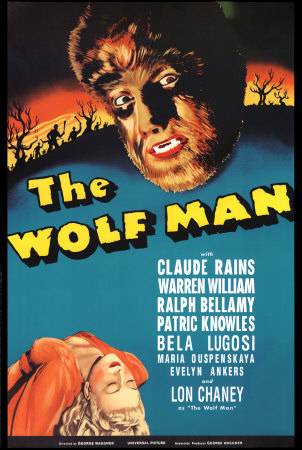
Larry (played by Lon Chaney, Jr.) is a loser.  When we first meet him, he is nervously returning to his childhood home in Wales.  (Chaney doesn’t sounds at all Welsh nor does he sounds like he’s from any other part of the UK for that matter, but that’s not really important.)  Larry’s older brother has recently died and Larry hopes that maybe he can reconcile with his father, Sir John (Claude Rains).  Larry’s brother was the favored son, the one who lived up to the Talbot name and made his father proud.  Larry, on the other hand, hasn’t really succeeded at anything he’s ever done.  To use the slang of the time, Larry comes across as basically being a lug.  A big dumb lug.

After discovering that his father really doesn’t seem to want to have much to do with him, Larry goes for a stroll through the nearby village.  He buys a silver-headed walking stick, mostly so he can flirt with the salesgirl, Gwen (Evelyn Ankers).  It turns out that there’s a gypsy camp nearby.  What better place to go on a date!?

Well, perhaps Larry should have just invited her to the movies.  Not only does a fortune teller (Maria Ouspenskaya) see something terrible in his future but Larry ends up getting bitten by what appears to be a wolf.  The good news is that Larry was bitten while saving the life of one of Gwen’s friends, which is certainly going to make him look like good boyfriend material.  The bad news is that the wolf was actually the fortune teller’s son, Bela (played by none other than Bela Lugosi).  It turns out that Bela was a werewolf and now, Larry’s going to be a werewolf too!

Larry, needless to say, is not happy about this.  But then again, Larry wasn’t happy before he became the werewolf either.  Lon Chaney, Jr. played Larry Talbot in five different movies and I don’t think he smiled once.  I guess that’s understandable, seeing as how he was a werewolf.  In every film in which he appeared, Larry would beg someone to kill him and put him out of his misery.  And, in every sequel, Larry would somehow be brought back to life and have to go through it all over again.  I guess he earned the right to be a little glum.

But still, even before he’s bitten in The Wolf Man, Larry is kind of a boring character.  The only time that he’s interesting is when he’s a wolf man.  And really, he’s a far more successful werewolf than human.  When we first meet Larry, he apologizing to his father for never living up to his expectations.  But once Larry turns into the Wolf Man, he finally manages to get things done.  When he’s the wolf man, Larry has the inner drive that he lacks as a human.

To me, the heart of The Wolf Man is not to be found in Chaney’s glum performance.  Instead, it’s in Claude Rains’s performance as John.  When we first meet Sir John, he seems like a rather imposing figure but, over the course of this 70 minute film, John slowly lowers his guard.  We discover that he’s actually a loving father and there’s something rather sweet about watching as he slowly welcomes Larry back into his life.  Of course, it all ends in tragedy.  These things often do.

Everything, from the set design to shadowy cinematography to the hard-working fog machine (which keeps the moors looking properly creepy) to the performances of Claude Rains and Maria Ouspenskaya, comes together to make The Wolf Man into a genuine classic of horror cinema.  And, of course, I have to mention the brilliant makeup job that was done to transform Chaney into The Wolf Man.  

Still, I have to wonder — why did Lugosi turn into an actual wolf while Chaney turned into this?

wm

Oh well, it probably doesn’t matter.  Just relax and enjoy the damn film, as a wise person somewhere once said.  Be sure to watch The Wolf Man this holiday season!

What Horror Lisa And The Snarkalecs Watched Last Night #156: The Crooked Man (dir by Jesse Holland)


Last night, my friends, the Snarkalecs, and I watched the latest SyFy original film, The Crooked Man!

the-crooked-man-707

Why Were We Watching It?

Gawdamn, y’all (as we tend to say down here in Texas), do you remember how much fun it used to be when SyFy would premiere a different movie every Saturday night?  Back when I first started regularly watching SyFy and live tweeting with the Snarkalecs, SyFy was all about original movies.

Sadly, things have changed.  Now, we only get SyFy original movies twice during the year.  Once is during the week leading up to the latest Sharknado film.  The other time is October, when SyFy does its 31 Days of Horror.

Since the Snarkalecs are still trying to change SyFy’s policy towards original movies, we make it a point to watch every single one of them.  We also make it a point to tweet about the movies, the hope being that someone at SyFy will see that there is an audience for original movies.

That’s what we were doing last night as we watched The Crooked Man.

What Was It About?

Olivia (Angelique Rivera) gets all of her friends killed but isn’t ever really held responsible because she’s the main character in the film.

Okay, there’s actually a little more to it than that.  The Crooked Man is a hybrid of The Ring, It Follows, Candyman, Slenderman, The Nun, and … well, just about every other horror film made over the past 16 years.  It starts with a slumber party, where a group of 12 year-old girls make the mistake of listening to a song online.  The song, it’s said, will summon the Crooked Man.

Later, the slumber party is interrupted when all the lights go out.  Fortunately, there’s also a pizza delivery guy at the party and he knows how to turn the lights back on.  Well, that’s good.  However, there is yet another interruption when one of the girls, Jill, is found dead at the foot of the stairs.  Standing over her is Olivia.  Though Olivia has a knife in her hands, she swears that she didn’t kill Jill.  It was … THE CROOKED MAN!

Olivia is sent to a mental asylum for six years.  When she’s released, she returns home.  The problem is that nobody in the town wants her to come home.  And actually, they have a point because, as soon as Olivia returns, The Crooked Man starts killing everyone who was at that slumber party.

EVEN THE PIZZA GUY!

What Worked?

I will be the first to admit that most of my tweets were pretty critical last night but there were a few effectively creepy moments in The Crooked Man.  The Crooked Man himself was scary.

The Voice‘s Dia Frampton showed up to sing a song and then promptly got killed.  That definitely provided the film with a nice WTF moment.

What Did Not Work?

Okay — so the Crooked Man can only get you when you’re in the dark, right?  SO WHY DOES EVERYONE IN THE FILM KEEP TURNING OFF ALL THE LIGHTS!?  Seriously, nobody seemed to appreciate that there was a really easy solution to most of their problems…

(Actually, in all fairness, The Crooked Man had the power to kill all the electricity and plunge people into darkness.  But still, it did seem like the characters often never even considered trying to turn on all the lights.  I would have at least liked to have seen some sort of effort.)

“OMG!  Just like me!” Moments

I related to the character of Violet.  Violet was at the slumber party and therefore, she was on Crooked Man’s kill list.  And Violet put the blame right where it belonged.  On Olivia!

Seriously, Olivia, way to get all your friends killed.

Lessons Learned

If a monster can only exist in the dark, turn on the damn lights!

Horror on TV: Tales From The Crypt 1.4 “Only Sin Deep” (dir by Howard Deutch)


You may remember, from previous horrorthons, that I like to end each day in October by sharing a classic example of televised horror.  Over the previous two years, I shared several episodes of The Twilight Zone and everyone seemed to enjoy them.  I know I certainly did.

Unfortunately, I can’t do that anymore.

All of the episodes of the Twilight Zone that were on YouTube have been taken down.  Copyright infringement, they say.  And, unfortunately, Hulu is no longer allowing people to watch The Twilight Zone for free.  I can still embed Hulu videos on this site but unless you’re a subscriber, you wouldn’t be able to watch them.

Which sucks, by the way!  Seriously, I was soooooo mad when I discovered what had happened…

However, fear not!  While I may not be able to share any Twilight Zone episodes this October, it turns out that every episode of HBO’s Tales From The Crypt has been uploaded to YouTube!  And what could be more appropriate for Halloween than a little trip to the crypt?

So, with all that in mind, here’s the fourth episode of Tales From The Crypt.  It’s called Only Sin Deep and it originally aired on June 14th, 1989.  It tells the story of a prostitute named Sylvia Vane (played by Lea Thompson) who agrees to sell her beauty for $10,000 and the chance to marry a rich man.  Sylvia doesn’t take the deal seriously.  You won’t be surprised to learn that was a mistake.  Only Sin Deep is an entertaining little morality tale.  Don’t mess with karma.

(As well, I’m going to assume that the name Sylvia Vane is meant to be an homage to the name of Angela Lansbury’s character in The Picture of Dorian Gray.)

Only Sin Deep was directed by Howard Deutch, who also directed Lea Thompson in Some Kind of Wonderful.  (And, of course, he also married her.)  It was written by Fred Dekker, who directed the classic Night of the Creeps.

And yes, the story is introduced by the infamous Cryptkeeper.

Enjoy!


The TSL’s Daily Horror Grindhouse: Color Me Blood Red (dir by Herschell Gordon Lewis)


color_me_blood_red_film_poster

That sure is an interesting poster, isn’t it?  The poster for Color Me Blood Red pretty much screams grindhouse and if you didn’t already know that this 1965 film was directed by Herschell Gordon Lewis and produced by David Friedman, you’d be able to guess just from looking at it.  My favorite part of the poster is the promise that Color Me Blood Red is “drenched in crimson color.”

There’s a lot of blood in Color Me Blood Red.  In fact, it’s a movie about blood.  Adam Sorg (played by Gordon Oas-Heim, who I’m going to guess was not a professional actor because, otherwise, why wouldn’t he have changed his name to Gordon O?) is a painter who hasn’t had much success.  Sure, he has a house on the beach and he has a girlfriend named Gigi (Elyn Warner) who is willing to model for him but one thing that Adam doesn’t have is respect.  No one wants to buy his paintings!  Could it be because Adam is living in a city full of Philistines?  That’s what Adam seems to believe but I think a far bigger problem is the fact that Adam is not a very good painter.  His paintings are cartoonish and his use of color is more than a little dull.  However, after Gigi cuts her finger and bleeds all over one of his canvases, Adam discovers that he has now found the perfect shade of red!

So, he decides to paint with blood.  Unfortunately, Gigi doesn’t want to give him any more of her blood.  So, Adam decides to open his own veins and use his own blood but he faints before he can finish his latest masterpiece.  What is Adam to do?  Well, he can always kill Gigi and use her blood.  And, of course, there’s always a fresh supply of teenagers showing up on the beach…

What’s sad about all this is that, even after Adam discovers that blood is the perfect shade of red, he’s still not a very good painter.  Believe me, I understand.  I majored in Art History.  The majority of my friends are artists.  Some paint, some write, some take pictures.  Believe me — I get it.  We all go through that phase where we fool ourselves into thinking that undeveloped talent, lazy thinking, and lack of ability is the same thing as having a unique vision that is destined to be unappreciated.  But most artists either eventually find their own voice or they give up by the time they turn 28.  Adam, on the other hand, is a middle-aged guy who is still acting like a student in an Intro to Graphic Design class.  What I’m saying is that blood is useless without a unique vision.  The perfect shade of red isn’t going to help if you still don’t have your own voice.

Then again, maybe I’m taking the film too seriously.

And really, that’s something you should never do when you’re reviewing a Herschell Gordon Lewis film.  Color Me Blood Red was the third part of Lewis’s blood trilogy but, unfortunately, it’s never quite as effective or memorable as either Blood Fest or Two Thousand Maniacs.  As silly as certain parts of the film may be, Blood Feast‘s gore still has the power to shock.  Two Thousand Maniacs is pure nightmare fuel.  Color Me Blood Red, meanwhile, is kind of bland.  It feels more like a successor to The Undertaker and His Pals than Blood Feast.

That said, the film is worth watching for some of the dialogue.  The entire film is full of campy lines, the majority of which are so strange that they give the proceedings an almost dream-like feel.

“Dig that crazy driftwood!” someone says upon spotting a corpse in the water.

“You mean the type who earn an honest living painting houses?” someone else says when asked for his opinion on artists.

And, of course, there’s my favorite line: “HOLY BANANAS!  It’s a girl’s leg!”

Color Me Blood Red is the least essential entry in the blood trilogy but, if you’re a Lewis/Friedman completist, you know you’re going to have to watch it.  So, you might as well sit back and enjoy it for the frequently silly little movie that it is.

The Films of Dario Argento: The Bird With The Crystal Plumage


the-bird-with-the-crystal-plumage-2

Dario Argento.

The name inspires a lot of reactions.  Some people will tell you that Dario Argento is one of the greatest directors of all time.  Some people regularly cite him as being a prime example of an artist who hit his peak too early and who has spent the latter part of his career imitating his previous successes.  Some people will tell you that his films are dangerous.  He’s one of those directors whose films always seem to end up getting banned in certain communities.  Other cineastes will always praise him as a superior stylist whose influence is still felt to this very day.  Argento’s films have inspired thousands of horror filmmakers.  His films have also inspired a countless number of viewers to fall in love with horror.  Without the influence of Argento the horror genre would be not only less interesting but less profitable as well.

Myself, I’m a huge Argento fan.  Yes, I do love Suspiria but then again, everyone love Suspiria.  I have also made it a point to track down and watch the forgotten and/or critically reviled Argento films, like Trauma and The Phantom of the Opera.  My love of Argento is so strong that I usually even find myself enjoying his less acclaimed work as much as his acknowledged triumphs.  He is one of the masters of horror, a true maestro of Italian art.  For the longest time, I’ve been meaning to watch and review all 21 of Argento’s cinematic thrillers.  (Sadly, his one non-thriller, The Four Days, is notoriously difficult to see.)  With this being October, I figured why not now?

Dario Argento made his directorial debut in 1970 with The Bird With The Crystal Plumage.  Before directing his first movie, Argento had been a film critic and a screenwriter.  (Among other credits, he is listed as being one of the writers of Sergio Leone’s Once Upon A Time In The West.  Interestingly enough, his co-writer was another future director, Bernardo Bertolucci.)  With his very first film as a director, Argento established himself as a master of both suspense and horror.

I have seen some reviews that have identified The Bird With The Crystal Plumage as being the first giallo film.  That’s not at all true.  If anything, the credit for directing the first giallo should probably go to Mario Bava (who directed The Girl Who Knew Too Much in 1964) and some students of Italian cinema would even disagree with that.  However, The Bird With The Crystal Plumage undoubtedly did a lot to popularize the genre outside of Italy.

The film tells the story of Sam (Tony Musante) and his girlfriend, Julia (Suzy Kendall).  Sam is a writer and he’s living in Rome.  Argento is not traditionally known as an actor’s director but Musante and Kendall are both remarkably sympathetic in their roles and they seem to have a very real chemistry when they’re both on-screen together.  You actually do care about them as a couple and you find yourself hoping that nothing bad happens to them.  One thing that I liked was that their tiny apartment looked like it was someplace where a couple actually would live, love, and try to solve a murder.  Looking at Sam and Julia in that apartment (which is decorated with a picture of Albert Einstein and a poster reading “Black Power!”), you get the feeling that they have an existence outside of what you’re seeing during the film’s 94 minute running time.  They feel real.

Reportedly, Tony Musante and Argento did not have a great working relationship.  (Mustante was a character actor who wanted to talk about motivation.  Argento was more concerned with the technical aspects of shooting the film.)  Mustante may have been miserable but that actually works for his character.  When we first meet Sam, he’s frustrated because he’s suffering from writer’s block.  He’s so frustrated that he’s on the verge of moving back to the United States.  Sam’s frustration feels real and if that’s because Musante happened to be frustrated while shooting the film, so be it.  Whatever works.

One night, Sam goes for a walk and witnesses a stabbing in an art gallery.  Monica Ranieri (Eva Renzi) survives but it appears that her assailant has managed to escape.  The police suspect that Sam might be more than just a witness so they confiscate his passport.  Until the attacker is caught, Sam is stuck in Rome.

There’s a serial killer terrorizing Rome and both Sam and the police suspect that Monica nearly became the killer’s latest victim.  Some of the film’s most unnerving sequences are shot from the point-of-view of the killer, a technique that both leaves the killer’s identity a secret and also makes the audience complicit in the murders.  It’s as if Argento the film critic is daring the audience to consider why they’re watching what Argento the director is doing.

(And the murders in The Bird With The Crystal Plumage are brutal, even by the standards of Italian cinema.  The first murder that we actually witness — which is usually referred to as being “the panty murder,” for reasons that I’m not going to freak myself out by describing — is pure and total nightmare fuel.)

Everything that you might expect to find in a giallo is present in The Bird With The Crystal Plumage.  It may not have been the first but it’s definitely one of the prototypes for what the genre is usually considered to be.  Graphic violence, sexual perversion, point-of-view shots, a constantly roaming camera, a dramatic musical score, a killer who wears black gloves and carries a razor, a witness who has to prove his innocence, and a solution that’s revealed only when Sam reexamines what he thinks he saw; it’s all here.

What distinguishes The Bird With The Crystal Plumage is the style with which Argento tells his story.  Dario was 30 years old when he directed The Bird With The Crystal Plumage and there’s an infectious enthusiasm to the way he frames the mayhem.  Like many film critics directing their first film, Argento fills his debut with homages to earlier films.  You can tell he’s having a lot of fun while discovering just how far he can go without losing his audience.

46 years after it was first released, The Bird With The Crystal Plumage holds up surprisingly well.  It’s a nightmarish but compulsively watchable thrill ride and it remains one of Argento’s best.

Horror Film Review: The Picture of Dorian Gray (dir by Albert Lewin)


picture-of-dorian-gray-32

Hello and welcome to the start of TSL’s annual October horrorthon!  All through the month of October, our focus will be on horror.  We will be sharing reviews and thoughts on some of the best (and worst) horror films ever made!  I have to admit that this is my favorite time of the year.  I love horror … like all good people!

I want to start things off by taking a look at a film from 1945.  The Picture of Dorian Gray is based on the famous novel by Oscar Wilde (a novel that some people think was inspired by the Jack the Ripper murders).  Dorian Gray (played by Hurd Hatfield) is a young and handsome aristocrat who lives in 19th century London.  When we first meet him, Dorian is intelligent, kind and virtuous.  He’s also more than a little boring.  He is the bland face of the establishment, a man destined to be celebrated for his position in society and largely forgotten after his death.

Dorian is posing for a painting that’s being done by his friend, an artist named Basil Hallward (Lowell Gilmore).  One day, Lord Henry Wotton (George Sanders) stops by the studio while Basil is painting Dorian.  Lord Henry is everything that Dorian Gray is not.  He’s a worldly and cynical man and he is very proud to live a life devoted to complete and total hedonistic pleasure.  He immediately sets out to corrupt Dorian and it turns out to be a lot easier than he was expecting.  Henry convinces Dorian that he can have everything that he wants as long as he’s young and handsome.  Dorian announces that he wishes the painting could age instead of him…

Now, here’s where the film takes a huge departure from Wilde’s novel.  In the novel, the painting ages while Dorian stay young.  No specific reason is given.  Instead, it’s just something that happens.  In the film, it turns out that Basil owns an ancient Egyptian statue and that the statue has mystical powers.  Dorian makes his wish in front of the statue and that’s why the painting starts to age.  Personally, I think the bit with the Egyptian statue is unnecessary and a little bit silly.  To me, the story is a lot more effective if the painting starts to age without an explanation.  The filmmakers obviously disagreed.

But no matter!  In the end, the Egyptian statue isn’t that important.  What is important that, freed from getting old or physically suffering for his actions, Dorian transforms into a different person.  Soon, he’s even more hedonistic than Lord Henry.  When he breaks the heart of a tragic singer named Sybil Vane (Angela Lansbury, in a poignant and Oscar-nominated performance), Dorian sees that the painting is now cruelly smirking while his own face remains innocent and untouched.  When Dorian eventually commits a murder to keep his secret from getting out, the blood appears on the painting’s hands while his own remain clean.

And the years pass.  Dorian finds himself both being hunted by Sybil’s brother (Richard Fraser) and falling in love with the niece (Donna Reed) of a man that he earlier murdered.  Dorian never ages but his portrait becomes more and more twisted.  What’s particularly interesting is that we see little of Dorian’s evil actions.  Instead, we watch and listen as other characters whisper about the horrific things that he’s done.  Physically, Dorian remains an innocent and young aristocrat.  But all we have to do is look at the picture and we can see what a monster Dorian has become…

The Picture of Dorian Gray is an absolutely gorgeous film, one that is full of elaborate sets that are often cast in shadow.  (It’s interesting to note that the more corrupt Dorian becomes, the darker and more shadowy his estate becomes.)  The film is in black-and-white, with the exception of three scenes in which the portrait is revealed in all of its Technicolor glory.  If that sounds like a gimmick … well, it is.  But it’s an amazingly effective gimmick.

The Picture of Dorian Gray is a classic exercise in psychological horror.  See it the next chance you get!

portrait-de-dorian-gray-1945-01-g

Escape From Tomorrow, ALT Title: It’s a Boring World Afterall


escape-from-tomorrow

Welcome to The Most Wonderful Time of the Year!!!  It’s October- Horror Month!!! I will be reviewing many great and terrible films for your reading pleasure.  My advice to you Gentle Readers: decorate your house, turn the lights down low, read my posts, like them, retweet them, tell your friends and family about them BECAUSE if you don’t demons will get you! Here we go!!!

I am watching a man have extreme explosive diarrhea and cough up furballs, when I think, some poor asshole paid to see this.

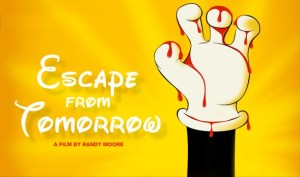
Escape From Tomorrow is a quasi horror film about a man on vacation with his family to Disneyworld and things go absurdly weird and boring.  It’s black and white, which gives it a good eerie feel.  It is, in fact, filmed entirely at Disney World and Disney Land. My expectations were raised- too bad for me.

The dad is fired in the first scene over the phone right before he takes his family to tour Disney World.  Upon entering the monorail to the park, the dad ogles and passively stalks two girls.  One of the ladies he ogles is Annet Mahendru – “Nina” – from The Americans and the other is a REALLY young lady.  He ogles them both on the monorail, in line, and pretty much all over the park.  His stalking is the only part of the movie that is moderately creepy and scary.  At so many points in the show I thought, Dude, your children are right there! Gross!

They arrive at the most wonderful place on Earth to find people coughing.  The dad goes on rides and hallucinates.  You expect it to get scary and it fizzles out like a damp sparkler. Eventually the mom and dad go to different parts of the park and the Dad is left to stalk the two girls again, but he gets distracted and blacks out and wakes having sex with a woman who looks a lot like a sexy version of the wicked witch in Snow White – It’s weird. The story gets rapidly off the rails and you have to grab at plot points like wet tissue paper. There’s a “Cat Flu, a ridiculous scene inside of Epcot, and redneck in scooter; it’s truly nonsensical and dull.  SNORE.

This is why the film fails to do anything but disappoint: he had done it- Randy Moore got into Disney and did pure guerilla filmmaking.  However, he forgot to have one thing: a story.  OOPS!!! Maybe he left the story at Universal Studios?! I hear the shark can really startle you on the tram!  From written accounts, Moore was so worried that he would be sued, he edited the film in South Korea.  What a waste of cash!  Disney realized quickly what I did- the film sucks and isn’t worth the paper to file suit in Court.

There was ONE and ONLY one part of the film that was compelling.  The dad had a drinking problem.  He does drink …. A LOT, but the movie strays from that interesting plot point to go off on some boring surreal tangent.  If the movie got away from the surreal bullshit and focused on the dad ruining his family and himself at Disney because of alcoholism, it would have been the most moving story about drinking since Leaving Las Vegas.  Moore, however, squandered that great opportunity and will either learn from this mistake or go into Real Estate.

He did manage to film in Disney without anyone giving a shit, which is novel and a bit impressive.  Also, I have to be stingy with my “As” and “Fs”.  Therefore, I give

Escape From Tomorrow a “D”.

escape-from-tomorrow-1