This October, I’m going to be doing something a little bit different with my contribution to 4 Shots From 4 Films. I’m going to be taking a little chronological tour of the history of horror cinema, moving from decade to decade.
This slice of rural horror is based on H.P. Lovecraft’s The Colour From Outer Space and, somewhat oddly, it was produced by Lucio Fulci. The Curse, in this case, is a meteorite the lands near a farm and poisons all the crops. Mayhem follows.
Seriously, country livin’ sucks. That’s why I’m glad to live in the suburbs, away from all the aliens and the poisoned meteorites.
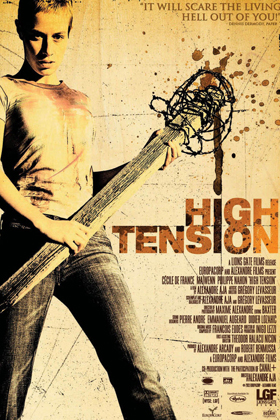
As I watched the end of High Tension, my immediate reaction was to storm out of my office, walk down the hallway, kick open the door to Arleigh’s mancave and yell at him for recommending this film to me. But then, I realized that Arleigh never recommended that I watch High Tension. He recommended La Horde and I got my French horror movies mixed up.
So, Arleigh is off the hook. I have no one to blame but myself and the filmmakers.
Anyway, High Tension is one of those films that starts out well but then totally falls apart due to a big twist that doesn’t make any sense. It’s also a pretty obvious rip-off of a Dean Koontz novel called Intensity. Intensity is a really good book, by the way. Perhaps not coincidentally, that awful twist that ruins High Tension is not present in Intensity. That twist was the one original thing that was contributed to High Tension and it pretty much ruined the whole movie.
Anyway, in High Tension, Marie (Cecile de France) and Alex (Maiwenn) are law students and best friends. Marie is spending the weekend with Alex’s family. She meets Alex’s mom. She meets Alex’s dad. She walks around at night and smokes a cigarette and sits on a swing and briefly spies on Alex as she showers. And then, during the night, a killer (Philippe Nahon) suddenly shows up, kills mom and dad, and kidnaps Alex! Determined to save her friend’s life, Marie chases the killer across the French countryside. For a while, she’s locked in the killer’s truck with Marie. And then, later on, she’s in a car and she’s chasing the truck. Because of the twist, it’s important to pay attention to the scenes where Marie is in a car and chasing the killer’s truck. Because, honestly, I’m not sure how any of that was supposed to have actually happened…
See, I love a good twist. I love a clever twist. I love an implausible twist. I love twists that are totally and completely over the top. What I do not like is a totally and completely unfair twist, one that cheats by basically defying the laws of the physics.
What’s truly unfortunate is that the film works perfectly without the twist. The twist is not necessary. (For proof, just read Intensity.) Up until the twist, the film is well-directed and suspenseful. Cecile de France, Maiween, and Nahon all give excellent performances. The film’s graphic violence may be excessive but it’s still undeniably effective. The nightmare-inducing gore effects were provided by Giannetto De Rossi, who created some of the most effective zombie makeup of all time for Lucio Fulci’s Zombi 2.
I mean, there’s so much that works and then just hit that twist and you shout, “Dammit!”
Tonight’s excursion into televised horror is the 10th episode of the 5th season of Tales From The Crypt!
Came The Dawn tells the twisted story of what happens when a mysterious hitchhiker (Brooke Shields) is picked up by a rich man (Perry King). This one is full of twists and turns as director Uli Edel pays homage to Hitchcock.
I have to admit that, when I first sat down to watch the 1979 version of Dracula, I wasn’t expecting much. I hadn’t even heard of the film until I came across it on Encore and, when I considered that it was made in 1979, I immediately assumed it would be a disco Dracula film.
And, let’s be honest — a disco Dracula film sounds kinda fun. But still, it’s Halloween. Dracula is an icon of horror. And somehow, the idea of watching disco Dracula just was not appealing. It would be appealing in November or September. BUT THIS IS OCTOBER!
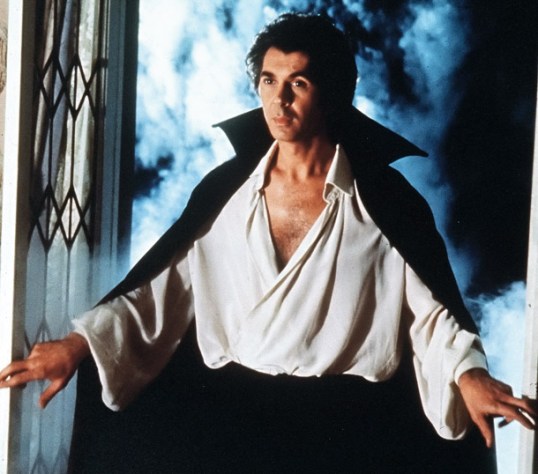
Well, despite my misgivings, I watched the film and I quickly discovered that it wasn’t a disco Dracula at all. This Dracula takes place in 1913 and there’s actually very little about it that would lead you to suspect that it had been made in the 1970s. Instead, it feels more like a tribute to the colorful and lushly erotic Dracula films that Hammer produced in the 60s. Except, oddly, the Hammer films were far more bloody than the 1979 version. Oh, don’t get me wrong. There’s a few gory scenes in 1979’s Dracula. Towards the end of the film, there’s a rather bloody impaling. Dracula graphically breaks another character’s neck as we watch. But, even with those scenes in mind, the 1979 Dracula feels oddly restrained at times.
In this version of Dracula, the title character is played by a youngish Frank Langella. I have to admit that it was a bit odd to see Langella playing someone other than a corrupt authority figure. Dare I say it, Langella is almost sexy in this film and his somewhat feral features are perfect for a character who considers wolves to be “the children of the night.” Langella’s performance falls between the haughty charm of Bela Lugosi and the animalistic fury of Christopher Lee. And while Langella’s performance never quite reaches the heights of those two actors, he’s still effectively cast.
As for the film itself, it starts with a shipwreck near a local asylum. One of the passengers on that ship is the charming but mysterious Count Dracula. Dracula introduces himself to the head of the asylum, Dr. Jack Seward (Donald Pleasence, stealing almost every scene in which he appears). There’s an immediate attraction between Dracula and Seward’s daughter, Lucy (Kate Nelligan). That does not amuse Lucy’s fiancee, Jonathan Harker (Trevor Eve, who is perhaps the whiniest Harker in film history).
Meanwhile, Lucy’s best friend, Mina (Jan Francis), has been taken ill and it might have something to do with the two puncture marks on her neck. After Mina dies, her father (played by Laurence Olivier) comes to investigate. Her father’s name? Abraham Van Helsing.
As I said, I was not expecting much from this version of Dracula so I was actually pleasantly surprised during the first hour of the film. This version gets off to a nice start, with director John Badham giving us a mix of lush romanticism and gothic moodiness. I’ve already talked about Langella’s performance but Donald Pleasence and Laurence Olivier also distinguish themselves. It’s obvious that these veteran performers enjoyed playing opposite each other and there’s a lot of pleasure to be found from watching Pleasence and Olivier compete to see who can steal the most scenes.
Unfortunately, after that strong first hour, Dracula slows down. Once Seward and Van Helsing know that Dracula is a vampire, the whole movie becomes about finding excuses for them to not do anything about it. The final 40 minutes feel almost like filler and, at one point, you’re required to believe that an elderly man, who has been seriously wounded, could still find the strength to swing a hook into a much stronger person’s back.
In the end, the 1979 Dracula is more of an intriguing oddity than a definitive version.
This October, I’m going to be doing something a little bit different with my contribution to 4 Shots From 4 Films. I’m going to be taking a little chronological tour of the history of horror cinema, moving from decade to decade.
Today’s horror on the lens is a made-for-TV movie from 1985!
In Deadly Messages, Kathleen Beller plays a woman named Laura who witnesses a murder and then becomes convinced that the murderer is after her. She also finds a Ouija board that continually sends her the same message: “I am going to kill you.” The police are skeptical of Laura. Even worse, her boyfriend (Michael Brandon) is skeptical! And, needless to say, Laura may have some secrets of her own…
Deadly Messages is a lot of fun. Thank you to frequent TSL commenter Trevor Wells for suggesting this movie!
For tonight’s excursion into televised horror, how about a little mummy-related terror!?
That’s what you get this episode of HBO’s Tales From The Crypt! From season 5, here is the ninth episode — Creep Course! What happens when you mix the principal from Ferris Bueller’s Day Offand the brain from the Breakfast Club with a mummy? Mayhem!
This episode originally aired on November 10th, 1993.
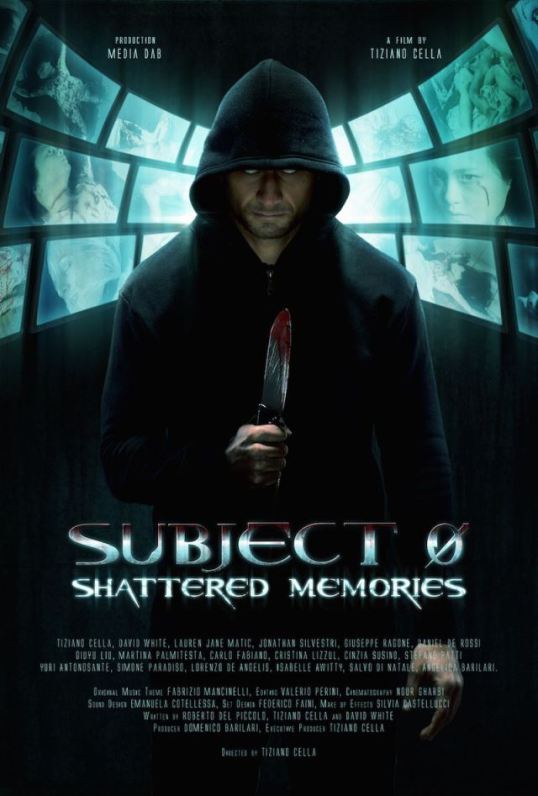
Last year, I had the chance to watch Subject 0: Shattered Memories, the feature-length debut of director Tiziano Cella.
Subject 0 is a film that juggles several different but ultimately connected storylines. In Rome, a woman wakes up one morning to discover that her lover has been murdered while she was asleep. Her husband, at first, acts as if he’s shocked to discover that she was cheating on him but, as the film progresses, we have reason to doubt anything that he says. As the film progresses, more and more people turn up murdered. A police inspector tries to solve the crime but he has no idea that one his colleagues has an agenda of her own.
Meanwhile, Josh (played by the film’s director) divides his time between his apartment and work. He has a crush on a co-worker but she already has a boyfriend. Josh’s neighbor continually threatens to call the police on him for making too much noise. All the while, Josh finds himself having hallucinations and comes to realize that there are huge chunks of his day that he cannot remember. Is Josh the murderer or is there something else going on?
And could it have anything to do with a group of sinister business executives who have been working on a project to develop a super soldier?
As a lot of our readers I know, I absolutely love old school Italian thrillers. Whether it’s the classic giallo films of Mario Bava, Dario Argento, and Sergio Martino or the gore-filled waking nightmares of Lucio Fulci, I love Italian horror. Subject 0 is a throwback to those old horror films, which is one reason why I enjoyed it. It combined the gore of Fulci with the suspense of Bava and the imagery of Argento and, as a result, Subject 0 is a tribute to everything that we love about Italian horror.
With the way that Subject O combined multiple storylines, body horror, conspiracy paranoia, and domestic drama, it also reminded me a bit of the classic British horror film, Scream and Scream Again. Much like that film, Subject 0 demands a little patience. Not all of its mysteries are immediately solveable. The clues are provided but, often times, it is up to the audience to put them together. (Subject 0 respects the intelligence of the audience and isn’t that a nice change of pace?) But for the observant viewer, Subject 0 delivers a powerful and, in its way, thought-provoking payoff.
In the end, Subject 0 is a nice combination of visceral shock and more subtle psychological thrills. Tiziano Cella does excellent work as both a director and an actor in this film and I look forward to seeing what he brings us in the future!
Ten years after making horror history as DRACULA, Bela Lugosi signed a contract with Monogram Studios producer Sam Katzman to star in a series of low-budget shockers. The films have been affectionately dubbed by fans “The Monogram Nine” and for the most part are really terrible, redeemed only by the presence of our favorite Hungarian. Two of the films were with the East Side Kids, SPOOKS RUN WILD and GHOSTS ON THE LOOSE, making them sort of Poverty Row All-Star Productions for wartime audiences.
I won’t go too deeply into all the Dead End Kids/East Side Kids/Bowery Boys variations here. Suffice it to say original Dead Enders Leo Gorcey (Muggs), Huntz Hall (Glimpy), and Bobby Jordan (Danny) landed at Monogram after their Warner Brothers contracts expired, much to Jack Warner’s relief. The young actors were a rowdy bunch, and Jack was probably glad to be rid of them! Anyway, the trio were popular with the masses, and…






 Through the Shattered Lens