The TSL’s Daily Horror Grindhouse: Amityville II: The Possession (dir by Damiano Damiani)


amityville_ii_the_possession

Agck!

The 1982 “prequel” Amityville II: The Possession is a film that is so grimy and icky and yucky and disgusting that you’ll want to take a shower right after you watch it.  And then you’ll probably end up taking two more showers, just to be sure that you’ve washed the film away.

Seriously, this is an amazingly disturbing film.

Claiming to show how that infamous house in Amityville, New York came to be haunted in the first place, this film opens with The Montelli Family moves into a big house with quarter moon windows.  The family patriarch is Anthony (Burt Young), a former cop who walks with a cane.  Anthony is an angry monster, an abusive husband, and a terrible father.  His wife, Dolores (Rutanya Alda), lives her life in denial, insisting that a new house means a new beginning and continually praying that her family will find peace.  Anthony and Dolores have four children.  The two youngest are at the mercy of their angry father.  Teenagers Patricia (Diane Franklin) and Sonny (Jack Magner) are both looking forward to the day that they can escape their family.

As soon as the Montellis move in, strange things start to happen.  It turns out that there’s a strange tunnel in the basement, one that appears to lead to nowhere.  When obscene messages appear on the walls of the house, Anthony starts to beat the youngest children but, fortunately, Sonny grabs a rifle and points it at his father’s head.  When the local priest, Father Adamsky (James Olson), shows up to bless the house, he ends up getting so disgusted at Anthony that he leaves without finishing.

In fact, Father Adamsy is a remarkable ineffectual priest.  When he attempts to talk to Sonny, he simply assumes that Sonny isn’t talking because he’s rude.  What Adamsky doesn’t suspect is that Sonny’s being rude because he’s been possessed by a demon for the basement!  When Patricia confesses that she and Sonny have been having sex, Adamsky doesn’t do anything about it.  When Patricia tries to call him to let him know that her brother appears to be possessed, Adamsky refuses to answer the phone and instead goes skiing for the weekend.

And, of course, while Adamsky is gone, Sonny grabs that rifle and, in a nightmare-inducing series of scenes, kills everyone in the house…

Of course, when Father Adamsky returns, he feels guilty and he decides to perform an exorcism.  MAYBE HE SHOULD HAVE DONE THAT EARLIER!  But no … he had to go skiing…

Anyway, Amityville II: The Possession is a deeply icky film.  It’s undeniably effective and has a lot of scary moments but it’s not an easy film to sit through.  Between Anthony beating his family and Sonny walking into Patricia’s room and asking her to “play a game,” this is a film that really gets under your skin.  You’ll never forget it but, at the same time, you’ll also never want to watch it again.

Interestingly enough, Amityville II was directed by Damiano Damiani, an Italian director who is probably best known for movies like A Bullet For The General and Confessions of a Police Captain, genre films that often featured a subversive political subtext.  Though Amityvile II is not overly political, the film’s portrait of the suburban Montelli family as a ticking time bomb does definitely fit in with Damiani’s other work.  Damiani reportedly set out to make the most disturbing film that he possibly could and he succeeded.

Halloween Havoc!: THE HOUSE THAT DRIPPED BLOOD (Amicus 1971)


gary loggins's avatarcracked rear viewer

drip1

Hammer Films wasn’t the only British company cranking out the horrors back in the 60’s and 70’s. American ex-pats producers Milton Subotsky and Max Rosenberg formed Amicus Films in 1962 and after a couple of films aimed at the teen audience (with American rockers like Chubby Checker, Del Shannon, Freddy Cannon, and Gene Vincent) began concentrating on horror. The team specialized in the anthology genre, or “portmanteau” as the intelligentsia call them. I’ll stick with anthologies!

THE HOUSE THAT DRIPPED BLOOD was a 1971 effort written by Robert Bloch, forever known as “The Guy Who Wrote PSYCHO”. The nail to hang Bloch’s four tales on concerns the disappearance of famous horror actor Paul Henderson, who was last seen at the old house in the countryside. Inspector Holloway (John Bennett) of Scotland Yard (where else?) arrives on the scene and speaks with the local constable, who warns Holloway about mysterious doings past:

drip2

In “Method for Murder”…

View original post 690 more words

Horror Film Review: Targets (dir by Peter Bogdanovich)


targetsposter

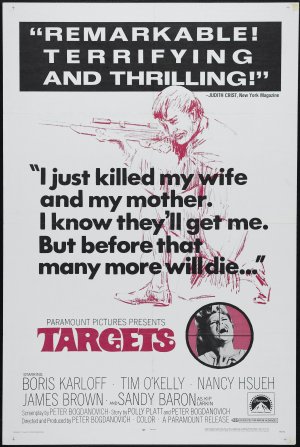
The year was 1968 and legendary producer Roger Corman had aging horror star Boris Karloff under contract.  Karloff still owed Corman two days of work and Corman was never one to let an opportunity pass him by.  Corman approached film critic Peter Bogdanovich and made him an offer.  Corman would finance any film that Bogdanovich wanted to make, on the condition that he stayed under budget, used Boris Karloff, and included some scenes from The Terror.  Bogdanovich agreed and the end result was one of the best films of Karloff’s long career.

Karloff plays Byron Orlok.  Orlok (named, of course, after the vampire in Nosferatu) is a veteran horror star who now finds himself working almost exclusively in B-movies.  When the film starts, he’s just announced his retirement.  Orlok is bitter that Hollywood never fully appreciated his talents but, beyond that, he’s come to believe that horror movies can never hope to compete with the horrors of the real world.  People have become so desensitized to horror that it’s impossible to scare them, he believes.  Orlok plans on making one final promotional appearance at a drive-in that will be showing his final film.  (His final film, of course, is The Terror.)

Meanwhile, there’s a man named Bobby Thompson (Tim O’Kelly) and he’s about to shock the world.  Bobby has just recently returned from Vietnam.  He works as an insurance agent and his cheerfully bland countenance hides the fact that Bobby is going insane.  He is struggling to pay the bills and he resents the fact that his wife is now working and that they have to live with his parents.  His strict and taciturn father continues to criticize him, especially after Bobby points a rifle at him during target practice.  Bobby, incidentally, loves his guns.  After he murders both his wife and his mother, Bobby uses that gun to start shooting at strangers.

Bobby starts his rampage by shooting at cars on the freeway but eventually, he ends up at the drive-in.  While The Terror plays out on the big screen, Bobby shoots at the men, women, and children who have gathered to watch the movie, proving Orlok’s point that cinematic horror cannot hope to match the horror of everyday life…

Even though it was made 48 years ago, Targets is a film that feels extremely relevant today.  As I watched the film, I couldn’t help but think about not only James Holmes’s 2012 rampage in Aurora, Colorado but also the more recent sniper attacks in my hometown of Dallas.  For me, it was interesting to see that apparently this stuff was going on even in 1968.  (We tend to think of mass shooting as being a recent phenomena.)  Targets is an open plea for gun control (which, again, is something that we tend to think of as being a relatively new thing).  I’ll leave the political debate for others to consider and instead just say that Targets is a chilling portrait of both madness and violence.

However, Targets also works brilliantly as a tribute to Boris Karloff.  Though he may have never been as bitter as Orlok, Karloff is basically playing himself in Targets.  He’s portrayed as a cultured and kindly man who just happened to be very good at playing scary characters and Karloff gives perhaps his best performance in the role. Some of the best scenes in Targets are the scenes where Orlok (and, by extension, Karloff) discusses his career with his friend, Sammy Michaels (played by Bogdanovich).  You find yourself really wishing that you could have hung out on the set of Targets just to hear the stories that were told while the cameras weren’t rolling.

(Incidentally, Sammy Michaels was named after famed director Sam Fuller, who helped to write the film’s screenplay and provided a good deal of free advice to Bogdanovich.)

Targets works as both a horror film and a tribute to a great actor.  If for no other reason, watch it for Boris.

4 Shots From Horror History: The Living Dead Girl, The Howling, Videodrome, A Nightmare on Elm Street


This October, I’m going to be doing something a little bit different with my contribution to 4 Shots From 4 Films.  I’m going to be taking a little chronological tour of the history of horror cinema, moving from decade to decade.

Today, we continue the 80s!

4 Shots From 4 Films

The Living Dead Girl (1982, dir by Jean Rollin)

The Living Dead Girl (1982, dir by Jean Rollin)

Poltergeist (1982, dir by Tobe Hooper)

Poltergeist (1982, dir by Tobe Hooper)

Videodrome (1983, dir by David Cronenberg)

Videodrome (1983, dir by David Cronenberg)

Nightmare on Elm Street (1984, dir by Wes Craven)

Nightmare on Elm Street (1984, dir by Wes Craven)

Horror on the Lens: The Terror (dir by Roger Corman, Francis Ford Coppola, Jack Hill, Monte Hellman, Dennis Jakob, and Jack Nicholson)


(As some of you may have noticed, I shared this movie last year as well.  However, since the video that I embedded in the previous post was subsequently taken down, I figured I might as well post it again this year.  Plus, it’s Boris Karloff, Jack Nicholson, and Dick Miller!  Why not post it twice?)

Have you ever woken up and thought to yourself, “I’d love to see a movie where a youngish Jack Nicholson played a French soldier who, while searching for a mysterious woman, comes across a castle that’s inhabited by both Dick Miller and Boris Karloff?”

Of course you have!  Who hasn’t?

Well, fortunately, it’s YouTube to the rescue.  In Roger Corman’s 1963 film The Terror, Jack Nicholson is the least believable 19th century French soldier ever.  However, it’s still interesting to watch him before he became a cinematic icon.  (Judging from his performance here and in Cry Baby Killer, Jack was not a natural-born actor.)  Boris Karloff is, as usual, great and familiar Corman actor Dick Miller gets a much larger role than usual.  Pay attention to the actress playing the mysterious woman.  That’s Sandra Knight who, at the time of filming, was married to Jack Nicholson.

Reportedly, The Terror was one of those films that Corman made because he still had the sets from his much more acclaimed film version of The Raven.  The script was never finished, the story was made up as filming moved alone, and no less than five directors shot different parts of this 81 minute movie.  Among the directors: Roger Corman, Jack Hill, Monte Hellman, Francis Ford Coppola, and even Jack Nicholson himself!  Perhaps not surprisingly, the final film is a total mess but it does have some historical value.

(In typical Corman fashion, scenes from The Terror were later used in the 1968 film, Targets.)

Check out The Terror below!


Halloween TV Havoc!: GHOST STORY “Elegy for a Vampire” (1972)


gary loggins's avatarcracked rear viewer

ghst1

NBC-TV tried to bring a horror anthology series back to prime time during the 1972-73 season with GHOST STORY, executive produced by the one-and-only William Castle . Sebastian Cabot played Winston Essex, introducing the tales from haunted Mansfield House hotel. GHOST STORY had great writers, including Richard Matheson (who helped develop the concept), Robert Bloch, Harlan Ellison, Henry Slesar, and Hammer vet Jimmy Sangster, some good directors (Richard Doner, John Llewelyn Moxey, Robert Day), and a plethora of Hollywood talent: Karen Black, Kim Darby, Angie Dickinson, Melvyn Douglas, Patty Duke, Jodie Foster, Helen Hayes, Tab Hunter, John Ireland, Janet Leigh, Patricia Neal, Jason Robards, Gena Rowlands, Martin Sheen, and William Windom.

Despite all this, the show got clobbered in the ratings by the CBS FRIDAY NIGHT MOVIE and ABC’s comedy duo of ROOM 222 and THE ODD COUPLE. A mid-season title change to CIRCLE OF FEAR (dropping the Cabot segments in the process) didn’t help, and…

View original post 57 more words

The TSL’s Daily Horror Grindhouse: Long Time Dead (dir by Marcus Adams)


key_art_long_time_dead

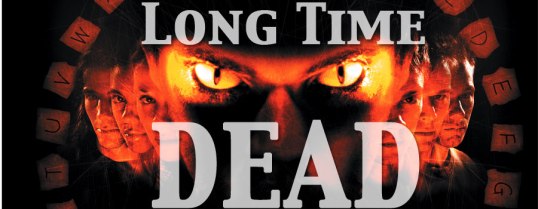
Am I the only person in the world who likes the 2002 British horror film, Long Time Dead?

I sometimes think that I may be.  Whenever I mention the film to anyone, they either say they’ve never heard of it or they kind of roll their eyes.  I have yet to read a positive review online.  Long Time Dead has only got a 4.9 rating at the imdb, which is saying something because usually even the worst of films can still manage to score at least a 6.0.

So, I guess it’s true.  I guess only I like Long Time Dead.

Now, I should clarify that, just because I like a movie, that doesn’t necessarily mean that it’s very good.  Long Time Dead is definitely a flawed film.  This is one of those films where an evil spirit — in this case, a fire demon known as a djinn — pursues a group of friends, killing them one-by-one.  There are eight friends, which seems to be a bit excessive for a 94 minute film.  We’re never quite sure how all of these characters got to know each other in the first place.  Some of them appear to be college students.  Four of them share a flat.  Another one lives on a boat.  And as for the other three, they appear to all live in the same building but still, you’re never really sure how everyone is related.

What’s odd is that we only really get to know five of the eight characters, which again leads the viewer to wonder why we needed the other three.  We know that Spencer (James Hillier) is perpetually stoned and that all of this is kind of his fault because he’s the one who suggested that the group should use a Ouija board to try to contact a spirit.  We know that his girlfriend, Lucy (Marsha Thomason), knows about the supernatural and, for some reason, lives on a boat.  We know that Liam (Alec Newman) was traumatized when his father murdered his mother.  We know that Liam’s girlfriend, Annie (Melanie Gutteridge), has asthma.  We know that Rob (Joe Absolom) appears to be a nice guy.  And then there’s Webster (Lukas Haas), Stella (Lara Belmont), and Joe (Mel Raido), who don’t really have any reason for being in the movie.

(Seriously, what is respected Texas character actor and friend-of-Leonardo-DiCaprio Lukas Haas doing in a low-budget British horror film?)

At first, we’re led to believe that the djinn is killing people because it’s upset that it was dragged out of its world by the Ouija board.  But, as the film progresses, we learn that the djinn has a personal score to settle with one of his potential victims.  We also learn that someone may or may not be possessed by the djinn.  It’s all a bit too much to keep track of.  I’ve read rumors that Long Time Dead was a difficult production and the fact that the film has seven credited writers might provide a clue as to why the film is such a narrative mess.

And yet, despite all of that, I still like Long Time Dead.

Why?

The reason is very simple.

The movie scared me.

Maybe it was because I was watching it late at night and I had the lights out or maybe it was because, as an asthmatic, I related to poor Annie but Long Time Dead scared the Hell out of me the first time I saw it.   Not only is the film full of effective jump scenes but the djinn is a terrifying monster.  He’s relentless, ruthless, and merciless.  I think what truly scared me is that the djinn would attack anyone anywhere.  There was literally nowhere that you could hide from it.

Long Time Dead is no classic but it still made me scream.

Horror on TV: Thriller 1.1 “The Twisted Image”


Tonight’s excursion into televised horror is the very first episode of Boris Karloff’s Thriller!

Thriller was an anthology series that lasted from 1960 to 1962.  Each episode presented a new story of horror and/or suspense.  What makes this series especially memorable is that each episode was introduced by none other than Boris Karloff!  I’ve seen a few episodes of Thriller (the entire series is on YouTube) and, to be honest, it’s kind of a hit-or-miss show.  But Karloff and that mischievous twinkle in his eye makes it all worth it!

This episode originally aired on September 13th, 1960.  It’s called The Twisted Image and stars Leslie Neilsen as a man being stalked by two mentally disturbed individuals.  This episode was well-directed by Arthur Hiller and, if it’s more of a suspense story than a horror story, it still has its creepy moments.

Enjoy!

Horror Film Review: The Revenge of Frankenstein (dir by Terence Fisher)


revengetitle

Last year, Gary reviewed the first of the Hammer Frankenstein films, The Curse of Frankenstein.  For today’s horror film review, I’m going to take a look at the second movie in Hammer’s Frankenstein series, 1958’s The Revenge of Frankenstein!

The Revenge of Frankenstein opens where The Curse of Frankenstein ended.  The monster (played by Christopher Lee in the first film) has been destroyed and Baron Frankenstein (Peter Cushing) has been sentenced to be executed for the monster’s crimes.  However, the Baron escapes the guillotine.  Instead, he arranges for a priest to be beheaded in his place.  Working under the name Dr. Stein, the Baron escapes to another village and, after several years, re-establishes himself as a wealthy and respected doctor.  While most of his patients are rich, Dr. Stein also helps the poor and the disabled.  By all accounts, he’s doing wonderful work but he’s also deliberately enigmatic, refusing to join the local doctors council.

Right from the beginning, we’re reminded of just how different Hammer’s Baron Frankenstein was from Universal’s version of the good doctor.  In the Universal films, Dr. Frankenstein — regardless of whether the doctor in question was Henry, Wolf, or Ludwig — was always portrayed as being misguided but ultimately noble.  If any of the Universal Frankensteins had been sentenced to death, it’s probable that they would have put on a stoic face, walked to the guillotine, and allow their head to roll.  In fact, they would have felt so responsible for the actions of the Monster that they probably would feel it was their moral duty to allow themselves to be executed.

That’s not the case when it comes to Hammer’s Baron Frankenstein.  Baron Frankenstein feels no guilt over what the Monster has done.  Go the guillotine?  No way!  Baron Frankenstein is determined to create life and if creating life means that other, lesser mortals end up dead … well, so be it.  As opposed to the Universal Frankensteins, who all developed god complexes after the success of their experiment, Baron Frankenstein has his god complex from the beginning.  And if Baron Frankenstein is a god, why shouldn’t a priest be sacrificed for the good of the Baron’s work?

Anyway, Dr. FrankenStein and his assistant, Dr. Kleve (Francis Matthews) are determined to once again bring the dead back to life.  This time, the plan involves transplanting the brain of hunchback Karl (Oscar Quitak) into a physically strong body (played by Michael Gwynn).  Dr. Kleve is worried that a brain transplant could lead to unforseen complications.  For instance, one of Dr. Stein’s chimpanzees reacts to being given an orangutan’s brain by turning into a cannibal.  However, Stein tells Dr. Kleve not to worry about it.  After all, what could go wrong?

Well, a lot goes wrong.  It’s a Frankenstein movie, after all.

I have to admit that, while I love Hammer’s Dracula films, I’ve never been a huge fan of their take on Frankenstein.  While Peter Cushing always makes for a wonderfully compelling and often chillingly evil Baron Frankenstein, the majority of the Hammer Frankenstein films always seem to move way too slowly.  Whenever I watch one of them, I always find myself growing rather impatient with the endless scenes of grave robbery and body stitching.  “HURRY UP AND BRING THAT DAMN THING TO LIFE!” I’ll find myself shouting.

However, I was actually pleasantly surprised by how well The Revenge of Frankenstein holds up.  That Cushing would give an excellent performance as Baron Frankenstein is to be expected.  But really, the entire film is well-acted and both Oscar Quitak and Michael Gwynn give poignant performances as Frankenstein’s latest experiment.  It’s a visually vibrant and nicely paced horror film, one that never drags like some of the later Hammer Frankenstein films.

The Curse of Frankenstein and The Revenge of Frankenstein make for a great double feature, especially in October!

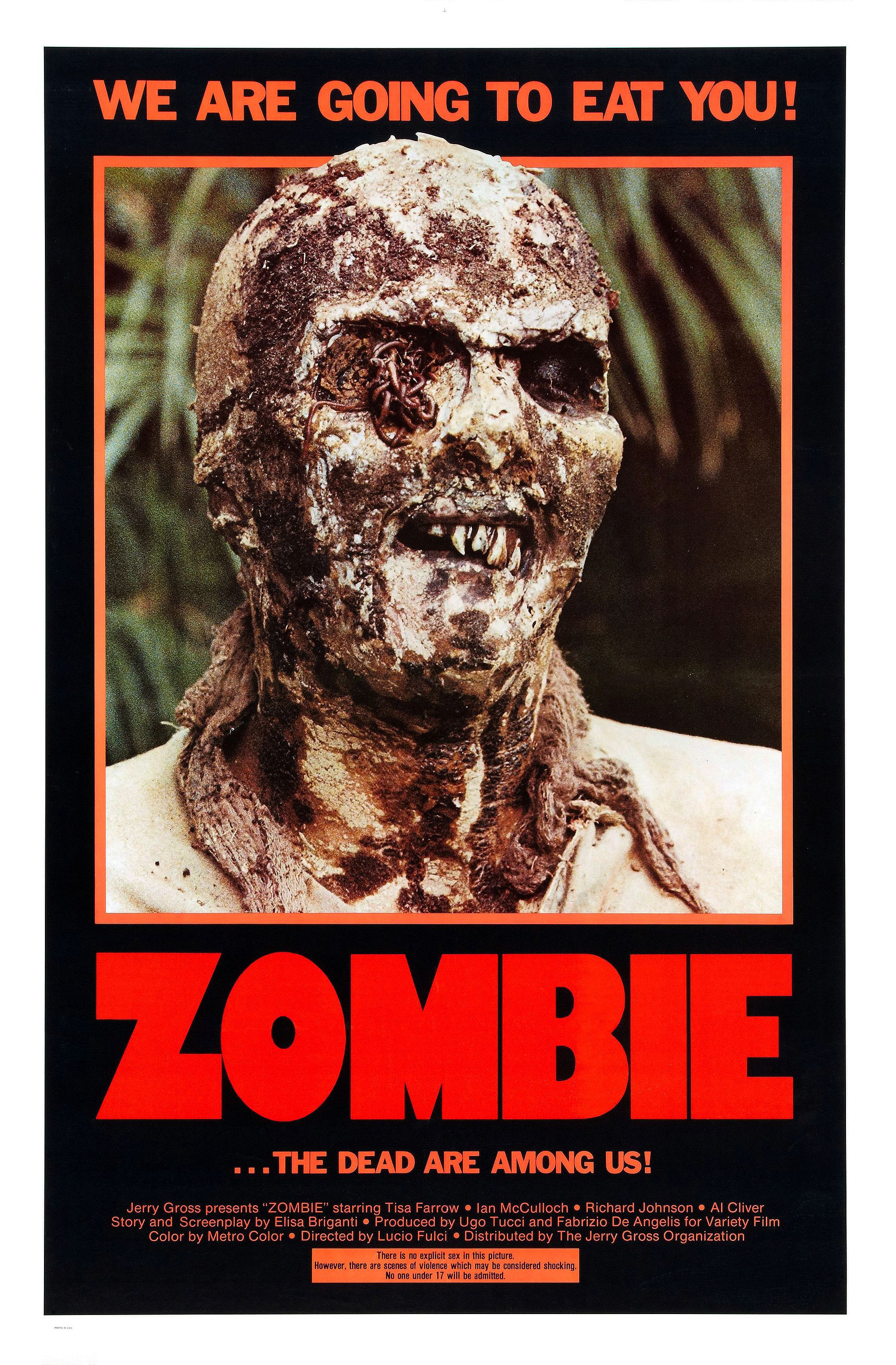
Halloween Havoc!: ZOMBIE (Variety Film 1979)


gary loggins's avatarcracked rear viewer

zomb1

I’ll admit, I’m a latecomer to the Lucio Fulci bandwagon. I viewed my first film by The Maestro, THE HOUSE BY THE CEMETERY , earlier this year, and absolutely loved it! I’ve been looking for more Fulci films to discover ever since, and recently recorded his most famous, ZOMBIE, off the El Rey Network (which I highly recommend to Grindhouse fans out there). ZOMBIE goes by many names, but this is the title I watched it under, so we’ll stick with that.

zomb2

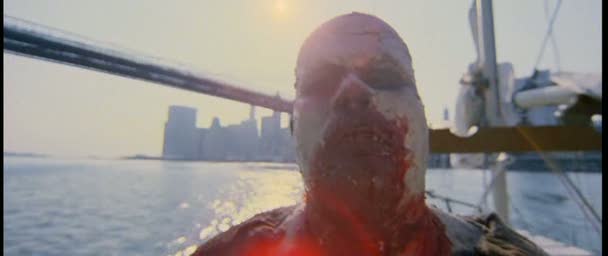
From that opening shot of a gun pointed at the camera, then blasting the head of a rising corpse, I knew I was in for a good time! After the credits roll, we see a derelict ship floating in New York harbor. The harbor patrol boards it, and find it deserted, with rotting food and supplies strewn everywhere. One of the cops investigates further, and is killed by a zombie…

View original post 746 more words