Horror Film Review: Hell Night (dir by Tom DeSimone)


Hell-night-1981

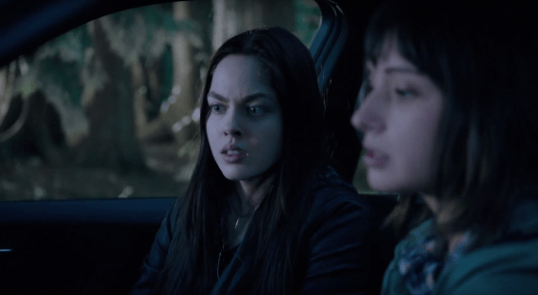
It’s pledge initiation night at Generic University!  Four students are hoping to join the Alpha Sigma Rho fraternity and its sister sorority.  Denise (Suki Goodwin) is English and never goes anywhere without a supply of quaaludes and a flask of Jack Daniels.  Seth (Vincent Van Patten) is the blonde jock, who wants to spend the entire night hooking up with Denise, despite the fact that Denise keeps calling him, “Wes.”  Jeff (Peter Barton) is the sensitive rich kid who fears that the only reason he’s getting into the fraternity is because of his family’s money.  And Marti (Linda Blair) is the girl from a poor family who works on cars during her spare time.  In order to pass the initiation, they have to spend the night in deserted Garth Manor.

However, they won’t be alone in Garth Manor.  The president of the fraternity, Peter (Kevin Brophy), is planning on spending the entire night playing pranks on them.  Helping him will be his girlfriend, May West (Jenny Nuemann) and his nerdy best friend, Scott (Jimmy Sturtevant).  Unfortunately, what Peter did not realize was that the four pledges are all smart enough to know that he’s going to be trying to scare them.  As a result, they just ignore his best efforts to make things creepy.

Of course, what none of them know is that the legend of Garth Mansion is actually true.  As Peter explains at the beginning of the film, it has long been rumored that Mr. Garth murdered his entire family, except for his horribly deformed son Andrew.  They say that Andrew still lives in the mansion, waiting for a chance to attack and kill all trespassers…

And that’s pretty much exactly what happens!

But you know what?  For a relatively straight forward slasher film from 1981, Hell Night is not a bad film at all.  In fact, with its relative lack of gore, nudity, and painfully stupid victims, it can probably be argued that Hell Night is a slasher film for people who don’t like slashers.  Hell Night emphasizes atmosphere over easy shocks and actually devotes some time to characterization.  Even if the majority of the characters are familiar horror film types, you still care about them.  Even poor Denise, who has the thankless role of being the sexually independent girl who you know is doomed from the minute she first appears on screen, gets a few good lines.

(Plus, the film opens with a costume party so, of course, all of the outfits are to die for!)

One of the things that really made Hell Night effective is that the characters are not idiots.  They don’t just stand around waiting to be picked off.  At first, they just assume that any and all strangeness is a result of Peter trying to scare them.  When it becomes obvious that Andrew Garth is alive, one of them manages to escape the manor and goes straight to the cops.  And how do the cops react?  They tell him that they’re tired of dealing with drunk frat boys and order him to go home, adding to the hopelessness of the situation.

(But, honestly, if some random guy told you that a deformed monster was trying to kill him, would you believe him?)

Hell Night is full of scary atmosphere, clever lines, and good acting.  As far as early 80s slasher movies go, it’s one of better examples of the genre.

Horror on the Lens: Feeders (dir by Jon McBride, John Polonia, and Mark Polonia)


For this morning’s horror on the lens, we have a low-budget alien invasion film from 1996.  The name of the film is Feeders and, much like Exorcist II: The Heretic, this is one of those films that simply has to be seen to be believed.

Patrick and I watched this with the Late Night Movie Gang back in July.  And we had a lot of fun with this film.  Feeders definitely rewards a snarky attitude.  Now, if you’re looking for a film with amazing special effects, great acting, and a good script, Feeders may not be for you.  But if you’re looking to enjoy watching a true WTF!? epic, so bad-its-watchable Feeders is for you!

Here’s the Official U.S. Trailer For Pride and Prejudice and Zombies!


Here’s the official U.S. Trailer for Pride and Prejudice and Zombies!  On the one hand, the trailer looks good.  On the other hand, the film is being released in February and it’s rare that anything good is ever released in February.

Horror on TV: The Twilight Zone 2.18 “The Odyssey of Flight 33”


TheTwilightZoneLogo

Remember how this morning’s movie — Robot Monster — featured dinosaurs?

Well so does tonight’s episode of The Twilight Zone!  In The Odyssey of Flight 33, a commercial airline flight somehow flies straight into the past, where they see …. dinosaurs!  Now, I’ll be honest here.  These are not dinosaurs like the dinosaurs in Jurassic World.  But I imagine for 1961, those dinosaurs were pretty impressive!

And this episode holds up as well.  I especially love the ambiguous ending.

The Odyssey of Flight 33 originally aired on February 24th, 1961.

The TSL’s Daily Horror Grindhouse: The Nun (dir by Luis De La Madrid)


The Nun (2005, directed by Luis De La Madrid)

When talking about the 2005 Spanish horror film The Nun, it’s best to admit one thing from the start.  This film has got an absolutely terrible ending.

It seems to be the unwritten rule of modern horror that every movie has to have a “shocking” twist that’s revealed during the film’s final 10 minutes.  Occasionally, the twist is so well-done and memorable that it will actually redeem an otherwise forgettable film.  Far too often, the twist turns out to be so predictable that most filmgoers will have guessed what it is within the first few minutes of the film.  And then you’ve got a film like the Nun, where the twist will be so bad and so illogical that it’ll actually cause you to hate the entire film regardless of how effective it may have been before the twist was revealed.

I’ve debated with myself whether or not to just say “Spoilers be damned!” and reveal film’s twist in this review.  Seriously, it literally comes from out of nowhere and it’s so ludicrous that I almost feel like I have a responsibility to warn you about what the film has up its sleeve.  However, after a lot of thought, I’ve decided not to give the specifics of the twist.  Instead, I’m just going to tell you that it’s there and it’s really, really stupid.  It’ll probably make you hate the entire film.  If you ever find yourself watching The Nun, maybe you should stop watching around the 90 minute mark, just so you don’t have to deal with “twist.”

Because, seriously, until that twist shows up, The Nun is actually a pretty well-done ghost story.

The movie tells the story of Sister Ursula, an insane nun who terrorizes six of her students until eventually, they end up fighting back and accidentally drowning her.  They hide her body in a nearby pond and go on with their lives.  However, 18 years later, the pond is drained and the former classmates start to die one by one.

Whenever it rains or a bathtub overflows or water drips from a leaky faucet, a murderous apparition of the Sister Ursula is formed from the drops of water.  It may be because I was raised Catholic and I’ve actually experienced Catholic school firsthand but I thought that the apparition of Sister Ursula was one of the most effective cinematic ghosts that I’ve seen in a long time.  Forming from clouds of mist and with a permanently enraged expression on her twisted face, Sister Ursula is a nightmare personified and, as long as she’s lurking about in the shadows, it doesn’t matter that the film itself doesn’t make much sense.  Sister Ursula is scary and the scenes where she takes revenge on her former students are truly frightening.

But the film couldn’t be happy just being the type of simple (but effective) ghost story that would keep you awake at a slumber party.  Instead, the film has to introduce that terrible “twist” during the final ten minutes and, as a result, the entire film collapses.

Sometimes, it’s better just to keep things simple.

Horror Film Review: Exorcist II: The Heretic (dir by John Boorman)


Exorcist2poster

The Exorcist is one of the greatest horror films of all time and a personal favorite of mine.  But what about Exorcist II: The Heretic?  Well, it would be a bit of an understatement to say that The Heretic has not quite received the amount of critical acclaim as the first film.  Since it was first released in 1977, The Heretic has been widely considered to be one of the worst sequels of all time.  It’s a film that is often cited as evidence as to why not all successful films need a follow-up.

Myself, I have sat through The Heretic twice.  And yes, it is a pretty bad film but I have to admit that I enjoyed it each time that I saw it.  It’s not a scary film at all.  It’s not a successful horror film.  But, as an unintentional comedy, it’s hilarious.

The Heretic opens four years after the end of The Exorcist.  Father Merrin (Max von Sydow) is dead, having had a heart attack during the first film while performing an exorcism on Regan MacNeil (Linda Blair).  In the years since, some in the Vatican have cast doubt on whether or not Merrin actually performed exorcisms.  It turns out that, contrary to everything that we saw in the first film, Father Merrin was actually something of a rebel.  His teachings are controversial.  For instance, he was convinced that everyone has latent psychic powers and that the demon Pazuzu possesses those who have the potential to be the strongest psychics.  Why?  Because those people have the ability to lead humanity into a shared global consciousness and…

Well, it gets a little bit complicated.  That’s one of the big differences between The Exorcist and Heretic.  The Exorcist kept things relatively simple.  The Heretic drags in a lot of metaphysical argle bargle.

The deceased Father Merrin has been brought up on charges of heresy.  The Cardinal (Paul Henreid, many, many years after Casablanca), assigns Father Lamont (Richard Burton) to investigate the circumstances surrounding Father Merrin’s final exorcism.

The presence of Richard Burton is what elevates Heretic from merely being bad to being so bad that it’s good.  As written, Father Lamont is supposed to be something of a naive idealist, someone who never met Father Merrin but who has been intrigued by his writings.  Reportedly, several youthful actors turned down the role and eventually, production decided to make Lamont an older man and they ended up casting Richard Burton.  Speaking in a shaky rasp and staring at the camera with bloodshot eyes, Burton appears to be at the height of his famous self-loathing in this film.  Burton is so miscast as an idealistic priest that the film becomes fascinating to watch.  Occasionally, the film tries to make us suspect that Lamont himself may be possessed but with Burton snarling his way through the role, how could anyone tell the difference?

Lamont tracks Regan down in New York.  Regan doesn’t remember a thing about the exorcism and appears to be an overly happy teenage actress.  (A good deal of the movie is devoted to her rehearsing a big dance number.)  She is under the care of psychiatrist Gene Tuskin (Louise Fletcher).  Tuskin has a device called the Synchronizer.  When two people are hooked up to it, they can literally see into each other’s minds.  They can share the same memories.  They can … wait a minute.  What the Hell?  The Synchronizer essentially appears to be little more than a blinking light but it can actually allow you to enter into someone else’s mind?  Doesn’t that seem like that should be a big deal?

Well, it’s not.  Everyone pretty much just shrugs and accepts it…

Through the use of the Synchronizer, Reagan, Lamont, and Tuskin get to watch a lot of scenes from the first Exoricst.  It also allows Father Lamont to have visions of Africa and another exorcism, this one involving a young boy named Kokumo.

This leads to one of my favorite parts of the film; Richard Burton wandering around a dusty African market and randomly telling people, “I am looking for Kokumo.”  It turns out that Kukomo has grown up to be a doctor and he’s now played by James Earl Jones, who appears to be amused by his dialogue.  Also showing up in the film’s Africa scenes is Ned Beatty.  Beatty plays a pilot who flies Lamont to Kokumo’s village.  “Have you come here before?” Beatty asks.  “Once … on the wings of a demon,” Lamont replies.

Well, okay then…

The first Exorcist worked largely because William Friedkin directed it as if he was making a documentary.  John Boorman takes the exact opposite approach here, trying to turn a cheap sequel into a metaphysical meditation on good, evil, and nature.  It’s amazingly pretentious and it would actually be rather annoying if not for the fact that Burton doesn’t make the slightest bit of effort to come across as being in any way emotionally or intellectually invested in his over-the-top dialogue.  When you combine Burton’s overwhelming cynicism with Linda Blair’s nearly insane perkiness, Louise Fletcher’s genial confusion, and James Earl Jones’s cheerful humor, the end result is something that simply has to be seen to be believed.

So, yes, The Heretic is as bad as you’ve heard.  But that doesn’t mean you shouldn’t watch it.

Horror on the Lens: Robot Monster (dir by Phil Tucker)


Robot Monster

I realize I shared this last year as well, but hey, it’s Robot Monster!  It’s a movie about what happens when Earth is invaded by a gorilla wearing a diving helmet.  (For some reason, it also causes the dinosaurs to come back to life.)  It’s one of the most compulsively watchable bad movies ever made so how could I be expected to resist the opportunity to share it again?

Seriously, it’s Robot Monster!

Horror On TV: Baywatch Nights 2.16 “Zargtha”


Tonight on Baywatch Nights

A mythical wolf man from Eastern Europe is murdering runaways in Los Angeles.  Can David Hasselhoff and Angie Harmon save the day?

Watch to find out!

And remember … “Don’t go out at night, or the zargtha will get you!”

(Zargtha originally aired on April 5th, 1997)

The TSL’s Daily Horror Grindhouse: Deathdream (dir by Bob Clark)


deathdream_poster_01

The 1974 film Deathdream opens with American soldier Andy Brooks (played by Richard Backus) on patrol in Vietnam. When he’s suddenly shot by an unseen sniper, he hears his mother’s voice calling out to him, telling him that he promised to come home. With the voice filling his head, Andy closes his eyes.

Sometime later, back in America, Andy’s family has been informed that Andy was killed in action. His father (John Marley, who you might recognize as the man who played Jack Woltz in The Godfather) and his younger sister (Anya Ormsby) have managed to accept the fact that Andy is dead but his mother (Lynn Carlin) remains in denial. Oddly enough, his mother is apparently proven to be correct in her doubts when Andy suddenly shows up at the front door.

The family (and, eventually, the entire community) welcomes Andy home but it quickly becomes apparent that Andy has returned as a far different person than when he left. Now pasty and emotionless, Andy spends most of his day sitting around listlessly. It’s only at night that Andy seems to have any energy and he spends those hours wandering around town and hanging out in the local cemetery.

It quickly becomes apparent to his father that Andy is no longer quite human. However, his devoted mother continues to insist that nothing is wrong with Andy and, once it becomes apparent just what exactly Andy is doing in order to survive, she becomes just as fanatical about protecting him as his father is about destroying him.

Not surprisingly, Deathdream is more than just a zombie film.  When Andy suddenly shows up on his family’s doorstep, he’s more than just a decaying monster.  He’s also a metaphor for the unease that viewers in the 70s would have felt about the state of American society.  (Of course, in many ways, contemporary viewers share that same unease.)  Andy goes off to war and it literally robs him of his humanity.  I would also argue that, in its way, Deathdream serves as a satire of the type of complacent society that sends young people off to fight for their lives and then expects them to come back exactly the same as they were before they left.  No matter how strange Andy’s behavior becomes, the people around him are willing to either ignore it or make excuses for it.  Andy’s mother emerges as a stand-in for everyone who willfully refuses to acknowledge the human consequences of war.

Deathdream is one of those wonderful horror films that deserves to be better known than it is. Deathdream was an early credit for the legendary effects artist Tom Savini and, while the film itself is not especially gory, Savini’s work can definitely be seen in the scenes where Backus’s body slowly decays. Screenwriter Alan Ormsby and director Bob Clark (who later went on to direct the far different A Christmas Story) perfectly creates and maintains a deceptively low-key atmosphere of perpetual unease while the cast elevates the entire film. Backus makes for an all-too plausible ghoul and Marley is great as a man struggling to understand what his son has become. The film is totally stolen, however, by Lynn Carlin who is both poignant and frightening as Andy’s devoted mother.

If you haven’t discovered Deathdream yet, this Halloween is the perfect season to do so.

Horror Film Review: The Mummy’s Shroud (dir by John Gilling)


360394-mummies-the-mummys-shroud-lobby-card

In this underrated horror film from the legendary Hammer Studios, a British archaeological expedition travels to Egypt and makes the mistake of entering a mummy’s tomb.  As often happens, it turns out that the tomb is cursed and everyone who sets foot inside of it is destined to be tracked down and murdered by a mummy!

That’s pretty bad news for some of members of the expedition.  Among those who are now on the Mummy’s list, there’s Sir Basil Waldron (Andre Morrell) who, in the film’s most effective moment, finds himself talking to a toothless fortune teller who cackles as she tells him, “You are going to die!”  (Needless to say, a 7 foot tall Mummy is soon standing behind him).  And then there’s Claire (Maggie Kimberly), the linguist who translated the curse.  And there’s the expedition’s hilariously pompous financial backer, Stanley Preston (John Phillips), along with Stanley’s son, Paul (David Buck).  And finally, there’s poor Mr. Longbarrow (Michael Ripper), Stanley’s press agent.  If you’ve seen any other Hammer films from the late 60s, you’ll recognize the majority of the cast and you will probably be able to guess everyone’s fate from the minute they first appear on screen.

That, of course, is part of the fun!


First released in 1967 and often dismissed as being one of the lesser horror films to come out of Hammer Studios, The Mummy’s Shroud is actually a pretty effective film.  I watched it late last night, with lights out and the sound of rain pounding on the windows outside and I have to admit that, even if nothing about the film surprised me, it still had enough eerie moments that I found myself watching for sudden shadows and the sound of heavily wrapped feet.

And why not?  Mummy’s are scary!  Even if you don’t know all of the grotesque details that go into the mummification process, Mummy’s just look frightening.  It’s the bandages, to be honest.  The bandages keep you from knowing exactly who is doing the stalking but, at the same time, you know that if those bandages were unwrapped, you wouldn’t want to see what’s hiding underneath them.  By their very existence, Mummies are proof of the finality of death.

And The Mummy in The Mummy’s Shroud is frightening!  He towers over all of the “human” actors in the film and when he attacks, he does it with a sudden and savage cruelty.  Perhaps the death that disturbed me the most was the death of poor Mr. Longbarrow, who is literally lifted up off of his feet and tossed out of a window.  He crashes to the street below and, briefly, the screen is awash with Hammer’s trademark red blood.  It’s a disturbing scene, both because Longbarrow is one of the few likable characters in the film and also because the Mummy could have just as easily and much more efficiently strangled him.  Instead, the Mummy had to be mean about it.

Seriously, there’s nothing more frightening than a sadistic mummy.

The Mummy’s Shroud may not be one of Hammer’s best films but still, it’s an efficient little horror film and one that, I think, many other horror critics have been a bit too quick to dismiss.