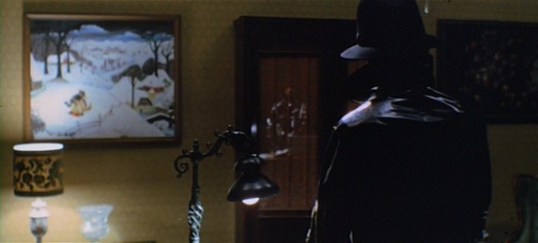
The TSL’s Daily Horror Grindhouse: The Ghost Galleon (dir by Amando de Ossorio)


gg

The Blind Dead are back and this time, they’re on a boat!

Yes, you read that correctly.  1974’s The Ghost Galleon is the third film in Spanish director Amando de Ossorio’s Blind Dead series.  The decaying and blind Knight Templar are back and they’re just as evil and blood thirsty as they were in both Tombs of the Blind Dead and Return of the Evil Dead.  However, this time, they’re on a boat.  What are they doing on a boat?  Apparently, they’re guarding some sort of Satanic treasure chest and they’re killing and eating anyone who makes the mistake of boarding their boat.

That means that this is the first Blind Dead film to not feature any scenes of the Blind Dead riding their horses in slow motion.  That may not sounds like much but the absence of those horses is definitely felt.  The Blind Dead on horses are a metaphor for everything from political tyranny to religious oppression.  The Blind Dead on a boat are still scary but now they’re also vaguely silly.

And yet, the Blind Dead on a boat is not the silliest part of the film!  The Ghost Galleon starts out with two models lost at sea.  Apparently, they were hired by a businessman and aspiring politician named (in the version released in America, anyway) Howard Tucker (Jack Taylor).  Howard is a boat manufacturer and he felt it would be great publicity if the models took one of his boats out into the ocean and pretended to get stranded.  Apparently, Howard felt that this would convince the public that they could live for weeks in one of his speedboats if they needed to…

No, I’m not making that up.  That’s the plot of the damn film.

ANYWAY — the models get stranded for real but suddenly, here comes a big, dark, old timey galleon.  It’s just floating out in the middle of the ocean and it appears to be surrounded by a very thick fog.  Naturally, the models decide to leave their boat for the galleon because why stay somewhere vaguely safe when you can get on a big, scary, evil looking galleon?

Now the models are missing and Howard needs to get his boat back.  So, he and his evil henchman get yet another model to sail out to the middle of the ocean with them.  Also accompanying them is a historian/scientist guy, who is mostly there because the film will later need him to fill in the backstory of the Blind Dead…

Now, I know that it probably sounds like I’m being supercritical of the third Blind Dead film but actually, it kind of works.  The key is not to worry about logic, consistency, or anything you learned about at that screenwriting workshop.  Instead, simply accept The Ghost Galleon as being the equivalent of a filmed nightmare.  For everything that the film lacks in logic, it makes up for in atmosphere.  (Let’s just say that the fog machine gets quite a workout.)  And while it may not make much sense for them to be on a boat, the Blind Dead are just as scary, evil, and merciless as ever.

Add to that, the film has a great ending.  I won’t spoil it here but I will say that the film’s final shot makes up for a lot of what you have to sit through in order to reach it.

The Ghost Galleon should not be the first Blind Dead film that you see.  (Unfortunately, it can be found in several ultra cheap box sets, complete with a bad transfer and spotty soundtrack.)  But if you’ve seen Tombs of the Blind Dead and Return of the Evil Dead, you should also see The Ghost Galleon.  If nothing else, it proves the de Ossorio could get results with even the most ludicrous of premises.

The Films of Dario Argento: Suspiria


I’m using this October’s horrorthon as an excuse to take rewatch and review all of Dario Argento’s films!  Today, we take a look at one of Argento’s best known and most popular films, 1977’s Suspiria!

suspiriaitaly

I’m going to start things out by admitting that this is an intimidating review to write.  I once had a discussion with fellow TSL contributor Leonard Wilson about why it’s always so much easier to write about films that we hate than it is to write about films that we love.  That’s certainly something that I’m thinking about right now, as I try to think of where to begin with Suspiria.

It’s not just that I like Suspiria.  Anyone who has ever visited this site before knows how much I appreciate Italian horror in general and Argento in specific.

No, it’s that I absolutely love this film.  I was sixteen the first time that I saw it and I’ve loved it ever since.  To me, Suspiria is not just one of the best horror films ever made.  It is truly one of the best films period.  And I know that I’m not alone in feeling like that.  Suspiria is a classic in every sense of the word.

Compared to almost every other film that Argento has made, the plot of Suspiria is remarkably straight forward.  Suzy Banyon, an American ballet student, enrolls at the prestigious Tanz Dance Academy in Frieburg, Germany.  From the minute she arrives, she gets the feeling that there is something strange happening behind the garish walls of the school and she’s right.  While the film may be best known for Argento’s directorial flourishes and Goblin’s classic score, the story itself unfolds with the simplicity of a fairy tale.

The film even opens with a narrator who informs us, “Suzy Banyon decided to perfect her ballet studies in the most famous school of dance in Europe. She chose the celebrated academy of Freiburg. One day, at nine in the morning, she left Kennedy airport, New York, and arrived in Germany at 10:40 p.m. local time.”  It’s the film’s equivalent of starting things off with, “Once upon a time…”  Having let us know that we’re about to watch a fairy tale and therefore having served his purpose, the narrator isn’t heard for the rest of the film.

Instead, we watch as Suzy first arrives in Germany:

As played by Jessica Harper, Suzy Banyon is yet another neurotic but brave Argento protagonist who has found herself in a strange land.  One of the things that I love about Suspiria is that Suzy is such an ordinary and relatable character.  She’s not “the chosen one.”  She’s not a witch or an aspiring witch or the daughter of a witch or the reincarnation of a witch.  She’s not desperately looking for a husband or dealing with a family tragedy or any of that other BS that we have to deal with in today’s cinema..  She doesn’t have any dark secrets or untapped magical powers.  She’s not seeking vengeance.  She has no trendy agenda.  She’s not the protagonist of the latest YA novel.  Instead, she’s a dancer.  She is someone who is attempting to pursue something that she is good at and that she loves.  In short, she is the viewer.  Suzy Banyon is us and we are Suzy Banyon.  Like us, she’s sometimes scared.  Like us, she’s sometimes brave.  And, like us, it’s just not in her nature to leave a mystery unsolved.

suspiria-008

It’s obvious, from the moment that Suzy arrives, that there’s something strange happening at the school.  We, of course, already know that it involves witchcraft.  This is largely because we’ve been listening to the film’s score and we’ve heard Goblin’s Claudio Simonetti chanting “WITCH!  WITCH!” as Suzy’s taxi drives through the woods and arrives at the school.  (The journey through the woods adds to Suspiria‘s fairy tale atmosphere.)

However, for Suzy, her initial concern is that everyone at the school appears to be trying to cheat her out of her money.  Madame Blanc (Joan Bennett) has arranged for Suzy to stay in an apartment on which she’ll have to pay rent.  When Miss Tanner (Alida Valli, a force of pure nature in this film) finds out that Suzy’s bags have yet to arrive and Suzy doesn’t have any ballet shoes, she tells her to borrow a pair from another student.  The student immediately offers to sell them to Suzy and is visibly deflated when Suzy says that she’s just needs to borrow them for a day.

And, of course, there’s Olga (Barbara Magnolfi), a student who thinks that names that start with S are the names of snakes.

(I have to admit that, as a former dance student, that scene brought back a lot of memories.)

But it’s not just money that Suzy has to worry about.  There are also maggots that fall from the ceiling, the result of a shipment of spoiled meat.  There’s the strange and labored breathing that Suzy occasionally hears behind the walls.  There’s the fact that her new roommate, Sarah (Stefania Casini), is convinced that the teachers are hiding a secret.  Sarah’s therapist, Dr. Frank Mandel (Udo Kier, playing an oddly respectable role) thinks that Sarah is suffering from delusions but is she?

And, of course, there’s all the mysterious deaths.

For instance, Daniel, a blind piano player, has his throat ripped by his seeing eye dog.  Interestingly enough, Daniel is played by Flavio Bucci who, in The Night Train Murders, played a murderer.  One of his Night Train victims was played by Irene Miracle, who would later have an important role in Suspiria‘s semi-sequel, Inferno.

Another former student, Pat Hingle (Eva Axen) is brutally stabbed to death and, after her body falls through a skylight, the shattered glass kills her best friend as well.  Of course, the killer wears gloves.  It wouldn’t be an Argento film otherwise.  (Pat’s murder is one of Suspiria‘s best known set pieces, one that is so brutal and violent that it retains its power to shock even after you’ve seen it a few times.  For the most part, if someone is going to stop watching or walk out on Suspiria, it’s going to happen during Pat’s murder.)

suspiria-2

And through it all, you have Goblin playing on the soundtrack.  The film’s score is so important and so relentless that, in its way, it becomes just as important a character as Suzy, Sarah, Madame Blanc, Miss Tanner, or even Udo Kier!  The score is relentless and, depending on how loudly you play the film, almost deafening.  I saw an interview with Goblin’s Claudio Simonetti where he said that he wanted the score to be “almost annoying” in its relentlessness.  The score overpowers you, in much the same way that the witches of Suspiria overpower their victims.

Suspiria was co-written by Daria Nicolodi, Dario Argento’s girlfriend and the mother of Asia Argento.  Nicolodi has long claimed that Suspiria is based on something that happened to her grandmother.  Argento, meanwhile, has said that nothing in the film was based on fact.  Reportedly, Nicolodi wanted to play the role of Suzy and was so offended with Argento instead offered her the role of Sarah that she went off and made Mario Bava’s Shock instead.

(Suspiria is often cited as the start of the long and acrimonious process that would eventually end with Argento and Nicolodi ending their relationship 8 years later.)

suspiria

Personally, I think that Nicolodi would have been wasted in the role of Sarah but, at the same time, it’s hard to imagine anyone other than Jessica Harper as Suzy Banyon.  For that matter, it’s also impossible to imagine anyone other than Dario Argento directing Suspiria.  Suspiria is Argento’s masterpiece, taking all of his frequent and familiar motifs (bloody murders, artistic protagonists, the constantly roaming camera, the use of primary colors) and pushing them to their natural extreme.  It’s hard to imagine anyone other than Argento telling Suspiria’s story.

Dario Argento on the set of Suspiria

Dario Argento on the set of Suspiria

And yet, that is exactly what is about to happen.  For years, of course, I’ve heard rumors of a remake and, perhaps naively, I’ve dismissed them.  I took some comfort in the fact that even Dario Argento himself came out and forcefully denounced the idea of anyone remaking his masterpiece.  Remake Suspiria? I would think to myself, Surely no one is that stupid.

Well, it’s happening and if that doesn’t outrage you, perhaps you should leave right now.  Reportedly, the remake is set to be released in 2017.  It’ll be directed by Luca Guadagnino and it’ll star Dakota Johnson, Chloe Grace Moretz, and Tilda Swinton.  Guadagnino says that his remake will be all about the “power of motherhood.”

Whatever, Luca.  Suspiria doesn’t need you and it doesn’t need to be remade.

Suspiria is perfect just the way it is.

suspiria-330

Horror Film Review: The Bride of Frankenstein (dir by James Whale)


brideoffrankposter

1935‘s The Bride of Frankenstein is usually described as being a sequel to Frankenstein, but I think it would be better to call it a continuation.  In much the same way that all modern YA adaptations seem to be split into two parts, Universal split Mary Shelley’s Frankenstein into two separate films.  The bare basics of The Bride of Frankenstein‘s plot — the monster learns to talk and demands that his creator build him a mate — can all be found in the original novel.

(Of course, in the original novel, the monster somehow learns how to speaks like an Oxford grad and Dr. Frankenstein destroys the female monster before bringing her to life.  The monster responds by killing Elizabeth.  Seriously, Frankenstein is a dark book.)

Bride of Frankenstein features one of my favorite openings of all time.  Lord Byron (Gavin Gordon) and Percy Bysshe Shelley (Douglas Walton) are praising Mary Shelley (Elsa Lanchester) and the story that she’s told about how a dedicated scientist played God and created life.  Mary informs them that she’s not finished and then proceeds to tell them the rest of the story.  It’s a great opening because it lets us know that the rest of what we’re seeing is taking place directly inside of Mary’s mind.  It frees the film from the constraints of realism and allows director James Whale to fully indulge his every whim, no matter how bizarre.  When you’re inside someone else’s imagination, anything can happen and that’s certainly the feeling that you get as you watch The Bride of Frankenstein.

The Bride of Frankenstein opens with that burning windmill and a wounded Henry Frankenstein (Colin Clive) being carried back to his wife, Elizabeth (Valerie Hobson, replacing Mae Clarke).  Gone is the original film’s coda, in which Elizabeth announces that she’s pregnant.  And why shouldn’t it be gone?  It felt awkward in the first movie and, like any good writer, Mary Shelley is fixing her story as she goes along.

While Henry is recovering, he is approached by a former mentor, Dr. Pretorious (Ernest Thesiger).  Dr. Pretorious is undoubtedly an eccentric and definitely a little bit crazy but he believes in Frankenstein’s work.  In fact, Dr. Pretorious has even created life on his own!  He’s created a bunch of tiny people that he keeps in several glass jars.  They’re impressive but, sadly, they’ll never conquer the world.  Pretorious wants Frankenstein to, once again, work with him to create life.  As Pretorious explains it, it’s time to usher in a new age of “God and monsters!”

(Interestingly enough, one of Pretorious’s henchmen is played by Dwight Frye, who previously played Frankenstein’s henchman, Fritz, in the first film.  Frye dies in both films.  Reportedly, Universal bestowed upon him the nickname, “The Man of a Thousand Deaths.”  It can perhaps be argued that Dwight Frye was both the Steve Buscemi and the Giovanni Lombardo Radice of Universal horror.)

Meanwhile, the monster (Boris Karloff, credited with just his last name because, just four years after Frankenstein and the Mummy, he was already an icon) has survived the burning windmill.  He’s lonely, he’s afraid, and he actually kills more people in The Bride of Frankenstein than he did in Frankenstein.  And yet, he’s still the film’s most sympathetic character.  With everyone constantly trying to kill him, you can understand why the monster is quick to attack every human being that he sees.  He’s almost like a dog who, after years of abuse, automatically growls and bears his teeth at anyone that he sees.

And yet, the monster does eventually find a friend.  A blind hermit (O.P. Heggie) invites the monster into his own home.  (Of course, the hermit does not know who the monster is.  He just assumes that monster is a normal man who does not know how to speak.)  As time passes, the hermit teaches the monster how to say a few words and also tells the monster that there is nothing worse than being lonely.  The monster learns that “Friend good.”  The monster even learns how to smoke a cigar and Heggie and Karloff play these roles with such warmth (Bride of Frankenstein is not only the film where the Monster learns to talk, it’s also the one where he learns to smile) that you really start to dread the inevitable scene where everything goes wrong.

And that scene does arrive.  Two hunters stop by the hermit’s shack and immediately attack the Monster.  The Monster flees.  The shack burns down.  The hermit is led away from his only friend, apparently destined to be lonely once again.

Eventually, of course, the Monster does get his bride.  The Bride is such an iconic character that it’s easy to forget that she only appears in the final ten minutes of the film.  Elsa Lanchester plays both Mary and the Bride.  She screams when she sees the Monster.  “We belong dead,” the Monster replies and my heart breaks a little every time.

So, which is better?  Frankenstein or The Bride of Frankenstein?  I don’t think it’s necessary to choose one or the other.  To use a metaphor that might be appreciated by Henry and Dr. Petorious, Frankenstein is the brain while The Bride of Frankenstein is the heart.  They’re two good films that, when watched together, form one great film.

4 Shots From Horror History: Dracula, Frankenstein, Vampyr, White Zombie


This October, I’m going to be doing something a little bit different with my contribution to 4 Shots From 4 Films.  I’m going to be taking a little chronological tour of the history of horror cinema, moving from decade to decade.

Today, we take a look at the start of the 1930s.

4 Shots From 4 Films

Dracula (1931, dir by Tod Browning)

Dracula (1931, dir by Tod Browning)

Frankenstein (1931, dir by James Whale)

Frankenstein (1931, dir by James Whale)

Vampyr (1932, dir Carl Theodor Dryer)

Vampyr (1932, dir Carl Theodor Dryer)

White Zombie (1932, dir by Victor Halperin)

White Zombie (1932, dir by Victor Halperin)

Horror on the Lens: Wasp Woman (dir by Roger Corman and Jack Hill)


Today’s Horror on the Lens is the 1959 Roger Corman film, Wasp Woman!

In this film, Janice Starlin (Susan Cabot) is the head of a cosmetic company.  When she discovers that her sales are suffering because the public has noticed that she is getting older, Janice does what any dedicated CEO would do!  She agrees to undergo a radical treatment involving the royal jelly taken from a queen wasp.

Do you think this treatment will make Janice look younger?

Or will it lead to her periodically transforming into a monstrous creature?

Or will it lead to both!?

Watch the movie to find out!

Horror On TV: Tales From the Crypt 2.10 “The Ventriloquist’s Dummy”


For tonight’s excursion into the world of televised horror, we have the 10th episode of the 2nd season of Tales From The Crypt!  This episode, which originally aired on June 5th, 1990, is called The Ventriloquist’s Dummy!

Who doesn’t love a creepy ventriloquist story?  And this is certainly a creepy one, with an ending that you’ll either love or hate.

This episode was directed by Richard Donner and written by future Shawshank Redemption director and Walking Dead showrunner, Frank Darabont!

Enjoy!

The TSL’s Daily Horror Grindhouse: Return of the Evil Dead (dir by Amando de Ossorio)


returnblinddead

First off, the 1973 Spanish horror film, The Return of the Evil Dead, is in no way connected to Sam Raimi’s Evil Dead films.  Bruce Campbell never shows up in The Return of the Evil Dead and that’s unfortunate because the villagers who are menaced in this film probably could have used some help from Ashley James Williams.

Instead, The Return of the Evil Dead is a film that, over the years, has been known by many names: Attack of the Blind Dead, Return of the Blind Dead, Mark of the Devil 5: Return of the Blind Dead, and Night of Blind Terror.  It’s usually referred to as being a sequel to Tombs of the Blind Dead but that’s not quite true.  Instead, it’s more of a reimagining.

The film opens, as do almost all of the entries in this franchise, with a retelling of the origin of the Blind Dead.  In Tombs of the Blind Dead, the Knights Templar were accused of heresy and hung, just to then have a bunch birds peck out their eyes.  In Return of the Evil Dead, the Templars are once again pillaging Europe, sacrificing virgins, and practicing witchcraft.  However, this time, they are captured by a group of Portuguese peasants.  After being bound in the village square, the Templar leader announces that someday, he and his compatriots will return from the dead and seek vengeance on the village.  The villagers respond by using a torch to burn out his eyes.

Jump forward 500 years.  The village is preparing to celebrate the anniversary of what they call “the Burning.”  We watch as they prepare for the festival and joke about the legend that the Templars will rise from their graves and spend the night seeking revenge.  Murdo (José Canalejas), who is known as being the town pervert, watches the preparations and is suddenly attacked by a group of rock-throwing children.  When Murdo falls to the ground, the children start to kick him.  When Monica (Loreta Tovar) steps in and runs off the children, her boyfriend asks her why she’s wasting her time defending Murdo.  Murdo, meanwhile, scurries off.

Meanwhile, the town’s mayor (Fernando Sancho) meets with Jack Marlowe (Tony Kendall).  Jack has been hired to supervise the festival’s firework show and the mayor promptly tries to cheat him out of his payment.  Jack discovers that the Mayor’s fiancée is his ex-girlfriend, Vivian (Esperenza Roy).  Meanwhile, the mayor’s henchmen stand in the background and grimly watch.

In short, it appears that the village is cursed even before the inevitable return of the Blind Dead.  And, in these scenes, it’s important to remember that, for the first half of the 1970s, Spain was still ruled by a dictator named Francisco Franco.  It’s not difficult to see the village and its villagers as a metaphor for the Franco regime.  Director Amando de Ossorio admitted as much when, in an interview before his death, he described Return of the Evil Dead as being the most political of all the Blind Dead films.

Naturally, the Templars do eventually return.  Tired and bitter after years of being persecuted by the other villagers, Murdo sacrifices a young townswoman.  As her blood pours over the graves of the Templars, the ground starts to shake and the Blind Dead come back to life and, once again, lay siege on the town.

The Blind Dead are still moving in slow motion and are just as decayed and deadly here as they were in Tombs of the Blind Dead.  Interestingly enough, the scene where they ominously knock on the door of an isolated house was later recreated in John Carpenter’s The Fog.  In fact, the entire film has quite a lot in common with The Fog, right down to the final siege on the church.

So, which is better?  Tombs of the Blind Dead or Return of the Evil Dead?  To a certain extent, it depends on what you’re looking for.  Return of the Evil Dead is faster paced than Tombs of the Blind Dead and Jack and Vivian are far more likable than the leads from Tombs.  As previously mentioned, Return has a stronger political subtext than Tombs.  However, speaking for myself, I prefer the more atmospheric and fatalistic Tombs.

But ultimately, both Tombs of the Blind Dead and Return of the Evil Dead are superior horror films, perfect for Halloween viewing.

Horror Film Review: Frankenstein (dir by James Whale)


frankenstein_poster_1931

Pity poor Frankenstein.

No, not Victor von Frankenstein, though he certainly suffered greatly for playing God.  How much he suffered depends on which version of the story you see or read.  If you’ve read the book, you know that Victor lost his family, his love, his mentor, his best friend, and eventually his own life.  Victor is usually a bit more resilient in the films.  For instance, if you go by what we’ve seen in the Hammer films, Baron Frankenstein was pretty much indestructible.  The only thing he lost was his sanity, sacrificed as he continually insisted on making the same mistake over and over again.

And when I say “Pity poor Frankenstein,” I’m not referring to the monster either, though he certainly deserves some sympathy as well.  The monster never asked to be brought to life.  He may have destroyed castles and killed people and tossed little girls into a lake but Frankenstein’s Monster rarely seemed to mean any harm.  He was just scared, confused, and often abused.

Instead, when I say pity poor Frankenstein, I’m referring to the 1931 film.  It’s a classic horror film, one that, after 85 years, still holds up remarkably well.  It’s probably the best directed of all the Universal horror films, with James Whale bringing his own dark wit and idiosyncratic style to the film.  As was often the case with films of the era, some of the performances are better than others but no one can find fault with Boris Karloff’s definitive portrayal of Frankenstein’s monster.

And yet, for a lot of filmgoers, Frankenstein will always just be that movie where Colin Clive rants, “It’s alive!  IT’S ALIVE!”  That scene is justifiably famous but it always bothers me when it shows up as an isolated clip, devoid of context.  I’ve seen it used in documentaries.  I’ve seen it used on snarky news programs where it’s almost always used to poke fun at someone.  I’ve even seen it used in a car commercial.

You’ve seen it too.  It’s one of those scenes that everyone has seen, regardless of whether or not they’ve sat through the entire movie:

When you watch this scene without any context, it’s easy to smirk.  You might assume that the entire film is Colin Clive ranting and Dwight Frye snorting.  It’s only after you’ve seen the entire film that you appreciate Clive’s performance.  Throughout the entire first part of the film, Colin Clive plays Henry Frankenstein as being unstable but also rather withdrawn.  He’s almost vampiric, hiding inside of his laboratory all day and only coming out at night to rob graves with the hunchbacked Fritz (Dwight Frye).  He’s almost a recluse, which is why his fiancée, Elizabeth (Mae Clarke) asks his best friend, Victor (John Boles), and his mentor, Dr. Waldman (Edward Van Sloan, who also played Van Helsing in Dracula) to check in on him.

When the monster does move its hand and Clive shouts, “It’s alive!,” it’s the first sign of true emotion that Frankenstein has shown through the entire film.  He’s spent a lifetime dreaming of playing God and, now that he has, it overwhelms his mind.  Much like poor Ralph Norton in The Mummy, Clive sees something that defies all reason and he has a breakdown.

I have to admit that, for me, the first third of the film drags.  That may not have been as much of a problem in 1931, when audiences were seeing the story for the first time and didn’t already know what was going to happen.  In 1931, the slow start undoubtedly helped to build up suspense.  But, when seen today, there is a temptation to say, “Get on with it!”

(Of course, I tend to say that with all Frankenstein movies, because I’m impatient and there always seems to be an endless number of scenes people digging graves and stealing brains until we finally get to the good part.  If anything, the 1931 Frankenstein doesn’t take as long to get going as some of the later Hammer films, many of which treated the monster as almost an afterthought.)

Fortunately, Frankenstein does get on with it.  When the monster finally comes to life and Colin Clive has his moment of divine madness (“This is what it feels like to be God!”), the film shifts in tone.  If anything it becomes a bit of a dark comedy.  Henry (who is noticeably more subdued after his outburst, a bit like a drug addict who is only now starting to come down after being awake for a week) and his friends now have to not only hide the monster but try to figure out how to deal with it.  Every few minutes, it seems like another villager or Frankenstein relative is dropping by the castle.  Having created life, Henry now has no idea what to do with it.  Being God isn’t as easy as it looks.  Having created life, all Henry can now do is keep the doors locked and attempt to go back to living a relatively normal life.  In this case, that means preparing for his wedding.

It’s not until the sadistic Fritz torments the frightened monster with a torch that this horror classic truly becomes a horror film.  And it’s significant that the true monster here is not Frankenstein’s Monster but instead Fritz.  When the monster kills Fritz, he does it out of self-defense.  When he strangles Dr. Waldman, it’s because Waldman was about to cut into him with scapel.

And then there’s the little girl.  How this scene must have shocked audiences in 1931!  It’s still shocking today, because we’re not used to children dying in movies, not even horror movies.  Of course, the monster doesn’t mean to hurt the girl.  The girl is the first person to show the monster any sort of kindness.  It’s just that the monster doesn’t understand that the girl won’t float like the flowers.

The sequence where the girl’s father carries her body into the town square is perhaps one of the most devastating ever filmed.   Not only does the father’s grief contrast with the happiness of the villagers but it also contrasts with the attitude of Henry and Elizabeth who are busy preparing from their wedding, ignorant of what Henry’s creation has done.

Or, at least, they are until the monster confronts Elizabeth in her bedroom.

karloff-boris-frankenstein_11

I love that dress.

It all ends, of course, with a confrontation between Henry and his monster and a windmill being set aflame.  There’s also a happy coda that, in the best tradition of horror, feels a bit tacked on.  Fortunately, those of us who know our film history know that the story didn’t end with this film.  It continued with The Bride of Frankenstein, which I’ll be reviewing tomorrow.

As for Frankenstein, it’s a classic and it’s pretty much required viewing for any film lover.  Boris Karloff’s performance as the confused and often child-like monster is both poignant and menacing.  Watching the film, you just wish that the world had been nicer to him.

(Then again, that approach didn’t exactly work out well for the little girl with the flowers…)

Frankenstein is so much more than just Colin Clive shouting, “It’s alive!”  If you haven’t actually sat down watched the entire movie from beginning to end, you owe it to yourself to do so today.

4 Shots From Horror History: The Phantom of the Opera, Faust, London After Midnight, The Fall of the House of Usher


This October, I’m going to be doing something a little bit different with my contribution to 4 Shots From 4 Films.  I’m going to be taking a little chronological tour of the history of horror cinema, moving from decade to decade.

Today, we take a look at the latter half of the 1920s.

4 Shots From 4 Films

The Phantom of the Opera (1925, dir by Rupert Julian)

The Phantom of the Opera (1925, dir by Rupert Julian)

Faust (1926, dir by F.W. Murnau)

Faust (1926, dir by F.W. Murnau)

London After Midnight (1927, dir by Tod Browning)

London After Midnight (1927, dir by Tod Browning)

The Fall of the House of Usher (1928, dir by Jean Epstein)

The Fall of the House of Usher (1928, dir by Jean Epstein)