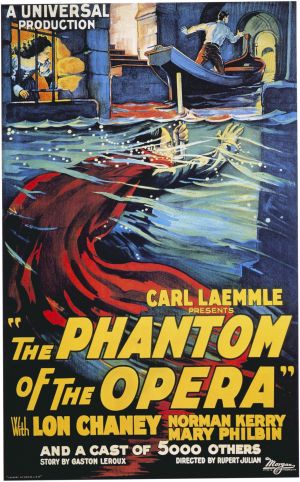
Today’s horror scene that I love comes from the 1925 version of The Phantom of the Opera.
In this famous scene, which was directed by Rupert Julian, Mary Philbin unmasks the Phantom (played, of course, by Lon Chaney). Both of their reactions are justifiably famous.
I have read that Philbin was apparently not told what Chaney would look like when she removed the mask, which contributed to her state of shock. I don’t know if that’s true but I hope it is. It’s certainly a good story.
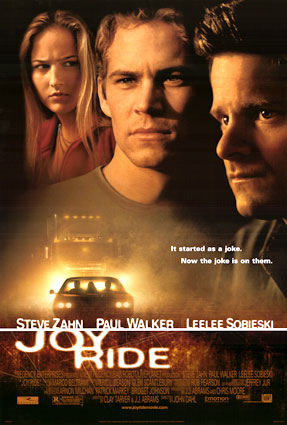
The 2001 film Joy Ride is an example of a subgenre of horror that I like to call the Don’t Fuck With Truckers genre. It all started with Duel back in the early 70s and since then, there’s been a large number movies about ordinary people who end up getting on the wrong side of a trucker.
Myself, I would never piss off a trucker. First off, I have a few cousins who are proud members of the Teamsters and I can tell you, from personal experience, that you don’t want to get on their bad side. Secondly, those trucks are really, really big and it takes a certain amount of skill to drive them, certainly more skill than it takes me to drive my little convertible. (Truckers can make turns in those gigantic trucks and somehow do it without crashing into a stop light. I can barely parallel park.) Trucks block out the road, making it impossible to see anything beyond them, which makes the prospect of trying to pass them all the more frightening. Essentially, if you get into a vehicle fight with a trucker, you’re going to die. There’s just no way your little car is going to be able to beat that giant truck.
Now, I have to admit that I really like Joyride but sometimes, I feel like maybe I shouldn’t. It basically comes down to two things:
Number one, I have always defended horror movies against the charge that they always feature people making the stupidest possible decisions. My defense is usually that people in real life are actually far more stupid than they realize and that whenever anyone says, “I would never be stupid enough to wander around a deserted camp ground in the middle of the night!,” they are essentially lying. Seriously, everyone would do that just so they could later joke about how it was just like being in a horror movie.
That said, the majority of the characters in Joy Ride are really, really dumb. Basically, two brothers (Steven Zahn and Paul Walker) are driving from California to Colorado so that they can pick up Walker’s best friend (Leelee Sobieski). Along the way, Zahn and Walker decide to have some fun by getting on the CB radio and telling a trucker who calls himself Rusty Nail (voiced by Ted Levine, who was also the killer in The Silence of the Lambs) that there is a prostitute named Candy Cane waiting for him in a motel room. The joke, of course, is that Zahn and Walker know that an obnoxious businessman is actually staying in the room.
The next morning, after playing their little joke and then listening to Rusty Nail and the businessman have a huge fight, the brothers are informed that the businessman has been found on the side of the road. He’s still alive but his jaw was ripped off. The brothers’ reaction is to get the Hell out of town.
Okay, so far, so good. The joke was mean but people are mean. Leaving town instead of helping with the police investigation was selfish but people are selfish. What drives me crazy is that, once they’re on the road, the brothers get back on the CB radio and inform Rusty Nail that there was no Candy Cane and that they were just playing a joke on him.
IDIOTS! Seriously, you’ve just been told that the guy ripped off another man’s jaw and now you’re going to piss him off more?
My other problem is that Leelee Sobieski’s character is so underdeveloped. The film’s nearly halfway over before Zahn and Walker reach Colorado and pick her up. Just a few scenes later, Sobieski is kidnapped by Rusty Nail. Characterwise, she pretty much only exists to be kidnapped and held hostage. It seems like a waste of Sobieski’s talents and the flatness of her character is especially disappointing when you consider how well-developed the characters played by Walker and Zahn are.
And yet, despite all of that, I really like Joy Ride. It’s just a well-made film, a relentless thrill ride that succeeds largely because director John Dahl never gives the audience any time to relax and think about whether or not the film makes any sense. As a largely unseen threat, Rusty Nail is both plausible and seemingly supernatural at the same time. I mean, that truck literally pops up out of nowhere sometimes. Zahn and Walker are very well-cast as brothers, with Zahn’s natural goofiness nicely paired up with Walker’s natural earnestness. You like them, even if they are selfish idiots.
Almost despite itself, Joy Ride is a good movie and it features an important message: Don’t fuck with truckers.
4 Shots From 4 Films is just what it says it is, 4 shots from 4 of our favorite films. As opposed to the reviews and recaps that we usually post, 4 Shots From 4 Films is all about letting the visuals do the talking.
This October, I am going to be using our 4 Shots From 4 Films feature to pay tribute to some of my favorite horror directors, in alphabetical order! That’s right, we’re going from Argento to Zombie in one month!
Today’s director is Tod Browning, who started his career during the silent era, ended it in the sound era, and was responsible for some of the most important horror and suspense films of both!
The Cabinet of Dr. Caligari is a film that I’ve shared four times previously on the Shattered Lens. The first time was in 2011 and then I shared it again in 2014, 2015 and 2016. Well, you know what? I’m sharing it again because it’s a classic, it’s Halloween, and everyone should see it! (And let’s face it — it’s entirely possible that some of the people reading this post right now didn’t even know this site existed in 2016. Why should they be deprived of Caligari just because they only now arrived?)
Released in 1920, the German film The Cabinet of Dr. Caligari is one of those films that we’ve all heard about but far too few of us have actually seen. Like most silent films, it requires some patience and a willingess to adapt to the narrative convictions of an earlier time. However, for those of us who love horror cinema, The Cabinet of Dr. Caligari remains required viewing. Not only did it introduce the concept of the twist ending (M. Night Shyamalan owes his career to this film) but it also helped to introduce German expressionism to the cinematic world.
My initial reaction to The Cabinet of Dr. Caligari was that it simply wasn’t that scary. It was certainly interesting to watch and I was happy that I was finally experiencing this film that I had previously only read about. However, the film itself was obviously primitive and it was difficult for my mind (which takes CGI for granted) to adjust to watching a silent film. I didn’t regret watching the film but I’d be lying (much like a first-year film student) if I said that I truly appreciated it after my first viewing.
But you know what? Despite my dismissive initial reaction, the film stayed with me. Whereas most modern films fade from the memory about 30 minutes after the end credits,The Cabinet of Dr. Caligari has stuck with me and the night after I watched it, I even had a nightmare in which Dr. Caligari was trying to break into my apartment. Yes, Dr. Caligari looked a little bit silly staring through my bedroom window but it still caused me to wake up with my heart about to explode out of my chest.
In short, The Cabinet of Dr. Caligari passes the most important test that a horror film can pass. It sticks with you even after it’s over.
For the curious who have 74 minutes to spare and an open mind to watch with, here is Robert Wiene’s The Cabinet of Dr. Caligari…
For tonight’s excursion into the world of televised horror, we have an episode from the 2002 revival of The Twilight Zone.
In The Pool Guy, Richie (Lou Diamond Philips) is a pool cleaner with a problem. While his clients appear to believe that Richie is living a glamorous life straight out of a bad suburban melodrama, Richie actually feels as if his life is going nowhere. He’s never even gotten seduced by a bored housewife! Maybe Richie just isn’t a very good pool guy…
However, Richie has another problem, on top of all that. A man keeps mysteriously appearing and telling him to “Wake up!” before then shooting him. Immediately after getting shot, Richie wakes up somewhere else, just to once again be approached by the same man.
What is going on and why is Richie being charged $12,000 for the experience!?
Over the years, there have been quite a few attempts to revive The Twilight Zone and the results have always been mixed. The 2002 revival featured Forest Whitaker as the host and was canceled after just one season. That said, The Pool Guy is actually pretty good. Philips gives a good performance and the episode’s central mystery is an intriguing one.
This episode originally aired on October 16th, 2002!
I have to admit that I’ve watched so many horror films that I’m sometimes tempted to get a little bit jaded about them.
Don’t get me wrong. I love the genre. I love watching horror movies. I love analyzing horror movies. I love writing about horror movies. It’s just that, after you’ve watched a few hundred of them, it becomes easier to pick up on all the little tricks. For instance, I now know not to worry whenever anyone hears a strange sound in the kitchen because it’s inevitably just going to be a cat in a cabinet. Instead, it’s only after the cat has run by and caused everyone to jump that you have to start worrying about something terrible to happen. I also know that there’s a good chance that the first chase scene is going to turn out to be an elaborate nightmare. As such, I sometimes I get cynical about whether or not I can really be frightened anymore.
But then I watch something like The Autopsy of Jane Doe.
I watched The Autopsy of Jane Doe back in Decemeber. It was two in the morning. I was alone in the house. It was raining outside. I was having trouble sleeping so, of course, I decided why not sit in the dark in my underwear and watch a horror movie? At the time, it didn’t occur to me that I was essentially putting myself in a classic horror movie situation. It was only later, when I was lying in bed with all the lights on and freaking out about every little noise that I heard that I realized my mistake.
The Autopsy of Jane Doe takes place in a morgue in a small town. The body of a woman has been brought in. It is believed that she died in a house fire but there are no signs of trauma on her body. Her finger prints are not on record. No one knows who she is. Over the course of the night, coroner Tommy Tilden (Brian Cox) and his son, Austin (Emile Hirsch), examine the body. With each incision, the mystery of Jane Doe’s identity deepens. The inside of her body is as damaged as the outside is perfect.
As the night continues, strange things start to happen inside the morgue. It’s small things at first. Strange sounds are heard. Austin thinks that he sees something out of the corner of his eye. A storm starts to rage outside. Austin says that they should stop the autopsy but Tommy says that they have to finish what they’ve started…
And things only escalate from there.
The Autopsy of Jane Doe sneaks up on you. It starts out as a collection of small scares and subtle hints that all is not right. At first, you’re kind of like, “Yeah, it’s weird noises and shadows in the corner. It’s a horror movie. Of course, that’s going on…” And then suddenly, about halfway through the film, you realize that you’re totally tense. All of those small scares have added up, leaving you wondering when the big scares are going to start. And when those big scares do arrive, they deliver. By confining the movie to one location, director André Øvredal creates a palpable atmosphere of claustrophobia and impending doom. It helps that Brian Cox is one of those older, paternal actors who you always expect to be in control of things so seeing him in a situation where he has no control carries an unexpectedly strong emotional impact.
If you doubt the power of horror, The Autopsy of Jane Doe will make you a believer.
It Comes At Night is yet another film about people waiting for the end of the world. In this case, the end is due to the outbreak of a mysterious disease. It Comes At Night is a film that I meant to see in theaters when it originally released but I never got a chance. It Comes At Night was acclaimed by critics but generally hated by audiences. (Some of the comments on twitter, from people who had just returned from seeing the film, were incredibly angry.) To be honest, it’s really not surprising that audiences didn’t embrace the film. Having recently watched the film myself, I can tell you that It Comes At Night is one of the most depressing movies ever made.
Seriously, remember how depressing the Arnold Schwarzenegger/Abigail Breslin zombie film Maggie was? Well, compared to It Comes At Night, Maggie might as well have been a musical comedy.
It Comes At Night opens with a former school teacher named Paul (Joel Edgerton) executing his father-in-law. Paul’s wife, Sarah (Carmen Ejogo), and his teenage son, Travis (Kelvin Harrison, Jr.) understand that Paul had no choice. There’s been an outbreak of a disease and the old man was infected. The only way to keep everyone else in the family safe was to kill him and burn his body.
Paul and his family live in an isolated cabin. At all times, the front door remains locked. Only Paul and Sarah are allowed to carry the key. No one is allowed to leave the house at night and under no circumstances are strangers allowed to enter the house. Sometimes, after the sun goes down, Travis thinks that he can hear sounds in the surrounding woods. It’s a reminder that people are out there but the majority of them are either slowly dying from the disease or scavengers trying to survive.
Paul ruthlessly enforces the rules but then, one night, a man named Will (Christopher Abbott) attempts to break into the house. Will swears that he’s not infected. He was just trying to find food for his wife, Kim (Riley Keough) and his son, Andrew (Griffin Robert Faulkner). After Paul determines that Will does not have the disease, he agrees to let Will and his family stay with them. If the house is ever attacked, Paul and Sarah figure, Will and Kim will provide an extra layer of defense.
And, for a few weeks, everything is fine. The two families bond. But Travis is still having vivid nightmares in which he sees men and women who have been infected and who are living in the woods. And he is still hearing sounds at night…
The inevitability of death hangs over minute of It Comes At Night. From the film’s first scene, you know that things are probably not going to end well. When the two families do start to surrender to their paranoia, it’s upsetting but not particularly shocking. It’s depressing because it all seems very plausible. I think we all know that, if the world really was ending, it wouldn’t bring about peace or reflection. Instead, people would keep fighting until the final second. That’s just human nature. What makes It Comes At Night so sad and disturbing is that there are no traditional heroes or villains. There’s just six people trying to live their lives in a world that’s rapidly coming to an end. They think they can beat the darkness surrounding them but the audience knows better.
I know, I know. You just read that paragraph and you thought, “Yeah, Lisa, that sounds like a really fun movie.”
And you’re right. It’s not a fun movie. I would seriously warn anyone struggling with depression to be careful about watching It Comes At Night. It’s definitely not going to cheer you up. I spent the first half of thid 90 minute film convinced that I was probably going to stop watching because it was just too dark. But I ended up watching it to the end because, even if it was depressing, it was also a very well-made film. It sucks you in, even though you might not want it to. The entire cast does a good job but special praise has to be given to Kelvin Harrison, Jr., who gives a searingly vulnerable performance as Travis.
It Comes At Night is a well-made, disturbing, and heartbreakingly sad movie and probably not one that I’ll have any desire to watch again for quite some time.
For the crime of having murdered over a 100 people, “Meat Cleaver Max” Jenke (Brion James) is sentenced to death and sent to the electric chair. Even though everyone thinks that Max was electrocuted, his electricity-fueled spirit is still alive and pissed off. If this sounds familiar, that is because it is the exact same premise that was used in Destroyer. The only difference is that Max is not haunting a prison and killing a film crew. Instead, he is living in a basement and seeking revenge on Lucas McCarthy (Lance Henriksen), the cop who arrested him.
Lucas is already tightly wound. There is a scene where Lucas is watching as his family laughs uproariously at a late night comic who is telling a not very funny joke about then-Vice President Dan Quayle. When Lucas thinks that he sees Max on TV, he pulls out his gun and shoots the screen. His wife, son, and daughter will probably never laugh at another joke about any vice president. Soon, Lucas is seeing and hearing Max everywhere. Max says that he is going to tear Lucas’s world apart and he means it.
That The Horror Show is going to be a mess is obvious from the opening credits, where the screenplay is credited to Alan Smithee. The credited director is visual effects specialist James Isaac but most of the film was reportedly directed by David Blythe. Isaac stepped in when Blythe was fired by producer Sean S. Cunningham. Full of false scares and scenes where people go down into the basement for no reason other than to become Max’s latest victim, The Horror Show is usually boring, except for when it is violent, gory, and mean-spirited. There are moments of strange attempts at humor that do not seem to belong. In the middle of all the carnage, there is a subplot about McCarthy’s son (Aron Eisenberg) ordering case after case of Nestle Quick. Did Nestle pay for the product placement? Were they happy to be associated with a movie where Lance Henriksen has a nightmare that his daughter (played by DeeDee “sister of Michelle” Pfieffer) is pregnant with Max Jenke’s baby?
The Horror Show provided both Lance Henriksen and Brion James with rare starring roles and they did their best what they had to work with. Also keep an eye out for veteran tough guy Lawrence Tierney as the warden who supervises Max’s execution.
Today’s horror scene that I love comes from the absolutely terrifying 1922 silent film, Nosferatu.
Directed by F. W. Murnau and featuring Max Schreck as Count Orlock, Nosferatu is often cited as being the first vampire film. That’s actually not true. There were apparently film adaptations of Dracula that were produced years before Murnau gave the world his “unauthorized” adaptation.
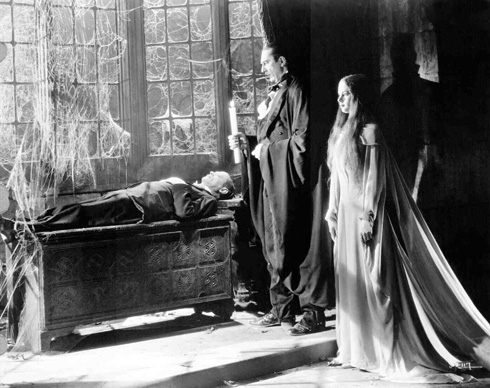
However, I do think it can be argued that Nosferatu is the most influential vampire film ever made. Every vampire movie released over the past 95 years has been a direct descendant of Nosferatu and it remains a truly nightmarish work of horror art. One need only compare it to Universal’s first Draculafilm to see how well Nosferatu has aged.



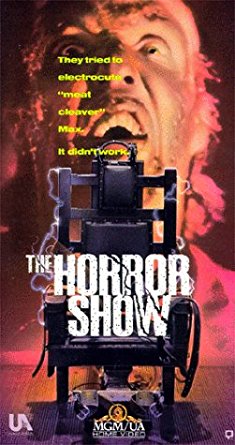 For the crime of having murdered over a 100 people, “Meat Cleaver Max” Jenke (Brion James) is sentenced to death and sent to the electric chair. Even though everyone thinks that Max was electrocuted, his electricity-fueled spirit is still alive and pissed off. If this sounds familiar, that is because it is the exact same premise that was used in
  Through the Shattered Lens