Today’s horror scene that I love is from the 1953 film, House of Wax!
In this scene, a curious visitor to Vincent Price’s wax museum discovers that more than a few of the figures are actually corpses that have been covered in wax. When she is confronted by Vincent Price, she hits his face and, in an homage to the famous unmaking scene from The Phantom of the Opera, discovers what is underneath.
(I’ve recently decided that they should change the name of October to something more appropriate, like Pricetober. Seriously, this month is all about Vincent Price…)
4 Shots From 4 Films is just what it says it is, 4 shots from 4 of our favorite films. As opposed to the reviews and recaps that we usually post, 4 Shots From 4 Films is all about letting the visuals do the talking.
This October, I am going to be using our 4 Shots From 4 Films feature to pay tribute to some of my favorite horror directors, in alphabetical order! That’s right, we’re going from Argento to Zombie in one month!
Today’s director: Guillermo Del Toro!
4 Shots From 4 Films
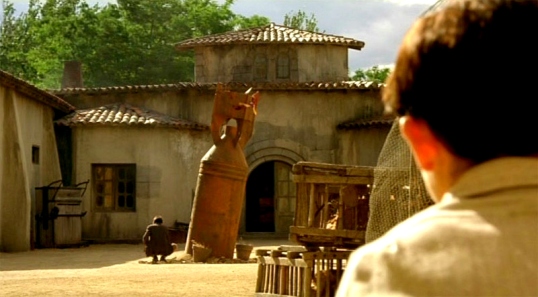
The Devil’s Backbone (2001, dir. by Guillermo Del Toro)
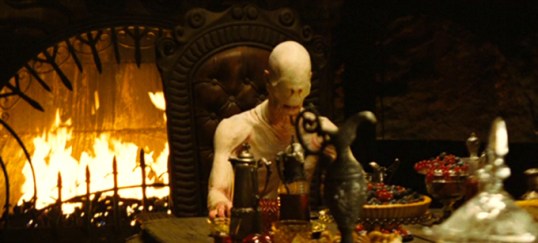
Pan’s Labyrinth (2006, dir. by Guillermo Del Toro)
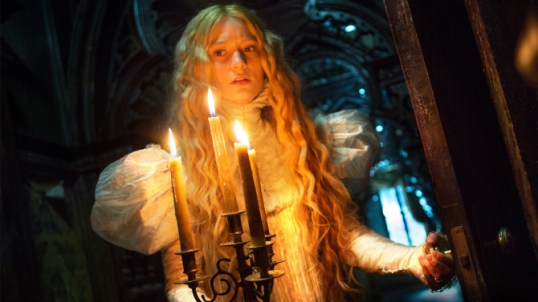
Crimson Peak (2015, dir by Guillermo Del Toro)
The Shape of Water (2017, dir by Guillermo Del Toro)
No, actually, they don’t. If anything, they cause crimes to happen.
First released in 1971 and directed by Al Adamson, Dracula vs. Frankenstein may not be a good film but it’s definitely an unforgettable film. Yes, it may be thoroughly inept but it’s also perhaps the strangest take on the Dracula/Frankenstein rivalry that you’ll ever see.
Plus, it’s one of the final films of Lon Chaney, Jr. Unfortunately, Lon doesn’t exactly look his best in Dracula vs Frankenstein...
Speaking of slumming celebrities, long before he played Dr. Jacoby and inspired America to shout, “Dig yourself out of the shit!,” Russ Tamblyn played a biker named Rico in this movie.
Also, like every other exploitation film made in 1971, Dracula vs. Frankenstein features hippies, leading to the age old question: who needs the supernatural when you’ve got LSD-crazed hippies running around?
Another age old question: Is Dracula vs. Frankenstein merely inept or is it a classic of bad filmmaking?
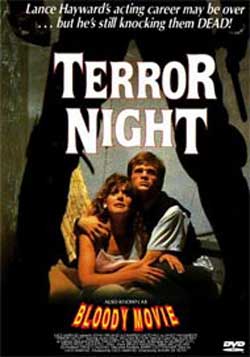
The movie known as Bloody Movie was originally filmed in 1987, under the title Terror Night. However, it was never released. There are plenty of rumors about why it wasn’t released. Some people say that it was because the film was produced with Mafia money. Some people say it was because it used a lot of footage that was lifted from other movies and the producers apparently didn’t bother to clear the rights. Of course, it’s also totally possible that the film wasn’t released because it wasn’t very good. I mean, that does happen.
Regardless of why, the film apparently sat on the shelf for 20 years. It was finally released by Fred Olen Ray’s Retromedia and retitled Bloody Movie. That said, the DVD that I own (and watched for this review) was released by Legacy Entertainment and still had the Terror Night title. The transfer on the Legacy DVD was notably bad. From what I’ve been told, the Retromedia release looks a lot better.
Now, there’s a lot bad things that can be said about Terror Night. It’s low-budget, which is one of those things that can be overcome by a clever director but, in this case, it just results in Terror Night looking cheap. It’s poorly written, full of one-dimensional characters who were shallow even by the standards of a late 80s slasher. This is also one of those movies where formerly respectable actors pop up for five minutes cameos. Whenever one of those actors shows up, all the action stops so that they can earn their paycheck. Aldo Ray is homeless and doomed. Cameron Mitchell is a cynical cop and doomed. Alan Hale, Jr. is an affable security guard and apparently not doomed. There’s no real reason for any of them to be there but there they are! There’s also a biker couple who show up for no particular reason, along with the typical collection of teenage victims.
But yet, there are moments when Terror Night goes from being bland to being almost transcendently odd.. There are moments of comedy mixed in with some surprisingly mean-spirited death scenes. Necks are snapped. Heads are chopped off. Bodies are split in half. It all gets rather messy and the presence of all those old time actors makes the sudden gore scenes feel all the more strange.
However, the main thing that distinguishes Terror Night from the other slashers of the era is the identity of the killer. (And, before anyone yells at me, this is not a spoiler. There is never any mystery about who the killer is.) Lance Hayward is not a zombie like Jason Voorhees or a silent symbol of evil like Michael Myers. He’s not seeking vengeance for some crime in the past. Instead, he’s a former silent screen star. (It seems like Hayward would have been close to 90 years old at the time of Terror Night. He’s still surprisingly spry.) Hayward commits his murders while wearing costumes from his old movies. Adding to the strangeness of the whole scenario is that actual silent footage is spliced into the murder scenes. Most of the footage comes from movies like The Thief of Baghdad, The Black Pirate, and the Gaucho. You have to wonder if Douglas Fairbanks cheated the director’s father or something.
(Since Hayward spends most of the movie in costume, I’m assuming that he was mostly played by stuntmen. When Hayward actually shows his face, he’s played by one-time Oscar nominee, John Ireland. At the height of his career, Ireland co-starred in films like All The King’s Men.)
As to why a silent scream star would be murdering teenagers … well, your guess is as good as mine. It’s a strange film, a mix of gore and nostalgia. I wouldn’t necessarily recommend it but I still always appreciate anything this strange.
From start to end, the 1994 film Ed Wood is a nearly perfect film.
Consider the opening sequence. In glorious black-and-white, we are presented with a house sitting in the middle of a storm. As Howard Shore’s melodramatic and spooky score plays in the background, the camera zooms towards the house. A window flies open to reveal a coffin sitting in the middle of a dark room. A man dressed in a tuxedo (played to snarky and eccentric perfection by Jeffrey Jones) sits up in the coffin. Later, we learn that the man is an infamously inaccurate psychic named Criswell. Criswell greets us and says that we are interested in the unknown. “Can your heart handle the shocking facts of the true story of Edward D. Wood, Jr!?”
As streaks of lightning flash across the sky, the opening credits appear and disappear on the screen. The camera zooms by tombstones featuring the names of the cast. Cheap-looking flying saucers, dangling on string, fly through the night sky. The camera even goes underwater, revealing a giant octopus…
It’s a brilliant opening, especially if you’re already a fan of Ed Wood’s. If you’re familiar with Wood’sfilms, you know that Criswell’s appearance in the coffin is a reference to Orgy of the Dead and that his opening monologue was a tribute to his opening lines fromPlan 9 From Outer Space. If you’re already a fan of Ed Wood then you’ll immediately recognize the flying saucers. You’ll look at that octopus and you’ll say, “Bride of the Monster!”
And if you’re not an Ed Wood fan, fear not. The opening credits will pull you in, even if you don’t know the difference between Plan 9 and Plan 10. Between the music and the gorgeous black-and-white, Ed Wood is irresistible from the start.
Those opening credits also announce that we’re about to see an extremely stylized biopic. In the real world, Ed Wood was a screenwriter and director who spent most of his life on the fringes of Hollywood, occasionally working with reputable or, at the very least, well-known actors like Lyle Talbot and Bela Lugosi. He directed a few TV shows. He wrote several scripts and directed a handful of low-budget exploitation films. He also wrote a lot of paperbacks, some of which were semi-pornographic. Most famously, he was a cross-dresser, who served in the army in World War II and was wearing a bra under his uniform when he charged the beaches of Normandy. Apparently, the stories of his love for angora were not exaggerated. Sadly, Wood was also an alcoholic who drank himself to death at the age of 54.
Every fan of Ed Wood has seen this picture of him, taken when he first arrived in Hollywood and looked like he had the potential to be a dashing leading man:
What people are less familiar with is how Ed looked after spending two decades on the fringes of the film business:
My point is that the true story of Ed Wood was not necessarily a happy one. However, one wouldn’t know that from watching the film based on his life. As directed by Tim Burton, Johnny Depp plays Ed Wood as being endlessly positive and enthusiastic. When it comes to determination, nothing can stop the film’s Ed Wood. It doesn’t matter what problems may arise during the shooting of any of his films, Wood finds a way to make it work.
A major star dies and leaves behind only a few minutes of usable footage? Just bring in a stand-in. The stand-in looks nothing like the star? Just hide the guy’s face.
Wrestler Tor Johnson (played by wrestler George “The Animal” Steele), accidentally walks into a wall while trying to squeeze through a door? Shrug it off by saying that it adds to the scene. Point out that the character that Tor is playing would probably run into that wall on a regular basis.
Your fake octopus doesn’t work? Just have the actors roll around in the water.
The establishment won’t take you seriously? Then work outside the establishment, with a cast and crew of fellow outcasts.
You’re struggling to raise money for your film? Ask the local Baptist church. Ask a rich poultry rancher. Promise a big star. Promise to include a nuclear explosion. Promise anything just to get the film made.
You’re struggling to maintain your artistic vision? Just go down to a nearby bar and wait for Orson Welles (Vincent D’Onofrio) to show up.
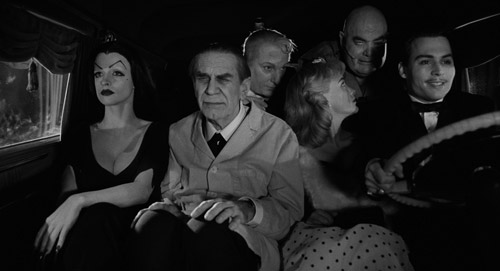
Personally, I’m of the opinion that Ed Wood is Tim Burton’s best film. It’s certainly one of the few Burton films that actually holds up after repeat viewings. Watching the film, it’s obvious that Wood and Burton shared a passionate love for the movies and that Burton related to Wood and his crew of misfits. It’s an unabashedly affectionate film, with none of the condescension that can sometimes be found in Burton’s other film. Burton celebrates not just the hopes and dreams of Ed Wood, Bela Lugosi, Tor Johnson and Criswell but also of all the other members of the Wood stock company, from Vampira (Lisa Marie) to Bunny Breckenridge (Bill Murray), all the way down to Paul Marco (Max Casella) and Loretta King (Juliet Landau). Though Ed Wood may center around the character of Wood and the actor who plays him, it’s a true ensemble piece. Landau won the Oscar but really, the entire cast is brilliant. Along with those already mentioned, Ed Wood features memorable performances from Sarah Jessica Parker and Patricia Arquette (one playing Wood’s girlfriend and the other playing his future wife), G. D. Spradlin (as a minister who ends up producing one of Wood’s films), and Mike Starr (playing a producer who is definitely not a minister).
For me, Ed Wood is defined by a moment very early on in the film. Wood watches some stock footage and talks about how he could make an entire movie out of it. It would start with aliens arriving and “upsetting the buffaloes.” The army is called in. Deep delivers the line with such enthusiasm and with so much positive energy that it’s impossible not get caught up in Wood’s vision. For a few seconds, you think to yourself, “Maybe that could be a good movie…” Of course, you know it wouldn’t be. But you want it to be because Ed wants it to be and Ed is just do damn likable.
As I said before, Ed Wood is a highly stylized film. It focuses on the good parts of the Ed Wood story, like his friendship with Bela Lugosi and his refusal to hide the fact that he’s a cross-dresser who loves angora. The bad parts of his story are left out and I’m glad that they were. Ed Wood is a film that celebrates dreamers and it gives Wood the happy ending that he deserved. The scenes of Plan 9 From Outer Space getting a raptorous reception may not have happened but can you prove that they didn’t?
I suppose now would be the time that most reviewers would reflect on the irony of one of the worst directors of all time being the subject of one of the best films ever made about the movies. However, I’ll save that angle for whenever I get a chance to review The Disaster Artist. Of course, I personally don’t think that Ed Wood was the worst director of all time. He made low-budget movies but he did what he could with what he had available. If anything, Ed Wood the film is quite correct to celebrate Ed Wood the director’s determination. Glen or Glenda has moments of audacious surrealism. Lugosi is surprisingly good in Bride of the Monster. As for Plan 9 From Outer Space, what other film has a plot as unapologetically bizarre as the plot of Plan 9? For a few thousand dollars, Wood made a sci-fi epic that it still watched today. Does that sound like something the worst director of all time could do?
Needless to say, Ed Wood is not a horror film but it’s definitely an October film. Much as how Christmas is the perfect time for It’s A Wonderful Life, Halloween is the perfect time for Ed Wood.
Did you know that there used to be a TV show called She-Wolf of London?
Apparently, there was. I came across it on YouTube while I was looking for old episodes of The Twilight Zone. She-Wolf of London was a TV show about an American grad student named Randi (Kate Hodge) who comes to the UK, investigates the supernatural with Dr. Ian Matheson (Neil Dickson), and who turn into a wolf whenever the moon is full! This British show ran from 1990 to 1991.
Interested in seeing the first episode, which acts largely as an origin story? Check it out below!
Today’s horror scene that I love comes from the 1945 film, House of Dracula!
House of Dracula may not be a classic but John Carradine definitely made for an intriguing Dracula. Far more than Bela Lugosi or even Christopher Lee, Carradine matched the physical description that Bram Stoker offered up of Dracula in his famous novel — tall, aristocratic, sophisticated, and disdainful of the world around him. Of course, Carradine’s American accent is all wrong for the role but no matter. He’s Carradine!
This scene features Carradine as Dracula, casting his hypnotic spell.
4 Shots From 4 Films is just what it says it is, 4 shots from 4 of our favorite films. As opposed to the reviews and recaps that we usually post, 4 Shots From 4 Films is all about letting the visuals do the talking.
This October, I am going to be using our 4 Shots From 4 Films feature to pay tribute to some of my favorite horror directors, in alphabetical order! That’s right, we’re going from Argento to Zombie in one month!
Today’s director is one of the great Spanish horror directors, Amando de Ossorio!
4 Shots From 4 Films
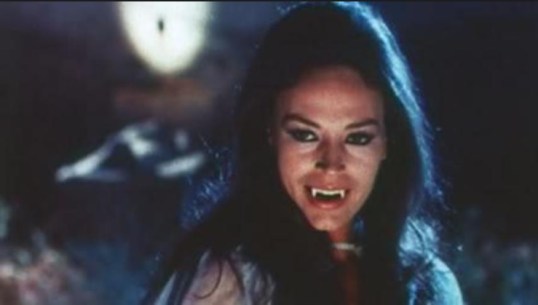
Malenka, the Vampire’s Niece (1969, dir by Amando de Ossorio)
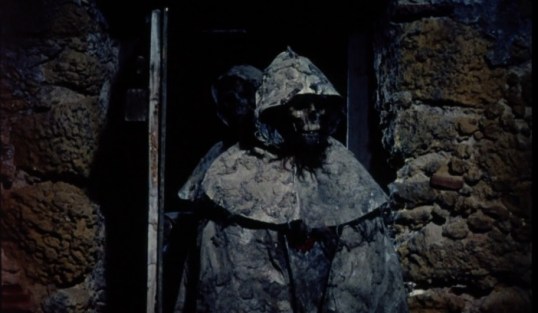
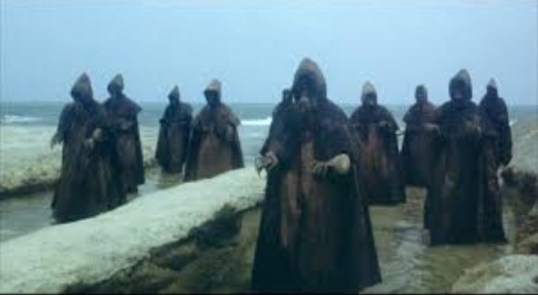
Tombs of the Blind Dead (1971, dir by Amando de Ossorio)
The Ghost Galleon (1974, dir by Amando de Ossorio)
Night of the Seagulls (1976, dir by Amando de Ossorio)
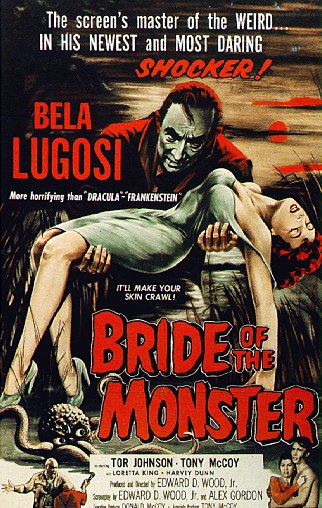
Today’s horror film on the lens is Edward D. Wood’s 1955 epic, Bride of the Monster.
(Much like Plan 9 From Outer Space, around here, it is a tradition to watch Bride of the Monster in October.)
The film itself doesn’t feature a bride but it does feature a monster, a giant octopus who guards the mansion of the mysterious Dr. Vornoff (Bela Lugosi). Vornoff and his hulking henchman Lobo (Tor Johnson) have been kidnapping men and using nuclear power to try to create a race of super soldiers. Or something like that. The plot has a make-it-up-as-you-go-along feel to it. That’s actually a huge part of the film’s appeal.
Bride of the Monster is regularly described as being one of the worst films ever made but I think that’s rather unfair. Appearing in his last speaking role, Lugosi actually gives a pretty good performance, bringing a wounded dignity to the role of Vornoff. If judged solely against other movies directed by Ed Wood, this is actually one of the best films ever made.





 Through the Shattered Lens